J. L. BELL is a Massachusetts writer who specializes in (among other things) the start of the American Revolution in and around Boston. He is particularly interested in the experiences of children in 1765-75. He has published scholarly papers and popular articles for both children and adults. He was consultant for an episode of History Detectives, and contributed to a display at Minute Man National Historic Park.

Subscribe thru Follow.it


•••••••••••••••••


Showing posts with label Vermont. Show all posts

Wednesday, September 16, 2026

“Behind Enemy Lines” along Lake Champlain, 25 Sept.

On Friday, 25 September, America’s History, L.L.C., is offering a unique tour titled “Behind Enemy Lines: General Benjamin Lincoln’s Pawlet Expedition and the Battle of Diamond Island.”

The event description explains:
In September 1777 during Lt. Gen. John Burgoyne’s campaign to capture Albany, American militia commanded by Maj. Gen. Benjamin Lincoln staged a daring raid on the British army’s supply line from Fort Ticonderoga to Lake George and Skenesborough. It is one of the most unappreciated operations of the campaign.

Although the Pawlet Expedition had some successes and some failures, in the main, it created major consternation in Burgoyne’s mind, forcing him to roll the dice in a failed attempt to turn the left flank of Maj. Gen. Horatio Gates’s army at Bemis Heights. Burgoyne’s defeat on October 7, 1777 paved the way for an ultimate retreat back to Saratoga (Schuylerville, New York) and the surrender of his army on October 17.

During this tour we will trace the march of Col. John Brown’s force from Pawlet to Ticonderoga Landing and Mount Defiance, Col. Samuel Johnson’s attack on Mount Independence, and Col. Benjamin Woodbridge’s actions at Skenesborough. We will take a boat ride to interpret Brown’s attack by water on the British supply depot on Diamond Island. Weather permitting (for docking purposes), we will land on the island, unlike Col. Brown, to see it from the British perspective.
This tour is limited to 39 participants. The bus will leave the parking lot of Fort Ticonderoga at 8 A.M. and return by about 5 P.M. (Fort Ti’s American Revolution conference starts that evening, with most presentations over the weekend.)

The $195 tour registration cost covers transportation by bus and boat; all admissions and gratuities; lunch, snack, and beverage breaks; a map and materials package; and the expertise of Bruce Venter as guide.

Dr. Venter is the author of The Battle of Hubbardton: The Rear Guard Action that Saved America. He created and co-manages the annual American Revolution conference in Virginia, as well as symposia, tours, and other events for students of American history.

For more information on this tour and to register, see this event page.

Tuesday, April 07, 2026

Crean Brush’s Team

To help him collect goods from Bostonians, loyal and otherwise, Crean Brush hired four men.

I can’t tell whether Brush assembled this team in late 1775, when Gen. Thomas Gage first gave him a commission, or in March 1776, in the busy days after Gen. William Howe led an evacuation, as discussed yesterday.

In March, Brush gave Gen. James Robertson the names of four assistants: Charles Blasquet, Richard Hill, John Hill, and David Cunningham.

According to John J. Duffy and H. Nicholas Muller III’s Inventing Ethan Allen, the Hills were Brush’s cousins who came from Ireland to farm on his New York land grants in what would become Vermont.

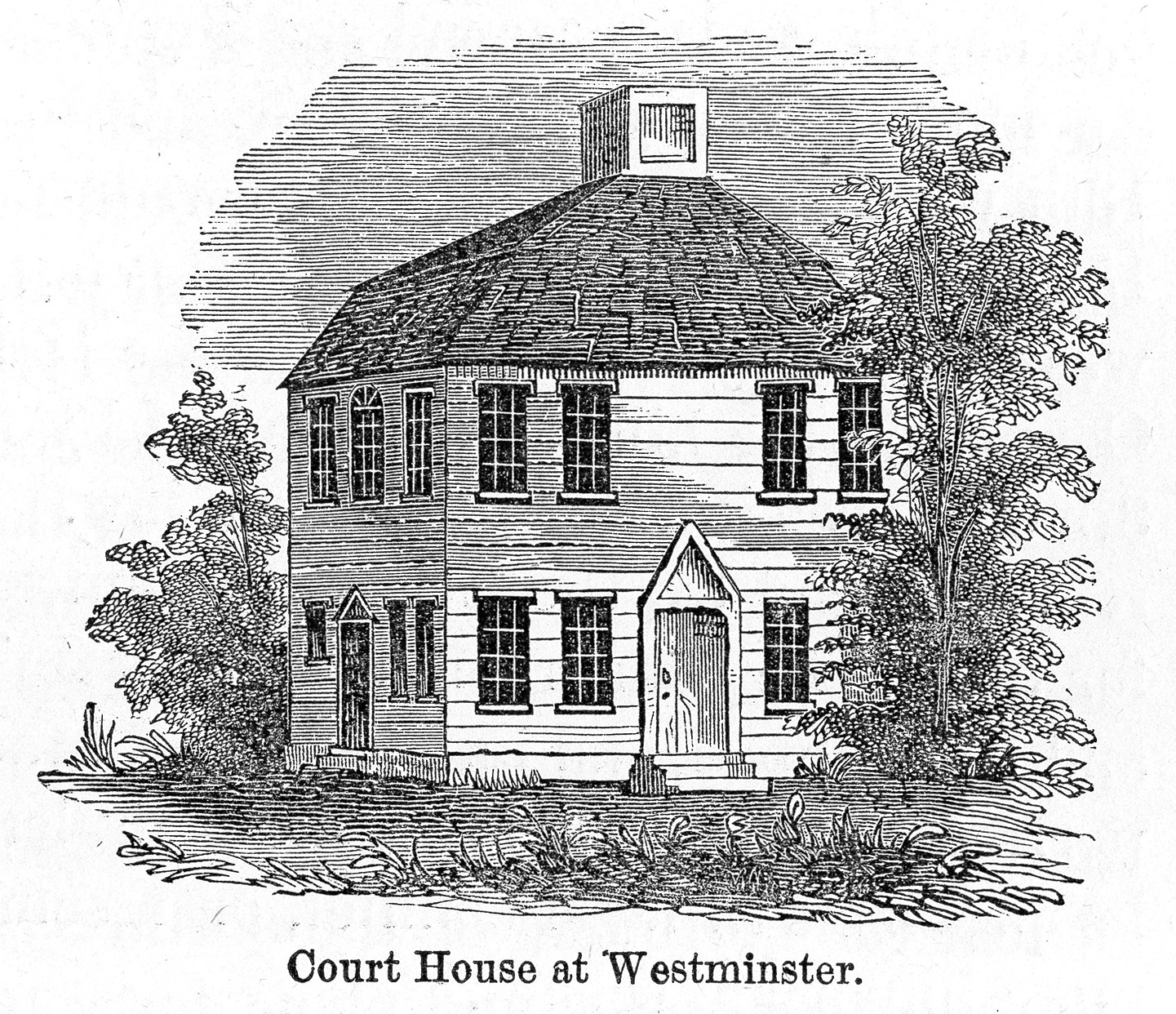
During the March 1775 fighting around the Westminster courthouse (shown above), Richard Hill aided the New York sheriff before being grabbed by the Green Mountain Boys. A Northampton committee set him free, and he hot-footed it to Boston.

As for John Hill, historians identify him as the man who was in New York City with William Cunningham on 6 March when they got into a fight with Patriots under the Liberty Pole. After being roughed up, Hill and Cunningham headed for Boston with their families. William Cunningham served as provost marshal there and later back in New York, becoming notorious among American prisoners of war.

In American Migrations, 1765-1799 Peter Wilson Coldham reports that David Cunningham was a baker in New York (earning £5 sterling per month, he said) who in 1775 was “forced to shelter at Westminster, a remote part of the country, with Mr. Richard Hill.” He may have been related to William Cunningham, but I found no indicators of that.

Charles Blasquet eludes me altogether. But it looks like Crean Brush hired men who had been his protégés in Westminster and/or his poorer relatives, and who had reasons to resent the Patriots.

TOMORROW: Search and seizure.

Saturday, April 04, 2026

Crean Brush’s American Career

Yesterday’s post reported that among the people captured aboard the evacuation ship Elizabeth in April 1776 was Crean Brush.

Eric Wiser wrote a good article about Brush for the Journal of the American Revolution: “Hell’s Half-Acre: The Fall of Loyalist Crean Brush.” More information can be found in “Crean Brush vs. Ethan Allen: A Winner’s Tale” by John J. Duffy and Eugene A. Coyle, published in Vermont History (P.D.F. download). I’ll review just the main points here.

Brush came to America from county Tyrone in Ireland in the 1760s when he was in his thirties and already a widower. He soon established himself as a lawyer and government appointee in New York City.

Brush married Margaretha Schoolcraft, who had a daughter named Frances from her previous relationship with Capt. John Montresor, the British army engineer. (Some sources say this girl was Margaretha’s niece. Others give the girl’s surname as Montezuma. It seems clear those were cover stories.)

In 1772, after accumulating grants of tens of thousands of acres of frontier land, Brush moved his family to the new town of Westminster, New York, between Lake Champlain and the Connecticut River. Soon he was a leader of the new community, variously commissioner of the court, surrogate of the court, county clerk, and representative in the colonial legislature. Brush worked with Philip Schuyler to establish the rule of (New York) law in his new county.

Unfortunately for Brush, others had settled the same region with grants from New Hampshire that overlapped and competed with the grants from New York. These men, led by Ethan Allen, Seth Warner, and Remember Baker, called themselves the Green Mountain Boys. Brush called them the Bennington Mob, becoming an early opponent and target of that faction. The London government had approved New York’s side of that dispute, giving Brush more reason to support royal policies.

On 13 Mar 1775, while Brush was away at the legislature, there was a fatal fight around the Westminster courthouse. Then war broke out in Massachusetts. The Green Mountain Boys seized Fort Ticonderoga for the rebels. Brush realized the region wasn’t safe for him, and neither was his former home in New York City. The Brush family moved into besieged Boston.

On 1 October, Gen. Thomas Gage gave Brush a commission to collect goods from the buildings of people who had left Boston so they wouldn’t be damaged when British soldiers were lodged in those homes and warehouses. The general required Brush “to take all due Care thereof, and to deliver said Goods when called upon, to those to whom you shall have given Receipts for the same.”

What Brush really wanted, though, was the British commander’s approval for his scheme to raise a Loyalist regiment and take back his corner of New York from the Green Mountain Boys. Gage never authorized that, which probably saved Brush from dying in a futile battle. Still, Brush presented the same proposal to Gen. William Howe in early 1776, but he didn’t get any further before it was time to leave.

TOMORROW: Preparing to evacuate.

Saturday, March 08, 2025

“Westminster Massacre” Sestercentennial Commemorations, 13–15 Mar.

This month, the town of Westminster, Vermont, is celebrating the Sestercentennial of the “Westminster Massacre,” a clash that began over land titles and ended in the death of two men.

In the 1760s both New York and New Hampshire claimed the land between Lake Champlain and the Connecticut River. Gov. Benning Wentworth of New Hampshire granted lots of real estate in six-mile-square town lots between 1749 and 1764. Meanwhile, the New York government issued larger, irregular land patents to wealthy landlords. Each set of claimants complained about the other.

In July 1764 the British government declared all that territory belonged to New York. By this time, a fair number of farmers from New England, particularly Connecticut, had moved into the region. The New York patentees demanded those settlers buy that land, pay rent, or leave. In 1770 the top court in New York confirmed that the New Hampshire land titles were invalid.

For the next few years, there were lots of disputes between settlers with New Hampshire titles and “Yorkers,” rent collectors or farmers arriving from New York with solid legal claims. The Green Mountain Boys formed as an unofficial militia to intimidate Yorkers. Settlers held conventions modeled after those in the rebellious colonies, but they focused their ire on New York, not the imperial government.

On 14 Mar 1775 a court session was scheduled to take place in the town of Westminster. Judge Thomas Chandler held a commission from New York, and his docket included evictions of men with old titles from New Hampshire as well as a murder. Probably inspired by the shutdown of courts in Massachusetts in late 1774, about a hundred local men surrounded the courthouse on the evening of 13 March.

Sheriff William Patterson declared that assembly a riot and ordered the men to disperse. When they refused, the sheriff went to Brattleboro, where New York law had more support, and recruited a posse of 60 to 70 men.

By the time Patterson and his force returned, the protesters were holding the Westminster courthouse and jail. Once again, the sheriff ordered them to leave. Night fell, and the courthouse was still occupied. Patterson told his Yorker posse to open fire on the courthouse. Some men inside fired back, wounding a magistrate.

Sheriff Patterson and his men stormed the building, shooting and clubbing those inside when they resisted. During that melee, twenty-two-year-old William French was shot five times; he died before dawn. Another man, Daniel Houghton, was beaten and died from his injuries nine days later. Seven rioters were arrested and locked into the jail.

On 14 March, a crowd of “upwards of 500” men came into Westminster from nearby towns. They freed the seven prisoners and locked up Patterson and his Yorkers. This mob then proceeded to Brattleboro, breaking into other Yorkers’ homes to arrest more men and bring them to the Westminster jail.

Benjamin Bellows, a militia captain from Walpole, New Hampshire, arrived with his company to restore order, but for local authorities, not New York. The Yorker leaders accused of killing French were taken to Northampton, Massachusetts.

Ultimately, the outbreak of the Revolutionary War overshadowed all these events. Between the overlapping jurisdictions, the end of royal rule, and more immediately pressing matters, no one was ever tried for the actions in Westminster.

Some local historians cast the “Westminster Massacre” as the first fatal battle of the Revolutionary War. I view it, like the 1766–1771 Regulator movement in North Carolina, as a parallel conflict, but not one that involved the core dispute of the Revolution between the royal government and colonists resisting new taxes. The lines weren’t tightly drawn: while Patterson became a Loyalist, Chandler and Bellows supported American independence.

The Westminster Historical Society has created an exhibit on the conflict 250 years ago in the Town Hall museum, and it will host three commemorative gatherings.

Thursday, 13 March, 3:30 P.M.
Walk from the Azariah Wright house site (corner of Sand Hill Road and Route 5) to the town cemetery. Wright’s house was one of the gathering-places for the men who closed the court. This walk is about fifteen minutes. The event is all outdoors with no bathroom.

Friday, 14 March, about 4:00 P.M.
Gathering at the D.A.R. Courthouse Marker on Shattuck Road, celebrating how the crowd took back the courthouse. Ray Boas of the Walpole Historical Society will deliver remarks about Col. Bellows and his militia company preventing further bloodshed.

Saturday, 15 March, 6 P.M.
The museum will open to share the exhibit, remarks by public officials, refreshments, and bathrooms. At 7:00 there will be a twilight vigil at William French’s grave site on the anniversary of his burial. This is the event designed for visitors from outside the region. There will be parking behind the Post Office on the other side of the road.

For more about Westminster history, see Jessie Haas’s books Revolutionary Westminster and Westminster, Vermont, 1735–2000: Township Number One.

Wednesday, May 15, 2024

“Terminated in a Duel…at Dorchester Point”

While looking for more ties between Charles Miller and the Boston Patriots, I came across this story from the next generation.

Boston’s Constitutional Telegraphe newspaper reported on 17 June 1801:
We hear, and are concerned to state, as we conceive it a painful task, which we consider to be our duty to perform, to announce to the public an unfortunate dispute between Mr. Charles Miller, jun. and Mr. Edward Rand, both of this town, which terminated in a Duel, early on Sunday morning last, at Dorchester Point…
Charles Miller, Jr., was baptized in King’s Chapel on 18 Nov 1770. So far as I can tell, he was the first and only child of Charles Miller, a younger son of Braintree’s Anglican minister, and his first wife, Elizabeth Cary of Charlestown.

Charles, Jr., followed his father into the mercantile business. Around the turn of the century there are lots of advertisements in Boston papers for goods offered by the firm of “Charles Miller & Son.”

Edward Rand was baptized in Boston’s New North Meetinghouse on 22 Aug 1773. He was the fourth child of Dr. Isaac Rand, Jr., a physician suspected of being a Tory but mostly tolerated because of his medical skills. (Dr. Isaac Rand, Sr., was an active Patriot, caring for soldiers with smallpox during the siege of Boston.) By the end of the 1700s the younger Dr. Rand’s reputation was solid enough that he was elected president of the Massachusetts Medical Society.

In April 1800, Charles P. Phelps (1772–1857) and Edward Rand announced that together they had rented a large store on Codman’s Wharf to sell imported fabric, hardware, and spermaceti candles. They offered to advance cash on consignments and sought “a Lad about 14 years of age” to work for them.

A duel between rising young men from such prominent families was bound to cause talk. In a letter to her youngest, Abigail Adams said: “it is reported that the Quarrel arose about a Female— this is the first instance of the Kind in our State.” Massachusetts had seen some duels before, but not that many involving locals.

The item in the Green Mountain Patriot of Peacham, Vermont, on 2 July avoided using the term “duel,” saying instead that the two men had met “for the purpose of honorably settling an honorable dispute.”

The Federal Galaxy of Brattleboro broke the full story on 29 June:
FATAL DUEL.

A report of a late duel in Boston has been current in town for ten days past—A letter dated Boston, June 17, received by the Editor, from his friend residing there, gives the following recital of the event:

“Some misunderstanding having taken place between Messr. Charles Miller, jun. and Isaac [sic] Rand, (respectable merchants in Boston) which originated respecting a certain young lady, to whom Miller had paid his addresses; after giving each other some hard words, Rand sent Miller a challenge, which was accepted. Having agreed on seconds, they repaired to Dorchester Point early on Sunday morning last;…”
Decades later, Rand’s business partner Phelps wrote in an unpublished memoir that the lady was “from Rhode Island,” but I located no source identifying her.

After describing the action, the letter in the Federal Galaxy stated:
“You will find no mention made of this affair in the Boston papers, as the several printers have been requested by the parents of Miller and Rand, not to notice it.”
And indeed the Constitutional Telegraphe’s article appears to be the only report printed inside Boston. It was, however, reprinted outside the town from Maine to Virginia.

TOMORROW: Who lived, who died, who told the story.

Thursday, April 11, 2024

“The unrivaled honor of having shed the first British blood”?

I’ve written several postings about Solomon Brown, even suggesting he might have been responsible for the first shot in Lexington on the morning of 19 Apr 1775.

There’s one source about him I haven’t been able to nail down.

In an 1880 issue of The Magazine of American History, the Rev. Horace Edwin Hayden of Pennsylvania quoted a local obituary of Solomon Brown like this:
Deacon Solomon Brown

The individual whose name heads this article, and a notice of whose death appeared in this paper, a short time since, was one of the oldest inhabitants of New Haven in this county [in Vermont], and died claiming the respect of all who knew him, for his virtues both as a man and a citizen. . . . 

Deacon Brown was a soldier of the Revolution, and bore a part in that memorable struggle, which should immortalize him in the annals of his country. He was a participator in the first battle for freedom on the plains of Lexington, and has the unrivaled honor of having shed the first British blood in defence of American liberty, at the battle of Lexington on the morning of the 19th of April, 1775.

This battle was the opening scene of the bloody drama which closed with the surrender of Cornwallis at Yorktown, and in this scene the subject of this notice stands forth the most prominent actor. He wrote in blood the first word in the charter of American freedom. Let his name be registered among the noblest of his country's benefactors and heroes, and honored by posterity as the most dauntless of their heroic sires. Deacon Brown served five years in the revolution as a sergeant of artillery, and encountered all the perils and hardships of that memorable and glorious struggle. He died mourned by his friends, lamented by the church, and respected by all. 
But as to the source of that encomium, Hayden could only say: “Middlebury, Vt., Free Press, about 1830.”

Two years later, Hayden published A Biographical Sketch of Captain Oliver Brown, an Officer of the Revolutionary Army who Commanded the Party which Destroyed the Statue of George the Third. Solomon was Oliver’s younger brother, so he tagged along in that booklet. Unfortunately, Hayden’s citation only got worse with Middlebury turned into “Middleburg.”

I went looking for the newspaper article Hayden quoted. It doesn’t appear in the newspaper database I access. Furthermore, I discovered that there was no Middlebury Free Press in 1830. The printer E. D. Barber was still calling his young newspaper the Anti-Masonic Republican.

In the Genealogical and Family History of the State of Vermont compiled by Hiram Carleton in 1903, I found a statement that Solomon Brown died on 6 June 1837. That date does fall in the period when Barber called his newspaper the Middlebury Free Press, just before he sold out to Hamilton Drury and it became the Vermont Argus and Free Press. So we should be able to narrow the search down to the summer of 1837—if copies of the newspaper survive from then.

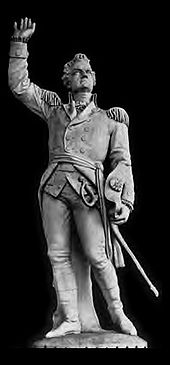
Another voice speaking to Solomon Brown’s primacy was Josiah Bushnell Grinnell (1821–1891, shown above). He was a U.S. Representative from Iowa and namesake of Grinnell College. In 1887 he returned to his home town of New Haven, Vermont, to deliver a historical address, later published. Grinnell stated:
Dea. Solomon Brown also lived and died here fifty years ago. To him belongs the honor of having fired the first effective shot at the red coats in the revolutionary war. I attended his funeral, at which his memorable shot was mentioned, and I just remember the story from his own lips. . . . He did not wait for orders and sighted an honest gun at a red coat spy, where was found blood, and to him belongs the honor of that first shot which “echoed round the world.”
Both Hayden and Grinnell cited the depositions collected by Elias Phinney in his 1825 History of the Battle of Lexington as supporting Brown’s claim. The evidence in that book is more equivocal.

It’s worth noting that in 1775 no British officers reported that the regulars on Lexington common suffered any wounds, and they had every reason to do so in the effort to cast blame on the provincials.

Solomon Brown might well have shot at the redcoats—he could even have been the first to do so. But that doesn’t mean his shots hit anyone.

Wednesday, April 19, 2023

“At Lexington they did appear Array’d in hostile Form”

Lemuel Haynes was born in West Hartford, Connecticut, in 1753. His father was African, his mother a white New Englander who abandoned her baby after five months.

David Rose, a deacon in Granville, Massachusetts, and his wife Elizabeth took the baby into their home under indenture. Worshipping with the family, Lemuel learned to read at the local school.

(Some recent profiles of Haynes say David Rose was blind and little Lemuel read to him, but there’s no mention of such a disability in Timothy Mather Cooley’s 1837 biography.)

In 1774 Haynes came of age as a free man. He was in the Granville militia company when it marched east at the start of the Revolutionary War. In the fall of 1776, Haynes enlisted for short service and marched to Fort Ticonderoga, only to catch typhus and have to return home.

In 1779 Haynes started to pursue a religious career, working for Connecticut ministers in exchange for training. He was ordained in 1785, and three years later took a permanent post as minister in Rutland, Vermont. Well, it was permanent until 1818, when that congregation dismissed him, but then he moved on to Manchester, Vermont, and Granville, New York.

During his lifetime Haynes published sermons and poetry. More manuscripts came to light in the 1980s, including this poem.
The Battle of Lexington

A Poem on the inhuman Tragedy perpetrated on the 19th of April 1775 by a Number of the Ministerial Brittish Troops under the Command of Thomas Gage, which Parricides and Ravages are shocking Displays of ministerial & tyrannic Vengeance composed by Lemuel a young Mollatto Man Mollato who obtained what little knowledge he possesses, by his own Application to Letters.

1
Some Seraph now my Breast inspire
whilst my Urania sings
while She would try her solemn Lyre
Upon poetic Strings.
2
Some gloomy Vale or gloomy Seat
where Sable veils the sky
Become that Tongue that wd. repeat
The dreadfull Tragedy
3
The Nineteenth Day of April last
We ever shall retain
As monumental of the past
most bloody shocking Scene
4
Then Tyrants fill’d wth. horrid Rage
A fatal Journey went
& Unmolested to engage
And slay the innocent
5
Then did we see old Bonner rise
And, borrowing Spite from Hell
They stride along with magic Eyes
where Sons of Freedom dwell
For those not raised on John Foxe’s Book of Martyrs, Bishop Edmund Bonner oversaw the burning of Protestants under Queen Mary, two centuries before.
6
At Lexington they did appear
Array’d in hostile Form
And tho our Friends were peacefull there
Yet on them fell the Storm
7
Eight most unhappy Victims fell
Into the Arms of Death
Unpitied by those Tribes of Hell
Who curs’d them wth. their Breath
8
The Savage Band still march along
For Concord they were bound
While Oaths & Curses from their Tongue
Accent with hellish Sound
9
To prosecute their fell Desire
At Concord they unite
Two Sons of Freedom there expire
By their tyrannic Spite
10
Thus did our Friends endure their Rage
Without a murm’ring Word
Till die they must or else engage
And join with one Accord
11
Such Pity did their Breath inspire
That long they bore the Rod
And with Reluctance they conspire
To shed the human Blood
12
But Pity could no longer sway
Tho’ ’t is a pow’rfull Band
For Liberty now bleeding lay
And calld them to withstand
13
The Awfull Conflict now begun
To rage with furious Pride
And Blood in great Effusion run
From many a wounded Side
14
For Liberty, each Freeman Strives
As its a Gift of God
And for it willing yield their Lives
And Seal it with their Blood
15
Thrice happy they who thus resign
Into the peacefull Grave
Much better there, in Death Confin’d
Than a Surviving Slave
16
This Motto may adorn their Tombs,
(Let tyrants come and view)
“We rather seek these silent Rooms
Than live as Slaves to You”

17
Now let us view our Foes awhile
who thus for Blood did thirst
See: stately Buildings fall a Spoil
To their unstoick Lust
18
Many whom Sickness did compel
To seek some Safe Retreat
Were dragged from their sheltering Cell
And mangled in the Street
19
Nor were our aged Gransires free
From their vindictive Pow’r
On yonder Ground lo: there you see
Them weltering in their Gore
20
Mothers with helpless Infants strive
T’ avoid the tragic Sight
All fearfull wether yet alive
Remain’d their Soul’s delight
21
Such awefull Scenes have not had Vent
Since Phillip’s War begun
Nay sure a Phillip would relent [?]
And such vile Deeds would shun
22
But Stop and see the Pow’r of God
Who lifts his Banner high
Jehovah now extends his Rod
And makes our Foes to fly
TOMORROW: Fifteen more verses.

Friday, September 02, 2022

Looking All the Way Back on History Camp 2022

Many of the sessions at last month’s History Camp Boston were recorded, and the videos are going up on the web now.

I started the morning with a talk on “Digging and Debunking: Using Online Tools to Investigate the Myths of American History.” I’m not sure I actually got to all the topics promised in the description:
From Founders’ quotes to inspirational legends to details that historians have repeated for so long that nobody considers where they came from, our history abounds with assertions that we should be skeptical about. This workshop discusses how to assess such historical tales and tidbits. It will share tactics for using Google Books and other free resources to pinpoint when and where stories arose, and lay out the dynamic of “grandmother’s tales,” “memory creep,” and other ways legends spread. And every so often these techniques reveal that a story almost too good to be true is supported by solid evidence.
Then again, I wrote that description in late 2019, so I’m just glad that I got to this talk at all. (The blog posting I used as a visual aid and online starting-point is here.)

At the end of the day I was part of a panel on “Using New Media to Present History” organized by Michael Troy of the American Revolution Podcast, with Jake Sconyers of HUB History and Larisa Moran of History Dame.
A panel of podcasters, bloggers, and video bloggers discusses how new forms of media are transforming the presentation of History. We will discuss how podcasting and other new media differ from traditional media, why they reach new audiences, and trends in how presenting new media is continuing to change.
As usual, those sessions conflicted directly with others I’d hoped to attend, so I’m pleased that many more talks were recorded. Here are videos of other History Camp Boston 2022 sessions on aspects of Revolutionary America:
Plus you can see four presentations on aspects of the Salem Witch Trials! Talks on early westward expansion and Salem’s mercantile flowering and racism in early recorded pop music! Lots more! If more videos come on line after being reviewed, I’ll post more links.

History Camp Boston is a project of The Pursuit of History, a non-profit corporation that produces History Camps in other metro areas, the upcoming online History Camp America, and the weekly History Camp discussions with authors. I’m on the organization’s board. If you’re grateful for this content and want to see more such gatherings, please consider a donation to The Pursuit of History through its webpage.

Friday, March 11, 2022

Ethan Allen, Potential Loyalist

At Borealia, the blog about early Canadian history, Benjamin Anderson, a doctoral student at the University of Edinburgh, shared some of his research on the Loyalists of Vermont.

More specifically, Anderson wrote on the question of whether Ethan Allen, conqueror of Fort Ticonderoga and then a prisoner of the Crown for three long years, was ready to fall into that category:
It was the summer of 1780 when Ethan Allen, Vermont’s self-proclaimed leader, was approached by a man on a dusty road to Arlington. Beverly Robinson, a Virginian Loyalist and friend of British Commander-in-Chief Henry Clinton, looked down at Allen from atop his horse and handed him a piece of paper. It was a proposal to Allen and Vermont: renounce their commitment to the Union, return to the British Empire, and they could potentially be rewarded with a “separate government under the king and constitution of England” with their lands validated.
Allen, and later his brother Ira and their friend Joseph Fay, tried to play the British and Americans off against each other for local advantage. Ultimately the Franco-American victory at Yorktown changed the equation.
Yet that was not the end of the matter for Ethan Allen. Throughout the 1780s, he maintained contact with the British and continued to push for Vermont rejoining the British Empire. He was “as rapacious as a wolf,” according to [Gen. Frederick] Haldimand. As late as 1788, he made overtures about a potential alliance or Vermont rejoining the empire as a means of protecting Vermont from a threatening United States, as well as its invaluable trade that was dependent on Quebec and the St. Lawrence River.
Allen’s fame grew from his 1779 Narrative of Colonel Ethan Allen’s Captivity, which appeared before his negotiations with British commanders. His infamy in early America came out of publishing Reason: The Only Oracle of Man, the argument for deism he created with Dr. Thomas Young. As a result, Allen’s dance with Loyalism, and what that says about his status as an American hero, got lost in the shuffle until recent decades. 

Sunday, November 14, 2021

Assessing the Revolution’s Effect on Slavery in New England

Even though most New Englanders went into the Revolution and Revolutionary War with no thought of changing chattel slavery, the ideology of liberty and natural rights produced new thinking.

In the ten years before the war we can see hints of the system breaking down. The number of enslaved people in Massachusetts stopped growing with the overall population. Advertisements in newspapers offered to give away small children; as horrific as that sounds, it indicates the economics of slaveholding looked poor. The first anti-slavery pamphlets in decades appeared shortly before the war.

The departure of wealthy Loyalists, first from their rural homes and then from Boston in 1776, left some enslaved people at liberty. It also cut the number of local elite voices defending their investment in human property since the new wealthy arising during the war didn’t have such a history of slaveholding.

In New York and the southern states, the British were able to organize companies of black troops and support personnel from slaves who had freed themselves. But they couldn’t do that in Boston or Newport. Instead, it was the Continental Army that formed two Rhode Island regiments made up largely of black and Native men.

Even more important, from the start of the war, New England regiments enlisted black men alongside whites. The Rhode Islanders were eventually dispersed among other regiments that way as well. For a sizable number of enslaved New England men, serving in the Continental Army was a path to freedom, not serving the British army.

In 1777 the settlers who came to Vermont from New England decided that there would be no slavery in their new independent state. In 1783 the Massachusetts high court decided that state’s new constitution rendered slavery unenforceable. New Hampshire quickly followed. Connecticut and Rhode Island enacted gradual emancipation laws—very gradual—in 1784.

To be sure, those forms of abolition didn’t produce fair outcomes. Some former slaveholders used the law to justify not supporting older people who had worked for them without pay for years. People remained legally enslaved in southern New England until the eve of the Civil War. The region’s economy remained bound up with slave societies to the south.

Nonetheless, in this significant part of the new U.S. of A., the Revolution had strongly contributed to slavery’s end. So can we say that was a major effect of the Revolution?

I decided to look at the numbers. In 1765 the provincial census counted about 5,200 black people in Massachusetts, including Maine. The breakaway government found about the same number in 1776. The first U.S. census of 1790 counted 5,369 non-white citizens. A significant fraction of those people were already free before the Revolution, but that’s the maximum number of people in Massachusetts freed by the state court. The corresponding number for the state of New Hampshire was 630.

Meanwhile, in the 1780s and ’90s the port of Charleston, South Carolina, imported about 2,000 enslaved Africans each year, on top of children born into slavery. Thus, every three years the new American republic absorbed more people into life as slaves than the total freed by the northern New England abolitions. As positive as the effects of the Revolution were in some states, the strong overall trend of the new nation was toward enslaving more people, even before the cotton economy took over.

Monday, August 23, 2021

All Roads Lead to Windham County

There’s a lot still to learn about the Akley family from Boston. From genealogy websites I’ve picked up that descendants have some lore about other relatives besides the brothers I’ve been writing about.

One claim is that the father, Francis Akley, Sr., died at the Battle of Bunker Hill. His name doesn’t appear on any of the American casualty lists, however. He would have been about fifty years old at the time, and as of September 1772 he had been admitted to the Boston almshouse and designated “Lame.” So I’m skeptical.

Similar family tradition says that the youngest brother, William, born in 1769, was killed at the Battle of Plattsburgh on Lake Champlain in 1814. I haven’t found a casualty list to address that.

Rather, the big mystery about the Akley family that I’d love to be revealed, but doubt ever will be, was how they stayed in touch.

The Akleys fell on hard times in the 1760s. The Boston Overseers of the Poor largely split up the family, sending children to far-flung towns in the province. Then came the disruption of the war.

Eventually four of the brothers applied for Revolutionary War pensions from the federal government. None of those documents described their birth family, upbringing, or other relatives not directly germane to proving their military service or need. Only one brother even mentioned being born in Boston.

Nevertheless, those pension applications offer evidence of a bond still holding the family together. Namely, all four of those brothers ended up in the same southeastern corner of Vermont.

The first was Francis Akley, Jr. He was indentured to Edward Houghton of Lancaster from 1763 until he came of age in 1772. There were two Edward Houghtons in that town in the mid-eighteenth century, and I’m guessing Francis’s master was the Edward Houghton born in 1730 and married to Lucretia Richardson in 1760. He evidently moved to Holden around the time he took in Francis since the Boston Overseers of the Poor got a character reference from Lancaster but listed Houghton as coming from Holden.

In 1773 that Houghton family moved to Guilford, Vermont. This new community had had its first town meeting just the year before. It had charters from Gov. Benning Wentworth of New Hampshire in 1754 and 1764, but there was also a competing land grant from New York in 1771, and that conflict took decades to sort out. The initial slate of officials elected in 1772 included constable David Goodnough and clerk and assessor John Shepardson.

Edward Houghton died in Guilford in 1782, having achieved the militia rank of lieutenant. His widow Lucretia ran a tavern that was focus of fighting between ”Vermonters” and “Yorkers” two years later, and their sons, including another man named Edward, became prominent property-owners in the following decades.

According to Francis Akley’s pension application, he was living in Guilford, Vermont, when the war began. He had evidently followed the Houghtons north, either to continue working for them or to seek his own farmland.

In early 1776 Francis’s younger brother Thomas Akley also came to Guilford. He had grown up in Dedham and spent most of the preceding year serving in a Dedham-based company of the Continental Army. For a while that company was stationed in Roxbury. Had Thomas met Joseph Akley and his young family there when they were refugees from Boston or when Joseph was doing militia duty on the siege lines?

In any event, the only reason Thomas Akley would have traveled out to Guilford after his army service was to rendezvous with big brother Francis. In June 1776, Thomas Akley decided to go back into military service, enlisting under Guilford official John Shepardson.

Six months later, in January 1777, Francis Akley also signed up for the army. He recalled being recruited by David Goodnough, who in May 1775 had been elected as first lieutenant of Guilford’s militia company.

Thomas was in his New Hampshire regiment for a year. Francis did a longer stint as a ranger. He was at the surrender of Gen. John Burgoyne after Saratoga—and so was their younger brother John, by then drum major for a Massachusetts regiment. Did Francis and John Akley seek each other out around the surrender ceremony?

After the war all three of those brothers returned to southeastern corner of Vermont. I can’t find primary records about Francis’s family, but he was living in the town of Halifax, next to Guilford, when he applied for a pension in 1819.

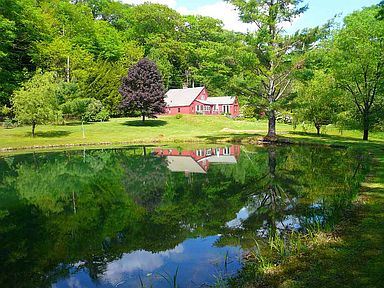
Thomas settled in Brattleboro, also next to Guilford. He married Abigail Wilder in 1783, and they had several lots of children who remained in the region, spelling their surname Akeley. The photo above shows Thomas and Abigail Akley’s house when it was on the market last year.

Francis and Thomas’s younger brother John returned to the Springfield, Massachusetts, area after the war and married in Connecticut. At some point, however, he and his wife Miriam Ward joined his brothers in southeastern Vermont. According to a Ward family genealogy, they lived with their children in Brattleboro for a while before moving to Connecticut in the early 1800s.

Finally, brother Samuel Akley grew up, married, and had children in Topsham, Maine. Nonetheless, he was living in Halifax, Vermont, in 1827 when he first applied for a Revolutionary War pension. Quite possibly his older brothers’ success at getting such pay inspired him to try. Later Samuel moved back to Maine.

That pattern means these Akley brothers somehow kept in touch even though they grew up from fairly early ages in different corners of Massachusetts. Had they been able to make periodic visits back to Boston to see their parents and siblings remaining there? Were they writing back and forth the whole time? We’ll probably need to find private correspondence to know.

Sunday, August 22, 2021

Samuel Akley, Continental Matross

The fourth Akley brother to serve in the Continental Army was Samuel.

He was baptized at the New South Meeting-House on 13 May 1764 and thus still only ten years old when the Revolutionary War began.

When Samuel had just turned four, the Boston Overseers of the Poor had indentured him to wheelwright John Merrill of Topsham, in the district of Maine, until 1785. But he didn’t serve that full term.

In February 1827 Samuel Akley, then living in Halifax, Vermont, applied for a Revolutionary pension. The text of that application can be read as an attachment to a later filing with the state of Maine, digitized here.

It says Samuel Akley
for the term of three years…Enlisted in the Company of Capt. [Thomas] Jackson and the Regiment of Col. [John] Crane. the first of March 1780, or 1781. enlisted in Topsham in the State of Mass: in the Mass: line—Passed Muster at Boston Mass. Joined the Army at West Point N.Y.
In 1848 Akley testified that he’d joined the army in April 1781. In 1855 he dated his service at West Point from 17 July 1780. He also said then that he was eighteen years old when he passed muster, which would mean the summer of 1782.

Samuel Akley of Topsham isn’t listed in Massachusetts Soldiers and Sailors of the Revolutionary War. However, there is a listing for a man by the same name who received a bounty from Thaddeus Lovering of Holliston to serve three years in the army in his place.

Because no families named Akley (however spelled) appear in Holliston’s published vital records from that time, and because Lovering paid the bounty in Boston, I wonder if that farmer crossed paths with Akley while he “Passed Muster at Boston.” The receipt is dated 17 June 1782, which would match the latest indicator for when Akley enlisted.

In any event, Akley became a matross in Crane’s Continental artillery regiment, the equivalent of a private on a gun crew. He served “till the Army was disbanded, and was discharged at West Point.”

Samuel Akley made his way back to Topsham, Maine. On 18 Nov 1791 he married Elizabeth (Betsey) Moody there; she appears to have been around age twenty. According to a descendant, they had at least six children together. Three of those children, ages seventeen to twelve, were still living with their parents in 1827.

In 1831, the Akleys moved to Rumford, Maine. Betsey died in 1842. Six years later, Samuel applied to the government for an increased pension as an artillerist. Seven years after that, at the age of ninety-three, he put in the paperwork for a land grant from Maine.

Samuel Akley finally died on 17 July 1861, as shown on his gravestone above. By then he and his family believed he was just short of his hundredth birthday; in fact, he was ninety-seven. He had served in the last months of the Revolutionary War and lived to see the first months of the U.S. Civil War. On his gravestone is this memento mori:
Stop traveler as you pass by
As you are now so once was I.
As I am now so you must be.
Prepare for death and follow me
TOMORROW: Wrapping up the Akely family.

Saturday, August 21, 2021

John Akley, Continental Drum Major

The next Akley brother, after Francis, Joseph, and Thomas, was John, baptized in September 1757.

In October 1764 John had just turned seven, and the Boston Overseers of the Poor sent him all the way out to Springfield.

Samuel and Lucy Williams promised to teach the boy to “Read Write & Cypher” and give him £13.6s.8d. when he came of age in 1779.

Before that date, war broke out. In April 1775, at the age of seventeen, John Akley marched with the town militia company. That unit got as far as Brookfield before the officers realized the emergency had passed and marched everyone home again. John served only three days that year.

In early 1776, however, John Akley enlisted in the Continental Army. In his pension application filed in May 1818 from Norwich, New York, he recalled that he had then lived in Longmeadow, a part of Springfield that didn’t formally become a town until 1783. Akley reported that he was a drummer and his first company commander was Capt. Silvanus Walker of Brookfield.

With that unit “he was in the battle at Trenton at the taking of the Hesians.” When his year was up, Akley recalled, he was discharged in Newtown, Pennsylvania. He then reenlisted for three years in the company of Capt. Asa Coburn of Sturbridge, regiment of Col. Icahbod Alden of Duxbury. Based on his experience, he was immediately made the drum major. He was nineteen.

During his second stretch, Akley stated, “he was in the Battle at the taking of Burgoin [Saratoga], and at Cherry Vally in the State of New York where the Col. was killed.” On 11 Nov 1778 Crown forces under Joseph Brant and Maj. Walter Butler attacked that settlement, catching Col. Alden and many other officers outside the fort. That defeat with civilian casualties became known to Americans as “the Cherry Valley Massacre.”

On 1 Feb 1780, John Akley was discharged from the regiment, now led by Col. John Brooks, at West Point. He went home and became close to Miriam Ward of West Springfield, then about sixteen years old.

In 1839 Miriam Akeley applied for a pension as John Akley’s widow. The law providing such pensions offered more money to women who had married soldiers while they were still in service. That might have influenced how Miriam Akeley described their nuptials on 29 Oct 1781:
John Akeley (or Ackley as the name is some times spelt) was at home on furlo and could not remain at home a sufficient time to be published according to the laws of Massachusetts, and that they went from West Springfield to Suffield in Connecticut and was there married (without being published) on the day where written by Rev. Mr. [Ebenezer] Gay Minister of said Suffield.
Suffield’s town clerk verified that marriage date. According to his widow, John Akley returned to the army in late 1781, then came home for good a year later.

Nonetheless, John Akley mentioned no such additional year in the army in his 1818 pension application. Massachusetts Soldiers and Sailors of the Revolutionary War records his last army service in February 1780.

Massachusetts also listed a man named John Ackley serving on board the Continental frigate Hague under Capt. John Manley in 1783. However, that’s probably another man of the same name. John Akley’s 1818 application didn’t mention fighting at sea, either.

Another wrinkle appears in Charles Martyn’s The William Ward Genealogy (1925). It states:
Miriam Ward married John Ackley of Brattleboro, Vt. They resided for a time in Brattleboro, then he disappeared and was never heard of again. She afterwards lived in Wethersfield, Conn.
That book lists two children for the couple, including Polly Ackley, who married a man named Flint in Wethersfield, Connecticut. Polly and John Flint appear in the Akleys’ pension file, so clearly it’s the same family.

According to the 1790 U.S. Census, “John Akeley” was then living in Guilford, Vermont, with one white boy and two white females—no doubt his son, wife, and daughter. That was close to Brattleboro. By 1800 that family may have moved to Hartford County, Connecticut, where a John Ackley and relatives appear on the census.

According to John Flint’s 1838 affidavit, he had known John Akley personally, Miriam Akley had lived at the Flint house in Wethersfield since about 1808, and John Akley was absent from that house “about eighteen or twenty years since.” Around that time, Polly Flint destroyed her father’s drum major warrant, “not supposing it to be of any value.”

Putting the dots together, that suggests John Akley left his extended family in Connecticut and went to central New York before 1818. He applied for a federal pension in Norwich that year. The government paid Akley that pension until he died on 1 Apr 1819.

Eventually word of John Akley’s death got back to his family in Connecticut, though Flint never knew the exact date, thinking it was in June 1820. Almost two decades later, the U.S. government approved a widow’s pension for Miriam Akeley. She was still signing for those payments (albeit with a mark) in 1848 at the age of eighty-five. Miriam Akeley finally died on 8 May 1850, and her gravestone, mentioning her long departed husband by name, appears above.

TOMORROW: An Akley artillerist.

Friday, August 20, 2021

Thomas Akley and “a military Road over the Green Mountains”

The third Akley boy was Thomas, baptized at King’s Chapel on 25 May 1755. When he was nine years old, the Boston Overseers of the Poor sent him to live with the Rev. Jason Haven in Dedham.

In 1832 Thomas Akley applied for a Revolutionary War pension. He was then living in Brattleboro, Vermont. He said he was 77 years old and had been “born in Boston, Mass. in the year 1755,” confirming the match.

Thomas Akley testified that he marched in Dedham’s minuteman company on 19 Apr 1775, and:
A few days after Lexington Battle I inlisted for eight months under Capt. [Joseph] Gild and Col. [John] Greaton. . . . Served that term of eight months, at Roxbury, Dorchester and Cambridge, and was dismissed at Cambridge at the end of the term, without any written discharge.

also served one month more in the same company after the said eight months had expired, to supply the place of some recruits who did not arrive in camp as expected.
When asked about officers he recalled serving under, Akley said that from that year he “remembers Col. [John] Patterson’s regment, remembers General [Artemas] Ward.”

Akley moved to Vermont in 1776, and in the middle of that year he joined another unit alongside Phinehas Mather:
we enlisted into a company to go & open a military Road over the Green Mountains from Charlestown (N.H.) or No. 4. to the Lake, so that the New Hampshire & other eastern militia could march over to Fort Independence & the Lake

I enlisted at Guilford, Vt. on or about the first day of June AD 1776 and marched thro’ Brattleboro’, Dummerston, Putney, Westmoreland & Walpole, to said Charlestown, under Capt. [Samuel] Warriner & Maj. John Shepardson.

From Charlestown, I went to Springfield (Vt.) to Col [John] Barrets, who provided for us. Thence to Cavendish, where we were encamped awhile & employed on said Road, the bridges &c.

We repaired or opened the Road over the Green Mountains & when we got to Rutland, were billetted out some time, working upon the said Road & bridges. We made a Bridge at Rutland, over Otter Creek River.

While there there was an Alarm or Two by the movements of the Enemy on the Lake, and we marched thro’ Castleton & Hubbardston to Mount Independence. Genl [Benedict] Arnold was on the Lake about this time, and being compelled to retreat & leave the lake, is said to have burnt his ship before he gave up.

As near as I can recollect, our time expired the first of December 1776 & we returned thro’ Cavendish, Springfield, & so down the River as we went, to our homes. We were then under New York State, & probably called New York troops. . . . We were armed with Guns & tomahawks.
Several documents in Akley’s pension file are arguments that this road-building was an army project, not a civilian effort, and thus should count toward his military service.

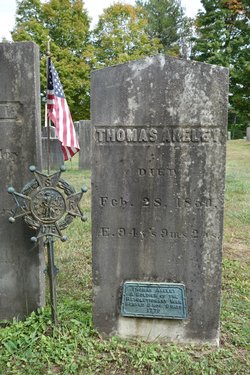
Thomas Akley settled in Brattleboro and married Abigail Wilder in 1783. They had fourteen children between 1783 and 1808. Abigail died in 1840. Thomas survived until 28 Feb 1850, dying at ninety-four. Shown above, courtesy of Find a Grave, is Thomas Akley’s gravestone in the West Brattleboro Cemetery.

TOMORROW: More Akleys.

Thursday, August 19, 2021

Francis Akley, Continental Ranger

When I started to focus on Joseph Akley, I also introduced his brothers: Francis, one year older, and Thomas, John, Samuel, and William, from three to seventeen years younger.

Samuel and William were so much younger, in fact, that Joseph never lived in the same household with them, being indentured out before he was born. (Joseph and William both grew up in Boston, so they might have known each other at least.)

The Boston Overseers of the Poor sent the other five brothers to new masters all over the province, as far west as Springfield and as far north as Topsham, Maine.

Those Akleys were young men and teenagers during the Revolutionary War. In 1775 only Joseph had married and started a family. Francis, Thomas, and John came of age before or during the war, meaning their apprenticeships ran out. They had no doubt built some personal ties in the communities where they grew up, but they didn’t have any relatives or property.

In sum, those Akley brothers were just the sort of young men the Continental Army was looking for. Just the sort of young men that towns were happy to grant a little bonus money and send off to fill draft quotas.

Indeed, all four of those Akley brothers joined the army, and, remarkably, all four survived long enough to apply for pensions in the early 1800s. By that time they had scattered across the northeastern U.S. of A. None of their applications described their family background or life in Boston before enlisting, but they stated their ages and the towns from which they enlisted, confirming that these are the right guys.

Francis Akley, Jr., baptized on 19 May 1751, was indentured to a cooper in Lancaster. After turning twenty-one in 1772 he moved to Guilford in what would be Vermont. In January 1777 he enlisted under Lt. David Goodnough in “an independant corpse of rangers mostly from New Hamps. at Tyconderoga commanded by Major [Benjamin] Whitcomb—and Capt. [George] Aldrich Company.”

Aldrich’s company fought in the Battle of Bennington on 16 Aug 1777. The only event Akley specifically recalled, however, was being “at the taking of Burgoyne” after Saratoga. He said he was discharged at Haverhill, New Hampshire, “I think in 1783.” Whitcomb’s Rangers actually disbanded at the start of 1781.

Francis Akley applied for a pension while living in Halifax, Vermont, in 1819. The following year he testified that he was seventy years old and his property consisted of “two Pigs—1 Jacknife & 1 old Pocketbook.” At that time, the law required veterans to show need before receiving any support.

The federal government granted Akley a pension. In 1829 he moved to Connecticut, and then in 1838 back to Vermont. Akley appeared on the U.S. government’s pension list in 1840, the year he turned eighty-nine.

The Vermont Mercury for 26 Mar 1841, published in Woodstock, carried a notice from the men commissioned to settle “Francis Akley’s Estate,” he being “represented insolvent.” They invited creditors to meet “at the dwelling-house of Lyman Akley in Plymouth,” most likely a descendant the veteran had been living with at the end of his long life.

TOMORROW: More Akley brothers’ service.

(The drawing above comes from the website of the reenacted Whitcomb’s Rangers and shows a soldier like Francis Akley.)

Friday, July 16, 2021

Charles Adams’s Wish

On 16 July 1775, Abigail Adams had an urgent message to pass on to her husband John, then at the Continental Congress in Philadelphia:
Our little ones send Duty to pappa. You would smile to see them all gather round mamma upon the reception of a letter to hear from pappa, and Charls with open mouth, What does par say—did not he write no more. And little Tom says I wish I could see par.

Upon Mr. Rice’s going into the army he asked Charls if he should get him a place, he catchd at it with great eagerness and insisted upon going. We could not put him of, he cryed and beged, no obstical we could raise was sufficent to satisfy him, till I told him he must first obtain your consent. Then he insisted that I must write about it, and has been every day these 3 weeks insisting upon my asking your consent.

At last I have promised to write to you, and am obliged to be as good as my word.
Charles Adams was then five years old. His father did not use his influence to land him a spot in the Continental Army. But later in the war Charles did accompany his father and older brother John Quincy on a diplomatic mission to Europe.

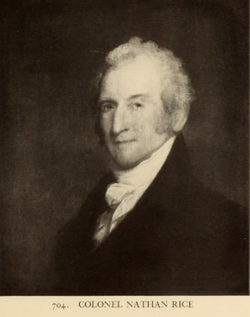
The “Mr. Rice” who started all this heartache with an offhand joke to little Charles was Nathan Rice (1754–1834, shown above later in life), son of a Sturbridge minister who graduated from Harvard College in 1773. By then his widowed mother had married a man in Hingham, bringing the family to the South Shore.

In August 1774 Rice joined the Adams household as one of John’s law clerks alongside John Thaxter. Because their arrival coincided with the shutdown of the Massachusetts courts and Adams’s service at the First Continental Congress, those young men didn’t get to see much lawyering.

Thaxter transitioned into being the Adams family’s live-in tutor, also going on that mission to Europe. Rice joined the army in May 1775, serving in staff positions for most of the war, including as aide de camp to Gen. Benjamin Lincoln.

Rice settled in Hingham, having married Sophia Blake. He returned to the army during the Adams administration’s Quasi-War, retiring as a lieutenant colonel. In the 1810s, after raising their children, Nathan and Sophia Rice moved up to Winooski, Vermont. The house they built in 1818, remodeled extensively, became known as the “Mansion House”; there was a local dispute over removing it to build apartments in 2019, and I don’t know how that turned out.

Sunday, May 16, 2021

“A conception that rivers were boundaries”?

In the Aacimotaatiiyankwi discussion of Little Turtle’s speech at the 1795 Treaty of Greenville, the scholars noted how that Myaamia (Miami) leader referred to the territory at stake.
Hunter Lockwood: …one of the things I noticed about that boundary definition is that it’s basically all using the rivers and watersheds. So one of the things I’ve been thinking about also is: what sorts of things are hard to translate, and what sorts of things are relatively easier to translate in general? . . .

David Costa: One thing Rich Rhodes talked about long ago, when I was a grad student, he said that one of the big salient differences between how territory was conceived of back then versus how white people conceived of it is white people came with a conception that rivers were boundaries. Whereas in North America, at least in the Great Lakes and Midwest, rivers were, that was the heart of territory, so conceiving of those as boundaries as Europeans were wont to do was a drastic change. Because, as you know, that was how people got around. People would take huge detours to get from A to B by following rivers when, if you look at it, as the crow flies a direct line will be much shorter but also next to impossible to do. . . .

Daryl Baldwin: The boundaries are probably heavily influenced because treaty negotiations are not about tribal epistemologies, but about American ideas of land ownership and boundaries. Little Turtle and the other leaders are having to figure out how to talk in those terms, and this might have been a good example of an early attempt for Little Turtle to speak in those terms.

David Costa: Yeah, even though I think he did not speak English, it is actually an interesting big adaptation to European ways of thinking. It’s already evident.
That got me thinking about whether making rivers into borders was a European way of thinking or whether it was an eighteenth-century American way of thinking.

When British settlers first came to New England in the 1600s, they built their settlements at harbors, the outlets of rivers. The colonies spread out from both sides of those bays, so when they met and had to define boundaries, the rivers ended up at the center of the territory, not the edges.

Massachusetts thus grew from Salem and Boston harbor and took over Plymouth harbor. Rhode Island got both sides of Narragansett Bay. Connecticut spread from New Haven, New London, and smaller ports. A minor river defined the southernmost part of the border between Connecticut and Rhode Island, but otherwise those colonies’ lines are straight, not natural.

The easternmost border between Massachusetts and New Hampshire is still defined by the Merrimack River, but it is not the Merrimack River. Rather, William and Mary’s grant stated:
That a line shall run Paralell with the sd. river at the Distance of Three English miles north from the mouth of the sd. river beginning at the southerly side of the Black Rocks so called at low water mark… 
That kept the mouth of the Merrimack River in Massachusetts.

Of course, there was another border between the New Hampshire and Massachusetts colonies, now between New Hampshire and Maine. The Crown finally defined that border with a decree in 1742: “the Divideing Line shall pass up thro the mouth of Piscataqua Harbour & up the midle of the river into the river of Newhichwannick (part of which is now called Salmon Falls) & thro’ the middle of the same to the furthest head thereof…” Legally, New Hampshire owns the river, with Maine starting on the eastern bank.

Finally, the Connecticut River became the dividing line between New Hampshire and Vermont. But of course before the Revolution (as shown in the 1755 map above), New Hampshire claimed everything on both sides.

The New England borders thus show us European settlers at first defining borders without little regard to rivers, then using a river but keeping both of its sides within one domain, and only in the mid-1700s making rivers the actual boundary lines. By the time Americans were divvying up the Northwest Territory, rivers like the Ohio, Wabash, and Mississippi were major lines on the maps.

Tuesday, February 09, 2021

Losing Sight of William Molineux—Live Chat

From the Transactions of the Colonial Society of Massachusetts:
A Stated Meeting of the Society was held at the house of the American Academy of Arts and Sciences, No. 28 Newbury Street, Boston, on Thursday, January 28, 1926, at three o’clock in the afternoon, the President, Samuel Eliot Morison, Ph.D., in the chair.

The Records of the last Stated Meeting were read and approved.

Mr. George P. Anderson spoke on William Molineux (1717–1774), a militant Boston Patriot, giving a biographical account of him and pointing out his connection with the political activities of the time.

[FOOTNOTE: Mr. Anderson’s paper will be printed in the Transactions of a future meeting.]
Alas, no such paper was ever published by the Colonial Society or elsewhere.

According to this finding aid from the University of Vermont, Anderson also “collected transcripts, chronology, notes, photocopies, articles, and other research on Thomas Young, an important figure in the American Revolution and the early history of Vermont, for a biography that was never published.” Again, alas.

Other scholars have studied Young, but Molineux has kept out of focus, in large part because he didn’t leave a body of written work. Indeed, when his public-works spinning venture prompted one of those long, drawn-out newspaper arguments in the early 1770s, someone else (maybe Young) wrote the articles on Molineux’s side. 

But we can’t understand Boston politics between 1767 and the end of 1774 without factoring in Molineux. I had a very long chapter about him and his untimely death in The Road to Concord, but it overloaded the book, so I took it out. Hopefully, it will evade the curse of Anderson’s paper and pop up somewhere else.

Tonight I’m scheduled to chat about Molineux with Jason on the Founder of the Day livestream, going live on Youtube at 8:15 Eastern time. We’ll see if I can control myself. Molineux couldn’t always do that.

Monday, August 17, 2020

The Death of Prisoners after the Battle of Bennington

New England troops and Crown forces, including French-speaking Canadians and German-speaking Hessians and Brunswickers, fought the Battle of Bennington on 16 Aug 1777.

The much larger American force won handily, killing more than 200 of the enemy and capturing 700.

On the day after the fighting, the Americans marched many of those prisoners of war across what’s now a state line to the Bennington Meetinghouse and locked them in under guard.

After dark on 17 August, the sentries around the building heard a loud crash inside. It’s not clear what broke—perhaps a bench that prisoners were resting on. Some of the men inside the church appear to have feared that the packed galleries were going to collapse, so they tried to push their way out.

In an article about this event for the Johannes Schwalm Historical Association, Michael P. Gabriel argued that the galleries didn’t collapse because the meetinghouse remained in use for another quarter-century. But perhaps some benches or railings fell onto people.

Outside the church, the guards heard the crash. They saw men pushing out the doors and windows. They feared their prisoners were trying to escape. The language barriers multiplied the confusion.

American soldiers fired their guns into the church. Others used their bayonets to round up the men who had made it outside.

In his article, Gabriel highlighted the experience of Dr. Julius Friedrich Wasmus and Dr. Friedrich Sandhagen, surgeons captured with the Brunswick regiments. They were dining with a local doctor at a militia captain’s house. The crashing, shouting, and shooting caused the hosts to rush out.

After a few minutes alone, the two German doctors decided to return to the Catamount Tavern, where they had been assigned. But on their way they ran into a group of militiamen hurrying toward the disturbance with their weapons. At the head of this group was the Rev. Thomas Allen of Pittsfield, a gung-ho Patriot keyed up by the battle.

Deciding these two German men were trying to escape, Allen started hitting Sandhagen with the flat of his sword. The militiamen cocked their muskets. Wasmus was afraid he would be killed. “I have never seen a man so enraged as this noble pastor,” he wrote.

Suddenly Dr. Wasmus was grabbed from behind. An American major had come across the group and recognized the captives. He pulled them away from the zealous minister, explaining who they were, and shoved them toward the meetinghouse.

At that site, the German surgeons started treating the injured. Wasmus counted two dead and five wounded. Eventually the prisoners were able to explain to their captors why they had tried to leave the meetinghouse. The local doctor sent over the dinner that his guests had missed.

Gabriel reports that American memories of the incident varied. Some veterans described the night in their pension applications, still convinced they had helped spoil an attempted escape. (Indeed, five prisoners seem to have vanished in the night.) Or they blamed the prisoners for the “disturbance.”

At least one man, however, felt he had unjustly participated in killing prisoners of war. When John Collester of Blandford, Massachusetts, applied for a federal pension, he listed many short-term enlistments and didn’t mention the event in Bennington. But in an 1850 speech to the local literary association, William H. Gibbs reported what the veteran had told him:
The prisoners were quartered in a church for the night, and placed under the care of seven sergeants, upon whom Mr. Collester was requested to keep a vigilant eye, About the middle of the night a crash was heard, and the soldiers rushed to the windows, when the guards were commanded to fire upon them. Seven were killed and restored. But morning opened a new revelation. The galleries of the church being weakened by the multitude of their occupants, had fallen, and crushed some and frightened others. Our aged and venerable townsman, on learning this fact, regretted the part he had acted, although in the discharge of his duty.
Many of the wounded prisoners remained in the Massachusetts countryside under guard with Dr. Wasmus kept to care for them. He spent time in Brimfield, Westminster, and Rutland before finally getting exchanged in 1781.