J. L. BELL is a Massachusetts writer who specializes in (among other things) the start of the American Revolution in and around Boston. He is particularly interested in the experiences of children in 1765-75. He has published scholarly papers and popular articles for both children and adults. He was consultant for an episode of History Detectives, and contributed to a display at Minute Man National Historic Park.

Subscribe thru Follow.it


•••••••••••••••••


Showing posts with label Bradford. Show all posts

Monday, April 22, 2024

Washington on Franklin on Gage on Lexington

In 1789, President George Washington went on a tour (I might even say a progress) through the northern United States.

This is how he recorded his travel through Massachusetts in his diary on Thursday, 5 November:
About sunrise I set out, crossing the Merrimack River at the town, over to the township of Bradford, and in nine miles came to Abbot’s tavern, in Andover, where we breakfasted, and met with much attention from Mr. [Samuel] Phillips, President of the Senate of Massachusetts, who accompanied us through Bellariki to Lexington, where I dined, and viewed the spot on which the first blood was spilt in the dispute with Great Britain, on the 19th of April, 1775. Here I parted with Mr. Phillips, and proceeded on to Watertown, intending (as I was disappointed by the weather and bad roads from travelling through the Interior Country to Charlestown, on Connecticut River,) to take what is called the middle road from Boston.
Washington didn’t mention where he dined in Lexington, but other sources confirm that it was at the tavern of William Munroe, who had been a militia sergeant back in April 1775. That building is now one of the museums of the Lexington Historical Society.

The President’s travelogue sounds rather dry, but this item in the 7 Jan 1790 Berkshire Chronicle suggests he was actually in a cheerful mood:
ANECDOTE.
When the President of the United States, in his late tour, was at Lexington, viewing the field where the first blood was shed in the late war; he with a degree of good humor, told his informant, that the Britons complained to Dr. [Benjamin] Franklin, of the ill usage their troops met with at Lexington battle, by the Yankies getting behind the stone walls, and firing at them. The Doctor replied, by asking them whether there were not two sides to the wall?
Well, it’s not exactly Abraham Lincoln’s joke about Ethan Allen, but we rarely get to hear Washington tell funny stories at all.

Washington’s comment echoes a poem published in the 27 Nov 1775 Boston Gazette called “The King’s Own Regulars.” Written in the voice of the redcoats, it includes this couplet about Gen. Thomas Gage:
Of their firing from behind fences, he makes a great pother,
Ev’ry fence has two sides; they made use of one, and we only forgot to use the other.
The following spring, Charles Carroll described this poem to his wife as “a song made by Dr. Franklin.” It looks like Franklin might have written those lines while visiting Gen. Washington in Cambridge in October 1775, then left them behind for the local press. And President Washington remembered the doctor’s pithy point years later.

Sunday, February 11, 2024

The Families of Sylvanus Lowell

Looking at the vital records from various Massachusetts towns helps to fill in the details of the life of Sylvanus Lowell, the ship’s captain maimed by a cannon in December 1773.

But those records also show some gaps and mysteries.

The vital records of Amesbury show the future mariner born to Moses and Francis (usually spelled Frances) Lowell on 2 May 1746. His name was apparently spelled as “Salvenas,” which looks more like church Latin than classical. He had siblings named Sarah, Thomas, Moses, Affea, Daniel, and Willebe (Willoughby). Their mother died when Sylvanus was two.

The vital records of Bradford say that on 2 Aug 1770 “Silvanus Lowell of Amesbury” married Hannah Hopkinson, daughter of Ens. Solomon Hopkinson of Bradford. That marriage is also noted, without an exact date, in the Amesbury records.

The Bradford records add that Hannah Lowell died on 20 Sept 1771, or possibly 26 September, “in her 26th year.” Thus, Sylvanus Lowell quickly became a widower.

There’s no child listed of that marriage in Amesbury or Bradford. However, the Bradford records are notably sparse if you weren’t named Kimball. The next sign of the family appears in the vital records of Newburyport, which say that Hannah Lowell, daughter of Sylvanus and Hannah, was baptized there on 20 June 1775. Was this a daughter of the captain’s first marriage, baptized at about age four? There’s no answer.

Likewise, I’ve found no answer about Sylvanus Lowell’s second marriage to a woman named Elisabeth. She pops up in the Newburyport records as mother of several children by him:
  • Elisabeth, baptized 6 Oct 1776 and buried 3 Sept 1777.
  • Elisabeth, baptized 12 Apr 1778.
  • Harrison, baptized 30 Jan 1780, probably died young.
  • Sylvanus, baptized 12 Aug 1781.
  • Sally, baptized 2 Feb 1783.
  • Thomas, baptized 11 Sept 1785 and buried 3 Sept 1786.
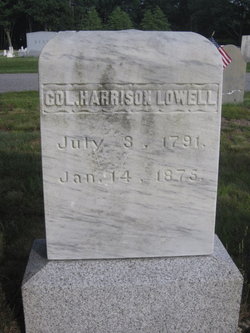
Newburyport also recorded the baptism of Harrison Lowell, son of Capt. Sylvanus and Elisabeth, on 29 Jan 1799. This may be the Maine legislator Harrison Lowell whose gravestone (shown above) gives his birthdate as 3 July 1791—though, again, that baptism would have been delayed.

Even more mysteriously, on 9 Mar 1791, Newburyport’s Essex Journal reported: “Died, Mrs. Lowell, wife of Capt. Silvanus Lowell of this town.” The vital records say that Elizabeth Lowell was buried that day. Obviously, she couldn’t have given birth to a son in July. Maybe the second Harrison was actually born in 1789 or 1790, and both the baptismal record and gravestone are off?

On 10 Oct 1791, just a few months after being widowed for the second time, Capt. Sylvanus Lowell married a widow about thirty-six years old named Elizabeth (McCard) Barriere or Berryer. She had a daughter, Fannie, from her first marriage.

I haven’t found any sign of Sylvanus having children by his second wife named Elizabeth. Each brought young children to the marriage to raise. Several of those children grew up, married, and had long lives. Both parents lived into their eighties.

This genealogical data shows Capt. Sylvanus Lowell having a fairly typical life for a New England patriarch of his time. Looking just at his three marriages and possibly eight children over more than a decade, one wouldn’t know that he’d come close to dying and lost significant portions of his body just before the Revolutionary War.

TOMORROW: What did you do in the war, Papa?

Tuesday, September 03, 2019

Moving into a Harvard Dormitory in 1785

At this time of year young people are settling in at college, including my godson at Cambridge. So I’m looking at the process of entering college in 1785.

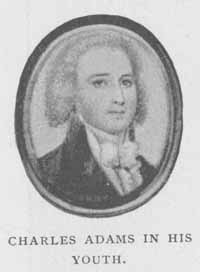
Fifteen-year-old Charles Adams started at Harvard College that year. His parents, Abigail and John, were across the Atlantic in London, so he was under the wing of relatives on his mother’s side.

Charles had been studying for the entrance exam with the Rev. John Shaw of Haverhill, an uncle by marriage. On 9 May Charles wrote to his cousin William Cranch: “we study in the bedroom as usual two young fellows from Bradford being added to our number, One of whom will be my chum if we get in and who I should be very glad to introduce to you.”

By “chum,” Charles meant a college roommate. That prospect was Samuel Walker (1768–1846). When Charles’s older brother John Quincy Adams visited that summer, he immediately assured their mother that Samuel was “a youth, whose thirst for knowledge is insatiable.”

Unfortunately, the dormitory wasn’t working out so smoothly. On 14 August, Abigail’s older sister, Mary Cranch, reported to her:
I have just heard that cousin Charles is not like to have the chamber he petition’d for, nor any other. Half his class will be oblig’d to Board out in the Town. Mr. Cranch and I are going tomorrow to see how it is, and to procure him a place if necessary. . . .

You cannot think how sorrowful your son looks about the loss of his chamber, but I hope to make him happy yet. I have got all the Furniture ready, (this is the part he is to find). The Bed and Linnin is found by his chum a very worthy pretty youth, who study’d with him at Mr. Shaws. Walker is his name, he is from Bradford.
Fortunately, the situation was soon resolved. On 17 August, Aunt Mary wrote:
Charles is happy he has got his chamber. I return’d last night. I found he had his petition’d granted. He is in the same college with Billy [Cranch,] has a Room upon the lower Floor [of Hollis Hall].

I have got him a pine Table made to stand under his looking glass. It doubles over like a card Table and is painted Marble colour and looks very well. He has the Square Tea Table to stand in his study. I got a few things for him in Boston as I came from Cambridge, and now I think he is equip’d and will go tomorrow with the best advice I can give him.
Charles Adams’s dorm room thus included a “Bed and Linnin” brought by his chum Samuel, a “looking glass,” a pine table painted like marble, and a “Square Tea Table,” among other things.

All four Harvard students I’ve mentioned went on to study the law. John Quincy Adams had a long and successful career while his brother Charles did not. William Cranch became a judge in Washington, D.C. Samuel Walker practiced in Rutland, Vermont, for a quarter-century.

Before then, however, Walker was rusticated for a year in 1787 for “stealing from his class mates.” And he seemed like such a studious boy.

Wednesday, July 01, 2015

Daniel George, Teen-Aged Almanac Maker

Daniel George was born in Haverhill, Massachusetts, on 16 Dec 1757, son of David and Anne (Cottle) George. He was the second boy named Daniel born to that couple, indicating that the first had died young. He had both older and younger siblings of both sexes.

From infancy Daniel was “a Cripple,” possibly having cerebral palsy. That made life as a farmer almost unthinkable. But the boy’s mind was sharp, and he took to mathematics and then astronomy. In 1775, Daniel prepared an almanac for the upcoming year, calculating the movements of the Sun and Moon and the tides for eastern Massachusetts.

On 26 August, Daniel George and his father visited the Rev. Samuel Williams (1743-1817) of Bradford. Williams was known for his scientific investigations, including two trips to observe the transit of Venus in the 1760s.

Williams talked with the teenager and wrote a recommendation of him to the printer Ezekiel Russell, then in Salem:
Mr. David George, of Haverhill, is now with me; he has brought his son Daniel, who appears to be a singular object of pity and compassion. But with all the disorders of body under which he labors, his mind does not seem to have been at all affected. He has composed an Almanack, which, as far as I have inspected it, seems to be equal to other compositions of that kind; and perhaps from the singular situation of the Author, bids fair to engage the popular attention. If it would be consistent with your business and interest to print it, it would be an act of kindness to the distressed, and a great encouragement to a rising Genius, in early years laboring under uncommon disadvantages, but yet bidding fair for very considerable improvements.—

I write this from motives of compassion to the unhappy Cripple, and because I really think his talents may be of use to mankind if encouraged. How far this will be consistent with your interest is not for me to say. But if you can favor the productions of a Cripple, in the seventeenth year of his age, it must not only give pleasure to him, but to the benevolent and humane who wish success to the ingenious, and comfort to the wretched.
Russell was open to new authors: he was the first printer to engage to issue Phillis Wheatley’s book, before she went to London, and he routinely published other female poets, such as Hannah Wheaton. In part that was because Russell was never a very successful printer, so he and his wife were often scrounging for business.

Russell engaged to print George’s Cambridge Almanack; or, the Essex Calendar. For the Year of our Redemption, 1776. Being Leap-Year, the Sixteenth of the Reign of George III. To make sure customers realized what a remarkable production it was, he credited it “By Daniel George, a Student in Astronomy at Haverhill, in the County of Essex, who is now in the Seventeenth [sic] Year of his Age, and has been a Cripple from his Infancy.” And he printed Williams’s letter at the front.

In his own introduction, dated September 1775, Daniel added:
This, however, my public-spirited Friends and Countrymen, you will be certain of, by becoming a Purchaser of my Almanack, you are helping one who is not able, or perhaps ever will have it in his power to help himself; which motive alone may be a sufficient incitement to a generous mind, even should your expectations with regard to my calculations, be in some measure disappointed.
But he then turned to the patriotic material he’d chosen to include, such as “A Narrative of the excursion and ravages of the King’s troops, under the command of Gen. [Thomas] Gage, on the 19th of April, 1775; . . . This concise and much admired narrative is said to be drawn up by the reverend and patriotic Mr. G——n, of the third parish in Roxbury.” (I believe that’s one of our earliest pieces of evidence that the Rev. William Gordon drafted that report for the Massachusetts Provincial Congress.)

The calendar pages inside highlighted such anniversaries as:
  • “Feb. 21 [actually 22]. Christopher Snyder, aged 14 [actually about eleven], cruelly massacred in Boston, by Ebenezer Richardson, the noted informer. He was the first Martyr to American Liberty.”
  • “March 5. Boston massacre.”
  • “April 19. Concord Fight, 1775, when began the bloody civil war in America, by the British Troops.”
  • “June 17. Bloody battle of Charlestown, where were killed and wounded 324 provincials, 1,450 regulars; there were destroyed in Charlestown by the latter 1 meeting-house, 350 dwelling-houses, and 150 other buildings.”
  • “Dec. 16. E. I. Tea destroyed in Boston, 1773.”
And all for only “6 cop.”

George’s Almanac sold well enough that Russell issued a second edition with added content: a “Narrative of the Bunker-Hill Fight” and “A Poem On The Late Gen. [Joseph] Warren.” But wait—there was more! The extra page also included “An Acrostic On Gen. Warren” (the same one I quoted here) and a woodcut portrait of the late doctor (shown above).

The next year Daniel, still a teenager, prepared an almanac for 1777 for new printers in Boston and Newburyport. Having established his name, he continued to publish almanacs into adulthood. Sometime in the mid-1780s he moved to what is now Portland, Maine, and eventually became a newspaper publisher.

In The History of the Press of Maine (1872), H. W. Richardson wrote:
George was a remarkable character. He is described as a man of genius, but so exceedingly deformed that he had to be moved from place to place in a small carriage, drawn by a servant. He came here in 1784 or ’5 from Newburyport, where he had published almanacs, as he afterwards did here. He was a printer, but kept school in Portland, and had also a small bookstore in Fish, now Exchange, street. In 1800 he became the sole owner of the Herald.
George “died suddenly at Portland” on 4 Feb 1804, age forty-six, having seen and accomplished much more than anyone expected back in 1758, the year when the George family probably realized that their new baby had a physical disability.


Friday, January 16, 2015

President Washington in Sickness and in Lexington

Having spent many autumn days outdoors meeting lots of American citizens, on 26 Oct 1789 President George Washington…got sick.

He wrote in his diary:
The day being Rainy & Stormy—myself much disordered by a Cold and inflamation in the left eye, I was prevented from visiting Lexington (where the first blood in the dispute with G. Britn.) was drawn. . . . in the Evening I drank Tea with Govr. [John] Hancock & called upon Mr. [James] Bowdoin on my return to my lodgings.
(The President’s encounters with Gov. Hancock will be the focus of T. H. Breen’s talk at the Cambridge Forum next Wednesday evening.)

According to the editors of the Washington Papers, the President might have been suffering from the “widespread epidemic of respiratory ailments” spreading in the central and southern states. In fact, Washington and his retinue may have carried the virus north. Certainly a lot of the people who had crowded onto the Boston streets to see him came down with a big, and local newspapers began to refer to the “Washington influenza.”

Washington eventually made it to Lexington, visiting the town on his swing south after seeing New Hampshire.
Thursday 5th. About Sun rise I set out, crossing the Merimack River at the Town over to the Township of Bradford and in nine Miles came to Abbots Tavern in Andover where we breakfasted, and met with much attention from Mr. [William] Philips President of the Senate of Massachusetts, who accompanied us thro’ Bellarika to Lexington, where I dined, and viewed the Spot on which the first blood was spilt in the dispute with great Britain on the 19th. of April 1775.
The President dined at William Munroe’s tavern, now a museum of the Lexington Historical Society (shown above).

In 1917, the Journal of American History published “A Young Woman’s Sprightly Account of Washington’s Visit to Lexington in 1789,” said to be written by Munroe’s daughter Sarah. It looks like a total fake. But sprightly.

Tuesday, May 29, 2012

Samuel Williams: minister, astronomer, fugitive,…

Along with future physician Isaac Rand (profiled yesterday), Prof. John Winthrop took a young man named Samuel Williams (1743-1817) up to Newfoundland in 1761 to help observe the transit of Venus.

After that experience Williams, son of a Waltham minister (and former young captive from the Deerfield raid of 1704), set out on a rather conventional career path. He became minister at Bradford, Massachusetts. But he also kept up his scientific interests. In 1769 Williams observed the decade’s second transit of Venus from Newbury, publishing his observations through the American Philosophical Society seventeen years later.

In 1780 Williams succeeded Winthrop as Hollis Professor of Mathematics and Natural Philosophy at Harvard. That year he wrote about New England’s famous “Dark Day” and led a small college expedition to Maine to watch the Moon eclipse the Sun.

That trip was hampered by the fact that Williams decided that the best place to make his observations was an island in Penobscot Bay which the British military had just defended from a large Massachusetts attack. As with the 1761 transit of Venus, however, warring governments were willing to let gentlemen make observations for the sake of science.

Later in the 1780s, Harvard student John Quincy Adams wrote: “Mr. Williams is more generally esteemed by the students, than any other member of this government [i.e., college faculty]. He is more affable and familiar with the students, and does not affect that ridiculous pomp which is so generally prevalent here.”

But in 1788 Prof. Williams suddenly had to depart Harvard—and the U.S. of A. He was charged with forgery for falsifying a receipt from a trust he administered. Williams rode north, leaving his family in Cambridge to await word of where to find him.

Williams settled in Rutland, Vermont, and found work as a legal copyist and minister, first fill-in and then full-time. He brought his family north and rebuilt a respectable life. Williams launched the Rutland Herald newspaper and edited it for three years. He published a history of the state and a short history of the Revolution for use in schools. Williams helped found the University of Vermont and in 1806 used his astronomical knowledge to settle the state’s northern boundary with Canada.

One of the telescopes Williams reportedly used is shown above courtesy of the Smithsonian Institution. The museum’s webpage says Williams used this one to observe the 1769 transit of Venus, but also implies he was a Harvard professor at the time. Soon I’ll share links to more of Williams’s equipment.

In 2009 Robert Friend Rothschild published Two Brides for Apollo, a sympathetic biography of Williams. I believe the title refers to the two types of astronomical events Williams studied: the transit of Venus and the solar eclipse.