J. L. BELL is a Massachusetts writer who specializes in (among other things) the start of the American Revolution in and around Boston. He is particularly interested in the experiences of children in 1765-75. He has published scholarly papers and popular articles for both children and adults. He was consultant for an episode of History Detectives, and contributed to a display at Minute Man National Historic Park.

Subscribe thru Follow.it


•••••••••••••••••


Showing posts with label Hector McNeill. Show all posts

Wednesday, February 18, 2026

A Last Word on Basile Boudrot

Whenever I recount a story at length, I like to add some new sources, connections, or interpretations. I don’t want to just repeat what other writers have said.

But when I started researching suspected murderer Basile Boudrot, I couldn’t find that sort of material. I felt so stymied that I thought I’d have to confine the story to my Ko-fi updates, where I’ve started to share loose ends and research in progress. 

Ultimately, I spotted enough sources to fill the past several postings. But like everyone else who’s written about this case, I hit a brick wall in August 1776, when the Continental Congress voted to send Boudrot to Massachusetts.

As my closing thoughts, I’ll offer this scenario for how the sources fit together. Bear in mind that this is only one possible reconstruction, perhaps tinged by a fiction writer’s search for plot twists, liable to be upended with a single new document. But here goes.

February 1772: Capt. Thomas Parsons and his eight-man crew sail a schooner (name unknown) out of Newburyport, headed for the Caribbean.

March 1772: Parsons’s ship founders in a storm that blows a lot of vessels north. Meanwhile, Basile Boudrot boards a ship in France, heading to Nova Scotia. Along the way he opens a letter from his relative Marguerite Landry to the D’Entremont family, describing where their relatives hid money as the British expelled Acadians almost twenty years before.

April 1772: Boudrot reaches Nova Scotia and registers for his land grant on St. Marys Bay. But first he follows the directions in the Landry letter and unearths “1004 pieces of money.” Meanwhile, people in Newburyport worry about Thomas Parsons’s ship; no one reports seeing it in the Caribbean.

May 1772: Boudrot visits the D’Entremonts in Pubnico, assuring them that Marguerite Landry and her family are in good circumstances in France. Then he takes off for the province of Canada, abandoning his land since he’s already found a fortune with much less work. Benoni d’Entremont gets suspicious and writes to Landry in Cherbourg.

Summer 1772: The D’Entremonts ask questions in Nova Scotia about Boudrot. Passing ship captains from Massachusetts, including Hector McNeill, ask questions about the missing schooner. Locals talk about Basile Boudrot suddenly having a lot of money and no good explanation for it.

Fall 1772: Folks in Newburyport piece together information and conclude that Basile Boudrot was behind the disappearance of Parsons’s schooner, that he got suddenly rich from plundering that ship after killing all its crew.

Spring 1773: Marguerite Landry writes to the D’Entremonts from Cherbourg, describing the buried money and reporting that French sea captains have spotted Basile Boudrot in North America. In Massachusetts, the Parsons family presses for an inquiry into the alleged attack on the schooner.

Late 1773: Basile Boudrot has spent through most of his windfall. He picks up whispers that the D’Entremonts and Yankee mariners are all hunting him. He adopts the alias “Dugan” to work on ships around Montréal, Lake Champlain, and points west.

Fall 1775: Americans invade Canada, besieging Québec. Massachusetts mariners Hector McNeill and William Farris leave the city and go to work for the Continental Army.

Spring 1776: As the Continentals withdraw to Montréal, McNeill spots “Dugan” working on another supply ship. McNeill identifies this man as Basile Boudrot and demands his arrest.

Summer 1776: The Continental Army holds Boudrot prisoner in New York City until the Congress endorses Gen. Samuel Holden Parsons’s plan to send him to Massachusetts to stand trial.

Fall 1776: Soon after Boudrot reaches Massachusetts, the authorities realize the accusation against him doesn’t hold water: he wasn’t even in North America when Thomas Parsons’s ship disappeared. Out of embarrassment, they drop the case and never mention it again. People in Newburyport persist in believing that Nova Scotians plundered the schooner. Basile Boudrot disappears once more.

[The photograph above shows Smuggler’s Cove park on St. Marys Bay, Nova Scotia. Nothing says “law-abiding maritime community” like naming a place Smuggler’s Cove.]

Sunday, February 15, 2026

“The Villain that murdered Colo: Parsons Brother is here”

Back here I described the family of the Rev. Jonathan Parsons of Newburyport, including his fourth son, Thomas Parsons, who disappeared in 1772.

The third son, Samuel Holden Parsons, became an attorney in Lyme, Connecticut. He prospered, getting elected to the colonial assembly, and then moved to New London. At the start of the Revolutionary War Parsons raised a regiment and marched north.

Parsons served through the siege of Boston and in the spring of 1776 led his troops south through Connecticut to defend New York.

Soon after Continental officers detained Basile Boudrot (alias Dugan) on suspicion of murdering Thomas Parsons and his crew, someone sent the news to Col. Parsons.

The next trace of Boudrot that we have is therefore Gen. Philip Schuyler’s 12 June letter from Albany to Gen. George Washington:
The Villain that murdered Colo: Parsons Brother is here. The Colo: desired Me to send him to New York I wait Your Excellency’s Directions.
Washington replied on 24 June:
As Colonel Parsons has requested you to send the Person who is supposed to have murdered his Brother, I have no objection to your doing it, if you judge it necessary. He, from what I have been told, designs to apply to Congress, for instituting some Mode of Trial for the Offence.
Schuyler (shown here) proceeded on that course. On 11 July, John Holt’s New-York Journal reported:
Last Sunday [7 July] one Bazel Bonderot, a native of Nova-Scotia, was brought to this city from Canada, charged with being a principal in the murder of Captain Thomas Parsons, and eight other persons, in Nova-Scotia, in February 1772.

Soon after this murder was perpetrated, he fled his country, and has been wandering from place to place ever since, till last April, when he was providentially detected by Captain Hector McNeil, properly secured, and sent forward to receive the just reward of his crimes.

He was yesterday sent on from this city to Newbury Port, the place where Captain Parsons last lived, for examination and trial.
That article was reprinted in several newspapers, and eventually in the 19 July Essex Journal of Newburyport.

That same issue of the Essex Journal reported:
This Morning, between 6 and 7 o’clock, departed this life after a long tedious illness, the Rev. JONATHAN PARSONS, in the 71st year of his age, and in the 31st of his MINISTRY in the PRESBYTERIAN Church, in this Town—His remains to be interred on Tuesday next, at three o’clock in the afternoon.
It’s not clear whether the minister heard about the capture of his son’s alleged killer before he died.

TOMORROW: Deliberations in the Congress.

Saturday, February 14, 2026

“Appointed to the command of the Schooner Isabella”

In the April 1776 letter from Capt. Hector McNeill to Col. Benedict Arnold (shown here) that I quoted yesterday is the line, “My William Farris is Saild for you I hope you will be kind to him.”

William Farris was twenty-three years old that year, having been born in Belfast in 1753. He came to Newburyport at the age of twelve. Then he went to sea.

In an 1832 pension application, quoted in John J. Currier’s History of Newburyport, Mass.: 1764-1905, Farris described what he did at the start of the war:
he was at Quebec as first officer of the Ship Mary Ann, belonging to Boston, in the summer of the year 1775, and there made arrangements with Captain Hector McNiel, and was under further engagement with him for a voyage and as first Officer of a vessel, in the Merchants service with him, and while thus engaged, and before the lading of the vessel, information was received of an expedition undertaken by General Arnold, in the service of the United States, who was then on his way through the woods.

To the best of his remembrance, General Arnold appeared with his Army in the month of November of that year [14 Nov 1775], and immediately thereupon a proclamation was issued by Lieutenant Governor Crambries [Hector Theophilus Cramahé] requiring every Individual in the City to take arms in its defence, or depart therefrom within three days, and declaring all who did not thus manifest their allegiance Rebels and Spies.

Your petitioner did not hesitate to make his election, but immediately procured a passport, leaving all his effects behind him, excepting only such few articles as were necessary for a change, and those contained in a single handkerchief, left the City, and proceeded to join the standard of his country, under General Arnold, who was then at about thirteen miles distance; he was favorably received by the General, and was immediately stationed by him at a place called Point aux Trembles, and there given in charge the care of several vessels, which had been captured from the British, and placed in a small creek at that place; from these vessels various articles which were considered useful and necessary for the American Army were selected and sent down from thence by land.

At this place he was stationed during the whole of the following Winter, having with him an officer from General Arnold’s Army, and a few soldiers, for the protection of this property. On the breaking up of the ice in the spring following, he was sent across the river to direct some Canadians, who were employed for that purpose, in making a number of sweeps, or large bars, for the use of gondolas, which were to be employed in transporting heavy cannon, and as soon as the Ice was sufficiently cleared away he was appointed to the command of the Schooner Isabella, one of the prises which had been captured from the British, mounting four carriage guns, and with this vessel was ordered for Montreal, as a transport, with supplies for the American army.

On arriving at said Montreal, it was found that General Arnold had been superceded in the command at Quebec [by Gen. David Wooster], and that information had been received of the arrival of a British fleet, upon which General Arnold immediately ordered all the materials which were considered useful and proper for the American Army to be selected, and these were laden and put on board the said Schooner, which was then under the command of your petitioner, and General Arnold, Colonel [Aaron] Burr, and several other officers of the American Army took passage in said Schooner with him and went down to the River Sorcel, where reinforcements for the Army were arriving, and at that place said Schooner was hauled in near the banks, and the General and all his officers continued on board several days, having no convenient place on shore for their accommodation.

When it became necessary to leave the said Schooner, there appearing no further use for her, or for the services of your petitioner at that place, he procured a passport from Colonel Burr, with which about the middle of June, 1776, he proceeded for the United States, with a view of entering the Navy, having been employed in the service of the United States, having the charge of said prises, and in the command of said Schooner, the full term of seven months.
I quote that at length because it offers a picture of the environment in which Capt. McNeill spotted the man he identified as Basile Boudrot.

In addition, Farris offers a link between McNeill, his mentor in Québec, and Newburyport, the port that Thomas Parsons had sailed from on his last voyage.

TOMORROW: Transporting the prisoner.

Friday, February 13, 2026

“He Now Passes by the Name of Dugan”

On 29 Aug 1775, Capt. Hector McNeill arrived in Québec on board another captain’s ship from Dominica. He brought false news of a battle at Roxbury where “most of the light horse were killed.”

Having been born in Ireland and raised in Boston, McNeill was then living in Québec with his daughters while carrying on trade with New England. His son Hector, Jr., based in Marblehead, had enrolled in Col. John Glover’s regiment.

A few months later, Col. Benedict Arnold and Gen. Richard Montgomery arrived at the walls of Québec with Continental troops. Lt. Gov. Hector Theophilus Cramahé ordered all able-bodied men to help defend the city or leave. The captain made his way to Arnold and started to carry supplies for the Continentals.

Though we usually tell the story of the American invasion of Canada with a climax and swift end in December 1775, the campaign went on for several more months, so McNeill had lots of work to do.

In the spring of 1776, the captain recognized a man aboard another ship, presumably also working for the Americans. On 25 April, McNeill at Pointe-aux-Trembles sent an urgent message to Col. Arnold, who was on the same island at Montréal:
This will be handed you by Major [Zachariah] Dubois, and is to Request the favour of you to Arrest, & Confine in Jail a certain acadian Whose proper Name is Basiell Boudrott, he Now Passes by the Name of Dugan and is the Mate of the Schooner Providence Commanded by Capt. Palmer,

I am bold to charge this fellow above named with the Murder of Capt. Thomas Parsons of Newbury Port, & his whole Crew at or near Cape St Mary’s in the Bay of Funda in the Month of March 177[2], I have been upon the look out for this chap ever Since & Now Providentially have found him, I am Sure he is the Principall of that gang of Villians who murderd Capt Parsons, & his crew, 9 in Number, & plundered first, afterwards burnt his Vessell—

I hope I need not urge you to Confine, & keep him close untill he can be Sent to New England, as Piracy, & Murder are Crimes which all good Men Should Endeavour to Prosecute & punish, I inclose you a Letter for the Owners of Capt Parsons his Vessell Which I beg you will read, Seal, & forward to the place of its distination—

My William Farris is Saild for you I hope you will be kind to him—as for your Capt Palmer—he has Sickened Me; of all Men to dispatch or manage affairs I Never Mett with worse hands then himself & his Lieut,—

I hear your wound is broke loose Which gives Me real Sorrow—you Must be Carefull of it or it may yet cost you dear

For heavens Sake do not Neglect to Secure the aforementioned Basiell Boudrot, for he is a Vile Murderer

May heavens preserve you in that Nest of Tory Scoundrels & grant you Wisdom & Fortitude to mannage them as they deserve
McNeill sent the same request to Gen. David Wooster. On 26 April, Wooster assured him: “I shall write Genl Arnold concerning the Acadien & also to arrest Palmer.”

TOMORROW: Sailing for Arnold’s army.

Saturday, July 24, 2021

“We lost Sight of Capt. Manly”

We don’t have Capt. John Manley’s account of the 7 July 1777 sea battle I’ve been recounting, but we do have the entries from Capt. Hector McNeill’s journal.

We even have McNeill’s sketches, as published in 1922. The drawing above shows the situation after Manley set fire to a captured coal sloop and cut it loose as two British frigates approached.

Here’s what McNeill wrote in that journal, spellings, abbreviations, and nautical terms intact:
Mounday, July 7, 1777. . . . two vesails [H.M.S. Rainbow and Victor] to the Eastward of us. At 4 a.m. see them again Bearring to the Eastwart. Still at 5 a.m. made a Saile [H.M.S. Flora] Bairing to W, we going WbS. She past us and gave us two guns, as soon as she got in our wake She put a Bout and stood for us and came up with us fast and we playd a way with our Stairn Chases.

At 11 a.m. Capt. Manly and the fox and frigate till Darck and could see the frigate two guns

after 11 we began to Engage and had it very warm, the fox being to Lewyard the frigat at hir and she Run be fore the wind. Ther was a two Decker [Rainbow] under our Lee, we ware a Stoping our Shot holes, we thought Not Safe to follow.

Tusday, July 8, . . . At 12 p.m. Capt. Manly put a Bout Stood after the fox, the two Decker gave Chace to him and fird Sevral guns. He stood away as fast as posable. The frigate [Flora] and fox made a Running fight, they stood away a Bout NNE, we stood about NWBN.

We lost Sight of Capt. Manly a Bout 4 p.m. But we keep Sight of the fox and our Ship put a Bout and stood for hir; at 35 Minnites shot off the fox, and thought the fox gaind of hir. The frigate mounted 32 or 36 Guns. We are Surrounded with Ships all Round.

At 5 a.m. we heard Guns for a Long time. We Expect some Engagement Soon. We had one [Gideon] Wasborn kiled out Rig[ht], one [Henry] Green a Quarter master wounded in the Leg, had it Cut of at 8 p.m., died at 4 A.M. See the Land.

Wednesday the 9. . . . The first part of this 24 hours Modrate pleasant we going under all the Saile that we Could Tack, the Latter part a fresh Gale in all Small Sailes. Expecting Every moment to make the Land. Saw a plenty of Rock wead and old Logs of wood. I Could hearitly wich the Hancock and fox was with us for we are all Most in a Good harbour thanks Be to God.
The bottom line was that McNeill had engaged in the battle early on, but on the afternoon of 8 July the Hancock, Fox, and Boston sailed in different directions, and after four hours he “lost Sight of Capt. Manly.”

The next morning, Capt. McNeill heard guns, so he knew there was a fight going on. But he didn’t head to the action to help. Instead, covinced there were “Ships all Round," he sailed as fast as he could for a safe harbor. “I Could hearitly wich the Hancock and fox was with us,” McNeill wrote the next day. But the bottom line was that they weren’t.

In letters written a few days later, McNeill emphasized some details not in his journal, such as Manley letting some captured sailors go, thus alerting the British of his fleet’s presence, while declining McNeill’s advice to sail down to South Carolina instead.

As for his departure from the action, McNeill told the Continental Congress’s marine committee: “We were constrain’d to keep the Wind for our own Security being neither able to Run from nor fight such force as then appear’d to Leward.” On Tuesday, 8 July, he now recalled, “I saw five Sail of the Enemy to the Leward of me three on the Lee bow and two on the Lee Quarter”—details not in his journal.

TOMORROW: Back in the action.

Friday, July 23, 2021

“Manly and McNeal do not agree”

As documented yesterday, there were a lot of people that Capt. John Manley of the Continental Navy didn’t get along with.

One of the most prominent was the navy’s next most senior captain, Hector McNeill. Their animosity was actually a matter of public concern in the spring of 1777, when they were both in Boston preparing frigates for cruises.

On 23 March, state official James Warren wrote to his friend John Adams, who had been on the Continental Congress’s marine committee but was now on the board of war:
The Hancock, Boston, Alfred and Cabot are all yet in port. It is said the Hancock [Manley’s ship] is ready to sail and was to have gone yesterday but remains here yet. I fear the Consequences of their going out single, but McNeil and Manly it is said like the Jews and Samaritans will have no Connections or Intercourse. They will not sail together.
The Rev. Dr. Samuel Cooper sent a similar warning on 3 April:
Manly and McNeal do not agree. It is not I believe, the Fault of the first. They ought to sail together with all the Force they can obtain here to join them—a large Privateer would have readily done it. McNeal is inclin’d, and has obtain’d Liberty from Congress it is said, to sail alone. All may be lost in this Way. Jointly they might take single Frigates of the Enemy, or oblige them to sail in Fleets, which would greatly open the Ports for the Supplies from France and evry Quarter. Pray let some Orders be taken in this Matter as early as may be.
Later in the same letter Cooper returned to that theme:
Manly and McNeal are now, like Matthews and Lestac [two feuding British captains in the 1740s]. If they are not better united, infinite Damage may acrue. The latter hardly brooks the Superiority of the former—tho no Man has merited more, in the marine than Manly, or promises better.
It’s not clear how Warren and Cooper knew about the captains’ animosity. Were there open arguments? Grousing behind each other’s backs? However the rift opened, a lot of people knew about it.

For his part, McNeill later insisted that in this period he’d been on his best behavior:
The General opinion which had prevail’d, that I was dissatisfied with being under Manley’s Command, made me sett up a resolution to obey implicitly every one of his Commands, (as for Signals, I never could get any from him) to the utmost of my power. I did however endeavour to advise him now and then when in a good mood, and he often appear’d to attend to what I said; but the unstableness of his Temper led him rather to do as he pleas’d. Nevertheless I follow’d him as the Jackall does the Lyon, without Grumbling except in my Gizard.
I find it striking that each of those writers reached for a metaphor as the best way to convey the depths of the two men’s relationship.

After the Hancock and Boston left port in May, the two captains managed to work together well enough to make some captures and avoid being captured themselves. But people back in Boston remembered the bad blood between Manley and McNeill.

TOMORROW: Back into battle.

Thursday, July 22, 2021

Captain Manley’s Temper

One of the striking details of Cdr. Sir George Collier’s account of the sea battle on 6-8 July 1777, recounted yesterday, is how his ship had almost no coordination with the other Royal Navy frigate in the fight.

Capt. John Brisbane had sailed the Flora up from New York on orders of Adm. Lord Howe. He happened to intersect the three Continental ships that Collier’s Rainbow was chasing down from Nova Scotia.

Brisbane and Collier didn’t expect to see each other. At first Collier thought Brisbane’s ship was an enemy vessel only pretending to be British. At one point in the maneuvers, Brisbane’s sailing master warned him that they might be so far north as to be out of their station.

I also wonder if the two Royal Navy officers were wary of giving up authority to the other. Collier was in home territory and (at least when the chase began) overseeing two ships, but as a captain Brisbane outranked him.

But the British captains weren’t the only ones who had trouble coordinating their attack.

Capt. John Manley on the Hancock was the star of the young Continental naval forces. Starting with command of one of Gen. George Washington’s schooners out of Beverly, Manley had racked up more and richer captures than any other captain. There was even a broadside ballad about him, illustrated with the engraving above.

But Capt. Manley also had a temper, and he was in continual conflict with other Continental naval officers. In October 1776 he complained about being ranked as second most senior captain in the navy, thus being “under the Command of one man, whose Ability I had reason to doubt.”

In April 1777, as I recounted back here, Manley insisted on a court-martial for his lieutenant, Joseph Dobel, for disobedience.

Then in early May, Manley summoned other captains onto his ship for a court-martial of eight men, including his pilot, ”for Mutiny.” 

One measure of Manley’s anger about those eight men is that the captains he summoned included Hector McNeill and John Paul Jones, and they hated him.

TOMORROW: Divided command.

Wednesday, July 21, 2021

Commander Collier and “Part of the Rebel Fleet”

On the morning of 6 July 1777, H.M.S. Rainbow sailed out of Halifax harbor. It was a fifth-rate frigate equipped with 44 guns. Behind the Rainbow came H.M.S. Victor, a brig carrying 10 guns.

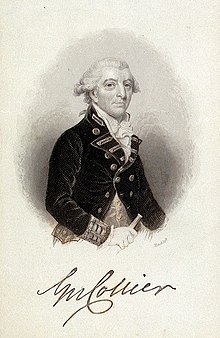
In command of that little Royal Navy fleet was Commander Sir George Collier (1738-1795, shown here).

That afternoon, the Rainbow “discovered Three Sail,” Collier reported. He “could form no Judgement of their Force, or what they were,” so he “immediately gave Chace.” After all, he was the navy.

The Victor was lagging three or four miles behind, so Cdr. Collier sent a signal to its captain to make more sail and speed up. As the day ended, the Rainbow’s crew could see they were chasing “large Ships” which looked “bound to some of the Ports of New England”—enemy territory.

Collier wrote, “I followed them with all the Sail I could croud.” At dawn his crew made out three ships plus a sloop “about 5 or 6 Miles distant.” Meanwhile, the Victor had fallen so far behind it was no longer in sight.

At this point Cdr. Collier was convinced he’d spotted the “Part of the Rebel Fleet, which had sailed some Time before from Boston.” Despite being outnumbered, he continued the pursuit. 

The Rainbow had indeed found Capt. John Manley’s growing fleet, consisting of his Continental frigate Hancock, U.S.S. Boston under Capt. Hector McNeill, a captured British privateer named Fox, and a recently seized sloop carrying coal.

The last vessel didn’t last long. Manley ordered it set on fire and cut loose. Then he gave orders for “setting Top Gallant Royals and every Sail that could be useful.”

Collier wrote:
A little after Six we discovered another Sail standing towards the Rebel Ships; she crossed us on the contrary Tack at about Four Miles Distance, and put about when she could fetch their Wakes; from her not making the private Signal to me, I concluded that she was another of the Rebel Frigates, and therefore paid no Regard as to an English Red Ensign she hoisted, and two Guns she fire to Leeward.
Ships didn’t have to display their true colors until they actually went into battle. Until then, captains could run up any nation’s flag to bluff another ship into thinking they were friendly or neutral or whatever seemed advantageous. Collier therefore suspected there were four enemy vessels ahead of him, but he kept chasing.

About 10:45 A.M., Collier was surprised to see this new ship and one of the original three exchange fire. He ordered his crew to raise the Union Jack. The match had turned out to be three American ships against two British.

The other Royal Navy frigate was H.M.S. Flora, a 32-gun fifth-rate that had started as the French warship Vestale. Its captain was John Brisbane (1735-1807).

One of the American ships split off from the other two. Brisbane on the Flora “exchanged a Broadside with each.” The Rainbow also fired on one that had fallen behind, seemingly “uncertain which to steer,” but “had not the good Fortune to bring down either a Mast or Sail.”

Cdr. Collier watched “the headmost Rebel Frigate put about,…just out of Gunshot to Windward.” He judged it “a very fine Ship of 34 Guns, with Rebel Colours flying.”

An officer on the Rainbow’s quarterdeck recognized that ship from when he had been a prisoner in Boston. It was the Hancock, and its master was Manley, “the Sea Officer in whom the Congress place great Confidence, and who is the Second in Rank in their Navy.”

Cdr. Collier realized he stood at a decision point. Of the enemy ships, he thought, “one of the three must unavoidably escape, if they thus steered different Courses.” The Flora had apparently picked its target, which turned out to be the prize ship Fox.

Collier decided to “put about and follow the Hancock, which appeared the largest Ship,” as well as the most important—and most dangerous.

TOMORROW: Commanders clash.

Tuesday, July 20, 2021

Six Weeks on the U.S.S. Hancock

Soon after Capt. John Manley guided the Hancock, Boston, American Tartar, and eight other ships out of Boston harbor in May 1777, the privateers sailed off in different directions.

After all, privateer captains didn’t owe Manley any obedience. Capt. John Grimes on the American Tartar, the largest of those ships, headed across the Atlantic and in July captured several British vessels off the Shetland Islands and the coast of Norway. The little ones stuck to the New England coast.

In contrast, Capt. Hector McNeill on the Boston was in the Continental Navy under orders to stick with Manley. Their target would be British fishing vessels and unaccompanied merchant ships in the north Atlantic.

Within days the Hancock and Boston caught a prize: a small brig carrying cordage and sailcloth.

On 30 May the two frigates spotted some military transports. Unfortunately for Manley, those ships were guarded by H.M.S. Somerset, the same 70-gun warship that had sat in the Charles River in the spring of 1775 (and that wrecked on Cape Cod in the fall of 1778).

The Somerset went after Manley’s Hancock, which had only half as many cannon. McNeill’s Boston then closed on the more lightly armed transport ships. That forced the Somerset to break off and return to protect the convoy, allowing both Continental ships to sail away intact.

On 7 June, Manley and McNeill’s frigates chased another promising ship. The Hancock caught up first, and Manley discovered his quarry was the Fox, a British privateer carrying 28 guns. The two ships fought for half an hour. Then the Boston arrived. Between them, Manley and McNeill forced the Fox’s surrender. Its mainmast and wheel were shot off, four men killed and eight wounded.

On board the Hancock, a black sailor named John Brick “on fortunetly Lost his Left Legg” in this fight, as a second lieutenant attested. Dr. Samuel Curtis thus did his first major operation as a combat surgeon.

Capt. Manley took a few days to make repairs to the Fox. He put a prize crew aboard and divided its crew as prisoners between the Hancock and Boston. This three-vessel Continental fleet then captured a coal sloop off Cape Sable Island at the southwestern tip of Nova Scotia.

By Sunday, 6 July, Manley’s four ships were near Halifax, a major British base. Two large warships came out of the harbor. Capt. Manley turned and headed back toward New England as fast as his fleet could sail.

TOMORROW: Commander over the Rainbow.

Monday, July 19, 2021

Dr. Samuel Curtis Goes to War

When, last September, I left Dr. Samuel Curtis of Marlborough, his wife Lydia and their two babies had all died in December 1774.

Lydia Curtis had been married before, to Dr. Ebenezer Dexter. Three teen-aged sons from that first marriage were still alive. The oldest, William Dexter, married in Shrewsbury in early 1775, so he was probably already in that town, training under another medical doctor.

I suspect the younger two boys were living with Lydia’s parents, who were wealthy and influential in Marlborough.

Dr. Curtis had served on Marlborough’s committee of correspondence since 1772 and represented the town at the 1774 Middlesex County convention. After his wife’s death, he may have thrown himself even more into the Patriot movement. In March 1775, as I recounted here, Curtis took the lead in hunting for British army spies seeking refuge at Henry Barnes’s house.

There are no records of how Curtis responded to the outbreak of war the next month. His name doesn’t appear in militia records. He continued to serve on town committees, and in the fall of 1775 the Massachusetts legislature appointed him a justice of the peace.

(Dr. Curtis was a son of the Rev. Philip Curtis of the second precinct of Stoughton, which in 1775 became the new town of Sharon. Late the following year, Samuel’s younger sister Susanna Curtis married his former trainee, Dr. Daniel Cony [1752-1842, shown above later in life], whose family had moved out to Shutesbury. Dr. Cony spent chunks of the next few years in military service. Eventually the Conys moved up to Maine, where one of his medical colleagues was the midwife Martha Ballard. But I digress.)

William Dexter turned twenty-one in 1776. I believe that meant he came into his mother’s Marlborough property, where Dr. Curtis had been living as a widower. That gave the doctor three reasons to make a life change:
  • psychological, after his wife and children’s deaths.
  • domestic, as his stepson was taking over the family home.
  • political, to help fight the war.
And impulse control might not have been Curtis’s strength.

In March 1777, Dr. Samuel Curtis signed on to be surgeon aboard the Hancock, the first frigate built for the Continental Navy. He would serve under Capt. John Manley, who in the fall of 1775 had proved to be the most stealthy and successful naval officer in the Continental military, winning several important prizes. Manley had been granted the authority of a commodore, meaning that in company with other Continental vessels he could boss their captains.

The Hancock was an excellent product of Newburyport shipwrights. Some British officers would even deem it “the finest and fastest frigate in the world.” It carried 24 twelve-pounder cannon and 10 six-pounders, plus a crew of 290 men. Dr. Curtis spent his first two months in the navy collecting medical supplies for that vessel.

On 21 May the Hancock slipped out of Boston harbor, past the Royal Navy patrols lurking in the ocean. Along with it came the Continental frigate Boston, 30 guns, commanded by Hector McNeill; the privateer American Tartar, 24 guns, under John Grimes; and eight other, smaller privateers. Manley’s target was British fishing vessels and unaccompanied merchant ships.

TOMORROW: Dr. Curtis’s first fights at sea.

Saturday, April 10, 2021

Joseph Dobel in the Continental Navy

Yesterday I discussed the early career of Joseph Doble, who followed his father in becoming a ship’s captain sailing out of Boston. Today I’ll skip over Owen Richards’s lawsuit and discuss Doble’s record in the Revolutionary War.

I’ll also switch from “Doble,” the spelling that the family used before the war, to Joseph’s preference of “Dobel.”

At least one of the Dobel brothers moved out to Braintree before the war. A man named Joseph Dobel enlisted in the Massachusetts army from that town in May 1775 and served most of the year as a private. It’s possible that was the sea captain, having moved out of Boston because of the Port Bill and the siege. But I suspect it was a younger relative.

The earliest I can definitely pick up Capt. Dobel’s trail is on 16 June 1776 when the Continental Congress commissioned him as second lieutenant on the warship Hancock, commanded by Capt. John Manley (shown here). During the siege, Manley had commanded one of the schooners that Gen. George Washington commissioned. He had streaks of cunning and good luck that let him capture several British ships and become America’s first naval hero. In April the Congress made Manley a captain in the Continental Navy.

Continental Navy officers spent as much time squabbling with each other as engaging the enemy. When the Congress issued a list of its captains ranked by seniority in October, Manley (number two) complained about being “under the Command of one man, whose Ability I had reason to doubt.” Meanwhile, Hector McNeill (number three) called Manley “totally unequal to the Command with which he has been intrusted, he being ignorant, Obstinate, Overbearing and Tyranical beyond discription.”

By the spring of 1777 Dobel had risen to be first lieutenant on the Hancock, then docked in Boston. Also, in fine Continental fashion, he and Manley hated each other. Dobel laid out his side of the rift in a 2 July letter to another of Manley’s rivals, John Paul Jones:
…the 22d of april which day Capt Manley told me he had no further service for me without giving me any reason or making any enquirey into my conduct

all the reason I Can Assign is on that day he sent for to his house as soon as I enter’d the room he said to me God Damn you I order you on board the ship in half hour

the ship laying in congress road I told him I could not possibly get on board in the time

he replied that was all the time I should have

I told him I Could not go on board unless my Acct was settled as we was so near sailing and that I would be oblig’d to him to do it

he then replied God Damn you I will not pay you one farthing he then repeated the above order for my going on board

I then told him I did not understand the meaning of the words god damn you I order you on board

this answer and asking for a Settlement is all the reason of his behaveour to me that ever I knew of or ever heard, I then ask’d him if he would please to tell me where the ships Tender lay

he replied with an Oath that if I wanted her I Might go look for her, which I did and found her in order to go on board,

Capt Manley was along side of her[.] after walking on the Wharfe half an hour he said Mr Dobel, I have no further Orders for you on board the ship

I ask’d him if I was Clear of the ship

he replied no without you’ll give me your commission for which he said he would pay my wages and if not he would Try me by a Court Martial and that he would either disgrace me or I should him and still further he says he has taken Several Methods to Affront me and make me leave the ship but that he could not do it till now.
In a postscript Dobel added, “I Could Insert a great many more Abuses that I have met with but must Omitt them they being so Lengthy.” Which suggests that he and Capt. Manley had been feuding for a while and he couldn’t really have been surprised at his commander’s anger.

True to his promise, two days later Capt. Manley assembled “a Court Martial on my first Lieut for his continual neglect of Duty & possative Disobedience of Orders.” In fact, Manley was so determined to exert his authority over Dobel that he asked even Capt. McNeill to serve on this board. I don’t know how that process worked out, but Dobel wasn’t on the Hancock when it sailed out of Boston harbor in June.

Instead, the Massachusetts board of war stepped in and gave Dobel a new assignment on 10 July:
You are hereby appointed to the command of the Guard Ship Adams now in this Harbour, by us provided agreeably to an Act of this State for the reception of all Persons convicted of being inimical to this & the other united States, & whose Residence in this State may be dangerous to the Public Peace & Safety; . . .

You are to receive Six Pounds per Month as Wages, & three Rations pr Day Subsistence…
Dobel thus got the rank of captain and his own ship to command—except the ship wasn’t supposed to leave the harbor. And his crew consisted only of a mate and four sailors. (If it was any consolation, that same July three British warships captured the Hancock, and Capt. Manley spent several months as a prisoner.)

In November, the board of war decided that the Adams would be better used as a trading ship, and better commanded by Capt. Isaac Phillips. It ordered Dobel to take his prisoners off. On 1 Jan 1778 he placed an advertisement in the Independent Chronicle:
FIFTY DOLLARS Reward.

RAN away from the House of the Subscriber, last Thursday, one CHARLES WHITWORTH, a noted Villain, who has for some Time, been confined for being an Enemy to the Thirteen United States of AMERICA; he is about five Feet 8 Inches high, light Complexion, long black Hair; had on when he ran away, a light coloured Coat and Jacket, black Breeches, a Pair light broad rib’d Stockings, and a light French Wrapper.

Whoever will take up said Run-away, and secure him in any of the Continental Goals, shall have the above Reward, and all necessary Charges paid by
JOSEPH DOBEL.

N.B. It is supposed he is gone towards Newport.
(Whitworth and his family settled in Shelburne, Nova Scotia, in 1782.)

Dobel kept his title of “Captain,” but his military service drained away on land. He witnessed the signing of papers for a Massachusetts privateer in 1777 but never commanded or owned one himself. Dobel appears as an inhabitant and property owner in the 1780 tax records of Boston. (Awkwardly, one of the properties he’d inherited from his father abutted the Boston home of John Manley.)

TOMORROW: Capt. Dobel in postwar Boston.

Friday, March 16, 2007

Capt. Charles Conner: mariner, trader, letter of horses

Yesterday I quoted Charles Conner’s testimony about how Patrick Carr was shot during the Boston Massacre. Unless I’m combining two men of the same name, which is always possible, Conner seems to have been around Boston for quite a while, involved in several significant events, though never fully embraced by the town’s leaders nor coming fully into focus.

Charles Conner was born in Ireland in 1734, according to later statements about him. He pops up in my sources first in 1755, sailing along the coast of Maine under Captain Hector McNeill, another Irish immigrant to New England. In his 1773 memoir, McNeill wrote about how a sailor named Charles Conner proved reliable during an attack on his ship by native soldiers, an early skirmish in the Seven Years’ War.

On 1 April 1758, Conner married Hannah Davis in King’s Chapel. The couple had three children baptized there: Charles, Jr., in 1762; Hannah in 1768; and Mercy Thompson in 1770. (They also sponsored other families’ children for baptism.)

In 1760 the Conners were living on Mackrel Lane. Unfortunately, we know that because they were burned out in the last of Boston’s disastrous colonial fires. By then Charles had the title “Captain,” so he’d become a ship’s captain while still in his twenties. He also seems to have been trading or supplying ships since he lost far more than one small family would need: 13 barrels of rum, 50 barrels of cider, 60 bushels of potatoes, 6 barrels of pork, 7 barrels of beef, 600 pounds of Smoked Beef, 300 pounds of sugar, 3000 pounds of cheese, “12 doz Neats Tongues” [calves’ tongues—yum!], 200 pounds of spun yard, 12 pairs of new shoes, 11 dozen shirts of different kinds, 24 Guns and two Swords, a “Hanging Compass,” a mainsail for a sloop and most of a ship’s rigging, 96 “Wooden Cans & Dishes,” and so much more. In all, Capt. Conner lost £414 and fourpence worth of property.

Conner was apparently involved in the “coasting trade,” sailing up and down the North American coast instead of crossing the Atlantic. For example, the 11 Mar 1771 Boston Post-Boy announced:

Just arrived from Virginia, the Schooner Nancy, Charles Conner Master, with Bread and Flour, which is to be sold by Wholesale or Retail, on board the said Schooner lying at Minot’s T [a particular dock].
John Adams’s legal notebooks include a model document taken from a trader’s complaint against Conner for not delivering goods; lawsuits were an ordinary part of New England business.

In 1761, Conner joined the Charitable Irish Society of Boston, a mutual-aid organization. He shows up in other sources connected to other Irish immigrants. Horse doctor Malachy Field arrived in Boston from Cork aboard the Freemason on 27 Dec 1764, and by the following August advertised that he spent two weeks each month at “Mr. Charles Connor’s, at the Queen’s Head Roxbury”—presumably an inn outside town, which the Conners might have taken on after the fire. Three years later Field reported that his base was “at Capt. Conner’s near the Mill-Bridge” in Boston. And of course in 1770 Conner was with Irish breeches-maker Patrick Carr when the younger man was shot. So the town’s Irish immigrants seem to have stuck together.

In May 1771, Conner bought a house on the corner of Salt Lane and Scott Alley, near Union Street in the North End, from widow Elinor Coley. In 1772 one Capt. Conner’s neighbors there was “Mr. Mc’Cluer,” another Scotch-Irish name.

Capt. Conner appears to have joined in the Boston Tea Party on 16 December 1773, and to have precipitously left. As I’ve quoted in the past, merchant John Andrews wrote to a friend in Philadelphia about
Captain Conner, a letter of horses in this place, not many years since remov’d from dear Ireland, who ript up the lining of his coat and waistcoat under the arms, and watching his opportunity had nearly fill’d ’em with tea, but being detected, was handled pretty roughly.

They not only stripp’d him of his cloaths, but gave him a coat of mud, with a severe bruising into the bargain; and nothing but their utter aversion to make any disturbance prevented his being tar’d and feather’d.
Conner wasn’t totally persona non grata with the Patriots after that, however. On 20 Oct 1775, the Rev. Dr. Jeremy Belknap was visiting the provincial troops in Roxbury, and wrote in his diary:
After breakfast, came into General [Artemas] Ward’s quarters several persons who had the preceding night made their escape from Boston; viz., Captain Mackay, Captain Conner, and Mr. Benjamin Hitchborn.
Conner had brought out copies of the Loyalists’ complimentary addresses to Gen. Thomas Gage, then sailing for England. (Hitchborn had escaped from British custody after being captured with letters that embarrassed John Adams, but that’s another story.)

By 1775, Hannah had probably died and Conner remarried, to Abigail Davis. They had a child named Juliana around the end of that year. On 17 Oct 1776, the Conners had her baptized in Trinity Church, back in Boston, and four days later she was buried. In June 1779 the couple had a son named Daniel.

In Dec 1776, Conner was drafted for the Continental Army from Boston’s ward 5, but he paid a fine to get out of that duty. He cooperated with the Revolutionary government a different way. In Sept 1779, the Boston selectmen “Agreed with Capt. Conner to improve a Building belonging to him as a Slaughter house, & to allow him a reasonable rent therefor.” That month the Continental Journal ran this ad:
Our Brethren in the Country are informed, That SLAUGHTER HOUSES are provided for the Reception of CATTLE and SHEEP, by the Country, viz.——At Mr. Robert Hewes’s, in Pleasant-Street; at Capt. Conner’s, by the Mill Creek; and at Capt. John Ballard’s Wharf, North End.
In 1784, Capt. Conner put his “House and Land, Situated in Boston, near Union-Street,” on the market. He might be the “Mr. Connor” living in Boston with two white females in the 1790 U.S. census, but by then the town had other notable inhabitants named Conner or Connor.

Trinity Church records state that “Mr. Charles Connor” died on 3 Nov 1793 at age 59.

Wednesday, September 06, 2006

Hector McNeill: young immigrant from Ireland

Hector McNeill was a ship's captain during the Revolutionary War, listed third among American captains of privateers on a list drawn up in October 1776. His loyalty to the Continental cause was remarkable considering how Bostonians treated him when he had arrived in the country about forty years earlier.

McNeill was born in County Antrim, Ireland, on 10 Oct 1728, of parents whom late-nineteenth-century historians would carefully label as "Scotch-Irish," to distinguish them from Irish Catholics. The McNeill family arrived in Boston on 7 Sept 1737. In a memoir he wrote in 1773 for his "children, and Freinds," he wrote:

Here we met with a verey indifferent reception from the People of the country, who seem’d to have a contempt for Strangers, of what denomination soever; more Especially those who came from Ireland (whom they took for granted were all Roman catholicks). . . .

On our Landing at Hubbards Wharf, my father was accosted by that churlish old man himself. He ask’d in an angry tone, from whence we came; who sent for us; why we came there; and why we did not stay in our own country. To all these questions, my father answered him in few words, telling him with some heat and firmness, that ’twas not him who sent for us, nor were we accountable to him in any respect whatsoever. The Vile wretch snarled as he went and shut his window, growling out something about takeing the Bread out of childrens mouths, etca., etca. This verey uncouth Salutation from the first man we met at Landing, lookd verey discouraging and wrought so deeply on my fathers spirrits, that he did not recover himself for some moments. At length the Tears running freely over his manly cheeks, gave Way to that Passion he could no otherwise vent, and he became calm before we reached the house of our Benefactors.

A Little Lad who lived next door Observeing me a Stranger, fell into conversation with me, and being highly diverted with my manner of Pronounceation, (whither to amuse himself or some of his comrades to whom he intended to introduce me) led me out into the streets where we soon met with other Boys who were going to see a Ship Launched. Thither I accompany’d them where were gathered togeither great numbers of Spectators among others many small boys, some of whom began to make remarks on my dress and appearance.

At length one more Audacious then the Others, singled himself out, and endeavour’d to Provoke me by his Scurrilous Language, which I for some time bore with christian Patience, (considering my self a Stranger, and haveing taken great notice of the reception my father had just received from Old Hubbard I expected little favour from those who were now round me). At length this unmannerly boy most unhappily for himself, call’d me Irish. The word was scarcely out of his mouth, before he had my little fist—dab—in his Eyes. A Battle ensued and he was beaten most unmercyfully; for tho I had but just come on shore from a fateaguing half starved Passage, the Agitation of Spirrits into which I had been thrown by that days Adventures supply’d my want of Strength and Experience too. For I had never been bred to a fighting or quarelsome life.

I returned to our Lodgings highly Extol’d by the Spectators for my courage and dexterity, little thinking of the train of Mischiefes and hardships, which began to follow me from that moment forward. For dureing the whole time of my Boy-hood in the town of Boston my life was one continued State of warfare. Scarcely ever did the day Pass, but one, two, or more Battles, was my sure lot. As the country boys were verey apt to cast reflections on me or my country, so never did I let them Pass unpunished. Even those who were much too old, and too Strong for me, I never Permitted to insult me with impunity. Untill at last I became such an Adept at Boxing, that they became civil and Complisante to me for theire own sakes. . . .

On my first appearance at a Publick School, where we were upwards of two hundred boys, (our Masters name was Allen,) I happened to be the only Stranger (for not being country born in those days made one an Alien to all intents,) here to theire everlasting Shame, I was cruely treated. For they Seldome contented themselves with threshing me one at a time, but would frequently shew me foul-play, and get at me two or more at once, untill they had master’d me for that time. This I allways revenged singley whenever an Oppertunity offer’d, untill at last, being brought by custom, to suffer a great deal of Bruseing and in my turn to Pay as well, they let me alone in peace.

Here I would not be understood to glory in haveing been the cock of the school. Nor would I have any body think, that I approve of a quarelsome fighting life, in Either Boys or Men; but I reather mention theese things (tho meer childish triffles) to Shew Posterity how hard the fate of Strangers was in those days in New England; and of all Strangers none so disliked as those whom they called Irish, of whom they thought as the Jews of Old, with respect to the Galileans (can any good come out of Ireland). But blessed be god the times are much alter’d; the People of New England, have now a better Oppinion of us; they haveing found by Experience, that the Protestant Settlers from the North of Ireland, are the most invaluable Set of People theire New country can boast of, they being in generall industrious, Sober, honest, people; and Valiant in theire Wars with the french and Indians, from which incumbrance this country has not been long Exempted. This more than can be said of the People of any Other country whatever who have yet come among the New-Englanders.
This passage is from McNeill's memoir, published in the Massachusetts Historical Society Proceedings in 1922. I added some paragraph breaks to make it easier to read on screen.