


J. L. BELL is a Massachusetts writer who specializes in (among other things) the start of the American Revolution in and around Boston. He is particularly interested in the experiences of children in 1765-75. He has published scholarly papers and popular articles for both children and adults. He was consultant for an episode of History Detectives, and contributed to a display at Minute Man National Historic Park.

Subscribe thru Follow.it


•••••••••••••••••


Showing posts with label Richard Brinsley Sheridan. Show all posts

Thursday, October 05, 2023

The Real Life and Death of Mrs. Coghlan

Margaret Moncrieffe was born in Scotland in 1762. Her father was army officer Thomas Moncrieffe, who soon became one of Gen. Thomas Gage’s aides in North America. Her wealthy mother died young.

When the Revolutionary War broke out, Margaret was in the New York area while her father was serving as a brigade major inside besieged Boston.

In 1776 Maj. Moncrieffe came to New York with the British expeditionary force, and his teenage daughter became a suspected spy, potential hostage, and all-around headache.

Over the next ten years, Margaret Moncrieffe:
  • Fell in love with an American officer—most authors believe that man was Aaron Burr.
  • Was sent over to the British in Manhattan.
  • Was married to Lt. John Coghlan of the 23rd Regiment of Foot.
  • Ran away from her husband to London.
  • Became mistress of Lord Thomas Pelham-Clinton.
  • Was sent to a convent in Calais.
  • Fell in with Charles James Fox, Richard Brinsley Sheridan, and others in the British political opposition.
  • Became mistress to a “Mr. Fazakerley.”
  • Became mistress to Lord John Augustus Hervey.
  • Became mistress to Capt. Andrew Barnard.
  • Became mistress to a “Mr. Giffard.”
Then, in June 1787, the London newspapers reported that Margaret (Moncrieffe) Coghlan had died. The Daily Universal Register, which later became the Times of London, stated she passed away on 4 June “After two days illness…at three o’clock.”

The Gentleman’s Magazine included her in its section “Obituary of Considerable Persons,” with these details: “In Cavendish-street, Portland-squ. … Mrs. Margaret Coghlan, lady of John C. esq; and dau. of Colonel Moncrieffe.”

Seven years later, British readers were presented with Memoirs of Mrs. Coghlan, (Daughter of the late Major Moncrieffe.) Written by Herself and Dedicated to the British Nation; Being Interspersed with Anecdotes of the late American and Present French War, with Remarks Moral and Political.

That book described adventures and affairs extending past 1787 to the date of publication. Among her later lovers was retired general William Dalrymple, who makes most of his Boston 1775 appearances as the British army commander in Boston during the Massacre.

In Revolutionary Ladies (1977), Philip Young guessed that Margaret Coghlan had left some memoirs before she died, but someone—he guessed it was the political writer Charles Pigott—had expanded that document in unreliable ways and arranged for it to be published.

In Revolution Song (2017), Russell Shorto cited documents showing Margaret Coghlan was active after 1787. He concluded that she reported her death to newspapers in order to escape creditors and flee to France. Later she published her memoirs herself in another bid for money. That made Coghlan’s memoirs a more credible historical source—albeit coming from someone dishonest enough to fake her own death.

Last month the Journal of the American Revolution published Jane Strachan’s two-part profile of Margaret (Moncrieffe) Coghlan, from birth through fake death to her last recorded writings, documents begging for support from 1803 and 1805. It’s a thorough discussion of her life and the challenges of sorting out the facts about that life. It’s also quite a ride.

Tuesday, April 05, 2022

Frith as “Madman” and “unfortunate stone-thrower”

Although John Frith expressed his grievance against the British government using the language of rights and social contracts, his cause was personal, not political.

That didn’t stop his case from being mixed into the factional politics of 1790, however.

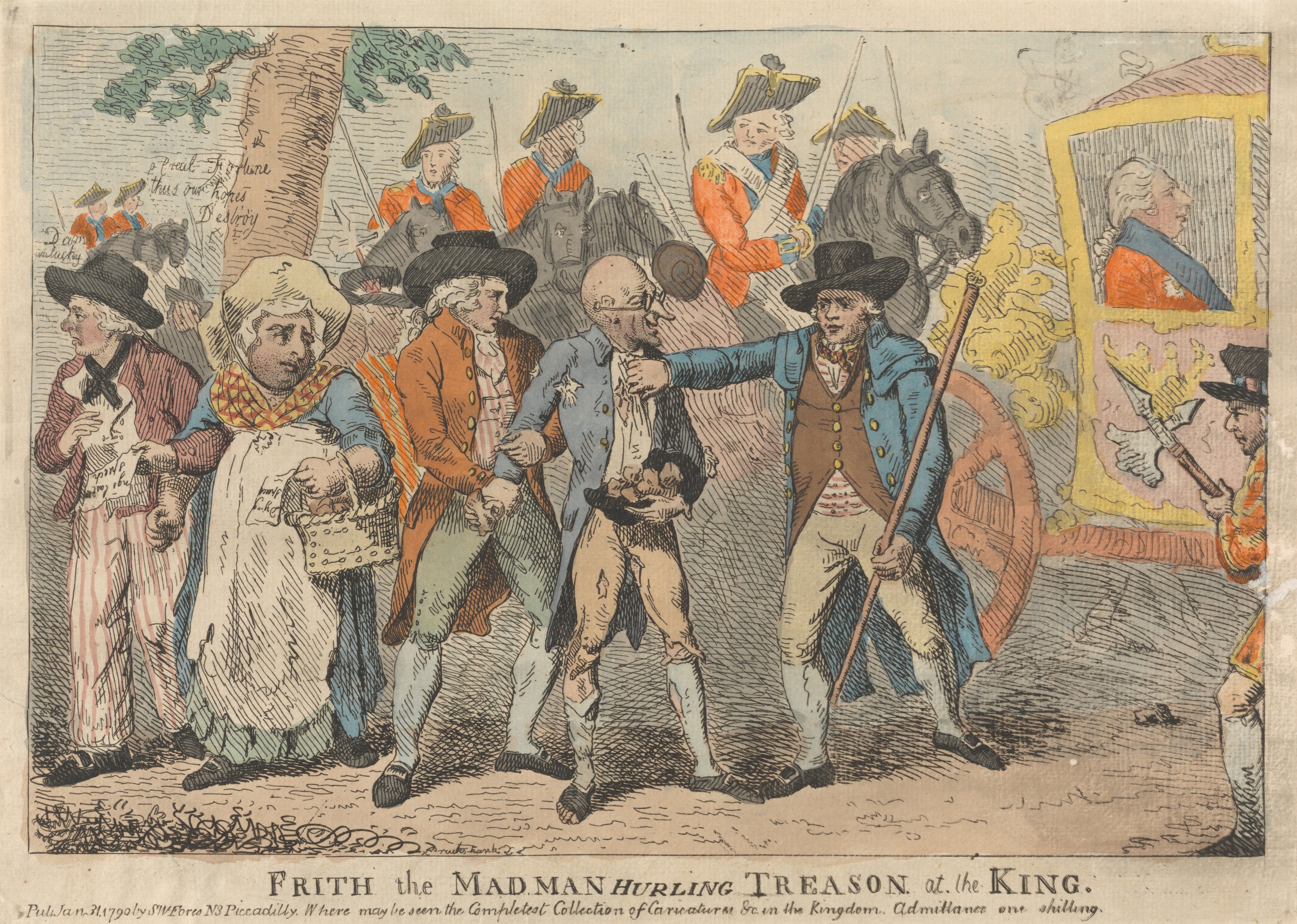
Ten days after Frith threw a stone at King George III’s gilded carriage, the caricaturist Isaac Cruikshank issued the print shown above, titled “Frith the Madman Hurling Treason at the King,” shown courtesy of the Yale Centre for British Art.

King George is at the right, riding by obliviously. A small fiddle-playing demon rides on his carriage and mounted guards follow.

In the middle of the picture, two men are seizing a third who holds a hatful of rocks. That central figure doesn’t look like Firth, however. Instead, it’s a caricature of the elderly Edmund Burke, bald, bespectacled, and ragged from being out of power. One of the men stopping him is dressed as a Bow Street Runner. The other looks like George, the Prince of Wales, as the British Museum expounds.

At the left are figures of a sailor and a woman carrying a basket, dismayed at the arrest. The woman’s five-o’clock shadow reveals her to be a lampoon of Charles James Fox, another opposition leader. The sailor looks like Fox’s ally Richard Brinsley Sheridan.

The message of this image is therefore that the opposition Whigs in Parliament metaphorically throwing rocks at the king.

Another, cruder image came from William Dent, shown here through the British Museum. It contrasted Frith “the unfortunate stone-thrower,” making “a follish throw for full pay” as an army officer, with the impeached India administrator Warren Hastings. As a “fortunate stone thrower,” Hastings is tossing diamonds as bribes “for a full P-rd-n.”

In this print Frith labeled is “Gulliver the little in Brob-dignag,” confronting the giants of the king and his bodyguards. In contrast, Hastings is “Gulliver the great in Lilliput,” lording over the grasping king and queen and Baron Thurlow, the former attorney general and lord high chancellor. George III and Thurlow were supporting Hastings in his ongoing impeachment trial.

The Member of Parliament who led the case against Hastings was Edmund Burke—the same man Cruikshank depicted as Frith in his print. Thus, artists on opposite sides of the political debate used Frith’s attack on the king’s carriage to convey contradictory messages.