J. L. BELL is a Massachusetts writer who specializes in (among other things) the start of the American Revolution in and around Boston. He is particularly interested in the experiences of children in 1765-75. He has published scholarly papers and popular articles for both children and adults. He was consultant for an episode of History Detectives, and contributed to a display at Minute Man National Historic Park.

Subscribe thru Follow.it


•••••••••••••••••


Showing posts with label Anthony Henry. Show all posts

Monday, November 25, 2024

“Admiral Renegado, came to anchor in Port Despair”

At the start of February 1770, the big news in Boston was the non-importation movement, and particularly the weekly demonstrations by schoolboys in support of it.

That is to say, every Thursday when the schools let out early, gangs of boys would converge on the shop of someone who hadn’t signed the non-importation agreement, set up a picket line, and shout insults at that shopkeeper and his or her customers. If the kids were feeling feisty, they’d throw snowballs and mud as well.

The Boston Chronicle, which opposed the movement, responded on 1 February with a fictional advertisement:
Intended speedily to be acted,
By a Company of young Tragedians,
A TRAGEDY
(Not acted here these seventy-eight years,)
called the
W I T C H E S,
With many Alterations and Improvements.
(The full item is quoted back here.)

That slammed the Whigs’ boycott, tweaked the town’s ban on theater, and poked at the sore spot of the Salem witchcraft trials all in one. It was masterful trolling before that term was invented.

Four days later, the Boston Chronicle fictionalized another common newspaper item with this start:
S H I P   N E W S.
January 25, 1770.
Last Tuesday Evening the “Well disposed” [i.e., Whiggish] fleet, under the command of ADMIRAL RENEGADO, came to anchor in Port Despair, having left their stations that morning in great confusion on the appearance of an English VICE ADMIRAL, with the British STANDARD flying at the mast head.
This was commentary on how William Molineux led a crowd to confront Lt. Gov. Thomas Hutchinson’s two importer sons at his house—an action that even Josiah Quincy, Jr., had warned could be treated as treason—and how that action had fizzled out.

Exactly one month after the second article, the Boston Massacre occurred. To defuse tensions in the streets, Hutchinson decided to have the 29th and then the 14th Regiments moved to Castle William.

As a result, in the following months there was no governmental force in the streets of Boston strong enough to deter the Whigs and their supporters. Crowds tarred and feathered Customs officer Owen Richards in May and threatened Scottish merchant Patrick McMaster with the same punishment in June.

In that atmosphere, I suspect, the printing staff of the Boston Chronicle didn’t feel safe publishing another item lampooning and lambasting the local Whigs. Somebody in that shop—or perhaps more than one somebody—composed a long article that built on three items the paper had already run:
  • Caricatures of prominent Whigs like “Tommy Trifle” and “Johnny Dupe” from October 1769’s “Outlines of the characters of…the Well-Disposed.”
  • The fake theatrical announcement.
  • The name “Admiral Renegado.”
Instead of publishing that piece in their own newspaper, however, they sent it to Anthony Henry in Halifax. Obviously, disguised gossip about Bostonians had less meaning for readers in Nova Scotia. But after he ran the piece on 8 May, it could filter back to its targets without sparking a riot. Not that any Boston printer dared to reprint it.

The October 1769 “Outlines of the characters of…the Well-Disposed” is always attributed to John Mein, publisher of the Boston Chronicle. He left a written key confirming the targets, so he was obviously involved in the production. But someone at the Boston Chronicle must have carried on in the same mode after Mein was driven away the next month. That person most likely wrote the piece published in Halifax.

TOMORROW: The most likely author.

Sunday, November 24, 2024

“Rescued from the Tyrants by the real Friends of Liberty”

Most of the “Characters in high Life, some in lowin the 8 May 1770 Nova Scotia Chronicle were derogatory.

Even when I’m not sure what this newspaper item said about someone (“Private Inspector of Glass and Shoes for a neighbouring Province, and grand Inspector of the original Curiosities in Noah’s Ark”), the tone seems negative.

But three personas stand out for being sympathetic.

I’ve mentioned two already: “Maria—…a worthy virtuous good Woman,” almost certainly points to Ruth Otis, wife of James Otis.

“John Plain Dealer, a Bookseller flying the Country,” was Boston Chronicle publisher John Mein, driven out of Boston by a gang of merchants.

And right after that entry appears:
John Dipe, persecuted by his Enemies for the glorious Liberty of the Press, rescued from the Tyrants by the real Friends of Liberty.
That was most likely Mein’s printing-house partner, John Fleeming. At the time of this publication he was still putting out the Boston Chronicle, but he had to give up in June as John Hancock took legal action to seize Mein’s goods.

These character profiles echo those John Mein had published in October 1769 as “Outlines of the characters of…the Well-Disposed.” Mein explicated those in a document filed in the papers of Customs official Joseph Harrison and now at Harvard’s Houghton Library.

In early 1774 the Public Ledger in London published dozens of essays signed “Sagittarius” sprinkled with similar gossip about the Boston Whigs. Those letters have long been credited to John Mein.

These profiles are also like the brief, catty identifications of the Boston Patriots chosen to promote the Continental Association in late 1774 published by the Massachusetts Historical Society in 1898. There’s no evidence about who wrote those, but Mein is certainly a candidate.

So my first instinct on seeing this page in the Nova Scotia Chronicle was that John Mein wrote it, too. But the timing doesn’t work.

According to John E. Alden’s article ”John Mein: Scourge of Patriots”:
Mein sailed from Boston on November 17 [1769] aboard the schooner Hope, on which he had first taken refuge. The vessel arrived at Halifax the following Friday, November 21, and was reported off Spithead about the middle of the following month.
Letters from London in January 1770 confirm that he was there. In fact, the book publisher Thomas Longman arranged for him to be confined in that city because of a debt.

The Nova Scotia Chronicle article appears to refer to Henderson Inches’s marriage to Sarah Jackson on 22 Feb 1770, as discussed yesterday. Mein couldn’t have written about that and left the article with printer Anthony Henry as he passed through Nova Scotia the previous November.

But equally, since a typical Atlantic crossing was six weeks, Mein couldn’t have received that news from Boston, incorporated it into an article in London, and sent that paper to Henry in Halifax in time to be printed in early May.

The “Characters in high Life” must have been composed in North America.

TOMORROW: A string of articles.

Thursday, November 21, 2024

“A Tragi-comic Farce, Called the present Times!”

Page 7 of the 8 May 1770 issue of Anthony Henry’s Nova Scotia Chronicle was nearly entirely taken up with what looks like an extraordinarily detailed advertisement for a play.

It began:
Just ready for the PRESS,
A Tragi-comic Farce,

Called the present Times! Some of the Characters in high Life, some in low. It is proposed to be acted by a Set of Comedians shortly expected; at a new Theatre in the enchanted Castle, at the Palace of the Sons of Liberty. Those who subscribe for Six Copies, will have the Seventh gratis; each stitched and bound, with a Variety of elegant Cuts, done by a masterly Hand! As there are already 5000 subscribed for, those who hereafter may be desirous to be out of that Number are requested to direct their Letters, (Post paid) to Don Joseph Azevedo at the Pontac Coffee House, HALIFAX, where Subscriptions are taken in.
The one mention of this newspaper item that I’ve found in books appears to treat it as authentic evidence of theater in Canada. But its real nature is revealed by the paragraphs that follow.
The Characters chiefly attempted are as follows.

William the Knave, introducing the Spinning Wheels, &c., &c. with a Bill of Taxation in his Hand (in order to support Home Manufactures) of Six Pence L[egal] M[oney] per Head on the whole P[rovince] of M[assachusetts] B[a]y; a great Procurer of Affidavits.

Thomas Trifle, Esq; Leading a drunking Man with a Glass of New-England Rum in his Hand, as a Cordial Specifick against all Disorders, lately chosen a great Officer for Indian Affairs.

Simple John, Lieut. Mandarin, demanding Audience of the Heads of the Junto, exclaiming against his Brother Commissioners of the Tribute Money to be collected—Treating the Rabble with good Chear in Hopes of reigning once more alone.
Back in October 1769 the Boston printer and bookstore owner John Mein had printed “Outlines of the characters of…the Well-Disposed” in his Boston Chronicle, lampooning leaders of the non-importation movement in highly personal terms.

That article used “William the Knave” as its label for William Molineux, an insult repeated in the 12 Feb 1770 Boston Chronicle. “Spinning Wheels” and public money “to support Home Manufactures” were allusions to Molineux’s publicly-funded scheme to employ women to make cloth in Boston. The merchant had also been busy helping to promulgate the depositions about the Boston Massacre.

The same “Outlines” article called Thomas Cushing, chairman of the merchants’ committee for non-importation and speaker of the Massachusetts House, “Tommy Trifle, Esq.”

“Simple John” must mean John Temple, the one Customs Commissioner to side with Boston’s merchants against the rest.

One of the few characters presented in a positive light was “John Plain Dealer, a Bookseller flying the Country.” A later entry mentions “Lieut. Col. Thomas Shears, his Valour is well known by his formal Attack on John Plain Dealer…”

Soon after that “Outlines” article appeared, a group of Boston merchants threatened Mein in the street. When the printer pulled out a pistol, Thomas Marshall, a tailor and militia officer not involved in the initial confrontation, swung at him with a shovel. Mein went into hiding and soon fled Boston.

“John Plain Dealer” obviously meant John Mein himself, and “Lieut. Col. Thomas Shears” meant Thomas Marshall.

This whole page in the Nova-Scotia Chronicle was a continuation of an argument that had started in Boston more than half a year before.

TOMORROW: More characters.

Wednesday, November 20, 2024

Paging Through the Nova-Scotia Chronicle

The Nova Scotia Archives has digitized several newspapers from various periods in the province’s history, with the results open for anyone to look at.

This digital archive doesn’t include the region’s first newspaper—the Halifax Gazette launched by John Bushell, fresh from Boston, on 23 Mar 1752. But the Nova Scotia Archives does own the one surviving copy of Bushell’s first issue; it acquired that precious sheet from the Massachusetts Historical Society in 2002.

The earliest newspaper available in the digital database is the Nova Scotia Chronicle and Weekly Advertiser, published by Anthony Henry in Halifax from 1769 to 1770.

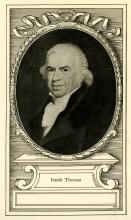
Henry had taken over the Halifax Gazette when Bushell died in 1761. But then he lost his position as the local government’s preferred printer by opposing the Stamp Act of 1765. (Isaiah Thomas, who worked for Henry after skipping out on his apprenticeship in Boston, claimed he pushed his employer into political action. Thomas also sniffed that Henry printed “in a very indifferent manner.”)

For a few years Robert Fletcher enjoyed the government’s favor for his new Nova-Scotia Gazette. Copies of that paper can be read through the University of Toronto.

Anthony Henry’s Nova-Scotia Chronicle was thus the province’s first newspaper published without being sponsored by the province itself. When he started, Henry had only eighty subscribers.

In 1770, after Fletcher returned to Britain, Henry renamed his newspaper Nova Scotia Gazette and Weekly Advertiser, regaining semi-official status by default. He even became the King’s Printer in 1788. After Henry died in 1800, another Boston-trained printer, the Loyalist John Howe, took over. A version of that paper appears today as an official organ of the provincial government: Nova Scotia’s Royal Gazette.

Like other North American newspapers, the Nova-Scotia Chronicle was a weekly. Its pages were half the size of most other papers, but a typical issue contained eight pages instead of four. Without much local news that his readers hadn’t already heard, Henry printed lots of excerpts from British newspapers, as well as articles from the other North American ports.

Folks using the digital archive to track particular citations should bear in mind that Henry dated each issue by the full week it covered: “From TUESDAY September 26, to TUESDAY October 3, 1769,” for instance. Each paper was actually printed on the last date in that range, and the database dates each paper accordingly. However, sometimes authors have cited issues by the first date.

I digitally flipped through these pages hoping to find interesting coverage of the Boston Massacre, but Henry appears to have reprinted articles from the Boston newspapers without commentary. But then I stumbled across an interesting page I’d never read anywhere before.

TOMORROW: Character studies.

Monday, June 13, 2016

Isaiah Thomas’s Travels and Togs

When Isaiah Thomas reached Halifax in early 1765, he didn’t have much. That’s what happens when you leave your apprenticeship early. Having worked for printer Zechariah Fowle for nine years, the sixteen-year-old knew he was taking a risk.

According to his grandson Benjamin Franklin Thomas, “He used to say, not without satisfaction in the contrast with his affluent condition in later life, that his linen was reduced to one check shirt, and that the only coat he had he sent to a tailor to turn, and the tailor ran away with it.”

But we know that Thomas built up his wardrobe quickly. In 1846 the Portsmouth Journal and Boston Courier reported that builders had discovered a document inside an “old building belonging to Mr. Supply Ham.” It was “a marble covered memorandum book” with the inscription “Isaiah Thomas His Book 1766,” and its text recorded the young printer’s travels and compensation:

Left Mr. Fowle the 19th of September 1765, and sat sail the next Day about 10 o’clock for Halifax, and arrived there on the 24th Day about 10 o’clock, which was just four Days from the Time I left Boston.

Went to Mr. [Anthony] Henry’s and engaged work with him for 3 Dollars per month and he to find me Boarding, Washing, &c. Work extremely scarce.

Received of Mr. Anthony Henry the following Articles, viz.
1 Pair of Broadcloth Breeches 0 15 0
Two pair of Stockings 7 0
1 pair of Shoes 8 0
Two Check Shirts 16 0
1 Pistereen 1 0
1 Bottle of [torn] 1 0
Two Dollars in Cash 10 0
To 1 yard of Black Shallon 4 0
To 1 yard of Blue Ditto 3 9
______________________
Halifax Currency 3 5 9

Work’d with Mr. Henry 5 months, 3 Weeks and 3 Days. Sailed from Halifax the 19th day of March, 1766, and arrived at Old York [Maine] the 27th (at Dark) of said Month.

Work with Mr. [Daniel] Fowle of Portsmouth [New Hampshire] 13 Days.

Friday, April 10, 1766. Came to work with Messrs. [Thomas] Furber & [Ezekiel] Russell for eight Dollars per month and my Board.

Received of Messrs. Furber & Russell 5 yards & half of Black Serge at 9 Shillings Lawful money per yard 2 9 6.
Thomas later said that friends in Boston recognized his work in Furber and Russell’s newspaper. He suggested that was the quality of his typesetting, but it may have been his woodcuts. Or Daniel Fowle may simply have written to his brother Zechariah that his wayward apprentice had reappeared, hungry for work. In any event, the Boston printer invited young Isaiah to return.

Thomas’s grandson wrote, “On his arrival at Portsmouth the people were celebrating with great enthusiasm the repeal of the Stamp Act.” But 27 March was too early for that. The young printer might have stayed in Portsmouth through that town’s celebration in May, but it’s also possible that he returned to Boston just in time for its big celebration on 19 May, and the memory got garbled.

According to Benjamin Franklin Thomas, back in his old master’s shop the teenager “gets along quietly for a few weeks. In July 1766, on the day of the funeral of Jonathan Mayhew [11 July], whom the whole town followed to his grave, he has fresh trouble, but the difficulty is compromised and he lives with him once more. He remains but a few weeks and then, with the full consent of his master, leaves his service finally.”

Isaiah Thomas’s next stop: Wilmington, North Carolina.

Sunday, June 12, 2016

The Stamp and the Printer’s Devil

I’ve been pointing out how some of Isaiah Thomas’s stories of defying the Stamp Act while working as an underaged journeyman printer in Nova Scotia don’t stand up to scrutiny. On the other hand, we know that the sixteen-year-old did sometimes express his dislike of that law in a quite visible way.

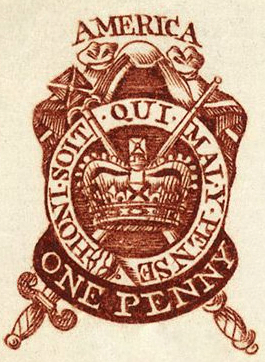
Above is an image from the American Antiquarian Society (which Thomas founded) of the 13 Feb 1766 Halifax Gazette. It clearly shows the revenue stamp, meaning Thomas couldn’t have disposed of all those stamps by that date as he later claimed. But it also shows a small woodcut that Thomas himself probably created, with a devil poking its pitchfork into the stamp.

Around the stamp are these added words:
Behold me the Scorn and contempt of AMERICA pitching down to Destruction

Devils clear the Way for B——s and STAMPS.
In addition, the Canadian printing scholar Marie Tremaine found December 1765 copies of the Halifax Gazette that had, in place of or on top of the stamp, “a skull and crossbones” in black and “a death’s head” in red.

Some printers included such images of death within every copy of their newspapers during those turbulent months, as in this example from Maryland. In contrast, by stamping his images over the printing, Thomas gave himself more flexibility. He could have the devil poke at the stamp on some copies but leave that image off others, perhaps those sent to local officials.

That brings us to an evidentiary problem. Nearly every surviving copy of the Halifax Gazette from this period is housed at either the American Antiquarian Society (built from Thomas’s own collection) or the Massachusetts Historical Society. Are those copies typical, or were those ones that young Thomas put his special decoration on, knowing he would keep them to himself or send them off to a colony where the Stamp Act was already dead? We can’t tell.

We do know that royal officials in Nova Scotia disliked the Halifax Gazette’s treatment of the Stamp Act enough to take printing jobs away from its publisher, Anthony Henry. He gave up publishing the newspaper in mid-1766. The officials then encouraged a newcomer to the province to launch the Nova-Scotia Gazette.

Meanwhile, having caused as much trouble in Nova Scotia as he dared, young Thomas had caught a ship headed south.

TOMORROW: Isaiah Thomas’s travels.

Saturday, June 11, 2016

“All the stamped paper for the Gazette was used”

Here’s another story that the respected master printer Isaiah Thomas told about his misadventures as a sixteen-year-old in Nova Scotia in 1765.

Back in Boston, the anti-Stamp Act demonstration and riot of 14 August ensured that no official was willing to distribute stamped paper. The imperial government avoided shipping any of the valuable commodity into the port. The law therefore never went into effect in Massachusetts as scheduled on 1 November. Newspapers continued to appear on ordinary paper.

In contrast, Thomas recalled, stamped paper was plentiful at Anthony Henry’s Halifax Gazette:
A short time before the exhibition of the effigy of the stampmaster, Henry had received from the stampoffice, the whole stock of paper that was sent ready stamped from England, for the use of the Gazette.
Thomas here recalled the printer receiving the stamped paper before the colony’s sole demonstration against the new law, which we know from other sources happened before the law went into effect. That’s a logical sequence, and more evidence that, as I discussed yesterday, Thomas was wrong to suggest his 5 December newspaper printed after the law had prompted the demonstration.

Back to the paper supply:
The quantity did not exceed six or eight reams; but, as only three quires were wanted weekly for the newspaper, it would have been sufficient, for the purpose intended, twelve months.
In the eighteenth century a quire was 24 pages, a ream 20 quires. So Thomas was saying that Henry had 3,000 to 3,500 sheets at hand but needed only 72 each week. At another point in his history of printing Thomas wrote, “Not more than seventy copies were issued weekly from the press.” Henry thus appeared to have about a year’s supply of paper with a stamp suitable for newspapers.

That calculation assumed each copy of the newspaper appeared on a full sheet. The earliest issues of the Halifax Gazette had been half-sheets of paper because there hadn’t been enough news, advertisements, or subscribers to justify more. But printing the newspaper on half a sheet of stamped paper would mean only half the copies would bear the necessary stamp.

Thomas wrote that the Stamp Act prompted Henry to expand the Gazette to a full sheet folded in two to make four pages—the standard size of a great North American newspaper. However, in A Bibliography of Canadian Imprints Marie Tremaine suggested that Henry was already publishing four-page issues.

In any event:
It was not many weeks after the sheriff, already mentioned [and doubted], made his exit from the printing house, when it was discovered that this paper was divested of the stamps; not one remained; they had been cut off, and destroyed. On this occasion, an article appeared in the Gazette, announcing that “all the stamped paper for the Gazette was used, and as no more could be had, it would, in future, be published without stamps.”
Such notices did appear in some other North American newspapers, but Tremaine didn’t report such a statement in any issue of the Halifax Gazette.

At another point in his history Thomas returned to the mysterious vanishing stamps, stating:
the stamps were [removed], unknown to him [Henry], by the assistance of a binder’s press and plough, cut from the paper; and, the Gazette appeared without the obnoxious stamp, and was again reduced to half a sheet.
Tremaine indeed found copies of the Halifax Gazette printed on half-sheets in mid-December 1765. Some of those copies had no stamps on them. However, at least one copy from that same period did have the stamp. Furthermore, James Melvin Lee’s History of American Journalism stated:
A copy of The Halifax Gazette for February 13, 1766, for example, has on the upper left-hand corner of the fourth page the red halfpenny stamp with the word "America" also in red above it.
That hard evidence suggests that Thomas sometimes cut the full sheets in half, and thus took the risk of issuing copies without stamps, but his story of some mysterious person slicing away all the stamps was an exaggeration. He was still printing on stamped paper months after that material had become taboo in Massachusetts.

TOMORROW: Isaiah Thomas’s own stamps.

Wednesday, June 08, 2016

The Halifax Gazette in Mourning

I was in the middle of relating the teen-aged Isaiah Thomas’s misadventures with the Stamp Act in Halifax last month when anniversaries, events, and my book publication interrupted.

So even though the sestercentennial of the Stamp Act crisis is happily behind us, I’m going to finish up those stories.

We left Isaiah Thomas at work in Anthony Henry’s shop in late 1765, printing the Halifax Gazette. Richard Bulkeley, the editor of that weekly newspaper, who was also the royal secretary of Nova Scotia, had told the young printer to stop saying the people of that province opposed the Stamp Act.

So Thomas began to run steady reports from newspapers to the south about how people in those other provinces opposed the Stamp Act. According to Marie Tremaine’s Bibliography of Canadian Imprints, “a quarter to a half of each issue consisted of reports from Boston, New York, and Philadelphia about resistance to the Stamp Act.”

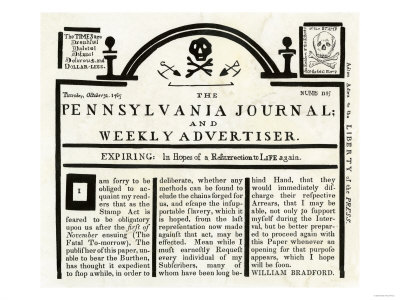
The 31 October Pennsylvania Journal was one of several North American newspapers that printed thick dark lines around all its columns when the law was taking effect, as shown above. (For more detail, see this article at the Journal of the American Revolution.) That style was usually a sign of public mourning. In 1765, it became a less than subtle way to mourn the death of liberty because of the new tax.

Thomas wanted to do the same with the Halifax Gazette, but he couldn’t do that directly without angering his newspaper’s sponsor. Instead, he wrote:
We are desired by a number of our readers to give a description of the extraordinary appearance of the Pennsylvania Journal of 30th [sic] of October last, (1765). We can in no better way comply with the request than by the exemplification we have given of that journal in this day’s Gazette.
Then he recreated the black borders. And he kept those thick black borders in every issue of the Halifax Gazette from 5 December onward.

TOMORROW: Isaiah Thomas stands up to the sheriff?

Friday, May 13, 2016

The “young Newenglander” and the Stamp Act

On 21 Nov 1765, the Halifax Gazette ran an item suggesting that the people of Nova Scotia opposed the Stamp Act, which had taken effect that month.

According to Isaiah Thomas’s History of Printing in America (1810):
This paragraph gave great offence to the officers of government, who called [printer Anthony] Henry to account for publishing what they termed sedition. Henry had not so much as seen the Gazette in which the offensive article had appeared; consequently he pleaded ignorance, and in answer to their interrogation informed them that the paper was, in his absence, conducted by his journeyman. He was reprimanded and admonished that he would be deprived of the work of government, should he in future suffer anything of the kind to appear in the Gazette.
Most of Henry’s business consisted of jobs for the provincial government, so losing that contract was a serious threat. But he didn’t bring his journeyman under control.
It was not long before Henry was again sent for on account of another offence of a similar nature; however he escaped the consequences he might have apprehended, by assuring the officers of government that he had been confined by sickness; and he apologized in a satisfactory manner for the appearance of the obnoxious publication. But his journeyman was summoned to appear before the Secretary of the Province; to whose office he accordingly went.
Now here we run into a problem knowing exactly what happened because the only account comes from Isaiah Thomas’s book, and the young journeyman causing trouble was Isaiah Thomas himself. Writing in Worcester more than forty years later, with those Halifax men distant and dead, he could tilt the story as he remembered it or wanted it remembered without fear of contradiction.

In this case, Thomas left out a pertinent fact about the royal secretary of Nova Scotia, Richard Bulkeley. That army veteran was also the major backer of the Halifax Gazette and for many years had overseen its news coverage. Bulkeley didn’t print the paper, but he had a legitimate interest in what appeared in it. (If a government official overseeing a newspaper seems like a conflict of interest, it was, but that was how most of Boston’s newspapers got launched in the early 1700s, too.)

Thus, when Bulkeley summoned Thomas to his office, he was both a government official and the young printer’s boss. But in his history of printing Thomas chose to present himself as up against royal authority alone:
Thomas was probably not known to Mr. Secretary, who sternly demanded of him what he wanted.

A.—Nothing, sir.

Q.—Why came you here?

A.—Because I was sent for.

Q.—What is your name?

A.—Isaiah Thomas.

Q.—Are you the young Newenglander who prints for Henry?

A.—Yes, sir.

Q.—How dare you publish in the Gazette that the people in Nova Scotia are displeased with the Stamp Act?

A.—I thought it was true.

Sec.—You have no right to think so. If you publish anything more of such stuff you will be punished. You may go, but remember you are not in New England.

A.—I will, sir.
Thomas still opposed to the Stamp Act. He just had to find other ways of expressing that opposition.

COMING UP: The death of liberty in America.

Thursday, May 12, 2016

Isaiah Thomas’s Second Job

In mid-1765 Isaiah Thomas was sixteen years old and apprenticed to the Boston printer Zechariah Fowle. But he was nowhere near Boston. Having worked for Fowle since he was seven, the teenager had gotten fed up and run away.

In Thomas’s own words later, “he went to Novascotia, with a view to go from thence to England, in order to acquire a more perfect knowledge of his business.” Benjamin Franklin had blazed that trail.

In Halifax, Thomas found work with “a Dutchman, whose name was Henry.” This was Anthony Henry, who was actually born in France of German parents. Henry had come to America as a fifer in the British army and settled in Halifax in 1760, taking over the colony’s main print shop the next year.

According to Thomas:

He was a good natured, pleasant man, who in common concerns did not want for ingenuity and capacity; but he might, with propriety, be called a very unskilful printer. To his want of knowledge or abilities in his profession, he added indolence…
Thomas clearly had no more respect for his new boss than for his previous one. He also deemed Henry’s shop antiquated and poorly equipped. But working there gave the teenager a taste of autonomy—Henry appears to have given him free run in printing the weekly Halifax Gazette.

On 1 November, the Stamp Act went into effect in all of Britain’s North American colonies. According to A Bibliography of Canadian Imprints by Marie Tremaine, the issue of the Halifax Gazette published on that date appeared on stamped paper. Its printer’s notice stated, “Advertisements are taken in and inserted as Cheap as the Stamp Act will allow.”

Later that month Thomas was a little more forthright about his opposition to the new law as he reported, “the People of this Province are disgusted with the Stamp Act.”

TOMORROW: And that was enough to get him and his boss in trouble.