J. L. BELL is a Massachusetts writer who specializes in (among other things) the start of the American Revolution in and around Boston. He is particularly interested in the experiences of children in 1765-75. He has published scholarly papers and popular articles for both children and adults. He was consultant for an episode of History Detectives, and contributed to a display at Minute Man National Historic Park.

Subscribe thru Follow.it


•••••••••••••••••


Showing posts with label book reviews. Show all posts

Wednesday, July 22, 2026

The Graphic Side of The British Are Coming
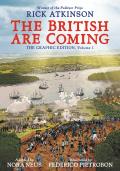
Speaking of comics, this Sestercentennial summer has also brought us The British Are Coming: The Graphic Edition, Volume 1, adapted from the first half of the first volume of Rick Atkinson’s ongoing history of the Revolutionary War.

The comic is credited to Atkinson, Nora Neus as adapter, and Federico Pietrobon as artist. This Altoona Mirror article on the project in progress and this WGBH interview with Atkinson on publication show how he approved work as it came along.

Yet it’s clear that Neus, a journalist and oral historian, made the creative choices in adapting hundreds of pages of dense, fact-filled narration into comics form for Pietrobon to illustrate.

As a CNN producer, Neus picked up the video dispatches of young Muhammad Najem from the midst of the Syrian Civil War and later worked with him to script the graphic memoir Muhammad Najem, War Reporter. She also scripted Renegade Girls, historical graphic fiction, for the same artist, Julie Robine.

The strategy Neus followed for this book, no doubt with Atkinson’s and Ten Speed Press’s approval, was to minimize the words. There are short captions to set the scenes and occasional labels to identify some individuals. All the speech balloons appear to be quotations from actual participants in the events. There are also sound effects, particularly the “BANG” of muskets. But there are an uncommonly large number of panels with no words at all.

The result doesn’t work. Almost all those quotations come perforce from written sources created after the fact, so they don’t read like speech in the moment. The speakers are rarely identified, though I’m sure the sources could all be searched out in the prose edition. The captions don’t provide enough background to understand most events, though military strategy gets a little more analysis than political developments.

In addition, because the siege of Boston was largely static from July 1775 to March 1776, with not much changing despite all the activity, the book devotes proportionally more pages to smaller campaigns: Gen. Richard Montgomery and Col. Benedict Arnold’s thrusts in Canada, Gov. Dunmore’s struggle in Virginia, and the Royal Navy attack on Falmouth.

The spare verbiage puts more burden on the art to convey the history to readers. Occasional infographics, including maps, take advantage of the visual format to impart useful information. But most of the art consists of straightforward, rather slow-paced depictions of events. And those depictions aren’t visually accurate. Pietrobon, working in Italy, didn’t get the guidance, visual references, and time that task would need.

One of my litmus tests of the right look for the late-1700s British Empire is whether a comic shows men with beards, mustaches, and sideburns, which that society shunned. In this book we see men with facial hair on just about every other page spread. Other tests: Does the art render the British flag of the 1770s correctly? No. Does it depict newspapers and shop signs in eighteenth-century style? No. Do all the women have their hair up? Not on page 208.

Except for George Washington, few individuals are recognizable, even when we know what they looked like from good portraits. Likewise, known settings such as King Street in Boston and the Lexington common appear strange. Other places, like Washington’s Cambridge headquarters and Yale College, are all too recognizable because Pietrobon relied on photographs of their present forms.

To assess panel breakdowns, I looked at an episode I’ve studied to death, the Battle of Lexington and Concord (shown on pages 21–49). This rendering starts by showing Lord Dartmouth’s strong suggestion to arrest Patriot leaders and Gen. Thomas Gage’s order to destroy armaments; we see those men’s own words, but the book doesn’t note or explain the difference for readers.

The commander of the British expedition reads his orders before leaving Boston, not after. Paul Revere and William Dawes are shown spotting the redcoats on the march in Cambridge and then setting out west together, not dispatched separately by Dr. Joseph Warren. Then comes the lantern signal from Old North Church, which is placed out in an open field, not on a hill in a dense neighborhood. We never see anyone receiving that signal (and in fact it didn’t matter to how events turned out).

The few seconds of confrontation in Lexington fill seven pages—perhaps proportionate to the importance of that event, but also an indication of how strung out the action is.

At Concord, the British enter in ranks over a hillside rather than along the road. The coloring on page 38 inexplicably changes from day to twilight. The terse description the troops’ search suggests they found nothing in town and all proceeded west. The fight at the North Bridge is portrayed as “a motley crew of farmers and part-time militiamen” stopping the British from crossing. In fact, four companies of regulars had already passed that point without opposition, and most of the British soldiers were still searching the center of town. Only three companies of redcoats were at the bridge, so the provincials were the larger force trying to take control of that chokepoint.

Much of that history is counterintuitive, calling out for explanation. But by choosing to use only historic quotations and minimizing the word count, the creators of this graphic recounting hobbled their ability to explain.

In its verbal approach and pacing, The British Are Coming: The Graphic Edition, Volume 1 might have worked as a visual teaser or accompaniment for Atkinson’s full prose volume—a way to give readers images of its complete, detailed, and explicated narration of events. But the many inaccuracies in the art undercut that value.

Steve Donoghue assessed the volume at Open Letters Review as a reader of history and comics rather than a historian plowing the same field. He came away disappointed as well.

Monday, June 08, 2026

“Washington and slavery have always been particularly instructive”

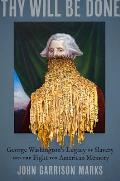
At Commonplace, Karin Wulf of the John Carter Brown Library interviewed John Garrison Marks about his new book, Thy Will Be Done: George Washington’s Legacy of Slavery and the Fight for American Memory.

Wulf started with an introduction reiterating that talking about the Washingtons’ slaveholding is far from new in American culture:
As anyone reading this will likely know, and as John Marks notes below, a remarkable volume of important research detailing George Washington’s (and Martha Dandridge Custis Washington’s, and their family’s) investment in slavery has been published over the last two decades. In conjunction with critical work on other “founders,” namely Thomas Jefferson, this work has helped usher in a shift in public perspective that has been greeted with angst by those who either didn’t know or don’t want to know about the foundational role of slavery at the founding, but also by relief among the many who did and do.

This book is different. It takes up the question of how this very specific issue about the first president—his role as an enslaver—was debated over centuries. In other words, this was not a phenomenon that leapt upon a settled historical narrative unbidden from the culture wars or the specific spate of racial violence that called forth the Black Lives Matter movement. For me, there was another dimension.

As soon as I heard about John’s project some time ago, I was intrigued in part because at one point I checked out a number of copies of Washington’s will printed in the 19th and 20th centuries. Why, I wondered, were so many people keen to have to hand a copy of what Washington willed? In part it has to do with the vexed issue of manumission. John shows, in this book that helps us to see historical memory in motion, Washington and slavery have always been particularly instructive.
In the interview, Marks noted three ways Americans have discussed George Washington’s connection to slavery. Some complain about exploitation and hypocrisy, some insist on reverence for the other things he did, and some argue we should focus on how he moved away from slavery over his lifetime. “What was really fascinating in researching the book was how early and consistently all three of these perspectives appeared in the record,” Marks added, finding examples of each approach in the period of his death.

Wednesday, May 06, 2026

This Year’s Pulitzer Winners on the Founding Era

This week Columbia University announced the Pulitzer Prizes for 2026. In journalism, the big trend was big exposés of big abuses by the current administration in Washington.

The awards for books reflected this Sestercentennial year more mildly, though of course that anniversary has meant authors and publishers produced more books about the Founding era. Here are two winners.

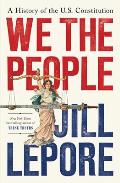
In History, the prize went to We the People: A History of the U.S. Constitution, by Jill Lepore. The judges called it “A lively and engaging narrative that investigates why the Constitution is so difficult to amend, including a review of noteworthy failed amendments proposed by marginalized groups.”

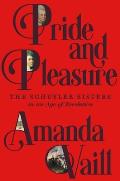
In Biography, the winner was Pride and Pleasure: The Schuyler Sisters in an Age of Revolution, by Amanda Vaill.

This was described as: “A lively and detailed biography of two daughters of wealthy and influential Dutch landowners who colored our nation’s history, using present tense to tell their story and past tense to chronicle the dramatic sweep of the American Revolution.”

Friday, February 20, 2026

The J.A.R.’s Books of the Year

The Journal of the American Revolution has announced its 2025 Book of the Year Award.

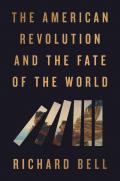
The winner is The American Revolution and the Fate of the World by Richard Bell (no relation, for the record).

The citation says:
The American Revolution undoubtedly changed world history. Many nations seeking their own independence tried to emulate the ideals of the Declaration of Independence, a document whose words still influence national and world events. What many people do not realize was that, at the time, the Revolution directly affected places all over the world. It was truly a global happening, reaching not only Europe, but also Latin America, India, China, and even Australia.
This is a book of synthesis, bringing together recent scholarship by many people to provide a global look at.

One of the runners-up took the opposite approach, looking at one community within one Massachusetts port: Enemies to Their Country: The Marblehead Addressers and Consensus in the American Revolution by Nicholas W. Gentile.
Gentile demonstrates how, even before a single shot was fired, the Revolution lived in the minds of this town’s residents as they harshly reacted to thirty-three signers of a letter of support to the departing governor Thomas Hutchinson. What follows is an interesting look at dynamics in this town—heavily influenced by Puritan theology—and the ways in which residents exerted social pressure to essentially coerce the signers back to the Patriot cause, placing ultimate importance on maintaining unity. Signers (“Addressers,” as they were called) ended up recanting through written and published statements, showcasing the growing importance of print culture during this period and the role that it played in creating a uniform identity going into the conflict. Gentile traces the fate of each of the thirty-three as they recanted and either rejoined the Patriot cause or, in the case of several, led lives in exile.
The other runner-up, The Course of Human Events by Steven Sarson, is a study of the intellectual roots and immediate impetuses behind the Declararion of Independence.

Saturday, January 17, 2026

“To incense the Soldiery against the People of the Massachusetts Bay”?

Yesterday I quoted from a pamphlet titled A Letter from a Veteran, to the Officers of the Army Encamped at Boston, which appeared in the fall of 1774.

Readers of the time recognized that its author was encouraging those officers to carry out stern measures against the Patriot resistance—but to be polite about it.

An essay in the 17 November New-York Journal called the publication “infamous” and said:
the Writer makes use of every Argument in his Power, to incense the Soldiery against the People of the Massachusetts Bay; and to stimulate them to shed the Blood of their Fellow Subjects, in America: without the least Reluctance, or Remorse.
However, because A Letter from a Veteran was obviously written by an educated, erudite person, and because its argument was founded on British Whig principles, other colonial politicians didn’t feel they could just dismiss it as war-mongering propaganda.

In The Other Side of the Question; or, A Defence of the Liberties of North-America, Philip Livingston (shown here) anonymously wrote:
Not long since I saw a Letter from a Veteran, to the Officers of the Army at Boston: I pray the author to receive my thanks, for the great pleasure enjoyed in the reading of it. I think I could easily perceive in it, the traces of that manly, generous, brave, and free disposition; which mark the character of the Soldier and the Gentleman.
If, to his share some little errors fall,
View his kind heart, and you forgive them all.
Livingston then proceeded to say the Veteran’s pamphlet was so much better than his main target, the Rev. Dr. Thomas Bradbury Chandler’s A Friendly Address to All Reasonable Americans on Our Political Confusions, that “comparisons are odious.” 

John Adams also felt a need to reply to A Letter from a Veteran. He did so in his first, third, and fifth “Novanglus” letters, in the midst of his lengthier responses to “Massachusettensis.”

Adams praised the “Veteran” for “his honesty,” “his taste, and manly spirit.” He called the anonymous author “honest amiable” and “frank.” Of course, Adams thought that author was all wrong in his conclusions: the principles they agreed on should apply fully to the American colonies and offered a solid basis for resistance.

In Political Ideas of the American Revolution (1922), Randolph Greenfield Adams said A Letter from a Veteran “has a good deal more merit than Adams allowed.” Most recently, Mark Somos in American States of Nature (2019) said the writer offered “a trenchant criticism of political theory, and of the American revolutionaries’ application of it to real life.”

TOMORROW: So where did this pamphlet come from?

Wednesday, December 31, 2025

Five Revolutionary Authors Recommending Five Revolutionary Books

Shepherd is a website founded by Ben Fox to provide a forum for book recommendations, like “little notes from the [indie bookstore] staff about which books are their favorites and why.”

The site offers authors the chance to highlight five books of a particular sort (with some exposure for their own work, of course).

Here are some offerings about America’s Revolutionary era.

Prof. Joel Richard Paul, author of Unlikely Allies: How a Merchant, a Playwright, and a Spy Saved the American Revolution and Without Precedent: Chief Justice Marshall and His Times, on “The best books on the American Revolution.” Mainly solid overviews.

Ray Raphael, author of Founding Myths, Constitutional Myths, A People’s History of the American Revolution, and The Spirit of ’74, among other books, on “The best books to expand and deepen your view of the American Revolution.” Getting beyond the standard stories.

Tom Shachtman, author of The Founding Fortunes: How the Wealthy Paid for and Profited from America’s Revolution, on “The best books on lesser-known figures in the American Revolution and early years.” Following the money.

Prof. James R. Fichter, author of Tea: Consumption, Politics, and Revolution, 1773–1776, on “The best books that made me think twice about the American Revolution.” Novel perspectives.

Prof. Richard Bell, author of the new The American Revolution and the Fate of the World, on “The best books on the American Revolution as a World War.” Broader views in space and time.

The Fort Plain Museum bookstore has a Revolutionary War section ranging well beyond its own region in central New York, with generous terms on shipping and the proceeds going to support a historic site.

Monday, December 22, 2025

New Foreword for Stark’s Loyalists of Massachusetts

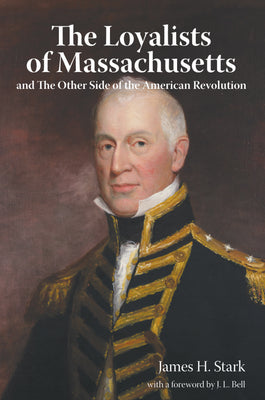
American Ancestors has just reissued James Henry Stark’s The Loyalists of Masssachusetts with a new foreword by me.

I came across a copy of Stark’s Loyalists of Massachusetts in my local library when I was early in my research on eighteenth-century Boston. I was struck by its combination of detailed research on exiled families and apparently still-hot resentment at how the whole Revolution thing turned out.

One notorious detail of this book is an illustration of Paul Revere on horseback—complete with fringed buckskin coat, beard, and vicious snarl.

In researching the publication of The Loyalists of Massachusetts for this foreword, I realized that Stark didn’t commission that and the other full-page illustrations. He reused them from an earlier history of the Revolution. He did, however, change the captions to make their message more pointed.

Stark published through his own printing company, which he had cofounded with a former “spirit photographer.” That gave him the freedom to devote hundreds of pages to “The Other Side of the American Revolution,” as his subtitle said.

I also looked into the reception of the book in 1910. Some reviewers thought Stark, a childhood immigrant from Britain, was too harsh on the Patriots. The press magnified that controversy. The argument became a front-page story in newspapers well outside New England as editors enjoyed the spectacle of elite Bostonians arguing over their ancestors’ actions.

Another of Stark’s interests was yachting. In fact, he was on a cruise when the controversy over his book broke out. I think he’d be pleased that the cover of this new edition shows Sir Isaac Coffin, alumnus of Boston’s South Latin School and admiral in the Royal Navy.

Wednesday, October 29, 2025

“Fully compensate for all the Insults and Indignities”?

Enemies to Their Country: The Marblehead Addressers and Consensus in the American Revolution is Nicholas W. Gentile’s first book, just published by the University of Massachusetts Press.

Timothy Symington’s review for the Journal of the American Revolution says:
Marblehead was an important fishing community, with an aristocracy created by the cod fishing industry. . . . the town’s harmony was threatened by the signatures of thirty-three residents to a letter published in the Essex Gazette in May 1774. The letter was a “send-off” to departing governor Thomas Hutchinson. . . . The thirty-three residents who added their names to the letter were hoping that Hutchinson would return to London and try to use his influence to calm the situation.

The letter thanked Hutchinson for his involvement on behalf of the fishing industry, and then ended on a conciliatory note: “‘We heartily wish you, Sir, a safe and prosperous Passage to Great-Britain, and when you arrive there may you find such a Reception, as shall fully compensate for all the Insults and Indignities which have been offered you.’”

The idea of apologizing to a man like Hutchinson was anathema to many who subscribed to the Patriot cause (which, at this point, meant a return to no taxation and stopping the abridgement of British liberties). Most of the Marblehead residents considered themselves Whigs and were incensed at the letter. Gentile describes the importance of everyone in the community at that time in history being on the same page. Giving up one’s individual needs for the common good helped to create social harmony. . . .

Most Addressers ended up offering recantations, and some then took active roles in fighting on the Patriot side after war broke out. Some Addressers were truly contrite and regretted signing the letter, claiming that they did not truly understand Hutchinson’s character. Other Addressers took a longer time to recant, which some did more than once since their first attempts were not accepted by the community. All Addressers did recant at some point, but some of them could not reconcile their politics for the good of the community.
The Marblehead Addresser I’ve written about most was John Pedrick, who after another century was turned into a Patriot hero through the stories of his daughter and granddaughter.

Gentile will speak about his book at the Marblehead Museum on Thursday, 6 November, at 7 P.M. For tickets to attend that event in person, go to this page. To watch online, go here. Tickets are $15, or $10 for museum members.

Saturday, July 19, 2025

Nominees for the 2025 George Washington Book Prize

The finalists for the 2025 George Washington Book Prize, all history titles published last year, have been announced.

In alphabetical order of the author’s surname, they are:
  • Jane E. Calvert, Penman of the Founding: A Biography of John Dickinson (Oxford University Press)
  • Francis D. Cogliano, A Revolutionary Friendship: Washington, Jefferson, and the American Republic (Harvard University Press)
  • Michael D. Hattem, The Memory of ’76: The Revolution in American History (Yale University Press)
  • Tyson Reeder, Serpent in Eden: Foreign Meddling and Partisan Politics in James Madison’s America (Oxford University Press)
  • Cara Rogers Stevens, Thomas Jefferson and the Fight against Slavery (University Press of Kansas)
The sponsors of this prize are Mount Vernon, the Gilder Lehrman Institute of American History, and Washington College. Mount Vernon will host an event featuring all the authors on 12 August, and the winner will be announced at a gala dinner in New York on 8 October.

Wednesday, April 16, 2025

Counterfactual 1: If Revere Had Never Reached Lexington

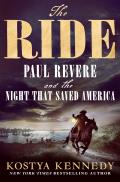
For the Journal of the American Revolution, Jim Piecuch just reviewed The Ride: Paul Revere and the Night that Saved America by Kostya Kennedy.

Piecuch writes:
Kennedy begins his book by posing an intriguing question: What might have happened if Massachusetts militia had not been present at either Lexington or Concord when British troops arrived on April 19? He speculates that John Hancock and Samuel Adams could have been captured or killed, that the munitions at Concord could have been seized, and that such events might have put the American Revolution on a completely different, perhaps even unsuccessful, course.

In Kennedy’s view, the question that gives rise to this hypothetical scenario can also be stated as: What might have happened had Paul Revere not made his ride to warn the inhabitants of towns outside Boston that British regulars were coming? While it is impossible to answer such a question, Kennedy uses it to underscore the importance of Revere’s ride, declaring that “Perhaps no night was more critical to [America’s] fate” (page 4).
I’ve been cogitating along similar lines but not coming to the same firm conclusions.

Let’s start with the question of what would have happened if Paul Revere had been satisfied with arranging for the signals from the North Church steeple to his colleagues in Charlestown. The rider they sent west toward Lexington never made it, probably stopped by a British mounted patrol. We don’t even know who that man was. But let’s imagine Revere went to bed thinking he’d sent the warning as Dr. Joseph Warren had asked.

Or we can imagine Revere heading out of Boston as he did but being stopped by the H.M.S. Somerset, or by that same mounted patrol in west Charlestown. If Revere had never made it past Medford, how would that have affected events the following day?

In that case, Dr. Warren’s warning would have reached Lexington about half an hour later than it did, as soon as William Dawes arrived in town. Since it took hours for Adams and others to persuade Hancock to leave Lexington, and since the regulars didn’t arrive until hours after that, those thirty minutes probably wouldn’t have made a big difference.

TOMORROW: But what if neither Revere nor Dawes had reached Lexington? 

Friday, March 21, 2025

New Book on Revere’s Ride Arriving

For the Sestercentennial, Macmillan is publishing The Ride: Paul Revere and the Night That Saved America, by Kostya Kennedy.

The publisher’s description says:
In The Ride, Kostya Kennedy presents a dramatic new narrative of the events of April 18 and 19, 1775, informed by fresh primary and secondary source research into archives, family letters and diaries, contemporary accounts, and more. Kennedy reveals Revere’s ride to be more complex than it is usually portrayed—a loosely coordinated series of rides by numerous men, near-disaster, capture by British forces, and finally success. While Revere was central to the ride and its plotting, Kennedy reveals the other men (and, perhaps, a woman with information about the movement of British forces) who helped to set in motion the events that would lead to America’s independence.
Kennedy’s background is in sports writing, with books on Jackie Robinson, Joe DiMaggio, and Pete Rose.

Looking at how the industry advance notices of the book, I don’t see anything new mentioned. What those reviewers tout as news—that Revere made many rides besides the famous one, that there were many riders on that date besides Revere, and that Margaret Gage may have leaked news of the British march—were all in David Hackett Fischer’s book Paul Revere’s Ride, published in 1994. But the reviews praise Kennedy’s fast-paced and witty writing style.

Kennedy is doing a book tour in New England in the coming fortnight.

Monday, 24 March, 6 P.M.
Harvard Coop
Cambridge

Tuesday, 25 March, 7 P.M.
Papercuts Bookshop
Jamaica Plain
Reserve space here

Thursday, 27 March, 7 P.M.
RJ Julia
Madison, Connecticut
Reserve space here

Monday, 7 April, 6 P.M.
Griswold Memorial Library
Colrain

Thursday, January 16, 2025

Amar’s Constitutional Conversation Continues in Concord, 16 Jan.

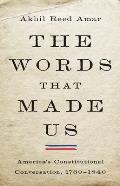
On Thursday, 16 January, the Concord Museum will host Akhil Reed Amar, Sterling Professor of Law and Political Science at Yale University, speaking on the U.S. Constitution.

Amar’s books include The Bill of Rights (1998), America’s Constitution (2005), America’s Unwritten Constitution (2012), and The Words That Made Us: America’s Constitutional Conversation, 1760–1840 (2021).

The event description says:
Uniting history and law through the biggest constitutional questions early Americans confronted, Professor Amar discusses the formative decades of the Constitution after its ratification and its resonance today. As Professor Amar notes, our national “constitutional conversation continues” to this day “in courtrooms, classrooms, newsrooms, family rooms and everywhere in between.”
A couple of years ago, however, Gregory Ablavsky wrote in the Michigan Law Review that Amar’s description of that “constitutional conversation” is too limited:
He focuses much of the book around the idea of a “constitutional conversation,” a cacophonous and capacious dialogue that encompassed many Anglo-Americans. Unfortunately, his account of that conversation quickly collapses to the views of a handful of too-familiar figures—a cramped vision that reads backward our own sometimes narrow constitutional conversation privileging a clubby legal elite oriented around the Supreme Court. Democracy, “America,” and “the people” all feature prominently here, but only as abstractions that get seen but not heard. This is a notably undemocratic history of democracy.

For over a generation, historians have offered a different version of the constitutional conversation—one that is fuller and more inclusive, highlighting the many ways that the actual people accessed and shaped constitutional law. . . . The point of this approach is not more inclusiveness to serve current sensibilities; it is that a diverse range of actors and arguments mattered. They shaped law. Often, the “Big Six [Founders]” were reacting more than acting. . . .

None of this is to fault Amar for not writing a different book. It is to fault him for failing to write the book that he claims he did write, about the early republic’s constitutional conversation. Without much evidence, he announces his conclusory, if regretful, finding that the views of those outside the room didn’t matter, thereby echoing past generations who labored so hard to ignore these voices. . . .

Why not instead have a constitutional history that reflects the pluralism that Amar acknowledges? People with “myriad ethnic backgrounds” and “ideologies” were already present at the beginning, sharing a continent and a nation. They might not all have been at the Constitutional Convention or in [George] Washington’s cabinet, but as Amar argues, “America” was: the document’s drafters were keenly aware of the complex nation that they sought to govern.
That offers plenty to think about.

This event starts at 7:00 P.M. Tickets for seats at the Concord Museum are free for members, $10 for the public. People can also register to watch online for free.

Friday, December 06, 2024

Donis Review of Parkinson’s Heart of American Darkness

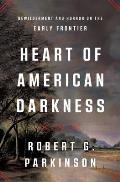
H-Early America just ran Jay Donis’s review of Robert G. Parkinson’s new book, Heart of American Darkness: Bewilderment and Horror on the Early Frontier.

Donis writes:
the Yellow Creek Massacre of April 30, 1774, and Logan’s Lament, once saturated the minds of the American public and “had become fixtures in early American culture” (p. 328). Millions of copies of educational books, such as Caleb Bingham’s American Preceptor (1811) and William McGuffey’s Eclectic Readers (1836/37) revealed the story to new generations of Americans well into the twentieth century. And yet, a search for “Yellow Creek” and “Logan’s Lament” in the flagship journals of early American history reveals few results, with the exception of a Robert Parkinson article in a 2006 issue of the William and Mary Quarterly.[1]

In short, Parkinson’s latest book restores the spotlight to an incident that once played a pivotal role in shaping how many Americans understood the nation’s history. How Parkinson restores this event, through the inclusion of Native actors and Native voices, is important as well. Based around the incident at Yellow Creek, the book examines the historical links and paths of the Cresap and Shickellamy families from the 1730s to the early twentieth century, focusing primarily on the mid to late eighteenth century. . . .

During the massacre, a party of white men murdered several members of Shickellamy’s family and other Natives, leading Soyechtowa, one of Shickellamy’s sons, to craft the speech that became known as Logan’s Lament. Part 3 examines the changing depictions of Michael Cresap and Logan’s Lament in national memory from the Revolutionary War through the twentieth century.

Although it may seem odd for a book to focus on the Cresap family, a family not present at the Yellow Creek Massacre, Parkinson explains why this choice is necessary. Most early Americans, including Soyechtowa, mistakenly believed that Michael Cresap orchestrated the murder of Native Americans at Yellow Creek. To be sure, Cresap did not like Native peoples and he threatened to kill, if not actually killed, Natives in April 1774 on the Ohio River, but he was miles away from Yellow Creek on the fateful day of the massacre. As a result of this confusion, the Cresap and Shickellamy families became linked in the minds of many Americans for generations. Parkinson masterfully untangles this link throughout the book.
A significant portion of the review concerns how to define and understand “settler colonialism.” That’s a relatively recent historiographical term, coined by Patrick Wolfe in the 1990s. I remember being puzzled by how authors seemed to expect readers to be familiar with the phrase when I’d never seen it before, so I was reassured to find it postdated my college years.

While we can productively discuss the nuances, at a basic level the value of distinguishing “settler colonialism” is easy to understand. The concept addresses an issue I’d puzzled over back in high school: a “colonial subject” in the context of the American struggle for independence is quite different from a “colonial subject” in the context of the Indian struggle for independence.

Monday, October 07, 2024

Smith on Abigail Adams on C-SPAN

“I wish I could write to you, much oftener than I do,” John Adams assured his wife Abigail on this date in 1774. “I wish I could write to you, a Dozen Letters every day.”

Abigail’s last letter to John included news of Braintree stepping up its militia practice, a rumor about “a conspiracy of the Negroes,” and criticism of slavery as “a most iniquitious Scheme.”

In her next, she advised:
The People in the Co[untr]y begin to be very anxious for the congress to rise. They have no Idea of the Weighty Buisness you have to transact, and their Blood boils with indignation at the Hostile prepairations they are constant Witnesses of.
This period seems to have been when Abigail Adams started growing into John’s closest political advisor. Telling him about events in Massachusetts while he was away on government business emboldened her to include her own observations, and then opinions.

Because Abigail and John Adams were separated at many crucial periods, and they and their descendants carefully preserved their letters, we can see that relationship evolve. It’s likely that some other politicians’ wives were giving them advice, too. But with Abigail, we know she was.

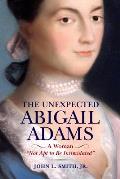
C-SPAN has just posted the recording of a talk by John L. Smith, Jr., author of The Unexpected Abigail Adams, a biography published earlier this year.

Smith spoke this past June at the Fort Plain Museum’s American Revolutionary War 250 Conference. The museum also sells Smith’s book at a discount.

Friday, September 20, 2024

Barbara Oberg and the Infrastructure of Early American Scholarship

Barbara Oberg, historian of early America, passed away this month. Though Oberg had the rank of professor in the Princeton History Department, she was known for a career of less visible work that benefited historical scholarship.

Primarily, Oberg was the lead editor of the Benjamin Franklin Papers and then the Thomas Jefferson Papers. Between the two series, she oversaw the publication of more than twenty volumes. In doing so, she both helped generations of scholars and readers access that correspondence and trained other documentary editors.

Dr. Oberg also edited collections of scholarly essays: Women in the American Revolution: Gender, Politics, and the Domestic World, Federalists Reconsidered, and Benjamin Franklin, Jonathan Edwards, and the Representation of American Culture.

Oberg was also known within the profession for serving the non-university organizations that support scholars, research, and publication. The Omohundro Institute for Early American History and Culture just eulogized her this way:
Barbara was also an insightful and incisive leader. Keenly aware of the importance of institutions for scholarship, she was devoted to the organizations that support early American history, including the OI. From 2010 to 2023, she served on the OI’s Executive Board, presiding as Chair from 2014 onward. Her steady counsel, exceptional generosity, and subtle wit helped us flourish even as we navigated shifts in leadership and sponsorship and moved into our new home. We are profoundly grateful to her for her help.

The OI is not the only organization to have benefitted from Barbara’s keen intellect and energetic engagement. She helped steer the American Philosophical Society, the Colonial Williamsburg Foundation, the Society for Historians of the Early American Republic, and the Society of Documentary Editors.

Indeed, at “A Life in Letters: A Celebration of Dr. Barbara Oberg”—a 2023 symposium jointly organized by the OI and the American Philosophical Society—historians, editors, and cultural leaders gathered in Philadelphia to discuss the ongoing importance of Barbara’s work. At “Barbara Fest,” as we called it, speakers and audience members alike testified to her profound impact on the organizations they cared most about.
The sessions of that symposium can be viewed here on YouTube. Historians of early America discuss Franklin, Jefferson, women, the field of documentary editing, and what Barbara Oberg brought to each of those areas.

Monday, July 22, 2024

“Over-emphasized the early conflict in the northern colonies”?

Last month Gene Procknow reviewed Alan Pell Crawford’s This Fierce People: The Untold Story of America’s Revolutionary War in the South, just published.

Procknow reports that Crawford
asserts that Revolutionary War historians have over-emphasized the early conflict in the northern colonies, leaving the impression that the conflict was “George Washington’s War.” As evidence, he cites that a more significant percentage of the eight-year war occurred in the southern colonies, while Washington’s army remained relatively inactive in the north.
He praises the book’s focus on particular individuals’ experiences, starting with the Bavarian-French volunteer Baron de Kalb. That allows the book to cover “over one hundred battles” vividly without bogging down in details.

“Storytelling is the veteran journalist and political analyst’s strong suit,” Procknow says of Crawford. “The book is laced with vignettes that engender reader interest and comprehension.”

However, the review also faults Crawford for repeating details from secondary sources not backed up by contemporaneous evidence, citing multiple examples, from Gen. Horatio Gates’s purported nickname to important details of the Battle of Guildford Court House.

Sunday, June 16, 2024

“A novel twist to this well-trod approach”

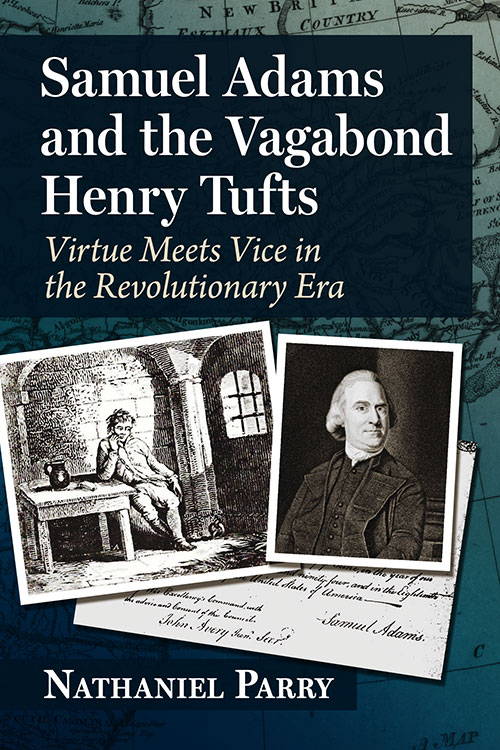
Later this month McFarland is due to publish Nathaniel Parry’s Samuel Adams and the Vagabond Henry Tufts: Virtue Meets Vice in the Revolutionary Era.

Author Gene Procknow has shared his thorough early review:
Comparative founder profiles are a crowded book genre with numerous volumes depicting any combination of George Washington, Thomas Jefferson, Alexander Hamilton, John Adams, and Benjamin Franklin as rivals, friends, or brothers. Nathaniel Parry offers a novel twist to this well-trod approach by comparing the lives of a famous founder, Samuel Adams, with a common criminal, Henry Tufts. . . .

Their lives briefly intersected in 1794 when Massachusetts Governor Adams saved Tufts’ life by commuting the thief’s death sentence to life in prison.
While most of those dual biographies could trace a long relationship between their subjects, in this book the insights arise from the big gap between the two men.

While Adams was devoted to political action, for example, Tufts joined the Continental Army only for the enlistment bonus and then promptly deserted. He was a habitual criminal, though Parry “asserts that if he were a tea smuggler rather than a thief, Tufts would be lauded as a Revolutionary hero.” Tufts did get a certain amount of glory as a rogue from his 1807 autobiography, most likely ghostwritten, which is the main source on his life.

The similarities between the two men can also be telling in reflecting attitudes that permeated their society. Procknow highlights how they shared common sentiments about slavery and race. Even after spending years with the Abenaki, Tufts (or at least his book) refers to Native Americans as “savages,” a term Adams also used.

At times, the review says, Parry pushes too hard on its theme of socioeconomic difference:
For example, the author overplays class conflict by asserting that Continental Army officers were “motivated more by class advancement than by deeply held convictions for the revolution” and, as evidence, cites a lieutenant who fought at Bunker Hill and Benedict Arnold’s self-aggrandizement (142, 241). However, for the vast majority in the Continental Army, officer advancement did not lead to newly found post-war wealth or status. . . .

Other minor weaknesses include several technical misstatements such as mislabeling Congressional members (Roger Sherman represented Connecticut, not Massachusetts), the object of British troops on the Lexington and Concord raid (General Thomas Gage sought four missing cannons and not the capture of Samuel Adams and John Hancock) and the number of allowable lashes in the Continental Army (100 was the maximum, not 500).
In all, Procknow concludes, by “innovatively comparing the lives of Samuel Adams and Henry Tufts,” Parry does a good job showing how “the nation’s founding was the product of elites and ordinary people” both.

Friday, March 29, 2024

New Collection from the Journal of the American Revolution

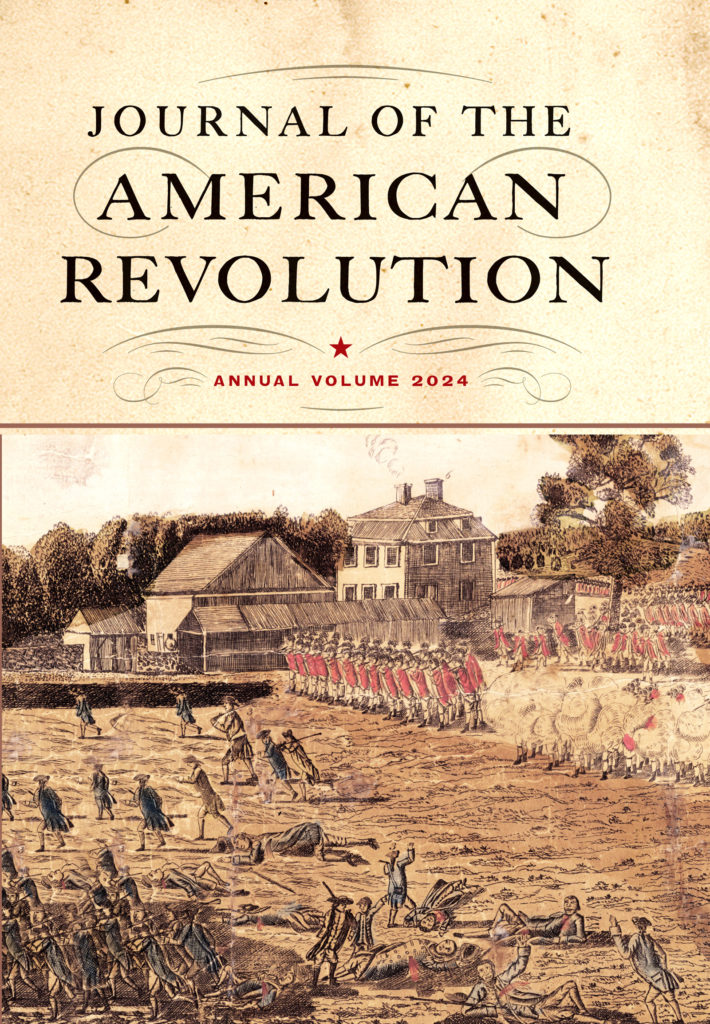
Next month Westholme Publishing will issue The Journal of the American Revolution Annual Volume 2024, edited ably once again by Don N. Hagist.

This webpage about the book says it will contain two articles by me.

In fact, the book will have only one article from me. That’s because I combined my two web articles about the confounding Samuel Dyer into one complete study.

This volume offers many other articles about Revolutionary New England, including:
  • Remember Baker: A Green Mountain Boy’s Controversial Death and Its Consequences by Mark R. Anderson
  • John Hancock’s Politics and Personality in Ten Quotes by Brooke Barbier
  • Mercy Otis Warren: Revolutionary Propagandist by Jonathan House
  • Captain James Morris of the Connecticut Light Infantry by Chip Langston
  • Smallpox Threatens an American Privateer at Sea by Christian McBurney
  • John Adams and Nathanael Greene Debate the Role of the Military by Curtis F. Morgan, Jr.
  • The Perfidious Benjamin Church and Paul Revere by Louis Arthur Norton
  • The Highs and Lows of Ethan Allen’s Reputation as Reported by Revolutionary-Era Newspapers by Gene Procknow
  • Captain Luke Day: A Forgotten Leader of “Shays’s Rebellion” by Scott M. Smith
  • Engaging the Glasgow by Eric Sterner
(My apologies to the authors of any other relevant articles I missed.)

And there are of course lots of articles about the American Revolution in, you know, other places.

Tuesday, March 19, 2024

Kleiser on Land’s Free Trade Argument about the Revolution

The H-Early-America list just ran Grant Kleiser’s review of Colonial Ports, Global Trade, and the Roots of the American Revolution (1700-1776) by Jeremy Land, an economic history published last year in Leiden.

The review frames the book’s main inquiry as: “Was this a conflict over free trade? That is, was a major cause of the American Revolution the fact that Great Britain restricted British North Americans’ ability to conduct commerce with people outside of the British Empire? Land’s answer is a resounding yes.”

There are, Kleiser says, three main claims in the introduction:
First, Land stresses that historians should consider colonial eighteenth-century Philadelphia, New York City, and Boston as a “cohesive port complex,” rather than thinking of them as serving distinct regions (p. 2). Land argues that “merchants in these three cities ... often complemented and cooperated with one another, creating intricate networks of credit, business, and trade” (p. 2).

Second, according to Land, this port complex’s robust mercantile economy was perfectly capable of operating without British sources of capital and often competed with English merchants and the English mercantilist agenda. Through rigorous quantitative methods, Land demonstrates that these three cities’ trade with the British Isles was less significant than trade with the rest of North America and the globe. Therefore, “the region was economically less oriented toward Britain than to the rest of the world,” which became “a constant source of tension between the colony and metropole” (p. 2).

Finally, Land stresses that British politicians did not pursue a policy of “salutary neglect” toward the colonies. Rather, they often tried to enforce “mercantilist” policies, particularly after the Seven Years’ War raised Britain’s sovereign debt exponentially. However, the inability of the imperial state to effectively enforce customs laws while also failing to provide adequate specie (i.e., gold and silver) made many British North Americans realize that resistance, that is, continuing to trade beyond the British Empire, was both possible and necessary.
I’m happy to agree that when viewed at some distance the three biggest ports in British North America, and indeed the others, were able to work together, despite differences, competition, and tensions. Certainly by the Revolutionary period they were doing so—that’s why there was a Revolution.

I’m also open to the argument that British imperial policy may not have been “salutary neglect” by choice, but at least sometimes by necessity as the government dealt with issues elsewhere. Land ultimately seems to go along with the traditional view that North Americans resented the stricter trade enforcement and more vigorous collection of taxes that most of the governments under George III tried. But did colonists seek “free trade” or a return to the previous form of regulation?

Land’s second point raises more questions for me. It seems to separate trade with Britain from trade everywhere else in the world, including parts of the British Empire, particularly in the Caribbean. I’d like to see the separation drawn between trade within the British Empire and trade outside of it.

Kleiser summarizes that part of Land’s argument as “the general lack of demand in Great Britain for these [North American] exports forced these traders to look outside the British Empire for profitable markets (e.g., the foreign West Indies) to acquire specie and afford highly demanded British manufactured goods.” But what about the demand outside Great Britain but inside the British Empire? That was what the New England economy fed on.

The book concludes that Boston, New York, and Philadelphia’s trade beyond the British Empire “was quite significant and more important than the direct trade with Britain and Ireland,” presumably in financial terms. But how did those commercial routes compare with trading between British colonies? Also unclear to me is whether North American trade in general would have been so safe or profitable without British imperial power—i.e., the Royal Navy—in support.

There’s no question that taxes on trade led to increasing friction and resistance in the North American port from 1765 to 1774. But that still seems several steps away from Land’s claim that “Britain’s military occupation of Boston was the first salvo in a battle for equal access to global markets.”

Kleiser chides Land for overstating British policy as barring all trade outside its empire. In fact, merchants could do business in foreign ports as long as they didn’t carry in specific “enumerated goods” (e.g., tobacco and indigo, not big crops for Boston, New York, and Philadelphia) and paid duties on what they brought back. Furthermore, British governments in the 1760s carved out exceptions to its rules, suggesting that if the resistance was all about business, folks could have struck a deal.

Kleiser concludes:
Overall, Colonial Ports offers an accessible overview of eighteenth-century commercial networks in Boston, New York, and Philadelphia. Nonspecialists and undergraduates will welcome its clear language, argumentation, and historical background, while specialists will gravitate to its exhaustive quantitative analysis and data tables on the contours of this trade.
For a scholarly book priced at over $100, “nonspecialists and undergraduates” might prefer to seek copies in libraries, smart economic actors as they are.

Sunday, March 10, 2024

Launch of the American Battlefield Trust Book Awards

This week the American Battlefield Trust got into the book awards game, announcing the “short list of finalists” for its first prize.

The award will go to “an outstanding published work focused on military history or a biography central to the nation's formative conflicts—the Revolutionary War, the War of 1812, and the Civil War.”

There are eleven finalists, which feels more like a long list to me. They were selected by a committee chaired by Gary W. Gallagher. The final selection will be made by a panel of expert judges, all history professors: James Kirby Martin, James McPherson, and Joan Waugh.

The honored titles about the Revolutionary War are:
  • Friederike Baer, Hessians: German Soldiers in the American Revolutionary War (Oxford University Press)
  • Ricardo A. Herrera, Feeding Washington’s Army: Surviving the Valley Forge Winter of 1778 (University of North Carolina Press)
  • Mark Edward Lender, Fort Ticonderoga, The Last Campaigns: The War in the North, 1777–1783 (Westholme Publishing)
  • Jack Warren, Freedom: The Enduring Importance of the American Revolution (Lyons Press)
Those on the U.S. Civil War are:
  • David S. Hartwig, I Dread the Thought of the Place: The Battle of Antietam and the End of the Maryland Campaign (Johns Hopkins University Press)
  • George Rable, Conflict of Command: George McClellan, Abraham Lincoln, and the Politics of War (Louisiana State University Press)
  • Timothy B. Smith, Early Struggles for Vicksburg: The Mississippi Central Campaign and Chickasaw Bayou, October 25–December 31, 1862 (University of Kansas Press)
  • Elizabeth Varon, Longstreet: The Confederate General Who Defied the South (Simon & Schuster)
  • Victor Vignola, Contrasts in Command: The Battle of Fair Oaks, May 31–June 1, 1862 (Savas Beatie)
  • Jeffry D. Wert, The Heart of Hell: The Soldiers’ Struggle for Spotsylvania’s Bloody Angle (University of North Carolina Press)
  • Ronald C. White, On Great Fields: The Life and Unlikely Heroism of Joshua Lawrence Chamberlain (Random House)
(The number of nominees about each war may reflect the total of titles being published.)

The prize money, provided by “a generous donor,” will include $50,000 for the winning author and smaller amounts to two additionl finalists. The announcement will come in September.