J. L. BELL is a Massachusetts writer who specializes in (among other things) the start of the American Revolution in and around Boston. He is particularly interested in the experiences of children in 1765-75. He has published scholarly papers and popular articles for both children and adults. He was consultant for an episode of History Detectives, and contributed to a display at Minute Man National Historic Park.

Subscribe thru Follow.it


•••••••••••••••••


Showing posts with label Wrentham. Show all posts

Saturday, November 29, 2025

Slocum’s “Authentic Narrative”

In 1844, John Slocum published An Authentic Narrative of the Life of Joshua Slocum: Containing a Succinct Account of His Revolutionary Services through a printer in Hartford.

This book fit into a growing genre: memoirs of unheralded Revolutionary War veterans looking back from old age. The most vital of these was Joseph Plumb Martin’s Narrative of Some of the Adventures, Dangers and Sufferings of a Revolutionary Soldier (1830), but I have a fondness for The Revolutionary Adventures of Ebenezer Fox, of Roxbury, Massachusetts (1838).

U.S. pension laws had encouraged veterans to write down their memories in order to authenticate their claims. I posit that that led men toward composing and then publishing these longer autobiographies. 

Joshua Slocum had died in 1816, at about the age of fifty-six, so he didn’t feel that impetus. Instead, his son John set down the veteran’s stories, shifting between third person, first person, and quoted documents.

Or so John Slocum claimed. He acknowledged pulling large sections of the book from other sources, such as the chapter on the capture of Fort Ticonderoga, which his father had no part in. But in truth he borrowed a great deal more. Over and over, the details in this Authentic Narrative just don’t add up, exposing a later perspective shaped by borrowed details and wishful thinking.

The book starts out by saying: “The subject of this sketch was born in the town of Franklin, Franklin county in the State of Massachusetts, in 1760.” The town of Franklin was never in Franklin County, and neither of those places legally existed in 1760. It’s possible Joshua Slocum was born in the town of Wrentham, which calved off Franklin during the war; there was a Slocum/Slocomb family there, but his birth doesn’t appear in the surviving vital records.

On the day after the town received news of the fighting at Lexington, the Authentic Narrative says, the “Franklin company” set out toward Boston. By the time those men made camp, “The intelligence of the surrender of Ticonderoga and Crown Point, with all their valuable stores, had already reached Roxbury.” That would mean the company took more than a month to travel fifty miles.

Somehow Joshua Slocum wrote a dramatic letter to his Loyalist father from Roxbury on 16 June 1775 but was also in one of the regiments based north of the Charles River that fought the Battle of Bunker Hill the next day.

In fact, Joshua was wounded—but he refused to leave his post! And a good thing, too:
Among the [British] killed was Major [John] Pitcairn, one of the flower of their army. I shall always believe that it was my rifle that sent him to his final account—for, as the enemy ascended the hill, I selected an officer answering his description, for a target, and as I took good aim, and my rifle seldom missing its object, I am very certain I killed him.
This account, then, is yet another claim to have killed Maj. Pitcairn. The narrator almost always refers to his weapon as a “rifle,” though such guns were almost unknown in New England at the time.

A month later, the narrator claims to have been about to volunteer for Col. Benedict Arnold’s expedition to Québec when he received a letter from a family friend dated 20 July. Since Arnold started to recruit in early September, that letter must have traveled even more slowly than the “Franklin company.”

The letter invited Slocum to leave the Continental Army camp, go out to the recruiting station at Worcester, and become a clerk in the friend’s company. Like most armies, the real Continentals frowned on soldiers deciding all by themselves where they’ll serve, but that’s what this account said Slocum did. 

And on it goes. Massachusetts Soldiers and Sailors of the Revolutionary War states that a Joshua Slocumb of Franklin served in the Rhode Island campaign of 1779–80. Ironically, the Authentic Narrative never mentions Rhode Island—most likely the one stint of military service by John Slocum’s father.

In 1882 Dr. Charles Elihu Slocum published A Short History of the Slocums, Slocumbs and Slocombs of America. Ordinarily such family histories are credulous toward sources that offer information and reflect well on members of the clan. But Dr. Slocum wrote of the Authentic Narrative:
This little book—of which but few copies can now be found—is written in a style interesting to the young, but it is open to criticism in some of its references to contemporaneous history.
In other words, don’t believe a word of it.

TOMORROW: The arrival of Washington through Slocum eyes.

Thursday, August 04, 2022

The Stinking Waters and George R. T. Hewes

As I type this, I’m in Richfield Springs, New York. In fact, I’m right across East Main Street (Route 20) from the springs that gave the town its name.

Those are sulphur springs, and the Haudenosaunee (Iroquois) referred to this place as Ganowauges, or “stinking waters.”

Europeans learned about the springs by the early 1750s, and British troops reached the site in 1757 during the French and Indian War. But there was still very little European settlement in the area two decades later when Adam Helmer ran past.

I heard about Richfield Springs first because of its connection to one memorable Revolutionary Bostonian: George Robert Twelves Hewes.

During the siege Hewes lost his shoemaking workshop in Boston and resettled with his family in Wrentham. That change may have helped to cement his memories of the pre-war port.

Later some of Hewes’s children, like many rural New Englanders, moved out to central New York. In the early 1800s the area around Richfield Springs was being developed, with the sulphur water itself promoted as a health remedy.

After the War of 1812, Hewes and his wife Sally followed those children to Richfield Springs. He was then seventy-four years old and ready to retire. Sally Hewes died in 1828. For the next few years, Hewes moved among the houses of relatives and neighbors, telling stories about the Revolution and pulling out his old militia uniform for patriotic holidays.

Some of Hewes’s Independence Day talks came to the attention of a New York writer named James Hawkes, who wrote a biography collecting those tales. The term “Boston Tea Party” had been coined a few years before, and Hawkes titled his 1834 book A Retrospect of the Boston Tea-Party.

That publication spurred Boston grandees to invite Hewes to revisit his home town, which he did in 1835. He sat for a portrait and for celebratory dinners. Since of course we couldn’t be satisfied with a book written by a New Yorker, local writer Benjamin Bussey Thatcher pumped Hewes for more stories, augmented them with other men’s recollections, and published Traits of the Tea Party.

Hewes returned to central New York, having thoroughly enjoyed being a celebrity. In 1840 he was boarding a carriage to ride to yet another Independence Day celebration when he suffered an injury. Hewes died on 5 November at the age of ninety-eight and was buried here in Richfield Springs.

Sunday, September 16, 2018

The News from 250 Years Ago

While looking at the newspaper coverage from 250 years ago this month, I was struck by some of the stories that Bostonians were reading at the same time they digested news of the imminent arrival of army regiments.

For example, the Boston Evening-Post of 12 September contained several reports of lightning strikes on the evening of Wednesday the 7th. One bolt in Wrentham “tore to pieces” a “very large white Oak Tree, which was more than two Feet Diameter,” and threw some pieces ten rods away. Another hit Daniel Mann’s inn, causing lots of miscellaneous damage but not hurting any of the thirty-odd people inside. Unfortunately, that same night lightning killed a ten-year-old boy in Rehoboth. The next evening, lightning set fire to a barn belonging to Joseph Palmer of Braintree, causing £200 worth of damage.

In other news from the 12 September Evening-Post:
Last Wednesday sailed from this Port his Majesty’s Sloop of War the Senegal, as also the armed Schooners, supposed to be bound to Halifax: There now remains in this Harbour with their Pendants flying, his Majesty’s Ship Romney, of 50 Guns, and the Sloop Liberty.

The above Sloop Liberty was sold at public Auction last Tuesday, and was struck off to the Collector of his Majesty’s Customs for this Port, and its said is now to be improved [i.e., used] as a Cruiser for the Protection of Trade.
The Customs service, having confiscated John Hancock’s ship Liberty for alleged smuggling and other legal violations, had bought that ship and planned to hunt down other smugglers with it. I don’t think the Customs service had had its own patrol ship before.

The 12 September Boston Chronicle:
We hear from Salem, that a person there, having given information of a vessel that arrived there with molasses, the populace were so enraged, that they stript him, then wrapped him in a tarred sheet, and rolled him in feathers; having done this, they carried him about the streets in a cart, and then banished him the town for six weeks.
This was the first documented example of tarring and feathering in New England. It established the pattern for such attacks: a crowd publicly punishing a working-class man believed to have helped the Customs service capture smugglers.

The 19 September Boston Chronicle:
Captain [James] Scott brought the account of the arrival of Benjamin Hallowell, jun. Esq; after a passage of twenty-nine days.

Letters brought by Captain [James] Bruce mentioned, that Mr. Hallowell, since his arrival, has had frequent conferences with the ministry…
Hallowell was the Comptroller of Customs in Boston, as well as the son and namesake of a well known merchant captain. He was one of the officers that carried out the confiscation of the Liberty and was then attacked by the crowd. Hallowell had gone to London to complain to the government on behalf of all the Customs officers and to see what compensation he could receive. Eventually he was promoted to be one of the Commissioners of Customs.

More from the 19 September Chronicle:
The Rev. Mather Byles [Jr.]. who went home last May with Capt. Davis, met with a favourable reception from the Bishop of London, was ordained, and is appointed missionary for Christ’s Church in this town, with a salary, it is said, of 40 l. sterling, per annum, and is expected to return with Capt. Davis.
Byles (shown above) was another son and namesake of a well known figure in town—in his case, the learned, punning minister of the Hollis Street Meetinghouse near the Neck. For the younger Byles, a descendant of the Puritan Mathers, to take orders within the Church of England was a big deal. It presaged the family’s long-lasting Loyalism.

From the 19 September Boston Gazette:
Monday in the Night [i.e., on 12 September] the Post contiguous to Liberty Tree was sawed off, the Damage was inconsiderable, but discovers the evil Disposition of the Perpetrators of such a base Action.
The 19 September Gazette:
We hear that last Saturday se’nnight [i.e., 10 September] two Informers, an Englishman and Frenchman, were taken up by the Populace at Newbury-Port, who tarred them; but being late they were handcuffed and put into custody until the Sabbath was over:—Accordingly on Monday Morning they were again tarred and rolled in Feathers, then fixed in a Cart with Halters, and carried through the principal Streets of the Town, to the View of the Gallows, but what further we know not.
The practice of tarring-and-feathering spread rapidly in Essex County.

Finally, from the 19 September Gazette:
We are credibly informed, that the Selectmen of a neighbouring Town have taken Care that their Town be supply’d with a sufficient Quantity of Gun-Powder, as the Law directs; and that the Col. of the Militia there, has declared his Intention to order a strict Enquiry into the State of his Regiment, respecting Arms, Ammunition, &c. . . .

Thursday next there will be a general Muster of the Regiment in this Town, and we hear a critical View of the Arms of the Soldiers.
These actions reflected Boston’s discussion of strengthening the militia ahead of the troops’ arrival.

Monday, September 03, 2018

The Powder Alarm Viewed from Westborough

Earlier in the summer I took note of the online edition of the diary of the Rev. Ebenezer Parkman of Westboro.

One of the events Parkman lived through and recorded was the “Powder Alarm” of September 1774. In fact, by writing down news at different times, the minister preserved the rumors that motivated that militia uprising.
1774 September 2 (Friday). This morning was ushered in with Alarms from every Quarter, to get ready and run down to Boston or Cambridge. The Contents Magazine of Powder at Winter Hill had been carryed off — namely [550?] Barrells; by Treachery; etc. This is told as the Chief Affair.

72 of our Neighbours marched from Gales (tis said) by break of Day; and others are continuely going. My young man goes armed, with them.

About 5 p.m. Grafton Company, nigh 80, under Capt. Golding, march by us.

N.B. Squire Whipple here. Says he is ready to sign etc. It is a Day of peculiar Anxiety and Distress! Such as we have not had — Will the Lord graciously look upon us; and grant us Deliverance — for we would hope and trust in His Name! We send for Mrs. Spring and her two Children to be here with us, while her husband is gone with the People.

Breck returned from Lancaster. At Eve we have most sorrowful News that Hostilitys have commenced at Cambridge, and that Six of our people are killed; that probably Some at least may be of Westborough. Joshua Chamberlin stood next (as it is related) to one that was slain. We have many Vague accounts and indeed are left in uncertaintys about Every Thing that has occurred.

Sutton soldiers — about 250, pass along by us — but after midnight are returning by reason of a Contrary Report. Mr. Zech. Hicks stops here. Breck is employed in the night to cast Bulletts. A Watch at the Meeting House to guard the Town stock etc. Some Towns, we hear, have lost much of theirs, as Dedham, Wrentham etc.
The initial report of the king’s soldiers taking hundreds of barrels of gunpowder from the provincial storehouse in Charlestown (shown above) on 1 September was correct. The later rumor of six men killed by those troops was entirely false. In his diary entry we can see Parkman struggling to make sense of the news he was hearing from different directions.

Many towns besides Westboro became anxious about their local supplies of gunpowder and other ordnance immediately after the alarm. After all, no one knew what would come next. The towns were preparing for war; descriptions like Parkman’s read very much like descriptions of the more famous Lexington Alarm of April 1775.

The next day the minister gradually realized the crisis had passed:
1774 September 3 (Saturday). Capt. Benjamin Fay came here between 2 and 3 o’Clock in the morn in much Concern and knew not what to do. After Light and through most of the forenoon, vague uncertain Reports. Sutton men that had gone to Deacon Wood, came back to go down the Road again.

My son Breck with provisions, Bread, Meat, etc., Coats, Blanket etc., for it was rainy, rides down towards Cambridge to relieve Asa Ware, Mr. Spring, and others who were unprovided.

About noon the Sutton Companys come back again and go home, Rev. Chaplin among them. So do the Grafton men.

Mr. Abraham Temple relates to me, that he, having been as far as to Cambridge and himself Seen many of the Transactions, that there were no Regulars there, no Artillery, no body Slain — but that Lt. Gov. [Thomas] Oliver, Messrs. [Samuel] Danforth, Joseph Lee, Col. [David] Phips (the high Sheriff) had resigned and promised that they would not act as Counsellors — that Mr. Samuel Winthrop computed there were about 7000 of the Country people had gathered into Cambridge on this Occasion — that it was probable, as he (Mr. Temple) conceived, that the Troubles would subside.

N.B. When the Sun run low, Our Company returned (consisting of Horse and Foot about 150). With them were my Son and my young man — all without any Evil Occurrance. To God be Praise and Glory! I Suppose Capt. Maynard and those who were with him are returned also.
The estimate of “7000 of the Country people” is high, but both Lt. Gov. Oliver and Dr. Thomas Young guessed there were 4,000 militiamen in Cambridge that day.

I started The Road to Concord with the “Powder Alarm” because it marked a turning point in Massachusetts’s conflict with the Crown. That was the moment that Gov. Thomas Gage lost control of most of the province, and the moment that people began to turn to military solutions for the political conflict.

Monday, September 18, 2017

“Mr. Cleaveland’s moral, Christian and ministerial character”

Yesterday we left the Rev. John Cleaveland, Jr., at odds with his Stoneham neighbors in 1794. The trouble was his second marriage to young Elizabeth Evans, until recently his housekeeper and apparently not even a dedicated member of the church.

As the Congregational Library says in its description of meetinghouse records from Stoneham: “While the church chose to support Cleaveland, the town did not, and both Cleaveland and the church building itself were targets of the town’s ire.” Not to mention the minister’s horse.

At the end of September 1794, after months of feuding, an ecclesiastical council of ministers from other towns came to work out the dispute. The congregation had to borrow money from two members to lodge and feed those ministers, one reason why they may have delayed that step for so long.

In his History of Stoneham William B. Stevens reported that council found:
1. That Mr. Cleaveland’s influence among this people is lost, and irrecoverably lost, and that it has become necessary that his ministerial connection with them be dissolved, and it is the advice of this council that he ask a dismission from his pastoral relations to them.

2. It appears from the fullest and they trust from the most impartial examination of the subject of which they are capable, that Mr. Cleaveland has given no just cause for that aversion and opposition to him which in so violent, and very unprecedented a manner they have displayed.

3. It appears to this council that Mr. Cleaveland’s moral, Christian and ministerial character stands fairly and firmly supported, and they cordially recommend him to the church and people of God wherever in the Providence of God he may be cast.

4. As Mr. Cleaveland has given to this people no just cause for that opposition to him which they discover, and which renders his removal from them necessary, and as his removal must be attended by great inconvenience and expense to him, it is the opinion of this council that he ought to receive a compensation, and they recommend it to the parties concerned to choose mutually three judicious, impartial characters from some of the neighboring towns to estimate the damage to which Mr. Cleaveland is subjected by his removal. . . .

Finally the council deeply impressed with the singular sacrifice which Mr. Cleaveland’s friends make in parting with their valuable and beloved pastor beg leave to exhort them to acknowledge the hand of God in this afflicting Providence as becomes Christians; to maintain the order of Christ’s house, and with unremitting ardor promote the interest of His kingdom.
In other words, no recriminations, please. I can’t tell if the Stoneham meeting gave Cleaveland a generous severance package as the council recommended. He preached his last sermon at the end of October—and then published the text. It included lines like, “people who have rejected a faithful watchman, will have a most dreadful account to give in the great day.” So there were some recriminations on his part.

Over the next few years Cleaveland worked a visiting minister at various meetinghouses. This had the advantage of letting him recycle his sermons for new audiences. Yale reports that one of his compositions “was first given at Newburyport on June 25, 1797, and then given twice more at Chebacco [another name for Essex, his home town] and Topsfield in 1797, at Medway in 1798, and at Medfield and Attleboro in 1799.”

In June 1798 the Rev. John Cleaveland finally secured a permanent pulpit at a new parish in Wrentham, which has since become Norfolk. Until the meetinghouse was finished he preached in the house shown above, photo courtesy of the town.

He became known for his very regular habits, devoting “two afternoons, weekly, to systematic visitation of his people.” In addition:
He was remarkably punctual; so much so, that when he found he was likely to arrive at the meeting-house five minutes too soon, he would walk his horse, so as invariably to reach the door within three minutes of the time.
Cleaveland preached in Wrentham until his death in 1815. The Rev. Nathaniel Emmons spoke at his funeral, a sign that Cleaveland was a traditionalist. His sermons now rest with his father’s in the Manuscripts and Archives Department of the library at Yale, the college he had never been able to attend. [I worked in that department as a student years ago.]

As for Elizabeth Cleaveland, she remained at the minister’s side until his death. They never had children (nor did he have any by his first wife). After being widowed, Elizabeth Cleaveland married another minister, the Rev. Walter Harris of Dunbarton, New Hampshire. Like her first husband, he was a Continental Army veteran, having served three years as a fifer from Connecticut. By the time Elizabeth Harris died in 1829, later authors agreed, she had become as pious as the people of Stoneham could have wished.

Sunday, April 16, 2017

“About one a clock the minute men were alarmed”

Samuel Haws of Wrentham, Massachusetts, was one of the militiamen called out on 19 Apr 1775 who left a journal of his experiences.

Haws’s journal would be consulted even more if he’d seen actual fighting that day. But Wrentham is on the Rhode Island border—too far for its militia company to hear of the regulars’ march, to assemble, and to hike all the way to the battle road. Instead, Haws and his comrades saw a lot of taverns and eventually made their own action.

Here’s an extract from Haws’s diary as it appeared in its second publication, in the New England Historical and Genealogical Register for 1976. The annotations are by editor Richard Brigham Johnson and me:
About one a clock the minute men were alarmed and met at Landlord [David] Mann’s.

We marched from there the sun about half an our high towards Roxbury for we heard that the regulars had gone out and had killed six men and had wounded Some more that was at Lexinton then the kings troops proceded to concord and there they were Defeated and Drove Back fiting as they went. They got to charlstown hill that night.

We marched to headens [Jonathan Hidden’s] at Walpole and their got a little refreshment and from their we marched to Doctor [Samuel] cheneys [still in Walpole] and their we got some victuals and Drink and from thence we marched to Landlord ellises at Dedham and their captain parson [Samuel Payson?] and company [from Stoughton?] joined us and then we marched to [Benjamin] Gays and their captain [John] Boyd and company [from Dedham] joined us and we marched to Landlord [Daniel] Whitings [still in Dedham]

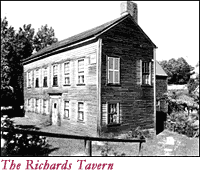
we taried their about one hour and then we marched to [Nathaniel] richardes [in west Roxbury, shown above] and Searched the house and found Ebenezer aldis and one pery who we supposed to Be torys
The Wrentham militiamen no doubt recognized Ebenezer Aldis as one of their neighbors. In fact, he even was a cousin of sorts to Samuel Haws. (I can’t identify “Pery”; Aldis’s wife was a Penniman, so it’s conceivable that man was one of her relatives and Haws wrote the name inaccurately.)

Haws’s report might dovetail with a tradition that came down in the family of Nathaniel Richards and was eventually published in Abner Morse’s A Genealogical Register of the Descendants of Several Ancient Puritans, vol. 3. That story focused on the landlord’s new son-in-law (and cousin) Solomon Richards:
On the morning of the battle at Lexington, he was met, on his way to Boston, with the report that the British were on their march to Concord; and as he was turning his course for Dover, to rally men to the scene of conflict, up rode a man direct from Boston, contradicting the report.

Capt. R. instantly marked him for a tory, took him prisoner, bound him upon his own horse, and escorted him to the Peacock tavern at Jamaica Plain, and detained him until the truth could be known. In the meantime a body of soldiers arrived, and demanded the tory, that they might hang him during their halt.
Morse believed that the Richards family owned the Peacock Tavern, but he was mistaken—its landlord was Lemuel Child. The Peacock Tavern was at the corner of Allandale and Centre; Nathaniel Richards’s tavern was further out along Centre where the West Roxbury post office now stands. The Richards family understood that Solomon Richards took his suspicious prisoner to his father-in-law’s tavern, and it looks like Morse inserted the Peacock Tavern name by mistake.

TOMORROW: Did the Wrentham company hang Ebenezer Aldis?