J. L. BELL is a Massachusetts writer who specializes in (among other things) the start of the American Revolution in and around Boston. He is particularly interested in the experiences of children in 1765-75. He has published scholarly papers and popular articles for both children and adults. He was consultant for an episode of History Detectives, and contributed to a display at Minute Man National Historic Park.

Subscribe thru Follow.it


•••••••••••••••••


Showing posts with label Silas Deane. Show all posts

Friday, September 04, 2026

“An account of the progress of our machine”

On 31 Aug 1775, the Rev. Benjamin Boardman, serving as a chaplain to Connecticut troops at the siege of Boston, wrote in his diary:
I collected this day in cash for the encouragt. of Mr. Bushnels Machine the sum of £13.4.4. in cash out of our regt.
Boardman was a graduate of Yale, and David Bushnell (1740–1826) had just graduated from that college.

On 24 September, Dr. Benjamin Church wrote to his British army contact:
The distroying the Ships in the manner I wrote you before they began to dispair of tho’ the former of the Machine is full of faith that he can do it, Works on hardly and so let him, I say.
This intel might have referred to the same machine, or to different technology designed to damage Royal Navy ships.

Bushnell’s invention was still in the works, but getting closer to completion, when the doctor and inventor Benjamin Gale (1715–1790) wrote from Killingworth to Silas Deane at the Continental Congress on 9 November:
In your last you requested I would give you an account of the progress of our machine, and whether anything may be expected of it. I now sit down to give you a succinct but imperfect account of its structure, which is so complicated that it is impossible to give a perfect idea of it. . . .

I conclude by the time this reaches you the machine will be in camp. Lately he has conducted matters and his designs with the greatest secrecy, both for the personal safety of the navigator as to produce the greatest astonishment to those against whom it is designed,—

if this projection succeeds, of which I make no doubt, as I well know the man and have seen the machine while in embryo, and every addition made to it fills me with fresh astonishment and surprize. And you may call me a visionary, an enthusiast, or what you please,—I do insist upon it, that I believe the inspiration of the Almighty has given him understanding for this very purpose and design.
But two weeks later, on 22 November, Gale had to report a delay:
I have to ask pardon for the wrong information I gave you. At the time of my last writing, I supposed the Machine was gone, but since find one proving the navigation of it in Connecticut River. The forcing pump made by Mr. [Isaac] Doolittle, not being made according to order given, did not answer; which has delayed him. The trials I mentioned to have been made since Dr. [Benjamin] Franklin’s being here, was the explosion, which prov’d beyond expectation.
The most famous American scientist of the day had stopped in Saybrook on his way back from Cambridge to Philadelphia in order to inspect this invention.

Gale sent another update and plea to Deane on 7 December:
…everything answers well, but still, he fails on one account. He proposes going in the night, on account of safety. He always depends on fox-wood, which gives light in the dark, to fix on the points of the needle of his compass, and in his barometer, by which he may know what course to steer and the depth he is under water, both which are absolute necessity for personal safety of the navigator; but he now finds that the frost wholly destroys that quality in that wood, of which he was before ignorant, and for that reason and that alone he is obliged to desist. He was detained near two months for want of money, and before he could obtain it the season was so far advanced he was, in the manner I have now related, frustrated. . . .

The person, the inventor of this machine, now makes all his affairs a secret even to his best friends, and I have liberty to communicate this much from him only with a view to know if Dr. Franklin knows of any kind of phosphorus that will answer his purpose; otherwise the execution must be omitted until next spring, after the frosts are past.
As of 1 February, Gale was still seeking some phosphorescent material for Bushnell. He wrote, “I have lately seen the man, and conversed freely with him. He is no enthusiast; a perfect philosopher, and by no means doubtful of succeeding.” But the siege of Boston would end before warm weather.

TOMORROW: A new campaign.

(Several replicas of the Bushnell’s machine have been built over the years based on the verbal descriptions. The one shown above was in Westbrook, Connecticut, as of last year.)

Monday, August 03, 2026

“So disagreeable that one half of the Congress withdraw”

Delving into the newly published John Dickinson letters also led me back into the notes of the Continental Congress during 1775.

The official record that secretary Charles Thomson kept for eventual publication was often anodyne. The delegates made themselves into a committee of the whole to avoid going on the record, and of course Thomson was politic about what he recorded.

But some delegates kept their own notes. In this period Silas Deane kept busy summarizing arguments and then grading the speakers.

Neither Dickinson nor John Adams came off in Deane’s notes as so composed and effective as they would have liked.

In his memoir Adams described himself as “not having ever been remarkable for very long Harrangues.” But on 15 May Deane described the Massachusetts man’s remarks as “lengthy, and argumentative.”

Dickinson felt he was guiding the Congress to a safe middle course. That same day Deane wrote that the Pennsylvanian “argues smoothly but Sophistically on the Subject and gives rather disgust.”

And here’s the delegates’ interactions on 24 May:
Mr. Dickinson in his old Way lengthy, and concludes in his old Way with a Fable

Mr. [Thomas] Mifflin animadvests[?] with spirit on him and exposes his reasoning &c

Mr. [Thomas] Johnson, on a reconciling plan and offers a Motion.

Col. [Richard Henry] Lee for a different mode of expression in ye Motion and is severe on Dickenson

Mr. Jno. Rutledge against any Concession whatever, that Lord North has given Us his Ultimatum with which We cannot agree. Treats Dickinsons plan with the upmmost Contempt. and is so severe that [Samuel] Chase rises to explain himself.

Col. Lee up again

Mr. [Thomas] Stone of Maryland so disagreeable that one half of the Congress withdraw
Deane’s 1775 notes were published in Letters of Delegates to Congress, and they can easily be found online at From the Page and American Founding.

Meanwhile, the Congress’s official record of 24 May 1775 is:
Peyton Randolph, President, returned to Virginia where he was Speaker of the Assembly. John Hancock was unanimously chosen President.

Samuel Ward reported that the committee of the whole had made progress in the business of the state of America, but not having come to a conclusion, requested permission “to sit again.”

Adjourned till to Morrow at 9 o’Clock.
Deane’s notes show what was really behind that “progress.”

Sunday, August 02, 2026

“Dependant upon the Imperial Crown of Great Britain”?

In 1775, John Adams and John Dickinson held the same basic position about the best course for the British Empire and its large North American colonies:
  • There must be a new understanding of the relationship between those colonies and the central government in London.
  • But those colonies need not become independent.
The problem was that the two men defined “independent” differently.

On 15 May, Silas Deane made these notes on the Continental Congress’s debate:
Mr. Jno Ruttlidge…insists it previously some that points must be settled, such as do We aim at independancy, or do we only ask for a Restoration of Rights & putting of Us on Our old footing. speaks long & well

Mr. Robt. R Livingston Succeeds him in the same way. short

Mr. Jno. Adams lengthy, and argumentative. independance on Parliamant is absolutely to be avowd. in the Americans, but a dependance on the Crown is what We own
Adams thus declared himself in favor of “independance” only from Parliament, not the entire British system (“the Crown”). How exactly that would work he didn’t say.

Two months later, in his letter to James Warren that fell into British hands, Adams went into more detail:
We ought to have had in our Hands a Month ago, the whole Legislative, Executive and Judicial of the whole Continent, and have compleatly moddelled a Constitution, to have raised a Naval Power and opened all our Ports wide, to have arrested every Friend to Government on the Continent and held them as Hostages for the poor Victims in Boston. And then opened the Door as wide as possible for Peace and Reconcilliation
Adams still didn’t use the term “independance.” He still held out the prospect of “Reconcilliation.”

To Dickinson, however, Adams’s wish list amounted to “a total Independence, & the Establishment of a Commonwealth.” The term “commonwealth” recalled the English protectorate of the mid-1600s, which Adams’s Puritan ancestors had applauded but most British subjects remembered with distrust.

Adams never saw the material that Dickinson sent to David Barclay in Britain in August 1775. In fact, hardly anyone in the history of the world saw those documents until they were just published in the William & Mary Quarterly. With his letter Dickinson included draft legislation he hoped would calm the crisis by resetting the imperial relationship to how it had been back before Parliament started raising tariffs in 1763.

But Dickinson prefaced part of that legal repeal with this language:
Whereas it is essential to the good Government & Prosperity of every Sosciety [sic] or State, that an undisputed Supreme superintending Power & Authority should exist within it; And whereas this Power & Authority hath always been vested in & exercised by Parliament; and whereas the respective local legislatures of distinct Colonies are in many Instances incompetent; be it therefore further enacted by the Authority aforesaid, that when any of the said Colonies shall by an Act of Assembly acknowledge & recognize & declare the said Colony to be dependant upon the Imperial Crown of Great Britain, and that the Kings most excellent Majesty by & with the Advice & Consent of the Lords Spiritual & temporal & Commons in Parliament assembled had hath & of Right ought to have full Power & Authority to make Statutes to bind the People of the said Colonies, where the general Wellfare of the Whole Empire shall require the Exercise of such a Supreme superintending Power & Authority, as especially to make Statutes for regulating the Trade & Navigation of the Whole Dominion of the Imperial Crown of Great Britain…
To Adams, Dickinson’s concession would have amounted to accepting dependence on Parliament.

Ironically, both men claimed that the disclosure of Adams’s letter was useful because it showed how far he wanted to go. Dickinson felt those words should make politicians in Britain realize that some Americans sought de facto independence. Adams felt the same words emboldened more Americans to adopt his position.

In fact, none of the documents I’ve been discussing—Adams’s intercepted letter, Dickinson’s two letters to Barclay and his draft legislation—made any difference in London. On 23 August, before those papers could cross the Atlantic, King George III issued a proclamation written by Lord Dartmouth that the North American colonies were in “open and avowed rebellion” and his forces should “use their utmost endeavours to withstand and suppress such rebellion.”

Saturday, June 06, 2026

“The wider transatlantic workers’ struggle that helped make the American Revolution”?

Jacobin just published Tom Cutterham’s essay “Class Struggle Was a Crucial Part of the American Revolution,” reflecting his upcoming book, Empire Ablaze: The American Revolution and the Atlantic Working Class.

The article begins:
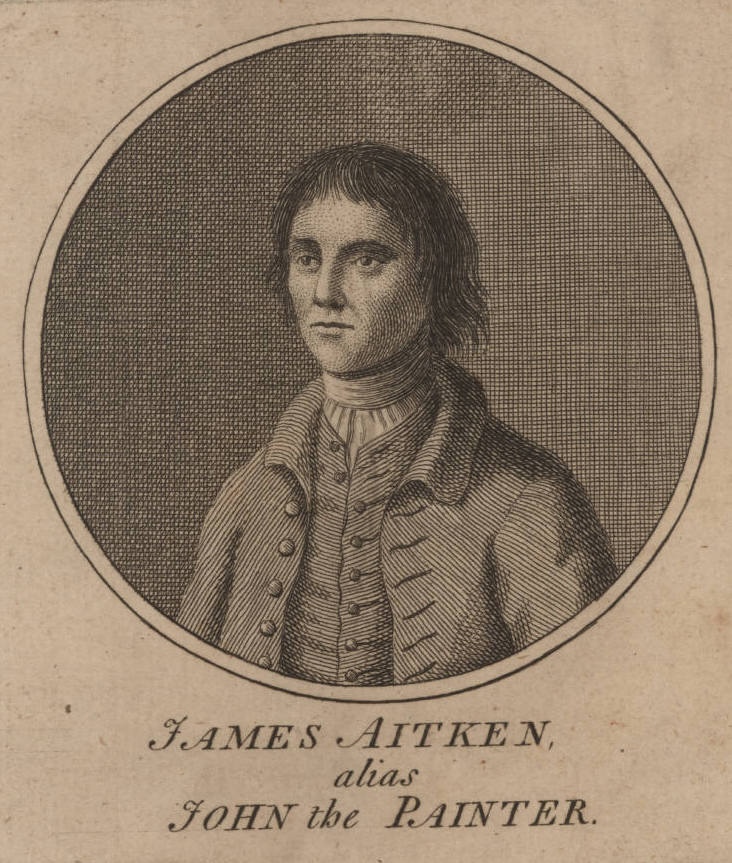
Late in 1776, with the War of Independence underway in the American colonies, a twenty-four-year-old housepainter named James Aitken walked into Britain’s most important naval dockyard and set it on fire. The damage was significant: estimates for repairs were twice the value of the tea destroyed at Boston harbor three years earlier.

The sense of threat experienced by Britain’s ruling elite was also profound. Few people today remember Aitken’s acts of sabotage against the British war machine. But they deserve recognition as part of the wider transatlantic workers’ struggle that helped make the American Revolution.
Aitken is the subject of one of my favorite books on the Revolution, Jessica Warner’s The Incendiary. But I’m not convinced he’s good evidence of a transatlantic political movement, even though he did start his life in working-class Scotland, was in Pennsylvania during the first years of the Continental Congress, and then returned to Britain to support the American cause. Aitken didn’t connect with other activists, except for Silas Deane in Paris. He seems to have been socially inept. Aitken was a movement of one.

Likewise, something seems to be missing from the article’s description of the Gordon Riots:
In London too, the long-standing collaboration between laborers, artisans, and the commercial middle class proved a point of fracture as the possibility of revolution grew too close for comfort. When huge crowds took to the streets in the summer of 1780, burning the home of the Lord Chief Justice, throwing open prison gates, and attacking centers of imperial power like the East India Company offices, it seemed as though the “general effort” [Catharine] Macaulay had called for might finally be at hand.
Those riots were spurred by support for a rather mad aristocrat’s protest against a new British law granting more political rights to Catholics. Though the violence threatened the political establishment, was it really for the benefit of the working class?

I expect Cutterham’s longer book addresses the details of these cases. And I don’t disagree that economic friction between the working class and their employers (still called “masters” in many fields) was part of the Revolutionary era. But so were a bunch of other factors that may have driven events more and certainly muddy the waters. Cutterham’s points are worth considering with care.

Thursday, January 29, 2026

America’s History Conference in Glen Allen, Virginia, 27–29 Mar.

America’s History, L.L.C., will hold its thirteenth Annual Conference of the American Revolution in Glen Allen, Virginia, on 27–29 March.

Here’s the lineup of speakers:
  • Richard “Rick” Bell on “The American Revolution and the Fate of the World”
  • Todd W. Braisted on “‘You must expect to hear me talked of as a monster of cruelty’: Colonel Francis Lord Rawdon and the Revolutionary War”
  • Denver Brunsman on “Prisoners, Press Gangs, and the Battle for Sailors in the Revolutionary War”
  • Iris de Rode on “Something New to Think About: The Dutch in the American Revolution”
  • William “Larry” Kidder on “Defending Fort Stanwix: New York’s Frontier During the Revolutionary War”
  • Stephen L. Kling (the Lorna Hainesworth Sponsored Speaker) on “An Underappreciated Victory: Bernardo de Gálvez’s Mississippi River Campaign Against the British in 1779”
  • Mark Edward Lender on “War Without Mercy: Liberty or Death in the American Revolution”
  • Charles P. Neimeyer on “Revolutionary Riverine Warfare: The War for Independence on America’s Rivers and Lakes”
  • Gordon Blaine Steffey on “‘Trust Not Professions’: Feuding Founders and Diplomatic Disorder in the Arthur Lee–Silas Deane Affair”
  • Andrew Waters on “Backcountry War: The Rise of Francis Marion, Banastre Tarleton and Thomas Sumter”
In addition to the conference, attendees can sign up for a bus tour on Friday, 27 March, visiting Ferry Farm, Gunston Hall, and Historic St. John’s Church to learn about “More Virginia Founding Fathers: Essentially Important for Independence” from Edward G. Lengel and site staff.

For more information and registration, visit this page.

Tuesday, June 03, 2025

“To turn his back sullenly on his General”?

As discussed yesterday, on 19 July 1775 Gen. Joseph Spencer arrived back in the camps of what was now the Continental Army, bringing a letter from the governor of his home colony of Connecticut, Jonathan Trumbull.

Trumbull asked Gen. George Washington to understand how Spencer was miffed at seeing Israel Putnam promoted to major general over him. And merely because Putnam had led troops in the Battle of Chelsea Creek.

Delivering that letter was probably the first time Spencer had met Washington. And I imagine the discussion was as stiff and cold as the new commander-in-chief could be. As Maj. Samuel Blachley Webb (shown here) wrote on 11 July, Spencer’s departure “without leave or license from Gen. Washington,…displeased him much.”

Indeed, Spencer’s hissy fit had damaged his standing even among his own officers. He’d asked his subordinates to sign a protest on his behalf, and Webb reported:
I have since been to Roxbury, and find the officers, many of them, heartily sick of what they have done, in particular, Maj. [Return Jonathan] Meiggs,—who says he was forced to sign what the others did—to keep peace; and says he had rather serve under Putnam than Spencer.

You’ll find Generals Washington and [Charles] Lee, are vastly more fond, and think higher of Putnam, than any man in the army; and he truly is the Hero of the day. . . . Better is it for us to lose four Spencers than half a Putnam.
News of Putnam’s higher rank “gave universal satisfaction,” Webb added.

Webb was sending these observations to his stepfather, Silas Deane. On 20 July, Deane told his wife how the Continental Congress was responding to Spencer’s behavior:
You can be at no loss to infer what opinion is formed of him from this conduct, in doors and out. Suffice it to say, the voice here is, that he acted a part inconsistent with the character either of a soldier, a patriot, or even of a common gentleman. To desert his post in an hour of danger,—to sacrifice his Country, which he certainly did as far as was in his power,—and to turn his back sullenly on his General, a General, too, of such exalted worth and character,—will, I can assure you, unless he take the most speedy and effectual measures to atone, draw upon him the resentment of the whole Continent.
Neither Deane nor fellow Connecticut delegate Eliphalet Dyer ever pushed Spencer for promotion again. (He was made a major general in the fall of 1776 as part of a general wave of promotions.)

On 21 July, Gen. Washington reported to the Congress that Spencer had agreed to “serve under Puttnam, rather than leave the Army intirely.” The men’s relative ranks would not change.

The next day, Gen. Washington announced a new organization for the Continental Army around Boston. With three major generals under him, he put Artemas Ward in charge of a brigade on the southern side of the siege lines, Lee in charge of the northern wing, and Putnam in charge of the center.

Among the brigadier generals, he assigned Spencer to the southern wing under Ward. Thus, Spencer would answer to a general he’d already acknowledged as senior, not to Putnam. Gov. Trumbull had suggested a similar way of keeping the two Connecticut officers apart. Which wasn’t the sort of issue Washington wanted to face.

Spencer served the rest of the siege, making no distinct contribution at all. He never gained Washington’s trust, and after an unsuccessful Rhode Island campaign he left the army.

Friday, September 13, 2024

“Boston was quiet & no hurt done”

On 8 Sept 1774, two days after the men at the First Continental Congress heard dire reports about the Crown military attacking Boston, accurate information arrived in Philadelphia.

The army had not killed half a dozen civilians. The navy had not bombarded the town. In fact, over two tense days nobody had been hurt at all.

Robert Treat Paine recorded the new news in his diary:
By the Post came advice from N. York that a person had arrived from Boston & Newport since the time Supposed in [Israel] Putnams Letters & that Boston was quiet & no hurt done.
John Adams did likewise, characteristically with more emotion:
The happy News was bro’t us, from Boston, that no Blood had been spill’d but that Gen. [Thomas] Gage had taken away the Provincial Powder from the Magazine at Cambridge [sic]. This last was a disagreable Circumstance.
Roger Sherman of Connecticut wrote the next day:
We were Alarmed a few Days ago with a report that Boston was fired upon by the Land and Sea forces, but it has been Since Contradicted.
Also on 9 September, Caesar Rodney of Delaware wrote about news from Massachusetts: ”A letter to Mr. [Thomas] Cushing by Express from Boston informs that all is Quiet as Yet…” He went on to discuss other forms of resistance snarling up the Suffolk County court sessions and mandamus Council.

People in the eighteenth century were used to hearing false reports and contradictory information to sort out. They knew that news could take days and weeks to travel, and be garbled along the way. They must have been used to rethinking how they understood distant events based on new facts.

Nonetheless, those reports of the British military attacking Boston must have tinged how the delegates at this Continental Congress viewed the ongoing dispute with the Crown. The news arrived just as those men were getting acquainted and setting out the rules for their body.

On 6 September, the same day that the false rumors prompted the Congress to adjourn early, Samuel Adams was proposing that the Rev. Jacob Duché, an Anglican, lead the body in prayer. As I wrote way back here, that “masterly stroke of policy” helped allay worries that the New Englanders were all religious bigots who would drag the whole continent into an unnecessary fight. And now Adams’s home town was under attack?

Philadelphians began to ring their church bells “muffled” in mourning for the Boston dead. According to Silas Deane, Christopher Gadsden (shown above) of South Carolina was “for taking up his Firelock, & marching direct to Boston.” John Adams wrote, “Every Gentleman seems to consider the Bombardment of Boston, as the Bombardment, of the Capital of his own Province.”

Then came the better news. Deane reported, “The Bells of the City are now ringing a peal of Joy on Acct. of the News of Boston’s having been destroy’d being contradicted.” The Congress didn’t have to consider military matters after all. At least, not right away. But for a couple of days, the delegates had faced the possibility of a war against the imperial government. Could their actions keep that from happening, or did they need to prepare for it—or was it possible to do both?

Thursday, September 12, 2024

“In what Scenes of Distress and Terror”?

On the afternoon of 6 September, news of the “Powder Alarm” reached Philadelphia, where the First Continental Congress had just started meeting in Carpenter’s Hall.

Of course, that news consisted of the dreadfully exaggerated rumors that had spread through New England after British soldiers had seized gunpowder on the morning of 1 September.

James Duane of New York kept private notes on each day’s session, and he wrote:
N B. During the meeting of the Congress an Express arriv’d to the Jersey Members giving Intelligence that the soldiers had seized the powder in one of the Towns near Boston. That a party was sent to take this; & that six of the Inhabitants had been killd in the Skirmish. That all the Country was in arms down to [blank] in Conneticut. That the Cannon fired upon the Town the whole Night.
Naturally, the Massachusetts delegates were most concerned. Robert Treat Paine wrote in his diary:
About 2 o Clock a Letter came from Israel Putnam into Town forwarded by Expresses in about 70 hours from Boston, by which we were informed that the Soldiers had fired on the People and Town at Boston, this news occasioned the Congress to adjourn to 8 o Clock pm. The City of Phila. in great Concern, Bells muffled rang all pm.
According to Samuel Ward of Rhode Island, the news of “the Troops & Fleets cannonading the Town of Boston &c occasioned an Adjournment to 5 o’Clock P.M.”

John Adams held out hope for better news:
Received by an express an Intimation of the Bombardment of Boston—a confused account, but an alarming one indeed.—God grant it may not be found true.
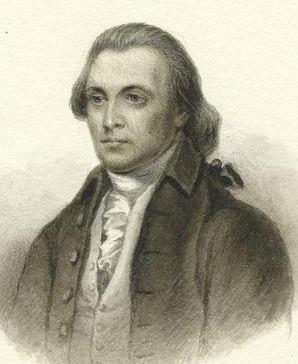
The next day, Silas Deane (shown above) of Connecticut wrote home to his wife:
An express arrived from N York confirming the Acct. of a rupture at Boston. All is in Confusion. I can not say, that all Faces, gather paleness, but they all gather indignation, & every Tongue pronounces Revenge. The Bells Toll muffled & the people run as in a Case of extremity they know not where, nor why.
As of the morning of 8 September, the Congress was still anxious for news. Adams wrote to his wife Abigail:
When or where this Letter will find you, I know not. In what Scenes of Distress and Terror, I cannot foresee.—We have received a confused Account from Boston, of a dreadfull Catastrophy. The Particulars, We have not heard. We are waiting with the Utmost Anxiety and Impatience, for further Intelligence.

The Effect of the News We have both upon the Congress and the Inhabitants of this City, was very great—great indeed! Every Gentleman seems to consider the Bombardment of Boston, as the Bombardment, of the Capital of his own Province. Our Deliberations are grave and serious indeed.
And Deane wrote:
We are all in the greatest anxiety, that of a most cruel suspence as to the certainty of the Boston rupture, as No fresh intelligence has as yet arrived.
TOMORROW: Fresh intelligence at last.

Thursday, July 25, 2024

Sorting Out the Solemn League and Covenants

In his 1915 study of the Solemn League and Covenant for the Colonial Society of Massachusetts, Albert Matthews concluded that the text of that boycott agreement he called Form A was the original text from the Boston committee of correspondence, and Form B the variation from Worcester.

Matthews based that conclusion on several points:
(1) As the form sent out from Boston was frequently, if not generally, regarded as too drastic, it is reasonable to infer that the more drastic of the two forms was the one sent out from Boston, and of the two forms A and B, A is the more drastic.

(2) Every town in Massachusetts received a copy of the Boston form. Westford is in Middlesex County and so presumably would have received only the Boston form. The document [from Westford] exhibited to-day is form A.

(3) Every town in Worcester County received a copy of the Boston form and also a copy of the Worcester form. At the bottom of the broadside (form B) owned by the American Antiquarian Society is written, in the hand of Isaiah Thomas, the words “This came from Sutton.” Since Sutton is in Worcester County, the Sutton document might conceivably be either the Boston form or the Worcester form; but as a matter of fact the Sutton document is form B, and so presumably is the Worcester form.

(4) Five newspapers were published in Boston in 1774, but only two of these printed the Solemn League and Covenant,…and this is form A. It is reasonable to assume that the only form printed in the Boston papers was the form sent out by the Boston Committee of Correspondence.
When I started this series of postings, I thought that was convincing. But as I looked at Matthews’s sources and others, I found myself coming to the opposite conclusion.

Here are some points Matthews missed. First, he assumed that people objected to the Boston committee’s draft as “too drastic,” and indeed the merchants of the town did make that complaint. But in a footnote Matthews acknowledged that organizers in Worcester had circulated “even more drastic” language, so we have to consider the possibility that those men thought the Boston draft wasn’t drastic enough.

Matthews assumed that the Worcester committee sent its draft only to other towns in Worcester County. But he quoted evidence that Braintree considered text “much like the Worcester covenant” on 27 June and Falmouth (now Portland, Maine) had received “the non-importation Agreement form’d at Worcester” by 30 June.

The Boston News-Letter did indeed print Form A, but it prefaced it this way: “The foregoing is a Copy of a Covenant, which I am told great Pains are now taking to promote in the Country.” The newspaper didn’t specify the agreement that followed was the Boston committee’s proposal. Rather, the phrase “in the Country” hinted at a rural origin.

The 22 June Pennsylvania Journal printed Form B below “a Circular Letter, written by the Committee of the Town of BOSTON,” suggesting that printer William Bradford had received them together. The Boston text sent on 8 June most likely reached Bradford days before the Worcester text sent on 13 June. Even if he had both in hand, Bradford clearly cited documents from Boston.

We know that the Boston committee spread its text outside of Massachusetts. Silas Deane wrote a letter responding to a copy in Wethersfield, Connecticut, on 13 June, before he could have received the Worcester committee’s version. That appears to have been Form B. [Deane’s letter casts doubt on that book’s assertion that Wethersfield actually adopted the Solemn League on 15 June; I’ve found no official town action.] Form B was also the basis of the Portsmouth, New Hampshire, variation (Form C).

In contrast, we don’t know that the Worcester committee sent its text outside Massachusetts. Its letter referred to recipients as “fellow-countrymen,” which in this period usually meant people from the same colony.

Finally, here are two facts that Matthews acknowledged but set aside. A copy of Form A at the Massachusetts Historical Society is labeled “Worcester Covenant.” The printer’s type and watermark of that copy match the printed letter issued by Worcester’s committee on 13 June—though Matthews explained that away by saying all these documents must have been printed in Boston since Isaiah Thomas hadn’t yet set up the first press in Worcester.

Looking at all that evidence, I reconstruct the sequence of events this way:
  • late May and early June: The Boston committee of correspondence and Worcester County radicals both drafted calls for a stronger boycott on British goods until the Boston Port Bill was repealed.
  • 8 June: The Boston committee sent out its printed circular letter and suggested Solemn League and Covenant (Form B) to all towns in Massachusetts and to allies in other colonies.
  • by 10 June: After feedback from Worcester, if not other places, the Boston committee sent a second printed circular letter approving other language as long as it led to the same broad boycott.
  • 13 June: The Worcester committee of correspondence wrote a new Solemn League and Covenant (Form A) based mostly on the Boston text but incorporating some of its earlier draft and sent that out with a printed circular letter to all towns in Massachusetts.
  • 20 June: Worcester formally adopted its form of the Solemn League and Covenant.
  • 22 June: The Pennsylvania Journal printed the Boston committee’s draft.
  • 23 June: The Boston News-Letter printed the Worcester committee’s draft, saying it was being promoted “in the Country.”
  • 27 June: Braintree adopted the Solemn League and Covenant in a form “much like the Worcester covenant,” according to the 30 June Massachusetts Spy.
  • before 28 June: The Portsmouth, New Hampshire, committee of correspondence sent out its variation on the Boston draft (Form C).
  • 30 June: Falmouth considered “the non-importation Agreement form’d at Worcester” and decided to ask other towns what they were doing.
  • 4 July: Westford adopted the Solemn League and Covenant with the Worcester text and started gathering signatures.
  • 14 July: Attleboro adopted the Solemn League and Covenant with the Worcester text and started gathering signatures.
In sum, Worcester’s version of the Solemn League and Covenant became the standard text within Massachusetts while Boston’s version spread outside the colony. This was an early example of Worcester’s radicals (who were, of course, not living under military occupation) being more confrontational than the usual troublemakers in Boston.

TOMORROW: One town’s debate.

Sunday, August 28, 2022

Mrs. Macaulay, Dr. Franklin, and Habeas Corpus

In late 1776 the Scottish artisan James Aitken, after receiving some encouragement of American diplomat Silas Deane, left incendiary bombs in the Royal Navy dockyards at Portsmouth and Bristol.

The British authorities tracked down Aitken, who had become known as “John the Painter.” He was tried, convicted, sentenced, and hanged by 10 Mar 1777. (Read the whole story in Jessica Warner’s study The Incendiary.)

Lord George Germain led the national government in another response to Aitken’s attacks: a Treason Act. Like laws that Parliament enacted during previous wars, this allowed the government to hold anyone suspected of treason or piracy without bail or trial—i.e., to suspend the right of habeas corpus—for the rest of the calendar year.

Parliament renewed this law each year until the end of the American war. The Massachusetts General Court passed a similar law to deal with traitors, though it promised more protections for the accused. Eventually the U.S. Constitution would carve out a wartime exception to habeas corpus as well.

Britain’s Treason Act was on Catharine Macaulay’s mind when she visited Paris at the end of 1777. Though her country wasn’t yet at war with France, there were American rebels in the capital—Deane, Arthur Lee, and most famously Benjamin Franklin.

I assume Mrs. Macaulay and Dr. Franklin had met in London during the 1760s when they were both Whig celebrities, but I don’t know if they became more than acquaintances. In late 1777, the two figures were definitely at the same dinner parties. According to Elizabeth Arnold, “Mrs. Macaulay met him several times, among the literati of Paris, at dinners given on her account, but she never received him at her hotel.”

Macaulay made a point of not visiting Franklin or inviting him to visit her. She explained herself to him in a letter dated 8 December:
Sir

I have some affaires which demand my immediat return to England. You are very sensible that the suspenssion of the Habeas Corpus Act subjects me to an immediat imprisonment on any suspicion of my having held a correspondence with your Countrymen on this side the Water. This Sir is the only reason why I did not fix a day to have the honor of seeing you at my own Hotel and why I have not been more forward in availing myself of my present situation to hold converse with my American friends who reside in this Capital.

I am sure Sir that you and every generous American would be exceedingly concerned to hear that my feeble constitution was totaly destroyed by a long imprisonment and to see me fall a sacrifice to the resentment of administration unpitied and unlamented as an impertinent individual who would needs make a bustle where she could not be of the smallest service and especially Sir as I hope the whole tenor of my conduct must have convinced you that I would with pleasure sacrifice my life to be of any real use to the public cause of freedom and that I am now nursing my constitution to enable me to treat largely on our fatal civil wars in the History I am now about.

I am Sir with a profound respect for your great Qualities as a Statesman Patriot and Phylosopher Your Very Obedient Humble Servant.
By “our fatal civil wars,” Macaulay meant the war then taking place in America—the very war that made it dangerous for her to be seen as too close to Franklin. And once again, Macaulay made a point of her delicate health.

COMING UP: Back home in Bath.

Friday, March 15, 2019

“He would raise a thousand Men at his own expence”?

At last night’s presentation on the John and Abigail Adams and George Washington, I related an anecdote that circulated at the First Continental Congress. It raised a question, so I decided to take a closer look at the record.

On 31 Aug 1774, John Adams dined with South Carolina delegate Thomas Lynch, Sr. (1727-1776, shown here) and wrote this into his diary:
He told us that Coll. Washington made the most eloquent Speech at the Virginia Convention that ever was made. Says he, “I will raise 1000 Men, subsist them at my own Expence, and march my self at their Head for the Relief of Boston.”
Silas Deane of Connecticut heard the same story about George Washington, writing home to his wife in the middle of September:
It is said that in the house of Burgesses in Virginia, on hearing of the Boston Port Bill, he offered to raise and arm and lead one thousand men himself at his own expense, for the defence of the country, were there need of it. His fortune is said to be equal to such an undertaking.
Adams recalled his conversation with Lynch in the autobiography he wrote in the early 1800s:
Mr. Lynch a Delegate from South Carolina, who, in conversation on the Unhappy State of Boston and its inhabitants, after some Observations had been made on the Eloquence of Mr. Patrick Henry and Mr. Richard Henry Lee, which had been very loudly celebrated by the Virginians, said that the most eloquent Speech that had ever been made in Virginia or any where else, upon American Affairs had been made by Colonel Washington.

This was the first time I had ever heard the Name of Washington, as a Patriot in our present Controversy, I asked who is Colonel Washington and what was his Speech?

Colonel Washington he said was the officer who had been famous in the late french War and in the Battle in which [Gen. Edward] Braddock fell. His Speech was that if the Bostonians should be involved in Hostilities with the British Army he would march to their relief at the head of a Thousand Men at his own expence. This Sentence Mr. Lynch said, had more Oratory in it, in his Judgment, than all that he had ever heard or read.
And in an 11 Nov 1807 letter to Dr. Benjamin Rush, Adams included the story among the influential “anecdotes” that preceded Washington:
Mr Lynch of South Carolina told me before We met in Congress in 1774 that “Colonel Washington had made the most eloquentt speech that ever had been Spoken upon the Controversy with England, viz That if the English Should Attack the People of Boston, he would raise a thousand Men at his own expence and march at their head to New England to their Aid.”
It’s a pity that there’s no basis to Lynch’s story. Sources from Virginia, where people were after all most likely to have heard Washington speak, say nothing about it.

Lynch and Adams spoke at the end of August. The Virginia delegation to the Congress started to arrive on 3 September, with Washington coming the next day. Yet the story continued to spread among the New England delegates, as shown by Deane repeating it in the middle of September. Even decades later, when Adams repeated the story, he didn’t write about now knowing it was untrue.

Evidently people were so impressed by Washington’s reported promise to march a thousand men to Boston that no one actually asked him about it.

Saturday, July 28, 2018

A Letter of Recommendation for the Baron de Steuben

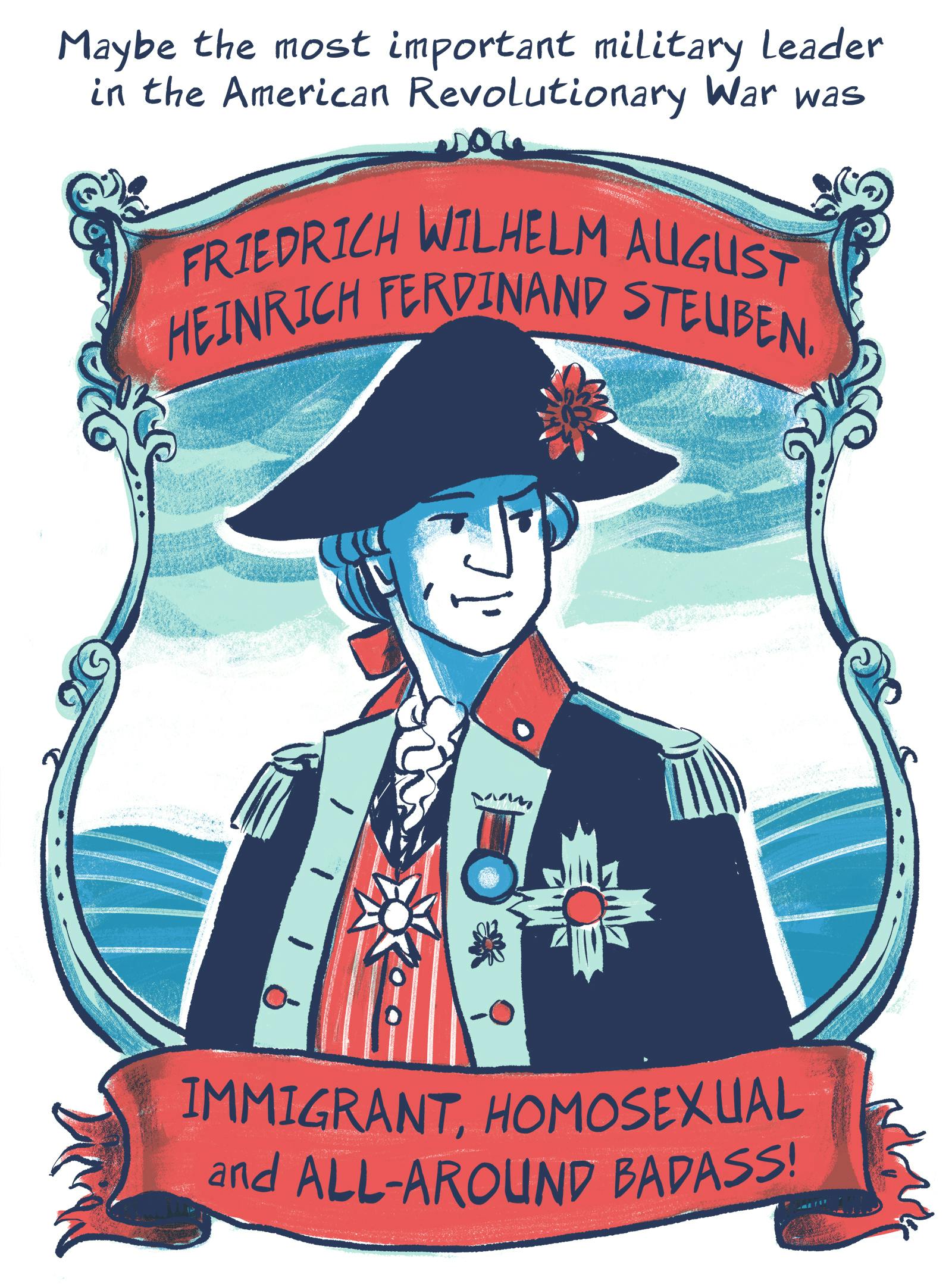
Yesterday I started to analyze evidence about Gen. Friedrich Wilhelm von Steuben’s sexuality. In sum, I think that evidence strongly suggests he was gay, but it’s not nearly as definite as popular articles have recently claimed.

I’m drawing from the draft of an essay I started years ago, somewhat abashed that I’m pulling it off my hard drive in response to a cartoon. Nevertheless, here’s the second installment of replies to claims in that cartoon.

“Franklin knew about Von Steuben’s past, but still decided to write a letter of recommendation to George Washington.”

There’s no evidence Benjamin Franklin knew about the allegations of child-molesting or homosexuality against Steuben in the principality of Hohenzollern-Hechingen. That statement rests on the assumptions that (a) that gossip reached Paris by September 1777, and (b) Franklin heard it. But actual evidence would be some document showing that Franklin knew more facts than he let on.

In fact, the evidence we have suggests Franklin knew less. Here’s the letter that he and his fellow envoy  Silas Deane sent to Gen. George Washington on 4 Sept 1777, recommending Steuben for a role in the Continental Army. The diplomats wrote:
The Gentleman who will have the Honour of waiting upon you with this Letter is the Baron de Steuben, lately a Lieutenant General in the King of Prussia’s Service, whom he attended in all his Campaigns, being his Aide Camp, Quartermaster General, &c. He goes to America with a true Zeal for our Cause, and a View of engaging in it and rendring it all the Service in his Power.
Steuben had never been “a Lieutenant General in the King of Prussia’s Service” or a “Quartermaster General.” He had indeed been an aide de camp to Frederick the Great for a while, but his highest Prussian army rank was captain. He’d been working in the civil government of a small German state since 1764.

I have to add that there’s nothing in Steuben’s European career to suggest he had “a true Zeal” for America or republican government, unlike some other Old World officers offering their services. He had personal reasons, both legal and financial, for sailing thousands of miles from home.

Where did Franklin and Deane get their information about Steuben? They dropped the names of two French high officials: “Mr Le Comte de Vergennes,” the foreign minister and spymaster, and “Mr Le Comte de St Germain,” the minister of war. St. Germain especially admired the Prussian military, and his attempts to reform the French army along those lines ran into such opposition that he resigned later that September.

But most of the American diplomats’ information probably came from Steuben himself. And he was a habitual liar. In John Macauley Palmer’s 1937 biography there’s an index entry for “Steuben…, his fictitous autobiography, 2-5, 53, 85-6, 103-108, 305, 407.” And those pages don’t even include all of his false claims to have become become a lieutenant general in Europe (e.g., 97, 138).

Palmer viewed Steuben as indispensable to American independence, and he didn’t want to believe that his hero lied as he offered his services to the young nation. In fact, when Palmer considered that possibility early in his research, he was ready to set aside the project. He wrote:
My first reaction upon discovering that my hero was a systematic, circumstantial and deliberate liar, was one both of disgust and disappointment. I was disposed to proceed no further with my book. Here was, indeed, a golden opportunity for a debunker or a muckraker, but that sensational role made no appeal to me. 
But eventually Palmer came up with a way to explain the discrepancy between the baron’s actual résumé and what Franklin and Deane wrote about him: Franklin came up with the lie. 

This approach depended on Franklin’s status in American culture and memory. We accept him as a trickster. From his teen-aged essays as “Silence Dogood” to his false supplement for a Boston newspaper printed at Passy and how we remember the oil in his cane, we enjoy stories of Franklin fooling people. We don’t tell such stories about Washington, Adams, or Hamilton, and Jefferson’s duplicity still gets people angry.

In the case of Steuben, Palmer decided that the baron didn’t make any false claims about his career to Franklin (who was supposedly too smart to fall for such lies, anyhow). Instead, Franklin was so smart that he made up those falsehoods himself. He recognized how useful Baron de Steuben would be near the top of the Continental Army. Therefore, he ensured that Gen. Washington and the Continental Congress would treat this newcomer as a man of invaluable experience who deserved top rank by harmlessly—even helpfully—inflating his Prussian credentials.

As for the hapless Silas Deane, Palmer blamed him for falsely claiming to have seen documents to confirm the baron’s credentials—a deception that, unlike Franklin’s, he couldn’t forgive. Palmer didn’t present the simpler possibility that Steuben had fooled Deane. The baron appears to have flashed papers and described their contents at his first meeting with the American envoys, but never handed them over; at the second meeting he said that, alas, he had left those documents behind.

Thus, Palmer rejected the evidence that Baron de Steuben was gay and argued that he was—if only at this crucial moment—honest about his past. Many later authors who accept that Steuben was gay have adopted Palmer’s conclusion that he was also honest. But if there’s one thing we can say for sure about the baron, it’s that he told a lot of lies about himself.

The simplest explanation for the glowing recommendation that Franklin and Deane sent to Gen. Washington is that they actually believed what Steuben had told them about his brilliant career. And the simplest explanation for why Franklin didn’t write anything about the baron being gay is not that he covered up that fact but that the baron didn’t tell him.

TOMORROW: Gen. Steuben in the Continental Army.

Friday, July 27, 2018

What Do We Know about Gen. de Steuben’s Sexuality?

Last month The Nib published Josh Trujillo and Levi Hastings’s comic about Gen. Friedrich Wilhelm von Steuben as a gay man.

I found it inaccurate at several spots. Yet the core message—that Steuben was both important to the Continental Army’s success and sexually attracted to other men—is almost certainly correct. It’s just that a lot of the details, especially those supporting that conclusion, are wildly exaggerated.

Most of the evidence about the Baron de Steuben’s sexuality appears in John Macauley Palmer’s 1937 biography, General von Steuben. Palmer admired Steuben greatly and disliked the idea of the baron being gay, so he tried hard to refute the evidence, leaving logical circles in the ground as he spun. But he did publish the relevant sources in English translation.

Many of the original European documents were probably destroyed in World War 2, along with others that might have been helpful. It’s therefore unlikely that we’ll find new evidence from Steuben’s lifetime. But we can do a better job than Palmer of interpreting those documents and spotting the most likely conclusions.

This comic instead overstates the evidence in various ways. It doesn’t cite sources but appears to have been based on articles written for American newspapers, magazines, and websites over the past twenty-five years since Randy Shilts’s Conduct Unbecoming focused attention on Steuben as a gay man.

I’ll go through the statements I think are exaggerated.

“Steuben lived openly as a homosexual before the term was even invented.”

It’s true that the word “homosexual” was coined in 1868. More important (as Trujillo and Hastings later acknowledge), people’s understanding of sexuality and expectations of how gay men behave were different in the Baron de Steuben’s lifetime and in our own. So what does it mean to say he “lived openly as a homosexual”?

Gen. de Steuben was a lifelong bachelor. He didn’t marry a woman while having affairs with men, as it was and is said of his monarch Frederick the Great of Prussia, Frederick’s brother Prince Henry, and Lord George Germain in Britain. The baron’s title was too new, his estate too small, to make a direct heir necessary. In that respect, Steuben was more like Horace Walpole or Charles Paxton.

But neither is there any evidence of Gen. de Steuben claiming a longtime partner or expressing sexual interest in males. When he set up a household with a young man late in life, he presented that man as his secretary.

Some of Gen. de Steuben’s letters express affection for other men more plainly than 20th-century male correspondents did, but there are similar letters between eighteenth-century men who had active heterosexual lives. Even in the baron’s circle, there’s a lot of joshing about young ladies, whether sincere or not.

So the comic’s statement that Steuben “lived openly as a homosexual” is highly questionable at best.

“Steuben was expelled from Germany on charges of sodomy.”

There was of course no political entity called “Germany” in Steuben’s lifetime. He was born in Prussia, but in the late 1760s and early 1770s he was a powerful government minister in the small principality of Hohenzollern-Hechingen. And then suddenly he wasn’t.

The baron met with American envoys Silas Deane and Benjamin Franklin in Paris in the summer of 1777, but they couldn’t promise him a rank and good pay in the Continental Army. He instead sought a position in Baden. An official from that small country wrote to the prince of Hohenzollern-Hechingen on 13 Aug 1777:
It has come to me from different sources that M. de Steuben is accused of having taken familiarities with young boys which the laws forbid and punish severely. I have even been informed that that is the reason why M. de Steuben was obliged to leave Hechingen and that the clergy of your country intend to prosecute him by law as soon as he may establish himself anywhere.
That’s the principal contemporaneous evidence for Gen. de Steuben’s homosexuality. We might even say the baron wasn’t accused of “sodomy” but of molesting children (in the original French, “d’avoir pris avec de jeunes garçons des familiaritiés, que les Loix defendent & punissent sévérément”). Again, the period’s understanding of sexual behavior is significant: the Prussian court appears to have revived the classical Greek admiration of adolescent boys as a noble way of expressing homosexual desire.

About five days after this letter was drafted, Steuben was back in Paris, over 300 miles away. Now he was quite interested in the Americans’ offer. By 4 September the baron had signed on to their cause, on 10 September he left Paris for Marseilles, and on 26 September he sailed for America, never to return.

All that said, no one has found evidence that Baron de Steuben faced formal “charges of sodomy” or that he was officially “expelled” from any country. Palmer even argued that the real problem in Hohenzollern-Hechingen was a budget crunch, and that the accusations of sexual misconduct were trumped up by Steuben’s court enemies—though he offered no evidence for such enmity. But the most likely explanation is that Baron de Steuben left his post and then Europe under a cloud because of those accusations of sexual misconduct, thus removing himself in a bid to keep the scandal as quiet as possible.

So again, The Nib’s comic takes the incomplete, somewhat murky evidence from Steuben’s lifetime and offers readers a definite statement reflecting modern expectations.

TOMORROW: What Franklin, Washington, and others knew.

Tuesday, May 16, 2017

Orreries in a Time of War

Silas Deane was the first American diplomat in Paris during the Revolutionary War, trying to win support for the Continental Congress from the French government.

Since France was a monarchy, Deane decided to do some old-fashioned fawning, presenting influential people with special gifts from America.

On 28 Nov 1776 he wrote to the Congress’s Committee of Secret Correspondence, which was directing foreign policy:
I wish I had here one of the best saddle-horses of the American or Rhode Island breed. A present of that kind would be money well laid out with a certain personage. Other curious American productions at this time would, though trifles in themselves, be of consequence rightly timed and placed. I mentioned Mr. [David] Rittenhouse’s orrery in a former letter, and I think Arnold’s collection of insects, etc., but I submit any step of this kind to your mature judgment.
I haven’t come across that “former letter,” but a few days later, on 3 December, Deane wrote to John Jay with the same bright ideas—and an identification for that “certain personage”:
The queen is fond of parade, and I believe wishes a war, and is our friend. She loves riding on horseback. Could you send me a narrowhegansett horse or two; the present might be money exceedingly well laid out. Rittenhouse’s orrery, or Arnold’s collection of insects, a phaeton of American make and a pair of bay horses, a few barrels of apples, of walnuts, of butternuts, etc., would be great curiosities here, where everything American is gazed at, and where the American contest engages the attention of all ages, ranks, and sexes.
On 10 May 1777, John Adams wrote to his wife:
Upon a Hint, from one of our Commissioners abroad, We are looking about for American Curiosities, to send across the Atlantic as presents to the Ladies. Mr. Rittenhouse’s Planetarium, Mr. Arnolds Collection of Rareties in the Virtuoso Way, which I once saw at Norwalk in Connecticutt, Narragansett Pacing Mares, Mooses, Wood ducks, Flying Squirrells, Redwinged Black birds, Cramberries, and Rattlesnakes have all been thought of.

Is not this a pretty Employment for great Statesmen, as We think ourselves to be? Frivolous as it seems, it may be of some Consequence. Little Attentions have great Influence. I think, however, We ought to consult the Ladies upon this Point. Pray what is your Opinion?
I haven’t found Abigail Adams’s reply to the idea of shipping rattlesnakes and other curiosities to Queen Marie Antoinette.

The man behind “Arnold’s collection of insects” was Edward Arnold of Norwalk. On his way to the Congress in May 1775, Robert Treat Paine “Went to see Mr. Edward Arnold and saw his Museum a very large Collection of Birds, Insects, Fossils, Beasts, Fishes &c w’h he has been 9 yrs collecting.” Those curiosities did eventually make its way to Europe. According to Adams, Arnold sold his collection to William Tryon, royal governor of New York, who shipped it to London. Those specimens went into Sir Ashton Lever’s private museum.

It’s not clear to me how Deane expected the Congress to obtain a Rittenhouse orrery for Marie Antoinette. Was the Congress to buy or confiscate one of the devices from the college at Princeton or Philadelphia? [The one at Philadelphia appears above.] Or did he want the legislature to commission a new device from Rittenhouse, despite the going price of £300-400?

In January 1777, soon after Deane wrote, the British and Continental Armies battled over the town of Princeton, each occupying the college buildings in turn. The Congress’s envoy to Spain, Arthur Lee, told Deane and Benjamin Franklin that “The barbarity of these Sarracen Invaders went so far as to destroy the Philosophical Apparatus at Princeton College, with the Orrery constructed by Dr. Rittenhouse.” That report was exaggerated, but after that news Deane stopped asking about shipping over an American orrery for the queen.

TOMORROW: Boston’s own orrery.

Tuesday, June 14, 2011

“Some resolutions which they had come into”

While folks in New England were discussing whether to occupy the Charlestown and Dorchester heights, here’s what the Continental Congress was up to in Philadelphia:
The Congress met and agreeable to the order of the day, resolved itself into a committee of the whole, to take into consideration &c.
As a committee of the whole, the Congress didn’t have to keep notes on its deliberations. In fact, it had been working as a committee of the whole for so long the secretary didn’t even bother to write out what they were considering.
After some time spent thereon, the president resumed the chair, and Mr [Samuel] Ward [of Rhode Island] reported, that not having yet come to a conclusion they desired him to move for leave to sit again. At the same time they desired him to report some resolutions which they had come into.

The resolutions being read, were adopted as follows:

Resolved, That six companies of expert rifflemen, be immediately raised in Pensylvania, two in Maryland, and two in Virginia; that each company consist of a captain, three lieutenants, four serjeants, four corporals, a drummer or trumpeter, and sixty-eight privates.

That each company, as soon as compleated, shall march and join the army near Boston, to be there employed as light infantry, under the command of the chief Officer in that army.

That the pay of the Officers and privates be as follows, viz. a captain @ 20 dollars per month; a lieutenant @ 13 1/3 dollars; a serjeant @ 8 dollars; a corporal @ 7 1/3 dollars; drummer or [trumpeter] @ 7 1/3 doll.; privates @ 6 2/3 dollars; to find their own arms and cloaths.

That the form of the enlistment be in the following words:
I have, this day, voluntarily enlisted myself, as a soldier, in the American continental army, for one year, unless sooner discharged: And I do bind myself to conform, in all instances, to such rules and regulations, as are, or shall be, established for the government of the said Army.
Upon motion, Resolved, That Mr. [George] Washington, Mr. [Philip] Schuyler, Mr. [Silas] Deane, Mr. [Thomas] Cushing, and Mr. [Joseph] Hewes be a committee to bring in a dra’t of Rules and regulations for the government of the army. . . .

Resolved, That the Congress will, to Morrow, resolve itself into a committee of the whole, to take into consideration the ways and means of raising money, and the state of America. This to be a standing order, until the business is compleated.

Adjourned till to Morrow at 9 o’Clock.
The record doesn’t really say what was significant about those resolutions. The Congress was accepting control of the army outside Boston, as the Massachusetts delegation had requested weeks before. In other words, it was legally turning the New England colonies’ combined army into the Continental Army. Furthermore, the Congress was going to pay for regiments from three other colonies to head to Cambridge and join the soldiers there.

Of the five men put on the committee to draw up rules for the army, the first two—Washington and Schuyler—would shortly be made commander-in-chief and major-general of that army. (That’s Schuyler up above.)

As a result, 14 June is usually treated as the anniversary of the founding of the U.S. Army, as well as (by coincidence) the anniversary of the establishment of the U.S. flag in 1777. But which was more significant?

Tuesday, May 04, 2010

The True Story of Isaac Bissell

We don’t have the original letter that Joseph Palmer dashed off on the morning of 19 Apr 1775, alerting the Massachusetts Provincial Congress’s political allies in Connecticut that the British army had killed people at Lexington and asking speedy passage for the man carrying it. Instead, we have copies of that letter, hastily written at stops along the post riders’ route.

It’s only natural that errors crept into Palmer’s text. By the time the note reached New York, it referred to “Israel Bessel” and “T. Palmer.” Later copies, such as the one transcribed in Charles Burr Todd’s A General History of the Burr family in America (1872), appeared to render the rider’s name as “Trail Bissell.”

So we need to go back to the earliest copies that survive. The one from Brooklyn, Connecticut, now owned by the National Heritage Museum, gives the name Israel Bissell. But according to this article, a copy signed by Connecticut official Silas Deane and owned by the William L. Clements Library in Michigan names the rider as “Mr. Isaac Bissell.” And a copy transcribed from the Springfield archives also names “Mr. Isaac Bissell.”

The name “Isaac Bissel” appears in the records of the Massachusetts Committee of Safety, authorizing payment for “a Post-Rider’s Account.”

That brings me to the research that Lion G. Miles has shared through iberkshires.com, the Berkshire Eagle, and Connecticut History.

According to Miles and his citations, all the papers in the Massachusetts Archives about the post rider who carried Palmer’s message are signed by “Isaac Bissell,” who identified himself as from Suffield, Connecticut, near the Massachusetts border. In July 1775, the Provincial Congress approved his bill for six days of expenses while riding “to Hartford,” but then that body dissolved for elections and no one got around to paying the man.

In March 1776 Bissell wrote to Palmer: “Sir you may Remember when Lexinton Fite was you gave me an Express to Cary to Hartford in Connecticut which I did. . . .I think I Earn my money.” Finally on 23 April the Massachusetts House voted to pay Isaac Bissell the £2.1s. he’d asked for.

So I now believe that Isaac Bissell rode to the Connecticut capital of Hartford, probably by way of Worcester and Springfield. An accurate copy of the letter he carried was sent on to Deane, who lived one town below Hartford in Wethersfield. Meanwhile, another rider or set of riders, names unknown to us, was carrying another copy of Palmer’s letter south from Worcester to Brooklyn, Norwich, and New London, and then along the coast to New York. That copy rendered the original courier’s name as “Israel Bissell,” and Isaac wasn’t around to correct that error or further deviations.

According to lineages published by the D.A.R. and S.A.R., after returning home to Suffield, Isaac Bissell (1749-1822) enlisted in a Connecticut regiment and marched back to Boston to participate in the siege. He was a sergeant in Col. Erastus Woolcott’s regiment until March 1776, and later mustered as part of the New Haven Alarm of July 1779. After the war he worked as a blacksmith in Suffield. His grave in the Suffield cemetery (shown in the thumbnail above; click for a full set on Flickr from caboose_rodeo) has been identified as that of a Revolutionary veteran for decades.

What about the Israel Bissell buried in Hinman Hinsdale, Massachusetts? His grave has gotten special attention from the D.A.R., and he’s been lauded in poetry, song, and art as the forgotten equal to Paul Revere. But all that celebration is just because of a spelling error.

Thursday, January 07, 2010

Clo Pratt at Old Sturbridge Village, 18 Jan.

I thought I’d finished with announcements of events this month, and then I read how Old Sturbridge Village is offering a historical presentation on an intriguing and hard-to-research aspect of life in colonial America:

Storyteller and museum educator Tammy Denease Richardson will present “Life after Slavery: the Clo Pratt Story” as part of the Martin Luther King Jr. Day activities at Old Sturbridge Village Jan. 18. The performance is based on the true story of Clo Pratt, an African-American woman born into slavery in Massachusetts in 1737. . . .

In character as former slave Clo Pratt, storyteller Richardson introduces her audience to a fascinating woman whose story has been obscured through history, but who was influential in the African-American community of her day. In 1774 after her owner’s death, Pratt finds she has been willed her freedom and must earn a living and make a place for herself in colonial New England.
Old Sturbridge normally presents life in the 1830s, but also tries to do well by other aspects of life in central New England, and this is one of them.

Clo Pratt was owned by the Rev. Daniel Russell of the Rocky Hill section of Wethersfield, Connecticut; it was common for New England ministers to own a person or two as household servants. Russell died in 1767. His widow Katherine made out a will in June 1773 that said:
my will is that my Negro woman Named Cloe prut Shall then Be free and Have Her time and also I Give to Her the Bead that She Lyeth on and furniture Belonging to it and a Loom that she weaveth in and tackling & a porige pot one old Chest with one Draw one puter pint pot one knife and fork and a plate and one puter platter and one quart Bason one tramil peil and tongs two old Chairs one pail one Small Square table one Large trunk and Several Books that are Called Her own one Small Brass Kittel and my Every Day wearing apperel and a Red Short Cloak and two spoons
I’m especially struck by “Several Books that are Called Her own.”

Eventually Pratt, by then in her sixties, lived with Hagar and Pompey Dorus, who had been enslaved in the house of Silas Deane.

In January, Old Sturbridge Village is offering free admission for children not in school groups when accompanied by an adult. Other King Day activities include “ice skating (bring your own skates), sledding on 1830s-style sleds, and sleigh rides (snow permitting).”

Sunday, January 03, 2010

Unlikely Events and Unlikely Allies

On Saturday the Boston Globe ran a brief interview with Joel Richard Paul, author of Unlikely Allies: How a Merchant, a Playwright, and a Spy Saved the American Revolution. The paper described that book as “a story too good not to tell—involving the celebrated French dramatist Caron de Beaumarchais, a cross-dressing secret agent named the Chevalier d’Eon, and a boatload of duplicity, hypocrisy, and corruption.”

I hadn’t thought that D’Eon de Beaumont had much to do with the American Revolution, but the book’s jacket copy says the chevalier’s “decision to declare herself a woman helped to lead to the Franco-American alliance.” I’ll have to put this on my list.

The interview contained some interesting observations about researching and interpreting historical documents:

Q. Tell me about doing research for this book. These are three pretty fringe characters you write about.

A. I spent a lot of time at the archives of the French foreign ministry and Bibliotèque nationale de France. I love France, but let’s just say that library science is not their forte. I came away convinced they hadn’t lost their colonies as much as misfiled them.

Q. We like to put the Founding Fathers on a pedestal, and your book paints a quite flawed and human picture of them. What kind of response are you getting?

A. When I speak to groups I always start off saying that the one thing we all know about the diplomacy of the American Revolution is that Ben Franklin went to France in 1776 and forged the Franco-American alliance that provided us with arms. And that’s wrong. Most people are very surprised, and very interested.

Q. Does it make you wonder how many more people are out there who changed the course of history and who we know nothing about?

A. Yeah. I think that most of us start with the assumption that history is shaped by great men or great ideas or great social movements. And one of the things I’ve seen is the extent to which history is shaped by accident, and people acting on the periphery of great events.
Another lively book based, like this one, in Silas Deane’s stumbling attempts at diplomacy and espionage is The Incendiary (also published as John the Painter), by Jessica Warner; I wrote more about it here.

Paul’s third answer above brings up the the question of “agency”—historians’ jargon for the idea that individual decisions can affect the course of major events. Usually that argument gets played out through “great men” and women, leaders making decisions for many other people. But might the real argument for individual effects lie in the plane of peripheral events, quirky accidents, and unintended consequences?