


J. L. BELL is a Massachusetts writer who specializes in (among other things) the start of the American Revolution in and around Boston. He is particularly interested in the experiences of children in 1765-75. He has published scholarly papers and popular articles for both children and adults. He was consultant for an episode of History Detectives, and contributed to a display at Minute Man National Historic Park.

Subscribe thru Follow.it


•••••••••••••••••


Showing posts with label John Paterson. Show all posts

Thursday, March 27, 2025

The Short Military Career of Lt. Col. Thomas Williams, Jr.
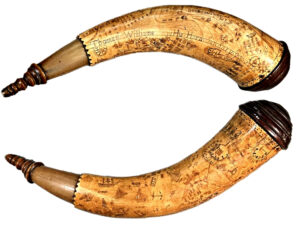
The Journal of the American Revolution just published Tim Abbott’s article about Lt. Col. Thomas Williams, Jr. (1746–1776), of Stockbridge.

Williams left behind an engraved powder horn, now in the collection of the Stockbridge Library Museum and Archives. It shows Boston landmarks.

(This is different from the Dr. Thomas Williams powder horn recorded by Rufus Alexander Grider in 1888 and now lost.)

The siege lines around Boston contained some professional horn carvers selling their work to men who wanted souvenirs of military service. I suspect the Williams horn is one like that. As an officer and as a lawyer in civilian life, he probably didn’t have the time or inclination to do his own carving.

As Abbott’s article recounts, Williams was one of two minute company captains who responded to the Lexington Alarm from Stockbridge. The other company included a score of men from the town’s Native community and thus gets more attention.

As the troops besieging Boston organized themselves into an army enlisted through the end of the year rather than an emergency militia force, Williams became part of Col. John Paterson’s regiment. In September he volunteered for Col. Benedict Arnold’s expedition through Maine to Québec.

However, Williams was in the rear guard led by Lt. Col. Roger Enos (1729–1808), who in late October decided to turn back. That was controversial. Enos was tried and acquitted in a court-martial. He was probably lucky to go through that procedure before the army at Cambridge received “Colonel Arnolds evidence,” as Gen. George Washington reported.

Williams left Paterson’s regiment at the end of 1775, but on 9 Jan 1776 he became lieutenant colonel of a new regiment under Col. Elisha Porter to be sent up to Québec along Lake Champlain and the St. Lawrence River. This time Williams made it to the outskirts of the city, but smallpox was weakening the Continental forces.

Those Americans were trying to inoculate and fight the war at the same time. Abbott writes:
The timing for the deliberate exposure of Porter’s Regiment to smallpox could not have been worse. The inoculation process required effective quarantine for three to four weeks, during which the men were both weak and contagious. Even for those under treatment, severe cases could still develop and mortality rates under the best conditions still ran 1 to 2 percent. Porter’s men had no more than three days in hospital after they were inoculated before the siege was dramatically lifted by the arrival of a British fleet on May 6 and the American forces were soon driven back upriver in full retreat. Not only were they exposed to physical stress while they developed smallpox symptoms, but they became a significant vector for the spread of the disease to others in its more deadly form.
The American commander, Gen. John Thomas, died on 2 June. Lt. Col. Williams led his men back to Crown Point, New York, before falling ill. He didn’t make it home to Stockbridge.

Williams doesn’t appear to have left behind his own diary or letters—his powder horn might have been his only personal record of military service, and it probably wasn’t his own creation. Abbott has therefore done the work of reconstructing his career by weaving together official records and other officers’ accounts.

Wednesday, February 15, 2023

“They ordered out both their Regiments to fire on Each other”

In his 24 Sept 1775 intelligence report, Dr. Benjamin Church, Jr., didn’t just describe dissatisfied enlisted men in the Continental Army.

He also wrote about the disputes among officers in the forces besieging Boston.

One paragraph of Church’s letter described a conflict that I haven’t found mentioned anywhere else:
A Quarrell happened between Col. Bruer and Col. Patterson, at length they got so high, that they ordered out both their Regiments to fire on Each other, but were Quelled by a third that was ordered to fire on them both in case they did not disperce which they did,
“Col. Patterson” was John Paterson (1744–1808, shown here) from Lenox by way of Connecticut. His regiment was assigned to Gen. William Heath’s brigade and thus stationed near the center of the lines.

Identifying “Col. Bruer” is less certain because the Continental Army had two colonels with the surname Brewer: Jonathan of Waltham and David of Palmer. They were in fact brothers, born in Framingham.

Col. Jonathan Brewer’s regiment was part of Gen. Nathanael Greene’s brigade, centered on Cambridge and Charlestown. Col. David Brewer’s regiment was assigned to Gen. John Thomas’s brigade, thus in Roxbury. I don’t know which was closer to Paterson’s position.

I suspect Paterson quarreled with David Brewer, who in October was cashiered for paying his teen-aged son as a lieutenant while the boy was back on the farm and other petty matters. The court-martial record said this Col. Brewer acted “contrary to the repeated remonstrances of the Officers of the regiment,” so it makes sense for another colonel to criticize him as well.

On the other hand, back in the spring Jonathan Brewer got a reputation for arguing with other officers about recruiting. So it’s possible Paterson harbored some hard feelings from that.

Cols. John Paterson and Jonathan Brewer reenlisted in 1776. Brewer, who had been wounded at Bunker Hill, shifted to the Massachusetts regiment of artificers later that year. Paterson (shown above) went on to become a major general.

Another conflict Church was happy to report on:
They begin to try Colonels and Captains for bad behaviour at Bunkers Hill battle, three Colonels have been Cashired and several Captains for their Cowerdice—and could the Army in General have their will General [Artemas] Ward wou’d go for one, for he never so much as gave one Written order that day.
There was indeed a short series of courts-martial in late 1775 removing officers from the army, either for misbehavior at Bunker Hill or for similar failings. (Sometimes, it seems, an officer’s behavior in that battle wasn’t bad enough on its own but left the man with no more chances to screw up.)

Gen. Artemas Ward definitely had his detractors. But he had exercised control during the Bunker Hill battle, sending spoken orders to the commanders on the Charlestown peninsula and to the other sections of the siege lines, which he also had to maintain.

TOMORROW: Dr. Church’s secrets and tales.