J. L. BELL is a Massachusetts writer who specializes in (among other things) the start of the American Revolution in and around Boston. He is particularly interested in the experiences of children in 1765-75. He has published scholarly papers and popular articles for both children and adults. He was consultant for an episode of History Detectives, and contributed to a display at Minute Man National Historic Park.

Subscribe thru Follow.it


•••••••••••••••••


Showing posts with label espionage. Show all posts

Tuesday, July 14, 2026

Interrogating Elizabeth and Mary Hill at the Boston Jail

Back in April I wrote a series of postings about John Hill, his wife Elizabeth (?), and their daughter, captured on board the brig Elizabeth as they evacuated Boston in March 1776.

Recently I stumbled back across a source I may have seen before since I could have mentioned it in 2012. But I viewed it with new eyes.

As you recall, on 12 Oct 1776, Patriots in New London detected the two female Hills trying to carry secret letters onto British-occupied Long Island. They sent those women back to Boston, where John Hill was locked up, for questioning.

The records of the Boston committee, inspection, and safety, published by the New England Historical Genealogical Society in 1880, let us fill out that story.

On 21 October, the committee met at the house of Joseph Otis, the jailkeeper. The merchant William Davis chaired. They summoned “One Mrs. Hill Wife of one Hill now in the Jayl of this County examined together with her Daughter” about the incriminating papers they were carrying when detained.

The committee minutes say:
A Letter of recommendation given Mrs. Hill by Dr. [Benjamin] Church was read, together with the other Papers found upon her.

Mrs. Mary Hill the younger was brought in, and examined particularly with respect to Dr. Church, and one Ralph Cunningham mentioned in the Paper, the latter of whom appeared to be a Person who had made Courtship to the said Hill & supposed to be in the British Army at New York.
This source thus tells us that John Hill’s daughter was named Mary, and that she must have been the daughter of John Hill who married Lt. Cunningham of the Legion in 1779, as I guessed here.
Mrs. Hill the Mother was brought in & examined more particularly with respect to Mr. John Timmins of this Town Merchant, who was characterized by Hill the Husband, as a person who had been faithful to Government [i.e., Loyalist].

Mrs. Hill being asked who it was that delivered her the Paper wrote by her Husband answered. that she could not well recollect but thought it was one Richard Newton.
Well, of course we know what happened next: the authorities went on a hunt for Timmins and Newton.

TOMORROW: Further investigation.

Tuesday, June 09, 2026

“Paul Revere and Plan B” in Medford, 11 June

On Thursday, 11 June, I’ll speak to the Medford Historical Society on the topic of “Paul Revere and Plan B: Planning and Improvisation in the Lexington Alarm.”

Our event description says:
After the Battle of Lexington & Concord on April 19, 1775, Massachusetts resistance leaders portrayed the uprising as a mostly spontaneous response to the army’s incursion into a peaceful countryside. Decades later, Henry W. Longfellow presented “Paul Revere’s Ride” as nearly a one-man show.

In truth, the Massachusetts Patriots had prepared for months to resist the Crown military. Revere was part of a network of organizers, informants, and alarm riders. At the same time, Revere and his colleagues succeeded by being able to respond to contingencies by changing their plans.

Drawing on new research, this talk will shed light on one of independent America’s oldest stories—and how the day could have turned out differently.
I developed an earlier, short version of this talk for the 19th of April several years ago, and now I’m backloading it with more about Revere’s pre-war propaganda and espionage work.

The society will meet at the Charlotte and William Bloomberg Medford Public Library starting at 7 P.M. This event is free and open to the public.

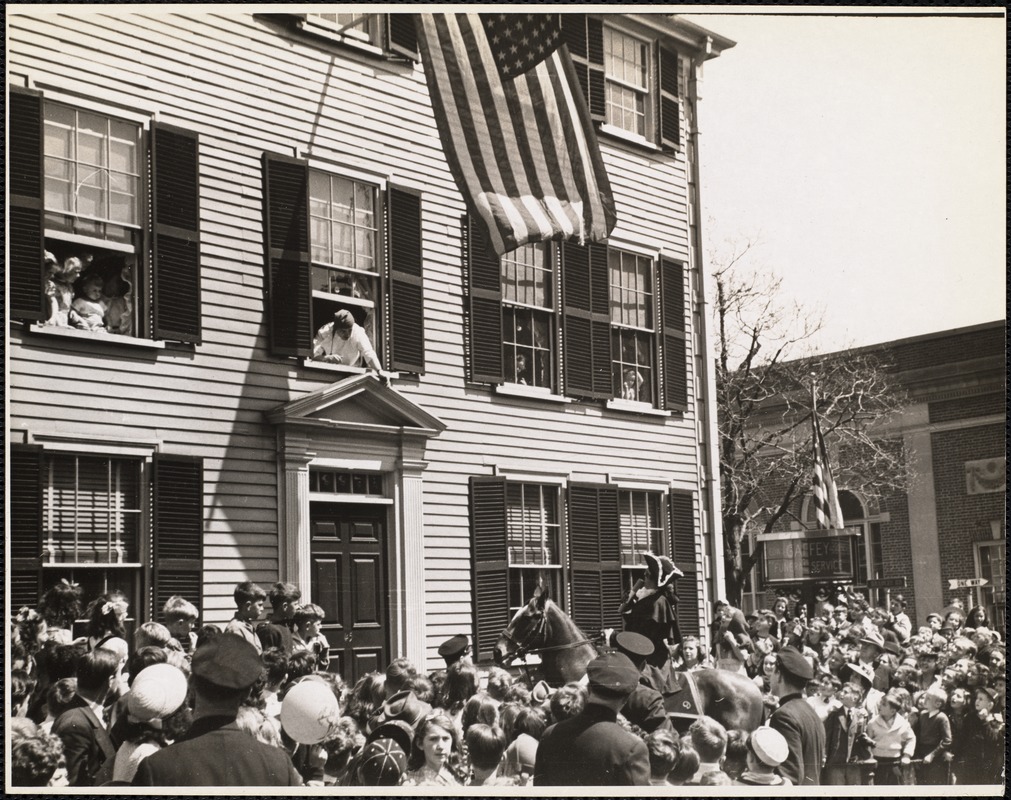
(The photograph above, which comes courtesy of Digital Commonwealth, shows the reenactment of Paul Revere’s stop at the Isaac Hall House in Medford sometime in the mid-1900s.)

Saturday, May 30, 2026

“How the Shooting Began in 1774” in Hampstead, N.H., on 2 June

On Tuesday, 2 June, I’ll be at the Hampstead, New Hampshire, public library, speaking to the Hampstead Historical Society about “How the Shooting Began in 1774: The Start of the Revolutionary War in New Hampshire.”

Here’s our event description:
Officially the Revolutionary War began with the Battle of Lexington and Concord in April 1775, but the first exchange of fire between the king’s government and the Patriots came the previous December in New Hampshire. The bloodless fight over Fort William & Mary in Portsmouth harbor was one stage of a months-long “arms race” as New England’s royal governors and political resistance vied to seize cannon and other artillery supplies in preparation for a war. This talk explores the mass demonstrations, armory break-ins, shadow governments, and espionage that brought on the war.
I’ll be drawing on The Road to Concord and more recent research to pander to the local audience speak bold truths about the start of the Revolutionary War—a story that starts months before the 19th of April and involves events hundreds of miles apart.

This free event is scheduled to take place from 6:30 to 8 P.M. at the library.

This talk is made possible by New Hampshire Humanities, N.H.P.B.S., and the Cogswell Benevolent Trust. It’s part of the “By the People: Conversations Beyond 250” series of community events developed by the Federation of State Humanities Councils and the Smithsonian Center for Folklife and Cultural Heritage.

Thursday, May 14, 2026

Twenty Years of Boston 1775

Twenty years ago today, on 14 May 2006, I posted my first item on this blog.

That post was a link to an article I’d written for the magazine then called New England Ancestors, now American Ancestors, published by the New England Historical and Genealogical Society.

The original link broke. A subsequent link from 2012 broke. But Boston 1775 is still here.

That article described how a message from Dr. John Homans to his mentor, Dr. Joseph Gardner, in the first days of the Revolutionary War was detoured by the duplicitous Dr. Benjamin Church, Jr.

Last August I revealed other messages that Dr. Church diverted into the files of Gen. Thomas Gage, from Boston magistrate Edmund Quincy to his daughter Dorothy and her fiancé, John Hancock.

Tonight I’m speaking in Stoneham about how Dr. Church managed to infiltrate Gen. George Washington’s network for sneaking intelligence out of besieged Boston before the Continentals realized their surgeon-general as a spy.

One way to look at this situation is that after twenty years of daily blogging I’m still working the same ground.

Another is that Dr. Benjamin Church’s treachery is an endless source of revelations and fun.

Tuesday, May 05, 2026

Upcoming Talks in Woburn and Stoneham

As April started, I planned to spend just a few days on the capture of the Elizabeth, one of the Loyalist evacuation fleet.

I expected to focus on that brig’s two most prominent passengers, Crean Brush and William Jackson, and then sail on.

But then other passengers—the Wheatons, the Hills—turned out to have their own stories, which hit some of my prime interests: espionage, mythmaking, and other suspect behavior.

So here it is early May, and I haven’t even gotten to the legal wrangling around the Elizabeth and its cargo, which took months to settle in 1776 and could take many days to recount.

But I’ll break off from that topic to announce a couple of public talks next week (speaking of espionage, mythmaking, and other suspect behavior).

Tuesday, 12 May, 6:30 to 8 P.M.
Before He Was Count Rumford: Benjamin Thompson’s American Youth
Woburn Public Library, Fireplace South Gallery

Even as a teenager and young man, Woburn’s own Benjamin Thompson was intelligent, ambitious, and full of trouble. This talk tracks the future count through his failed apprenticeships (he blew himself up only once) to his youthful marriage, dealings with royal governors, and first known affair. The outbreak of war in Massachusetts presented young Thompson with bigger dangers—and opportunities.

This talk is free to the public. Register for a seat here. There are no plans to record this talk.

Thursday, 14 May, 7 to 8:30 P.M.
George Washington’s Spy—and Stoneham’s Minister?
Stoneham Historical Society and Museum

Twelve days after arriving in Massachusetts as the new commander-in-chief of the Continental Army, George Washington paid a man to go into Boston and secretly report on British “movements & designs.” For two centuries that person’s name remained hidden. Recent research reveals that he was John Carnes, a grocer with an unusual past: he had started his career in the 1750s as Stoneham’s minister. This talk uncovers Carnes’s background, his role in the first Continental spy network, and what happened to him when the British commander had his own spy among the Massachusetts Patriots.

This event is free, with donations welcome. Doors will open at 6:45 P.M. for museum viewing, and there will be a brief historical society business meeting at 7:15 before the presentation at 7:30. Again, I don’t think this talk will be recorded. [UPDATE: There are now plans to record this talk for sharing later on StonehamTV.]

Sunday, May 03, 2026

“When passing at Brooklyn Ferry was strictly examined”

In October 1776, as recounted here and here, John Hill’s wife Elizabeth (?) and his daughter were stopped at New London and found to be carrying secret messages to the royal authorities on Long Island.

Ironically, a few years later John became inspector at the Brooklyn Ferry, charged with detecting deserters, smugglers, and spies.

That brings me to a letter that Abraham Woodhull wrote on 19 May 1781, after a visit to New York, as quoted by Morton Pennypacker in George Washington’s Spies on Long Island and in New York:
Your very pressing letter of the 3d inst. came to hand. And it is a matter of grief to me that I cannot completely execute your request. When at New York myself, together with Culper Junior [Robert Townsend] almost racked our invention to point out a proper person and made several attempts but failed—no person will write.

The enemy have got some hint of me for when passing at Brooklyn Ferry was strictly examined and told some vilian supported a correspondence from this place. I do assure you am greatly alarmed—and wished to be relieved from my present anxiety. I shall not think it safe for me to go to New York very soon—and can only supply you with verbal accounts as hath been the case for some time.

If that will answer let me know as shall continue as heretofore until I hear from you. . . .

In haste am Yours Sincerely,
Saml. Culper.
John or Richard Hill, or both, had put the scare into the leader of the Culper Ring. We don’t know if Woodhull was right to suspect those inspectors of suspecting him. But of course he had to be careful.

Other members of that cell, such as Austin Roe, were still getting information out of New York City, but Woodhull stuck to Long Island for a time.

TOMORROW: A second evacuation.

Tuesday, April 28, 2026

“For attempting to Carry Intillegence to the Enemy”

As I quoted back here, on 12 Oct 1776 the New London committee of correspondence detected two women trying to carry secret letters into British-occupied New York.

Due to the quirks of weekly newspaper publication, the first report of the arrest of those women didn’t appear in New London’s newspaper but on 17 October in the Independent Chronicle of Boston:
Last Saturday two Women were apprehended at New-London and properly secured, for attempting to convey a Number of Letters to the Commanders of the Foreign and British Mercenaries there, containing a very particular Account of the Situation of this and the adjacent Towns, with their present state of Defence.—

Some of them were wrote by a certain John Hill, now a Prisoner in this Town.
A week later, the Independent Chronicle updated its readers:
Last Tuesday, the Wife and Daughter of one John Hill, mentioned in our last to have been apprehended at New-London, for attempting to convey Intelligence to the Enemy at New-York, were brought to this Town, and committed to safe Custody.
That meant the Boston jail. As I said yesterday, I suspect the older woman was named Elizabeth Hill, and the younger might have been John Hill’s daughter by a previous marriage.

In his 1858 History of Eastern Vermont, Benjamin H. Hall stated:
Hill, on the 4th of June [1776], petitioned for his release, alleging as reasons the dying condition of his wife, and the starving state of his mother and daughter.
Hall presumed that request was granted because “it is well known that cruelty was not a characteristic of the conduct of the Americans in the war of the revolution.” 

In fact, Hill’s wife and daughter remained in custody for months.

TOMORROW: A look inside the jail.

Monday, April 27, 2026

“Possessed of that sweet Disposition towards all Mankind”

I’ve been hunting for the names of John Hill’s wife and daughter in 1776.

According to the profile of Hill at the Loyalist Directory, his first wife was Ann Powell (1737–1775), and they had a son named John in 1764.

If that’s true, Hill remarried quickly after Ann’s death since newspapers and legal documents say he had a wife by the fall of 1776. We might presume his daughter came from the first marriage.

Intriguingly, Boston’s marriage intentions list the couple ”John Hill & Eliza Kennedy” with the date of 7 Oct 1776. (But as a reminder about common names, that same volume shows men named John Hill marrying women named Elizabeth in 1753, 1759, 1784, and 1793—and women named Hannah in 1756 and 1808.)

The 29 April 1779 New-York Gazette stated that “Mrs. ELIZABETH HILL, Wife of John Hill, Esq;” had just died. It called her “A Woman amiable in her the domestic Relations, and possessed of that sweet Disposition towards all Mankind, which nothing but Christianity can bestow.” I’m guessing she’s the same wife as three years earlier.

As for Hill’s daughter, the 22 Nov 1779 New-York Gazette reported the marriage of “Miss Hill, Daughter of Mr. John Hill,” to “Lieut. Cunningham, of the Legion.” Alas, the newspaper didn’t provide the young people’s first names. The lieutenant might well be Ralph Cunningham, given John’s link to William Cunningham. Lt. Cunningham was killed in a fight at Hanging Rock, South Carolina, on 6 Aug 1780.

The reason John Hill’s wife and daughter are so interesting is that, as recounted yesterday, in 12 Oct 1776 the New London committee of correspondence stopped them from crossing onto Long Island and found they were carrying incriminating papers.

The Connecticut Gazette described “sundry Papers, containing Matters of Intelligence respecting the People, and State of the Country, sent from said Hill and others in Boston, to be communicated to General [William] Howe.”

What’s more, the women didn’t seem to be carrying that correspondence unknowingly. The article went on: “it appeared from the Papers found upon them, that they had been possessed of other Papers, which they had secured or destroyed.”

Hill’s wife and daughter “were both sent back with the Papers, under a proper Convoy, to the Place from whence they came,” reported to be Providence, Rhode Island.

TOMORROW: A family reunited.

Sunday, April 26, 2026

“John Hill be sent under a proper Guard to Boston Goal”

As recounted yesterday, on 25 Apr 1776 the Massachusetts General Court issued a resolve to catch John Hill, an Irish-born Loyalist accused of helping to loot Boston as the British evacuated.

I haven’t found any newspaper advertisements for Hill, suggesting that local authorities located him within just a few days.

The Marblehead committee of correspondence sent the man back to Watertown, and on 1 May the legislature passed a new act: 
Whereas John Hill a Prisoner now before this Court is justly suspected to have been assisting Crean Brush in Robbing the Inhabitants of the Town of Boston of their Goods & Merchandize

It is therefore
Resolved that the said John Hill be sent under a proper Guard to Boston Goal, there to be confined as a prisoner until he shall be Examined by the Seven Justices of the Peace of the County of Suffolk or the major part of them who are appointed to try associators and abetters of the Ministerial Army, which Justices are impowered to Examine the said Hill and deal with him in the same manner as if he had remained in Boston after the said Fleet & Army had gone away
Magistrates in Boston were questioning a long list of people who had stayed in town through the siege about their political loyalties.

Boston’s “goal” or jail appears on the detail from the 1769 town map above, but barely. At the bottom of that image are two large buildings: the Town House, now the Old State House (lowercase a), and the First or Old Brick Meeting-House (big A). Above the meeting-house is the label “Church Square.” And above that, mostly worn off because of a fold, is the label “Prison.” That building faced onto Queen Street, now Court Street—named for the courthouse, which was conveniently near the prison.

Hill remained in that Boston jail for several months. The United States declared independence. The British military returned to New York in force.

On 18 October, the Connecticut Gazette of New London reported:
Last Saturday [12 October], the Wife and Daughter of one John Hill, a Prisoner in Boston Goal, for being concerned with Crean Brush and others, in Robbing the Inhabitants of Boston, when that Place was evacuated; came to this Town from Providence by Water, and was endeavouring to get a Passage to the West End of Long-Island, but were stopped by the Committee of this Town, and on Examination were found upon them, sundry Papers, containing Matters of Intelligence respecting the People, and State of the Country, sent from said Hill and others in Boston, to be communicated to General [William] Howe;…
TOMORROW: Mystery women.

Thursday, November 13, 2025

The Vanishing of Mary Wenwood?

As recounted earlier, Gen. George Washington had Mary Wenwood brought his headquarters to answer questions about a ciphered letter she had given to her former husband to pass on.

The woman held out against the general’s questioning for hours. But still under guard the morning after she arrived, she gave up the name of the cipherer: her lover, Dr. Benjamin Church.

After that, Mary Wenwood fades from the historical record. She had every reason to adopt a low profile. Gen. Washington kept her name out of his official report and paperwork. No surviving informal comment on the episode mentions her name. 

But men had a lot to say about her character. Indeed, just as she vanished as a person, she started to appear as a character in a moral fable—the downfall of a doctor.

James Warren, speaker of the Massachusetts house, called her “a suttle, shrewd Jade” and “an Infamous Hussey.” The Rev. Ezra Stiles of Newport said she was “a Girl of Pleasure,” and had carried the ciphered letter “in her stocking on her Leg.” How did he know?

Lt. Ebenezer Huntington of Norwich, Connecticut, told his brother: “the Plot was discoverd by his [Church’s] Miss who is now with Child by him and he owns himself the father (for he has Dismissed his Wife).” Huntington was stationed in Roxbury, far from Washington’s headquarters, and had no link to people in the case. No one closer to the investigation said the woman was pregnant. Some other details in Huntington’s account are wrong. Therefore, unless other evidence turns up, I think this was probably baseless gossip.

Here are further facts possibly about Mary Wenwood.

The 14 December 1775 New-England Chronicle reported that the Cambridge post office was holding mail for a woman named Mary Butler—which was Mary Wenwood’s maiden name.

Mary was the most common given name for women, and Butler a fairly common surname. Wainwood/Wenwood/Wanewood was much less common. Indeed, all mentions of “Wenwood” and its variants in late-1700s New England newspapers lead back to Godfrey Wenwood, Mary’s former husband.

That said, Newport vital records show that another Mary Wenwood, wife of Frederick Wenwood, gave birth to a baby girl named Mary in December 1785, and that couple baptized a baby girl named Mary (perhaps a new one) in June 1787. Even an uncommon name isn’t necessarily unique.

The most tantalizing clues are that a Mary Wainwood/Wanewood was in and out of the Boston almshouse after the war:
  • Admitted 6 May 1785, left 30 May 1786.
  • Admitted 29 Feb 1792.
  • Admitted 12 Jan 1793.
  • Admitted 25 Apr 1797, died 23 May 1797.
And that last entry stated that the woman was from Rhode Island.

Tuesday, November 11, 2025

“i expeted you would have arote to me be for this”

Several of the questions after my talk in Watertown about Dr. Benjamin Church, Jr., involved his lover Mary (Butler) Wenwood.

Unfortunately, we have lots of rumors and little hard evidence about this woman, and I’m wary of overstating what we know. But I can share some more information and leads for further research.

We have a note in Mary Wenwood’s own handwriting, preserved in the George Washington Papers at the Library of Congress.

This note is undated, but it appears to have prodded her former husband, Godfrey Wenwood, into showing a ciphered letter she’d previously left with him to the Patriot authorities in Rhode Island. That happened in September 1775, so it’s likely Mary Wenwood wrote this note that month.

She addressed it “To Mr. godfrey wenwood / Baker / in Newport” but added no signature. Neither the handwriting nor spelling is clear:
Dear sir—

i now Sett Down to right a fue Lines hoping thay will find [you] in good helth as thay Leave me

i expeted you would have arote to me be for this But now i expet to Sea you hear every Day i much wonder you never Sent wot you promest to send if you Did i never reseve it so pray Lett me know By the furst orpurtnuty wen you expet to be hear & at the Same time whether you ever Sent me that & wether you ever got a answer from my sister i am a litle unesey that you never rote

thar is a serten person hear wants to Sea you verey much So pray com as Swon as posebell if you righ[t] Direct your Lettr to mr Ewerd Harton Living on Mr t apthorps farm in Little Cambrig
It’s tempting to treat personal details in the letter—the “sister,” “the serten person hear [who] wants to Sea you verey much”—as clues. But those could just as well have been parts of a cover story, to fool Godfrey or someone else who might see the note into thinking it’s all about a family matter.

The real tenor of this note is anxiety about having received no answer to the earlier, ciphered letter. Mary was even suspicious that Godfrey hadn’t sent it on (which he hadn’t). She wanted to know what was happening. Dr. Church was probably hoping some money was on its way to him.

The information about how to send a reply to Mary Wenwood must therefore have been sincere. “Little Cambridge” was the portion of that town on the south side of the Charles River which we now call Brighton. The local historian Lucius Paige found an Edward/Edmund Horton living there in 1776.

The note suggests Horton was living on the estate of Thomas Apthorp (1741–1818), one of several younger sons of Charles and Grizzell Apthorp. In 1858 the Rev. Nicholas Hoppin wrote, “James and Thomas Apthorp Esqrs., brothers of the missionary [Rev. East Apthorp], also had houses…in what is now Brighton, then called Little Cambridge,” but James (1731–1799) moved to Braintree in 1768.

That same year, Thomas lobbied to become a deputy paymaster for the army, as his father had been. With that affiliation, he would have been inside Boston when the war broke out, and he would leave with the British troops in March 1776. Horton might have been looking after Apthorp’s country estate.

Mary Wenwood could have been living on that estate, or she could have been living nearby. Godfrey showed up at her home toward the end of September, asking about the ciphered letter. Mary refused to answer his questions. So Gen. George Washington ordered her brought to his headquarters.

TOMORROW: Rumors and unanswered questions.

Monday, November 10, 2025

“Writing this has employed a day”

Dr. Benjamin Church, Jr., used a variety of ways to send messages into Boston after the start of the war, including:
  • crossing the siege lines himself in April 1775 and pretending to have been placed under arrest.
  • having a letter “sewed in the waist of [a paid confederate’s] breeches.” That unnamed man was stopped and “confined a few days,” but the letter wasn’t found.
  • possibly piggybacking on a letter from Gen. Charles Lee that Church arranged to be sent into Boston in early July.
  • meeting a Crown agent in Salem. William Warden told the Loyalists Commission “he was sent by General [Thomas] Gage to Salem and Marblehead to receive intelligence from Dr. Benjamin Church, but failed to execute his business.” Church wrote in July, “I have been to Salem to reconnoitre, but I could not escape the geese of the capitol.”
  • asking Gen. George Washington’s staff to send in a letter through the channel they established to communicate to their agent, John Carnes. That document was sent through the hands of military secretary Joseph Reed, Lt. Col. Loammi Baldwin, a man named Tewksbury raising sheep what’s now Winthrop, and a waterman going into Boston.
  • And of course asking his mistress, Mary (Butler) Wenwood, to arrange for someone she knew in Newport, Rhode Island, to deliver a letter to a royal official there to pass into Boston. Unluckily for them, she chose her ex-husband, Godfrey Wenwood.
Of those communications, only the last letter survives and can be connected with a transmission route because it was intercepted, proving to be Church’s undoing.

For that letter through Newport, Dr. Church used a cipher for added security. One of the many fine questions asked after yesterday’s presentation on Dr. Church was if there were any other ciphered letters from him in Gen. Gage’s papers. I don’t think there are others. And in fact, since the one that incriminated Dr. Church was never delivered, there aren’t any at all.

As part of his defense Dr. Church displayed and translated a letter from his brother-in-law, John Fleeming, written using the same cipher. The doctor said Fleeming had asked him to use the cipher. That letter survives only in printed translations. Earlier Church told Washington that he had received and destroyed another ciphered letter from Fleeming, but that might have been the same one he later displayed.

In General Gage’s Informants, Allen French identified other letters from Dr. Church in the general’s papers on the basis of internal detail (the writer was about to leave for Philadelphia) or handwriting. Those were all in plain English.

As is the long letter written on 24 Sept 1775 and published in Henry Belcher’s The First American Civil War, which I identified in this post as probably Church’s last report to his royal handlers.

It appears, therefore, that Church used the cipher only in exchanges with Fleeming. Why not all the time?

One reason is that having a cipher and sending lots of coded letters might have raised questions. In one of those letters in Gage’s files Church said that an encounter with an angry man named Timothy had prompted him to destroy his cipher lest people suspect him.

Another factor may simply have been time. It took extra effort to copy each letter symbol by symbol. In the intercepted letter the doctor complained, “Writing this has employed a day.”

We might say that using every means to conceal a spy letter would be time well spent. But in Church’s case, the cipher roused Godfrey Wenwood’s suspicions and was soon broken, but the letters the doctor sent in other ways remained secret for over a century.

Sunday, November 09, 2025

“Let not that man be trusted who can voilate private faith”

The Massachusetts Whigs were flabbergasted by the evidence that Dr. Benjamin Church, Jr., was corresponding with someone behind enemy lines.

By the fall of 1775, those men had worked alongside Dr. Church for a decade. He had helped to compose instructions for representatives, correspondence to Whigs in Britain, and political verse for engravings.

The doctor had delivered the Massacre memorial oration in 1773. He had represented Boston in the Massachusetts Provincial Congress and then the General Court, serving on the most sensitive committees.

His fellow legislators had chosen Church to take important documents to the Continental Congress in Philadelphia, and then to escort Gen. George Washington across the state from Springfield. He was serving as the top doctor in the Continental Army.

Church’s erstwhile colleagues wrote to each other in astonishment.

One group of Massachusetts Patriots who didn’t express such surprise, however, were the Massachusetts Whigs’ wives.

Those women had noted Church’s habit of extramarital affairs, rumored as early as 1769. By 1774 he was maintaining a mistress outside of Boston. To other men’s wives, the doctor’s betrayal of Sarah Church made it easy to believe he’d betrayed his political movement as well.

Abigail Adams wrote to her husband John on October 9:
You have doubtless heard of the viliny of one who has professd himself a patriot, but let not that man be trusted who can voilate private faith, and cancel solem covanants, who can leap over moral law, and laugh at christianity.
Mercy Warren, wife of Massachusetts house speaker James Warren, added her voice three days later:
I fear a Late Instance of perfidy and Baseness in one who Rancked Himself among the Friends to the Rights of society and the Happiness of the Community Will occasion many Inviduous Reflections from the Enemies of the American Cause.

I was Ever sorry that there should be one among the Band of patriots Whose Moral Character was Impeachable for when the Heart is Contaminated, and the Obligations of private Life Broken through, And the man has thrown of[f] the Restraints Both of Honour and Conscience with Regard to His own Domestic Conduct, what Dependance is to be Made on the Rectitude of His public Intentions.
Abigail Greenleaf, wife of the publisher Joseph Greenleaf, wrote to her brother Robert Treat Paine on 14 October:
How Sir, did you receive the news of the Perfidy & treachery of Docter Church? Was it not in Silent astonishment? It will I believe, bow down the grey hairs of his Father & Mother, with Sorrow to the grave. His Poor wife too, is an object of the Pitty, & Compassion of every one. She still Loves him, tho, he has treated her in so base a manner. If she looses her senses I think twill not be strange; but it will be melancholy.
Abigail Adams came back to the topic on 21 October:
What are your thoughts with regard to Dr. Church? Had you much knowledg of him? I think you had no intimate acquaintance with him.

“A foe to God was ne’er true Friend to man
Some sinister intent taints all he does.”
The wise response to such questions from a spouse was of course: ‘I agree with you, dear. I barely knew the man. You’re so right.’

Saturday, November 08, 2025

“A proper Method for bringing Dr. Church before the House”

As described yesterday, on 17 Oct 1775 the Massachusetts General Court decided to summon Dr. Benjamin Church to Watertown to explain why he’d sent a ciphered letter into British-occupied Boston.

Dr. Church’s first response to that action arrived on 23 October, as reported by James Warren: “The Speaker communicated to the House a Letter received from Dr. Church, wherein he expresses a Desire to resign his Seat in the House of Representatives.”

The previous month, Church had also tried to resign as Surgeon-General of the Continental Army, following a month of turf disputes with regimental surgeons. Gen. George Washington and his aides had urged him to stay, only to be blindsided by that ciphered letter. Those two resignations suggest that Church was realizing what a hole he’d dug for himself and just wanted to go away.

The legislators didn’t want to let Church go, though. Particularly Speaker Warren. He’d been immersed in this case since Washington had called him to Cambridge to share the first hints of the doctor’s dealings.

Back on 1 October, Warren had written to his friend John Adams:
Dr. C——h has been detected in a Correspondence with the Enemy at least so far that a Letter wrote by him in Curious Cypher . . .

We all thought the Suspicion quite sufficient to Justify an Arrest of him and his Papers, which was done, and he is now under a Guard. He owns the writeing and sending the Letter. Says it was for [John] Fleeming in Answer to one he wrote to him, and is Calculated, by Magnifying the Numbers of the Army, their regularity, their provisions and Ammunition &c, to do great Service to us. He declares his Conduct tho’ Indiscreet was not wicked.
Something had to be done. The legislature therefore voted on 23 October to let Church’s resignation letter “lay on the Table, till the Committee who are directed to consider a proper Method for bringing Dr. Church before the House shall report.”

As Warren and others understood by this time, the Continental Army rules and regulations didn’t allow a court-martial to sentence a spy to death. Gen. Washington was therefore holding off on formal proceedings. His most recent council had decided “to refer Doctor Church for Tryal & Punishment to the General Court of Massachusetts Bay.”

On 26 October the house committee came back with their recommendation. They started by stating that Church “has been convicted by the Judgment of a Council of War, at which his Excellency [Gen. Washington] presided, of having carried on a criminal Correspondence with the Enemy.”

In fact, Washington’s councils weren’t courts and had no power to convict anyone. But neither did the legislature have the power to try and punish Church as the last council suggested—all the General Court could do was expel the doctor. Each body was pushing for the other to take on the authority of judging Dr. Church. And everyone was still waiting for guidance from the Continental Congress.

The General Court voted:
…whereas the said Benjamin Church is also a Member of this House, and the Charge brought against him is of so criminal a Nature, that it is the Duty of the House to make strict Enquiry into the Fact, and upon Proof of the same to manifest their utter Abhorrence thereof:

Therefore, Resolved, That Mr. William Howe, the Messenger of this House, be and he hereby is directed on Friday the 27th of October Instant [i.e., this month], to apply to his Excellency George Washington, Esq; for a sufficient Guard, safely to conduct the said Benjamin Church to and from the Barr of this House, and being furnished therewith, to take the Body of the said Church and bring him to the Barr of the House accordingly, at Ten o’Clock in the Forenoon of the same Day.
On that Friday morning, there was a motion “That there be fixed in the Alley [i.e., aisle] a Bar, at which Dr. Church will be brought.” The stage was set.

I’ll speak about what happened next in Watertown on Sunday afternoon, as detailed here.

TOMORROW: Records of the case.

Friday, November 07, 2025

“The House being jealous of their Priviledges”

As recounted yesterday, on 4 Oct 1775 Gen. George Washington and his fellow generals realized that the Continental Congress’s articles of war weren’t strict enough about passing information to the enemy.

Which was a problem since they had just uncovered evidence that the head of the army’s hospitals, Dr. Benjamin Church, had been doing just that.

In reporting the situation to John Hancock as chairman of the Congress, Washington respectfully wrote that he was “suggesting to their Consideration, whether an Alteration of the 28th Article of War may not be necessary.”

Dr. Church didn’t just have a military appointment. He was also one of Boston’s four representatives in the Massachusetts General Court, elected back on 18 July. Of course, that town meeting hadn’t happened inside British-held Boston. Instead, the “dispersed” inhabitants had gathered in the meetinghouse at Concord.

Dr. Church was active in the first few days of the legislative session in Watertown’s meetinghouse. But in August he took up his new job overseeing the medical care of the army. Two of the other men chosen to represent Boston, Samuel Adams and John Hancock, were away in Philadelphia. That left John Pitts to speak for the town. But that assembly couldn’t do much to affect life in Boston then anyway.

Then in early October came the bombshell news that the army had put Church under arrest. People were soon hearing about why, but this was the house’s first formal response on 14 October:
ORDERED, That Mr. [James] Sullivan bring in a Resolve making a proper Application to General Washington, relative to the imprisonment of one of the members of this House, viz. Doctor Benjamin Church.
The resulting resolution said:
…the House being jealous of their Priviledges, and desirous to know the Cause of said Imprisonment:—— Therefore

Resolved, That the Speaker [James Warren], Mr. Sullivan and Major [John] Bliss, be a Committee to apply to is Excellency George Washington, Esq; requesting him as soon as may be to certify to this House the Cause of the Detention and Imprisonment of said Benjamin Church, Esq; that they may advise thereon.
On 17 October, Warren reported that he had received from Joseph Reed, Washington’s military secretary, “a Letter from Dr. Church to the Enemy, as decyphered by the Rev. Mr. [Samuel] West.” The house voted:
Resolved, That Dr. Church ought to be brought to the Bar of this House, to shew Cause, if any he has, why he should not be expell’d the same.
The next day, Gen. Washington sat down for a council with Benjamin Franklin, Benjamin Harrison, and Thomas Lynch from the Continental Congress and with officials from the New England governments. That meeting would run through 24 October and cover many topics. One item on the agenda was “What Steps are necessary to be pursued with Regard to Dr Church?”

The developments in Watertown offered an out: “Upon a Discussion of all Circumstances it was agreed to refer Doctor Church for Tryal & Punishment to the General Court of Massachusetts Bay.” As for what the army should do, given the articles of war, Washington would wait for the Congress’s guidance.

TOMORROW: Dr. Church makes his move.

Thursday, November 06, 2025

“Examining Dr. Church” in Watertown, 9 Nov.

As previously announced, on Sunday, 9 November, the Historical Society of Watertown and Watertown Free Public Library will host me speaking about “Examining Dr. Church: The Trials of the Revolutionary War’s First Notorious Spy.”

Our event description:
In October 1775, Massachusetts politicians gathered in Watertown to try one of their own on the charge of supplying intelligence to the king’s army.

Dr. Benjamin Church, Jr., had been a leader of Boston’s resistance and then Surgeon-General of the Continental Army. The rebel authorities had collected the reluctant testimony of Church’s mistress and a letter written in cipher—but was that evidence strong enough to impeach the doctor as an enemy spy?
This Sestercentennial talk will start at 2 P.M. in the Watertown Savings Bank Room on the library’s first floor. It will be free and open to the public, thanks to a grant from the Watertown Community Foundation.

Here’s how this inquiry into the Continental Surgeon-General’s actions came to be held in Watertown.

On 14 June, 1775, the Continental Congress created a committee “to bring in a dra’t of Rules and regulations for the government of the army.” To chair that committee, the delegates chose George Washington, formerly colonel in charge of the Virginia regiment, just as they had put him in charge of previous committees on military topics.

However, the next day the Congress voted to make Washington commander-in-chief of that army. So the task of completing those rules shifted to other committee members—probably Silas Deane, Thomas Cushing, and Joseph Hewes. On 17 July the Pennsylvania Packet printed “the rules and articles of war agreed to by the Congress.”

Among those articles was:
Art. XXVIII. Whosoever belonging to the continental army, shall be convicted of holding correspondence with, or of giving intelligence to, the enemy, either directly or indirectly, shall suffer such punishment as by a general court-martial shall be ordered.
In late September, Gen. Washington learned that Dr. Church had broken that rule, at least the part about secretly corresponding with people inside Boston. As serious as that charge was, a Continental court-martial couldn’t order just any punishment. Its options were limited by another article:
Art. LI. That no persons shall be sentenced by a court-martial to suffer death, except in the cases expressly mentioned in the foregoing articles; nor shall any punishment be inflicted at the discretion of a court-martial, other than degrading, cashiering, drumming out of the army, whipping not exceeding thirty-nine lashes, fine not exceeding two months pay of the offender, imprisonment not exceeding one month.
The commander-in-chief called his generals together as a council of war on 4 October. According to the notes of that meeting:
after examining the Regulations of the Continental Army & particularly the Articles 28 & 51—

It was determined from the Enormity of the Crime, & the very inadequate Punishment pointed out that it should be referr’d to the General Congress for their special Direction & that in the mean Time he be closely confined, & no Person visit him but by special Direction.
The Continental commanders couldn’t ignore what Church had done. But they also couldn’t proceed against him, lest they have to let him off with punishment that would be, though degrading to a gentleman, far less than they thought a traitor deserved.

TOMORROW: Passing the buck.

Monday, October 13, 2025

On the Trail of Capt. William Browne

In the HUB History podcast episode “Drinker, Draftsman, Soldier, Spy,” Jake Sconyers quotes my remark on how difficult it is to track Capt. William Browne of the 52nd Regiment before 1775 because there were so many men named William Brown(e).

He also quoted a portion of Ens. Henry DeBerniere’s report on his spy missions with Capt. Browne that I’d read many times but hadn’t tumbled to how it’s helpful with that precise challenge.

One of my favorite moments in that narrative is when Browne, DeBerniere, and their manservant have reached Jonathan Brewer’s tavern in Waltham.

a little out of this town [Watertown] we went into a tavern, a Mr. Brewer’s, a whig, we called for dinner, which was brought in by a black woman, at first she was very civil, but afterwards began to eye us very attentively; she then went out and a little after returned, when we observed to her that it was a very fine country, upon which she answered so it is, and we have got brave fellows to defend it, and if you go up any higher you find it so,—

This disconcerted us a good deal, and we imagined she knew us from our papers which we took out before her, as the General had told us to pass for surveyors; however, we resolved not to sleep there that night, as we had intended, accordingly we paid our bill which amounted to two pounds odd shillings, but in [sic] was old tenor.

After we had left the house we enquired of John, our servant, what she had said, he told us that she knew Capt. Brown very well, that she had seen him five years before at Boston, and knew him to be an officer, and that she was sure I was one also, and told John that he was a regular—he denied it; but she said she knew our errant was to take a plan of the country; that she had seen the river and road through Charlestown on the paper; she also advised him to tell us not to go any higher, for if we did we should meet with very bad usage
That waitress didn’t just recognize Brown—she recognized him from “five years before at Boston.” That was in 1770, and there were only two British army regiments in Boston then: the 29th and the 14th. That narrows the field considerably.

Sure enough, the officers of the 14th included Lt. William Browne. On 12 July 1771, the War Office announced that “Lieut. William Brown, of the 14th regiment of Foot,” had purchased the rank of captain in the 52nd in the place of Archibald Williams. In the 14th, Ens. William Napier moved up to lieutenant’s rank.

One implication of that fact is that Gen. Thomas Gage might have chosen Capt. Browne to scout the countryside in 1775 because that officer was more familiar with Massachusetts than most of his colleagues, having spent about two years in Boston and on Castle Island back in 1768–1770.

Of course, that had the drawback of more people in Massachusetts being familiar with Browne, as the woman in Waltham showed.

For earlier information on Lt. Browne I hunted down the Army List for 1767. And I found this list of lieutenants in the 14th Regiment of Foot:
Goddammit!

Two men named William Browne became lieutenants in the 14th Regiment four days apart in June 1766. One of them had joined the army in 1762, the other at some unknown time. They were both still lieutenants in the 14th at the start of 1771. 

And during the same period when one or both of these lieutenants were serving in Boston:
And there were probably others.

TOMORROW: Capt. Browne’s own voice?

Friday, August 29, 2025

Bell on “Dr. Benjamin Church,” 9 Nov.

As long as I’m discussing Dr. Benjamin Church, Jr., here’s early notice of a talk I’ll give about him for the Historical Society of Watertown this fall.

Sunday, 9 November, 2:00 P.M.
Dr. Benjamin Church
Watertown Free Public Library

The society’s event description says:
Dr. Benjamin Church was a patriot activist who was exposed as a spy for British Major General Thomas Gage. The Massachusetts General Court held an inquiry into his activities from October to November 1775. November 2025 will mark the 250th anniversary of the legislature’s decisions. New details regarding Church's spying activities will be revealed. Attendees will also learn where the Massachusetts General Court held the Church inquiry.

J. L Bell is a writer who specializes in the start of the American Revolution in New England and is the proprietor of the popular Boston 1775 website. A Fellow of the Massachusetts Historical Society and elected member of the American Antiquarian Society and Colonial Society of Massachusetts, he authored the book The Road to Concord: How Four Stolen Cannon Ignited the Revolutionary War as well as a National Park Service study of George Washington’s work in Cambridge. He has written many articles, delivered papers to the Massachusetts Historical Society and appeared on a panel of the Organization of American Historians. Some of his lectures have been broadcast on the C-Span Networks and he has spoken at many historic sites around greater Boston and beyond.
This event will be free and open to the public. Parking in the Watertown library lot is free on Sundays. This historical society’s programming is funded by a 2025 grant from the Watertown Community Foundation.

Thursday, August 28, 2025

“By Doctor Church I send”

As recounted yesterday, after returning from besieged Boston on 23 Apr 1775, Dr. Benjamin Church told Paul Revere that he’d been detained by Gov. Thomas Gage’s troops and kept in a North End barrack for most of his time in town.

Church’s Patriot colleagues accepted that story, probably even admired his daring. They chose him to travel to Philadelphia and consult with the Continental Congress, and the Congress in turn made him Surgeon-General of its army.

However, the documentary record I explored earlier this week casts doubt on Church’s story. While in Boston he was clearly communicating with relatives of his colleagues and offering to deliver letters for them.

On 22 April, Edmund Quincy gave Church two letters to carry out of town: to his daughter Dorothy and to her fiancĂ©, John Hancock. The letter to Dolly Quincy refers to the “opporty (unexpected) by Doctr. Church” to communicate. There’s no apparent worry about Church being under the royal authorities’ control.

In addition, Edmund’s son Henry Quincy wrote a letter to the elder Dr. John Sprague in Dedham, shown here. That too stated: “Dr. Church Arrived here this PM. from Concord on Business with the General is Allowed in the Morning to Return.”

In further addition, Rachel Revere (shown above) wrote a short, undated note to her husband Paul. That began “by Doctor Church I send a hundred & twenty five pounds”—probably devalued Old Tenor currency.

All those documents are in the files of Gen. Gage. Did soldiers seize them from Dr. Church as he left Boston? That wouldn’t explain how those same files contain Dr. John Homans’s note to Dr. Joseph Gardner asking for surgical knives, which Church carried into town. 

When Allen French explored Church’s activities in General Gage’s Informers (1932), the letter from Rachel Revere was one of the prime pieces of proof that the doctor was cooperating with the royal authorities. I wrote about the Homans letter in an article for New England Ancestors in 2006. The Quincy letters add more evidence to that pile.

I wonder what Dr. Church told his colleagues when he arrived back in Cambridge, knowing that their relatives inside Boston would eventually mention that they’d given him letters to deliver. Presumably to maintain his cover the doctor spoke ruefully of having the big, bad soldiers take all his papers away. No one appears to have spoken of those missing documents as evidence of Church’s treachery, even after Gen. George Washington put him under arrest in October.

All the documents I’m speaking of remain in the Thomas Gage Papers at the Clements Library in Michigan. The library has just released digital scans of Gage’s correspondence in the weeks after the start of the war (along with poor computerized transcriptions which I’ve largely ignored). I’m sure there are some surprises to be found, as well as more evidence for what we already know.

Saturday, August 02, 2025

William Jasper and the Resistance

First in Boston 1775 postings and then in this article for the Journal of the American Revolution (also printed in this volume), I posited that Dr. Joseph Warren’s crucial informant on the night of 18 Apr 1775 was a British-born cutler named William Jasper.

I also laid out that argument in this talk for the Colonial Society of Massachusetts in April.

In collecting information about William Jasper, I looked for ties between him and the Boston activists. Of course, he couldn’t appear too close to Dr. Warren’s network in 1774–75 or else he wouldn’t have made a good spy. But I kept hoping for some documented link between Jasper and Boston’s resistance movement.

This summer I stumbled back into this page of signatures on a non-importation agreement from October 1767, protesting the new Townshend duties. It’s at Harvard’s Houghton Library.

And there’s William Jasper’s signature. He pledged to join this boycott several months before his June 1768 marriage to Ann Newman, previously the earliest sign I’ve found that he’d moved from New York to Boston.

What’s more, William Jasper’s signature appears right after John Pulling’s, and on the same sheet as Paul Revere. Those men were probably all in the same neighborhood, or even at the same neighborhood meeting. This sheet thus includes the signatures of three men involved in spreading the alarm on the night of 18 Apr 1775.