


J. L. BELL is a Massachusetts writer who specializes in (among other things) the start of the American Revolution in and around Boston. He is particularly interested in the experiences of children in 1765-75. He has published scholarly papers and popular articles for both children and adults. He was consultant for an episode of History Detectives, and contributed to a display at Minute Man National Historic Park.

Subscribe thru Follow.it


•••••••••••••••••


Showing posts with label Hercules Posey. Show all posts

Thursday, July 16, 2026

New Signage Installed at the President’s House During the Night

Since September 2025 I’ve been following the dispute over displays at the President’s House, part of Independence National Historical Park in Philadelphia.

Reflecting its overall ideology, the Trump White House ordered the National Park Service to replace signs discussing how that site had been a site of enslavement when George and Martha Washington lived there in the 1790s.

Because the city of Philadelphia had participated in creating the exhibit, it claimed legal standing to sue for the signs to be restored. A district judge agreed. A higher judge stopped the restoration process. Over the last month the full circuit ruled that the federal government could control the site and remake the signage.

Yesterday WHYY reported: “Workers replaced the remaining exhibits overnight Tuesday.”
The new exhibit retains references to slavery and those enslaved by Washington while serving as president in Philadelphia, but it devotes significantly more space to the history of the executive mansion and the early presidency. A panel that had been titled “The Dirty Business of Slavery,” for example, has now been replaced by signage that reads, “Celebrating Independence Throughout the Years.”

It also softens Washington’s views on slavery compared to the previous display.

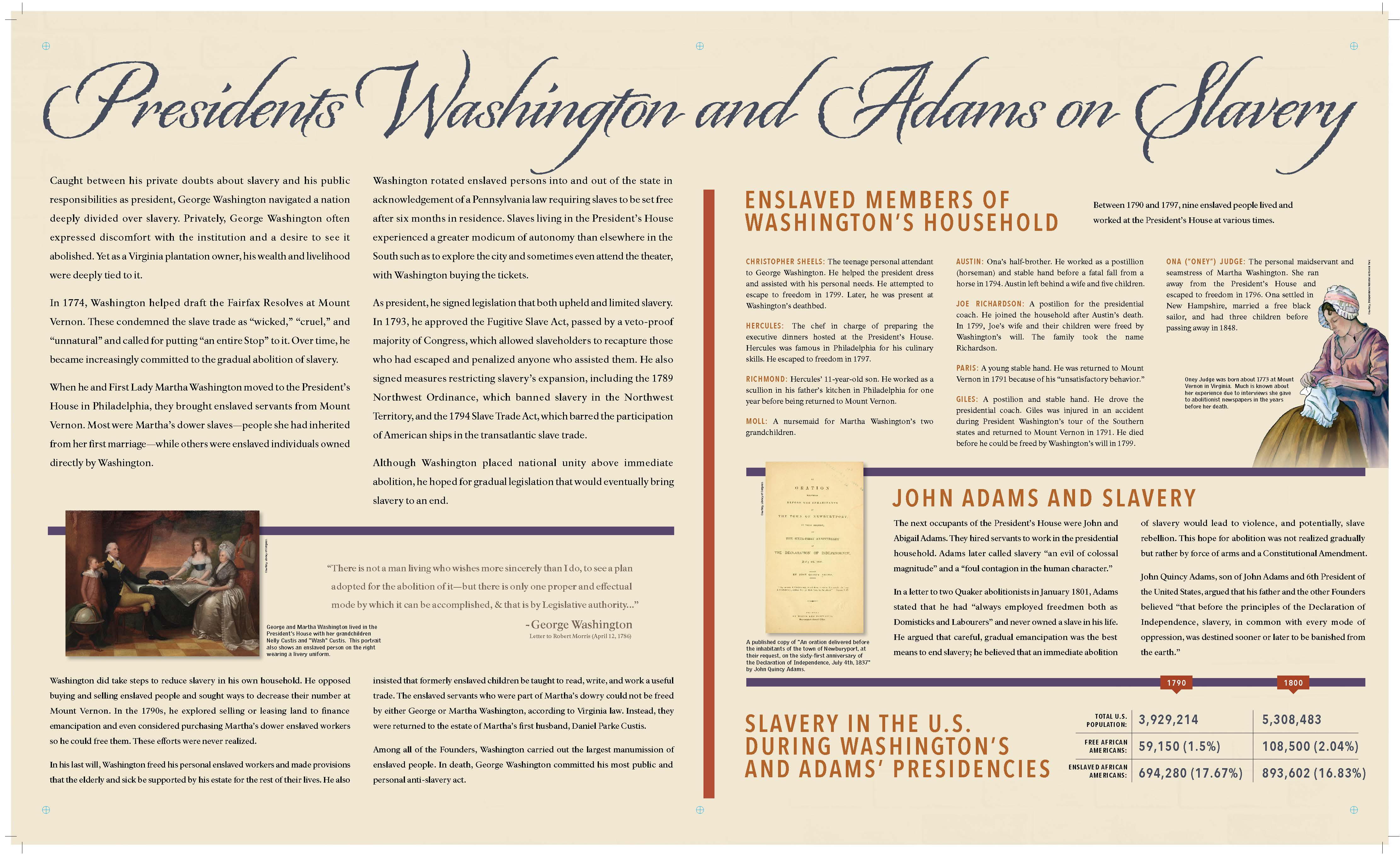
“In 1774, Washington helped draft the Fairfax Resolves at Mount Vernon,” one panel reads. “These condemned the slave trade as ‘wicked,’ ‘cruel,’ and ‘unnatural’ and called for putting ‘an entire Stop’ to it. Over time, he became increasingly committed to the gradual abolition of slavery.” . . .

on Wednesday, several armed members of the National Park Service Police were seen vigilantly watching over the site.

Park service officials stopped one activist, Dr. Sandra Shachar-Krasnoff of Philadelphia, after she briefly taped a piece of paper with “the excavation revealed a kitchen and a slave quarters below the president’s house site” to one of the walls.

She was fined $310.
The photo above, taken by Abraham Gutman for the Philadelphia Inquirer, shows a federal officer writing a citation for Dr. Shachar-Krasnoff. The Inquirer also reported that the N.P.S. installed security cameras at the outdoor site last week, ostensibly because the All-Star Game was about to be played in the city. So there’s no doubt the government will surveil the walls more tightly.

The park website displays eleven large new panels, but the Inquirer states there are also “more than a dozen smaller panels that detail governmental processes, the lives of various historical figures, and a panel dedicated to the escape of Ona Judge and Hercules [Posey], two people enslaved by Washington who fled to freedom.”

All told, says the Inquirer, “the new exhibits mostly offer a broad timeline of U.S. history that significantly strays from the original intent of the President’s House as outlined in the park’s foundation document in 2017: ‘It would explore the historic context of the site in the context of its ties to slavery and the lives of the enslaved who lived at the site.’”

There’s already an effort to have Philadelphia erect a historic marker about Hercules Posey outside of federal control, like one already up for Ona Judge.

Friday, May 08, 2026

“The only ‘emancipation’ relevant to this site was Ona Judge’s own”

On 21 April, the Philadelphia Inquirer shared an opinion piece about the President’s House exhibit by Sharon Ann Holt, a public historian recently retired from Penn State Abington.

Holt was previously director of education and interpretation at the Historical Society of Pennsylvania and director at the Sandy Spring Museum in Maryland. She’s the author of Freedom Pay: North Carolina Freedpeople Working for Themselves, 1865–1900.

The web headline for Holt’s essay is “We can’t give in to the Trump administration’s attempts to make the history of slavery invisible in Philadelphia.” I don’t know if it appeared in the newspaper’s print edition, and the webpage now behind a paywall unless one has a guest link. So here’s an extended extract:
The digital images posted on the Park Service’s website make it clear that, under Donald Trump, the first priority of the Park Service seems to be to make enslaved people and slavery itself as invisible as possible. Panels that discussed the lives of urban enslaved people, Philadelphia’s free Black community, the Washingtons’ enslaved “family,” fugitives from enslavement (and the laws Washington signed to reclaim them) have all disappeared. The rich biographies of Christopher Sheels, Hercules, Richmond, Austin, Giles, Ona Judge, Joe Richardson, Moll, and Paris have shrunk to single sentences. . . .

So what stories are they telling? George and Martha’s determination to flout Pennsylvania’s six-month limit on holding people in slavery is reframed as a lovely gift of theatre tickets rather than their cynical move to get enslaved people across the river to New Jersey, thus restarting the six-month residential countdown. I’m surprised the Park Service left out the Washingtons’ “kind” willingness to let enslaved workers visit their families left behind in Virginia, which worked the same trick.

If Park Service bureaucrats value relevance, I challenge them to explain the transformation of the story about 18th-century slavery at the President’s House into a puzzling evocation of the Emancipation Proclamation of the 19th century and the Civil Rights Movement of the 20th century. Is it that, to them, all stories having to do with African Americans belong in the same place? They must think so, because they have randomly added completely irrelevant references to Frederick Douglass, the Civil War, the Rev. Dr. Martin Luther King Jr., the Underground Railroad, and Abraham Lincoln to the history of the President’s House.

Worse, the Park Service has embraced sentimental claims that Washington, Thomas Jefferson, and James Madison all “had their doubts” about slavery from the beginning.

None of those “doubts” persuaded the Founders to end slavery when they could have, either in our founding documents or in their own personal lives. None of the 19th- and 20th-century stories that the Park Service has shoehorned into their new panels ever involved the President’s House at all. The only “emancipation” relevant to this site was Ona Judge’s own self-liberation — the very story the Park Service has all but erased.

Speaking of irrelevance, the opening panels are even more laughable. Park Service interpreters have decided to feature discussions of the 1876 Centennial, the 1926 Sesquicentennial, and the 1976 Bicentennial, all of which happened long after the President’s House had been remodeled into oblivion or entirely demolished. . . .

If the judges choose these new panels to replace the ones taken down earlier this year, they will disparage millions of Americans who have struggled since 1776 to improve on the shaky foundations the founders laid. The President’s House should honor those struggles, alongside the nine people enslaved there by George and Martha Washington.
While Holt directs her critique at the National Park Service, which produced this revised signage, it’s clear that agency was working under directives from the White House. Based on what sort of historical presentations the White House has produced on its own, N.P.S. historians undoubtedly worked hard to drag this material into the realm of historical fact, even if it’s far from complete and relevant.

Thursday, May 07, 2026

A Closeup Look at the President’s House in Philadelphia

I’ve been following the story of the President’s House site within Independence National Historical Park.

That structure marks the residence of George Washington and John Adams before the District of Columbia was built and also memorializes the people enslaved to the Washingtons who lived and worked there.

In September, we first learned that White House policy was putting pressure on the park to change the signage on that site. In January, the signs were taken down.

In February, after the city of Philadelphia filed a lawsuit, a judge ordered the signs be put back up. But then a higher judge halted that process while also requiring those signs already restored to remain. The U.S. Circuit Court has upheld that stasis.

Last month I traveled to Philadelphia for the Pursuit of History’s weekend examining the creation of the Declaration of Independence. One morning I walked through the President’s House.

Most of the frames for signs are empty; the few panels that have been restored appear to be almost random. In some of the blank spaces people had posted small images of the missing signs. While I was there, a local taped a large sheet of paper in another space along with two markers, inviting people to share their own thoughts on the controversy. I presume those unofficial displays are taken down each evening and replaced each day.

In April the National Park Service unveiled new draft signage, created (by people unknown) to please the White House. Those panels now appear on the webpage for the President’s House Site. WHYY reported:
The new panels include references to slavery, the Underground Railroad and figures like Frederick Douglass. Like the previous panels, they also make mention of the nine enslaved people held by Washington while he was president and living in Philadelphia.

However, they would have changed the overall tone of the site, softening and significantly reducing references to slavery, and shifting the focus toward the “anti-slavery sentiments” of the slave-owning Founding Fathers. For example, text on one notes that the U.S. Constitution did not contain the word “slavery,” and another one argues that Washington had “doubts” about the institution.
Local critics called that revision “whitewashing” and “maliciously outrageous.”

TOMORROW: A historian’s take.

Saturday, February 21, 2026

An Update from the President’s House in Philadelphia

Last month I noted the news reports that White House policy had pushed the National Park Service into removing signage in Independence National Historical Park which discussed people enslaved there in the 1790s.

Earlier this week the signs were restored under a court order while a lawsuit over them proceeds. The Trump administration is appealing that order and contesting the suit.

The lawsuit was filed by the city of Philadelphia, which participated in the creation of the President’s House Site and the signs, spending money on them. The city is therefore in the position to argue that it had a contract with the federal government. (The head of this administration is, of course, notorious for disregarding contracts.)

The administration has likewise pushed the removal of signage, books, photographs, flags, inconvenient scientific information, and other material from other national parks, as the press has documented. There’s even a grass-roots effort called “Save Our Signs,” aimed at collecting photographs of signage that might be affected by such trumpery. The legal situation in Philadelphia probably doesn’t apply in all those cases, meaning the damage will be harder to fix. 

The restoration at the President’s House was also made possible by the National Park Service’s careful storage of the signs. While they were gone, someone used a marker to improvise a replacement, as shown in the photo above. The cartoon President says:
I cannot tell a lie.
I, George Washington, “owned” human slaves on this very spot.
President Trump doesn’t want you to think about that.
Isn’t that great?!
A FURTHER UPDATE: On Friday another judge, acting on an appeal from the Trump administration, stayed the first judge’s order requiring all the signage to be restored. However, that order also stated that all the signage that had been restored so far must stay. So the site now has some of its dozens of signs visible and others back in storage.

Monday, January 26, 2026

Historical Signage Removed at Independence National Park

Back in September, I shared news reports of the Trump White House complaining about signs at the President’s House Site in Independence National Historical Park.

That mansion, now gone, was the home of Presidents George Washington and John Adams in the 1790s. During Washington’s time, it was a site of enslavement—and of self-liberation.

Two of the Washington’s staff, Oney Judge and Hercules Posey, escaped from bondage at that house and made their way to free lives in New Hampshire and New York, respectively. (Boston 1775 readers might recall this blog played a tiny part in documenting Posey’s presence in New York.)

In erecting brick walls to show the outline of the mansion, the National Park Service also developed detailed signage to interpret the history of that site for visitors. That’s standard N.P.S. procedure, with the material going through many reviews for accuracy.

Last week, the Philadelphia Inquirer reported that N.P.S. workers had acted under orders to remove all those signs. All that remains now is a list of the people documented as enslaved in President Washington’s household, etched in cement. (And I have no idea how long that list will remain visible.)

I first read complaints about commemorating slavery at Independence N.H.P. over twenty years ago on the Revlist discussion group. I pointed out that this was also a story of people gaining their liberty and independence, so what park could be more fitting?

The objector was unwilling to recognize that freedom for black Americans was more significant than comfort for white Americans. That same attitude is evident in the current trumpery from the White House.

This President’s respect for historical fact is evident in his June 2024 comment on Washington owning slaves: “Actually I think he probably didn’t.” Likewise his 4 July 2019 statement about how the Continental “Army manned the air, it rammed the ramparts, it took over the airports,…”

After years of complaints that any community’s removal or alteration of a statue or monument was tantamount to erasing history, this administration is literally erasing history from a public site. But only a particular sort of history. 

Thursday, September 18, 2025

“Officials plan to substantially alter an exhibit that memorializes nine people enslaved”

Back in July, the Philadelphia Inquirer reported on how pressure from the Trump White House was affecting signage at Independent National Historical Park.

Its article said:
More than a dozen displays at Independence National Historical Park that share historical information about slavery during the founding of United States have been flagged for a content review in connection with an executive order from President Donald Trump. . . .

The President’s House Site, where Presidents George Washington and John Adams once lived, came under particular scrutiny with six exhibits flagged for review. The exhibit focuses on the contradictory coexistence of liberty and slavery during the founding of America and memorializes the people Washington enslaved.
White House staff had written an executive order for Donald Trump to sign with his distinctive signature that singled out the Independence park for training interpretive rangers to be sensitive to racial issues.

This Wednesday was the administration’s initial deadline for removing content it might deem “inappropriate.” Early in the week more articles appeared. The New York Times reported: “At Independence National Historical Park in Philadelphia, officials plan to substantially alter an exhibit that memorializes nine people enslaved by George Washington.”

A day before, the Washington Post said:
That park includes the President’s House Site, where George Washington served as president before the capital moved to Washington, D.C. The house was demolished in the 1800s, but an exhibit opened there in 2010 based on archaeological excavations.

Local advocates had pushed for the exhibit to provide in-depth information on the lives of nine people who were enslaved by George Washington while he lived in the house as president. The exhibit includes their names carved into a granite wall.

“This is not just a handful of signs that tell the story of slavery,” said Ed Stierli, senior Mid-Atlantic regional director at the advocacy group National Parks Conservation Association. “This is a place that tells the complete story not just of slavery in America, but what it was like for those who were enslaved by George Washington.”

Trying to extricate slavery from the President’s House exhibit would fundamentally change the nature of the site, said Cindy MacLeod, who was superintendent of Independence National Historical Park for 15 years until 2023.

“This is just one of many exhibits at Independence National Historical Park,” MacLeod said. “And to me, it’s a vital one.”
Alerting the news media to this pressure from above is the first step to resisting it. Philadelphians quickly protested the prospect of erasing information about slavery in the park, the Inquirer reported on Tuesday.

Independence National Historical Park commemorates how Americans sought their liberties and political rights in the late 1700s. The lives and struggles of Americans born into literal slavery, some of whom managed to secure their freedom on that very site, fit right into that theme. The stories of Oney Judge, Hercules Posey, and others can be enlightening, even inspiring, for people who recognize them as fellow humans. But champions of trumpery would prefer to suppress that history.

Tuesday, March 28, 2023

More Findings about a Famous Portrait

Back in spring 2019 I reported on the new scholarly conclusion that the painting shown here, for decades said to be Gilbert Stuart’s portrait of George Washington’s chef Hercules:
  • was not by Stuart,
  • did not show Hercules Posey or any other eighteenth-century cook, and
  • probably, given the hat, showed a man from Dominica.
I wrote then:
One detail which should have made people wonder, I think, is that this painting is at the Museo Nacional Thyssen-Bornemisza in Madrid. An odd place to find an American painting linked to an American President, wouldn’t you say?
Later that year Mount Vernon published a more detailed story on those findings by curator Jessie MacLeod, and here’s a webpage adapted from that article. It answers my question of how this painting came to a Spanish museum:
What we know of the portrait’s story begins in the early 19th century, when it was owned by English painter Sir Thomas Lawrence. Sometime before his death in 1830, Lawrence gave the painting to his childhood friend John Hulbert as a wedding gift. This history is recorded in an early 20th-century file in the Witt Library at the Courtauld Institute of Art in London. Here, an image of the portrait is filed under “Gilbert Stuart—Unidentified Sitters.”

In 1946, the portrait was purchased by Daisy Fellowes, an American socialite living in Paris. She displayed it in the dining room of her luxurious hôtel particulier, which was featured in a 1977 magazine. A caption identified the work as “Painting by Gilbert Stuart (an alleged portrait of the cook of George Washington).” The painting was purchased at auction in 1983 by Baron Thyssen-Bornemisza, who opened his namesake museum in 1992 (the Spanish government purchased the collection in 1993).
As for who really posed for the painting and who created it, the article states:
According to the Museo Thyssen-Bornemisza,…“If the Thyssen sitter is Dominican, he probably fled to England as part of the exodus of English planters just before the French claimed the island from the English in 1778.” . . .

Considering the man’s neckpiece and the cut of his coat, as well as the painting style, researchers can date the portrait to about 1780. . . .

The latest research released by the Museo Thyssen-Bornemisza asserts that, with the face and hat rendered in relatively broad brushstrokes, the portrait follows the general painting style of Sir Joshua Reynolds (1723-1792), the first president of the Royal Academy in London.
I don’t know the art-history world well enough to know if “general painting style” means the museum is really pointing at Reynolds, at his studio or circle, or simply at artists working when his style was fashionable. But the details are fitting together better.

Sunday, February 28, 2021

A Long Search for Hercules Posey

At Zagat, the chef and culinary historian Ramin Ganeshram shared the story of her research into Hercules Posey, head cook at Mount Vernon and the Presidential Mansion in Philadelphia until he freed himself from slavery.

In this article, Ganeshram describes the roots of her quest in childhood. Like me, during the Bicentennial she and her family toured the seat of the Continental Congress and other Revolutionary sites, but with a different perspective:

In 1976, I visited Philadelphia and Washington’s Mount Vernon to celebrate the American Bicentennial with my Trinidadian father. As young as I was, I could sense my father was moved as we stood on a long line to see the Liberty Bell. We didn’t know it, but as we waited, we stood on the buried remains of the President’s House where Hercules had lived.

No one talked about the enslaved Africans in the city of independence. It would be decades before the President’s House site was excavated as an open-air exhibit honoring them. It was a week later while visiting George Washington’s Virginia home that I began to viscerally sense this omission, although I was too young to name it. Instead, I sensed it in how my father’s mood changed, how he asked the tour guides about the enslaved people of the house and the field, and how his questions were deflected with twittering Southern charm. Later he brooded a long time at the slave quarters and the kitchen—Hercules’ kitchen. When I asked what was wrong, he just shook his head darkly. For years after, even the mention of Mount Vernon gave me a shifting sense of unease.
Later learning about Posey, Ganeshram started gathering more facts about him. This project took her through a picture book, cancelled at the last moment; a historical novel; experts’ realization that the painting said for decades to be Posey’s portrait was in fact nothing of the kind; and finally her discovery of records of the man in nineteenth-century New York. (In 2019 I recounted her findings and added a data point.)

Ganeshram ends her essay at another location linked to Posey:
When he died of tuberculosis on May 15, 1812, at age 65, Hercules was buried at the 2nd African Burial Ground in Chrystie Street. The cemetery was overflowing its boundaries by the time of Hercules’ death. He, along with others, was likely buried under what is now pavement and roadway. When the cemetery was disinterred in the 19th century and moved to Cypress Hills in Brooklyn, some were left behind. I believe Hercules was among them.

When I first visited the site in 2019, I looked around Chrystie Street with fresh eyes, seeking clues about Hercules. Seeing none, I spoke to him in my mind as I often do, for we have come a long way together. I brooded as I walked. If only I had a sign that I was on the right track. Stopping for a light at a cross-street, I looked at the curb ahead of me and saw a small white van with Hercules Dry Cleaning emblazoned on its side. I pressed on.

The former burial ground is now a private lot with an apartment building. At the southern end of Chrystie street hulks the Manhattan Bridge. Across the street is a public park where I have been encouraging New York City’s parks department to place a commemorative plaque for the Burial Ground, the once-thriving Free Black community, and for Hercules Posey—who was America’s first celebrity chef and so much more.
This post from the New York Cemetery Project has maps showing where the city’s Second African Burying Ground lay.


Wednesday, February 19, 2020

“Calling himself William Lee”

In October 1767, George Washington bought two “Mulatto” boys named Will and Frank and two “Negro” boys named Adam and Jack from Mary Lee, widow of Col. John Lee of Westmoreland County.

John Lee (1724-1767) had married the young widow Mary (Smith) Ball in 1749. They had no children together before he died. Given how the enslaved mulatto boys were Col. Lee’s property and later took his surname, he’s the man most likely to have been their father. In any event, his widow sent them off with another master soon after the colonel’s death.

Mary went on to wed John Smith in August 1768, and Washington dined with that couple the day after their marriage. There were so many Smiths, Lees, and Balls in Virginia that I can’t tell if John or Mary Lee was related to Washington’s mother’s Ball family or the Lee family his descendants married into, but they were in the same social circle.

Washington paid £61.15s for Will and Frank, more than three times the £19 he paid for the other two youths. All four slaves were probably teenaged males with many productive years before them, but the brothers’ lighter skin made them particularly valuable as domestic servants.

The Washington Papers include lists of “tithables” on his lands each June for many years. High among the “Ho[use]. Servants” on those lists from 1768 to 1771 was “Billy.” On 8 Oct 1770, Washington wrote in his diary about “my boy Billy who was taken sick.”

In September 1771, however, Washington recorded paying for a “pair of Boots for Will.” The editors of the papers wrote that there were enslaved men named Will on different farms, but those boots mostly likely went to the house servant he had bought in 1767, now close to manhood.

After that point, Washington stopped referring to the young man as “Billy,” at least in writing (except indirectly in connection with one incident I’ll discuss tomorrow). On the tithables lists “Will” appeared starting in 1772. His brother “Frank” had arrived on those list of house servants in 1771, along with “Herculas,” most likely Hercules Posey.

When Washington rode off to war in 1775, he brought Will with him as a body servant. The young man, then probably in his twenties, was at the commander’s headquarters in Cambridge, where on 22 Feb 1776 the steward recorded this expense in his: “Paid Margaret Thomas for making three shirts for William.”

Ten years later, on 18 Feb 1786, Washington made a comprehensive list of his human property. At the top was “Will Val de Chambre,” followed by waiter “Frank” and soon after cook “Herculus.” In that decade Will suffered two falls that injured his knees badly so he was no longer able to wait on Washington as had trained to do. He became a shoemaker at Mount Vernon.

In his 1799 will, Washington granted freedom and a pension to “my Mulatto man William (calling himself William Lee)”—the first time he referred to his wartime companion with a surname.

In a memoir first extracted in the American Turf Register and Sporting Magazine in 1829, Washington’s step-grandson, George Washington Parke Custis, referred to “his huntsman, Will Lee.” But he also wrote that that servant “was better known in Revolutionary lore as Billy.”

Indeed, while Washington himself never wrote of his body servant as “Billy” after 1771, other people referred to him by that diminutive. For example, on 27 Apr 1789 Clement Biddle wrote to the new President from Philadelphia, “I have frequently called to see Billy.” William Lee continued to live at Mount Vernon until his death around 1824, and nineteenth-century articles and memoirs about visiting there, such as the one by Elkanah Watson, called him “Billy.”

Nineteenth-century authors therefore developed a new way of referring to Washington’s body servant Will—as “Billy Lee,” a combination of names the general himself never used in writing. That’s become a standard reference. It shows up in, for instance, this month’s History Channel series about Washington, at least from some commentators.

But is that how historians should refer to the man, especially during the war years? We don’t know what Gen. Washington called him in conversation, but in writing it was always “William” or “Will.” We also know that William Lee kept the surname of his first owner (and father?) more than thirty years after coming to Mount Vernon.

“Billy” is of course a diminutive, and American slaveholders and racists used such nicknames to belittle black men. Yet we also use such names for friends; it’s possible that Washington’s valet was happy to answer to that name from people he knew well. It’s also conceivable that when Will Lee became disabled, still only in his late thirties and enslaved, he was reduced to such a state of dependency that people started to infantilize him as “Billy” again.

All those are conjectural possibilities, however. We know from Washington’s will that in middle age his former valet was “calling himself William Lee,” and that’s the name I use.

Tuesday, March 19, 2019

Hercules Posey, Cook in New York

Craig LaBan’s article for the Philadelphia newspapers about the mysteries surrounding George Washington’s escaped cook Hercules didn’t stop at debunking the claim that he was the black man wearing a tall white hat in a widely reprinted portrait.

LaBan also reported new information about what really happened to Hercules. The last known trace of him had been a 15 Dec 1801 letter from Martha Washington to the mayor of New York, thanking him for seeking Hercules and concluding, “I have been so fortunate as to engage a white cook who answers very well. I have thought about it therefore better to decline taking Hercules back.”

That hinted that the Washingtons, having previously sought Hercules in Philadelphia, came to suspect he was in New York.

Back in 2016, a children’s book about Hercules was abruptly canceled just before publication, as discussed back here. The author who had been recruited to write that book, Ramin Ganeshram, had already been working on a novel about the cook and the painter Gilbert Stuart, inspired by the mistaken belief that LaBan wrote about. That book, The General’s Cook, was published last year.

Ganeshram is also the executive director of the Westport Historical Society in Connecticut, and as doubts arose about the “Hercules portrait” that inspired her fiction she wanted to find out more about the real man. Ganeshram and her colleague Sara Krasne, an archivist, looked at New York records for traces.

The crucial clue was that Washington had bought Hercules as a young man from another Virginia planter named John Posey. We know that William Lee, the general’s body servant during the war, continued to use the surname of his first owner throughout his life. Had Hercules done the same?

The New York city directory for 1812 listed a black man named Hercules Posey living on Orange Street. On 15 May of that year, that Posey died of consumption. The death record stated that he was sixty-four years old and had been born in Virginia, which is a reasonable match for what little we know about Hercules the cook.

As described in this blog post, New York City archivists found evidence from a few years later that Posey’s address was in a neighborhood of black workers.

I’m adding another breadcrumb to this cook’s trail. The 1812 directory listed Posey as a laborer. The 1808 edition of Longworth’s American Almanac: New York Register and City Directory listed him at another address on Orange Street, and identified him as a cook.

ADDENDUM: After I wrote about this posting on Twitter, Sara Krasne replied that she and Ramin Ganeshram had just found Hercules Posey listed as a cook in an 1807 New York city directory.

Monday, March 18, 2019

New Findings about an Old Portrait

Earlier this month Craig LaBan reported for the Philadelphia newspapers on the portrait shown here.

In recent decades this been widely identified as showing Hercules, a cook enslaved by President George Washington. Hercules achieved high status in the Mount Vernon workforce, but then he secured his freedom by leaving in 1797.

The painting has been attributed to Gilbert Stuart, apparently because he’s the most famous painter known to have painted the Washingtons around that time.

One detail which should have made people wonder, I think, is that this painting is at the Museo Nacional Thyssen-Bornemisza in Madrid. An odd place to find an American painting linked to an American President, wouldn’t you say? (To be sure, there are reproductions in many American museums now.)

LaBan reported some important conclusions about the painting and Hercules:
  • Experts in Stuart’s art agree that this canvas doesn’t match his technique. The only link to that artist is wishfulness.
  • The tall white cylindrical hat that we know as a toque didn’t become standard for chefs in France until the early 1800s, spreading from that country to others. Hercules surely didn’t wear one at Mount Vernon or the Presidential mansion.
  • The headgear in the painting looks similar to the hat of a man in a painting of free black people on Dominica made by the Italian artist Agostino Brunias (d. 1796) around 1770. 
Thus, the painting is most likely a portrait of a man on Dominica or another Caribbean island. An unnamed man by an unnamed artist—at least for now.

TOMORROW: A real trace of Hercules the cook?

Monday, January 18, 2016

No Birthday Cake for George Washington

This month Scholastic published a book about Hercules, the Washingtons’ cook at Mount Vernon and Philadelphia in the 1790s.

And this week Scholastic decided to pull that book from circulation. As The Guardian reported:
A Birthday Cake for George Washington was released on 5 January and had been strongly criticized for its upbeat images and story of Washington’s cook, the slave Hercules, and his daughter, Delia.

“While we have great respect for the integrity and scholarship of the author, illustrator and editor, we believe that, without more historical background on the evils of slavery than this book for younger children can provide, the book may give a false impression of the reality of the lives of slaves and therefore should be withdrawn,” the publisher said in a statement. . . .

While notes in A Birthday Cake for George Washington from author Ramin Ganeshram and illustrator Vanessa Brantley-Newton pointed out the historical context of the 18th-century story and that Hercules eventually escaped, some critics faulted Ganeshram and Brantley-Newton for leaving out those details from the main narrative. . . .

The trade publication School Library Journal called the book “highly problematic” and recommended against its purchase. Another trade journal, Kirkus Reviews, labeled the book “an incomplete, even dishonest treatment of slavery”.
One notable detail about this publication is that the book’s editor, Andrea Davis Pinkney, is one of the industry’s most respected and active African-American editors and champions of black authors and artists. She has published many books about African-American history, including slavery. Both the author and the illustrator of the book are women of color.

Last year there was a big controversy in the children’s book world about how another picture book, A Fine Dessert, depicted a moment in the lives of a mother and child enslaved in ante-bellum South Carolina. (I wrote about an early presage of that controversy but didn’t anticipate what developed.) By that time, A Birthday Cake for George Washington was probably too far along in production to be changed in major ways.

Pinkney and her colleagues clearly anticipated some complaints about how the new book portrayed slavery and prepared online essays explaining their choices. That makes Scholastic’s decision to reverse course and pull the book—on a weekend, yet—even more striking.