Yesterday I discussed the political effect of the second
Boston Tea Party in London. Today I’ll wrap up this topic with a look at the ripples from the event in Massachusetts.
Five local men were linked to the shipment of
tea on the
Fortune. All of them insisted that they hadn’t expected the tea to cause such trouble and wanted to send it back. How did the public accept those assurances?
The captain of the
Fortune was
Benjamin Gorham. Alas, not only were there other men of that name in Massachusetts, but two had the title “captain” from either maritime or military service. One was born in 1715, died in 1788, and is
buried in Barnstable.
According to genealogists, though, this ship’s captain was the Benjamin Gorham born to Shubael and Mary (Thacher) Gorham in
Barnstable on 5 June 1726. As of the late 1760s he commanded coasting vessels, bringing in the
Hannah in 1769. In 1773, the owners of the
Fortune sent him to London with a cargo and instructions to sell the ship there. Instead, Capt. Gorham came back with a range of goods, including those 28 1/2 chests of tea.
Nonetheless, Boston merchants continued to regard Gorham as reliable. On 18 April the
Boston Post-Boy announced that he would soon sail the brig
Leopard back across the Atlantic, carrying its owner,
Jonathan Williams, Jr., and passengers in “genteel Accommodations.”
Gorham was back in Boston that fall; he married Nancy Hinckley in Boston on 28 Nov 1774 at the Rev.
Samuel Stillman’s Baptist church. Eventually they had five
children.
Early in the war, Gorham carried hatter
Nathaniel Balch back to New England from London. In 1776 he became commander of a
privateer named the
Lizard, but that appears to have been his only military venture. In 1782 the Gorhams bought a house on North or Fore Street; four years later they sold it to John Hinckley, probably a relative of Nancy. In 1785 Capt. Gorham had the license for the Pine Tree Tavern in Dock Square. According to the
Columbian Centinel, Gorham was widowed at the start of the year 1793, and genealogists say he died two years later.
The merchant who was supposed to receive most of the tea on the
Fortune was
Henry Lloyd (1709-1795). In its first report on the cargo, the
Boston Gazette accused him of ordering forty chests. A week later, evidently after Lloyd showed them his letterbook, printers
Edes and Gill ran a correction:
Better information obliges us to inform the public that Mr. Lloyd on the fifth and seventh of November last wrote to his correspondent to send him no tea on any account whatever, till further orders. . . .
Mr. Lloyd directly contrary to his order and expectation has been drawn into view in a light very disagreeable to himself, and wishes nothing more ardently than to have his conduct truly represented to his Country, with whom his highest ambition is to stand fair and agreeably.
In his politics,
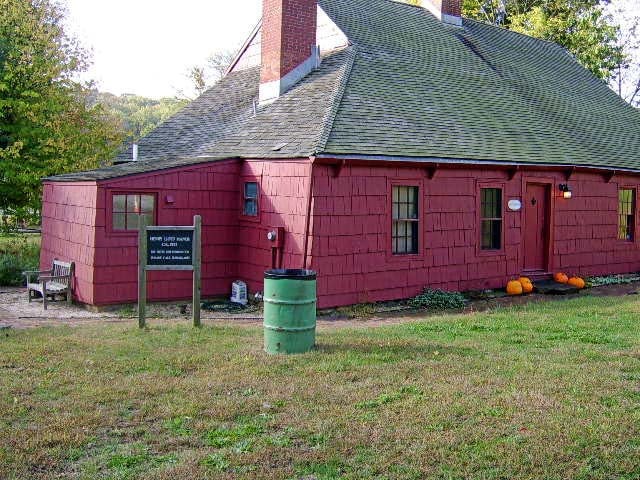
religion, and extensive property outside Massachusetts (family manor in Huntington,
New York, shown above), Lloyd had many reasons to align with the royal government. As the political split widened in 1774, he signed the address welcoming Gen.
Thomas Gage to Boston. Later he supplied the army. A niece he raised,
Elizabeth, married royal appointee
Joshua Loring, Jr., and also became mistress to Gen.
William Howe. In 1776 Henry Lloyd joined the
evacuation to Halifax. Though he made one return visit to Boston in 1785, Lloyd didn’t end up standing “fair and agreeably” with most of the people there.
Also among the
Loyalist refugees was the brazier
William Bowes, who in March 1774 loudly if unreliably stated that the owners of the
Fortune had brought in tea for themselves. Although Bowes later claimed to have supported from the Crown from early on, in August 1769 he was among the many Boston men dining with the Sons of Liberty. Bowes’s father was a Congregationalist minister and his mother was a Hancock, so it would have been natural for him to be a Whig. Instead, after 1774 he declared his Loyalism by signing all the addresses to royal governors and then leaving the province.
As for those three owners of the
Fortune, I still can’t trace William Thompson.
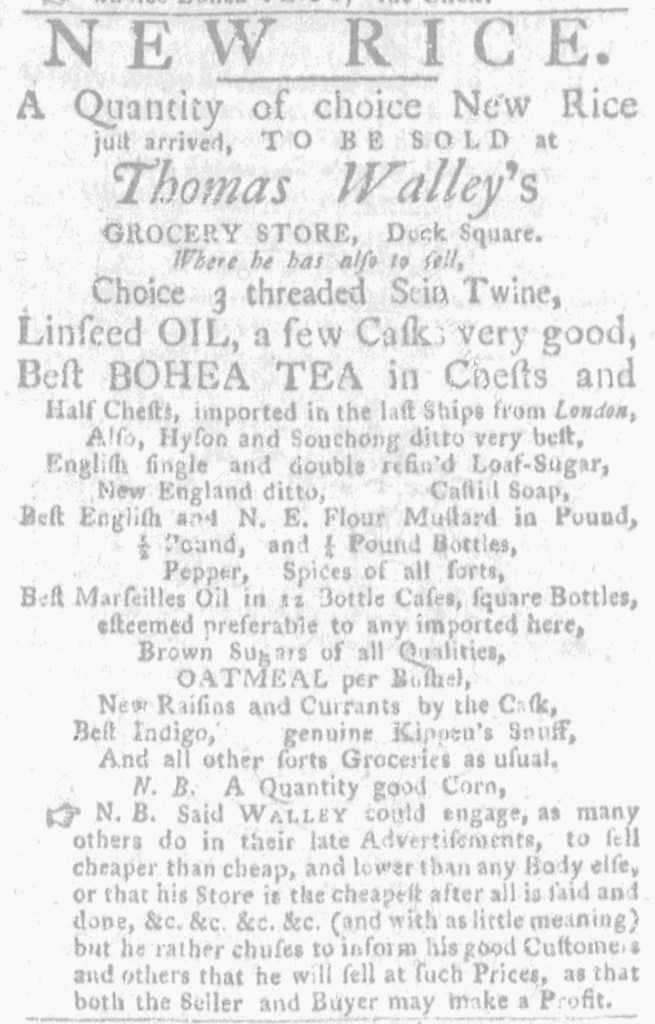
Thomas Walley and
Peter Boyer were, as I wrote before, solid Whig merchants up to 1774. Like Lloyd, they insisted that they had told their London contacts they didn’t want any tea and were completely surprised at what Capt. Gorham brought back.
Unlike Lloyd, Walley and Boyer remained trusted Whigs after the second Tea Party. Indeed, they became more politically active.
According to John W. Tyler’s
Smugglers and Patriots, Walley was a documented smuggler, and he remained firmly in the center of the Boston business community. He served in the
Massachusetts General Court during the war, and from 1786 to 1797 the town chose him as a
selectman.
Meanwhile, Boyer served on Boston’s committee to help the poor after the
Boston Port Bill and on the committee of correspondence, safety, and inspection in 1776. The following year he
signed Massachusetts money along with
John Scollay and
Ezekiel Price. In 1782
David Jeffries resigned as Boston’s treasurer after many years, and the town meeting elected Boyer to that office, which he held until 1791. The community couldn’t have demonstrated any more trust in him.