J. L. BELL is a Massachusetts writer who specializes in (among other things) the start of the American Revolution in and around Boston. He is particularly interested in the experiences of children in 1765-75. He has published scholarly papers and popular articles for both children and adults. He was consultant for an episode of History Detectives, and contributed to a display at Minute Man National Historic Park.

Subscribe thru Follow.it


•••••••••••••••••


Showing posts with label astronomy. Show all posts

Sunday, November 17, 2024

More Light from the Portrait of Francis Williams
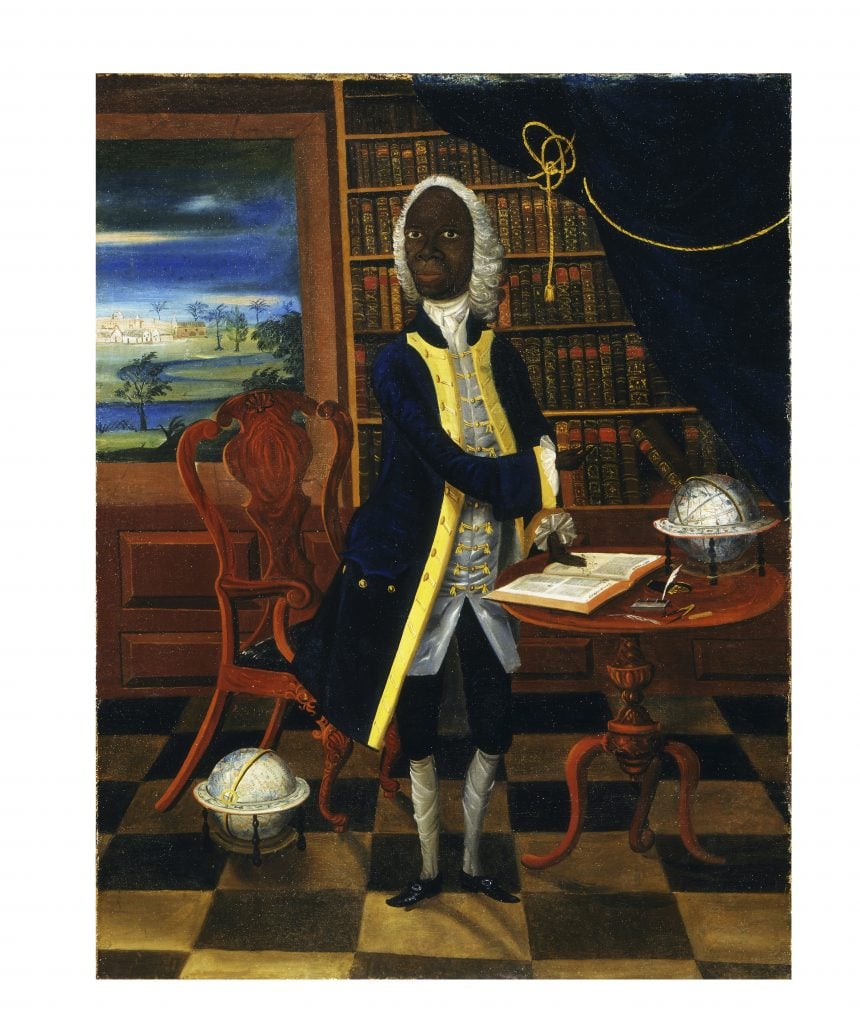
Earlier in the month I reported on Fara Dabhoiwala’s work on the portrait of Francis Williams based on two news articles.

I’ve now read Prof. Dabhoiwala’s own article in the London Review of Books, and he has even more to say.

About the painter:
The only oil painter known to have been active in Jamaica during these years was an Anglo-American artist called William Williams, who was then in his early thirties. This Williams, the son of an ordinary mariner, had been born in Bristol in 1727. He’d always loved to draw. Sent to sea as a youth, he abandoned his crew in Virginia and spent a few years knocking around the West Indies and Central America, sometimes living among Indians, learning their language and trying his luck as a painter for the local colonists.

Eventually, around 1747, he ended up in Philadelphia, where he worked for a theatre, painting sets and backdrops, and in a boatyard, painting ships, as well as doing sign-painting and lettering, teaching music, writing poetry and composing what is now regarded as the first American novel.

Though he was entirely self-taught, he also made landscapes and portraits; he collected engravings; he used a camera obscura as a drawing aid; he studied the lives of the great artists and wanted to be one himself. He was the earliest teacher of the young Benjamin West, who…in the 1770s commemorated his old mentor by including his likeness in one of his monumental historical canvases.

William Williams kept a list of every painting he ever made. The original doesn’t survive, but in the 19th century someone jotted down a summary of it. In the spring of 1760, Williams travelled from Philadelphia to Jamaica to offer his services as an artist. His list recorded that during his months in Jamaica, he painted 54 pictures. None of these has ever been found. I am confident that the portrait of Francis Williams is one of them.

There is in fact a scientific test that could prove this, because it has recently been discovered that William Williams prepared his canvases with a distinctive and very unusual triple layer of underpainting. I’m pressing the V&A [Victoria & Albert Museum] to undertake this new test as soon as possible.
Dabhoiwala also posits that the painting depicts not only the page in Newton’s Principia showing how to calculate the path of a comet but Halley’s comet itself. I’m not entirely convinced by this because the visual clues aren’t distinct. Then again, neither are comets a lot of the time. And the painter was definitely charting something in that portion of the canvas:
We can see that on the infrared scans of the picture. When William Williams made his first pencilled marks on this canvas, to plot the composition, he carefully ruled a series of lines to show where that white object in the sky should go – and to mark its relation to the constellations he was told to paint below. His sitter made sure of that, as he made sure of every other carefully placed detail in his portrait.

The portrait of Francis Williams is the only painting ever made of Halley’s comet in 1759, on its momentous first predicted return. 

Friday, November 08, 2024

New Light on the Portrait of Francis Williams

Last month Artnet and the Guardian reported on historian Fara Dabhoiwala’s findings about a painting I discussed in 2009.

The painting shows Francis Williams (1697–1762), a Jamaican of African ancestry. Born into a free and prospering family with special legal status, he went to London for education and then returned to the family estate.

The painting is in the collection of the Victoria and Albert Museum, and fifteen years ago I quoted its webpage as saying:
Some writers have suggested that the painting is a caricature of Francis as he has been depicted with a large head and skinny legs. . . . Other critics have considered that the ‘unnaturalistic’ depiction may have been intended to emphasise the subject’s intellectual skills over his physical stature (Francis was alive at the time of the painting’s creation and may even have commissioned it). It may, more simply, be a reflection of the artist’s limited skills.
The new research connects the creation of the painting to a specific historical, and astronomical event.

The Guardian report explains:
Dabhoiwala…discovered the significance of the page number carefully inscribed on the book Williams is reading: it is the page in the third edition of Newton’s Principia that discusses how to calculate the trajectory of a comet by reference to the constellations around it.

An X-ray of the window scene depicted in the background of the painting showed lines intersecting what appears to be a luminous white comet, streaking through the sky at dusk, and connecting – with stunning accuracy – to constellations of stars. These stars would have been visible in that position in the firmament when Halley’s comet was in the sky over Jamaica in 1759, according to research by Dabhoiwala.
In other words, this picture shows a particular moment when Halley’s comet appeared over Williams’s estate, and it shows him as an educated gentleman who knew how to calculate the path of that comet.

Artnet adds:
As for the painting’s creator, Dabhoiwala is confident it’s the work of William Williams, an English-American artist who traveled to Jamaica in the 1760s. The comet together with the appearance [in the bookcase] of [Dr. Samuel] Johnson’s Dictionary, which was first published in 1755, align with this timing and the painting’s style is similar to other early Williams portraits of Benjamin Lay, a Quaker abolitionist, and Hendrick Theyanoguin, a Mohawk Indian.
The Lay portrait, now at the Smithsonian’s National Portrait Gallery, also shows a man “with a large head and skinny legs.” Like Williams, Lay (c. 1681–1759) was notable for standing out in British-American society rather than fitting in. Williams (1727–1791) might have specialized in such subjects.

TOMORROw: More on William Williams’s work.

Thursday, May 11, 2023

Early American Science in Kansas City

The Linda Hall Library in Kansas City is featuring a small but mighty display of publications titled “Promoting Useful Knowledge: The American Philosophical Society and Science in Early America.”

The items include:
The label on the Thomas almanac says, “after the battles of Lexington and Concord, Thomas had to move his press from Boston to Worcester to prevent his own arrest and that of his printers, and to prevent the presses from being seized and destroyed by the British.”

Thomas left Boston just before the war began to feel safe from the British army. Timothy Bigelow and other Worcester Patriots assured him he could sell newspapers in their town.

Thomas hoped to gain the printing business of the Massachusetts Provincial Congress, but then Benjamin Edes set up in Watertown and Samuel and Ebenezer Hall moved their press from Salem to Cambridge. Thomas got the contract to print the congress’s report on the opening battle and nothing else, but he did become Worcester’s postmaster.

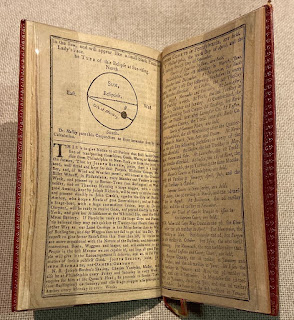
Back to the Linda Hall Library exhibit. Its anchor is a copy of Poor Richard’s Almanack for 1753, describing Benjamin Franklin’s first electrical experiments and showing a transit of the planet Mercury.

That almanac was loaned to the library by the American Philosophical Society in Philadelphia after a bet on the outcome of last winter’s Super Bowl. (The Kansas City Chiefs beat the Philadelphia Eagles, 38–35.) The story behind the exhibit is thus itself notable.

I was also intrigued by the story behind the Linda Hall Library. Herbert and Linda Hall left a multimillion-dollar bequest to establish “a free public library for the use of the people of Kansas City.” In post–World War Two America, the trustees decided that institution should be dedicated to scientific and technical information.

The Linda Hall Library started by purchasing the collection of the American Academy of Arts and Sciences, founded in 1780 by James Bowdoin and other Enlightened gentlemen from newly independent Massachusetts. Which probably explains why it holds so many almanacs from New England.

Sunday, September 25, 2022

Explaining the Summer of 1783

I looked up the Massachusetts newspaper coverage of Europe’s unusual atmosphere in 1783, quoted yesterday, after reading Katrin Kleemann’s online article from a few years back, “Speculating About the Weather: The Unusual Dry Fog of 1783.”

Kleemann wrote:
…in the summer of 1783, Europeans had more than enough reasons to be concerned with the weather. A peculiar dry fog with an odd sulfuric smell cloaked Europe and remained for months, with neither wind nor rain managing to disperse it. The fog was not the only oddity these individuals were facing that summer: The sun had a blood red color when it set and rose; an unusual number of thunderstorms seemed to pass through; meteors were visible over western Europe, earthquakes occurred in Italy, and a new island emerged from the sea off the coast of Iceland. Speculation was rife as to the cause of all this.

Hekla, an Icelandic volcano, known in Europe since medieval times as the gate to hell, was thought to be a potential culprit. When referring to historical maps of Iceland, Hekla is usually pictured as erupting. Famously, Benjamin Franklin suggested that Hekla or Nyey, the newly emerging island, might have caused the dry fog. However, what is often forgotten in this context is that in the same paragraph, Franklin suggested “great burning balls” (meteors) might alternatively have caused it.

At the time a very fashionable explanation was electricity: Lightning was believed to fertilize the soil when it hit the ground. The numerous thunderstorms of the summer quickened the spread of the lightning rod, which had not yet had its breakthrough. The lightning rod was believed to withdraw the beneficial electricity from the atmosphere, which—so the theory went—caused the dry fog, as sulfuric odor had previously been consumed by the “electrical fire.”

There was yet another story making its rounds in the newspapers in July 1783: Not just one but two volcanic eruptions were described within the German territories. The Cottaberg near Dresden as well as the Gleichberg mountains near Hildburghausen were said to have roared to life and to be spitting fire. Both mountains are actually of volcanic origin—however, their last eruptions occurred 25 and 15 million years ago, respectively. The reports were retracted a few weeks later.

The most popular theory of the time suggested that earthquakes in Italy and this dry fog were directly related: people believed the earthquakes had opened a crack in the Earth, which released sulfuric odor from the Earth’s interior into the air. The concept of a subterraneous revolution plausibly explained the sulfuric smell, the fog, the earthquakes, and the newly emerging island.
As Kleemann related, the answer to the atmospheric mystery did lie in Iceland, but it took a long time to come out. Eleven years after that odd summer, an Icelandic scientist named Sveinn Pálsson (1762-1840, shown above) described the volcanic fissure now called Laki. That system had erupted from June 1783 to February 1784, emitting huge amounts of basalt lava and poisonous clouds. The effects in continental Europe were nothing compared to what happened locally, as more than half of Iceland’s livestock died, followed by most of the crops, followed within a few years by about a quarter of the humans from famine.

Despite all those effects, Pálsson’s report wasn’t published by the Danish Society of Natural History but simply filed away. A century later, the eruption of Krakatoa confirmed that massive volcanic activity could affect the atmosphere all over the planet. People rediscovered what Pálsson had written. His manuscript was finally published in full in 1945, explaining the odd summer of 1783.

(Kleeman’s article appeared on the website of N.I.C.H.E., which is both the Network In Canadian History & Environment and the Nouvelle Initiative Canadienne en Histoire de l’Environnement. Coming up with a name to justify a good acronym is tough enough, but doing so in two languages at once is a real feat.)

Monday, February 21, 2022

A Poetic Postmistress

I heartily recommend reading this webpage from Carpe Librum books, written to sell a rare book of poems printed in London in 1773.

Setting out the sparse known facts about the author Ann Williams, Brad at Carpe Librum succeeded in both assembling an interesting life story and in selling the book.

A taste:

Unlike the majority of women authors before 1800, Williams was not to the manor born. She appears [to] have hailed from the middling classes, and worked for a living as the post mistress of Gravesend, Kent. To the extent that she is remembered today, Williams is known as an experimental biologist, who corresponded with the Society of Arts (after 1908 the Royal Society of Arts, or RSA), which awarded her twenty guineas in 1778 for her observations on the care and feeding of silkworms. She kept her “little family” of “sweet innocent reptiles” in the dead letter pigeon-hole at the post office.
Williams’s poems address astronomy, Gen. James Wolfe, women’s equality, and many other topics, including one “Written when I was extremely sleepy, yet obliged to attend business.”

Unfortunately, Williams died after a laboratory accident in 1779.

Saturday, March 13, 2021

Tales of the Second Boston Tea Party?

Boston’s first tea crisis lasted two months. The town heard about East India Company tea coming to certain merchants by 18 October, when the Boston Gazette published the news. The men and boys who destroyed that tea headed home late at night on 16 December.

In contrast, the second tea crisis in March 1774 was resolved in less than thirty-three hours. The town learned of the brig Fortune’s arrival with 28 1/2 chests of tea at three o’clock on Sunday afternoon. By eight o’clock Monday evening that tea was going into the harbor.

Dumping tea before the tax could be collected on it had become almost ho-hum. Back in December, John Adams had exulted in his diary:
There is a Dignity, a Majesty, a Sublimity, in this last Effort of the Patriots, that I greatly admire. The People should never rise, without doing something to be remembered—something notable And striking. This Destruction of the Tea is so bold, so daring, so firm, intrepid and inflexible, and it must have so important Consequences, and so lasting, that I cant but consider it as an Epocha in History.
In March, Adams simply wrote: “Last Night 28 Chests and an half of Tea were drowned.”

With far less tea to destroy, the March action would have taken fewer men and/or less time. Still, it’s remarkable how little documentation we have for the second Boston Tea Party.

We don’t have detailed letters from the night, like merchant John Andrews’s much-read account of 16 December. The press reports appeared in a sort of code, as I’ll discuss tomorrow.

We don’t have signs of the nineteenth-century Boston newspaper editors keeping track of old men who had participated in the March tea destruction. The two books that helped to popularize the December event and the joshing term for the men involved, Retrospect of the Boston Tea-Party and Traits of the Tea-Party, don’t mention the March follow-up at all. Families didn’t pass down dramatic stories of the second Boston Tea Party.

Or did they? Is it possible that some of the tales people told about “the Tea Party” were actually about the March tea destruction, not the one in December? If the same men took part in both, did the details meld together in their memories?

Some specifics of the December action can be pinned down through other sources. For example, Ebenezer Stevens’s recollection that his future brother-in-law, Alexander Hodgdon, was a mate on one tea ship. And the way leaves piled in the shallow water beside the ships; astronomers have confirmed that the harbor was at low tide at the crucial hours on 16 December.

But do other memories come from March? Have we inherited tales of the second Boston Tea Party without knowing it?

COMING UP: The code of the Tea Party.

Monday, April 01, 2019

“To gaze at an invisible Eclipse on the first of April”

In the 1730s Benjamin Franklin printed John Jerman’s American Almanack several times even as he was establishing his own Poor Richard’s Almanack.

Franklin had a habit of ribbing his rivals through the voice of Richard Saunders, his almanac-making pseudonym. Specifically, “Saunders” suggested Jerman was about to turn Catholic, which even in Philadelphia was suspicious.

Eventually Jerman chose to work with different printer, telling readers that Franklin had maligned him. “Saunders” responded in his almanac for 1744:
My Adversary J--n J----n has indeed made an Attempt to outshine me, by pretending to penetrate a Year deeper into Futurity; and giving his Readers gratis in his Almanack for 1743 an Eclipse of the Year 1744, to be beforehand with me: His Words are, “The first Day of April next Year 1744, there will be a great Eclipse of the Sun; it begins about an Hour before Sunset. It being in the Sign Aries, the House of Mars, and in the 7th, shows Heat, Difference and Animosities between Persons of the highest Rank and Quality,” &c.

I am very glad, for the Sake of these Persons of Rank and Quality, that there is no manner of Truth in this Prediction: They may, if they please, live in Love and Peace. And I caution his Readers (they are but few, indeed, and so the Matter’s the less) not to give themselves any Trouble about observing this imaginary Great Eclipse; for they may stare till they’re blind without seeing the least Sign of it. . . .

I leave him to settle the Affair with the Buyers of his Almanack as well as he can, who perhaps will not take it very kindly, that he has done what in him lay (by sending them out to gaze at an invisible Eclipse on the first of April) to make April Fools of them all.
I’ve found lots of quotations and some discussions of this passage, but I haven’t found confirmation that Jerman indeed made such a prediction. According to a N.A.S.A. website, there was no eclipse on that date, and that would have been an unusual mistake for an experienced astronomer.

Of course, Jerman might have been making an April Fool’s joke that “Saunders” insisted on taking literally. Or “Saunders” could have made the whole thing up, the same way he made up the stuff about Jerman becoming Catholic.

Tuesday, February 13, 2018

Yet Another “Liberty Song” in 1770

On 13 Feb 1770, Josiah Flagg gave a concert in Boston. According to his newspaper advertisements, Flagg had a house near the Old North Meetinghouse and a store on Fish Street. Having started as a silversmith, he got into engraving, publishing, and selling music, particularly religious music. One of his ads added that he “teaches Psalmody, on Monday and Thursday Evenings.”

Flagg didn’t advertise his February 1770 concert, so far as I can tell. We know about it only because the printers Edes and Gill referred back to that event in their North-American Almanack and Massachusetts Register, for the Year 1770. That almanac offered readers the lyrics to “A New Song, compos’d by a Son of Liberty, and Sung by Mr. Flagg at Concert-Hall, Boston, February 13, 1770.”

Of course, those lyrics were just one item in that almanac. In advertisements that appeared in multiple Boston newspapers starting the week after Flagg’s concert, Edes and Gill laid out its full contents in detail:
CONTAINING, A Prospective View of the Town of Boston the Capital of New-England; and of the Landing of Troops in the Year 1768, in Consequence of Letters from Gov. Bernard, the Commissioners, &c. to the British Ministry—Eclipses—Extract from the Life of Publius Clodius Britano Americanus, continued—A List of the Importers and Resolves of the Merchants &c. of Boston—A Table in Sterling, Halifax, Massachusetts L.M. & O.T. [Lawful Money and Old Tenor,] Virginia, Pennsylvania, and New-York Currencies—Courts in Massachusetts-Bay, New-Hampshire, Connecticut and Rhode-Island—Judgment of the Weather, Suns and Moon’s Rising and Setting, Time of High Water, Feasts and Fasts of the Church of England, &c.—A List of the Hon. His Majesty’s Council, and the Honorable House of Representatives—Judges of the Superior and Inferior Courts, Judges of Probate, Registers of Deeds, High Sheriffs and their Deputies—Officers of the Admiralty and Custom-House—Notaries Public—Post-Office—Justices of the Peace thro’out the Province, and for each County—Barristers at Law—President, Overseers, &c. of Harvard College—Ministers, Churches and Religious Assemblies thro’ the Province—Officers of the 14th & 29th Regiments in Boston—Officers of the Ancient and Honorable Artillery Company, with the Names of the Captains of said Company, from its Incorporation—Officers of the Troop of Horse Guards—Officers of the Boston Regiment—Field Officers of the several Regiments through the Province—Officers of Castle William, and the Batteries in Boston—Coroners—Officers of the Town of Boston—Fire-Engine Men—List of Commissioners and other Officers of the Revenue, WITH THEIR SALARIES!——Liberty Song—Parody Parodiz’d—A New Song, to the Tune of the British Grenadier, by a Son Of Liberty—Public Roads, with the best Stages or Houses to put up at—Quakers Yearly Meetings in New-England—Difference of the Time of High Water at several Places on the Continent, &c.
The “Prospective View of the Town of Boston,” shown above, was a woodcut that Paul Revere made for Edes and Gill based on the larger cityscape that he and Christian Remick had created.

The “New Song, to the Tune of the British Grenadier” was the song that Flagg had introduced a few days before the almanac’s publication. As the contents list shows, it came after “The Liberty Song,” with lyrics by John Dickinson and Arthur Lee; and the “Parody Parodiz’d‚” also known as “The Massachusetts Liberty Song,” with lyrics by Dr. Benjamin Church.

Eventually the song debuting in February 1770 got the title “The New Massachusetts Liberty Song,” just to confuse matters further.

COMING UP: The lyrics and the lyricist.

Sunday, August 27, 2017

John Adams’s First Visit to Princeton

On 27 Aug 1775, John Adams visited the College of New Jersey in Princeton. He arrived in town about noon, checking into Jacob Hyer’s tavern at the “Sign of Hudibrass,” near the college’s Nassau Hall (shown here).

In his diary Adams recorded his impressions:
The Colledge is a stone building about as large as that at New York [i.e., what is now Columbia]. It stands upon rising Ground and so commands a Prospect of the Country.

After Dinner Mr. [John] Pidgeon a student of Nassau Hall, Son of Mr. [John] Pidgeon of Watertown [actually Newton] from whom we brought a Letter, took a Walk with us and shewed us the Seat of Mr. [Richard] Stockton a Lawyer in this Place and one of the Council, and one of the Trustees of the Colledge. As we returned we met Mr. Euston [William Houston], the Professor of Mathematicks and natural Philosophy, who kindly invited Us to his Chamber. We went.

The Colledge is conveniently constructed. Instead of Entries across the Building, the Entries are from End to End, and the Chambers are on each side of the Entries. There are such Entries one above another in every Story. Each Chamber has 3 Windows, two studies, with one Window in each, and one Window between the studies to enlighten the Chamber.

Mr. Euston then shewed us the Library. It is not large, but has some good Books. He then led us into the Apparatus. Here we saw a most beautifull Machine, an Orrery, or Planetarium, constructed by Mr. [David] Writtenhouse of Philadelphia. It exhibits allmost every Motion in the astronomical World. The Motions of the Sun and all the Planetts with all their Satellites. The Eclipses of the Sun and Moon &c. He shewed us another orrery, which exhibits the true Inclination of the orbit of each of the Planetts to the Plane of the Ecliptic.

He then shewed Us the electrical Apparatus, which is the most compleat and elegant that I have seen. He charged the Bottle and attempted an Experiment, but the State of the Air was not favourable.
For more about Rittenhouse’s orreries, see here.

TOMORROW: Adams’s college tour continues.

Monday, August 21, 2017

Dr. Joshua Frost’s Calculation of an Eclipse

While exploring the fictionalized account of the early military career of Jacob Frost, I mentioned his younger brother, Dr. Joshua Frost.

Dr. Frost graduated from Harvard College in 1793. The university still holds his drawing of the lunar eclipse that would occur on 14 Feb 1794. Massachusetts was on the edge of the viewing area while states outside of New England got no sight of this eclipse.

Thus, even though David Rittenhouse was making astronomical observations in Philadelphia that year, he had nothing to observe.

Friday, May 19, 2017

Joseph Pope’s Orrery in “The Philosophy Chamber”

Eventually, Joseph Pope’s orrery went to Harvard College. I’ll tell that story in more detail sometime, but today I’m highlighting how the machine is on display once more as part of the Harvard Art Museums’ new exhibit, “The Philosophy Chamber: Art and Science in Harvard’s Teaching Cabinet, 1766–1820.”

As this Harvard Gazette article explains, the Philosophy Chamber housed the college’s finest scientific instruments, biological and anthropological specimens, and artistic treasures in the early republic. The new exhibit is an attempt to recreate that assemblage.
The exhibition features more than 100 works displayed in four thematic sections, including a loose reconstruction of the Philosophy Chamber itself. Included are full-length portraits by John Singleton Copley; exceptional examples of Native Hawaiian feather work and carving by indigenous artists of the Northwest Coast; a dazzling, large-scale orrery (a model of the solar system) by Joseph Pope; mezzotints after the work of expatriate American artists; and Stephen Sewall’s mural-sized copy of the Wampanoag inscription on the landmark known as Dighton Rock, an 11-foot boulder located in Berkley, Massachusetts. The objects are drawn from a number of private, academic, and public collections in the United States and the United Kingdom…
The exhibit opens today. In conjunction with it, on Tuesday, 23 May, at 3:00 P.M., Prof. Jane Kamensky will deliver a free lecture about Copley’s experiences in pre-Revolutionary Boston.

On the following two days, 24-25 May, admission to the museums, and this exhibit, is free. Of course, those days are also Harvard University’s Class Day and Commencement, so Cambridge might be a little crowded.

Thursday, May 18, 2017

Boston’s Orrery “luckily preserved”

Yesterday we left watchmaker Joseph Pope burned out of his home and workshop on the west side of Orange Street in April 1787.

The Massachusetts Gazette’s 24 April report on the fire included some good news:
We are happy, however, in informing the publick, that, amidst the destruction by the fire, a curious specimen of art and industry, which does honour to our country, was luckily preserved; we mean the ORRERY constructed by Mr. JOSEPH POPE.

This admirable performance, the result of many years labour and study, is near six feet in diameter, and was almost finished, when the house of the artist, with most of his effects, were in a few minutes reduced to ashes. Much praise is due to those gentlemen who, by their exertions, preserved to the lovers of science this curious specimen of philosophick and mechanick ingenuity, and deposited it at the house of his Excellency the Governour, where, we are told, it still remains.
Citing a letter written by Joseph Pope’s daughter, the Memorial History of Boston (1881) described the rescue of the orrery this way:
Governor Bowdoin, who had been interested in it, when he heard of its danger, sent six men with a cart and blankets to rescue it. With difficulty it was brought down the stairs (Mr. Pope himself tearing away the balusters), and taken temporarily to the Governor’s house…
Gov. James Bowdoin (shown above) was a highly learned man in eighteenth-century style: born to wealth, successful as a merchant, he became a prominent amateur in several fields without really distinguishing himself in any.

As a writer, Bowdoin was the principal author of Boston’s report on the Boston Massacre and traded poems with Phillis Wheatley. A longtime member of the Massachusetts Council, he followed John Hancock in being elected governor of Massachusetts. In scientific pursuits, he corresponded with Benjamin Franklin and the Royal Society in London. In 1780 Bowdoin was the principal founder of Massachusetts’s own learned society, the American Academy of Arts and Sciences, and remained its president until 1790.

Bowdoin had obviously heard about Pope’s orrery and thought it deserved to be saved. However, the report of the machine being saved from the fire was the first time Boston newspapers had mentioned it. Perhaps Pope had not yet been ready to announce his creation, it being only “almost finished” and still upstairs in his workshop.

In any event, the fire appears to have made the orrery famous in Boston. According to Pope’s daughter, the watchmaker moved to a new house on Essex Street, and his invention “was visited by hundreds a day.” But where, gentlemen asked, did it really belong?

TOMORROW: The orrery on display.

Wednesday, May 17, 2017

Joseph Pope’s Own Orrery

All the talk in the 1770s about David Rittenhouse’s orreries and the honor they brought to America might have inspired a young Boston watchmaker named Joseph Pope (1748-1826).

Pope married Ruthy Thayer, daughter of a tallow-chandler, on 13 May 1773. She died on 22 Aug 1775 in Braintree, at a relative’s house. Apparently the couple had evacuated there during the siege of Boston. I don’t see a record of Joseph serving in the army.

After the British military evacuated in 1776, it appears, Pope returned to Boston and started to build an orrery. At least, he later said he had started that year. But his project didn’t attract any print attention for a long time.

Pope’s plan for the orrery was ambitious. It was to show not only the Sun, the Earth, the Moon, and the known planets from Mercury to Saturn, but also all the known moons of those planets and Saturn’s rings.

In 1781, after the watchmaker had already put in years of work, astronomer William Herschel announced the discovery of Uranus (which he called Georgium sidus, after George III, who in return named him King’s Astronomer). Pope ignored that and kept to his original plan, working in his shop on the west side of Orange Street.

Then on 20 Apr 1787, as the Massachusetts Gazette reported four days later:
About sun-set,…a fire broke out in the malt house of Mr. William Patten, in Beach-street, a little to the north-east of Orange-street, at the south part of the town; and it is with real sorrow we announce, that the devastation which ensued, within about three hours time, was never equalled in this place, excepting in the years 1711 and 1760, since its settlement. . . .

The wind blowing fresh from the Northward, the coals of fire, burning shingles, &c. were, however, carried, in great quantities, and lodged on the roofs of many of the houses in Orange-street, some of which were instantly on fire, while a number of the interjacent buildings were preserved. It raged on both sides of the street, with awful fury, as long as the current of wind was nearly parallel with the direction of it; but coming to that part which inclines a little more south-easterly, and the wind tending something more to the eastward, the fire was stopped in this street, but raged on the west side of it till an opening of vacant land towards the bay, on the west side of Boston neck, prevented farther destruction. . . .

The place where the fire commenced being remote from most of the engines—the driness of the weather—10 or 15 buildings being in flames in a few minutes after the fire began, which greatly divided the attention of the inhabitants—the scarcity of water, the tide being down, and but few pumps near at hand—were circumstances which baffled the utmost efforts of the citizens for putting a stop to the devouring element for the space of upwards of three hours.
Two days later, the Continental Journal ran a list of inhabitants who had been burned out—including Joseph Pope and his brothers.

TOMORROW: And Mr. Pope’s orrery?

Tuesday, May 16, 2017

Orreries in a Time of War

Silas Deane was the first American diplomat in Paris during the Revolutionary War, trying to win support for the Continental Congress from the French government.

Since France was a monarchy, Deane decided to do some old-fashioned fawning, presenting influential people with special gifts from America.

On 28 Nov 1776 he wrote to the Congress’s Committee of Secret Correspondence, which was directing foreign policy:
I wish I had here one of the best saddle-horses of the American or Rhode Island breed. A present of that kind would be money well laid out with a certain personage. Other curious American productions at this time would, though trifles in themselves, be of consequence rightly timed and placed. I mentioned Mr. [David] Rittenhouse’s orrery in a former letter, and I think Arnold’s collection of insects, etc., but I submit any step of this kind to your mature judgment.
I haven’t come across that “former letter,” but a few days later, on 3 December, Deane wrote to John Jay with the same bright ideas—and an identification for that “certain personage”:
The queen is fond of parade, and I believe wishes a war, and is our friend. She loves riding on horseback. Could you send me a narrowhegansett horse or two; the present might be money exceedingly well laid out. Rittenhouse’s orrery, or Arnold’s collection of insects, a phaeton of American make and a pair of bay horses, a few barrels of apples, of walnuts, of butternuts, etc., would be great curiosities here, where everything American is gazed at, and where the American contest engages the attention of all ages, ranks, and sexes.
On 10 May 1777, John Adams wrote to his wife:
Upon a Hint, from one of our Commissioners abroad, We are looking about for American Curiosities, to send across the Atlantic as presents to the Ladies. Mr. Rittenhouse’s Planetarium, Mr. Arnolds Collection of Rareties in the Virtuoso Way, which I once saw at Norwalk in Connecticutt, Narragansett Pacing Mares, Mooses, Wood ducks, Flying Squirrells, Redwinged Black birds, Cramberries, and Rattlesnakes have all been thought of.

Is not this a pretty Employment for great Statesmen, as We think ourselves to be? Frivolous as it seems, it may be of some Consequence. Little Attentions have great Influence. I think, however, We ought to consult the Ladies upon this Point. Pray what is your Opinion?
I haven’t found Abigail Adams’s reply to the idea of shipping rattlesnakes and other curiosities to Queen Marie Antoinette.

The man behind “Arnold’s collection of insects” was Edward Arnold of Norwalk. On his way to the Congress in May 1775, Robert Treat Paine “Went to see Mr. Edward Arnold and saw his Museum a very large Collection of Birds, Insects, Fossils, Beasts, Fishes &c w’h he has been 9 yrs collecting.” Those curiosities did eventually make its way to Europe. According to Adams, Arnold sold his collection to William Tryon, royal governor of New York, who shipped it to London. Those specimens went into Sir Ashton Lever’s private museum.

It’s not clear to me how Deane expected the Congress to obtain a Rittenhouse orrery for Marie Antoinette. Was the Congress to buy or confiscate one of the devices from the college at Princeton or Philadelphia? [The one at Philadelphia appears above.] Or did he want the legislature to commission a new device from Rittenhouse, despite the going price of £300-400?

In January 1777, soon after Deane wrote, the British and Continental Armies battled over the town of Princeton, each occupying the college buildings in turn. The Congress’s envoy to Spain, Arthur Lee, told Deane and Benjamin Franklin that “The barbarity of these Sarracen Invaders went so far as to destroy the Philosophical Apparatus at Princeton College, with the Orrery constructed by Dr. Rittenhouse.” That report was exaggerated, but after that news Deane stopped asking about shipping over an American orrery for the queen.

TOMORROW: Boston’s own orrery.

Monday, May 15, 2017

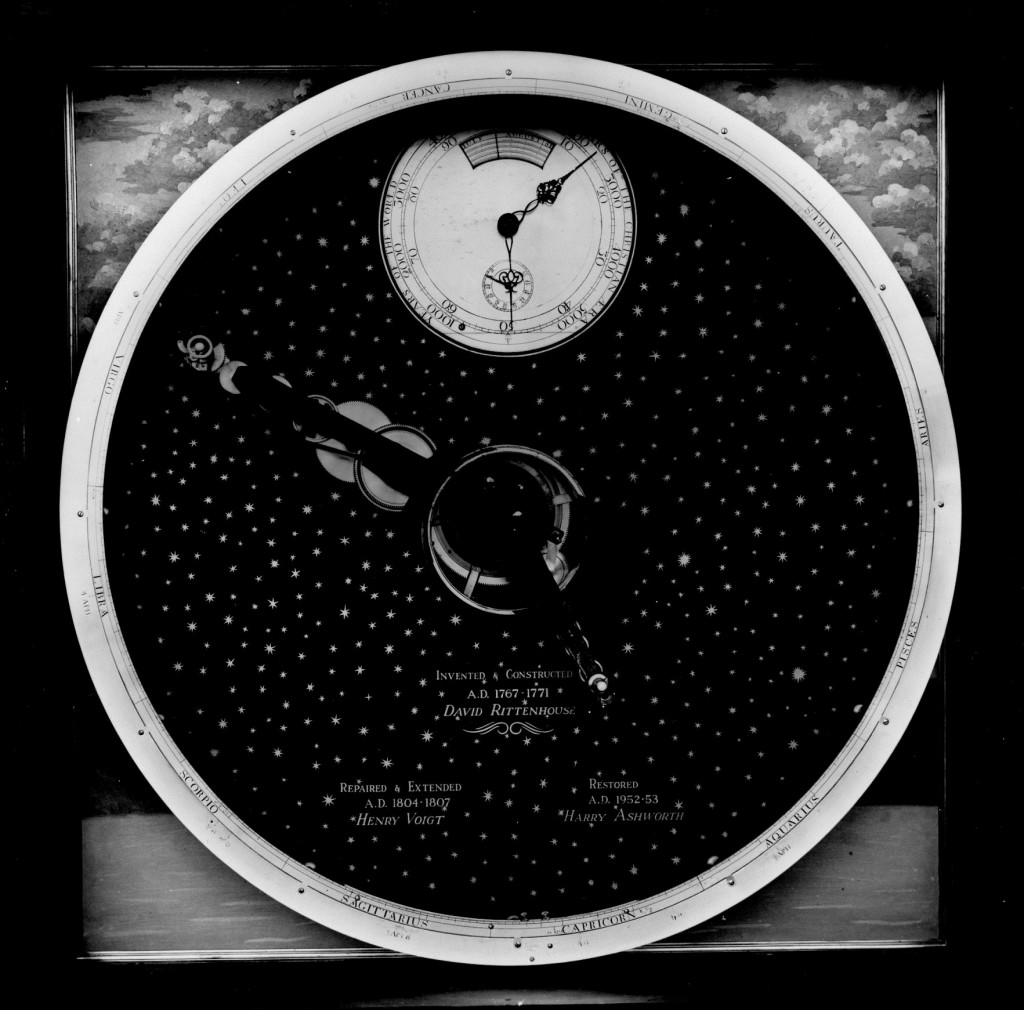
The Rittenhouse Orreries

On 5 May 1768, the Pennsylvania Gazette ran an article headlined, “A Description of a new ORRERY, planned, and now nearly finished, by Mr. DAVID RITTENHOUSE, of Norriton, in the County of Philadelphia.”

An orrery was a machine that simulated the movements of the solar system through axles and gears. The term had been coined early in the 1700s in honor of the fourth Earl of Orrery. He didn’t invent the device, but he was the patron and funder of the man who did, George Graham. [It was good to be an earl.]

Like Graham, Rittenhouse was a clockmaker. Their orreries were based on the idea that the solar system ran like a clock.

Rittenhouse’s orrery was just one of the machines he invented in Revolutionary Philadelphia. He was also a surveyor and astronomer, and one of the Philadelphia Whigs.

In honor of his orrery, Princeton College gave Rittenhouse an honorary degree. The college president, the Rev. John Witherspoon also raised nearly £300 to buy the machine in April 1770. It was installed in Nassau Hall the following year.

John Adams viewed the Princeton orrery on 27 Aug 1774, on his way to the First Continental Congress, writing:
Here we saw a most beautifull Machine, an Orrery, or Planetarium, constructed by Mr. Writtenhouse of Philadelphia. It exhibits allmost every Motion in the astronomical World. The Motions of the Sun and all the Planetts with all their Satellites. The Eclipses of the Sun and Moon &c.
However, the sale to Princeton had miffed the Rev. William Smith, head of the College of Philadelphia (precursor of the University of Pennsylvania). He thought he’d wooed Rittenhouse into giving his institution first refusal on the device. So Smith convinced the Pennsylvania legislature to “purchase from Mr. Rittenhouse a new Orrery, for the use of the Public, at any sum not exceeding four hundred pounds.”

This new machine, apparently delivered by the end of the year, was bigger and more sophisticated than the first. Rittenhouse followed the same basic design but added some new features. British-Americans viewed the “Rittenhouse orrery” (they seem to have treated the two machines as one) as a convincing argument of their society’s sophistication.

TOMORROW: Orreries at war.

Monday, March 20, 2017

Colonial Comics at the Royall House, 22 Mar.

On Wednesday, 22 March, I’ll be part of a panel discussion with comics creators E. J. Barnes and Jesse Lonergan at the Royall House and Slave Quarters in Medford.

We’ve all contributed to the two volumes of Colonial Comics: New England, whose main editor is Jason Rodriguez. Volume I told stories from the years 1620-1750, and the new Volume II brings the history up to 1775.

Both books feature an array of writing and illustration styles from many talented creators. They focus on lesser-known events that expose the fault lines of colonial society—“stories about Puritans and free thinkers, Pequots and Jewish settlers, female business owners and playwrights, gravedigging medical students, instigators of civil disobedience, college students, rum traders, freemen, and slaves.” Here’s a recent review of the first volume from Comics in the Classroom.

In volume 1, E. J. Barnes wrote and watercolored the story of Thomas Morton, an English settler in what’s now Quincy who was at odds with the Massachusetts Bay Puritans. She created portraits of historic figures for volume 2. She’s also the author of “Caroline’s Catalog,” about astronomer Caroline Herschel, and “A Beautiful Young Nymph Going to Bed,” based on a poem by Jonathan Swift.

Jesse Lonergan is the author of the graphic novels All Star, Flower and Fade, and Joe and Azat, as well as many short stories in comics form. For the second volume of Colonial Comics he and I created a story about watchman Benjamin Burdick working to solve a mystery about one of the victims of the Boston Massacre.

We’ll talk about how we created these stories, the choices we made historiographically and artistically, and the potential of the comics form, especially in schools.

This event is scheduled to start at 7:30 P.M. It is free for Royall House members, $5 for others. There will be copies of Colonial Comics and other publications available for purchase and signing afterward.

Sunday, September 11, 2016

“The most stupendous sight we poor mortals are allow’d to see”

In the summer or autumn of 1806, Susan Bulfinch of Boston wrote a letter to her brother Thomas Aphthorp in Britain with news of a recent family event:
Now, my dear Brother, I will attempt to give you some account, but by no means a description, of the most stupendous sight we poor mortals are allow’d to see, a total eclipse of the Sun, which took place the 16th of June, more apparent to us, the inhabitants of Boston, than those of any other part of the Globe.

It was progressing an hour, during which we watch’d it with Smoak’d glasses. Total darkness, three minutes and a half, when many stars were perfectly brilliant, particularly in the West. It was truly sublime and magnificent, notwithstanding the chill, which equall’d that of night. Myself and children assembled in the yard, as we wish’d to observe it in every stage of its progress, which we could with common window glass, smoak’d in different degrees. My little Grandchildren were at their Aunt [Anna] Storer’s, of whom they are very fond, each accommodated with a glass, their countenances quite philosophic, their minds fully engag’d, and their noses partaking of the smoak in contact with them.

When the darkness was evident, but not total, the effect upon Animal nature was wonderful. The pigeons precipitately flew to their homes, the little birds, of which we have many nests in our trees, ceas’d to sing, and the more domestic animals compos’d themselves for the night, and when the Glorious Luminary again broke forth, with his refulgent brightness, they each in their several ways hail’d the return of day with animated joy. Indeed, it was so stupendous a sight, it was worth living seventy years to see, and now if I was as good as old Simeon I should be apt to say, “Lord, now lettest Thou Thy Servant depart in peace.”
The “Smoak’d glasses” that Bulfinch wrote about were just that—pieces of glass covered with smoke. An 1888 pamphlet titled Instructions for Observing the Total Eclipse of the Sun, January 1, 1889 tells how to make them correctly:
This can be made of a small pane of good window-glass by holding it over the flame of a lamp or candle until a black film is deposited on it. If possible, it should be smoked so that the tint will be so dense at one end that the full light of the sun seen through it will not dazzle the eye; while at the other the film should be so thin that objects in an ordinarily lighted room may be seen distinctly through it. Smoke the glass as evenly as possible from one end to the other. Paste a narrow strip of thick paper across each end of the glass, on the smoked side, and lay on it a sheet of unsmoked glass of the same size. Then secure the two sheets together by a strip of paper pasted around the edges of both plates.
Boston was indeed an ideal location for viewing this eclipse, according to N.A.S.A. Others who wrote about it included the West Springfield minister Joseph Lathrop; the young printer Andrew Newell, writing as an anonymous “Inhabitant of Boston”; and “A number of gentlemen in Boston, who had furnished themselves with proper instruments,…at the house of Mr. Benjamin Bussey.”

This anecdote is a little outside the period I ordinarily cover, but I couldn’t resist the image of those well-bred children all watching the solar eclipse, “quite philosophic,” with black dots on the ends of their noses.

Monday, November 09, 2015

Digging through Harvard’s Digital Papers

I rather like my segue yesterday from the Stamp Act confrontation unfolding 250 years ago to Harvard’s new Colonial North American Project.

As the university announced, its archivists are digitizing all the seventeenth- and eighteenth-century documents in several different collections. With 2,400 objects documents available for viewing, the project is still in an early stage.

For example, here’s a notebook of Prof. John Winthrop’s meteorological observations for the mid-1740s. The professor kept those up to his death in 1779, meaning we have detailed weather records from just outside Boston for all the important days of the pre-Revolutionary turmoil and the siege of Boston. But the later notebooks don’t appear to be digitized yet.

Winthrop’s astronomical studies probably explain why the papers of him and his wife Hannah, who were firm establishment Whigs, include almanacs from the Loyalist printers John Mein and John Fleeming. But maybe they were just intrigued by the scientific reports on the covers of those publications, about giants in South America and a furious wild beast in France.

There’s a lot of other visual material in the online collection, more easily reproduced that way than in print. Harvard students learned how to take surveys and sketch buildings as part of their mathematics courses, so more than one left a plan of Cambridge common,

William Tudor, Jr.’s mathematics notebook shows him using “Genl. Warren’s monument on Bunker Hill” to calculate heights in 1795, illustrated above. A couple of decades later, Tudor helped to organize the initial drive to create today’s Bunker Hill Monument on the same hilltop.

Tuesday, August 13, 2013

What Lay Behind Dr. Joseph Warren’s Horoscope

Yesterday I quoted a horoscope for John Hancock signed by Roger Rintoul of London in 1760. It surfaced in 1904 and was published several years later. A couple of years after that, John W. Farrell came into possession of a horoscope of Dr. Joseph Warren. Reportedly “found in a bookstore in St. Louis,” it was dated 1743 and signed Roger Elwes.

Like the Hancock horoscope, this document was uncannily accurate about Warren’s future—particularly striking since the future doctor was only two years old as of the horoscope’s date. Elwes wrote:

Two yeeres before the firste decade of the natives life Saturn shall transmit the place of hys ruling planet mercury which shall implicate advantage to ye native from studie or knowledge of the arts or sciences. It is not clearly shown that the native shall make due and careful use of these advantages altho Jupiter is well Configurated in ye ascendant implicates that hee shall obtaine honour & esteeme in a certaine propter capacity. In or about ye yeere 1768 Saturn shalle transitte the playce of the Sun and this is implicative of some strong contention with magistrates or men in power in that yeere. Untoe this native presageth a violent configuration of the malefics forboden onward. Ye aspect of hylig or giver of life forms a quartile or opposition with each other. these malignent raies are implicative that the natives life is threatend at different times & seasons but averted by occasions showing strong & dignifyd aspects.
And so on.

John W. Farrell got hold of the Hancock horoscope and compared the two. He concluded, “Although this one is dated some seventeen years earlier and the family name in the signature is different, the handwriting is so similar that they appear to have been written by the same person.”

Farrell then removed the antique paper on which the Warren horoscope was written from the board on which it was mounted. The other side of that page was a sheet of music published in or after 1786. That was, of course, eleven years after Warren had died, making the predictive quality of the horoscope much less impressive.

Indeed, one might even suspect that someone had obtained antique paper, written out horoscopes of famous Patriots in an exaggerated archaic language, and signed fictitious names to those documents!

Since Farrell published his findings, we’ve heard nothing more about either the Hancock or Warren horoscopes.

Monday, August 12, 2013

Hancock’s Horoscope: “free from unbenign radiations of infortunes”

In 1904 The Literary Collector announced that a dealer called Libbie & Company was selling the autograph collection of Prof. Vincenzo Botta and his wife, highlighted by a horoscope for John Hancock cast by Roger Rintoul of London in 1760. The next year, Publishers Weekly reported:
Ginn & Co. have brought out in neat pamphlet form the horoscope of John Hancock, made in 1760. when he was about twenty years old, by Roger Rintoul, of London. . . . The Boston offices of Ginn & Co. stand on the site of the old John Hancock dwelling.
In 1916 the Bostonian Society Proceedings published the same document. Rintoul’s foresighted forecast:
Sign Capricorn. Under this sign native should excel in diplomacy, and have far-reaching ideas, hasty and impulsive, proud, high-minded and determined, and live much on externals and vain show. Diseases indigestion and melancholia. The sun in the second house (M. C.) in good aspect with Jupiter in the radix free from unbenign radiations of infortunes.

The geniture shows an unimportant and quiet life for over two decades, the native will then journey on the seas. The Lord of the 4th in a fixed sign at about age 28 gives wealth by means of the father or aged person and the revolutional ascendant being in the place of the Dragons head in the radix gives at this time honour & worldly esteem of position. And further at this time he shall have conflict with the powers by the malefic rays of Saturn. And further the native at this period is subject to danger of death or disease—the malignancy of the aspect heightens the violence of the means. But as the part of Fortune falls in the same degree as the radix it hath implication of influence averting the danger altogether.

After 10 decades of life in which the native who hath much pride and desire for fine living will attayne still greater honour and preferment the geniture showeth sicknesse still followeth the subject and that he hath great irritability of temper e’en to his best friends. About the age of 35 the native will take wife but showeth no child. The moon falling in the same hyleg in the radical figure of birth gives a violent configuration of the malefics and operates nearly half a decade from his access to dignitys operates at this time to affect the natives life from which he will die implicating from great weaknesse.
Aside from the “10 decades of life,” this description generally matches Hancock’s biography. In his early twenties he did “journey on the seas” to London. He inherited his uncle’s business at age twenty-seven and also came into “honour & worldly esteem of position.” He married at age thirty-eight. Dolly Hancock bore two children, but both died young.

TOMORROW: Another Revolutionary Boston horoscope.