J. L. BELL is a Massachusetts writer who specializes in (among other things) the start of the American Revolution in and around Boston. He is particularly interested in the experiences of children in 1765-75. He has published scholarly papers and popular articles for both children and adults. He was consultant for an episode of History Detectives, and contributed to a display at Minute Man National Historic Park.

Subscribe thru Follow.it


•••••••••••••••••


Showing posts with label Boston Massacre. Show all posts

Wednesday, August 12, 2026

Benjamin Davis, Jr., at the Boston Massacre
On 4 Apr 1756, Trinity Church in Boston recorded the baptism of “Benjamin Davis, Son of Benj. & [blank].”

Benjamin, Jr.’s mother was Elizabeth (Phillips) Davis, a convert to the Church of England. She bore a third child in 1757 but must have died in the few years following.

Presumably Benjamin, Jr., was baptized a few days after birth, meaning he was born in the spring of 1756. However, when he died on 28 Dec 1836, Boston newspapers reported that he was eighty-one, so it’s also possible his baptism was delayed a few months.

In 1762 Benjamin, Sr., married a second time, to Anstis Greenleaf, daughter of Suffolk County sheriff Stephen Greenleaf. She died in 1764, after giving birth, and Benjamin, Sr., remarried again to Alice Whipple of Rhode Island—and we all know how that turned out.

As a teenager, Benjamin, Jr., was present at the shooting on King Street in March 1770. He was called to testify at the soldiers’ trial, identified as “son to Mr. Davis a former witness.”

Here, as taken down by John Hodgson, is what Benjamin, Jr., experienced:
On the evening of the 5th March last, near the bottom of Royal exchange-lane, I saw a mob by Mr. [John] Greenleaf’s, I went right along into King street, I saw the Sentinel [Hugh White]; a barber’s boy [Edward Garrick] was there crying, and said the Sentry had struck him, and asked him what business he had to do it:

I went home and staid at the gate in Green’s lane some time,

Samuel Gray (one of the persons killed that night in King-street) came along, and asked where the fire was?

I said there was no fire, it was the soldiers fighting, he said, damn it, I am glad of it, I will knock some of them on the head; he ran off, I said to him, take heed you do not get killed in the affray yourself, he said, do not fear, damn their bloods.

Q. Had he a stick in his hand?

A. He had one under his arm.

Q. What sort of a stick was it?

A. I did not take notice.

Q. How long was this before the firing?

A. I do not suppose he could have got into King-street two minutes before the firing.
Benjamin’s father was also observing the action from a different angle, and his uncle Edward’s family had a clear view across the street at the Customs office. They were all defense witnesses at various trials.

TOMORROW: Fire!

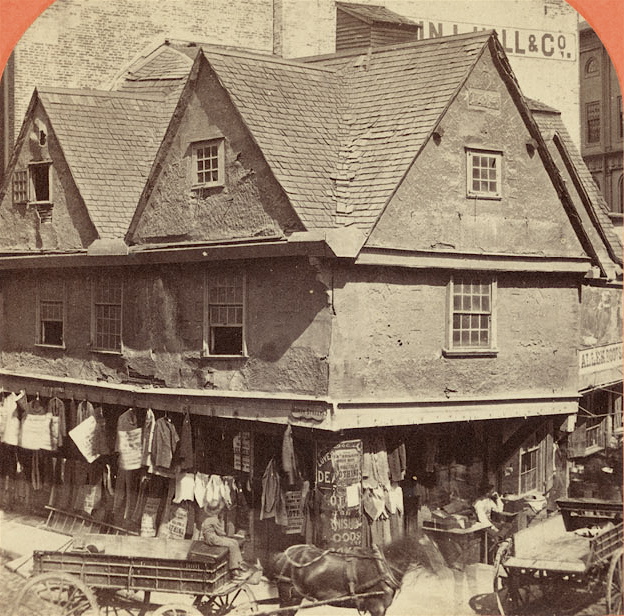
(Based on Benjamin’s quick description, I’m guessing he first spotted the crowd near John Greenleaf’s apothecary store, which survived into the late 1800s as the Old Feather Store at Dock Square, shown above.)

Friday, August 07, 2026

“The extraordinary self-denials and usages of the Sandemanians”

Hopestill Capen wasn’t the only Sandemanian clapped into the Boston jail in the summer of 1776, as discussed yesterday.

Another merchant who had joined that sect, Benjamin Davis (1729–1805), had been locked up since 26 July.

Like Capen, Davis was from an old New England family. For years he and his brother, Edward Davis (1730–1811), ran a mercantile firm located on the “South Side of the Town Dock.”

Among the European goods Benjamin and Edward Davis advertised for sale were coal, ale, cheese, snuff, salt, and stoneware. In return, they offered farmers money for flaxseed and potash.

Family sources say the Davis brothers’ partnership came apart during the non-importation campaign of 1768–70. Indeed, as of May 1771 the shop on “the South Side the Dock” was “Benj. Davis’s Store.” Having advertised their firm for many years, the brothers’ names appeared in only one more newspaper notice together: in August 1772 they offered “Two new Copper Stills & Worms,” perhaps their last joint property.

The Davis brothers definitely started to split politically in those years. On 28 Oct 1769, Edward was one of three angry merchants who confronted printer John Mein about how he was printing Customs house records. Mein stated, “Davis first made a push at me with his Cane which struck me on the left side of the belly.”

On 5 Mar 1770, Benjamin Davis was out in the evening about nine o’clock as locals faced off against soldiers at the Customs office. According to Robert Treat Paine’s notes from Capt. Thomas Preston’s trial, Davis testified: “Some body clap’d me on sholder and asked me if I would go and help fight the Soldiers. I said no.” He was a defense witness in the Boston Massacre trials.

Meanwhile, Edward Davis was watching the dispute with other merchants from the stoop of Edward Payne’s house, opposite the Customs office. At a bail hearing for Edward Manwaring in April and then at Manwaring’s trial, Davis and members of his family testified that they had seen no guns fired from the Customs building. In fact, Davis said that “soon after the firing he saw two women standing in the chamber of the Custom-house…with their hands under their aprons, in the posture of spectators.”

After the death of his wife, the former Ruth Vassall, in January 1774, Edward became a more active Whig. By the end of the year he was serving on Boston’s committee to enforce the Continental Association boycott.

In contrast, once Benjamin joined the Sandemanians in the 1760s, he appears to have sworn off actions to resist the royal government. In October 1774, John Andrews reported, “Ben Davis has let his Store on the Dock for the use of the troops.” He signed the usual Loyalist addresses and protests.

The mercantile house wasn’t the only partnership Benjamin Davis gave up for his faith. He married his third wife, Alice Whipple, daughter of a former lieutenant governor of Rhode Island, in 1768. According to family lore published by the Colonial Society of Massachusetts:
The lady’s amour propre was offended and her philosophy over-taxed by the extraordinary self-denials and usages of the Sandemanians. Following the example of the early Christian Church, it was their custom to hold a love-feast on Sunday at one another’s houses, at which only Sandemanians were present. The wives who were not members of the Sect, naturally did not take kindly to their exclusion from their own tables, and, at last, the third Madam Davis felt constrained to return to her family, thus, practically, deserting her husband.

A legal divorce being then unobtainable, the Sandemanians took the matter under consideration and concluded to sanction another matrimonial alliance on the part of Mr. Davis, declaring his to be one of those cases where voluntary abandonment by the wife justifies the dissolution of the marriage tie in the sight of Heaven.
Benjamin Davis didn’t actually remarry, though.

Unlike Capen, Davis chose to sail away to Nova Scotia with the British military in March 1776. But then he got on a ship headed to New York, presumably to help supply or administer Britain’s reinvasion.

TOMORROW: Captured at sea.

(The John S. Copley portrait above shows Anstice [Greenleaf] Davis, Benjamin’s second wife, courtesy of the Brooklyn Museum. She died in 1764, only two years after their marriage.)

Saturday, March 07, 2026

“A more interesting and bloody scene is apprehended”

The Rev. William Gordon’s account of the end of the siege of Boston continues, picking up (in the present historical tense) just after Gen. William Howe has spotted the Continental Army positions on the hills of the Dorchester peninsula:
The admiral [Molyneux Shuldam] informs him, that if the Americans possess those heights he cannot keep one of his majesty’s ships in the harbour. A council of war determines to attempt dislodging them.

General [George] Washington has settled his plan of defence and offence. Boston is so surrounded on every land side by neighbouring hills, that nothing can take place on the wharves or next to the water, but it may be noted by the help of glasses. Proper signals having been agreed on, by means of the hills, which are in view one of another, intelligence can be conveyed instantly from Dorchester heights to Roxbury, and from Roxbury to Cambridge and so the reverse. This mode of communicating information is the speediest and safest.

General Washington’s plan is, in case any number of the enemy leave Boston to attack the heights and are defeated, to communicate such defeat by the proper signal, when 4000 provincials are to cross over from Cambridge side, and attempt the town in the confusion that the regulars will be under. The boats are prepared, and the men paraded ready to embark. General [John] Sullivan commands the first division, and general [Nathanael] Green the second. Gen. [William] Heath objected to the command when offered, and remains in perfect safety with the troops left in Cambridge. The whole force which the commander in chief now has, including all the militia, is not much short of 20,000.

All is hurry and bustle in Boston. General Howe orders the ladders in town to be cut to ten feet lengths, that they may be fit for scaling. A large body of troops are to embark on board the transports, and to proceed down the harbour, with a view of landing in the hollow between the furtherest of the two fortified hills and the castle.

The men are observed by one, at whose door they are drawn up before embarking, to look in general, pale and dejected; and are heard to say, “It will be another Bunker’s Hill affair, or worse”—they have adopted the prevailing mistake of Bunker’s for Breed’s Hill. Some show great resolution and boast of what they will do with the rebels. When these troops, amounting to about 2,000, and designed to be under the command of lord Percy, are upon the wharves, and passing in the boats to the transports, the Americans expect they are intended for an immediate attack, clap their hands for joy, and wish them to come on.

General Washington happens at that instant to be on one of the heights; thinks with his men; and says to those who are at hand, “Remember it is the fifth of March, and avenge the death of your brethren.” It is instantly asked by such as are not near enough to hear, “What says the general?” His words are given in answer. They fly from man to man through all the troops upon the spot, and add fuel to the martial fire already kindled, and burning with uncommon intenseness.

The surrounding hills and elevations about Boston, affording a secure view of the ground on which the contending parties are expected to engage, are alive with the numerous spectators that throng them. A more interesting and bloody scene is apprehended to be just upon commencing, than what presented at Charlestown. They wait, as do the troops, officers and privates, the morning through; and till far into the afternoon, when they are convinced of the tide’s being so far ebbed, that no attack can be made by general Howe on the Tuesday, which indeed is not his intention, for he is preparing to do it on the Wednesday.

The transports go down in the evening toward the castle, a floating battery is also towed down, but the wind is unfavorable, and before they reach their destination blows up fresh, and forces three of the vessels ashore on Governor’s Island. A storm succeeds at night, such as few remember ever to have heard; and toward morning it rains excessively hard.

[March 6.] The design of general Howe was hereby frustrated, and a deal of bloodshed providentially prevented. A council of war, was called in the morning, and agreed to evacuate the town as soon as possible. The time that had been gained by the Americans for strengthening their works, before any attempt could be now made upon them, took away all hope of success…
And with that return to the past tense, Gordon signaled that the height of suspense was past. The siege would not end with a second mighty battle.

TOMORROW: When is an exchange of messages not an exchange of messages?

Thursday, February 05, 2026

“I fired two guns & my Master Mr. Manwarring fired one”

Another document related to the Boston Massacre in the collections of the Boston Public Library is catalogued as “Examination and answers of a servant of Edward Manwaring.”

Though his name doesn’t appear in the manuscript, that servant was Charles Bourgate, the “French boy.”

The handwriting identifies this document as having been made by Samuel Winthrop (1716–1779, shown here), long-time clerk of the Massachusetts superior court.

So far as I can tell, this text has never been published. It doesn’t contain information not found elsewhere—in fact, given that Charles Bourgate was lying, it doesn’t contain actual information at all. But here it is.
Q. was you at the Custom house in Boston on the Eveng. of the 5th. of March last
A. I was there

Q. at what time did you go there
A. I do not know at what hour I went there; it might be half an hour or an hour after Sunset

Q. how long did you stay there
A. after I got into the Custom house I staid there not quite half an hour

Q. Did you leave the Custom house before the firing was over
A. the guns were all discharged before he [sic] left the house

Q. was you at the Custom house at the time the bells rung for fire
A. I went there while the bells were ringing & staid there while the bells rang, when I came out of the house the bells had done ringing—

Q. do you know of any guns being fired out of the Custom house at that time
A. I fired two guns & my Master Mr. Manwarring fired one—

Q. Where were you when Mr. Manwarring fired
A. I was below. I had come from the Chamber down stairs I did not see him fire, I saw him direct the gun out of Window

Q. how came you to give those guns
A. my Master & the tall man ordered me

Q. What Chamber was those guns fired out of
A. Right over the Sentry box

Q. Whether when you went home you found Mr. Hudson & his Wife at home
A. I found them at home in the same Room where I left them when I went away—
There’s no date on this document, but I think it comes from the week after the Massacre. That was when Bourgate first told his story to legal authorities, but before John Munro came forward to provide an alibi for Edward Manwaring. Bourgate subsequently changed his story to accuse Munro as well, and a grand jury indicted both men and a couple more.

The indictment of Capt. Thomas Preston and the soldiers, also in the Boston Public Library, was written and signed by the Massachusetts attorney general, Jonathan Sewall. He then retired from the case. The indictment of Manwaring, Munro, and other men connected to the Customs service appears in Samuel Winthrop’s handwriting, based on Charles Bourgate’s testimony.

Wednesday, February 04, 2026

“Causes of the breaking out of this ill Humor”

Among the items in the Boston Public Library’s manuscripts department is a 21 Apr 1770 letter from Charles Lloyd (1735–1773) to George Grenville, former prime minister of Britain (shown here).

Lloyd was working at the Treasury office by 1761. His elder brother had tutored Grenville’s sons before becoming dean of Norwich, and through him Charles secured the job of secretary to the new prime minister in 1763.

After the Marquess of Rockingham took over government, Lloyd lost some patronage appointments but continued working at the Treasury. As of 1770, he was writing from the “Salt Office”; that department collected the salt tax, operating somewhat independently.

Lloyd also continued serving Grenville, who remained in Parliament, as a source on London news and a pamphleteer. According to the Dictionary of National Biography, Lord North even suspected that Lloyd wrote the radical Junius letters, a theory most later scholars called “absurd.”

This particular letter passed on news from Boston, which is probably why it ended up on this side of the Atlantic. It began:
Salt Office Saturday
21st April 1770.

Dear Sir

Nothing has occurred since youn left Town that I thought worth troubling you with till this morning when Mr. Robertson [John Robinson] (one of the Commrs. of the Customs in America) arrived in Town with an account that he left the whole Town of Boston in the utmost Confusion.

The immediate Causes of the breaking out of this ill Humor arose from some petty Quarrel between a Townsman & a Soldier. Each had their respective Partizans from words they came to Blows some were killed by the Soldiers & many wounded—

The next Day, a more General Engagement took place between the Civil & military when the Commander in Chief [acting governor Thomas Hutchinson] to prevent further Effusion of Blood order’d the Troops to retire into the Castle, & the Commrs. of the Customs are lodged there likewise—

The Townsmen were guilty of several outrages before the military Fired.
Lloyd then went on to write more about a lottery. He added a brief postscript of political gossip.

We can barely recognize the Boston Massacre in Lloyd’s description. The “petty Quarrel” was probably the ropewalk brawl. Robinson or Lloyd put less significance on the people killed than on Lt. Gov. Hutchinson agreeing to the town’s demand to move the troops—“a more General Engagement…between the Civil & military.” That was how some conservative elements in London first learned about the Massacre. 

Tuesday, February 03, 2026

Rhymes with Memes

The corporal arrested after the Boston Massacre is recorded in Massachusetts legal papers as William Wemms.

The soldiers’ trial was therefore designated as Rex v. Wemms et al., with the corporal always listed first as a matter of rank. (Ironically, he was most likely the one man who didn’t fire his gun that night.)

We know from the case of Edward Montgomery that those legal records can err. Both the army’s muster rolls and Boston town records establish that that private’s first name was Edward, but his indictment and conviction came under the name of Hugh Montgomery.

In Cpl. Wemms’s case, the army muster rolls consistently spell his name as Wemys, a name which these days is more often rendered as Wemyss.

It wasn’t till this year that I got curious about how that name was pronounced.

Turns out it’s a Gaelic name pronounced “Weems,” like the parson.

So now I have to retrain my brain and mouth around how to say Rex v. Wemms.

Wednesday, January 28, 2026

“All occupations resemble one another in some way…”

Back on 17 January, the New York Times columnist Jamelle Bouie drew a historical parallel in an essay for his newsletter:
Not since the British occupation of Boston on the eve of the Revolutionary War has an American city experienced anything like the blockade of Minneapolis and its surrounding areas by the federal government. . . .

All occupations resemble one another in some way, and it is striking to read descriptions and accounts of the occupation of Boston in light of events in Minnesota. “Having to stomach a standing army in their midst, observe the redcoats daily, pass by troops stationed on Boston Neck who occupied a guardhouse on land illegally taken it was said from the town, and having to receive challenges by sentries on the streets, their own streets, affronted a people accustomed to personal liberty, fired their tempers, and gnawed away at their honor,” writes the historian Robert Middlekauff in “The Glorious Cause: The American Revolution, 1763 to 1789.”

“Harrison Gray, a prominent merchant and a member of the council, told soldiers who challenged him one evening that he was not obligated to respond,” writes Richard Archer of the same period in “As if an Enemy’s Country: The British Occupation of Boston and the Origins of Revolution.” “They retaliated by thrusting their bayonets toward his chest and detained him for half an hour.”
Harrison Gray (shown above) was the province’s treasurer, a future Loyalist. Yet he had the same complaint as resistance leader Samuel Adams, who as “Vindex” complained in 1768:
when these gentlemens attendants [i.e., soldiers] take upon them to call upon every one, who passes by, to know Who comes there as the phrase is, I take it to be in the highest degree impertinent, unless they can shew a legal authority for so doing.

There is something in it, which looks as if the town was altogether under the government & controul of the military power: And as long as the inhabitants are fully perswaded that this is not the case at present, and moreover hope and believe that it never will, it has a natural tendency to irritate the minds of all who have a just sense of honor, and think they have the privilege of walking the streets without being controul’d.
The British army’s occupation of Boston ended in the Massacre. Bouie drew a parallel between that event and federal agent Jonathan Ross’s killing of RenĂ©e Good. When his essay appeared, two still-unidentified agents had not yet killed Alex Pretti.

Though there are similarities, I’ve been wary about analogizing the Massacre to this month’s events in Minneapolis. For instance, the eight soldiers in King Street were much more vulnerable than the heavily armed and armored federal agents shoving people around. And those soldiers weren’t grabbing people off the street just because they didn’t look white.

Nonetheless, it’s hard not to be reminded of the past. Bouie concluded, “I think the administration is more likely to break…and learn, as the British did in Boston, that Americans are quite jealous of their liberties.”

Saturday, December 20, 2025

“I can recollect something of their faces…”

As recounted yesterday, immediately after the Boston Massacre, town watchman Benjamin Burdick went up to the soldiers and examined their faces so he could identify them later.

That didn’t actually turn out to be helpful.

When he was called to testify at the soldiers’ trial in November, Burdick had this exchange:
Q. Did you see any of these prisoners in King street the night of the 5th of March?

A. Not that I can swear to as they are dressed. I can recollect something of their faces, but cannot swear to them.

When I came to King-street, I went immediately up to one of the soldiers, which I take to be that man who is bald on the head, (pointing to [Edward] Montgomery). I asked him if any of the soldiers were loaded, he said yes. I asked him if they were going to fire, he said yes, by the eternal God, and pushed at me with his bayonet, which I put by with what was in my hand.

Q. What was it?

A. A Highland broad sword.
John Adams’s notes on this exchange echo some details:
I went up to one that I take to be the bald man but cant swear to any. I askd him if he intended to fire. Yes by the eternal God. I had a Cutlass or high Land broad sword in my Hand.
In an earlier deposition Burdick said that the soldier he spoke to was “the fourth man from the corner, who stood in the gutter.”

However, multiple other witnesses agreed that Pvt. Montgomery was on the right end of the grenadiers’ arc (James Bailey, Jedediah Bass), and that the man in that position was the first to fire (Bailey, Bass, James Brewer, Thomas Wilkinson, Nathaniel Fosdick, Joseph Hiller). The watchman himself described the first shot coming from “the right hand man,” not the men closest to him. So the soldier Burdick spoke to wasn’t Montgomery, despite all his effort to memorize the men’s faces on King Street.

Burdick’s testimony does offer us some details about the soldiers in the courtroom. As defendants, those men were “dressed” differently from how they appeared on 5 March—differently enough for Burdick to say he could no longer recognize any of them with certainty. That suggests the soldiers were no longer wearing their full uniforms.

In addition, Montgomery wasn’t wearing a wig or hat since Burdick (who, incidentally, had been trained as a barber and peruke-maker) saw that he was “bald.”

Friday, December 19, 2025

“I wanted to see some faces that I might swear to”

For a new project I’ve been taking a deep dive into Benjamin Burdick’s accounts of the Boston Massacre.

Back in 2008 I pointed out that, while previous publications about the event didn’t make this clear, Burdick was a Constable of the Town House Watch. All his actions make sense when we consider that he was on King Street to keep the peace and enforce the law.

One of those actions was helping to carry away the bodies. As Burdick brought Dr. Joseph Gardner and David Bradlee to lift Crispus Attucks, the soldiers aimed their muskets again. Capt. Thomas Preston knocked the guns up, telling his men not to fire.

Burdick then boldly walked up to the soldiers. Here’s how he’s quoted describing that action in different sources.

Boston’s Short Narrative report, printing Burdick’s own deposition:
I then went close up to them, and addressing myself to the whole, told them I came to see some faces that I might be able to swear to another day—Capt. Preston, who was the officer, turned round and answered (in a melancholy tone) perhaps you may. After taking a view of each man’s face I left them.
Prosecuting attorney Robert Treat Paine’s notes on how Burdick testified at Capt. Preston’s trial:
I said I wanted to see a face I should sware to, Prisoner said in a Melancholly tone perhaps you may.
An anonymous spectator in the courtroom taking notes for Gov. Thomas Hutchinson:
After the firing I went up to the Soldiers and told them I wanted to see some faces that I might swear to them another day. The Centinel in a melancholy tone said perhaps Sir you may.
(This observer moved Preston’s words into the mouth of the sentry, Pvt. Hugh White. Or the transcriber mistook “Captain” for “Centinel.”)

Burdick’s testimony at the soldiers’ trial, as taken down by John Hodgson:
I went to them to see if I could know their faces again; Capt. Preston looked out betwixt two of them, and spoke to me, which took off my attention from them.
John Adams took notes on what Burdick said at the second trial, but not on that detail.

TOMORROW: Burdick identifying individual soldiers?

Thursday, November 20, 2025

The Samuel Maverick Inquest

Three of the people shot in the Boston Massacre died almost immediately: Crispus Attucks, James Caldwell, and Samuel Gray.

The soldiers’ guns also wounded several men and boys, and by the next morning one of those had died: seventeen-year-old Samuel Maverick.

On 6 Mar 1770, Thomas Crafts convened his second coroner’s inquest in two days to consider Maverick’s case. While the jury that had looked into Caldwell’s death included some prominent Bostonians and the victim’s employer, this men on this second jury appear more typical: ordinary citizens from the neighborhood.

The foreman was Benjamin Harrod. The town had two men by that name, father and son. The father owned the building where Henry Knox rented space for his bookstore in 1775. After the war they moved to Haverhill and Newburyport, respectively.

Harrod and his thirteen fellow jurors determined that Maverick had died after a “Musket Bullet entered into his Belly and lodged between his Ribs.” Later Crafts produced that musket ball in court, according to the notes of John Adams.

Samuel Maverick had worked for and lived with Isaac Greenwood, an ivory turner in the North End. The teen-aged apprentice shared a bed with Greenwood’s nine-year-old son John, a notable voice in this week’s American Revolution documentary on P.B.S.

Two years after the Massacre, Gov. Thomas Hutchinson appointed Isaac Greenwood to be another coroner in Suffolk County.

Wednesday, November 19, 2025

The Jury for the James Caldwell Inquest

As I wrote yesterday, I now lean toward housewright Thomas Crafts, Sr., being one of the Suffolk County coroners who responded to the Boston Massacre rather than his namesake son.

In fact, Thomas Crafts was apparently the first coroner to act. His date on the inquest into the death of James Caldwell is “the Fifth Day of March” in 1770. In other words, his jury convened, examined the evidence, and issued their determination in the immediate hours after the shooting.

Decades later, Benjamin Bussey Thacher interviewed the shoemaker George Robert Twelves Hewes about how the crowd on King Street had carried away Caldwell’s body:
Caldwell, who was shot in the back, was standing by the side of Hewes at that moment, and the latter caught him in his arms as he fell, and was one of those who bore him up to Mr. [Alexander] Young’s, the Jail-House in Prison Lane. He…was at this time second mate of a vessel commanded by Capt. Morton. This man lived in Cold Lane, and Hewes ran down directly to his house, from Young’s, and told him what had happened. The corpse soon followed him. . . . Morton…looked upon the dreadful object, and shouted like a madman for a gun, to run out “and kill a regular”…
The 12 March Boston Gazette reported that Caldwell was buried out of Faneuil Hall alongside Crispus Attucks as a “stranger,” a detail later histories repeat. But the 19 March issue said: “In the account of the funeral procession in our last, it should have been said, James Caldwell was borne from the House of Capt. Morton in Cold-Lane, instead of Faneuil Hall.”

Way back in 2006, the first year of this blog, I identified that sea captain as Thomas Morton. (Over a decade later came the Boston Massacre Sestercentennial commemoration in the Old South Meeting House. That was a weird event, on the lip of the pandemic shutdown when we were all wondering whether we should gather at all. But the weirdest moment for me was hearing a speaker identify Caldwell as Capt. Thomas Morton’s mate and flashing back to when I’d drilled down to find that name.)

I was therefore struck by seeing Thomas Morton’s signature among the members of the coroner’s jury examining James Caldwell’s body. Clearly he was emotionally involved in that death. Nonetheless, coroner Crafts made him part of the inquest. Maybe that was a way to calm Morton down, letting him respond to the young man’s killing in a productive way.

Other members of this jury were prominent Bostonians. The foreman was town treasurer David Jeffries. His son, Dr. John Jeffries, was a juror, months before he testified as a defense witness for the soldiers. William Dorrington, keeper of the smallpox hospital, was another.

Other members of this coroner’s jury included:
  • Samuel Gridley. In his testimony for the Short Narrative report, the apothecary Richard Palmes said he “followed Mr. Gridley with several other persons with the body of Capt. Morton's apprentice, up to the prison house.” Did that “Mr. Gridley” stay around to serve on the inquest jury?
  • Nathan Spear, whose younger brother Pool Spear was in the crowd on King Street and offered testimony against the soldiers.
  • Samuel Franklin (1721–1775), cutler. On 8 June, his first cousin once removed Benjamin Franklin wrote from London: “I received your kind letter of the 23d of March. I was happy to find that neither you, nor any of your family, were in the way of those murderers.” 
The verdict those fourteen men delivered to coroner Crafts: Caldwell was “murdered by a Musquet Ball shot thro’ his Body, & another Ball lodged in his Shoulder.” At first the men said the culprit was unknown, but then they revised the form to read “the Murderer a Soldier to us unknown.”

Monday, November 17, 2025

The Coroners Who Oversaw Inquests after the Boston Massacre

The most famous piece of coroners’ paperwork from the Boston Massacre is a verdict from the inquest into the death of Michael Johnson—or Crispus Attucks, as he was soon to be identified.

That document is in the collection of Revolutionary Spaces and has been on display in the Old State House. It’s been reproduced and transcribed in several places. Here’s an article about its conservation.

The coroner for that proceeding was Robert Pierpont, a Whig who lived at the far southern end of town.

I knew that the Boston Public Library’s Special Collections Department holds several more inquest documents. Mellen Chamberlain collected those papers for the library in the late 1800s, for both their historical value and their autographs.

Last last month, therefore, I made an appointment to look at the Chamberlain Manuscripts. I’ve done research at the B.P.L. for years, but the Special Collections Department upgraded its facilities and tightened its procedures since my last visit, so this required making an appointment and learning some new procedures.

I’m pleased to report that I found the verdicts of two inquests overseen by coroner Thomas Crafts. One examined the body of James Caldwell on 5 Mar 1770, and the second examined Samuel Maverick the next day.

In addition, Chamberlain acquired verdicts from two inquests headed by Thomas Dawes (shown above). He handled the cases of Samuel Gray (6 March) and Patrick Carr (15 March).

The collection also includes testimony for the Gray inquest from Richard Palmes, Robert Goddard, Joseph Petty, and Richard Ward, plus a deposition about aggressive soldiers from John Leach, Jr., that Dawes took in on 6 March. All but one of those witnesses also testified for Boston’s Short Narrative of the Horrid Massacre report or the trials or both. (Frankly, they couldn’t shut Palmes up.)

Thus, we should list Thomas Dawes among the coroners who did the first investigations of the Boston Massacre. In fact, he did more than Pierpont, and more evidence from his inquiries survive.

TOMORROW: So am I satisfied that Thomas Crafts, Jr., was a coroner in 1770?

Sunday, November 16, 2025

“Mr. Craft producd the Ball in Court”

Yesterday I showed a list of the men appointed as coroners in Suffolk County from 1747 to 1774. And that list made me nervous.

For nearly two decades now I’ve been writing that Thomas Crafts, Jr., member of the Loyall Nine and reader of the Declaration of Independence on 18 July 1776, was a coroner at the time of the Boston Massacre.

In my mind, that position showed how he was rising in society from the middling mechanical class into gentility, and how he was involved in all the political events of his time.

I think I saw that statement first in The Legal Papers of John Adams. Volume III quotes thus from John Adams’s notes on the soldiers’ trial for the Massacre: “Mr. Craft producd the Ball in Court.” A footnote adds: “The reference is probably to Thomas Crafts, the Suffolk County Coroner, and is presumably JA’s note, not the witness’ testimony.”

Hiller B. Zobel, one of the editors of those Adams papers, shortly afterward wrote in The Boston Massacre about the morning of 6 Mar 1770: “County Coroners Robert Pierpoint and Thomas Crafts were arranging for inquests on Johnson and the other victims.”

Note, however, that the only primary source I had on hand referred to “Mr. Craft” with no given name.

Now look back at the list of coroners yesterday, from The Massachusetts Civil List for the Colonial and Provincial Periods, 1630-1774. The name “Thomas Crafts” doesn’t appear anywhere.

There was a “Thomas Crofts” appointed or reappointed on 5 Nov 1761, and that could be an easy error for “Thomas Crafts.” But it could just as easily be an easy error for “Thomas Cross,” first named on 18 Apr 1749.

Furthermore, William Crafts was made a coroner on 11 Apr 1768. Based just on that list, the coroner called “Mr. Craft” in Adams’s notes would be William, not Thomas. Indeed, that list offers no confirmation Thomas Crafts, Jr., was ever appointed a coroner at all.

Newspapers also reported the governors’ appointments of new coroners in formulaic lines, as in the 18 June 1772 Boston News-Letter:
At a General Council held on Thursday the 4th of June Instant [i.e., of this month], at Boston, His Excellency the Governor was pleased to nominate,…

Thomas Allen, Esq; to be a Justice of the Peace for the County of Suffolk.

Mr. Isaac Greenwood, to be a Coroner for said County…

To which Nominations His Majesty’s Council did advise and consent.
(All the new justices of the peace were labeled “Esq.” while the coroners were ordinarily “Mr.,” showing the gap in prestige between the two offices.)

I couldn’t find such a newspaper item for Thomas Crafts, Jr., however. (Nor for the other Crafts/Crofts/Cross coroners discussed above.)

Thus, at the beginning of this month I was contemplating the possibility that Thomas Crafts, Jr., wasn’t a coroner in 1770 after all. I needed to see some original documents.

TOMORROW: To the archives!

Monday, November 03, 2025

“The Disease was rapid and poignant”?

Last month I faced a Boston 1775 emergency.

Which was, of course, not really an emergency. No one was in the least danger. I just felt an urgent need to confirm a statement I’d been repeating for years and suddenly had reason to question.

This dire situation arose because I asked myself how the coroners of Suffolk County responded to the death of William Molineux on Saturday, 22 Oct 1774.

John Rowe wrote in his diary that Molineux died “suddenly,” though Dr. Joseph Warren had visited the man the day before. Thomas Newell recorded death came “after three days’ illness,” Molineux’s political work having “produced an inflammation of the bowels.” John Andrews said Molineux died “After surviving a fit of apoplexy two days.”

By the time the Monday newspapers appeared, the Patriots had their story down. Edes and Gill’s Boston Gazette declared:
His Watchfulness, Labours, Distresses and Exertions to promote the general Interest, produced an Inflammation in his Bowels: The Disease was rapid and poignant; but in the severest Pangs, he rose superior to Complaint; he felt no Distresses but for the Public.
As for the Boston Post-Boy and Boston News-Letter, friendly to the royal government, they didn’t report Molineux’s death at all.

Some diarists and the Boston Gazette said that Molineux’s last words were “O SAVE MY COUNTRY HEAVEN!” That may even have been true, but I must note that “Oh, save my country, heav’n!” is a line from Alexander Pope’s Moral Essays. And that Molineux was notorious in his time for being a deist.

By March, Loyalists were publicly hinting that Molineux had committed suicide: through “the Laudanum of Doctor Warren, he quitted this Planet.” But there were also rumors, recalled by George Robert Twelves Hewes, that British army officers had poisoned the man.

That muddled situation led me to wonder if there was any official verdict on Molineux’s death. Massachusetts had inherited the English system of county coroners convening juries and holding inquests on suspicious deaths.

Unfortunately, not much paperwork seems to survive from inquests in pre-Revolutionary Massachusetts. There’s a small cache of documents relating to the Boston Massacre, probably saved those for their historic significance. Otherwise, collectors preserved a few determinations of coroners’ juries because they contained notable signatures.

Furthermore, in late 1774 the Massachusetts judicial system was being brought to a standstill by Patriot protests over judicial salaries and the Massachusetts Government Act. Some men, most prominently Molineux, refused to serve on juries. Outside Boston, crowds were blockading courthouses. Did that shutdown extend to coroners’ inquests as well?

Those questions led me to look more deeply into the coroners. How many were there? How long did they serve? How did they operate?

TOMORROW: Reading the law.

Wednesday, October 15, 2025

On the Trail of Capt.-Lt. John Goldfinch

In Lt. William Browne’s deposition about the Boston Massacre, quoted yesterday, The senior officer in the 14th Regiment that he referred to was “captain lieutenant [John] Goldfinch.”

By courtesy, captain-lieutenants and lieutenant-colonels were addressed by the higher version of their rank, so Capt.-Lt. John Goldfinch usually shows up in records from colonial Boston as just “Captain Goldfinch.”

Goldfinch provided his own deposition what happened on 5 Mar 1770, describing how he broke up a fight earlier in the evening and then responded to the military alarm after the shooting.

The captain-lieutenant said nothing in that document about his most significant role in the Massacre, however. Between those two episodes he chose to ignore wigmaker’s apprentice Edward Garrick calling out to him to pay his barber’s bill. (In court Goldfinch said he’d just paid that bill, so recently that he still had the receipt in his pocket, but he wasn’t about to answer an apprentice shouting in the street.)

Young Garrick was the opening witness in the trial of Capt. Thomas Preston, and an anonymous observer for the Crown reported his testimony this way:
Edward Gerrish. . . . I heard a noise about 8 Clock and went down to Royal Exchange lane. Saw some Persons with Sticks coming up Quaker lane. I said Capt. Goldsmith owed my fellow Prentice. He [Pvt. Hugh White] said he was a Gentleman and would pay every body. I said there was none in the Regiment.
I used that passage in my early article about the politicization of Boston’s youth and elsewhere. But quoting it is always hindered by the fact that it calls the officer “Goldsmith” instead of Goldfinch. Then again, the document calls the boy “Gerrish” instead of Garrick.

Most likely the note-taker got the names wrong. It’s also possible young Garrick didn’t remember the captain-lieutenant as accurately as he believed.

But in looking for clues about William Browne this month, I found that people got Goldfinch’s name wrong a lot.

The 22–29 Sept 1759 Universal Chronicle in London reported the promotion to lieutenant in the 14th Regiment of Joseph Goldfinch. Likewise, he appeared on the 1767 Army List as Lt. Joseph Goldfinch.

Goldfinch’s deposition in A Fair Account of the Late Unhappy Disturbance at Boston, printed in 1770, was signed Capt.-Lt. John Goldfinch. In all the other parts of the Massacre trial records but Garrick’s testimony, people agree his last name as Goldfinch.

Then the 1771 Army List listed Capt.-Lt. John Goldsmith.

On the 1772 list he was back to Capt.-Lt. John Goldfinch.

On 2 Mar 1772, the War Office reported that John Goldfinch had resigned his post as captain-lieutenant, to be replaced by Lt. John Stanton.

In the period of the long s that looked a lot like an f, it must have been easy to confuse the names of Goldfinch and Goldsmith. But the shift from Joseph to John is weird. Sadly, considering that the name John Goldfinch is a lot less common than William Brown(e), I haven’t found more about this man.

Tuesday, October 14, 2025

Lt. Browne “hearing the drum beat to arms”

Yesterday I finally noted that Capt. William Browne, who was in the thick of the action in early 1775 as a spy and an army officer, had also been in Boston from 1768 to 1770. He was then a lieutenant in the 14th Regiment.

In fact, we might have Capt. Browne’s description of the night of the Boston Massacre.

After that confrontation, the army and the Loyalist justice of the peace James Murray compiled testimony from soldiers and officers about their side of the conflict. Customs Commissioner John Robinson carried those depositions to London, where they were published in a book titled A Fair Account of the Late Unhappy Disturbance at Boston.

One of those depositions, dated 13 March, reads:
I William Brown, junior, lieutenant in the 14th regiment of foot, do swear, that on the evening of Monday the 5th of March, 1770, being in company with lieutenant [Daniel] Mattear, ensigns [William] Napier and [Henry] Hallwood, in the quarters appropriated for part of the officers of the 14th regiment, between the hours of nine and ten o’clock, I was alarmed with an extraordinary ringing of bells, and the words “Turn out,” which continued some time, and then ceased a little; but on the bells beginning to ring again, and hearing the drum beat to arms, I prepared to go to the barracks;

at this time, captain lieutenant [John] Goldfinch coming in, the gentlemen then ready went along with him, leaving lieutenant [Alexander] Ross and myself, who presently followed. All along Queen’s-street, and King-street, we were pursued by a number of people with clubs and sticks, calling out, “Here goes two more; kill them, kill them;”

on turning into Quakers-lane, I received a blow across the neck with a stick thrown at me, another being aimed, passed with great violence, and numbers rushing in, I was separated from lieutenant Ross, and followed with the cries, “Down with him, kill him, kill him,” and other opprobrious language, to the middle of Green’s-lane, where they left me; from thence I got safe to the barracks.

WILLIAM BROWN, junior,
Lieutenant of the 14th regiment.
I say this might be the same officer as the man who was later Capt. Browne of the 52nd because the Army Lists for 1767 and 1771 show there were two lieutenants named William Browne in the 14th during its time in Boston.

When I first saw “William Brown, junior,” I thought that might indicate this man’s father was also named William Brown, offering another (thin) clue to his identity. But it’s also possible that the deponent used “junior” to distinguish himself from the older Lt. Browne in the same regiment.

All of the officers Browne named, plus Ens. Andrew Lawrie, provided similar testimony. Capt. Goldfinch also described breaking up a fight earlier that night, and Ens. Napier said a woman told him the bell-ringing “war to raise the inhabitants against the soldiers.” All that could easily be read as evidence of Bostonians being hostile and violent toward British army officers for no reason.

Closer reading shows, however, that Lt. Browne and his colleagues went out into the street after the Massacre. They heard a long stretch of bells, shouting, and other cacophony. Then the noise “ceased a little” as the crowd absorbed the effect of the shots. Finally, the officers heard more bells along with the army drums summoning all the soldiers to their barracks. Browne and his fellows in the 14th headed for those buildings, running into townspeople upset that soldiers had shot a dozen of their neighbors.

TOMORROW: The frustrating Capt. Goldfinch.

Wednesday, October 01, 2025

Bell-Ringing on Special Occasions

Yesterday I looked at the daily schedule for ringing the bells of Boston’s meeting-houses in the 1740s.

I presume those bells also rang for their primary purpose, summoning congregants for services on Sunday.

Beyond that weekly routine, church sextons rang (or arranged for someone else to ring) the bells on various special occasions.

Bells were supposed to signal town meetings, for example. In September 1747 many North Enders complained that no bell had sounded in their neighborhood that morning, so the citizens agreed to postpone that day’s meeting until 3 P.M. The selectmen gave orders “that the Bells be rung throughout the Town.”

The selectmen also ordered sextons to ring their bells for celebrations: on imperial holidays, in response to news of military victories against the French, and when a high-ranking dignitary came to town.

Church bells rang in mourning, as when Boston received word that George II had died. And each meetinghouse’s bell was rung for a funeral, though on 12 May 1747 the town government moved to regulate that practice:
That for the Burial of any Person within the Town of Boston there shall not be more than the Bells of two Churches toll’d and that but twice at each Church on Penalty of Twenty shillings for each Bell more that shall be Toled at one and the same Funeral to be paid by him that shall order Procure or Tole the same.——

The second or Passing Bell not to exceed one hour and half after the first on Penalty aforesaid.——

That any Person demanding or Receiving any more than the Selectmen shall allow for twice Tolling said Bell at one Funeral shall forfeit the Sum of Twenty shillings.
Boston’s Whigs made a sonorous point on the second anniversary of the Boston Massacre, as the Boston Gazette reported: “the Bells muffled toll’d ’till Ten.”

Of course, church bells had also played a role in that 1770 event. After Pvt. Hugh White clubbed barber’s apprentice Edward Garrick, some of the boy’s friends got into the Old Brick Meeting-House to ring its bell. An unscheduled ringing was a fire alarm, but could also be useful in bringing out a crowd for a riot.

You can find more sources on public bells in eighteenth-century Boston in this article from the Colonial Society of Massachusetts.

TOMORROW: A new sound in Boston.

Friday, September 05, 2025

“Lt. Hawkshaw yesterday near expiring thro. his bad wounds”

During the British army withdrawal on 19 Apr 1775, Lt. Thomas Hawkshaw of the 5th Regiment was shot in the side of his face.

As recorded by his regiment’s surgeon, blood gushed from his nose and mouth as well as his wound. Some of the affected tissue became inflamed. He had trouble swallowing.

People thought Lt. Hawkshaw was lying on his deathbed. And according to legal and popular understandings of the time, that meant he couldn’t lie in another way. After all, a person wouldn’t utter a falsehood just before meeting his maker, right?

Or, as a legal maxim quoted in 1700s reference books said: Nemo moriturus præsumitur mentiri. A dying person is not presumed to lie.

Usually that “dying declaration” doctrine allowed testimony from a dead victim that would otherwise be ruled out as hearsay. Thus, Patrick Carr’s doctors could report his remarks about the soldiers holding back before the Boston Massacre in 1770. To discredit such strong evidence, Samuel Adams had to resort to sneering that Carr “in all probability died in the faith of a roman catholick.”

The same thinking made “deathbed confessions” convincing. In the case of Lt. Hawkshaw, word went around that as his life slipped away he blamed the army for starting the war. Justice of the peace Edmund Quincy wrote to John Hancock on 22 April:
Here they say & swear to it all round, in excuse of ye Regulars, proceeding at Lexinton—that they were attack’d first & I doubt not many oaths of Officers & men are taken before J. G—ley [Justice Benjamin Gridley], to confirm it—but among others who contradict ’em—Lt. Hawkshaw yesterday near expiring thro. his bad wounds——Call’d Several Credible persons to him & told ’em as a dying man—that he was obliged in Conscience to confess—that the first Action of ye Whole at L. was done by the Kings troops—wr. they killd & wounded eight men—but doubtless you have sufficient proof of ye Fact & every Circumstance attending near at hand— . . .

Capt. [John] Erving, at his house yesterday Gave me ye Account of Hawkshaws Confesso.-proved to him at ye No: End yesterday to be real
As discussed here, Quincy gave that letter to Dr. Benjamin Church, Jr., who slipped it to Gen. Thomas Gage. Which meant Lt. Hawkshaw’s commander read that he was contradicting the official army line.

TOMORROW: A quick response.

Thursday, May 08, 2025

“The Body of Michael Johnson then and there being Dead”

Revolutionary Spaces preserves what might be the first piece of legal paperwork arising from the Boston Massacre: the report of an inquest convened the day after the shooting.

This document a printed form filled out with specific details on the deceased and the names and signatures of the coroner and his jury. I’ve transcribed it with the printed words in boldface:
Suffolk, ss.

AN Inquisition Indented, taken at Boston within the said County of Suffolk the Sixth Day of March in the tenth Year of the Reign of our Sovereign Lord George the third by the Grace of God, of Great-Britain, France and Ireland, King, Defender of the Faith, &c. Before Robert Pierpont Gentm. one of the Coroners of our said Lord the King, within the County of Suffolk aforesaid;

upon the View of the Body of
Michael Johnson then and there being Dead, by the Oaths of Benjamin Waldo Foreman Jacob Emmons John McLane William Fleet John Wise John How Nathaniel Hurd William Baker junior William Flagg William Crafts Enoch Rust Robert Duncan William Palfrey & Samuel Danforth good and lawful Men of Boston aforesaid, within the County aforesaid; who being Charged and Sworn to enquire for our said Lord the King, When and by what Means, and how the said Michael Johnson came to his Death: Upon their Oaths do say,

That the said Michael Johnson was wilfully and feloniously murdered at King Street in Boston in the County aforesaid on the Evening of the 5th. instant between the hours of nine & ten by the discharge of a Musket or Muskets loaded with Bullets, two of which were shot thro’ his body, by a party of Soldiers to us unknown, then and there headed and commanded by Captain Thomas Preston of his Majesty’s 29th. Regiment of foot against the peace of our Sovereign Lord the King his Crown and dignity and so by that means he came by his death as appears by evidence.

In Witness whereof, as well I the Coroner aforesaid, as the Jurors aforesaid, to this Inquisition have interchangeably put our Hands and Seals, the Day and Year aforesaid.
This document was made so early that Bostonians hadn’t realized that “Michael Johnson” was really named Crispus Attucks.

Revolutionary Spaces shared an essay about this document’s history as a museum artifact and the work that’s been done to conserve it.

Tonight I’ll speak online to the American Revolution Round Table of New Jersey about how Massachusetts’s legal system responded to the Boston Massacre. Four criminal trials followed that event, though we usually hear about only one or two (so I might end up talking more about the others). 

Monday, November 25, 2024

“Admiral Renegado, came to anchor in Port Despair”

At the start of February 1770, the big news in Boston was the non-importation movement, and particularly the weekly demonstrations by schoolboys in support of it.

That is to say, every Thursday when the schools let out early, gangs of boys would converge on the shop of someone who hadn’t signed the non-importation agreement, set up a picket line, and shout insults at that shopkeeper and his or her customers. If the kids were feeling feisty, they’d throw snowballs and mud as well.

The Boston Chronicle, which opposed the movement, responded on 1 February with a fictional advertisement:
Intended speedily to be acted,
By a Company of young Tragedians,
A TRAGEDY
(Not acted here these seventy-eight years,)
called the
W I T C H E S,
With many Alterations and Improvements.
(The full item is quoted back here.)

That slammed the Whigs’ boycott, tweaked the town’s ban on theater, and poked at the sore spot of the Salem witchcraft trials all in one. It was masterful trolling before that term was invented.

Four days later, the Boston Chronicle fictionalized another common newspaper item with this start:
S H I P   N E W S.
January 25, 1770.
Last Tuesday Evening the “Well disposed” [i.e., Whiggish] fleet, under the command of ADMIRAL RENEGADO, came to anchor in Port Despair, having left their stations that morning in great confusion on the appearance of an English VICE ADMIRAL, with the British STANDARD flying at the mast head.
This was commentary on how William Molineux led a crowd to confront Lt. Gov. Thomas Hutchinson’s two importer sons at his house—an action that even Josiah Quincy, Jr., had warned could be treated as treason—and how that action had fizzled out.

Exactly one month after the second article, the Boston Massacre occurred. To defuse tensions in the streets, Hutchinson decided to have the 29th and then the 14th Regiments moved to Castle William.

As a result, in the following months there was no governmental force in the streets of Boston strong enough to deter the Whigs and their supporters. Crowds tarred and feathered Customs officer Owen Richards in May and threatened Scottish merchant Patrick McMaster with the same punishment in June.

In that atmosphere, I suspect, the printing staff of the Boston Chronicle didn’t feel safe publishing another item lampooning and lambasting the local Whigs. Somebody in that shop—or perhaps more than one somebody—composed a long article that built on three items the paper had already run:
  • Caricatures of prominent Whigs like “Tommy Trifle” and “Johnny Dupe” from October 1769’s “Outlines of the characters of…the Well-Disposed.”
  • The fake theatrical announcement.
  • The name “Admiral Renegado.”
Instead of publishing that piece in their own newspaper, however, they sent it to Anthony Henry in Halifax. Obviously, disguised gossip about Bostonians had less meaning for readers in Nova Scotia. But after he ran the piece on 8 May, it could filter back to its targets without sparking a riot. Not that any Boston printer dared to reprint it.

The October 1769 “Outlines of the characters of…the Well-Disposed” is always attributed to John Mein, publisher of the Boston Chronicle. He left a written key confirming the targets, so he was obviously involved in the production. But someone at the Boston Chronicle must have carried on in the same mode after Mein was driven away the next month. That person most likely wrote the piece published in Halifax.

TOMORROW: The most likely author.