J. L. BELL is a Massachusetts writer who specializes in (among other things) the start of the American Revolution in and around Boston. He is particularly interested in the experiences of children in 1765-75. He has published scholarly papers and popular articles for both children and adults. He was consultant for an episode of History Detectives, and contributed to a display at Minute Man National Historic Park.

Subscribe thru Follow.it


•••••••••••••••••


Showing posts with label John Langdon. Show all posts

Monday, July 28, 2025

A Hero of Lake George

The Battle of Lake George on 8 Sept 1755 probably involved fewer than 3,500 men, a little more on the British side than the French. Each commander reported that his force had faced a much larger foe, however.

Each commander also reported inflicting more casualties than his force suffered, and more casualties than the rival commander reported. In fact, it seems impossible to pinpoint the number of dead and wounded.

Both sides lost leaders, however. On the French side, Baron Dieskau was wounded and captured, and Canadian commandant Jacques Legardeur de Saint-Pierre was killed. The British lost Col. Ephraim Williams and Mohawk ally Hendrick Theyanoguin. Among the provincial officers who died of their wounds was Capt. William Maginnis of New York.

Gen. William Johnson was wounded early in the fighting near Lake George and had to sit out the rest of the battle. Not that he mentioned the last detail in his report to the Crown. Nor did he name Col. Phineas Lyman as the officer who took over and completed that part of the fight. But of course Johnson portrayed the battle as a great victory for Britain.

It probably was a British victory, though limited and costly. Crown forces could now move safely from Fort Lyman to Lake George, and the lakefront was clear enough to build another fort there.

But that clash was an even bigger win for William Johnson, Britain’s liaison to the Iroquois and new provincial general. He was made a baronet, thus Sir William Johnson. Eventually Benjamin West painted Johnson nobly sparing a French officer from attack by a Native warrior, as shown above.

The new baronet returned the king’s favor, renaming the nearby landmarks for the royal family: Lac du Saint-Sacrement became Lake George after George II, Fort Lyman became Fort Edward after one of the king’s grandsons (another slight for Phineas Lyman), and the new fort was dubbed Fort William Henry after the king’s younger son and another grandson. Since the territory remained in British hands, those names prevail.

As the senior (and surviving) British captain in the last part of this battle, Nathaniel Folsom enjoyed some of that glory. He rose within the New Hampshire military establishment, ranked as a colonel within a couple of years. Folsom’s businesses in Exeter prospered.

In 1774 the province chose Nathaniel Folsom as a representative to the First Continental Congress, alongside John Sullivan. His son, Nathaniel, Jr., participated in the first raid on Fort William and Mary that December. Decades later a veteran named Gideon Lamson stated (using military titles the men acquired later):
At nine, Colonel [John] Langdon came to Stoodley’s and acquainted General Folsom and company with the success of the enterprise,—that General Sullivan was then passing up the river with the loaded boats of powder and cannon.
Folsom took charge of one barrel of gunpowder removed from the fort.

Given Nathaniel Folsom’s success in the last war, his support for the Patriot resistance, and his activity in the New Hampshire Provincial Congress, it’s no surprise that that body voted to make him commander of the province’s troops on 21 Apr 1775. The legislators reaffirmed that decision on 23 May.

The problem was that no one had checked with the officer who was actually leading the New Hampshire troops around Boston.

TOMORROW: Stark divide.

Monday, December 16, 2024

The Cochrans of New Hampshire

The Cochran family came to New England from northern Ireland. They settled in towns named to attract such migrants: Belfast in what would be Maine and Londonderry in New Hampshire.

At least that’s according to a family history recorded in Lorenzo Sabine’s American Loyalists, based on the account of a daughter of John and Sarah Cochran living in Portsmouth, New Hampshire, in 1845.

However, some details of that account don’t match what contemporaneous documents tell us about the confrontations over Fort William and Mary in 1774 and 1775. That daughter might have been too young to grasp the details and chronology.

It’s also not clear how the daughter (never named, alas) came to be in Portsmouth when her parents had moved with four of their children to New Brunswick, Canada, in 1783.

Multiple Cochran households settled in the region in the early 1700s. Leonard A. Morrison’s History of Windham in New Hampshire (1883) has an extensive genealogy for one family, but focuses on descendants that remained in the U.S. of A. The Cochrans I’m interested in may have been related, and they certainly used the same common given names, but I have no hope of sorting them all out.

The best I can say is that it looks like John’s father James was born in Ireland about 1710 and made the trip across the Atlantic. John was born in America in 1730. He went to sea for some years. The New-Hampshire Gazette reported a captain of his name in charge of the Berwick in 1762, the Onondaga in 1763, and the Londonderry in 1769 and 1770.

John Cochran then returned to the family farm in Londonderry. His wife Sarah and their children lived there—possibly as part of an extended clan. They ultimately held deeds for well over a hundred acres of land.

In 1770 John accepted the post of commander of Fort William and Mary from Gov. John Wentworth, which took him back to the sea—or at least to an island in Portsmouth harbor. On St. John’s Day in 1771 and 1774, Brother Cochran hosted a Freemasons’ dinner at the fort.

As I recounted here, John and Sarah were in the fort on the afternoon of 14 Dec 1774 when John Langdon led in a militia force that took away all but one barrel of gunpowder.

James Cochran joined his son at the fort, perhaps brought by news of that confrontation. He was still there the next night when John Sullivan, recently returned from the First Continental Congress, showed up with more militiamen to collect artillery pieces and ordnance.

According to Gov. Wentworth, the older Cochran laid into Sullivan:
The honest, brave old Man stop’d him short, call’d him and his numerous party perjur’d Traitors & Cowards, That his Son the Capt. Shou’d fight them two at a time thro their whole multitude, or that He would with his own hands put him to death in their presence, Which the Son readily assented to, but none among them wou’d take up the challenge, relying on and availing themselves of their numbers to do a mischief which they never wou’d have effected by Bravery.
Sullivan had been struggling all day to figure out how to handle this event, pushed by more radical militiamen while trying not to go too far in defying the king. He probably didn’t care to hear James Cochran’s opinion.

But the New Hampshire forces left the Cochrans alone. John continued to command the fort, soon protected and probably rearmed by the Royal Navy. Sarah and their children, and probably James, continued to farm in Londonderry, even as war began down in Massachusetts.

On 23 Aug 1775, as I said yesterday, Gov. Wentworth and John Cochran sailed away from Fort William and Mary for Boston. That left Sarah and the children behind. And the environment had changed.

TOMORROW: Cochrans on the move.

Saturday, December 14, 2024

“Beset on all sides by upwards of four hundred men”

In 1770, New Hampshire governor John Wentworth appointed John Cochran (1730–1807) the official commander of Fort William and Mary in Portsmouth harbor. This was a more permanent responsibility than a militia rank, though less than the regular army.

According to an article in Loyalist Trails, Cochran was a sea captain who had settled on a farm in Londonderry, New Hampshire, with his wife Sarah and their children.

Both John and Sarah Cochran were on the fortified island on 14 Dec 1774, 250 years ago today. The evening before, Gov. Wentworth had sent a warning that local Patriots might try to take possession of the fort or its military supplies.

The Cochrans noticed an unusual number of visitors that day—men saying they’d just dropped by the island to chat, even though they’re never done that before. The couple became suspicious, and Sarah brought John his pistols.

More men arrived, kept outside by the fort’s guns. Future Continental Congress delegate John Langdon and sea captain Robert White convinced Cochran to let them in for a conversation.

Those two men told the commander they wanted to remove all the gunpowder from the fort. Cochran asked if they had authorization from the royal governor. Langdon reportedly replied that he “forgot to bring his Orders, but the Powder they were determined to have at all Events.”

In the evening Cochran wrote a quick report to Gov. Wentworth about what had happened next:
I received your Excellency’s favour of yesterday, and in obedience thereto kept a strict watch all night, and added two men to my usual number, being all I could get.

Nothing material occurred till this day one o’clock, when I was informed there was a number of people coming to take possession of the Fort, upon which, having only five effective men with me, I prepared to make the best defence I could, and pointed some Guns to those places where I expected they would enter.

About three o’clock the Fort was beset on all sides by upwards of four hundred men. I told them, on their peril, not to enter; They replied they would. I immediately ordered three four pounders to be fired on them, and then the small arms, and before we could be ready to fire again, we were stormed on all quarters, and they immediately secured both me and my men, and kept us prisoners about one hour and a half, during which time they broke open the Powder House, and took all the powder away, except one barrel, and having put it into boats and sent it off, they released me from my confinement.

To which can only add, that I did all in my power to defend the Fort, but all my efforts could not avail against so great a number.
Wentworth later interviewed witnesses, gathered depositions, and compiled a longer account. Those documents weren’t published until the 1970s. They contained more dramatic details, such as where the fort’s cannon shot had ended up: one four-pound ball “went thro a warehouse,” another “pass’d thro a Sloop,” and the third “lodg’d in an House in Kittery,” Maine.

As the attackers stormed in, Cochran found himself pushed back against a wall, his musket broken, jabbing at assailants with his bayonet. A Portsmouth sailor named Thomas Pickering jumped onto the captain’s shoulders and grabbed him by the neck. Finally the “Multitude” marched Cochran off to his house to retrieve the key to the powderhouse.

Instead, they found Sarah Cochran, who had herself “snatch’d a bayonet” and tried to rescue her husband. The crowd overpowered her and locked the couple (and perhaps their children) in the house while some went to break open the powder supply.

TOMORROW: What happened to the Cochrans?

Monday, September 25, 2023

“A Doll of the present mode”

The little stories I’ve told over the last two days about Benjamin Franklin’s and George Washington’s grandchildren raise the question: Did any Founders’ children not have to wait more than twelve months for toys to arrive from France?

Founders Online points me to one lucky child.

On 11 Sept 1785, American diplomat Thomas Jefferson wrote from Paris to John Langdon (1741–1819), president of the Confederation Congress, enclosing a gift:
I beg leave to renew my acquaintance with Miss Langdon by sending her a Doll of the present mode, dressed in Muslin, a mode which prevailing here to an almost total exclusion of silk, has literally and truly starved a great number of people. I add to it a box in which she will find a small gentleman who will teach her a short-handed and graceful manner of going down stairs.
Elizabeth Langdon was born in 1777 and thus about eight years old when Jefferson wrote. She was living in the house her father had commissioned in Portsmouth, New Hampshire (now preserved by Historic New England). 

Unlike the other cases I discussed, Jefferson lucked out in the choice of ship he sent the toys and that letter on. By 7 December, Langdon was able to write back:
Our dear Bets, begs leave to present you with her grateful thanks, for the great honor you have been pleased to conferr on her, in sending such an agreable present: all Companies who come into the house must be entertained with the sight of her doll, and tumbling Gentleman; and she does not fail to confess her obligations to Governor Jefferson.
I’d like to know more about this “tumbling Gentleman” with “a short-handed and graceful manner of going down stairs.”

I wonder if that toy was designed along the same lines as this tumbling man in the collection of the Longfellow House–Washington’s Headquarters National Historic Site. That plaything dates from the mid-1800s, but the design was reportedly around well before then.

(To my surprise, I found that Elizabeth Langdon already made an appearance on this blog. In 1796, eleven years after receiving her toys from Jefferson, she recognized the Washingtons’ escaped slave Oney Judge in Portsmouth.)

Saturday, August 26, 2023

Dr. Benjamin Rush’s “Travels Through Life” Digitized

Here’s another source on the Revolution recently digitized: eight handwritten volumes of Dr. Benjamin Rush’s “Travels Through Life: or Account of Sundry Incidents and Events in the Life of Benjamin Rush…written for the use of his children.”

The American Philosophical Society in Philadelphia owns these volumes and has made them perusable over the web.

There’s a ninth and final volume nearby at the Library Company of Philadelphia.

George W. Corner transcribed and edited Rush’s memoir for publication by the A.P.S. in 1948, which was late for the first-person reminiscences of a noted Founder. The Autobiography of Benjamin Rush is still under copyright, therefore, and I haven’t come across any digitized edition on the web.

As a result, some of Rush’s anecdotes aren’t as well known and retold as one might expect. Here from near the start of handwritten volume 6, for example, is the doctor’s recollection of interactions with George Washington on 18 June 1775, right after he agreed to be the Continental Congress’s top general:
A few days after the appointment of General Washington to be commander in chief of the American Armies, I was invited by a party of Delegates and several citizens of Philada. to a dinner which was given to him at a tavern on the Banks of the Skuilkill below the city.

Dr. [Benjamin] Franklin, Mr. [Thomas] Jefferson, James Wilson, Jno. Langdon of New Hampshire and about a dozen more, constituted the whole company. The first toast that was given after dinner was “The Commander in chief of the American Armies.” General Washington rose from his seat, and with some confusion thanked the company for the honor they did him. The whole company instantly rose, and drank the toast standing.

This scene so unexpected, was a Solemn one. A silence followed it, as if every heart was penetrated with the awful, but great events which were to follow the Use of the Sword of liberty which had just been put into general Washington’s hands by the unanimous voice of his country.

About this time, I saw Patrick Henry at his lodgings, who told me that general Washington had been with him, and informed him, that he was unequal to the station in which his country had placed him, and then added with tears in his eyes “Remember Mr. Henry what I now tell you,- From the day I enter upon the command of the American armies, I date my fall, & the ruin of my reputation.”
My transcription differs from Corner’s in tiny details of punctuation and capitalization. But only by looking at the manuscript can we see, for example, that Rush:
  • added the words “New Hampshire” because, I presume, he didn’t think his readers would remember who John Langdon was.
  • started to write that Washington thanked his companions with “great confusion” before easing that down to “some confusion.”
  • first quoted Henry as saying Washington spoke of “what I this day tell you” and changed that to “what I now tell you,” probably because the phrase “the day” appeared in the next clause.
Rush biographer Stephen Fried, whose tweet alerted me to this digital offering, noted that the digitization of Rush’s memoirs “even shows the parts his kids tried to cut out,” and that “his infamous riffs on his fellow signers is in Vol 7.” Have fun.

Tuesday, December 06, 2016

Oney Judge and “the President’s Wishes”

As I reported yesterday, George Washington has been our richest President so far. Most of his property consisted of land, both plantations in Virginia and unsettled claims to the west, and slaves. A lot of those slaves had come to his wife Martha or her children, inherited from her first husband’s family, and George felt obliged to preserve that wealth.

When the federal government moved to Pennsylvania in 1791, that state’s law gradually ending slavery posed a problem for the Washingtons. If they brought their household servants to Philadelphia—and how could a rich couple live without their household servants?—then those people were entitled to be free after six months in the state.

On 24 April Washington’s plantation manager, Tobias Lear, wrote to him about what the U.S. Attorney General, Edmund Randolph, had said about that law:
But he observed, that if, before the expiration of six months, they could, upon any pretence whatever, be carried or sent out of the State, but for a single day, a new era would commence on their return, from whence the six months must be dated for it requires an entire six months for them to claim that right.
Lear then discussed the specific situations of several enslaved people, including: “Mrs Washington proposes in a short time to make an excursion as far as Trenton, and of course, she will take with her Oney & Christopher, which will carry them out of the State; so that in this way I think the matter may be managed very well.”

Oney Judge was Martha Washington’s personal maid. She had been born at Mount Vernon around 1774. Judge was part of Martha’s property, and the First Lady planned to bequeath her to a granddaughter. So the Washingtons made sure that she was never in Pennsylvania for six months at a stretch.

Five years after Lear’s letter, on 21 May 1796, Judge slipped away from the Presidential mansion. She later told an interviewer, “I had friends among the colored people of Philadelphia, had my things carried there beforehand, and left Washington’s house while they were eating dinner.” Frederick Kitt, the President’s steward in Philadelphia, placed an advertisement seeking Judge in the 24 May Philadelphia Gazette.

At the end of June, Thomas Lee, Jr., wrote from New York to President Washington in response to, as he wrote, “the desire you expressed that I should make enquiry about your runaway Woman.” Lee reported a cook saying that Judge had gone north to Boston, and he planned to make inquiries there. Washington knew multiple men named Thomas Lee, and I’m not sure which one this was, but he appears to have been pursuing Judge as a private favor.

Later that summer Elizabeth Langdon, daughter of Sen. John Langdon, recognized Oney Judge on the street in Portsmouth, New Hampshire. Slavery was already unenforceable in that state. According to Washington’s understanding, Langdon “was about to stop and speak to her, but she brushed quickly by, to avoid it.”

The President moved to track Judge down—but instead of continuing his efforts through private channels, he began to use the resources of the federal government. On 1 Sept 1796 he wrote to his Secretary of the Treasury, Oliver Wolcott:
Enclosed is the name, and description of the Girl I mentioned to you last night. She has been the particular attendent on Mrs Washington since she was ten years old; and was handy & useful to her, being perfect a Mistress of her needle. . . .

Whether she is Stationary at Portsmouth, or was there en passant only, is uncertain; but as it is the last we have heard of her, I would thank you for writing to the Collector of that Port, & him for his endeavours to recover, & send her back: What will be the best method to effect it, is difficult for me to say. If enquiries are made openly, her Seducer (for she is simple and inoffensive herself) would take the alarm, & adopt instant measures (if he is not tired of her) to secrete or remove her. To sieze, and put her on board a Vessel bound immediately to this place, or to Alexandria which I should like better, seems at first view to be the safest & least expensive. But if she is discovered, the Collector, I am persuaded, will pursue such measures as to him shall appear best, to effect those ends; and the cost shall be re-embursed & with thanks.
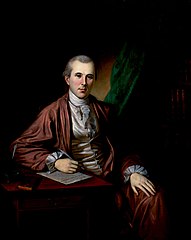
The “Collector” was Joseph Whipple (1738-1816, shown above), the head of the Customs service in Portsmouth and thus a federal employee who answered to Wolcott. He had held the same position for the state of New Hampshire until 1789, and the new President had reappointed him on John Langdon’s recommendation.

Whipple wrote back to the Treasury Secretary on 10 September, “I shall with great pleasure execute the President’s wishes in the matter.” The next month, on 4 October, he wrote again, telling Wolcott that Judge had expressed “a thirst for compleat freedom” as well as “great affection & reverence for her Master & Mistress”; she was (at least initially) willing to return to Mount Vernon if the Washingtons guaranteed her freedom on their deaths.

The President replied directly to Whipple on 28 November, rejecting those terms. He also told the Collector:
…you would oblige me, by pursuing such measures as are proper, to put her on board a Vessel bound either to Alexandria or the Federal City; Directed in either case, to my Manager at Mount Vernon, by the door of which the Vessel must pass; or to the care of Mr Lear at the last mentioned place, if it should not stop before it arrives at that Port.

I do not mean however, by this request, that such violent measures should be used as would excite a mob or riot, which might be the case if she has adherents, or even uneasy sensations in the minds of well disposed Citizens. rather than either of these shd happen, I would forego her services altogether; and the example also, which is of infinite more importance. The less is said before hand, and the more celerity is used in the act of Shipping her, when an opportunity presents, the better chance Mrs Washington (who is desirous of receiving her again) will have to be gratified.
Again, this wasn’t government business. Washington was asking Whipple to do him a big favor, one gentleman for another. But Whipple was a federal government employee, and he owed his position to Washington. Today that would strike us as a clear conflict of interest.

There’s more to Oney Judge’s story, and the Washingtons’ pursuit of her. Today I’m just looking at how having the resources of government presents a great temptation to a President with private interests.

Saturday, June 18, 2011

A Dinner for General Washington

On 18 June 1775, George Washington wrote in his diary:
Dined at Mullens upon Schoolkill. Spent the Evening at my lodgings.
The next day he recorded dinner at the house of Joseph Reed, soon to be his first military secretary. And then, on the day he received his formal commission as general from the Continental Congress, Washington stopped keeping his diary for a few years.

Years later, Dr. Benjamin Rush described what was probably that dinner at a tavern along the Schuylkill:
A few days after the appointment of General Washington to be commander in chief of the American armies, I was invited by a party of delegates and several citizens of Philadelphia to a dinner which was given to him at a tavern on the banks of the Skuilkill below the city. Dr. [Benjamin] Franklin, Mr. [Thomas] Jefferson, James Wilson, Jno. Langdon of New Hampshire and about a dozen more constituted the whole company.

The first toast that was given after dinner was “The Commander in chief of the American Armies.” General Washington rose from his seat, and with some confusion thanked the company for the honor they did him. The whole company instantly rose, and drank the toast standing. This scene, so unexpected, was a solemn one. A silence followed it, as if every heart was penetrated with the awful, but great events which were to follow the use of the sword of liberty which had just been put into General Washington’s hands by the unanimous voice of his country.
In his autobiography Rush added another anecdote:
About this time I saw Patrick Henry at his lodgings, who told me that General Washington had been with him, and informed him that he was unequal to the station in which his country had placed him, and then added with tears in his eyes “Remember, Mr. Henry, what I now tell you: From the day I enter upon the command of the American armies, I date my fall, and the ruin of my reputation.”
That story seems out of character for Washington to me. But of course he worked hard at presenting a certain character to the world, and we’re not privy to many unguarded moments. A slight change in the words Henry remembered—“I fear that from the day I enter…,” or some such—makes it easy to imagine those words from Washington’s mouth.