J. L. BELL is a Massachusetts writer who specializes in (among other things) the start of the American Revolution in and around Boston. He is particularly interested in the experiences of children in 1765-75. He has published scholarly papers and popular articles for both children and adults. He was consultant for an episode of History Detectives, and contributed to a display at Minute Man National Historic Park.

Subscribe thru Follow.it


•••••••••••••••••


Showing posts with label John Viets. Show all posts

Thursday, July 23, 2026

Back to the Old New-Gate Prison

In January I broke off a series of postings about the first years of Connecticut’s New-Gate Prison because of the press of other matters.

As awful as we might think of being imprisoned underground in an old, dank copper mine, the colony actually opened that prison as a reform measure. It was an alternative to corporal and capital punishment. And enforced labor might even make that mine profitable.

From December 1773 to April 1774, Connecticut courts sent six convicted criminals to the prison in Simsbury, to be locked down under the eye of keeper John Viets.

By that April, all six had disappeared, either to parts unknown or under the rubble of a collapsed tunnel.

In a comment on my last posting Mike asked:
Did it occur to the people of Connecticut that Mr. Viet may have been a less than adequate overseer?
That’s a good question, and here are some thoughts grappling for an answer.

First, the official “overseers” of the prison were three members of the Connecticut legislature who supervised Viets. They had the responsibility to hire the keeper, but they were also responsible for securing him the resources necessary to do that job.

Second, long-term incarceration was still an experiment. If the Connecticut legislature wanted its prison to work (and the government had already sunk a fair amount of money into converting the old mine), it needed to get the budget and rules right. The legislators might have expected (or accepted) a period of adjustment.

Finally, the overseers had probably hired John Viets because he was convenient. He owned a tavern right next to the mine. That was the infrastructure for feeding the prisoners, housing the guards, and keeping someone on site watching for disturbances and escapes. Hiring a new keeper and setting him up in Simsbury would have been a big expense.

Viets knew that an unfortunate pattern was developing. His 26 April advertisement began “New Gate Prison was again broke open…” But he remained on the job.

TOMORROW: A hardened criminal appears.

Tuesday, January 06, 2026

“New Gate Prison was again broke open”

Three months and a day after he first reported a convict escaped from Connecticut’s New-Gate Prison, keeper John Viets wrote out a second notice for the newspapers.

Here’s the text as it appeared in Hartford’s Connecticut Courant on 3 May 1774:
Simsbury, April 11, 1774.

LAST Saturday night the prisoners in New Gate Prison in Simsbury opened a way that had been in part stop’d up, that led from the place of their confinement into an old deep shaft that was partly filled with rocks & stones;

William Johnson Crawford, and Daniel Humphry (sometimes called Daniel Collyer Humphry) being more bold than the rest, ventured to pull away the stones from over their heads, and to work upwards in the old shaft, and so these two in the shaft pulled down the stones and the other three prisoners be low removed them out of the way to keep a communication between them, and all promised themselves a speedy escape—

when (at about three o’clock in the morning) the rock, stones, &c. in the shaft all gave away, and sunk into the shaft, where Crawford and Humphry were at work, to the great consternation of the three other prisoners, who say they really believe that Crawford and Humphry are both buried under the stones, &c.—but whether they are buried there or by some means escaped appears uncertain to those who have viewed the place, but rather conjecture the latter.

Therefore, this is to give notice, that if any person or persons will take up said Crawford and Humphry, or either of them, and convey them to said New Gate, shall have Ten Dollars reward for each, paid by
JOHN VIETS, Keeper of said Prison.

N B Said Crawford is about twenty four years of age, five feet and eight inches high, black curled hair, black eyes had on a light brown broad cloth cost, red duffel trowsers. Humphry is about twenty years of age, five feet and eight inches high, had on a light brown sea jacket, and brown plush breeches, both well set, spry young men.
That advertisement ran for another week, indicating the two fugitives were unaccounted for a month after their disappearance.

The other three men were still in the prison—two horse thieves convicted alongside Humphry and a “Ruffian” who had mugged a man near Norwich for his rum.

Then the 26 April Connecticut Courant offered this notice:
Last Saturday night
New Gate Prison was again broke open, and the following persons made their escape, viz. Zephaniah Ramsdel about 27 years of age, about 5 feet 8 inches high, lightish yellow hair something short, grey eyes, thinish face; had on a black coat & vest, cloth coloured plush breeches, a blue duffel great coat, and new shoes.—

Also, John Roberts, about 40 years old, about 5 feet 9 inches high, grey eyes, and short black curled hair; had on a brownish or redish colour’d surtout, a pair leather breeches very black if not washed since, a pair old shoes.—

Also, James Williams, a short well set fellow, about 28 years old, with short black hair; had on a blue cap, a pair long nasty linnen trowsers, check shirt, and new shoes. Whoever will take up either or all of said fellows, and return them to said New Gate, shall have Fifteen Dollars reward for each, paid by
JOHN VIETS.

Simsbury, April 25, 1774.
Apparently John Roberts had recovered from falling down a shaft, as reported when he first arrived at the prison.

For those keeping score, in 1774 the colony sent six men to its new New-Gate Prison for sentences of two to ten years, and by the end of April all six of those men had disappeared. (Two of them possibly under rubble, or possibly free.)

COMING UP: A hardened criminal.

Sunday, January 04, 2026

“Escaped from New Gate Prison at Simsbury, one John Hinson”

Exactly one month after a New Haven court sentenced John Ensign to ten years inside Connecticut’s new prison at Simsbury, as reported yesterday, he disappeared from his underground cell.

On 10 Jan 1774, John Viets, keeper of that New-Gate Prison, wrote out an advertisement for the New Haven newspaper. Here’s the text of the ad as it appeared in the 1 February Connecticut Courant, out of Hartford:
Ten Dollars Reward.

LAST Night escaped from New Gate Prison at Simsbury, one John Hinson, lately committed for Burglary, who is about 5 Feet 8 Inches high, has black Eyes, dark Hair, of a fair Complexion, and about twenty Years of Age—(he was helped out by some evil minded Persons from without).

Whoever will take up said Fellow, and return him to the Subscriber Master of said Prison, or shall discover those that aided him in his said Escape, so that they may be brought to conviction, shall have TEN DOLLARS reward, paid by
JOHN VIETS.

January 10, 1774.
Seven decades later, in 1845, Noah A. Phelps published A History of the Copper Mines and Newgate Prison, at Granby, Conn.. It was based on interviews with Viets’ descendants, so it used his spelling of the escapee’s name (Hinson) rather than what appeared in the newspaper reports of his trial (Ensign).

Phelps wrote:
The first convict received into the prison was John Hinson. He was committed Dec, 22, 1773, and escaped on the 9th of January following, by being drawn up through the eastern shaft by a rope, assisted, it is said, by a woman, to whom he was paying his addresses.
How did the Viets family know this? How confident was Phelps about this information, which he qualified by adding “it is said”?

Despite reasons for less than full certainty, subsequent histories of the Old New-Gate Prison repeat that 1845 account in a definite tone. And it may even be accurate. But in this Boston 1775 series, I’ll emphasize contemporaneous accounts.

Whether or not Viets was right in guessing the escape method, the Connecticut legislature acted quickly to prevent future departures through that shaft. By the end of the month it voted:
Upon the representation of the overseers of Newgate Prison: It is resolved by this Assembly, that said overseers be and they are hereby directed and impowered to cause the east shaft of said prison to be effectually secured with stone or iron, at their discretion, and to cause a log-house to be built and to consist of two or three rooms, one of which to be directly over the west shaft of said prison; taking care to preserve a free communication of air.
Young Ensign was gone, those officeholders might have told themselves, but he’d benefited the colony by providing a useful test of the New-Gate Prison. Now they were making that place stronger. Soon it was ready to receive more convicts.

TOMORROW: Two sets of arrivals.

Friday, January 02, 2026

The New New-Gate Prison

Last month I broke off a series of postings about three men Gen. George Washington sent to Simsbury, Connecticut, to be locked up in the New-Gate Prison.

Now I’m returning to that topic, but first I’m going back to fill in the background of that prison.

In the eighteenth-century British Empire, convicted criminals didn’t usually get sentenced to extended prison terms, with the perpetrator housed and fed by the state.

Instead, the most serious offenses, from murder down to major or repeated property crimes, were deemed worthy of death. Lesser infractions might bring corporal punishment like whipping or public exposure. (For assaults, it was often up to the victim to sue for damages.)

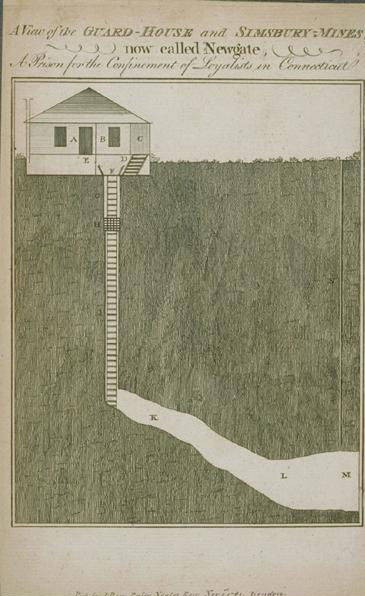
In October 1773 the Connecticut legislature voted to convert an unprofitable copper mine into a prison to house criminals for long periods. Henceforth, men convicted of burglary, robbery, and counterfeiting would be confined underground for up to ten years, or for life if they had already been convicted once. They were expected to work the mine. By modern standards that was harsh, but in this era it was an almost experimental reform.

The colony paid to build a blockhouse over the vertical entrance to the mine and to dig out living quarters below. As “Master or Keeper of said prison,” the legislature appointed John Viets (1712–1777), who ran a nearby tavern, shown above. He was a former Simsbury selectman and militia captain, respected in the community. He hired guards, many appearing to be laid-off miners; they were expected to train the prisoners in digging.

The new prison was dubbed New-Gate, after a famous jail in London. Those two places had little in common, but Americans didn’t know many other lock-ups to compare theirs to.

On 9 Dec 1773, a court in New Haven handed down the first sentence sending a man to New-Gate Prison.

TOMORROW: The first prisoner.