J. L. BELL is a Massachusetts writer who specializes in (among other things) the start of the American Revolution in and around Boston. He is particularly interested in the experiences of children in 1765-75. He has published scholarly papers and popular articles for both children and adults. He was consultant for an episode of History Detectives, and contributed to a display at Minute Man National Historic Park.

Subscribe thru Follow.it


•••••••••••••••••


Showing posts with label Old North Church. Show all posts

Saturday, November 01, 2025

Revolutionary Music Coming out of the North End

Our favorite Revolutionary sites in the North End are concatenating again with two musical events coming up early this month.

Wednesday, 5 November, 7 to 8:30 P.M.
Music-Making in Colonial Boston
Laura Zoll
Online from Old North Illuminated

Colonial Boston was home to a rich soundscape of music that helped define the lives of early New Englanders. Music-making set the tone and tempo of militia, home hospitality, tavern frivolity, and community singing circles. This talk will explore questions like:
  • What did music sound like during the colonial era?
  • Who played it?
  • What sort of instruments were played?
  • How did music reflect contemporary culture and beliefs?
Laura Zoll is a musicologist with degrees in Music Theory and Medieval Musicology. She plays numerous modern and historic instruments.

Register for the link to this event with a donation of any amount.

Thursday, 13 November, 7 to 8:30 P.M.
A Revolutionary Concert: Paul Revere, the Man, the Myth, and the Music
Regie Gibson and Ensemble
Converse Hall, 88 Tremont Street

Join the Paul Revere Memorial Association, Massachusetts Poet Laureate Regie Gibson, and Paul Revere for an engaging and immersive free program to commemorate the 250th anniversary of the Midnight Ride. From the loyalist anthems of the Tories to the fiery songs of the Revolutionaries and original 19th-century compositions written to further Revere’s legacy, this program brings 18th- and 19th-century America to life through the music of the times. The evening will include performances by some of Boston’s finest musicians.

Blending rich narration, historical images, and live music, this program offers a fresh, moving, and insightful take on one of the Revolution’s most misunderstood heroes. Far more than just a messenger on horseback, Paul Revere was a devoted family man, a savvy businessman, and a respected civil servant. This special evening promises to be a powerful journey through sound and story, separating fact from folklore while painting a vivid portrait of one of America’s most iconic patriots.

This concert is free, but please register for a seat here.

Friday, October 03, 2025

“To Ring the Bells for two hours Each Time”

Yesterday I described the arrival in 1745 of a set of eight bells from Gloucester, England, for the steeple of Christ Church, now also called Old North Church.

Those bells were tuned to different notes and made for change ringing, the first such set to arrive in British North America. Few Bostonians had heard that style of bell-ringing. Even fewer knew how to do it.

The church’s website states:
Reverend Timothy Cutler had a difficult time finding any experienced bellringers. They sat idle and unused for five years—that is, until 1750, when a group of teenage boys living in the North End was contracted to ring for two hours per week for one year. Each of them was paid 2 pennies a week for their work.
Those boys formed a collective, and its charter agreement survives in the church archive:
We the Subscribers Do agree To the Following Articles Viz

That if we Can have Liberty From the wardens of Doctor Cuttlers church we will attend there once a week on Evenings To Ring the Bells for two hours Each Time from the date here of For one year

That will Choose a Moderator Every three Months whose Business shall be to give out the Changes and other Business as Shall be Agreed by a Majority of Voices then Present

That None shall Be admitted a Member of this Society without a Unanimous Vote of the Members then Present and that No member Shall begg Money of any Person In the Tower on Penalty of Being Excluded the Society

and that will Attend To Ring at any Time when the Warden of the Church Aforesaid shall desire it on Penalty of Paying three Shillings for the good of the Society (Provided we Can have the whole Care of the Bells)

That the Members of this Society Shall nott Exceed Eight Persons

and all Differences To be decided By a Majority of Voices

John Dyer
Paul Revere
Josiah Flagg
Barthw. Ballard
Jonathan Law [Low?]
Jona. Brown, junr.
Joseph Snelling
For some of these names there are multiple candidates in the Boston vital records, and I have no candidate at all for Law/Low. But it looks like all of these signers were in their late teens in 1750 except Dyer, born in 1730. Revere, born at the start of 1735, and Flagg, born two years later, were the youngest. (Nonetheless, Revere signed with a fancy paraph.)

Here’s a question I haven’t seen discussed before. Seven boys signed that agreement to ring the bells—but there were eight bells. They seem to have recognized that in limiting their society to “Eight Persons.” Shouldn’t they have brought in someone else? Or did the sexton of Christ Church join them in pulling a bell rope since sextons usually rang the bells in Boston?

The church’s statement that each boy was named 2d. a week suggests that payments might show up in the account books. It would be interesting to see how long the payments and thus the bell-ringing society might have lasted.

TOMORROW: The fading of Boston’s bells.

Thursday, October 02, 2025

“A fine set of 8 Bells were brought hither”

On 25 July 1745 the Boston News-Letter reported the arrival of a new type of sound in Boston—or at least the potential for one.

The newspaper said:
Last Week a fine set of 8 Bells were brought hither in a Vessel from Bristol, designed for Dr. [Timothy] CUTLER’s Church at the North Part of this Town: We hear the largest of them is near 1500 Weight, and the whole Set about 7000.
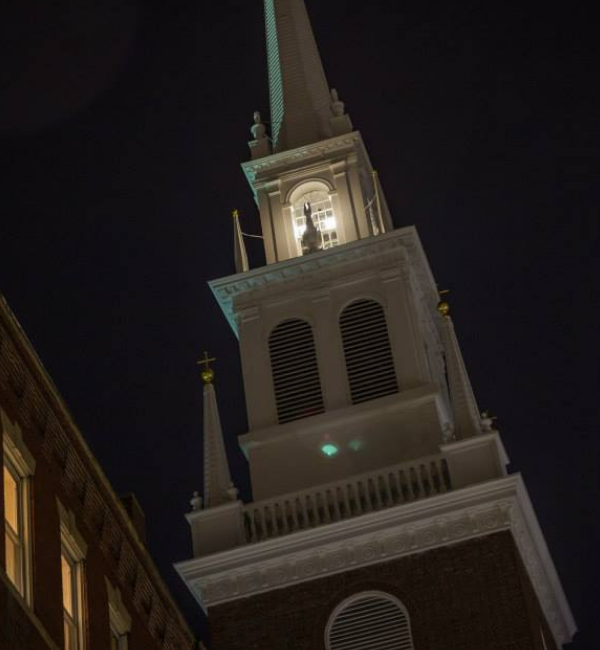
That was Christ Church, now also known as the Old North Church. Its steeple was also the tallest in town. As an Anglican place of worship, it could be fancier than the several Congregationalist meetinghouses with their single bells.

The church’s website states:
Old North has a total of 8 bells, each cast to ring at a different pitch. The treble bell, or #1, is the smallest bell and weighs in at about 620 lbs. The largest is the tenor, or #8, which weighs about 1,500 lbs. Each bell is hung inside a wooden wheel and frame, with ropes attached that extends to the bell-ringing chamber two floors down.
Each bell has a unique message cast in its metal:
  • 1: “Abel Rudhall of Gloucester, cast us all, Anno 1744.”
  • 2: “Since generosity has opened our mouths, our tongues shall ring aloud its praise. 1744.”
  • 3: “The subscription for these bells was begun by Iohn Hammock and Robert Temple, Church Wardens, Anno 1743; completed by Robert Ienkins and Iohn Gould, church Wardens, Anno 1744.”
  • 4: “William Shirley, Esq., Governor of the Massachusetts Bay, in New England. Anno 1744.”
  • 5: “God preserve the Church of England. 1744.”
  • 6: “We are the first ring of bells cast for the British Empire in North America. A.R. 1744.”
  • 7: “This Church was founded in the year 1723. Timothy Cutler, DD, the first Rector, A.R. 1744”
  • 8: “This peal of eight bells is the gift of a number of generous persons to Christ Church, in Boston, N.E. Anno 1744.”
“A.R.” usually meant “in the year of his reign,” referring to the current king, but here it appears to be used as a synonym for “A.D.”

Abel Rudhall (1714–1760) was the head of a family firm that cast bells in Gloucester from 1684 to 1835. According to Wikipedia, his grandfather had invented a way of “tuning bells by turning on a lathe rather than the traditional chipping method with a chisel.”

Those bells were designed to be rung together, but that required a group of bell-ringers.

TOMORROW: You rang?

Saturday, July 05, 2025

“Siege and Liberation of Boston,” 7–8 Aug.

Registration is open for the third Pursuit of History Weekend that I’ve helped to program, this one on “The Siege and Liberation of Boston” on 7–8 August.

Organized with the folks who manage History Camp, these sessions are designed to offer in-depth looks at developments 250 years ago through expert speakers and visits to the actual sites where the history happened.

We’ll start on the slope of Breed’s Hill in Charlestown, exploring what turned out to be the decisive battle of the first campaign of the Revolutionary War. Sam Forman and Mary Adams will introduce two of the leaders of the American forces, Dr. Joseph Warren and John Stark. We’ll walk the battlefield and hear about ongoing investigations of the landscape from Boston City Archaeologist Joe Bagley. Then we’ll take a road trip to other places that the Continental Army fortified, which few visitors see. That day we plan to have meals at two restaurants that go back to the eighteenth century.

On the following day, we’ll move into the North End, collaborating with the Paul Revere House, the Old North Church, and veteran tour guide Charles Bahne to offer an in-depth look at the experience of living inside besieged Boston. Finally, I’ll speak about George Washington as a new commander-in-chief, what he thought his job was, and what he really learned.

The Pursuit of History webpage for this event has a video of me explaining more. Sam Forman and I are also scheduled to talk about the siege and this event in the History Camp discussion series on Thursday, 10 July, at 8:00 P.M.

This Pursuit of History Weekend is not, in fact, on a weekend but on a Thursday and Friday. That’s to allow people to also attend History Camp Boston on Saturday, 9 August, and even the related tours the next day if their history interests are still unsated.

And speaking of History Camp Boston 2025, I’ll be speaking there, too. My topic is related to the end of the Boston siege. That talk is called “Henry Knox, Loyalist?” It offers a new interpretation of that American general’s rise to prominence.

Saturday, June 21, 2025

“The Ghost of Major John Pitcairn,” 24 June

Sticking with the saga of Henry Howell Williams and his quest for (over?)compensation meant I mustered only a brief mention of the Battle of Bunker Hill on its Sestercentennial.

But today I’m watching the reenactment of that battle in Gloucester, and I’ll discuss some aspects of the event in the coming days, both on this site and live.

On Tuesday, 24 June, I’ll speak on “The Ghost of Major John Pitcairn” for Old North Illuminated’s digital speaker series.

Our event description:
After Major John Pitcairn was killed in the Battle of Bunker Hill, he was remembered in Britain as “a Gentleman of universal good character.” In Massachusetts, however, people still accused Pitcairn of having ordered redcoats to fire at the Lexington militia two months earlier. The major’s body was laid in the crypt of the Old North Church, but his memory haunted American history through stories, rumors, and artifacts linked to his name.

In this talk, J. L. Bell, proprietor of the history blog Boston 1775, sifts through the evidence behind those legends before digging into how a church warden with a shaky reputation sent Maj. Pitcairn’s body back to Britain—or did he?
I suppose I should make clear that I know of no stories about Pitcairn’s spirit haunting people or places. Rather, his memory and Americans’ hunger to make meaning of that memory have produced several oft-repeated narratives.

I’ll talk about several legends of Maj. Pitcairn: his pistols and horse, who shot him at Bunker Hill, how Bostonians remembered him, and what happened to his body in the decades after his death. Some of those stories might even be true.

Register to hear this talk online with a donation through this Eventbrite page. It’s scheduled to begin at 7:00 P.M., and there will be time for questions afterward. Assuming the recording goes well, a video will appear online afterward.

Sunday, April 13, 2025

Sestercentennial Talks in Boston on the 18th of April

Friday, 18 April, will be the 250th anniversary of the day when Maj. Edward Mitchell led over a dozen British army officers on horseback out into Middlesex County to tamp down alarms (and thus caused alarms).

The 250th anniversary of the day when William Dawes and Paul Revere rode out into the same countryside to do all they could to spread the alarm as far as Lexington, at least.

And finally the 250th anniversary of the day when more than 700 British light infantrymen and grenadiers embarked across the Charles River to begin their alarming march to Concord.

Some of those events will be reenacted that evening in various places, and there will also be talks in the city of Boston on both sides of the Charles River.

The U.S.S. Constitution Museum and Paul Revere House are sponsoring “The Messenger and the Maker,” a free evening of activities at the Constitution Museum in the Charlestown Navy Yard. From 5 to 9 P.M. families can explore the galleries and make their own lanterns to help escort Revere on his journey from the Navy Yard through Charlestown.

At 8:00 P.M. I’ll speak in the museum on “The Reasons for Revere’s Ride.” The organizers asked me to lay out the background for the events on 18 Apr 1775, and they said I had twenty minutes. Later they revised that to thirty. I’m preparing a whirlwind tour through history up to that fateful evening. And I can’t speak too long because the audience will go out to meet Mr. Revere.

At City Square Park in Charlestown, two events are scheduled at 8:45 P.M. Revere will arrive at Deacon John Larkin’s House and emerge to mount his borrowed horse. Around that event Joe Bagley, Boston’s Chief Archaeologist, will speak on “Unearthing the Untold Stories of Charlestown’s Sacrifice.” Drawing on recent discoveries and study, he will introduce the inhabitants of Charlestown, enduring the frightening end of one battle and the destruction caused by another.

Meanwhile, over in Boston’s North End, the Old North Church will offer a free costumed reading of Revolution’s Edge from 6:30 to 8 P.M. on Paul Revere Mall (or, in case of rain, inside St. Stephen’s Church). This play by Patrick Gabridge dramatizes the choices that the Rev. Mather Byles, Jr.; Capt. John Pulling; and Cato, the minister’s enslaved servant, faced in April 1775.

Starting at 7 P.M., the church will also host its traditional Lantern Service. This year’s keynote address will be offered by Heather Cox Richardson, professor of American history at Boston College and author of Democracy Awakening: Notes on the State of America. This commemoration will also include inspirational music, Revere’s recollection of his ride, prayers for the nation, and the lighting of the lanterns in the belfry at about 8:15 P.M. (This event is currently at capacity.)

Wednesday, March 26, 2025

Planning for the Sestercentennial of Battle of Lexington and Concord

As the 250th anniversary of the Battle of Lexington and Concord approaches, I’ve gotten requests for information about where the commemorations will happen.

The answer is that they’ll happen all over because that battle didn’t take place on one field, but spread out over twenty miles.

Furthermore, we New Englanders like our traditions. Many towns and organizations have their own time-honored ways of celebrating the anniversary: local parades, marches, pancake breakfasts, and the like. We’re not going to cancel those just because this anniversary ends in 50.

That said, because of the Sestercentennial many of our commemorations this year will be much bigger than usual: more participants, more spectators, more traffic. And that’s not counting the potential complications from the weather and from Washington, D.C.

Therefore, my only recommendation is to choose a couple of events to enjoy from the many on the schedule. But don’t assume that when I say “schedule,” there is one master schedule. Oh, no, that’s not how we operate here. Here are multiple sources to consult, and I don’t claim this list is exhaustive.

Battleroad.org is a venerable website [check out that coding!] which is updated each year with the latest details about events in Middlesex County. These include celebrations on the weekend before the big anniversary, such as Bedford’s pole-capping and Lincoln’s Paul Revere Capture ceremony. More events in early April appear on Minute Man National Historical Park’s page.

On Friday, 18 April, the National Parks of Boston, the Paul Revere House, and the Old North Church all have events linked to the start of Paul Revere’s ride to Lexington. Those three links go to overlapping lists of offerings, which include a reading of the play Revolution’s Edge, a reenactment of Revere’s movements, the lighting of two lanterns in the steeple, a talk by Prof. Heather Cox Richardson, and a talk by me. It’s impossible to see all those since the whole point is that they’re on opposite sides of the Charles River.

Saturday, 19 April, will start with the confrontation on Lexington common; see the Lexington 250 events calendar. Then the action moves into Minute Man Park for the clash at Concord’s North Bridge, followed by what promises to be the largest, most authentic reenactment ever of the fighting along the Battle Road. The best information on those happenings and how to enjoy them safely comes from the park.

This year the reenacting continues on Sunday afternoon with the Battle of Menotomy along Massachusetts Avenue in Arlington. The setting looks modern, but it’s the actual ground of the bloodiest fighting in April 1775.

Monday is of course Patriots’ Day, the state holiday best known for the Boston Marathon. And the celebrations aren’t over yet. It looks like the Lincoln Salute for fife and drum corps has been pushed to 27 April, for example. So choose your fighters.

Tuesday, March 11, 2025

Sconyers on Boston’s Street Lamps, 18 Mar.

Old North Illuminated is living up to its name by hosting an online presentation by Jake Sconyers on the topic “They Burnt Tolerable Well: The Tea Party & Boston’s First Street Lamps” on Tuesday, 18 March.

The event description says:
In the 1770s, Boston was in a state of transformation and upheaval. While we mostly think of the American Revolution as the driver of this whirlwind of change, a technological revolution was happening at the same time. The introduction of street lamps in Boston had a profound effect on how people behaved at night.

The political revolution and the technological revolution were intertwined, with the effects of one impacting the other—including at pivotal moments like the Boston Massacre and the Boston Tea Party.

Sconyers will touch on these “burning” questions:
  • How did Boston’s very first street lamps survive a shipwreck and the Boston Tea Party?
  • Why did Boston decide to buy English oil lamps for the streets but fuel them with American whale oil?
  • Why did Boston vote to let its new street lamps sit dark after just a few months of illumination?
  • How did the Boston Port Act affect the cost of street lighting?
Not to mention how the events of April 1775 might have been different if Boston’s main streets had been lit up at night.

Jake Sconyers is the host of the HUB History podcast, formerly cohosted by Nikki Stewart, executive director of Old North. The podcast has discussed these lamps, but I don’t recall it addressing all these details.

Register for this online event with a donation of any amount to Old North Illuminated through this webpage.

Thursday, December 05, 2024

Checking Out the Cherubs at Old North Church

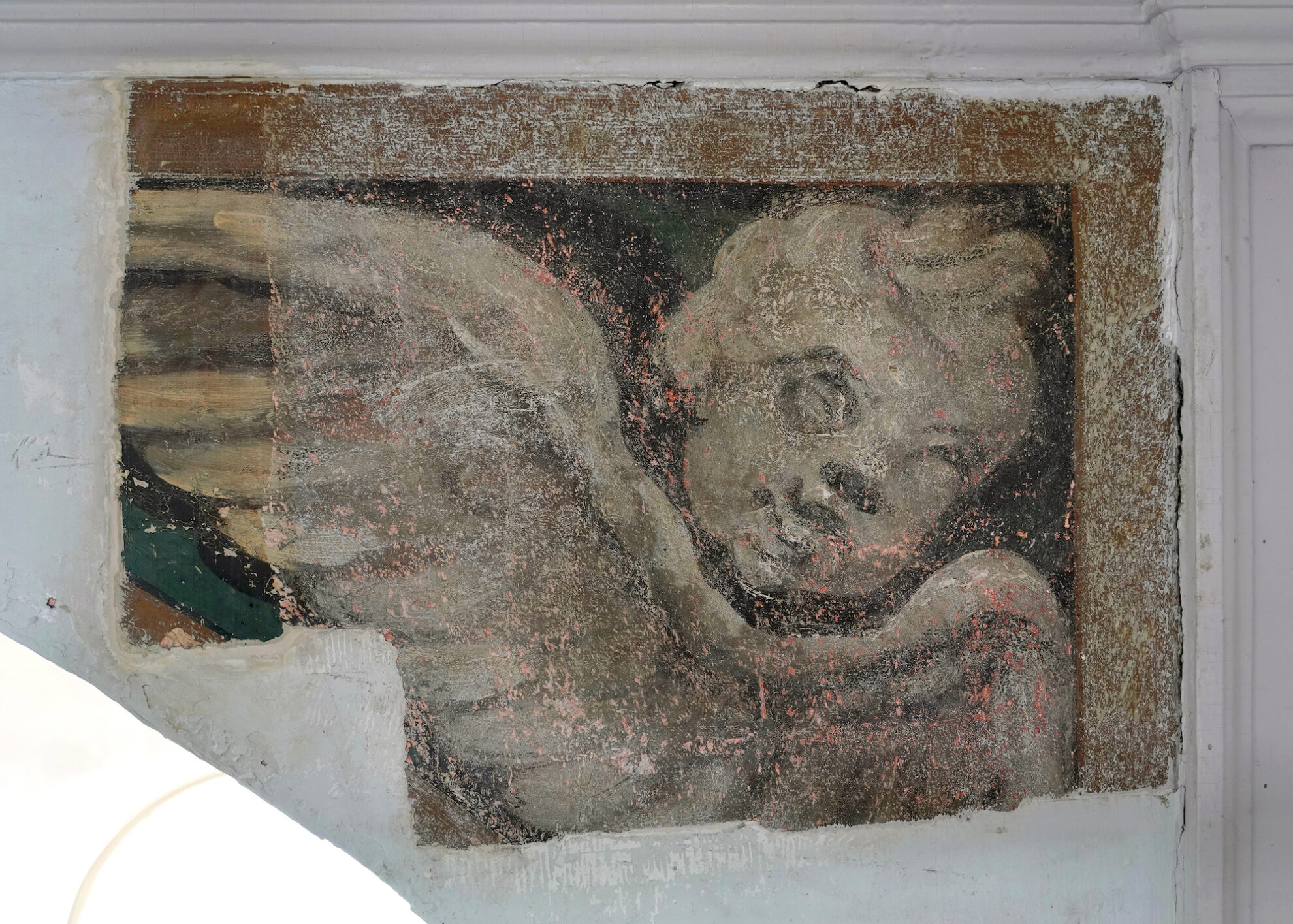
Old North Illuminated has announced that its project to conserve cherubs painted high on its interior walls in the 1700s is going faster than expected.

Each cherub, originally painted by John Gibbs, has proved to have a different facial shape and expression. The craftspeople expect to reveal all sixteen of the faces.

People can learn more in this GBH News interview with lead conservator Gianfranco Pocobene.

Visitors to the Old North Church can enjoy a closer view of the paintings by purchasing slots on a “Cheeky Cherub” tour. The church’s interpreters will lead that group up to the balcony (meaning there are stairs to climb) and discuss how these figures fit into the church’s original design scheme.

The “Cheeky Cherub” tour is available at different times and on different days. It costs $10 and includes regular admission to the church sanctuary. Tours are booked through this website.

Finally, there’s a live online event about the cherubs next week.

Wednesday, 11 December, 7 to 8 P.M.
Uncovering Our Angels: Paint Restoration at Old North Church
Gianfranco Pocobene, the lead conservator of the historic paint restoration project at Old North, will discuss the techniques, tools, and technology that have allowed his team to penetrate layers of white overpaint to reveal the beautiful artwork hidden underneath. He will share photos of the newly revealed angels, discuss theories as to how the angels were painted in the 1700s and why they were painted over, and answer your questions about the project.

Born in Italy and raised in Canada, Gianfranco Pocobene has spent decades working in art conservation for prestigious institutions like the Isabella Stewart Gardner Museum and the Harvard Art Museums. Some of his most significant projects include the restoration of the John LaFarge murals at Trinity Church, Boston, the Women’s Gallery mural at Vilna Shul, Beacon Hill, Puvis de Chavannes’ Philosophy mural at the Boston Public Library, and Benjamin Constant’s mural at the Ames-Webster Mansion, Boston.
Register for that talk through this webpage.

Wednesday, December 04, 2024

The Clough Family Bible Comes to Old North

Recently descendants of Ebenezer Clough, the brick mason who built Christ Church (now better known as Old North), donated a family Bible to the institution.

Even before the church went up in 1723, Clough built some nearby residences. One of them was bought for the church in 1959 and now houses offices, store rooms, a gift shop, and the Edes & Gill printing office. That building now carries the builder’s name, pronounced cluff.

The Bible is about as old as that building, printed in London in 1715. A few decades later, Ebenezer and Thankful Clough’s son John started to use it to record family events, including his own birth (retrospectively, of course), his marriage in 1745, and the births (and deaths) of his children.

As the Boston Globe reported and the photo above shows:
While modern Bibles often include pages set aside for family records, Colonists had to improvise, writing in any blank space, even on the title page, where the Clough family Bible records the death of a child by smallpox in 1792.
That volume traveled with members of the family to the Midwest. Eventually they began to pronounce that surname clow. The old family Bible descended into the hands of Harry Bulkeley of Galesburg, Illinois.

Bulkeley was a Resident Circuit Judge of Knox County. He’s also a big history buff, portraying Ulysses S. Grant at Civil War reenactments, leading graveyard tours, and writing opinion pieces for the local newspaper.

Visiting a daughter in Massachusetts about twenty years ago, Bulkeley saw the name of Ebenezer Clough on a plaque at the Old North complex and recognized it from the family history. Eventually he and his relatives decided to donate the Bible to the church to preserve and share with new generations of visitors.

Wednesday, October 09, 2024

More Angels in Old North Church

Old North Church in the North End has announced another eye-opening part of its project to preserve and restore parts of its interior to how it looked in the eighteenth century.

The building, more formally Christ Church, was one of Boston’s Anglican places of worship. Its minister and parishioners didn’t inherit Puritan attitudes toward decoration. The Colonial Revival archetype of the colonial New England meetinghouse as plain and white didn’t really apply.

The church explains:
For much of its history, the church boasted a rich color scheme with ornate and intricate designs. A highlight of Old North’s early decor was artwork from John Gibbs, an accomplished painter and congregation member. Between 1727 and the 1730s, Gibbs painted a series of beautiful angels in the balcony arches of the sanctuary. Gibb’s stunning artwork was covered over with white paint during a 1912 renovation and has been hidden for more than a century…until now.

We are thrilled to share that a 6-month restoration project is now underway to uncover the angels that Gibbs painted in the 18th century. An initial paint study in 2017 partially restored one of Gibbs’s angels, and now expert craftspeople are painstakingly removing layers of paint to reveal the rest of the angel and four additional angels. Later, a talented artist will paint replica angels on removable veneers to adorn the rest of the arches, giving us a glimpse of the sanctuary as Paul Revere would have seen it as a young bellringer.

This fall, visitors to Old North Church will have a once-in-a-lifetime opportunity to watch long-hidden history being revealed. This sort of paint restoration is rare in the United States; you would typically have to go to Europe to see a similar project. We invite you to visit us throughout October and November and watch the conservation team in action.
Lead conservator Gianfranco Pocobene took the photo above this month, stating, “I am using different solvent gel and free solvent combinations from what the original team used in 2017, and so far I’m very pleased that I’m able to completely remove the overpaint without damaging the original paint surface.”

In other art restoration news, the Lexington Historical Society has received a grant from the Wyeth Foundation of American Art to support the conservation and reinterpretation of Emanuel Leutze’s “The News of Lexington.” The German artist painted that canvas in 1852, one year after he created his iconic image of Gen. George Washington crossing the Delaware.

Sunday, June 09, 2024

Revolution’s Edge Returns to Old North

Old North Illuminated has brought back Revolution’s Edge, its thought-provoking play set inside the church on 18 Apr 1775.

Patrick Gabridge wrote this drama to be performed in Christ Church, Boston, about actual people in that congregation in 1775, using the historical record and some dramatic imagination. It’s directed by Alexandra Smith and produced by Jess Meyer for Plays in Place.

It looks like there’s a new cast this summer. The Rev. Mather Byles, Jr., a Loyalist at odds with most of his flock, is being played by Eric McGowan and Tim Hoover. Cato, the African man enslaved by Byles and the play’s narrative voice, is played by Stetson Marshall and Joshua Lee Robinson. Captain John Pulling, Jr., a church vestryman and Patriot activist, is played by Dustin Teuber and Kevin Paquette.

I wrote about the play last summer. The approaching Sestercentennial anniversary of the day it depicts makes it even more resonant.

Revolution’s Edge lasts about forty-five minutes. It will be performed four nights a week through 10 August. For more information, a video preview, and tickets, visit Old North Illuminated.

Saturday, June 08, 2024

“Bruised and splintered by the bullets of the British soldiers”

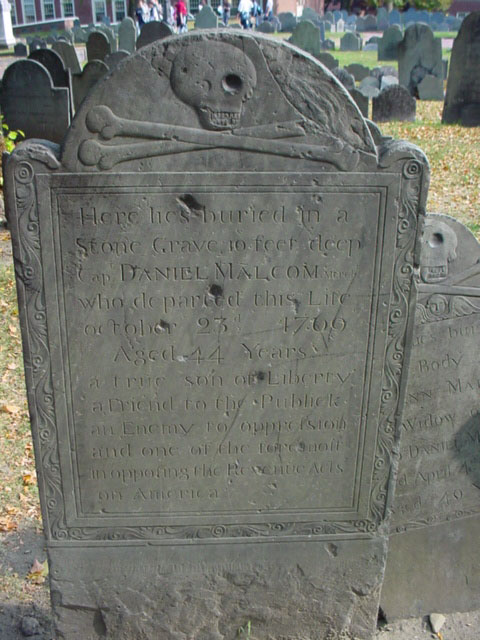
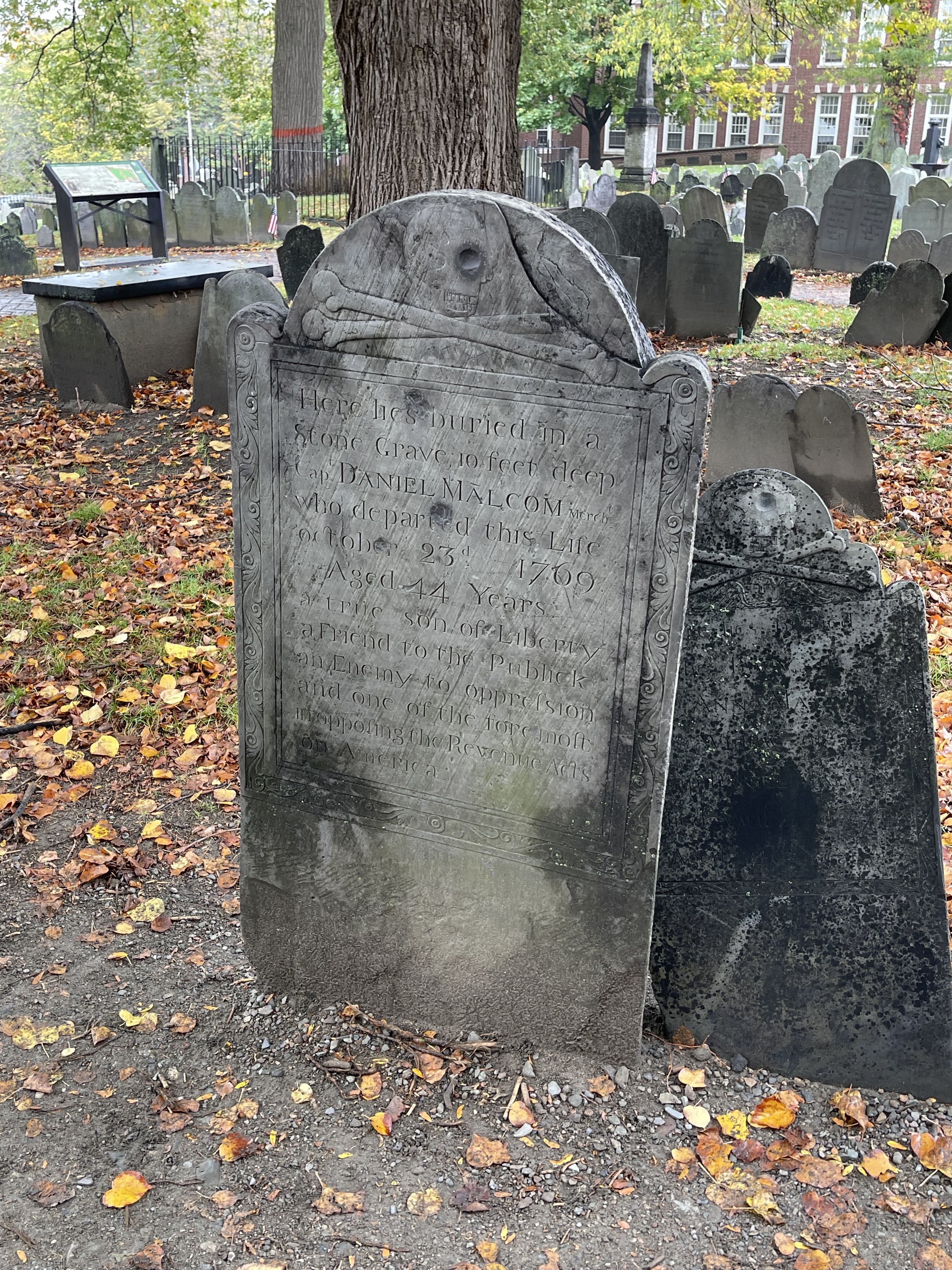
As shown yesterday, Capt. Daniel Malcom’s gravestone still stands in Copp’s Hill Burying Ground.

Indeed, it’s one of the featured attractions there, with signage pointing out how the stone is pitted, reportedly by British soldiers’ musket balls.

The uppermost round mark on the stone was produced by the carver, not by a musket. It’s the eye socket of the skull facing right. A very similar design appears on Ann Malcom’s stone nearby and on the Rev. John Barnard’s gravestone in Marblehead, both from 1770.

But there’s clearly other damage to the Daniel Malcom stone, divots in the middle of the text. I went looking for more information about those marks and was surprised by what I found.

The earliest printed mention was a note in the back of Urania: A Rhymed Lesson, a poem published by Oliver Wendell Holmes, Sr., in 1846, seventy years after the British military evacuated Boston. It quoted Malcom’s marker and added:
The gravestone from which I copied this inscription is bruised and splintered by the bullets of the British soldiers.
I’d be pleased to hear about earlier mentions. Unlike a quotation or phrase that one can search for exactly, this fact could be stated in many ways.

A couple of years after Holmes’s poem, the April 1848 issue of the New England Historical and Genealogical Register stated:
There are marks upon the stone, and tradition says that the British soldiers made use of it as a target during their occupation of Boston, at the commencement of the Revolution.
The 4 Aug 1849 Boston Statesman newspaper quoted this item from the reformist Boston Chronotype:
Mean Revenge.—During a stroll through Copp’s Hill burying ground, a few days ago, a gentleman directed our attention to the following inscription on a grave stone:— . . .

The stone exhibits marks of violence, and our informant—who is an antiquarian, versed in the genealogy of almost every family buried on Copp’s Hill—stated that Capt. Malcolm [sic] had rendered himself extremely obnoxious to the British troops, and that a short time after his death a file of soldiers was drawn up and discharged a volley of musketry at his grave stone. Our informant said that in his younger days he had heard several eye witnesses related the story. The marks of the balls are distinctly visible at the present day. We might search long to find a more despicable species of revenge than this.
That article was reprinted later that year in Scientific American.

Assuming this story was accurate, the next question is when such vandalism took place. Malcom died in 1769, when British regiments were in Boston and his defiance of royal authority was recent. Those soldiers (or officers) might have seen Malcom in action. But if people had seen redcoats shooting at his grave then, there would surely be complaints in the vigorous local press.

Vandalism would more likely have gone unreported during the siege of Boston, with no opposition newspapers in town and bigger stories to print. That would mean the soldiers (or officers supervising them) were angered by the “true Son of Liberty” phrase on the stone rather than direct knowledge of Daniel Malcom.

Yet another possibility is that the damage was produced by something other than British muskets, but saying that made for a better story. The unnamed “antiquarian” in 1849 referred to “several [unnamed] eye witnesses” to the actual shooting, however.

I’d also like to know when the plaque for Malcom, shown here, was put up inside Old North Church. It refers to him being “Safe from British Bullets.” Was that an allusion to the scars on his gravestone nearby?

COMING UP: John Malcom’s welcome to Newport.

Friday, June 07, 2024

“The Remains of Captain Daniel Malcom”

On Thursday, 26 Oct 1769, the Boston News-Letter announced:
On Monday last departed this Life, Capt. DANIEL MALCOM, of this Town, Merchant, in the 44th Year of his Age: His Remains are to be interred To-Morrow at half after Three o’clock Afternoon.
The following Monday, 30 October, the Boston Gazette reported:
On Friday last were interred the Remains of Captain Daniel Malcom of this Town Merchant, who died a few Days before in the 44th Year of his Age.

By Means of his honest Industry, he left his Family in good Circumstances. And tho’ this Gentleman was one whom the Nettleham Baronet had stigmatiz’d in his infamous Letters, his Funeral was attended by a long Train of his Fellow Citizens, as a Token of Respect to the Family of one who in his Life was zealously attached to the Liberties of his Country.
The “Nettleham Baronet” was Sir Francis Bernard, the royal governor who had sailed away from Boston a three months earlier. He had mentioned the 1766 stand-off between Malcom and the Customs service in reports to London, and those letters had been leaked back to Boston—which only enhanced Malcom’s local reputation.

In fact, Malcom’s profile was so high that even his grave marker made news, in the 17 November Boston News-Letter:
The following Inscription is on the Grave-Stone of the late Capt. Malcom.

Here lies buried in a Stone Grave 10 feet deep, Capt. DANIEL MALCOM, Merchant, who departed this life October 23d 1769. aged 44 Years.

A true Son of Liberty.
A Friend to the Publick.
An Enemy to Oppression.
And one of the foremost in Opposing the Revenue Acts on America.
That stone, shown above courtesy of Find-a-Grave, stands in the Copp’s Hill Burying Ground.

In addition, there’s a memorial plaque inside Old North Church, as shown here on Vast Public Indifference. That inscription must have been put up years after the captain’s death. It doesn’t use the long s like the gravestone, and it refers to “British Bullets” while in 1769 Bostonians still saw themselves as British.

Daniel Malcom’s widow Ann died the following April, aged only forty.

TOMORROW: Balls for Capt. Malcom.

Wednesday, December 27, 2023

The Return of the Angels at Old North Church

This fall, in addition to archeological work in its crypt, Old North Church had its four carved angels conserved and repaired.

Old North Illuminated explained the origin of these artifacts:
The four Baroque angels date to the 1620s and were likely carved in what is now known as Belgium. It is unknown where they spent their first century. In 1746, however, they were on board a French ship en route to a Catholic Church in Quebec.

During this time period, England and France were almost constantly at war, and one of the ways the war was waged was economic: ships, and their cargo, were fair game. Privateers were legally sanctioned to act like pirates and pillage the ships they captured. British privateer Captain Thomas Gruchy captured the French ship on its way to Quebec and seized its cargo, including these angels.

He and his investors sold most of the goods, but Captain Gruchy, a North End resident, donated the four angels to Old North Church, where he worshiped.
The angels are thus decades older than the church, which is itself one of the oldest buildings in Boston.

Originally all four figures held trumpets, but only two of those instruments survived. Chris Gutierrez of Manzi Appraisers & Restoration also noted “evidence of previous damage that nearly split one of the angels in half,” as well as cracks that had developed over the decades.

Gutierrez and his team cleaned the figures, fabricated two new trumpets, and touched up the painted surfaces to make the two-foot-tall angels look good without hiding their age.

The angel statues returned to their places on the gallery railing in front of the church’s pipe organ in time for the Christmas season.

Tuesday, October 17, 2023

Hanson on Copp’s Hill Burying Ground, 22 Oct.

On Sunday, 22 October, Old North Illuminated will host two events featuring John G. S. Hanson speaking about the nearby Copp’s Hill Burying Ground.

A tour of that cemetery with Hanson is already sold out, but it’s still possible to take in his talk “The Stones Cry Out” in the church or online.

The event description says:
Many people visit Boston’s historic burying grounds to see the monuments of historical figures like Samuel Adams, Paul Revere, John Hancock, Crispus Attucks, Samuel Sewall, Prince Hall, and Cotton Mather. But few pause to read the inscriptions on the stones of other early “every day” Bostonians, whose names and lives are now long forgotten.

For those who take the time to look and “listen” closely, these gravestones convey highly personal messages that not only reveal a glimpse into their personal lives, but also the literature that they read, the hymns they sang, and the poetry that moved them. These stones also can tell us a great deal about colonial Bostonians’ attitudes toward life, death, and eternity.

Join burial ground expert John Hanson for “The Stones Cry Out” and explore the history and poignancy of the Copp’s Hill Burial Ground epitaphs, followed by a reception and multimedia presentation at the Old North Church, as we illuminate history through the artistic disciplines of poetry, verse, and music.
Most of the names in that description are buried at the Granary Burying Ground, but Copp’s Hill is the resting-place of Mather and Hall, as well as firebrand merchant captain Daniel Malcom, both men named Robert Newman, Benjamin Edes, and Shem Drowne.

John G. S. Hanson is the author of Reading the Gravestones of Old New England (McFarland, 2021), based on years of research into grave markers and the sources for their texts.

The lecture is scheduled to take place from 5:15 to 6:30 P.M. People can register for in-person or online attendance through this webpage, and Old North Illuminated asks those attendees to donate what they can.

Tuesday, September 19, 2023

O’Brien on Loyalists via Old North, 21 Sept.

On Thursday, 21 September, Old North Illuminated will host a virtual talk by G. Patrick O’Brien on “‘This Perilous Hour of Trial, Horror & Distress’: Loyalist Exile and Return.”

The event description says:
Between April 1775 and the early months of 1783, more than 75,000 colonists fled the upheaval of the Revolution for the protection of the British Empire. Nearly half of these refugees, including many New Englanders, landed on the rocky shores of Nova Scotia.

The most prominent of these exiles called themselves “loyalists,” a label they fashioned to accentuate their own unwavering fidelity, and the broader collective’s shared dedication to maintaining Britain’s empire in North America. . . .

Concentrating on a few loyalist families from the greater Boston area, including that of Rev. Mather Byles Jr., the rector of Old North Church until 1775, Dr. G. Patrick O’Brien of the University of Tampa will explore what it meant to be a loyalist during the American Revolution.

The talk will pay special attention to how marginalized loyalists, including women and enslaved people, grappled with the hardships of wartime exile and the role these figures had in bringing families back to their American homes after the war.
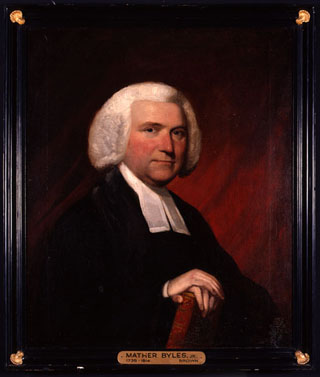
It’s notable that although the Rev. Mather Byles, Jr. (shown above), left with the British troops, his father, the Rev. Dr. Mather Byles, Sr., remained in Boston, as did his two half-sisters. The Boston Byles family continued to profess loyalty to the king, even in the new republic. While some Loyalists came back to the U.S. of A., or tried, these Byleses never left.

G. Patrick O’Brien is professor at the University of Tampa. He is working on a book about the experiences of loyalist women and families during the Revolution, their exile in Nova Scotia, and the social networks repatriating loyalists created between British Canada and the United States.

This online event will run from 7:00 to 8:30 P.M. Register for the link through this Eventbrite page; make a donation of of any amount to Old North Illuminated to support the preservation and interpretation efforts at Old North Church in the North End.

Saturday, July 08, 2023

Peeking in on “Revolution’s Edge”

A month ago I noted the upcoming premiere of “Revolution’s Edge,” a play dramatizing the stresses affecting three men associated with Christ Church in the North End on 18 Apr 1775.

The three characters are the Rev. Dr. Mather Byles, Jr., planning to leave that church; his enslaved servant, Cato, worried about being removed from his family; and John Pulling, a merchant captain and vestryman who’s also interested in the movement of British soldiers. Byles is a Loyalist, Pulling a Patriot, and for Cato the lack of liberty cuts most deeply.

I attended that first performance at Old North and can recommend the show as a thoughtful exploration of how the Revolution’s big issues intersected with individual desires and needs. Performances run through 19 September.

WBUR’s report on the play included this passage:
Nathan Johnson, the actor who plays Cato, says it is one of the most important projects in which he’s been involved.

Johnson, who is Black, promised himself early in his acting career that he would never play an enslaved person. But the depiction of Cato, and the importance of the play’s message, made the role too compelling to pass up.

“I want everyone to see that we have all something to contribute to our history,” Johnson said. “I want everyone to see that it is not a matter of white and Black. It is a matter of America. It is a matter of progress. It is a matter of stakes, it is a matter of tension. And not just for Pulling and Byles, but for Cato as well.”
Cato is the least documented of the three characters. Playwright Patrick Gabridge had to gather vital records from Boston, Roxbury, and Nova Scotia, and then make an educated assumption that all those mentions of a man named Cato related to the same person.

To compound the challenge of building Cato’s character when none of his words survive, an enslaved man in a room with his owner wouldn’t have been able to speak his mind.

Gabridge turned that vacuum into an advantage by making Cato the character who addresses the audience, introducing the historic situation, the other characters, and his own unvoiced thoughts.

For folks who want to hear more, WBUR also ran an audio report.

The photo above of Johnson performing as Cato was taken by Evan Turissini, who plays Pulling, as he waited to enter.

Saturday, June 10, 2023

“Revolution’s Edge” Premieres at Old North, 15 June

Old North Illuminated has commissioned a new play depicting the tensions within its Anglican congregation on the eve of the Revolutionary War.

The playwright and producer is Patrick Gabridge. Through Plays in Place, he has previously written site-specific dramas about the Boston Massacre and the John Hancock household for Revolutionary Spaces.

“Revolution’s Edge” portrays three men connected with Christ Church, Boston, in early 1775:
  • the Rev. Dr. Mather Byles, Jr., the minister and a firm Loyalist, though descended from the Puritan Mathers. 
  • John Pulling, a vestryman on the committee who hired Byles, a merchant captain, and an active Whig (member of the North End Caucus, for example). 
  • Cato, a domestic servant enslaved to Byles, married to a woman enslaved to Byles’s in-laws out in Roxbury. 
All three men have young children. All three face the prospects of separating from their families or communities. Byles has just resigned to take a pulpit in New Hampshire while Pulling is wondering if it’s safe for him to remain in army-occupied Boston.

And it’s also the morning of 18 April.

To hear more about this production and the historical facts behind it, listen to Gabridge and Nikki Stewart, execuctive director of Old North Illuminated, chatting with Jacob Sconyers for the HUB History podcast. (Disclosure: Stewart and Sconyers are married. Double disclosure: I’m referenced in this discussion.)

“Revolution’s Edge” will premiere on Thursday, 15 June. After that, there will be performances every Tuesday, Thursday, and Saturday evening until 19 September. Seating starts at 5:00 P.M., with the performance running from about 5:20 to a little after 6:00. Tickets are $20 for adults, $10 for people under age eighteen, though the show isn’t really recommended for kids under twelve.

Tuesday, May 30, 2023

Brekus on “American ‘Choseness’,” 31 May

On Wednesday, 31 May, the Old North Church will host the 2023 Walter B. and Kay W. Shurden Lecture on Religious Liberty and Separation of Church and State, delivered by Harvard Divinity School’s Dr. Catherine Brekus.

Prof. Brekus’s topic will be “The Myth of American ‘Chosenness’.” The talk will be followed by a panel discussion featuring four more thinkers on religion and then a reception, all co-hosted by the Baptist Joint Committee for Religious Liberty.

Brekus is the Charles Warren Professor of the History of Religion in America at Harvard Divinity School, chair of the Committee on the Study of Religion in the Faculty of Arts and Sciences, and an associate member of the Program in American Studies and the Department of History.

She is currently writing a book about the relationship between American nationalism and Christianity and co-authoring a biography of Sarah Edwards (1710–1758) with Harry Stout and Ken Minkema. Among her many articles and books are Strangers and Pilgrims: Female Preaching in America, 1740-1845 and Sarah Osborn’s World: The Rise of Evangelicalism in Early America.

The panel members will be:
  • The Rev. Dr. Jaimie Crumley (moderator), Assistant Professor of Gender Studies and Ethnic Studies at the University of Utah and the outgoing Research Fellow at Old North Illuminated in Boston.
  • The Rt. Rev. Carol Gallagher, Ph.D., assistant bishop in the Episcoal Church’s Diocese of Massachusetts.
  • Dr. Michael Hoberman, professor of American literature at Fitchburg State University and author of New Israel/New England: Jews and Puritans in Early America.
  • The Rev. Darrell Hamilton, Administrative Pastor at the First Baptist Church in Jamaica Plain and Protestant Chaplain at Babson College.
Doors will open at the church at 5:00 P.M. Prof. Brekus will speak for half an hour starting at 5:30, and the panel discussion will fill the next hour. For in-person attendees, the reception will last until 8:00. This event is free for all, either in person or online. Register through this link.