J. L. BELL is a Massachusetts writer who specializes in (among other things) the start of the American Revolution in and around Boston. He is particularly interested in the experiences of children in 1765-75. He has published scholarly papers and popular articles for both children and adults. He was consultant for an episode of History Detectives, and contributed to a display at Minute Man National Historic Park.

Subscribe thru Follow.it


•••••••••••••••••


Showing posts with label Philip Schuyler. Show all posts

Saturday, April 04, 2026

Crean Brush’s American Career

Yesterday’s post reported that among the people captured aboard the evacuation ship Elizabeth in April 1776 was Crean Brush.

Eric Wiser wrote a good article about Brush for the Journal of the American Revolution: “Hell’s Half-Acre: The Fall of Loyalist Crean Brush.” More information can be found in “Crean Brush vs. Ethan Allen: A Winner’s Tale” by John J. Duffy and Eugene A. Coyle, published in Vermont History (P.D.F. download). I’ll review just the main points here.

Brush came to America from county Tyrone in Ireland in the 1760s when he was in his thirties and already a widower. He soon established himself as a lawyer and government appointee in New York City.

Brush married Margaretha Schoolcraft, who had a daughter named Frances from her previous relationship with Capt. John Montresor, the British army engineer. (Some sources say this girl was Margaretha’s niece. Others give the girl’s surname as Montezuma. It seems clear those were cover stories.)

In 1772, after accumulating grants of tens of thousands of acres of frontier land, Brush moved his family to the new town of Westminster, New York, between Lake Champlain and the Connecticut River. Soon he was a leader of the new community, variously commissioner of the court, surrogate of the court, county clerk, and representative in the colonial legislature. Brush worked with Philip Schuyler to establish the rule of (New York) law in his new county.

Unfortunately for Brush, others had settled the same region with grants from New Hampshire that overlapped and competed with the grants from New York. These men, led by Ethan Allen, Seth Warner, and Remember Baker, called themselves the Green Mountain Boys. Brush called them the Bennington Mob, becoming an early opponent and target of that faction. The London government had approved New York’s side of that dispute, giving Brush more reason to support royal policies.

On 13 Mar 1775, while Brush was away at the legislature, there was a fatal fight around the Westminster courthouse. Then war broke out in Massachusetts. The Green Mountain Boys seized Fort Ticonderoga for the rebels. Brush realized the region wasn’t safe for him, and neither was his former home in New York City. The Brush family moved into besieged Boston.

On 1 October, Gen. Thomas Gage gave Brush a commission to collect goods from the buildings of people who had left Boston so they wouldn’t be damaged when British soldiers were lodged in those homes and warehouses. The general required Brush “to take all due Care thereof, and to deliver said Goods when called upon, to those to whom you shall have given Receipts for the same.”

What Brush really wanted, though, was the British commander’s approval for his scheme to raise a Loyalist regiment and take back his corner of New York from the Green Mountain Boys. Gage never authorized that, which probably saved Brush from dying in a futile battle. Still, Brush presented the same proposal to Gen. William Howe in early 1776, but he didn’t get any further before it was time to leave.

TOMORROW: Preparing to evacuate.

Sunday, February 15, 2026

“The Villain that murdered Colo: Parsons Brother is here”

Back here I described the family of the Rev. Jonathan Parsons of Newburyport, including his fourth son, Thomas Parsons, who disappeared in 1772.

The third son, Samuel Holden Parsons, became an attorney in Lyme, Connecticut. He prospered, getting elected to the colonial assembly, and then moved to New London. At the start of the Revolutionary War Parsons raised a regiment and marched north.

Parsons served through the siege of Boston and in the spring of 1776 led his troops south through Connecticut to defend New York.

Soon after Continental officers detained Basile Boudrot (alias Dugan) on suspicion of murdering Thomas Parsons and his crew, someone sent the news to Col. Parsons.

The next trace of Boudrot that we have is therefore Gen. Philip Schuyler’s 12 June letter from Albany to Gen. George Washington:
The Villain that murdered Colo: Parsons Brother is here. The Colo: desired Me to send him to New York I wait Your Excellency’s Directions.
Washington replied on 24 June:
As Colonel Parsons has requested you to send the Person who is supposed to have murdered his Brother, I have no objection to your doing it, if you judge it necessary. He, from what I have been told, designs to apply to Congress, for instituting some Mode of Trial for the Offence.
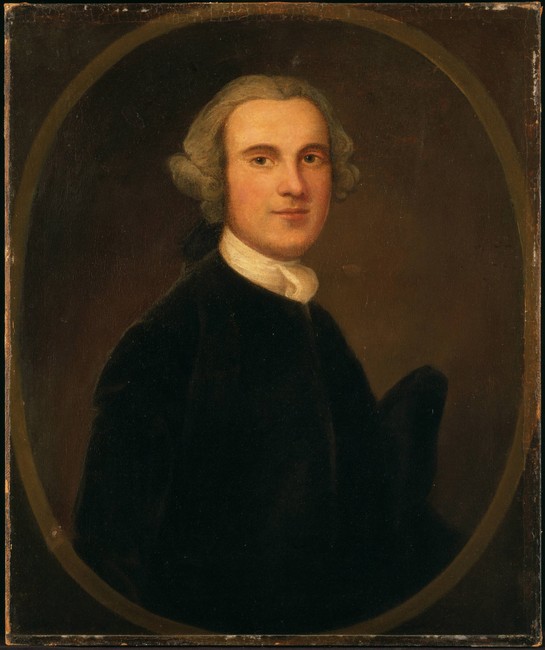
Schuyler (shown here) proceeded on that course. On 11 July, John Holt’s New-York Journal reported:
Last Sunday [7 July] one Bazel Bonderot, a native of Nova-Scotia, was brought to this city from Canada, charged with being a principal in the murder of Captain Thomas Parsons, and eight other persons, in Nova-Scotia, in February 1772.

Soon after this murder was perpetrated, he fled his country, and has been wandering from place to place ever since, till last April, when he was providentially detected by Captain Hector McNeil, properly secured, and sent forward to receive the just reward of his crimes.

He was yesterday sent on from this city to Newbury Port, the place where Captain Parsons last lived, for examination and trial.
That article was reprinted in several newspapers, and eventually in the 19 July Essex Journal of Newburyport.

That same issue of the Essex Journal reported:
This Morning, between 6 and 7 o’clock, departed this life after a long tedious illness, the Rev. JONATHAN PARSONS, in the 71st year of his age, and in the 31st of his MINISTRY in the PRESBYTERIAN Church, in this Town—His remains to be interred on Tuesday next, at three o’clock in the afternoon.
It’s not clear whether the minister heard about the capture of his son’s alleged killer before he died.

TOMORROW: Deliberations in the Congress.

Monday, December 15, 2025

The Northern Department’s Wagon Masters in 1778

On 21 Aug 1778, Morgan Lewis (1754–1844), deputy quartermaster general of the Northern Department of the Continental Army, wrote out a list of men working under him.

A copy of that document is now in Horatio Gates’s papers. It’s transcribed here as part of a New York State Museum web exhibit called “The People of Colonial Albany Lived Here.”

Lewis listed four men as wagon masters that summer, and Stefan Bielinski provided profiles of three of them:
All three identified men were residents of Albany, New York. They were of middling age, married with children, exempted from military duty. They owned property, held local offices, and could command the respect of their neighbors.

August 1778 was well over two years after Gen. Philip Schuyler sent his wagon master out to recruit teams of horses for Col. Henry Knox. Nonetheless, it would be worth looking at his papers from 1775 to see if he worked with any of these three men. Documents show that Schuyler interacted with other members of the Winne and Yates families after 1778, but of course Albany was a small society and Schuyler had lots of business.

As for Samuel Bond, Gen. George Washington’s general orders for 9 Sept 1778 state that at a court martial on 31 August (or ten days after Lewis made his list):
Samuel Bond Assistant Waggon Master was tried for 1st “Picking a Lock; breaking into a public store and taking from thence rum and Candles” which he appropriated to his own use, found guilty of the charges exhibited against him and sentenced to receive fifty lashes and to return to the Regiment from which he was taken.

The General remits the stripes & orders said Bond to return to the Regiment from which he was taken.
Bond thus appears to have been a regular soldier drafted to manage wagons, and then sent back into the ranks.

Deputy quartermaster general Morgan Lewis went on to become the third elected governor of New York, as shown above.

Sunday, December 14, 2025

“I Enquired for the waggon master”

On 16 May 1776, Gen. John Sullivan was at Albany, New York, trying to organize the remnants of the Continental Army’s invasion of Canada.

He sent a letter to Gen. George Washington complaining of the Northern Department’s wagon master, among other things:

Early on the 15 Inst. to my Surprize I found three hundred Barrels (which I had Sent forward) Lying on the Beach without any teams to Carry them to Still water about twelve miles further

I Enquired for the waggon master & was Informed he was at his own House About Six miles off

I Immediately wrote him of the Necessity of his Exerting himself at this time
Two days later Sullivan sent off another complaint about the wagon drivers:
I found at Still water a Number of Barrells of Pork that the Waggoners had Tap[p]ed & Drawn off the pickle to Lighten their Teams. This pork must Enevetably be Ruin’d before it can reach Canada,

as Genl [Philip] Schuyler was Absent I Order’d the Commissary not to Receive any Such from the Waggoners & the Commissary at half moon not to receive out of the Boats any or Deliver out such to the Waggoners.

I order’d the Waggoners not to Receive any such as it would Eventually be thrown on their hands I then Directed the Commissary here not to Send any Barrels forwards that had lost the Pickle which would be only taking up Batteaus & Waggons to Cary Provisions which when brought to Canada Could not be Eaten.

By this Step I hope to prevent any further fraud in the Waggoners who (it is said) Learnt this piece of Skill in the Last War, for which Some of them were well flogged, and I hope Some of them may Share the Same fate—again.
Washington passed on word of those complaints to Schuyler, who responded a month later:
As to the Waggon master he is an Industrious Active and I believe an honest Man, But It is not in his Power, nor any Mans whatsoever to procure Waggons at all Times & at that Time It was peculiarly difficult both on Account of the Scarcity of Forrage the Badness of the Roads and the extravagant Abuses the Waggoners had met with from some of the Troops that preceded General Sullivan’s Brigade.
Neither general named the wagon master, which might reflect how he wielded authority over the teamsters but wasn’t at the level of a gentlemen. Their letters do offer some clues about the man: He had his own house about six miles from where Sullivan was in Albany. He was literate. He was independent.

Now that man in May 1776 wasn’t necessarily the same official whom Schuyler oversaw in December 1775. Nonetheless, he was clearly not one of Schuyler’s slaves.

TOMORROW: Names at last.

Saturday, December 13, 2025

Was Gen. Schuyler’s Wagon Master One of His Enslaved Workers?

As quoted yesterday, on 29 Dec 1775 Col. Henry Knox wrote that Gen. Philip Schuyler “sent out his Waggon Master & other people to all parts of the Country” to hire teams of horses for transporting heavy ordnance to Springfield.

Back in 2016 Ian Mumpton at the Schuyler Mansion wrote:
It is unclear who the “Waggon Master” refers to, but as mentioned in a previous article, many of the men enslaved by the Schuyler family were skilled at driving carts and sleds. As there is no surviving record of Schuyler hiring a wagon master, it is likely that this person was one of the enslaved servants, possibly Lisbon or a man named Lewis who, five months later, was lent to Benjamin Franklin as a driver for a trip from the Schuyler’s home to New York City.
That previous article, also posted by Mumpton, analyzed a 1771 document which mentioned enslaved workers and said:
Lisbon and Dick are both mentioned in other Schuyler documents as carters or wagoners, conveying goods and people for the Schuyler family. Lisbon in particular is mentioned in at least four other sources, always in regards to his driving goods back and forth between Albany and Saratoga. These men’s ability to drive carts and sleds was a large part of their value to the Schuylers, as this was a specialized skill-set that involved being able to work with draft animals, manage tack and harness, and maintain the carts and sleds in their charge.
A comment noted another wagon driver named Anthony, Tony, or Tone.

I wouldn’t be surprised if Gen. Schuyler assigned some of his enslaved wagon drivers to the operation moving cannon toward Boston (and collected the same pay he was offering to other farmers for himself).

However, I’m not convinced that one of those men could have been Schuyler’s “Waggon Master.” That was an official designation within the Continental Army’s quartermaster department. On 9 August, Gen. George Washington appointed John Goddard of Brookline “Waggon Master General to the Army of the Twelve United Colonies.” (That count included Georgia but not Delaware, still officially a subset of Pennsylvania.)

In the fall of 1775 Schuyler had overseen preparations for Gen. Richard Montgomery’s invasion of Canada, an operation that probably required a convoy of wagons and thus an official to oversee them.

And that’s a crucial aspect of the job of wagon master. It required more than driving a wagon—indeed, the wagon master might not do any actual driving at all. The job involved making deals on behalf of the Continental Army with a large number of independent contractors and then overseeing a force of teamsters. The word “master” was even in the name. Did any enslaved man, however skilled, have the legal standing and social authority to do that job in 1775?

TOMORROW: Glimpses of Schuyler’s wagon master in spring 1776.

Friday, December 12, 2025

“After a considerable degree of conversation”

On Christmas 1775, Col. Henry Knox was making his way on horseback to Gen. Philip Schuyler’s mansion in Albany, New York.

Knox has just called off his deal with George Palmer of Stillwater to supply eighty pair of oxen to transport heavy cannon into Massachusetts.

Palmer was in his late fifties. Born in Connecticut, he had bought mills and other real estate in Stillwater in 1764 and become a big man in that town. He didn’t like being dismissed, as shown by the letter I quoted yesterday.

Since we have only one side of the correspondence, we don’t know if Knox had revealed that he’d canceled the deal on a direct order from Gen. Schuyler, who insisted he’d started making his own arrangements for moving the cannon.

Schuyler was in his mid-forties, scion of a family of Dutch landowners in Albany. He was a big man in the whole colony. He’d been elected to the Second Continental Congress and then appointed a general of the Continental Army in charge of the Northern Department.

In between those two local bigwigs was Knox, a twenty-five-year-old from Boston who hadn’t yet received his official commission as colonel. He was following orders direct from Gen. George Washington, but that mentor was very far away.

On the afternoon of 26 December, Knox reached Schuyler’s house. Evidently he persuaded the general to at least talk with Palmer. The next day Knox wrote in his journal: “Sent off for Mr Palmer to Come immediately down to Albany.”

On 28 December Knox recorded the result of that meeting:
Mr Palmer Came Down & after a considerable degree of conversation between him & General Schuyler about the price the Genl Offering 18/9. & Palmer asking 24/. P[er] day for 2 Yoke of Oxen the treaty broke off abrubtly & Mr Palmer was dismiss’d
It seems clear from the way Knox described that long conversation as between Palmer and Schuyler that he was left out—perhaps he even wanted to be left out. We don’t know what price he had offered Palmer and thus how that fit into this conversation. Did Schuyler bargain Palmer down, or did Palmer insist on sticking to the original deal?

Authors describe Knox scrapping his initial plan to use Palmer’s oxen as purely a matter of cost. That makes the situation seem entirely reasonable, especially on the part of the men commemorated with statues—Schuyler and Knox. But Schuyler had told Knox to dismiss Palmer more than a week before this sit-down, before he knew anything about prices.

That suggests Schuyler made his decision on something besides 5s.3d per day. He and Palmer might have been rivals for influence in the county. He might have assumed Palmer wouldn’t offer the best price. He might have felt he’d sunk too much money into his own preparations to stop now. The general might simply have wanted more control.

Whatever his motivation, on 29 December Schuyler sent his wagon master and other agents “to all parts of the County to immediately send up their slays with horses,” as Knox wrote. The price would be “12/. P[er] day for each pair of horses or £7. P[er] Ton for 62 miles.” At the end of the year the wagon master brought back a list of 124 teams. That number of horses would cost £74.8s. per day.

In contrast, Palmer had offered 80 yoke of oxen. Knox wrote that he ultimately quoted 24s. per day “for 2 Yoke of Oxen.” If that’s correct, using Palmer’s oxen would have cost £48 per day, considerably less than Schuyler’s arrangement. However, if Knox really meant that price to apply to each yoke of two oxen (the usual way of calculating), then Palmer was indeed asking for more than Schuyler.

There might well have been other costs and factors involved, such as the number of teamsters needed or how quickly the animals and equipment could be assembled. But whatever the details, it seems clear that Schuyler was making the decisions at this point, not Knox.

Indeed, Knox confided some worries about the final arrangement in his journal, meant for himself and perhaps for showing Gen. Washington later. On 31 December he wrote about the “Slays which I’m afraid are not Strong enough for the heavy Cannon If I can Judge from the sample Shewn me by Genl Schuyler.”

Nonetheless, those sleighs and those horses were what he had to work with.

TOMORROW: The wagon master.

Thursday, December 11, 2025

“You will therefore Countermand any directions you may have given Mr. Palmer”

As discussed back here, as of 13 Dec 1775 Col. Henry Knox and George Palmer of Stillwater, New York, had agreed on how to transport heavy ordnance to Springfield.

Knox wrote to Gen. George Washington about those arrangements on 17 December:
I have made forty two exceeding strong sleds & have provided eighty yoke of Oxen to drag them as far as Springfield where I shall get fresh Cattle to carry them to Camp.
This is the letter in which Knox promised “to present to your Excellency a Noble train of Artillery,” a phrase authors still use to describe the guns.

On the same day, Knox wrote to Gen. Philip Schuyler (shown above) in Albany. He had thought Schuyler had gone south to Philadelphia, so he might have made decisions thinking that he didn’t have to clear them with his superior officer. Knox told Schuyler:
I have agreed with Capt. Palmer of Stillwater to get proper Conveyances for them from hence to Springfield— . . . I expect Capt. Palmer up with the Teams on Tuesday & on Wednesday or Thursday I hope to move as far as Saratoga if the sleding continues as at present from thence we must wait for Snow—
The next day, Schuyler wrote back:
I am happy to hear that all the Military stores you had in charge to bring from Ticonderoga are arrived at Fort George,— I have taken Measures to forward them to Boston as soon as we shall be favoured with a fall of Snow— but I am Informed that you have Applied to Mr. Palmer to Construct Carriages for the purpose, this is a very unnecessary Expence as there are a Sufficiency of Carriges Suitable for the purpose in this County Sufficient to Carry ten times the quantity, you will therefore Countermand any directions you may have given Mr. Palmer on this head.
Note how Knox referred to Palmer as a captain, probably a militia rank, while Schuyler called him only “Mr. Palmer.”

Having received a direct order, Knox wrote to George Palmer saying that his services were no longer needed.

Palmer had been making arrangements with his network of farmers around Stillwater. He didn’t take this news well. On 25 December he responded to Knox:
Since your Departure from this I have an oppertunity with Many of the inhabitants with whom I have Contracted for the Removal of the artillery and Stores, I find all Determined To A Man to fulfill on their Part & that I Shall on mine or Be answerable for the Consequences of A Disapointment which is More than I Shall be able to Do,

Depend Sir the People (& Not only those Employed in Service But others General) are Not indifferent, they are Sensible of the importance of the Grand Cause

they are Sensible To the Minutest Degree of the insult offered in Counteracting your Measures, I take this Earliest opportunity To inform you of the Disposition of the People among whom I Live with whom I am Concerned Particularly in this afair,

your Penetration will Easily Dissern the Consequences that will follow Disapointing Such A Number of People So Resolutely Determined as you may Depend Those are, with Regard to what you mentioned of our Carrying the heavy [space] they are Determined Since there is Such an they are Determined Since there is Such an attempt made To Supplant them To fulfill the whole Contract

I am Sir with all Possible Respect your most obedient hume. Sert/.
I get the impression that Palmer no longer had complete respect for young Col. Knox.

TOMORROW: A sit-down in Albany.

Sunday, December 07, 2025

Following the Knox 250 Trail through New York, 13–14 Dec.

On the weekend after my 11 December talk at the Saratoga battlefield park, many local historic sites and communities in New York will host commemorations of Henry Knox’s mission to transport more ordnance to the siege of Boston.

The first leg of that journey involved floating and dragging heavy cannon and mortars south on Lake George and then to greater Albany in December 1775.

The Saratoga 250 website lists these celebrations.

Saturday, 13 December
Sunday, 14 December
The celebrations appear to culminate in this event.

Sunday, 14 December, 1 to 5 P.M.
Knox’s Noble Train of Artillery Layover at Albany
Schuyler Mansion State Historic Site, Albany

In the early afternoon, the ceremonial linstock will arrive at Gen. Philip Schuyler’s home. Historical reenactors and 18th-century refreshments will be on hand. This outdoor event will be free and open to the public.

From 2 to 4 P.M., visitors with tickets can go inside the mansion for guided dramatic tours. Witness Knox’s stay at the mansion, his impact on the household, and Schuyler’s role as host and facilitator of the wagon train’s passage through Albany and over the Hudson River. Space is limited. Purchase timed tickets through this site or by calling 518-434-0834.

The Knox Trail 250 events will pick up again in January.

Friday, September 01, 2023

“Pray Subscribe for me the Declaration of Independence”

Elbridge Gerry left Philadelphia on 16 July 1776, heading for home in Massachusetts with a pound of green tea.

His fellow Continental Congress delegate John Adams wrote that Gerry was “worn out of Health, by the Fatigues of this station.”

But Adams also wrote that he expected Gerry to enthusiastically inspect the Continental Army and fortifications while traveling through New York, and that’s just what Gerry did.

On Sunday, 21 July, while staying near the King’s Bridge that connected Manhattan to the mainland, Gerry sat down to write a long letter to Adams and his cousin, Samuel Adams.

Gerry wrote of the Continental officers:
they appear to be in high Spirits for Action and agree in Sentiments that the Men’s as firm and determined as they wish them to be, having in View since the Declaration of Independence an object that they are ready to contend for, an object that they will chearfully pursue at the Risque of Life and every valuable Enjoyment.
The area was well fortified, he judged, and the people of New Jersey and New York City enthusiastic about the Patriot cause.

He reported on Adm. Lord William Howe’s interactions with Gen. George Washington, which included rejecting a proposal for a prisoner swap of Philip Skene, Loyalist governor of Crown Point and Ticonderoga, for James Lovell, a Boston Patriot.

Gerry recommended removing Gen. Philip Schuyler from command of the Northern Department. Indeed, he suggested that Schuyler should be “sent to Boston, recalled to answer any Charges that may be brot against him.” With the collapse of the invasion of Canada, “The N England Colonies are warm for the Measure.”

After discussing how to reenlist and resupply the army, Gerry shared an idea for increasing business with the French:
Would it not be a good Measure to propose to the French Court to supply with Grain their Army in the West Indies and to impower them to employ suitable persons in the States for that purpose who shall be supplyed by Congress with Money and Ship it in their own Vessels; Whilst they are to make Returns by allowing Us a Factor in their Kingdom to purchase Arms or other military Stores to a certain Amount who is to be furnished by their Court with Money for that purpose. This would be a speedy Way of coming at Arms and Ammunition, and open a Channel for a Breach with Britain.
Finally, Gerry addressed two political matters. He asked for one of the confidential printed copies of the new draft Articles of Confederation, and he wrote:
Pray Subscribe for me the Declaration of Independence if the same is to be signed as proposed. I think We ought to have the privilege when necessarily absent of voting and signing by proxy.
After Gerry had left Philadelphia, the Congress formally approved creating the handsome handwritten Declaration that we know. If Gerry’s proposal had been adopted, some of those signatures would not have been the delegates’ actual signatures but signatures of their friends for them. Gerry was worried that after voting for independence he’d be left out.

TOMORROW: About Gerry’s signature.

Wednesday, August 10, 2022

Getting Fort Plain Sorted Out

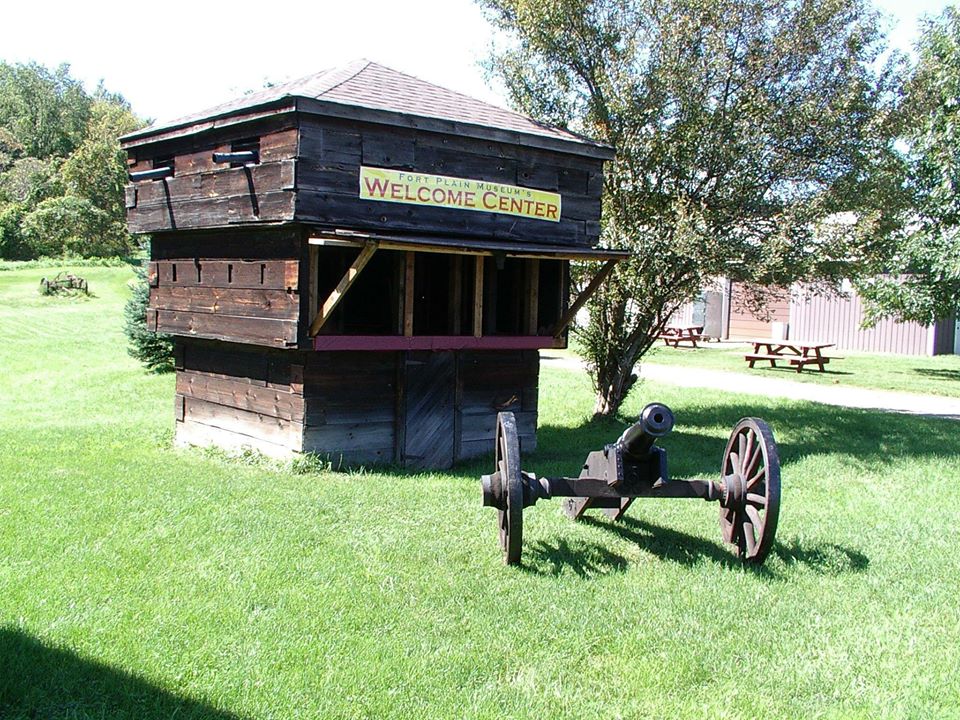
The year that The Road to Concord was published, I spoke at the American Revolution Conference organized by the Fort Plain Museum, and I had enough fun to go back in other years.

I’ve also enjoyed the Fort Plain Museum’s online bookstore, which stocks a wide range of books about the American Revolution, well beyond the titles on its region. The store often offers generous discounts on recent titles and free shipping for larger orders.

But on my visits I’d never had time to visit the museum itself, not until this week. It provides a thorough account of the fight between the U.S. of A. and the British Empire over New York’s Mohawk Valley.

I must confess I’d need to take better notes to sort out all the “forts” in the area, ranging from a large construction like Fort Stanwix to little more than a big farmhouse with shutters and a bunch of soldiers assigned to it.

I felt reassured, though, that I’m not alone in that confusion. In fact, the struggle to tell the Mohawk Valley fortifications apart apparently reached up to the highest level of the Continental Army. For this I’m relying on a roundup of period quotations from Norm Bollen (P.D.F. download).

As early as 1780, an invoice documents that people living around where Otsquago Creek joined the Mohawk River called their fortification Fort Plain. But when Gen. Robert Van Rensselaer made it his headquarters later that year, he dubbed it Fort Rensselaer.

There was a geographic and class division between the frontier farmers and Gen. Van Rensselaer, aggravated by a court-martial pitting him against the county’s militia officers. This resentment came out in people living near the fort continuing to call it “Fort Plain.”

Even when Col. Marinus Willett took over and proved more popular and more militarily successful, locals still sent him messages about “Fort Plain.” Willett regularly crossed out that name and wrote in “Fort Rensselear” (close enough by 18th-century standards).

In February 1782 the French military engineer Villefranche de Genton sent Gen. George Washington a “plan of a Redoubt with a Block-house the inside proper to contain two hundred men, and large magazines, as well for ammunition as provisions” for “Fort Ranceler,” as requested by Willett.

Washington thanked the engineer for his work, and in April sent a bunch of paperwork to Gen. Philip Schuyler, including a contract to finish that blockhouse at Fort Rensselaer. Schuyler was Gen. Robert Van Renssalaer’s brother-in-law, so we can be sure of what he called that location.

At the end of May, Col. Benjamin Tupper of Massachusetts took over at that fort. But when he wrote to Washington about the situation, he used the local name:
There is an unfinished Blockhouse at Fort plain which if compleated would be a strong barrior in that Country; I think if some money could be sent on for the Meterials we can procure workmen among the levies to compleat it.
Washington immediately wrote back to say it was “out of my Ability to furnish you with any Money for the Completion of the Block House at Fort plain.” This despite how he’d already asked Schuyler to start work on the blockhouse at Fort Rensselaer.

On 24 June, Gen. Washington traveled up to the Albany region to inspect the Continental posts and supply depots. As part of that trip, he appears to have learned that Fort Rensselaer and Fort Plain were the same place, and it still needed a blockhouse. On 2 July he ordered the quartermaster to send supplies there. Meanwhile, the latest commander of the post, Col. George Reid, was careful to refer to it in his letters to the commander-in-chief as “Fort Plain, or Ransler.”

After the war, the fortification was no longer needed. It disappeared by the end of the century. But the memory of it was strong enough that when the settlers living around Otsquago Creek needed a name for their village, they chose Fort Plain.

Saturday, July 02, 2022

“The Sick suffered much for Want of good female Nurses”

The fourth quotation to track down from that U.S. Army webpage is the first to appear in its paragraph about the creation of the Continental Congress’s nursing policy:
Shortly after the establishment of the Continental Army on June 14, 1775, Maj. Gen. Horatio Gates reported to Commander-in-Chief George Washington that “the sick suffered much for want of good female Nurses.”
The way that webpage lays out events, Gates’s warning prompted the Congress to hire nurses.

However, as I showed yesterday, the Congress established its standards for an army medical department in July 1775 without needing guidance from the generals at Cambridge. 

The phrase “the sick suffered much for want of good female Nurses” doesn’t appear on Founders Online, which includes all of Washington’s incoming and outgoing correspondence during the war.

It doesn’t appear in the Journals of the Continental Congress, still searchable through the Library of Congress’s old American Memory website, where we can find the paragraph’s other phrases (approximately) because those were part of official resolutions.

I tracked the phrase in question to Peter Force’s American Archives (digitized and searchable here) and the Orderly Book of the Northern Army, at Ticonderoga and Mt. Independence, published by Joel Munsell in 1859.

Not surprisingly, yet another committee of the Congress was involved. In November 1776, the Congress sent two delegates—Richard Stockton of New Jersey (shown above) and George Clymer of Pennsylvania—to northern New York to assess the Continental forces in the aftermath of the collapse of the invasion of Canada.

Stockton and Clymer consulted with Gen. Gates, Gen. Philip Schuyler, and commissary general Joseph Trumbull before reporting back to the Congress on 27 November. That body named a larger committee to take up the discussion and report back, which meant the original report wasn’t entered into the Congress’s journal.

The first committee report, as printed in the Munsell book, includes this about medical care:
Your Committee also beg leave further to Report, that they have visited the General Hospital for the Northern Army, situated at Fort George; that there is a Range of Buildings erected convenient for the Purpose, which on the 20th of October last contained about four hundred Sick, including those wounded and sent from General [Benedict] Arnold’s Fleet; that they were sufficiently supplied with fresh Mutton and Indian Meal, but wanted Vegetables; that the Director-General in that Department [Dr. Samuel Stringer] obtained a large Supply of Medicines, but the Sick suffered much for Want of good female Nurses and comfortable Bedding; many of those poor Creatures being obliged to lay upon the bare Boards. Your Committee endeavoured to procure Straw as the best temporary Expedient; but they earnestly recommend it to the Attention of Congress, that a Quantity of Bedding be speedily furnished,…
The American Archives version has fewer capital letters, more italics, and one added “that.”

Thus, a Revolutionary War source did say “the Sick suffered much for Want of good female Nurses.” But that source wasn’t Gen. Gates writing to Gen. Washington on or shortly after 14 June 1775. It was Richard Stockton and George Clymer reporting to the Continental Congress in November 1776.

That report came more than a year after the Congress authorized hiring nurses for its hospitals; it didn’t prompt that hiring. Stockton and Clymer were actually describing an anomaly in the army’s medical establishment. Up in the frontier fortifications along Lake Champlain and Lake George, there weren’t enough women to staff the army hospitals as commanders had come to expect.

In fact, back on 13 July 1776 Gen. Schuyler had ordered:
One woman from each company of each of the Pennsylvania Battalions now at this post, to be draughted as soon as possible, and sent to the General Hospital at Fort George. They will have the customary allowance of provisions, and so forth from Dr. Stringer, director of the hospital there.
The Continental Army expected soldiers’ wives to be ready to serve as nurses.

TOMORROW: How the error appeared and metastasized.

Tuesday, August 24, 2021

Upcoming Online Book Events

Here are some book discussions coming to a computer screen near you in the next couple of weeks.

Thursday, 26 August, 8:00 P.M.
History Camp
Kathleen DuVal, Professor of History at the University of North Carolina, Chapel Hill, will discuss her prize-winning book Independence Lost: Lives on the Edge of the American Revolution, which looks at the history of the American Revolution through the eyes of slaves, American Indians, women, and British loyalists on Florida’s Gulf Coast. Free.

Tuesday, 31 August, 7:00 P.M.
Harvard Book Store
Mike Duncan, host of the groundbreaking podcast The History of Rome and author of The Storm Before the Storm will discuss his latest book, Hero of Two Worlds: The Marquis de Lafayette in the Age of Revolution. He will be joined in conversation by Patrick Wyman, host of the Tides of History podcast. This is a ticketed event. A $35.25 ticket buys access to the event plus a signed hardcover copy of Hero of Two Worlds mailed afterwards.

Thursday, 9 September, 8:00 P.M.
History Camp
Jack Kelly, author and historian, on his new book, Valcour: The 1776 Campaign That Saved the Cause of Liberty, which covers the Revolutionary War battle on Lake Champlain, led by Philip Schuyler, Horatio Gates, and the heroic Benedict Arnold, that delayed British invasion until the following year. Free.

Saturday, February 02, 2019

“The Indiscretion of a very few Persons of the lowest Class”

The burning of effigies in New York City on 14 Nov 1768 prompted a strong response from the royal governor of that colony, Sir Henry Moore.

It came in the form of a message to the colony’s legislature one week later, delivered by a deputy secretary named (wait for it) Goldsbrow Banyer:
Some Intimations having been given to the Mayor and Magistrates of this City, in the Course of the Week before last, of a Design to disturb the public Peace, by a Riot; the Zeal shew’d by them on this Occasion, together with the laudable Declaration of the Inhabitants, of their Willingness to assist and support them, in maintaining the Tranquility of the City, gave me Hopes, that nothing of so illegal and dangerous a Tendency, would be attempted: A few ill-disposed Persons have, nevertheless, eluded the Vigilance of the Magistrates, and ventured to execute their Purpose, by exciting a Riot last Monday Evening.

As these turbulent Proceedings, at a Juncture so peculiarly critical, may occasion Imputations injurious to the Colony, I have requested the Magistrates to exert themselves for the Discovery of the Rioters, and with the unanimous Advice of his Majesty’s Council, issued a Proclamation, offering a Reward of Fifty Pounds, to be paid upon the Conviction of the Contrivers, and chief Promoters of this Outrage. And as I have no Doubt of your Readiness to prevent the Mischiefs of a Measure, daring and insolent in itself, previously disavow’d by the Inhabitants, and seemingly calculated to insult the several Branches of the Legislature now sitting; I flatter myself, you will concur with me, in the necessary Steps to prevent the Colony from suffering any Detriment, and by making a proper Provision, enable me to fulfil the Engagements I have entered into for this Service.
In other words, Moore had promised a reward of £50 and was now asking the assembly for £50.

The Massachusetts General Court would have laughed at such a request. But the New York legislature was dominated by large landowners who had worked well with Gov. Moore. The next morning the assembly voted to grant the £50 and respond to the governor’s address with one of its own.

To head the committee writing that address, the assembly chose rookie lawmaker Philip Schuyler (shown above). He returned with the document, and on 23 November the legislators voted on it. The Livingstons and their many allies supported it, so of course their rivals the DeLanceys and three supporters voted against it. Probably the DeLanceys opposed the Whiggish protest that Schuyler’s committee slipped into what otherwise reads like slavish assent:
We his Majesty’s most dutiful and loyal Subjects, the General Assembly of the Colony of New-York, having taken your Excellency’s Message of Yesterday, in our most serious Consideration, beg Leave to assure your Excellency, that, tho’ we feel in common with the Rest of the Colonies, the Distresses occasioned by the new Duties imposed by the Parliament of Great-Britain, and the ill-policed State of the American Commerce; yet, we are far from conceiving, that violent and tumultuous Proceedings will have any Tendency to promote suitable Redress. . . .

It is with Pleasure that we can assure your Excellency, that these disorderly Proceedings, are, as appears to us, disapproved by the Inhabitants in general; and are imputable only to the Indiscretion of a very few Persons of the lowest Class. . . .
Speaker Philip Livingston signed that address on behalf of the assembly. The following afternoon, Gov. Moore told the legislators that “your readiness to support the dignity and authority of government, cannot fail of being attended with the most favorable consequences to the colony, and render abortive any future attempt to disturb the public tranquility.” So everyone was in agreement.

The assembly went back to their chamber, made itself a committee of the whole (so they didn’t have to keep such detailed records), and discussed “proper and constitutional resolves, asserting the rights of his Majesty’s subjects within this colony, which they conceive have been greatly abridged and infringed, by several acts passed by the last parliament of Great Britain.” In sum, most New Yorkers were just as opposed to the Townshend Acts as the Massachusetts Whigs. They just didn’t like riots. Especially riots about some local issue in Boston.

TOMORROW: The reaction back in Boston.

Tuesday, December 26, 2017

Digital Wallpaper at the Schuyler Mansion

Earlier this year Susan Holloway Scott of the Two Nerdy History Girls shared a look at the wallpaper of the Schuyler Mansion in Albany.

Philip Schuyler was, of course, a wealthy man. He wanted the mansion he commissioned in 1761 to look good. And that meant choosing fashionable wall coverings. Scott’s posting focused on the paper that Schuyler bought for his halls, upstairs and down.
Unlike most 18thc wallpaper which was block-printed, or “stampt”, this paper was painted entirely by hand in tempera paint in shades of grey – en grisaille was the term – to mimic engraved prints. In fact, the entire scheme of the papers was an elaborate trompe l’oeil to represent framed paintings and cartouches, all custom designed for the walls and spaces they would occupy.

This was, of course, extremely expensive, and as much a sign of Philip’s deep pockets as his taste. The wallpaper he ordered featured romantically scenic landscapes by the Italian painter Paolo Panini, and was called “Ruins of Rome.” The “Ruins of Rome” wallpaper was so rare and costly that there are only two examples of it known to survive in America: in the Jeremiah Lee Mansion in Marblehead, MA, and in the Metropolitan Museum of Art, NY, which has installed the paper taken from the now-demolished Rensselaerwyck, the home of Stephen Van Rensselaer II, also near Albany. . . .

The scenic wallpaper had long been removed. But over the last few years, the state’s Peebles Island Resource Center, led by Rich Claus and Erin Moroney, has painstakingly recreated a high-quality digital reproduction of the “Ruins of Rome” based on the wallpaper from both the Lee Mansion and the Van Rensselaer installation in the Met, but redesigned to fit the Schuyler Mansion’s walls and woodwork as perfectly as the original once did. The new wallpaper was completed and hung as part of the Mansion's centennial celebration this year.
Both the Schuyler Mansion and the Lee Mansion are now closed for the season but well worth a visit in warmer months. The Met is of course open year-round.

Thursday, January 26, 2017

How Many Cannon Did Henry Knox Transport?

Another question about Col. Henry Knox’s mission to northern New York to collect artillery for the siege of Boston is how many pieces he brought. And how many did he leave behind?

We have a couple of counts of artillery-pieces in the region from Gen. Philip Schuyler:
Schuyler first counted 54 cannon at Fort Ti with sizes ranging from four-pounders to eighteen-pounders, but 29 of those were in a category called “Bad cannon.” By December Schuyler was counting 53 cannon in all. There were other artillery pieces as well, including swivel guns and mortars. The general sent some weapons north into Quebec with Gen. Richard Montgomery.

Henry Knox left at least three different listings of the artillery pieces he decided to transport back. The first, dated 10 Dec 1775, was transcribed in his earliest biography, by Francis S. Drake. It includes 59 pieces of artillery, including 43 cannon and 16 mortars of different sorts. Knox also determined that one brass cannon Schuyler had labeled an eighteen-pounder was instead a twenty-four-pounder; the difference in bore appears to have been less than half an inch.

On 17 December, Knox sent Gen. Washington a list of the guns he planned to bring east, probably so that Massachusetts blacksmiths could start making shot for them. That list contained only 55 guns—he left off 4 twelve-pounders from his earlier list.

Drake also transcribed the heading of Knox’s expense report for this trip:
For expenditures in a journey from the camp round Boston to New York, Albany, and Ticonderoga, and from thence, with 55 pieces of iron and brass ordnance, 1 barrel of flints, and 23 boxes of lead, back to camp (including expenses of self, brother, and servant), £520.15.8¾.
So we might think the colonel transported 55 cannon to Boston, including 43 cannon. But on 5 January he told Gen. Washington, “We got over 4 more dble fortified 12 pounders after my last to your excellency.” So his count was back to 59. Why Knox mentioned only 55 on his expense report is a mystery, but presumably his expenses were the same.

Yet another Knox document was transcribed in the first volume of the Harvard Illustrated Magazine, published in 1900.
Knox evidently made these notes during his journey, recording what ordnance went on a scow and what on a periauger. There are overlapping listings here, but at that point the freight included “42 Cannon of different Sizes” and “16 Mortars.”

Those numbers match the inventory that I quoted yesterday from John Adams, who viewed the train of artillery in Framingham in January 1776. (Of course, an editorial note indicates that the editors of the Adams papers used the Knox papers as a reference, so we should expect them to match.)

We also have Knox’s diary for the first part of his trip, and that tells us that he lost one cannon along the way. On the afternoon of 4 January, he wrote, he was “much alarm'd by hearing that one of the heaviest Cannon had fallen in to the [Mohawk] River at Half Moon Ferry.”

Three days later, near Albany, another cannon went “fell into the River notwithstanding the precautions we took.” Knox and the locals managed to get that gun out of the water the next day, but he’d had to leave the first sunken gun behind. That explains why he set out with one more iron eighteen-pounder than Adams saw.

Thus, Col. Knox set out from Lake Champlain with 59 artillery pieces, including 43 cannon; lost one eighteen-pounder; and arrived in eastern Massachusetts with the rest.

I’ve seen a report that the 59 artillery pieces Knox selected came almost evenly from Crown Point and Fort Ticonderoga. However, I haven’t found a source for that statement.

There’s also the story told in an article in the Bulletin of the Fort Ticonderoga Museum titled “History of a Wandering Cannon.” During work on a dam across the Mohawk River in the 1850s, an iron six-pounder with the royal monogram was dredged up. It was eventually displayed at the restored Fort Ti as the cannon Knox had lost back in 1776. But I’m not sure how it shrank from being an eighteen-pounder.

Thursday, January 05, 2017

“There is no undoing this gordian knot”

We left Angelica Schuyler and John Carter in the house of her mother’s family near Albany, New York, in July 1777.

They had just eloped and were hoping that her father, Gen. Philip Schuyler, would accept their marriage.

The couple had apparently asked the general in advance for his permission to wed, and he had refused. He complained that he knew almost nothing about Carter, a young Englishman in exile who had come to his home the year before to audit army accounts for the Continental Congress.

If Gen. Schuyler had known all about Carter—that he was really named John Barker Church, that he had left Britain to escape a scandal, that that scandal was a duel or a bankruptcy, or maybe even both—he probably wouldn’t have been any more pleased.

But there were limits to patriarchal authority, even then. Schuyler had plenty on his mind already with Gen. John Burgoyne marching an army down from Canada. He had several other daughters and sons to worry about. His wife’s family seems to have supported the young couple. So the general gave in.

In the same letter in which he revealed the marriage to William Duer, Schuyler wrote:
But as there is no undoing this gordian knot, I took what I hope you will think the prudent part: I frowned, I made them humble themselves, forgave, and called them home.
The Carters returned to the Schuyler Mansion in Albany, shown above.

In September, John Carter wrote to the Congress asking that he be replaced as one of the auditors for the Continental Army’s Northern Department. He said that “important business requires his immediate presence in Boston.” The Congress probably saw that it wouldn’t do to have a man checking the books created in part by his own father-in-law, so it quickly gave him leave to resign. The Carters moved to Boston, and John went into business supplying the army.

Gen. Schuyler didn’t forget the brief estrangement from his eldest daughter. Three years later, on 8 Apr 1780, he wrote to the young American colonel who had asked for his daughter Betsy’s hand:
Yesterday I had the pleasure to receive a line from Mrs Schuyler in answer to mine on the subject of the one you delivered me at Morris town [New Jersey]; she consents to Comply with your and her daughters wishes. You will see the Impropriety of taking the dernier pas [last step—i.e., the actual wedding] where you are. Mrs. Schuyler did not see her Eldest daughter married. That also gave me pain, and we wish not to Experience It a Second time. I shall probably be at Camp In a few days, when we will adjust all matters.
Col. Alexander Hamilton and Elizabeth Schuyler married on 14 December at the Schuyler Mansion.

TOMORROW: A glimpse of the Carters in Boston.

Wednesday, January 04, 2017

“I have found a wealthy husband”?

Folks who spotted the name of Angelica Schuyler in yesterday’s posting might immediately have thought of last year’s Broadway sensation Hamilton.

Angelica is a major supporting role in the play. RenĂ©e Elise Goldsberry first played the role and won a Tony Award for it. (Another notable performance came from Joshua Colley in the “Miscast” benefit concert, shown here; click on the picture for the video.)

In that show, Angelica is the first Schuyler sister to meet Alexander Hamilton in 1780. She steps away when she realizes her younger sister Eliza is more interested. As she explains in a number titled “Satisfied”:
I’m a girl in a world in which
My only job is to marry rich
My father has no sons so I’m the one
Who has to social climb for one
So I’m the oldest and the wittiest and the gossip in
New York City is insidious
And Alexander is penniless
Ha! That doesn’t mean I want him any less
Later Angelica marries a rich, boring man, though she’s full of silent regrets about not pursuing Hamilton. In “Non-Stop” she sings:
I am sailing off to London
I’m accompanied by someone who always pays
I have found a wealthy husband
Who will keep me in comfort for all my days
He is not a lot of fun, but there’s no one
Who can match you for turn of phrase
My Alexander
So if that’s Angelica Schuyler’s story, her elopement with the mysterious English adventurer “John Carter” (actually John Barker Church) couldn’t have lasted, right?

In fact, Schuyler family is one of the parts of history that Hamilton creator Lin-Manuel Miranda took the most liberties with. To begin with, Gen. Philip Schuyler had three sons. All three married into other wealthy, politically active Dutch New York families—the Van Rensselaers, the Ten Broecks, and the Rutsens. One became a U.S. Congressman. The family fortunes didn’t depend on Angelica’s marriage.

In notes on “Satisfied” Miranda wrote:
I actually forgot that Phillip had 15 children. But I think that my brain wanted me to forget because it’s stronger dramatically if societally she can’t marry you. And in reality, she was married when they met.

She was married when Hamilton came into the Schuyler sisters lives. Moreover, “Helpless” and “Satisfied” are a microcosm for the whole story which entirely depends on who tells it.

To me, it’s extremely effective to see the courtship from Eliza’s perspective, then rewind the whole thing and then tell it again. Angelica, while she and Hamilton are soul mates, she reads him in a second and knows she can’t marry him so she lets her sister marry him to keep him in her life. I definitely had to take a dramatic license.
But here’s the rub: In a world not centered on Alexander Hamilton, one could hardly find more drama than Angelica Schuyler deciding to run off with John Barker Church in 1777. His past was even more shadowy than Col. Hamilton’s, his behavior more dangerous, and his prospects more dubious.

TOMORROW: So will that marriage be saved?

Tuesday, January 03, 2017

“Carter and my eldest daughter ran off”

On 26 July 1776, the Continental Congress commissioned three men “to liquidate and settle the accounts in the northern department” after the unsuccessful invasion of Canada.

The three men the Congress selected were “Mr. James Milligan, Mr. John Carter, and Mr. John Wells.” I don’t know anything about Milligan and Wells, but Carter was an interesting choice for this job. He’d come to America from London less than two years before.

Obviously, the twenty-seven-year-old had convinced members of Congress that he had the accounting skills they wanted and was loyal to their cause. The New York politician William Duer, who himself had arrived from England in the early 1770s, was telling people that Carter “though young in years is an old fashioned english Whig.”

As of 31 October, according to a letter from the Congress’s auditor general to the New Hampshire assembly, the three commissioners were in Albany. There they worked closely with Gen. Philip Schuyler, the commander of the Continental Army’s Northern Department (shown above). Schuyler hadn’t gone into Canada himself, but he’d overseen the logistics of that campaign.

In March 1777, the commissioners sent the general a letter, possibly wrapping up their audit. The same month, the Congress entrusted Carter with $1,380 to deliver to Jonathan Trumbull, Jr., the deputy paymaster for the northern army. In May the Congress considered all three men’s salary, approving payment to them of $3,444—“26 July to 9th May, inclusive, 287 days, at four dollars each per day.”

That summer, Carter was back in Albany, possibly flush with Continental cash. We know that because on 3 July Gen. Schuyler wrote to Duer:
Carter and my eldest daughter [Angelica] ran off and married on the 23d inst. [i.e., of this month]. Unacquainted with his family, his connections and situation in life, the match was exceedingly disagreeable to me, and I had signified it to him.
This letter is usually interpreted as saying that the couple eloped on 23 July. But Schuyler couldn’t have written on the 3rd about an event that would surprise him three weeks later. Perhaps the couple married on 23 June, and Schuyler mistakenly wrote “inst.” instead of “ultimo”—last month. Or perhaps Schuyler wrote this letter on 30 or 31 July and Benson Lossing got the date wrong when he published it in 1873.

Right after the marriage, Angelica and John Carter went to stay with her mother’s family, the Van Rensselaers, hoping her father would change his mind. Gen. Schuyler was upset that he didn’t know about his putative new son-in-law’s “family, his connections and situation in life.” He would probably have been even more angry if he’d known that John Carter wasn’t even John Carter.

Carter’s real name was John Barker Church. He was indeed a well-born English businessman, and there are competing stories of why he’d left London:
  • According to descendants, Church feared he’d killed a man in a duel or brawl; “wishing to avoid arrest, he left his hat and broken sword in the street and fled by ship ready to sail to America.”
  • Church had gone bankrupt as a grocer (i.e., wholesaler), as shown by contemporaneous notices in the London Gazette and Gentleman’s Magazine in 1774. Later an anonymous book called The Whig Club claimed that “after several mornings spent unsuccessfully at the Stock Exchange, and as many nights passed equally unpropitiously at A——n’s coffee-house, in F—t-street [gambling], he found himself a considerable sum worse than nothing.”
  • Finally, there’s a suggestion in a letter to Gen. Horatio Gates that Church had absconded from his London partners with a huge sum in gold, “leaving his hat and sword in a London field, from which his friends were to assume that he had been murdered.” (Those are the words of Schuyler biographer Don Gerlach.)
None of those stories looked good, of course. It’s striking how Church or his family seemed to prefer the story of the duel over that of bankruptcy, but if the bankruptcy also involved embezzlement or accusations of it, that might make sense. It’s also conceivable that all stories hold some truth, that Church’s financial problems brought on violent clashes, or vice versa, with angry accusations to follow. Whether Church’s twenty-year-old bride Angelica Schuyler knew any of that history is unclear.

COMING UP: Can this marriage be saved?

Friday, June 27, 2014

Following the Drums Along the Mohawk

American Heritage Living History Productions and the Historical Society of Rockland County, New York, are teaming up to offer an overnight guided bus tour on the theme of “Drums Along the Mohawk.”

Taking place on the weekend of 9-10 August, the tour starts on Saturday morning by taking on passengers at two spots: West Nyack and New Paltz. The bus will stop at twelve historic sites, including the homes of Gen. Philip Schuyler and Gen. Nicholas Herkimer and the Van Schaick Mansion. There will be guides on the bus and at the sites.

On Saturday evening, guests will view a performance of the Drums Along the Mohawk outdoor drama at the Gelston Castle Estate in Mohawk, New York. Based closely on Walter D. Edmonds’s novel, this drama tells “the story of a newlywed couple thrust into the brutal conflict of the American Revolution during the year 1777.” Bring your own lawn chair or blanket to sit on while watching the show.

The price for the entire tour is $279 per person, single occupancy; $244 per person, double occupancy. That ticket includes the bus transportation, admission to all sites and stops, lodging at the Knights Inn in Little Falls, and meals (except a bring-your-own lunch for Saturday to eat on the bus). The deadline for reserving a space through the Historical Society of Rockland County is 30 June. Call 845-634-9629 or see this page for more information.

Other performances of the Drums Along the Mohawk outdoor drama this summer are scheduled for 2, 3, and 10 August. Tickets are $10-15, but you have to get yourself to Mohawk, New York, on your own.

Thursday, April 03, 2014

Memories of History Camp

Remember last month’s History Camp? If you weren’t able to make it, you can still partake of some of the program through the videos that organizer Lee Wright has just posted on YouTube.

Here I am talking about “The Boston Bankruptcy That Led to the American Revolution” (about forty minutes with questions).

Here’s Liz Covart on “How the Patriots Almost Lost the Battle of Saratoga.”

And here’s a panel I missed: “Employment Options for History Lovers.”