J. L. BELL is a Massachusetts writer who specializes in (among other things) the start of the American Revolution in and around Boston. He is particularly interested in the experiences of children in 1765-75. He has published scholarly papers and popular articles for both children and adults. He was consultant for an episode of History Detectives, and contributed to a display at Minute Man National Historic Park.

Subscribe thru Follow.it


•••••••••••••••••


Showing posts with label Samuel Pemberton. Show all posts

Sunday, September 13, 2026

“Mr. Capen insults the State, by denying their jurisdiction”

At the end of 1776, Hopestill Capen was still locked away from his wife Patience.

And Capen lost patience in another way. On 30 December, he sent a letter from “Boston Prison” to Joseph Greenleaf, a justice of the peace.

As transcribed in American Archives, that letter says:
It is now one hundred and forty-seven days since you, with John Hill, Joseph Gardner, and Samuel Pemberton, Esqrs., accused and judged me unfit to go at large, for no other cause whatever than my plainly and simply pleading conscience in obeying the plain Scripture commands; and for that only, you, with the other three of my accusers, committed me to close prison in a felon’s room, there to be kept until delivered by a due course of law.

Can any one with truth say this is not unjust, and against the law of the God of Heaven, who speaketh in the Scriptures? Is there any law that forbids any man’s obeying the plain commands of the great Lawgiver, who is the Maker and Judge of all men? [Multiple citations from the Bible follow] . . .

But I shall be very glad of my just liberty; and I beg that you will not persecute me any longer for that I cannot in conscience do. Can you, on a cool reflection, take any pleasure in such tyranny, while you profess to be the supporters of liberty? What liberty is dear as the liberty of conscience? And I again beg of you to release me from such cruel oppression. . . .

P.S. Surely injustice continued will not atone for past wrongs; and I most heartily entreat you not to keep me away any longer from my just and lawful liberty.
Capen sent similar letters to Sheriff William Greenleaf (not a close relative of the justice) and jailer Joseph Otis (not a close relative of the Barnstable family).

Justice Greenleaf forwarded his copy to James Warren, speaker of the Massachusetts House (and not a close relative of the Roxbury family), with this request:
I must beg the protection of the Court from the insults of Mr. Capen, who stands committed for signing an association to join the enemies of his country whenever called upon, and other crimes. Mr. Capen insults the State, by denying their jurisdiction. He disowns me as a Magistrate, because appointed by the present Administration, while he owns the jurisdiction of the other members of the Court of Inquiry, because appointed by the King’s Governour, and (as he apprehends derive) their authority from thence.
The “association” Greenleaf referred to was a Loyalist militia formed during the siege of Boston. Capen hadn’t just signed up; he’d volunteered to be a sergeant. Greenleaf had “the Books, which contain the Names of the Associations.”

This letter might help to explain why the Massachusetts General Court took no action on Patience Capen’s petition asking for her husband’s release. He was still in jail as the spring of 1777 arrived.

TOMORROW: Yet another approach.

Sunday, June 06, 2021

“I told Cushing as Ruggles told Tyler”

Yesterday I quoted a long anecdote that John Adams wrote out in 1789 about a discussion between two Massachusetts politicians seventeen years earlier.

The specifics of Adams’s anecdotes aren’t always reliable when he was trying to make a point about politics or personalities or, in this case, both.

Adams dated that exchange to 1772. At that time one of the men he quoted, Timothy Ruggles, no longer had a seat in the Massachusetts General Court. He lived in Hardwick, in western Worcester County. The Boston merchant John Rowe recorded several encounters with Ruggles in the late 1760s but none in the early 1770s, suggesting he didn’t routinely visit the coast. So how likely was Ruggles to be socializing with Royall Tyler and other Boston Whigs in 1772?

As it turns out, however, Adams also left us solid evidence that he had heard (or heard about) that exchange between Ruggles and Tyler by the end of 1772.

On 1 Jan 1773, Adams recorded this event in his diary:
This Evening my Friend Mr. [Samuel] Pemberton invited me and I went with him, to spend the Evening with Jere. Wheelwright. Mr. Wheelwright is a Gentleman of a liberal Education about 50 Years of Age, and constantly confined to his Chamber by Lameness. A Fortune of about two hundred a Year enables him to entertain his few Friends very handsomely, and he has them regularly at his Chamber every Tuesday and Fryday Evening.
Wheelwright (1717-1784) was a wealthy heir who graduated from Harvard College in 1736. On receiving his master’s degree three years later, he delivered a speech against slavery, its effect diluted by being in Latin. After that he enjoyed a long life of wealthy obscurity, keeping out of religious and political controversies. Among Wheelwright’s properties were “the Hills at New-Boston,” which we now call the crest of the Beacon Hill neighborhood, and settlements in New Hampshire and Maine.

In Sibley’s Harvard Graduates, Clifford K. Shipton wrote:
About 1770 one of Wheelwright’s legs was so badly broken by the upsetting of his riding chair that he was confined to his chamber for the rest of his life. Having an income of about £200 a year, he moved into comfortable quarters in Newton from which, during his remaining years, he surveyed the world with intelligent curiosity.
Wheelwright kept notes on current events in his almanac diaries for more than forty-five years. Only one folder’s worth of that work survives at the Massachusetts Historical Society. He never married or had children.

Back to Adams’s diary entry, which describes a New Year’s visit to Wheelwright’s house. (Shipton identified “Mr. Swift” as John Swift, Harvard 1733; Adams doesn’t mention that man in his papers while Samuel Swift was a good friend and a link between him and Wheelwright, so I put Samuel Swift in this party.) Adams wrote:
The Speaker [Thomas Cushing], Dr. [Joseph] Warren and Mr. [Samuel] Swift were there— And We Six had a very pleasant Evening. Our Conversation turned upon the Distress of Rhode Island [during the Gaspee investigation], upon the Judges Dependency [salary grants from the tea tax], the late numerous Town Meetings, upon [William] Brattles Publication in [Richard] Drapers Paper [the Boston News-Letter] of Yesterday, and upon each others Characters. We were very free, especially upon one another.

I told Cushing as Ruggles told Tyler, that I never knew a Pendulum swing so clear.

Warren told me, that Pemberton said I was the proudest and cunningest Fellow, he ever knew.

We all rallied Pemberton, upon the late Appointment of Tommy Hutchinson [the governor’s son] to be a Judge of the common Bench, and pretended to insist upon it that he was disappointed, and had lost all his late Trimming, and Lukewarmness and Toryism.

Warren thought I was rather a cautious Man, but that he could not say I ever trimmed. When I spoke at all I always spoke my Sentiments. This was a little soothing to my proud Heart, no doubt.
Thus, by the time of this gathering Adams definitely knew that Ruggles got off a good line about Tyler and was happy to borrow it to tease Cushing. Perhaps the original conversation happened earlier than 1772, and perhaps it didn’t really start with Dr. Thomas Young, but it happened.

Now I can’t imagine anything more antsy for John Adams than waiting for his colleagues to tease him and having to chuckle about it.

Thursday, March 26, 2020

“The Committee reserve all the printed Copies”

On Monday, 26 Mar 1770, 250 years ago today, the inhabitants of Boston once again gathered in Faneuil Hall for a town meeting. Technically, this was a continuation of the meeting they had adjourned the week before.

To discourage various sorts of bad behavior, the town elected twelve men, one from each ward, to the office of “Tything Men.” In his dictionary Samuel Johnson defined a tithingman as “A petty police office; an under-constable.”

The town already had a warden and a constable from each ward, enforcing the Sabbath, delivering writs, and otherwise policing public morals. But in this month they apparently needed help.

Notably, colonial Boston never elected tithingmen again. The town had done without them since 1727. Yet the town felt they were important in 1770—perhaps as a belated response to the presence of soldiers, perhaps because with the Massacre people felt a renewed need for the town to look proper.

The committee on how “to strengthen the Non Importation Agreement; discountenance the Consumption of Tea and for employing the Poor by encouraging Home Manufactures” reported that three new ships would be built in town. Those vessels would of course provide for more employment, but how they affected tea and imports is unclear. Nonetheless, that committee’s report “passed in the affermative by a unanimous Vote.”

Later, another committee reported that 212 sellers of tea had signed an agreement “not to sell any more Teas, till the late Revenue Acts are repealed,” and others were willing to agree “if its general.” Bostonians had no way of knowing that over in London the Parliament was already moving to repeal the Townshend duties—except the one that produced the most revenue, the tax on tea.

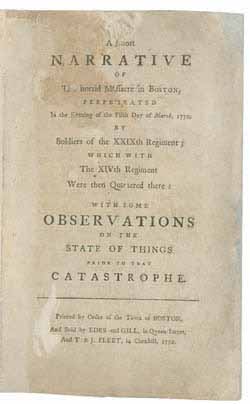
At this meeting James Bowdoin, Dr. Joseph Warren, and Samuel Pemberton reported that their analysis of “the execrable Massacre perpetrated on the Evening of the 5” was ready for printing. The town responded with an important vote:
whereas the publishing said Narrative with the Depositions accompanying it in this County, may be supposed by the unhappy Persons now in custody for tryal as tending to give an undue Byass to the minds of the Jury who are to try the same—

therefore Voted, that the Committee reserve all the printed Copies in their Hands excepting those to be sent to Great Britain ’till the further orders of the Town

Voted, that the Town Clerk [William Cooper] be directed not to give out Copies or deliver any of the Original Papers respecting the late horred Massacre; till the special order of the Town, or the direction of the Selectmen
The town would send copies of the report to advocates in London and sympathetic British politicians. As this letter shows, William Molineux sent a copy to Robert Treat Paine so he could prepare to prosecute the case. But the town meeting officially kept those books under wraps in America.

On this same date, Josiah Quincy, Jr., told his father why he had agreed to defend Capt. Thomas Preston in court:
I at first declined being engaged; that after the best advice, and most mature deliberation had determined my judgment, I waited on Captain Preston, and told him I would afford him my assistance; but, prior to this, in presence of two of his friends, I made the most explicit declaration to him, of my real opinion, on the contests (as I expressed it to him) of the times, and that my heart and hand were indissolubly attached to the cause of my country; and finally, that I refused all engagement, until advised and urged to undertake it, by an Adams, a Hancock, a Molineux, a Cushing, a Henshaw, a Pemberton, a Warren, a Cooper, and a Phillips.
Two of the three Short Narrative authors had urged Quincy to represent Preston, along with several of the town’s other leading politicians. Molineux, who had worked to build the case against Customs officer Edward Manwaring as being one of the shooters, nonetheless told Quincy to speak for the defense.

To make the town look good, to make any pardons seem unjust, and simply to be fair, the Boston Whigs wanted Capt. Preston, his soldiers, Manwaring, and even Ebenezer Richardson to have fair trials in Massachusetts courts.

And then to be hanged.

Thursday, March 19, 2020

When Boston Approved the Short Narrative

On 19 Mar 1770, 250 years ago today, Bostonians gathered for another session of the town meeting they had begun a week before.

Having finished electing men to the municipal offices, the people were now concentrating on how to respond to the Boston Massacre.

There were reports that some of the Superior Court judges were sick, which could delay the trials of Ebenezer Richardson, George Wilmot, Capt. Thomas Preston, and the soldiers of the 29th Regiment for murder. So the town appointed Samuel Adams, John Hancock, and John Barrett as a committee to ask Lt. Gov. Thomas Hutchinson and the Council to approve “special Justices” to ensure those trials could go forward.

Then James Bowdoin, Dr. Joseph Warren, and Samuel Pemberton “laid before the Town a Draft” of their report on “the late horred Massacre.” This was the first version of what was eventually published as A Short Narrative… The town meeting “Voted unanimously, that the same be accepted, and that the draft be recommitted for a further Revision,” which seems contradictory. Was the report complete and approved, or still in the works?

I think the Short Narrative was significantly revised after that approval vote. On 19 March, the French boy Charles Bourgate was in jail, his story discredited. But the published version of the report put a lot of weight on those allegations, citing depositions taken after the vote.

Indeed, the magistrates collecting testimony wrote about sessions on 16, 17, and 19 March, and they dated their report on that process on 22 March. But the final report included Charles Bourgate’s testimony on 23 March, plus (for fairness) responses from Customs employees dated the next day. Nonetheless, the vote on 19 March was Boston’s official approval.

Even as Bowdoin, Warren, and Pemberton were sent off to revise, the meeting turned to how to send it to supporters in England. Someone made a motion “that a Fishing Schooner might be hired by the Town as a Packet to carry home their Dispatches.” The town appointed sea captain John Bradford and merchants William Molineux and John Barrett to hire “a suitable Vessel immediately upon the best terms they can.”

Capt. Samuel Dashwood then stood up and “offered himself in Town Meeting, to go Home charged with the Delivery of such Dispatches as were going by the Packet.” The meeting accepted Dashwood’s offer and agreed to defray his expenses.

All that seemingly settled, the meeting turned to bigger issues, such as encouraging people not to buy tea or patronize shopkeepers who were still defying the non-importation agreement. The town once again expanded its list of importers to shun, this time adding Israel Williams of Hatfield and Henry Barnes of Marlborough.

Last came the biggest issues of all—finding
some effectual Methods to prevent unlicensed Strangers and other Persons from entertaining and supplying the Youth and Servants of the Town with spirituous Liquors; for the breaking up of bad Houses; and removal of any disorderly Intruders to the Places from whence they came; and for the further discountenancing of Vice, and promoting a Reformation of Manners
The meeting dealt with that item by, of course, appointing a committee.

Tuesday, December 03, 2019

“Treading the reforming justice out of me”

Yesterday we bravely accompanied James Murray, a justice of the peace known to be friendly to the royal government, into Faneuil Hall as two Whig magistrates heard a charge against William Burnet Brown for helping to assault James Otis, Jr., in September 1769.

According to a letter Murray wrote at the end of the month, selectman Jonathan Mason chided the crowd for jostling him, even if everyone knew he was no fan of Otis.

Then, lending me his hand, [Mason] helped me over the door into the selectmen’s seat. Before I got down from the seat I was hiss’d. I bowed. I was hiss’d again, and bowed around a second time. Then a small clap ensued. Compliments over, I sat down.

The justices asked me up to the bench. I declined.
The justices of the peace presiding at this session were Richard Dana and Samuel Pemberton. Murray had the status to sit beside them and render judgment—but of course he knew he would be outvoted.
The examination of some evidence [i.e., witness] was continued, and, being finished, the justices thought fit to bind over Mr. Brown. He lookt about for bail. No one offered but I.
According to Dr. Thomas Young, the printer John Mein also offered to be one of Brown’s “sureties.” That of course didn’t make Mein any more popular with the crowd. (This was several weeks before he was driven into hiding, as discussed here.)

Murray insisted that his offer to put up bail for Brown didn’t mean he supported one side of the the British Coffee-House brawl:
Here I desired the justices to take notice that I did not mean by this offer to vindicate what Mr. Brown had done, but only to stand by him now the torrent was against him. The recognizance taken, the justices desired the people to disperse, for that Mr. Brown had complied with the law; but the crowd, intending more sport, still remained.

As I was pressing out next to Mr. Dana, my wig was pulled off, and a pate, clean shaved by time and the barber, was left exposed. This was thought a signal and prelude to further insult, which would probably have taken place but for hurting the cause.

Going along in this plight, surrounded by the crowd, in the dark, Lewis Gray took hold of my right arm and Mr. William Taylor of my left, and supported me, while somebody behind kept nibbling at my sides and endeavoring to trip me; for the pleasure, as may be supposed, of treading the reforming justice out of me by the multitude.

Mr. [Gilbert or Louis] Deblois threw himself in my rear, and suffered not a little in my defence. Mr. G. Hooper went before, and my wig, disheveled, as I was told, was borne on a staff behind.

The gentlemen, my friends and supporters, offer’d to house me near the Hall, but I insisted on going home in the present trim, and was by them landed in safety, Mr. Gray and others having continually thus admonished my retinue in the way, “No violence, or you’ll hurt the cause.”
Gray, Taylor, and the Debois brothers were all Boston merchants who became Loyalists during the war. Taylor eventually moved back to Massachusetts.

I’m guessing that “Mr. G. Hooper” was George Hooper (1747-1821), a son of the late Rev. William Hooper of Trinity Church. Murray promised to look after that family when the minister died in 1767.

Murray had lived for decades in North Carolina, and he probably helped the Hooper brothers set themselves up in that colony. Oldest surviving brother William, having studied law under Otis, started a practice in Wilmington. He became politically active and eventually signed the Declaration of Independence.

George Hooper followed William to the Wilmington area by the 1770s, worked as a merchant, and held some local offices. In 1780 he was suspected of having Loyalist sympathies and left for Charleston, South Carolina. Since that city had fallen into British hands, that looks like the sort of thing a Loyalist would do. But Hooper’s brother and father-in-law, both active Patriots, advocated for him and he managed to come back to Wilmington after the war. Eventually he was the first president of the Bank of Cape Fear.

Murray’s experience on 6 Sept 1769 might have been the inspiration for this engraving, which appeared in James S. Loring’s Loyalists of Massachusetts. Having tried to describe the situation with detached wit, the justice wouldn’t have appreciated this depiction.

Monday, December 02, 2019

“For being accessory in beating Mr. Otis”

Back in September, before other Sestercentennial anniversaries came along, I started to explore the 5 Sept 1769 brawl in the British Coffee-House between James Otis, Jr., leader of the Boston Whigs, and John Robinson, one of His Majesty’s Commissioners of Customs.

As those two gentlemen were going at each other with canes and fists, other men intervened. The most energetic on Otis’s side was young John Gridley, identified here. On 6 September, Dr. Thomas Young wrote to John Wilkes that Gridley “had the ulna of his right arm fractured in the fray.”

The Whigs complained that several officers of the British army, navy, or Customs took Robinson’s side, but the one they named was William Burnet Brown, a native of Salem who had married and moved to Virginia. As I discussed here, he was probably visiting Boston to finish selling his New England property.

Interestingly, several recent authors credit Benjamin Hallowell, Jr., comptroller of the Boston Customs office, for breaking up the fight. I’ve read more anecdotes about Hallowell getting into disputes than stopping them, so this offers a novel perspective on him. Unfortunately, I haven’t been able to find the contemporaneous source for that detail.

Robinson went into hiding after the brawl, probably moving out to Castle William, the Customs officers’ usual refuge, which was now in army hands. That kept him beyond the reach of Whig magistrates or writs. Otis’s supporters therefore focused their legal efforts on William Burnet Brown. In fact, some people accused Brown of having attacked Otis himself.

On 6 September the merchant John Rowe wrote in his diary: “this afternoon the sheriff took Mr. Brown, Esq., formerly of Salem, for being accessory in beating Mr. Otis; he was carried to Faneuil Hall.” Sheriff Stephen Greenleaf was acting on a legal complaint sworn out by John Gridley, not making an arrest on his own authority the way police do now.

The magistrates overseeing the hearing at Faneuil Hall that evening were justices of the peace Richard Dana and Samuel Pemberton. Dana was a highly respected member of the Boston judiciary. Pemberton was a magistrate of long standing and a selectman. However, they were also both known for challenging Crown decrees and ignoring complaints from British officers. They were the Whig activists’ go-to magistrates, as the cases of Capt. John Willson, Ens. John Ness, and John Mein show.

In an attempt to counterbalance such magistrates, Gov. Francis Bernard had appointed James Murray (1713-1781) as a justice of the peace in the previous year. Murray was a Scottish gentleman who had settled in North Carolina in 1735, becoming a member of the governor’s council there. However, he didn’t do nearly so well financially as his little sister Elizabeth did in Boston, so in 1765 Murray moved north to join her.

In 1769 Elizabeth (Murray Campbell) Smith was widowed for a second time and decided to visit family in Britain, leaving her brother to manage her extensive property. They had already rented one large building to the British army; locals called that “Smith’s barracks” or “Murray’s barracks.” The public knew Justice James Murray supported the Crown in other ways.

On the evening of the 6th, Murray was taking a walk around the Town House when a gentleman named Perkins told him that Brown had been taken to Faneuil Hall. At the end of the month Murray wrote:
consulting my feelings for another's distress more than my own safety, [I] went directly to the Hall to attend the proceedings. Soon as the multitude perceived me among them, they attempted repeatedly to thrust me out, but were prevented by Mr. [Jonathan] Mason, one of the selectmen, calling out, “For shame, gentlemen, do not behave so rudely.”
What had started as a personal fight between two gentlemen had grown into a legal case. And now it was threatening to become a public fight that would make Boston look like a lawless place.

TOMORROW: Inside and outside Faneuil Hall.

Sunday, October 27, 2019

The Riot against the Neck Guard

I have still more to share about the Otis-Robinson brawl, but sestercentennial anniversaries are catching up, so I’ll have to get back to that story. That fight was just the start of an uptick of violence in the fall of 1769.

The next confrontation started on the night of 23 October, when a housewright and Whig activist named Robert Pierpont (also spelled “Peirpoint”) went to the British army guardhouse on Boston Neck. Pierpont owned land nearby, and he had already complained about soldiers stealing his firewood.

Under the Quartering Act of 1765, when the British government stationed soldiers in a town, the local government was supposed to supply housing and firewood. Boston had already balked at the housing back in 1768, and I don’t doubt they resisted supplying firewood as well. As the nights grew cooler, soldiers might not have worried about the such legalities.

The officers of the Neck guard sent Peirpoint away. Sgt. James Hickman and four men of the 14th Regiment later testified that the local man warned “he would go home where he had a brace of Pistols, would Load them and Fire at the first Soldier that came in his way belonging to the Guard.”

The next morning, a little before 10:00 A.M., a constable came to the guardhouse and asked for the officer in charge, Ens. John Ness. He brought a warrant from justice of the peace Richard Dana for “Stealing wood, assaulting, and knocking down one Robt Peirpoint,” in the ensign’s words.

Ens. Ness refused to leave his post until his shift was done. In other words, he placed the authority of the army over the authority of the local legal system. Instead, the young officer promised to obey the summons after he went off duty. The constable was satisfied with that. And really he didn’t have the force to make an army officer protected by armed soldiers do anything.

But there was force in numbers. Ness recalled: “Some minutes after, Peirpoint with a Number of People, came to the Front of the Guard room abusing, and pressing in upon the Centinels.” Ness assembled his whole guard with their bayonets fixed. For fifteen minutes there was a stand-off, during which “the Mob increased, keeping a little distance from us, throwing dirt, and Giveing a great deal of abuse.”

Then another squad of soldiers arrived to take over the post on the Neck. Ness formed his troops into lines to march them back to their barracks. The crowd, seeing no sign of the officer obeying the legal summons, grew angry. They started “Throwing Stones” at the soldiers. One man was hit “in the Face which made the Blood flow from his mouth and nose,” comrades recalled.

Ens. Ness declared:
In forming the Guard again, which by the Crowding in of the People had been divided, a Firelock, which had been loaded unknown to me went off, on hearing the report I turned about to the Guard, and gave positive orders for no Soldier to Load or Strike any of the Mob.
But that shot had hit the doorway of a forge where a young blacksmith named Obadiah Whiston was working. This was, as far as I can tell, the first gunshot in Boston’s Revolutionary history.

Enraged, Whiston ran after the squad to attack the soldier who had fired, Pvt. William Fowler. Ness said the blacksmith caught up opposite “the Officers Barracks of the 14th Regiment,” coming up on the right side of the troops. Fowler said Whiston “Struck him with a piece of a brick, which Cutt his head in a desperate manner, and for some time deprived him of his Sences.”

Whiston charged up a second time. Sgt. Hickman testified that he “placed the Butt end of my Halbred before him to hinder him from passing, but without striking or doing the said Whiston the least Violence.” Ens. Ness kept his soldiers moving, Fowler now staggering. He got the men “into the Barrack yard” and reported to the regimental commander, Col. William Dalrymple. Despite the crowd throwing rocks, despite Fowler’s musket firing, despite Whiston’s counterattacks, no one had been killed.

The conflict then moved to the courts. Ens. Ness reported to Justice Dana to answer Pierpont’s warrant. Meanwhile, Whiston hurried to a magistrate to swear out a complaint against Sgt. Hickman for assaulting him. The next day, Pvt. Fowler tried to start an action against Whiston, and Ness received a second summons, issued by Dana, John Ruddock, and Samuel Pemberton, for having his men fire on the people.

The proceedings that followed over the next few days showed how biased those Whig magistrates were against the soldiers. They tried to put off Fowler’s complaint. They ignored Pierpont shaking his fist and threatening Ness during the proceedings. They refused to hear testimony from soldiers. They declined to accept bail from a British officer and a Customs solicitor. When Sgt. Hickman was finally released, the crowd yelled, “Bail him with a Rope!” Soldiers said the hatter Thomas Handysyd Peck was particularly abusive. After officers complained about that behavior, Justice Dana declared “that he was deaf and could not hear…any abuse.”

Eventually all those court cases fizzled out. But the Neck guard riot raised tensions in Boston in late October 1769, 250 years ago.

(The map above shows the British fortifications on the Neck during the siege of 1775-76. Back in 1769, there was just a gate and a guardhouse. And a pile of firewood.)

Sunday, October 20, 2019

“Too late to see your Friend Otis have a good Drubbing”

One of the more evocatively named citizens of Revolutionary Boston was a sea captain named Mungo Mackay (1740-1811).

According to family tradition, Mackay came from the Orkney Islands to Boston as a teen-aged cabin boy. He married Ruth Coney in 1764 and became a ship’s master the next year, trading with Newcastle and Tenerife. Soon he had a store on Long Wharf, and in 1768 he joined the St. John’s Lodge of Freemasons.

Mackay was another man who watched the John Robinson–James Otis fight from the open front door of the British Coffee-House, having been attracted by the noise. He could offer only a confused description of the action, not recognizing Robinson. He said he saw Otis “hustled back by the Crowd” and then “at least three [Sticks] over his Head, and the Blood running.”

Mackay’s testimony was most useful to the Whigs when he added:
I saw two Officers of the Navy talking together, one of whom said, “You have come too late to see your Friend Otis have a good Drubbing”, to which he replied, “I am very glad of it, he deserved it.”

I saw William Burnet Brown in the Room with a Whip in his Hand, who came up to Capt. [John] Bradford who was looking for Mr. Otis’s Hat & Wig, and asked him in a scornful Manner what he looked at him for, it appeared to me that he had a Desire to pick a Quarrel with Capt Bradford.
Bradford was another merchant captain and an active Whig. He was one of the Boston leaders who went out to deal with the “Powder Alarm” in 1774 and became the Continental government’s agent for the port of Boston during the war.

Mackay concluded his testimony by saying that almost all the men in the coffee-house were “Officers of the Army and Navy.” In other words, even if some men had been on Otis’s side, they were clearly outnumbered.

The Orkney-born captain swore to his affidavit “taken at the Request of James Otis, Esq;” in front of justices Richard Dana and Samuel Pemberton on 21 September, the same day as Thomas Brett.

As for Capt. Mungo Mackay, far from being only a pawn in the game of life, he’s managed to be remembered even in the age of Wikipedia.

TOMORROW: Who was William Burnet Brown?

Saturday, October 19, 2019

“Mr. Otis made a Trip (as they call it) at Mr. Robinson”

In the 25 Sept 1769 Boston Gazette, printers Benjamin Edes and John Gill ran two more eyewitness accounts of the fight between James Otis, Jr., and John Robinson.

One came from Thomas Brett, a merchant from Ireland. He said that on 5 September he was “in a Shop almost opposite the British Coffee-House” when he heard “an unusual Noise” that made him go look to see what was happening.

When I entered the Coffee-Room I perceiv’d two Gentlemen fighting with each other, the rest of the Company round them. I perceived several people rush upon Mr. Otis but in particular when Mr. Otis made a Trip (as they call it) at Mr. Robinson, which I believe would have brought him to the ground if he had not been supported by many people, who held him up.
Brett described John Gridley’s attempt to intervene, how “several people with Sticks struck” at him, and how he was shoved out of the building. Otis was shoved out at the same time, Brett said—a detail not in Gridley’s recollection.

And I don’t recall Gridley mentioning this moment, either:
Mr. Gridley in a short Time made his Appearance the second Time with his Arm (if I don’t mistake) tied up, and his Face very much disfigured with Blood, who said they were all a Pack of cowardly Rascals to take such an Advantage of a single Man, and told them altho’ one of his Arms were disabled, he would fight any cowardly Rascal of them all:
The Irish merchant also remarked on another man in the coffee-house, not previously mentioned:
I heard Mr. John Mein say that he was very glad if Mr. Otis had got much more; but said he was sorry for Mr. Gridley, as he believed he was an honest Fellow. I heard him say to some other Man he lost some Wine about it, but should pay it with the greatest Pleasure.
Mein, a Scottish bookseller and printer, had been carrying on a feud with Otis, Edes, and Gill since early 1768. That, too, had turned violent (Mein clubbed Gill because Edes had refused to confirm that a particular newspaper attack on Mein had come from Otis). So just as Mein was pleased to see Otis get beat up, Edes and Gill were probably happy to drag Mein into that affair.

“Upon the whole, as I was a Stander-by,” Brett concluded his affidavit; “in my Opinion there was foul Play shewn to Mr. Otis.” He signed that document on 21 September in front of justices Richard Dana and Samuel Pemberton, respectable officials who were always sympathetic to the Whig party line.

TOMORROW: Another witness, another accusation.

Saturday, February 08, 2014

Footnotes on “Reporting the Battle of Lexington”

Last night’s talk at the Lexington Historical Society was fun, and I learned new stuff while preparing it.

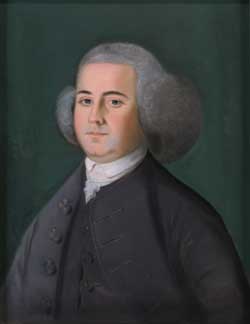
For instance, the Museum of Fine Arts in Houston owns this John Smibert portrait of Samuel Pemberton painted in 1734 when he was eleven years old. Not too young to shave his head and wear a wig, however. In 1770, Pemberton was on the committee with James Bowdoin and Dr. Joseph Warren to prepare Boston’s official report on the Boston Massacre.

The main thesis of my talk was that the Massachusetts Patriots, and Warren in particular, learned from that episode in 1770 that they could be scooped by royal officials if they didn’t send their version of events to London quickly. So after the Battle of Lexington and Concord in 1775, Dr. Warren and his Massachusetts Provincial Congress colleagues worked fast and commissioned the Derby brothers of Salem to speed their documents to London ahead of Gen. Thomas Gage’s dispatches.

In writing about that voyage in Reporting the Revolutionary War, I said that John Derby sailed with issues of the Salem Gazette dated 21 and 28 Apr 1775. I was relying on my notes on Robert S. Rantoul’s article in the Essex Institute Historical Collections for 1900, “The Cruise of the ‘Quero’.” As shown here, Rantoul wrote that Derby “had with him copies of the Salem Gazette for April 21st and 25th.” The Salem Gazette, like almost all colonial newspapers, was a weekly, so issue dates had to be seven days apart. I figured either Rantoul or I had made a mistake in our notes and “25th” should be “28th.”

Before my talk Todd Andrlik, chief author of Reporting the Revolutionary War, sent me an image from the 27-30 May 1775 London Chronicle showing a long quotation from the 25 April Essex Gazette, published up the coast from Salem in Newburyport. So that was one of the newspapers Derby had brought to convince people in London there really had been a battle. I should have corrected Rantoul not on the date but on the name of the paper: Derby sailed with the 21 April Salem Gazette and the 25 April Essex Gazette.