J. L. BELL is a Massachusetts writer who specializes in (among other things) the start of the American Revolution in and around Boston. He is particularly interested in the experiences of children in 1765-75. He has published scholarly papers and popular articles for both children and adults. He was consultant for an episode of History Detectives, and contributed to a display at Minute Man National Historic Park.

Subscribe thru Follow.it


•••••••••••••••••


Showing posts with label Ebenezer Learned. Show all posts

Tuesday, March 17, 2026

“This Convinced me that they were Actually fled”

Gen. John Sullivan of New Hampshire wrote this description of how experienced the end of the siege of Boston for John Adams:

We Saw the Ships under way about 8 in the morning and the River full of Boats with Armed Soldiers. This gave an Alarm as Some Suspected they were about to Land at Dochester but having a full view of them with a Glass from Plowed Hill I found they were going on board the Ships.

I then took my Horse and Rode Down to Charlestown Neck where I had a Clear view of Bunkers Hill. I Saw the Sentrys Standing as usual with their Firelocks Shouldered but finding they never moved I Soon Suspected what Regiment they belonged to and upon taking a Clear view with my Glass found they were only Effigies Set there by the flying Enemy. This Convinced me that they were Actually fled for if they meant to Decoy us they would have taken away Every appearance of Men.

By this time I was Joined by Colo. [Thomas] Mifflin who with my Brigade Major [Alexander Scammell] agreed to go up[;] Sending two persons Round the works to Examine whether there was any of them in the Rear of the works while we went up in the front. I at the Same time Sent for a Strong party to follow us on to the Hill to assist us in Running away (if necessary).

We found no persons there and bravely Took a fortress Defended by Lifeless Sentries. I then brought on the party to Secure what we had So bravely won and went Down to the other works where we found all Abandoned but the works not Injured in any part.

We hailed the ferry Boat which came over and Informed us that they had abandoned the Town. We then gave Information to the General who ordered me with the Troops under my Command to take possession of Charlestown and General [Israel] Putnam with 2000 men to take possession of the works in Boston
Samuel Hall’s New-England Chronicle for 21 March offered the public this account of the action at the other end of Boston on the Neck:
About the same time General [Artemas] Ward, attended by about 500 troops from Roxbury, under the command of Col. Ebenezer Learned, (who unbarr’d and opened the gates) entered the town on that quarter, Ensign [Samuel] Richards carrying the standard.

The command of the whole being then given to General Putnam, he proceeded to take possession of all the important posts, and thereby became possessed, in the name of the Thirteen United Colonies of North-America, of all the fortresses in that large and once populous and flourishing metropolis, which the flower of the British army, headed by an experienced General, and supported by a formidable fleet of men of war, had, but an hour before, evacuated in the most precipitate and cowardly manner.
That’s rubbing it in, don’t you think?

TOMORROW: Ens. Richards’s perspective.

Sunday, March 08, 2026

“He would take no notice of it”

On 8 Mar 1776, 250 years ago today, three Loyalists walked out of Boston under a flag of truce.

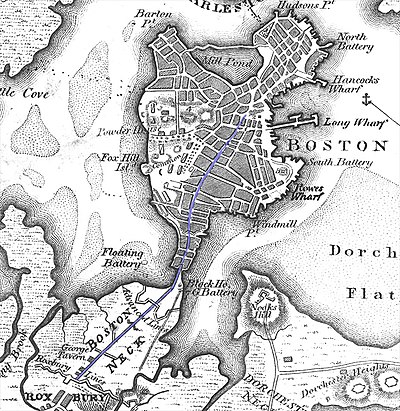
Peter Johonnot and the brothers Thomas and Jonathan Amory handed a letter to the Continental Army officer commanding at the bottom of the Neck, Col. Ebenezer Learned (1728–1801) of Oxford.

That letter was signed by four Boston selectmen, and I quoted it in full here, a mere eighteen years ago.

The gist of the message was that “Genl [William] Howe…has no intention of destroying the Town Unless the Troops under his command are molested during their Embarkation.” The British army was ready to leave.

However, that gist was coated in verbiage and layers of intermediaries: the three gentlemen who brought the message, the four selectmen, Lt. Gov. Thomas Oliver, Gen. James Robertson. It wasn’t a letter from Gen. Howe himself or anyone he’d designated as his representative.

The next day, Col. Learned wrote back from Roxbury to the three Loyalists:
Agreeably to a promise made to you at the Lines Yesterday I waited upon his Excellency Genl [George] Washington and presented to him the Paper (handed to me by you) from the Select Men of Boston.

The Answer I receiv’d from him was to this effect “That as it was an unauthenticated Paper; without an address and not obligatory upon General Howe he would take no notice of it”
As Washington noted, Gen. Howe had put no promise in writing. He had also avoided acknowledging any legitimacy to Washington’s claim to be a fellow general.

Nonetheless, the reply Learned sent back assured the Loyalists, and the British officials behind them, that Gen. Washington had read the message.

Indeed, even as the Continental commander-in-chief was officially taking no notice of the letter, his staff was making several copies of it, and he was conveying its contents to Gov. Jonathan Trumbull of Connecticut and the Continental Congress.

When I spoke in Acton last month, someone asked if Washington and Howe had made an agreement about letting the British depart. This exchange of letters that wasn’t officially an exchange was why I had to answer, “Yes and no.”

Sunday, June 20, 2010

“An Attack Was Expected” in Roxbury

Earlier this year I had a few ideas about that note from Lt. Col. Robert Carr that Richard Ketchum quoted in Decisive Day but couldn’t explain.

To start with, the only Capt. Farrington mentioned in British Officers Serving in the American Revolution, 1774-1783, is Capt. Anthony Farrington of the Royal Artillery (son of Maj. Charles Farrington of the same service). So he was the British officer whom Carr asked to dislodge some American field-pieces—with an artillery barrage rather than an infantry attack.

As for “Brownes House,” Enoch Brown’s tavern was a landmark on Boston Neck, sitting between the British fortifications and the provincial lines. Gen. John Burgoyne proposed a parley there to Gen. Charles Lee in July 1775, but the Americans burned it down. So could this note refer to something happening near there, on the other side of town from the Battle of Bunker Hill?

Throughout 17 June 1775, each commander worried that, while so much of his army was engaged in Charlestown, the enemy would open a second front by attacking across the Neck. That danger kept Gen. Artemas Ward at his Cambridge headquarters, monitoring news from both wings. Gen. Thomas Gage was probably in his official residence, the Province House, doing much the same. (More discussion of his location here.)

I therefore wondered if Lt. Col. Carr was the officer in charge of the fortifications on the Neck—the “lines”—and not with his regiment in Charlestown. The fact that he wrote to Gage and not to Gen. William Howe, the battlefield commander, strengthens that hypothesis.

But is there any evidence of the provincials advancing field pieces along the Neck, and the Royal Artillery trying to “make them remove,” as the note says? Indeed there is. Here’s an extract from the journal of Samuel Bixby of Sutton, Massachusetts, printed in volume 14 of the Massachusetts Historical Society Proceedings:

About noon we fired an alarm, & rung the bells in Roxbury; and every man was ordered to arms, as an attack was expected.

Col. [Ebenezer] Larned marched his Regt. up to the meeting house, & then to the burying yard, which was the alarm post, where we laid in ambush with two field pieces placed to give it to them unawares, should the regulars come.

About 6 o. c. [o’clock] the enemy drew in their sentries, & immediately a heavy fire was opened from the Fortification. The balls whistled over our heads, & through the houses, making the clap-boards and shingles fly in all directions.

Before the firing had begun, the Genl. [John Thomas] ordered some men down the street to fall some apple trees across the street, to hinder the approach of their Artillery.

Lieut [John] Hazeltine picked up a 12 lbs ball—we were anxious to get their balls as though they were gold balls.
If Carr was commanding on the Neck, the American field-pieces he wrote about weren’t any of the cannon left behind on the Bunker Hill battlefield, but the couple used as an ambush in the Roxbury burying-ground. There might still be a mystery in why Carr was separated from his regiment, and who was commanding those men back on the beach at Charlestown.

Bixby’s last line above is another example of Americans stationed in Roxbury “contending for cannon balls.” However, I still haven’t found an example of a man hurt by not waiting until a ball had stopped rolling to try to pick it up.

Sunday, March 09, 2008

Washington’s Reply to the Selectmen

On 9 Mar 1776, Capt. John Barker of his Majesty’s 4th Regiment of Foot recorded that the Continental Army had consolidated its position on Dorchester heights, and was building new artillery batteries even as the British authorities continued to prepare for evacuation:

The Rebels having been deserned carrying Materials for making a Battery to Foster’s hill [also called Nook’s hill] at Dorchester, the nearest of any to Boston; and at 8 o’clock in the evening it being reported they were at work there, our Batteries at the Blockhouse, the New Work at the Neck and...Wharf began to play upon them, and kept it up all night so as to prevent their Working: they likewise fired at the Town from their different Batteries at Roxbury.

All the Brass Artillery on board except a few small field pieces. Orders for all the sick Men and Wo[men to] be embarked before night.
On the same day, in his diary Timothy Newell wrote the eighteenth-century abbreviation for “ditto,” meaning he saw the same “hurry and commotion” as the day before, and described some property damage from the Continental barrage:
Do. Do. Do. Received answer from the lines from Colo. Learned commanding officer at Roxbury—Saturday evening 9 oclock, began cannonade, which continued the whole night—One 18 pound shot came thro’ our house, another thro’ the fence and summer house into the Garden, and several shot, thro’ my neighbour’s Houses.
On the 7th, Newell and three fellow selectmen had sent a letter “To the Commanding Officer at Roxbury,” describing their conversation with Gen. James Robertson, who in turn had spoken to Gen. William Howe, the overall British commander. Col. Ebenezer Learned replied to the gentlemen who had carried that letter out, Thomas and Jonathan Amory and Peter Johonnot:
Roxbury March 9th 1776.

Gentlemen, Agreeable to a promise made to you at the lines yesterday, I waited upon his Excellency General [George] Washington and presented to him the Paper handed to me by you from the select-men of Boston. The answer I received from him was to this effect—

That as it was an unauthenticated paper without an address and not obligatory upon Genl. Howe, he would take no notice of it.

I am with esteem and respect,
Gentn. your most humble servt.
Ebenezer Learned.
Though that reply might have seemed discouraging, the letter had probably accomplished its purpose. Washington and other American officers had read the report that Howe had “no intention of destroying the Town” if the inhabitants and besiegers didn’t try to harm his men as they left. The Continental commander-in-chief might stand on protocol and refuse the letter, but he now knew that his rival was leaving Boston and probably didn’t plan to burn it to the ground.

Even during the day’s artillery exchanges, some people saw signs of moderation as the siege came to an end. An anonymous British officer whose remarks were published in the Remembrancer in London wrote:
I have slept one night on board [a transport ship]; the troops are embarking as fast as possible. I mistook when I imagined the works already made could destroy the town; but the rebels possess a hill so situated, that if they pleased to erect a battery it would entirely consume us. They as yet have not proceeded to make a work, nor do they attempt to molest us in our embarkation. It appears as if there were at least a tacit agreement between Washington and General Howe.
Today’s image is “George Washington at Dorchester Heights,” painted by Jane Stuart (1812-1888) after a canvas by her father, Gilbert Stuart. His version is at the Museum of Fine Arts in Boston. Hers comes courtesy of the Maryland Historical Society.