J. L. BELL is a Massachusetts writer who specializes in (among other things) the start of the American Revolution in and around Boston. He is particularly interested in the experiences of children in 1765-75. He has published scholarly papers and popular articles for both children and adults. He was consultant for an episode of History Detectives, and contributed to a display at Minute Man National Historic Park.

Subscribe thru Follow.it


•••••••••••••••••


Showing posts with label militia. Show all posts

Thursday, August 06, 2026

Hopestill Capen from the Cornfields to the Jail

On 6 Aug 1776, 250 years ago today, authorities in Boston locked merchant Hopestill Capen (1731–1807) in jail for “aiding and abetting those called enemies to the Colonies.”

For decades Capen had run his dry goods business at the sign of the Cornfields in a building he owned, now known as the Union Oyster House. He served as a militia officer and held minor town offices.

Late in 1769 Capen took on Benjamin Thompson as an apprentice, but that arrangement didn’t last long. The merchant later reportedly told the teenager’s mother “he oftener found her son under the counter, with gimblets, knife, and saw, constructing some little machine, or looking over some book of science, than behind it, arranging the cloths or waiting upon customers.”

from 1771 until just before the war, one of Capen’s tenants in the building was the Whig printer Isaiah Thomas.

During that time, Capen had become known as a mild Loyalist. He signed the complimentary addresses to Gov. Thomas Hutchinson and Gen. Thomas Gage, and he joined the protest against the Solemn League and Covenant.

Capen chose not to evacuate with the British military in 1776, however. Unlike many Loyalists, he had deep family roots in Massachusetts, and all his property was there.

In April 1776 the Massachusetts House directed the Suffolk County justices and sheriff to detain and question dozens of individuals suspected of disloyalty. Capen was fifth on that list, showing his prominence in town.

But it wasn’t until the summer, after Massachusetts had declared independence from the Crown, that the Council ordered those authorities to lock Capen up. No one ever appears to have ever produced evidence of him “aiding and abetting” Crown forces, but he did refuse to pledge allegiance to the new state.

Capen presented himself as a conscientious objector, motivated by religion. In the 1760s he had joined Boston’s small Sandemanian sect, and he said that his faith required him to stay out of the war.

Some analysts have described the Sandemanians as pacifist because of statements like Capen’s. But he wasn’t opposed to military action in principle. He’d been an active member of the Ancient and Honorable Artillery Company as well as the colonial militia, and during the siege he became a sergeant in a Loyal Associated Volunteers under Capt. Adino Paddock.

Rather, the Sandemanian creed said believers should be loyal to the government in control on the grounds that it must be divinely ordained. With the war still going on, and thus divine will not yet clear, Capen insisted that he couldn’t promise his allegiance to the U.S. of A.

Monday, July 20, 2026

“At the French lines on Prospect Hill”

In 2019 Ric Detwiller published an excellent article at the Journal of the American Revolution about a Frenchman recruited as a provincial engineer early in the siege of Boston.

Though “Monsieur Dubuque” (Jean-Baptiste du Buq?) lasted only a short time before defecting to the British, he left behind a fortification near Prospect Hill labeled “French Redoubt” on Henry Pelham’s map of the siege, as shown in this posting.

In a comment to the Detwiller article, Les Haskell added a pertinent entry from the diary of his relative, Caleb Haskell, on 26 July 1775:

This morning our regiment was ordered out of the great Fort [on Prospect Hill] to man the French lines — where we are for the future to repair in an alarm. A grenadier, belonging to the enemy’s side when on sentry, quitted his post, came over to us and delivered himself a prisoner to our guards.
In addition, the Massachusetts archives has a return of Capt. Edward Crafts’s artillery company dated 12 Oct 1775 from the “French lines.”

While preparing yesterday’s talk on the Convention Army, the prisoners of war held at Prospect and Winter Hills in 1777–78, I spotted how the label “French lines” lasted past the siege of Boston.

In 1894 the Maine Historical Society published the “Military Journal of Col. Ichabod Goodwin,” an orderly book for a militia contingent detailed to help guard those prisoners. That document shows that the three main positions where the Continental forces posted guards included “french lines.”
The editor of this volume guessed that term “probably refers to Hessians, no French troops having been present.”

However, the German-speaking prisoners (actually Brunswickers) were housed on Winter Hill. Pelham’s map locates the “French Redoubt” much closer to Prospect Hill. And the transcript of the early 1778 inquiry into Col. David Henley’s treatment of the British prisoners shows Col. Jacob Gerrish speaking of “the guard at the French lines on Prospect Hill.”

Thus, nearly three years after “Monsieur Dubuque” slipped away from his job with the Americans, military men in New England still referred to the fortifications he oversaw as the “French lines.”

Friday, May 29, 2026

Meeting the Real Samuel McClellan

Yesterday’s post introduced Samuel McClellan (1730–1807) of Woodstock, Connecticut, the captain of a militia troop of horse in 1774.

McClellan was a shopkeeper and landowner in his small town. After the Revolutionary War he became a brigadier general in the state militia.

The McClellans remained locally important, and one of his great-grandsons was Gen. George B. McClellan of the Union Army and the 1864 Presidential race.

As often happens in that situation, Samuel McClellan’s descendants were influential enough to get their understanding of his role in the Revolution into local histories and biographical profiles when primary sources were hard to consult. For example, the 1902 National Cyclopedia of American Biography said:
On Oct. 13, 1773, he was commissioned captain of a fine troop of horse, raised in the towns of Pomfret, Woodstock, and Killingly, and led it Boston on receipt of the news of the battle of Lexington. He passed through the battle of Bunker hill uninjured, and in commemoration of that his wife planted three elm trees in front of residence, which attained great size and were standing when Gen. George B. McClellan visited Woodstock in 1884.
Ellen Douglas Larned’s History of Windham County, Connecticut: 1760–1880 says there were originally four elms.

The latest version of that lore is Samuel McClellan’s Wikipedia page, which as of this week says:
In 1775 Major Samuel McClellan led 184 men at the Battles of Lexington and Concord. He played a prominent role in the Battle of Bunker Hill, and after achieving the rank of lieutenant colonel in 1776, colonel in 1777, and brigadier general of the 5th Brigade in 1779, his regiment of the Connecticut Militia was stationed near New Jersey. McClellan was solicited by General George Washington to join the Continental Army and was offered a commission, but his domestic and business affairs compelled him to refuse.
That overstates the facts in multiple ways, starting with how McClellan wasn’t commissioned a major in the militia until October 1775.

News of the outbreak of war in Massachusetts didn’t reach Woodstock until 20 April, after the fighting was over, so there was no way men from that town were “at the Battles of Lexington and Concord.” Col. Israel Putnam was one of the first men from Connecticut to respond. On 21 April he wrote from Concord to say that the Massachusetts Provincial Congress hoped that Connecticut would send 6,000 men for “a standing Army.”

Putnam added as a postscript: “The Troops of Horse are not expected to come until further notice.” But Capt. McClellan had already led his 184 mounted men north into Massachusetts. That’s shown by Connecticut records of militia service, as tabulated here.

However, those same records also show that McClellan was paid for only eight days of service. Like most of his neighbors, he went home when it was clear the emergency had passed. Some men stayed or returned and enlisted in what became the New England army. McClellan didn’t.

There’s no evidence putting McClellan at the Battle of Bunker Hill or on the siege lines around Boston at the time. That undercuts the claim he “played a prominent role” in the battle, but it does explain how he remained “uninjured.”

Later in the war McClellan did mobilize with his militia regiment for short assignments in the Northern Department. He also served in the Connecticut assembly and as a commissary. In that last capacity his name comes up in Washington’s papers, but there’s no direct written solicitation from the commander for McClellan to join the Continental Army.

McClellan apparently left a fowling-piece, made by the Massachusetts gunsmith Joel White, equipped with a bayonet mount and bearing the initials “SMC.” That’s been displayed as a weapon from the Battle of Bunker Hill. McClellan may well have carried it during the Revolutionary War, but not at that fight.

Thursday, May 28, 2026

“Specimens of Indian Insult”

I’ve quoted a couple of accounts of mock battles on Boston Common during militia musters, as reported proudly in the local newspapers. On those occasions, half the local unit provided an enemy by portraying the French.

Here’s a report from the 12 May 1774 Norwich Packet, describing a different scenario in Woodstock, Connecticut, a town on the border with Massachusetts:
NORWICH, May, 12.

A Correspondent from Woodstock informs us, that on Monday the 2d. Inst. the Three Military Companies of that Town met upon the Parade, in the First Society, where they performed the Manual Exercise with a Spirit and Activity that did Honour to their Officers and themselves.

At Eleven o’Clock a Troop of Horse, under the Command of Capt. Samuel McClellan, came upon the Parade; which, for elegance of Dress, goodness of the Horses, and suitable Furniture, were judged, by the numerous Spectators present, to be inferior to no Troop in America.

At Three o’Clock the Foot and Troop feigned a Skirmish with each other, which they conducted with Propriety and Order: Suddenly a Company of Aborigines appeared, who made Captives of some of the Children present, and gave other Specimens of Indian Insult to the Foot and Horse: Their Depredations roused the New-England Spirit in the Troop, who, with seem Fury, attacked and drove them yelling off the Field, to the great Joy of the Spectators.

The good Order that was observed, not only by the Troop and Foot Companies, but also by the Spectators, was remarkable.----No Injury was sustained by any One present. The Day and Evening Entertainments, were concluded with strict Sobriety and Decency.

The Captain of the Troop gave an elegant Dinner to his Company and a Number of Gentlemen, as also did Capt. [Benjamin?] Lyon, and the Colonel of the Regiment honoured the Day with his Presence.
I’ve found this event mentioned in a local history but not quoted in full. It offers an example of what Philip J. Deloria called “playing Indian” in American culture. This moment was a few months after the Boston Tea Party, a few months before the Patriot press began to share fearful speculations that the Crown government might recruit Natives and French Canadians to attack resistant colonies.

Ironically, the town of Woodstock contains the site of Wabaquasset, a Native American “praying town” from the mid-1600s. That community was split and depopulated by the King Philip’s War. Englishmen from Roxbury then settled the land. The town’s seal now depicts Native and English men standing on either side of a heraldic shield.

Saturday, May 02, 2026

“Inspector of all Boats, Letters, Goods and Passes”

In the fall of 1777, as recounted yesterday, John Hill and his family were released from captivity in Boston as part of a prisoner exchange.

I haven’t been able to find more about that deal—who arranged it, what prisoners of the Crown went free, and so on. To the Hills, those details probably didn’t matter.

Soon John and Elizabeth Hill and John’s daughter were inside British-held New York City. Before the war, they had run an inn there. Had that building survived the fire of 1776? Was it awaiting their return?

Later, in describing his services to the Crown, Hill simply said that he joined a volunteer militia company commanded by David Mathews, the city mayor.

But his major service began, he said, in July 1779 when he “was appointed Inspector of the Ferry, at Brooklyne; near New York, a place of great Trust, and received 10 shillings New York Currency, per Day.”

The Royal Gazette announced that appointment on 14 August:
JAMES PATTISON, Esq; Commandant of the city of New-York and Major General of his Majesty’s Forces in North-America, has been pleased to appoint JOHN HILL, Inspector of all Boats, Letters, Goods and Passes, at Brooklyn-Ferry.
John’s brother Richard, another evacuee from Boston, held the same post, perhaps earlier. In May 1780, Richard broke his thigh bone and had to use crutches, but he appears to have continued in the job.

On 10 Nov 1779, John Hill’s daughter (unnamed) married “Lieut. Cunningham, of the Legion,” at Brooklyn. As I wrote before, this officer might have been Ralph Cunningham, killed the next year in South Carolina.

As ferry inspector, John Hill ran periodic notices in the newspapers announcing lost property. For example, on 11 Dec 1779 he put a notice in the Royal Gazette that he was holding “a Vellice with a Marque, marked Capt. Knight, 43d regiment, with some small articles.” That was presumably Henry Knight, by then major in the 45th.

Hill also sold Richard Speaight’s “Royal Bitter Tincture, for the Fever and Gue,” that franchise being arranged “For the conveniency of the Inhabitants of Long-Island.”

But Hill’s main job was to keep watch for deserters and spies.

TOMORROW: Counterespionage.

Friday, April 24, 2026

William Jackson in and out of the Boston Jail

One month after he’d decided to sail out of Boston with his goods, the brazier William Jackson was locked up in the town jail, suspected of stealing from his fellow merchants.

Cdre. John Manley had captured him on the Elizabeth. Crowds in Newburyport, Salem, and Boston had jeered him. The Massachusetts Council had ordered him into prison.

Bostonians already had some reasons to dislike Jackson. The great fire of 1760 started in his shop. He defied the non-importation movement in 1770, and on top of that he hosted Capt. Thomas Preston before the Massacre.

Then in 1774 Jackson signed the complimentary Addresses to Govs. Thomas Hutchinson and Thomas Gage. He stayed in town when war broke out. He joined the Associators, the Loyalist militia formed in Boston during the siege, though he tried to explain that away:
General [William] How…isued a Proclamation for the Inhabitants to Associate themselves and bear Arm’s in defence of the Town, being what I did not thing [think] was my duty I did not sing [sign],

sometime After he Isued another recommending to the Inhabitants to Associate themselves for preserving the peace and good Order of the Town by preventing any Riotous doings by the Soldier’s or other’s which I thought Incumbent with every good Citizen to comply
The Patriot government naturally looked askance at any “associators” who fell into its hands.

At the same time, William Jackson had some local support. Unlike Crean Brush and the other merchants locked up alongside him, Jackson had grown up in Boston. His mother Mary and older brother James still lived there. His shop sign, the Brazen Head, was a long-time landmark for locals and visitors.

The jailers had been ordered not to let Jackson have pen and paper, but he could ask his family for help. He stated, “after my Committment my brother wrote Mr [Joshua] Wentworth for my Baggage.”

More surprisingly, other members of Boston’s business community spoke up for him. I already quoted Isaac Smith, Sr.’s comment that he hadn’t really done anything bad. A few years back, Chris Hurley told me that Jackson garnered letters of support from selectmen John Scollay and Samuel Austin, printer John Gill, and other Patriots. (Among those names is John Peters, who could be the future husband of Phillis Wheatley.)

Later William Jackson would tell the Loyalists Commission that he was let out of jail after 126 days, or in August 1776. Some of his fellow prisoners would be locked up for much longer.

TOMORROW: Back to Cape Ann.

Friday, March 13, 2026

A Council of War in Roxbury

Early on the morning of 13 Mar 1776, 250 years ago today, Gen. Artemas Ward received a note from Stephen Moylan, muster-master general of the Continental Army, who was acting as an aide to George Washington, commander-in-chief.

Moylan wrote:
His Excellency the General, wants to Consult with you, General [John] Thomas, & General [Joseph] Spencer upon many matters & as he does not think it prudent at this time, that you all Should be So far as Cambridge from your posts, I have it in Comand to inform you that he will Call at your house or General Thomas’s this day at ten ôClock, where he will expect to meet you & them
I imagine a bit of a scramble that morning as the generals on the southern wing of the Continental siege lines prepared to receive their boss.

(It’s notable that Moylan didn’t mention Joseph Frye, a colonel ranked as a brigadier under Ward. The commander didn’t much like Frye. He had served in the summer of 1775, gone home when he didn’t get a Continental commission, and come back in February 1776. On 7 March, Gen. Washington told Joseph Reed that Frye “has not, and I doubt will not, do much Service to the cause—at present he keeps his Room, & talks learnedly of Emeticks Catharticks &ca. For my own part I see nothing but a declining life that matters him.”)

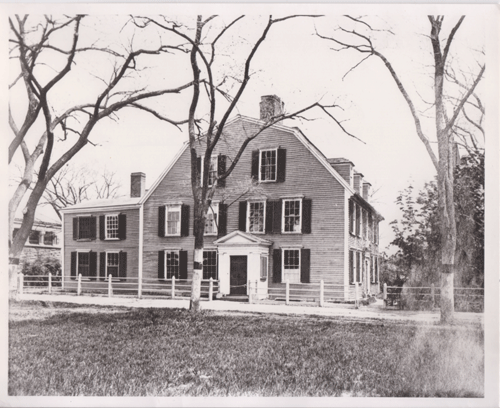
When Gen. Washington came to Roxbury, he brought Gens. Israel Putnam, William Heath, John Sullivan, Nathanael Greene, and Horatio Gates—all the generals present at the siege. They held a council of war in Ward’s headquarters. (The picture above shows that house in the mid-1800s after a lot of modification.)

The record of that council shows that Washington asked for advice on three questions:
  • Should he order part of the army to head to New York to guard that city in case the British military struck there next?
  • If the British evacuated Boston, should he leave part of the army there to guard the town?
  • If the British lingered in Boston, should he order the army to try fortifying Nook’s Hill, as they had on 9–10 March (with the loss of four men)?
The council of war concluded:
  • The rifle battalion should march immediately to New York, to be augmented by militia troops from that and neighboring colonies.
  • There would be no need to leave Continental troops in Boston since the Massachusetts militia could guard it.
  • If the British troops were still in Boston on 14 March, the army would go back onto Nook’s Hill.
Once again, the siege was over, and yet not over.

Thursday, March 12, 2026

“Without the leave of the Governor”

Earlier this month the Journal of the American Revolution ran an article by Ray Raphael about colonial Massachusetts’s constitution and how the royal government tried to curtail it.

Here’s a taste:
Of the four punitive acts passed in response to the Boston Tea Party, closing the port of Boston receives most attention in textbooks today—but at the time, with 95 percent of the colony’s population living outside Boston, it was “An Act for the Better Regulating the Government of the Province of the Massachusetts Bay”—known today as the Massachusetts Government Act—that sparked the people’s fury and led them to cast off British rule.

Under the 1691 Charter, “freeholders” could call a town meeting whenever they saw fit—but no longer: “Whereas a great abuse has been made of the power of calling such meetings, and the inhabitants have, contrary to the design of their institution, been misled to treat upon matters of the most general concern, and to pass many dangerous and unwarrantable resolves,” the 1774 act declared, “no meeting shall be called by the Selectmen, or at the request of any number of freeholders of any township, district, or precinct, without the leave of the Governor, or, in his absence, of the Lieutenant Governor, in writing, expressing the special business of the said meeting.”

Likewise, on the provincial level, power was wrested from the people. No longer would the incoming “general court or assembly” choose the Governor’s Council:
Whereas the said method of electing such counsellors or assistants. . . hath been so far from contributing to the attainment of the good ends and purposes thereby intended, and to the promoting of the internal welfare, peace, and good government of the said province, or to the maintenance of the just subordination to, and conformity with, the laws of Great Britain, . . . the said method of annually electing the counsellors or assistants . . . should no longer be suffered to continue . . .

Be it therefore enacted . . . that the council, or court of assistants, shall be composed of such of the inhabitants or proprietors of lands within the same as shall be thereunto nominated and appointed by his Majesty.
All other officers would also be appointed by the governor, who could remove them at will…
The voters of Massachusetts didn’t like to see Gov. Thomas Gage implement the new law. Soon they were protesting against it—and shutting down the colonial government to do so.
The next courts were scheduled for Springfield, shiretown of Hampshire County, two weeks later, on August 30—but some 1,500 citizens made sure they did not sit. One eyewitness, Joseph Clarke of Northampton, gave a vivid account: “The people of each town being drawn into separate companies marched with staves & musick . . . The trumpets sounding, drums beating, fifes playing and Colours flying, struck the passions of the soul into a proper tone, and inspired martial courage into each.”

The judges and justices of the peace offered no resistance to “the body of the county,” as Clarke called the men who marched with their town’s militia companies. When a committee asked them “whether they meant to hold their commissions and exercise their authority according to the new act of parliament for altering the constitution of the province,” they all said they would not.
One corrective for the article: The Boston Port Bill went into effect on 1 June 1774. The Massachusetts Government Act may have been drafted to start at the same time, but the final language said it took effect on 1 August. And then the text didn’t arrive in Salem until a few days after that.

In other words, it took only about two weeks from the start of the law for people in western Massachusetts to organize major protests and shut down a branch of the royal government. That’s how much people wanted to maintain their constitution.

Tuesday, February 24, 2026

“As ever the two Armies met”

Yesterday we left schoolteacher Jonathan Hastings, Jr., and the rest of Col. Thomas Gardner’s Cambridge militia contingent caught near the Lexington meetinghouse on 19 Apr 1775.

Lt. Col. Francis Smith’s expedition to Concord (which Hastings called “the Detachment”) was headed back their way from the west, harried by other militia companies.

Col. Hugh Percy’s reinforcement column (“the Brigade”) was approaching from the east. Percy had more soldiers. And he had cannon.

We return to Hastings’s 11 June letter, now in the Thomas Gage Papers:
We were commanded to retreat into a thick Grove of Oaks over a Meadow, up to our Knees in water, wch. saved us. The Brigade turned their Artillery immediately upon us.—Their Cannon Balls cut down the Branches of the Trees merrily but none of us were killed.

As ever the two Armies met, it being about 3 Quarters after one OClock, they begun a precepitate Retreat for Bunkers Hill in Charlestown under the Protection of the navy. There were not above 400 that attacked them, being 1850 at once that day. Lord Peircy put the Cannon in Front, himself in the Centre, & the Marines were formed in the Rear. The Grenadiers & Marines were nobly peppered. Peircy had a Ball shot thro’ the Bosom of his shirt.

Two Officers were treppaned in the Red House leading to Charlestown. Quarters were offered them, they refused, replying their Orders were neither to give nor take any Favour. They met Death bravely.—

It is easier for you to imagine, than for me to describe the Horrid Barbarity & savage Cruelty of the British Troops in their Retreat. Houses plundered & burnt, wounded Men begging for mercy, had Bayonets struck into their Heads, & the Piece discharged, Women in Child Bed commanded into the Streets with a Gun at their Breasts, Old Men unarmed thrust thro’ their Bodies. Harmless young Fellows shot dead, such was the horrid Scene.

But on our side no such Vestiges of Cruelty were seen or exercised on any who chose to live: the wounded taken the utmost Care of, & when exchanged for our Men who were taken Prisoners, & have been treated most inhumanly: they cryed like Children to tarry among us.—
Of course, the redcoats had their own tales of atrocities by the enemy, starting with the “scalping” at Concord’s North Bridge.

I can think of one example of a woman who had recently given birth ordered out of her house (Hannah Adams of Menotomy) and one of a young teenager shot when he peeked out a window (Edward Barber of Charlestown). But Hastings’s letter rendered those examples as plural. And I’m not sure what he referred to with the bayonets.

Likewise, Hastings’s numbers of the troops engaged—400 militiamen chasing off 1,850 regulars—are skewed to make his side look good. Many groups of 400 provincials attacked the British column in turn. The Massachusetts force had a clear advantage in numbers.

Hastings wrote of emergency surgeries in “the Red House leading to Charlestown” as if his correspondent knew that location. Indeed, there appears to have been a brick house fitting that description. I haven’t been able to identify who owned or lived there, but sources do refer to its appearance and location.

On 12 May the Massachusetts committee of safety mentioned “the red house at the head of the creek near the road from Cambridge to Charlestown.” Soon provincials built the “Red House Fort,” more commonly called Fort No. 3, to guard a nearby crossroads, as shown in the detail of Henry Pelham’s map above. Today the site is just south of Union Square in Somerville.

TOMORROW: Finishing the letter.

Monday, February 23, 2026

“At length we have had the Commencement of Hostilities begun”

Here’s an account of the start of the Revolutionary War that I don’t believe has been published before.

It’s a letter dated 11 June 1775 from Jonathan Hastings, Jr. (1751–1831), son of the steward of Harvard College, to a friend named Jacob.

Hastings graduated from Harvard in 1768 and a few years later become one of Cambridge’s school teachers. He was living in his father’s house beside the common, shown here. On 8 June, three days before writing this letter, the young man took the job of town postmaster.

Ironically, his letter appears to have been intercepted by the Crown forces because it’s filed among Gov. Thomas Gage’s papers at the Clements Library. The library offers scans and an imperfect transcription.

Hastings wrote:
Your Brother’s Letter of 18th. May we received the 9 of June. Notwithstanding my many Avocations (our House being made Head Quarters) I cannot miss an Opportunity of sending you a Letter. Am happy you had so safe a Passage & found your Friends well.

At length we have had the Commencement of Hostilities begun by Gage’s Troops, at the Battle of Lexington, where 8 of our Men were killed, there being about 50 assembled on a Green.—

The Evening preceeding the 19 of April, I was met by 11 Officers equipt with Pistols & Cutlasses; when I got Home I acquainted several Gentlemen therewith; but they thought it was like to prove nothing but a false Alarm. They were mistaken. About 2 OClock the next Morning, we were roused out of Bed to pursue 1100 Grendadiers & Light Infantry being a Detachment from all the Regiments in Boston.—

They made their way to our Magazines at Concord, but affected nothing more than destroying 80 Barrels Flour, knocking of [sic] the Ears of 3 twenty four pounders & burning the Carriages. A Quantity of Bullets they threw into a pond, but have been got out since.

Coll. [Thomas] Gardner ordered our Regiment to parade at Watertown, not knowing but that Gage’s Reinforcement would take that Course. He was mistataken [sic], they marched thro’ Cambridge, wch. being known our Regiment took the nearest Way to meet the Detachment. Unluckily for us we had no sooner placed ourselves in an advantageous Post near Lexington Meeting House to give Battle to the Detachment, than we perceived the Brigade in the other Side of us. Our Situation was bad, being between both Armies.
Well, that seems like an exciting place to break, doesn’t it?

TOMORROW: Under fire.

Sunday, February 01, 2026

Getting Warmer on the Origin of a Warming Pan

At Historic New England, Erica Lome, curator of collections, shared a behind-the-scenes essay about a warming pan with a Revolutionary heritage of sorts:
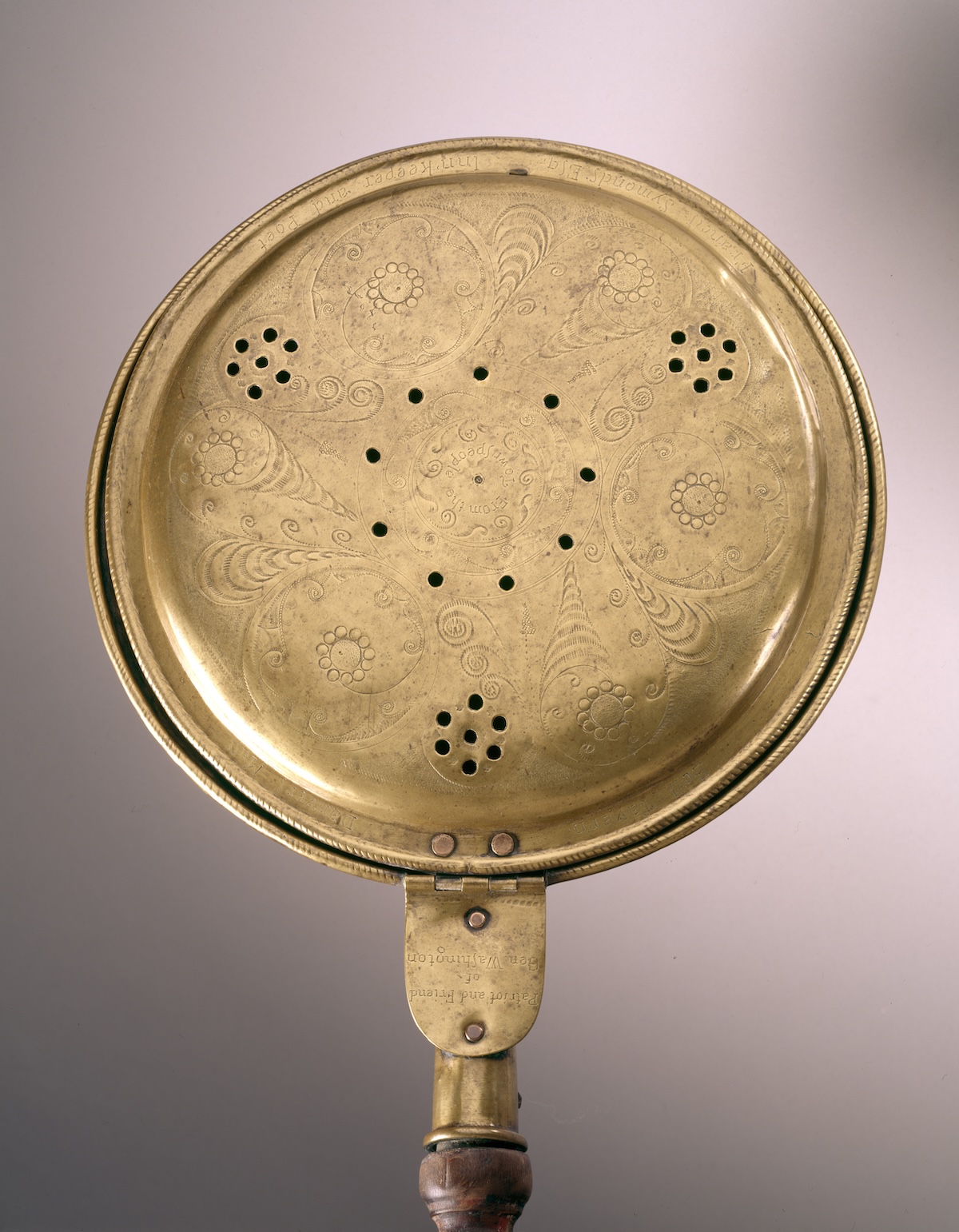
Tucked away in the parlor at Historic New England’s Cogswell’s Grant in Essex, Massachusetts, is a warming pan with a turned wooden handle and a brass container pierced with holes and engraved with scrolling vines and flowerheads. Also referred to as bed warmers, warming pans were a common household tool in colonial and post-revolutionary America, filled with embers and placed under the sheets of a bed to warm it before use.

This particular warming pan had more than just decorative motifs adorning its metallic surface. Engraved on its lid are the words:
From the Townspeople / Patriot and Friend of Gen. Washington / Bell Tavern, Danvers, Massachusetts / Francis Symonds Esq. Innkeeper and Poet.
On the pan’s sides, inside the incised outline of a bell:
I’ll toll you / if you have need / and feed you well / and bid you speed.
On the other side:
Francis Symonds / makes and sells / the best of chocolate / also shells.
John Warner Barber’s Historical Collections (1839) recorded that those verses hung on signs outside the Bell Tavern. In 1841 the Boston Cultivator stated that innkeeper Symonds’s “poetic genius caused [those lines] to be inscribed”; as Lome notes, he was known for adding bits of rhyme to his advertisements. (The Cultivator changed “also shells” to “and shells,” which scans better if you put three syllables into “chocolate.”)

The essay continues:
By its history, as recorded by Nina Fletcher Little, the warming pan was presented to Symonds around 1785: “After the war’s close, the citizens of Danvers evidently wished to present Symonds with a token of their esteem and decided on a warming pan as a practical gift.” The engraved inscription inside the bell matched the Bell Tavern’s signpost. The additional inscription praised Symonds as a patriot, friend of George Washington, and a poet, truly a prominent citizen and worthy of appreciation.

When researching this object for [the upcoming exhibit] Myth and Memory, one major detail of Symonds’s life challenged its story: Francis Symonds died on September 22, 1775. According to the Essex Gazette:
“On the 22nd Instant died at Danvers and on the 24th was very decently interred, Mr. Francis Symonds, Innholder, in the 5th Year of his Age. He was very just in his Dealings, and compassionate to the Poor as far as lay in his Power. In his last Sickness, especially towards the Close of Life, his Calmness and Resignation were very remarkable. He has left a sorrowful Widow and 6 Children, for whom we wish that the fame Compassion that he has shown to others may be shown to them.” . . .
Francis Symonds mustered for two days with Colonel [Timothy] Pickering’s regiment during the Battle of Lexington and Concord, and again on April 24, 1775, serving for a little over three months, until August 1, 1775. He was at home when he died of illness.

So, what about the warming pan? It seems very unlikely that the town of Danvers presented it to him on his deathbed, nor to his family immediately after, given the ongoing Siege of Boston. What is its true history?
Lome doesn’t offer a definite conclusion, but I like her hypothesis that the words were inscribed during a commemoration of the Revolution, such as Danvers’s dedication of a memorial obelisk near the Bell Tavern in 1835. Or later, when warming pans themselves were becoming relics of a quaint past. 

Tuesday, December 30, 2025

“Everything he can to build a standing army that he can use domestically”

Earlier this month, Prof. Noah Shusterman, author of Armed Citizens: From Ancient Rome to the Second Amendment, shared an essay through H.N.N. titled “Deploying Federal Troops to U.S. Cities Is a Second Amendment Issue.”

Here’s a taste:
The Second Amendment was meant to prevent events like the Boston Massacre… The amendment was meant to prevent the government from turning its military into an occupying force, as the British were doing when they began stationing troops in Boston. It is also what our current president is trying to do when he sends federal troops into Los Angeles. Or Portland. Or Chicago. Or, eventually, New York and Boston.

The courts have been treating those deployments as Tenth Amendment issues, or as potential violations of the 1878 Posse Comitatus Act, but back when the Bill of Rights was written, the domestic deployment of federal troops was the Second Amendment issue. And if the courts understood that, we would be in much less of a mess right now. In 2025, the amendment might be about privately owned guns, but when the Bill of Rights was ratified in 1791, it was about the military — specifically, the threat that a nation’s military could pose to its own people, as it had in Boston during the 1770s, when the British government began stationing troops there. . . .

In the years immediately following independence, neither the state militias’ shortcomings on the battlefield during the Revolution, nor the Continental Army’s successes, made Americans any less wary of peacetime standing armies. Leaders of the founding generation still believed that because a professional soldier relied on his job for his livelihood, his allegiance was to his commander, not his nation. (The current commander-in-chief recently endorsed this view, albeit unknowingly, when he told an audience of military leaders that “if you don’t like what I’m saying, you can leave the room. Of course, there goes your rank, there goes your future.”) . . .

In Second Amendment terms, this president is doing everything he can to build a standing army that he can use domestically against his own population. If the Second Amendment’s self-proclaimed supporters both inside and outside the courts appreciated the significance of these policies, and how contrary they are to the amendment’s original goals, the nation might be in a better place right now. In deploying federal police and military units as an occupying force, the president is doing precisely what the amendment was meant to prevent.
I write this from Washington, D.C., where the President has summoned over 2,600 National Guard troops from multiple states. While traveling to libraries, I see small groups of young people in uniform pulled away from their homes and jobs to stand around in subway stations and parks. Courts have disagreed about the constitutionality of that order and others, with the President getting even more deference than usual in the federal district.

The President claims this authority based on laws speaking of “invasion” and “rebellion,” neither of which applies, and he also claims he’s acting against “crime.” This same President is a convicted criminal who pardoned about 1,600 people for attacking the U.S. Capitol on his behalf in January 2021.

Saturday, December 27, 2025

“This letter betrays the state of the poor Colonel’s mind”

engraved portrait of Israel PutnamOne of the key nodes in the spread of the “Powder Alarm” was Israel Putnam. On 3 Sept 1774 he summoned the militia in eastern Connecticut and sent urgent messages to other parts of the colony.

On 6 September one of those messages arrived at the First Continental Congress. Robert Treat Paine recorded that from Putnam’s letter “we were informed that the Soldiers had fired on the People and Town at Boston.”

In fact, British soldiers had done no such thing. That became clear over the next few days.

Whigs spun the false alarm into a Good Thing, saying it showed how the populace was united and ready to defend Boston in an actual military emergency. “It is surprising and must give great satisfaction to every well-wisher to the liberties of his country, to see the spirit and readiness of the people to fly to the relief of their distressed brethren,” said an item in the 9 September Connecticut Gazette.

But other newspaper writers were more critical. Most of the front page of Hugh Gaine’s New-York Gazette on 19 September was filled with an open letter “To the Inhabitants of North-America” from “A New-York Freeholder” that said in part:

Col. PUTNAM’s famous letter, (forwarded by special messengers to New-York and Philadelphia) and the consequences it produced, are very recent and fresh in our memories. He informs Capt. [Aaron] Cleaveland [of Canterbury]---
“That the men of war and troops had fired on Boston—that the artillery played all night—that six were filled at the first shot, and a number wounded—that the people were universally rallying from Boston as far as Pomfret in Connecticut—and he begs the captain would rally all the forces he could, and march immediately for the relief of Boston.”
The evident confusion of ideas in this letter betrays the state of the poor Colonel’s mind, whilst writing it, and shews he did not then possess that calm fortitude which is so necessary to insure success in military enterprizes. . . .

What the design of this infamous report was—whether to inflame the other colonies, and to learn how they would act on such an emergency if real, or to influence the deliberations of our congress now sitting, I shall not taken upon me to determine.

One thing it has eventually made evident past all doubt, that many in the New-England colonies are disposed and ripe for the most violent measures: For it is certain that some thousands of armed men, in consequence of it, proceeded on their march from Connecticut towards Boston. . . .

These circumstances are mentioned with no other view than to shew that the apprenhension of a civil war is justly founded; and it is no more than justice to say that I think Col. PUTNAM himself was deceived when he wrote the above letter, tho’ still he acted imprudently in writing it. The authors of the report are to me unknown.
The “New-York Freeholder” went on to write about the horrors of a civil war, closing with Tobias Smollett’s poem “The Tears of Scotland,” composed after the Jacobite uprising of 1745. That would have annoyed the New England Whigs, not just because they were telling people that a firm, unified militia response would help stave off civil war but also because they hated being equated with Jacobites.

TOMORROW: How Putnam responded.

Friday, December 26, 2025

“The Powder Alarm” in Essex, Connecticut, on 4 Jan.

I’ll start off the Sestercentennial year with a talk in the America 250 Winter Lecture Series of the historical society in Essex, Connecticut.

My topic on the afternoon of Sunday, 4 Jan 2026, will be “The Powder Alarm: The Breakdown of Royal Rule in New England, September 1774.”

Here’s our event description:
Before dawn on September 1, 1774, the royal governor of Massachusetts ordered some of the colony’s gunpowder moved into army-occupied Boston. That action put thousands of militiamen on the march. As rumors spread, they grew more dire. People in Connecticut heard that the king’s army and navy had attacked Boston. In Milford, a 13-year-old boy went to bed fearing he would “be dead or a captive before to-morrow morning.” But the real result of this event, dubbed the “Powder Alarm” by later historians, was that almost all of New England was free of royal rule—almost two years before the Declaration of Independence.
I’ve spoken about the “Powder Alarm” before, and this time I’ll emphasize Connecticut’s experience through figures like Israel Putnam, Silas Deane, and Joseph Plumb Martin.

Here’s an account of the colony’s reaction from the 8 Sept 1774 Massachusetts Spy:
By letters from Connecticut, and by several credible gentlemen arrived from thence, we are informed that there were not less than 40,000 men, in motion, and under arms, on their way to Boston, on Saturday, Sunday, and Monday last [3–5 September], having heard a false report that the troops had fired upon Boston, and killed several of the inhabitants: Twelve hundred arrived at Hartford from Farmington, and other places forty miles beyond Hartford, on Sunday last, on their way to this place, so rapidly did the news fly. But being informed by expresses that it was a false report, they returned home, declaring themselves ready at a minute’s warning to arm again, and fight for their country, and distressed brethren of Boston.
That report from printer Isaiah Thomas was no doubt exaggerated. In 1774 Connecticut’s total population was just under 200,000. More than half of those people were under the age of sixteen, and half the adults were women, so “no less than 40,000 men” would be virtually the entire adult male population.

Nonetheless, it’s clear the alarm was widespread, reflecting the urgency that people had come to feel about what was happening in Massachusetts. Several other newspaper articles about the “Powder Alarm” also included the phrase “a minute’s warning,” popularizing it just as citizens were discussing how to improve their militia system.

This talk is scheduled to run from 3:30 to 4:30 P.M. in Hamilton Hall at Essex Meadows, 30 Bokum Road in Essex, Connecticut. It’s free and open to the public. The society asks people to register through this page. Doors will open at 3 P.M., and seating will be on a first-come, first-served basis.

(The modern town of Essex appears on the map above as “Putty Pogue” on the Connecticut River.)

Monday, November 24, 2025

The Laboratory beside Boston Common

As described in The Road to Concord, Boston’s South Writing School shared a fenced-in yard with the militia train’s newer gunhouse.

In September 1774, the two small brass cannon stored in that gunhouse disappeared, even as British regulars stood guard at its door.

Frustrated Royal Artillery men hauled away the rest of the train’s equipment. Then came the outbreak of war, the siege, the evacuation. And Boston had it gunhouse back.

Except it didn’t have the train’s guns anymore. The town meeting sent a committee of Thomas Crafts, Paul Revere, and Thomas Marshall to ask Gen. George Washington for those brass cannon, but they were already on their way to the New York theater.

The state military establishment scrounged up more cannon, mostly old iron guns abandoned by the British military. But those weapons were in demand, needed to arm ships and guard the harbors. Leaving them in a building beside the Common didn’t make sense.

What do you do with a gunhouse that has no guns to house? We can see the answer in a report in the 15 Aug 1776 New England Chronicle about how the town celebrated the eleventh anniversary of the first Stamp Act protest: “a Detachment of the Train of Artillery, with two Field Pieces, marched from the Laboratory into King-Street.” 

The gunhouse was turned into a “Laboratory” or workshop for making weapons, especially artillery equipment. On 3 December the Massachusetts House formally discussed how “to have a laboratory established,” but even before its committee finished its work the 27 Jan 1777 Boston Gazette was telling readers to find Col. Thomas Crafts “at the Laboratory” if they wanted to store their gunpowder.

Crafts had been second-in-command of the train before the war. He’d tried for the rank of artillery colonel in the Continental Army in late 1775 but was rebuffed. Massachusetts then made him colonel of its own artillery regiment, and that job included overseeing the Castle and “the Laboratory on the Common.”

The man running that workshop was William Burbeck (1715–1785, represented above by his gravestone on Copp’s Hill). He had been storekeeper of ordnance at Castle William until the war broke out, then slipped away to become lieutenant-colonel and second-in-command of the Continental artillery regiment under Col. Richard Gridley.

At the end of the siege of Boston, Burbeck informed Gen. Washington that his commission came from Massachusetts, not the Continental Congress. He would therefore stay in Massachusetts, not heading down to New York (or serving further under Col. Henry Knox, thirty-five years his junior).

Burbeck immediately went to work improving Massachusetts’s military supplies. By 18 Apr 1776, the Massachusetts General Court discussed how to supply him “with Powder, wherewith, to prove the Cannon lately Cast for the Use of the Colony.” A year later, he was chosen as the Continental agent to inspect gunpowder.

In the spring of 1778 the state legislature approved regulations for the laboratory in Boston, and that October it unanimously chose Burbeck to be “Comptroller of the Laboratory.” 

A year later, the legislature appointed Burbeck captain-lieutenant of the Castle (under John Hancock as captain of the castle, who was soon more busy as governor). Burbeck remained comptroller of the laboratory, but in early 1782 the General Court determined that work had “greatly decreased,” so it adjusted his pay accordingly while still making him responsible for the facility.

These days we might raise questions about having a weapons workshop, possibly used for testing gunpowder, right next to a school. But the people of newly independent Boston didn’t see a problem. What could go wrong?

TOMORROW: Fire!

Sunday, November 23, 2025

Back to the Scene of the Crime

A significant portion of The Road to Concord focuses on one spot in Boston: the corner of West Street and Tremont Street. There, across from the Common, stood the South Writing School and the newer gunhouse of the militia train of artillery.

(Now that space is occupied by a Suffolk University dormitory, a Sal’s Pizza, and a Blue Bikes rack.)

In September 1774, as I wrote in the book, the artillery company dissolved amid political recriminations. Soon their four small brass cannon disappeared, two from that corner.

In April 1775, war broke out, in some immediate sense because of those cannon, and all of Boston’s public schools shut down.

The following March, the British military left Boston. Patriot authorities gained control. After tending to the most dire problems, the selectmen looked ahead to a new school year, which would ordinarily begin in July.

In June the selectmen ordered the South Writing School to reopen. However, Master Samuel Holbrook was still out of town. So were a lot of families—Boston’s population was only a fraction of what it had been.

The selectmen therefore said that James Carter, the master of the Queen Street Writing School, would fill in for Master Holbrook. In effect, I think, that was consolidating the two schools for at least a few months until enough pupils returned to justify reopening both schoolhouses.

In October 1777 the town looked into repairing the South Writing School, possibly from damage during the siege. Two months later, Master Holbrook asked for an assistant, to be paid £34 plus £16 “on Accot. of the rise of Provisions”—i.e., the price of food had inflated. 

Ordinarily a schoolmaster had an adult assistant called an “usher,” paid about half of the master’s salary. Holbrook asking for an “assistant” with a smaller salary suggests that he was seeking to hire a teenager, as he had employed Andrew Cunningham in 1774–75. Perhaps he had in mind his own son Abiah, then fourteen years old.

We can see the effects of inflation in how the town meeting voted to pay Holbrook over the next few years:
  • March 1778: £100 salary plus £100 “on Account of the present high Price of Provisions &c.” in the next six months.
  • November 1778: £140 more to cover the remaining six months of the year.
  • March 1779: a town committee recommended £600 for Holbrook himself plus £100 for his usher and £30 house rent. The meeting approved even more: £640 for the master, £300 for the usher.
  • November 1779: and another supplemental grant, £1,500 for September through March.
Master Holbrook’s usher arriving in October 1778 was named Abiah Holbrook. The master’s son would still have been too young to command that title and salary. But Holbrook also had a nephew named Abiah Holbrook. A man of that name advertised a school in Portsmouth, New Hampshire, from 1775 to 1777. So perhaps that man moved to Boston to work for his uncle, taking the place of his young cousin. Running writing schools was a family business; Master Holbrook had started out working as usher under his own brother—named, of course, Abiah.

Thus, as the 1770s ended, the South Writing School was back in operation under Master Samuel Holbrook, just as it had been at the start of the decade. But it was costing a lot more to operate, at least in inflated wartime currency.

TOMORROW: Changes at the gunhouse.

Tuesday, November 18, 2025

Considering Thomas Crafts the Coroner

As recounted yesterday, two documents at the Boston Public Library establish that one of the coroners holding inquiries after the Boston Massacre was Thomas Crafts.

Does that evidence restore that milestone in my mental narrative of Thomas Crafts, Jr.’s rise from a member of the Loyall Nine to artillery colonel and judge in the new republic?

Unfortunately not. Because, as the name implies, Thomas Crafts, Jr., wasn’t the only Thomas Crafts in Boston in 1770.

Thomas Crafts, Sr. (1706–1789), was a housewright of standing. He had moved into Boston from Roxbury and joined the First Baptist Meeting. He and his wife Anne had seven children between 1729 and 1752. Starting in 1745 he held town offices like surveyor of boards, fence viewer, and warden. In 1766 he got the contract to frame the new town jail.

In contrast to his father, Thomas Crafts, Jr. (1740–1799), was a decorative painter. At the time of the Massacre, he was still only twenty-nine years old. He married Frances Pinkney Gore in 1763, and they had two children by 1770. Thomas, Jr., was a member of the St. Andrew’s Lodge of Freemasons and an officer in the militia artillery company. He was on his way up. But he wasn’t yet a respected elder.

Back here I noted that The Massachusetts Civil List for the Colonial and Provincial Periods, 1630-1774 didn’t list any Thomas Crafts among the Boston coroners in the third quarter of the eighteenth century. But that book did list Thomas Crofts, who could be our man. (The Crafts family genealogy notes Craft and Crofts as alternate spellings used in the 1600s.)

If Gov. Francis Bernard appointed Thomas Crofts/Crafts as a coroner in 1761, that definitely wasn’t Thomas, Jr., since he was barely legal at the time. But Thomas, Sr., was then fifty-five years old, the sort of weighty neighbor whom people would trust as a coroner.

Did Crafts the coroner fill out the verdict forms himself? If so, then we could compare his handwriting and the signature on the fifth line to other documents by the two Craftses.

Until such additional evidence arises, I’ll make my best guess based on the social evidence and say that Thomas Crafts the coroner of 1770 was the housewright father, in his mid-sixties with experience in several town offices. He was an example to his sons, but Thomas, Jr., hadn’t yet achieved the same political stature.

TOMORROW: Examining the coroners’ examinations.

Saturday, November 01, 2025

Revolutionary Music Coming out of the North End

Our favorite Revolutionary sites in the North End are concatenating again with two musical events coming up early this month.

Wednesday, 5 November, 7 to 8:30 P.M.
Music-Making in Colonial Boston
Laura Zoll
Online from Old North Illuminated

Colonial Boston was home to a rich soundscape of music that helped define the lives of early New Englanders. Music-making set the tone and tempo of militia, home hospitality, tavern frivolity, and community singing circles. This talk will explore questions like:
  • What did music sound like during the colonial era?
  • Who played it?
  • What sort of instruments were played?
  • How did music reflect contemporary culture and beliefs?
Laura Zoll is a musicologist with degrees in Music Theory and Medieval Musicology. She plays numerous modern and historic instruments.

Register for the link to this event with a donation of any amount.

Thursday, 13 November, 7 to 8:30 P.M.
A Revolutionary Concert: Paul Revere, the Man, the Myth, and the Music
Regie Gibson and Ensemble
Converse Hall, 88 Tremont Street

Join the Paul Revere Memorial Association, Massachusetts Poet Laureate Regie Gibson, and Paul Revere for an engaging and immersive free program to commemorate the 250th anniversary of the Midnight Ride. From the loyalist anthems of the Tories to the fiery songs of the Revolutionaries and original 19th-century compositions written to further Revere’s legacy, this program brings 18th- and 19th-century America to life through the music of the times. The evening will include performances by some of Boston’s finest musicians.

Blending rich narration, historical images, and live music, this program offers a fresh, moving, and insightful take on one of the Revolution’s most misunderstood heroes. Far more than just a messenger on horseback, Paul Revere was a devoted family man, a savvy businessman, and a respected civil servant. This special evening promises to be a powerful journey through sound and story, separating fact from folklore while painting a vivid portrait of one of America’s most iconic patriots.

This concert is free, but please register for a seat here.

Friday, October 31, 2025

“Sparking the Revolution” conference in Springfield, 20–21 Nov.

On 20–21 November the Springfield Armory will co-host the 2025 Fall Conference of the Firearms Research Center, on the topic of “Sparking the Revolution: Flintlocks, Gunpowder, and Policy in America’s War for Independence.”

The Firearms Research Center is based at the University of Wyoming law school. It states its mission as “to foster a broad discourse and produce meaningful change in how firearms are discussed and understood.”

The conference will open the afternoon of Thursday, 20 November, with a reception and fireside chat on the theme “Exercising the Bruen Test: A Study in the Modern-Day Debate on the Second Amendment.”

“Examining Revolutionary-era topics through the lens of today’s constitutional debates” will be Firearms Research Center director George Mocsary, Megan Walsh of the Gun Violence Prevention Law Clinic at the University of Minnesota, and moderator Ashley Hlebinsky, the center’s executive director.

The “Bruen test” is the outcome of a 2022 U.S. Supreme Court decision that stated the constitutionality of gun restrictions must be “consistent with the Nation’s historical tradition of firearm regulation.” Since there isn’t a consistent, unchanging, and non-discriminatory tradition of firearm regulation, judges have struggled to understand and apply that test. The Brennan Center for Justice says it’s unworkable. In a follow-up case this year, United States v. Rahimi, the nine Supreme Court justices issued seven opinions to tweak the Bruen language.

That opening session is scheduled to take place at the Springfield Armory National Historic Site. As a National Park Service unit, that’s currently closed because of the lapse in Congressional funding with almost all the employees furloughed. I suppose that location may change before 20 November.

On Friday, 21 November, the conference will move across the street to Springfield Technical Community College’s Scibelli Hall. That day’s program will include these parts.

Panel 1: Disarmament and the Revolution
  • Bob Cottrol, George Washington University
  • E. Gregory Wallace, Campbell University
  • James Slaughter, Marshall University
Guns of the American Revolution
Erik Goldstein, Colonial Williamsburg

The Earliest Days of Springfield Armory
Alex Mackenzie, Springfield Armory

Panel 2: The Colonial Militia
  • Jody Madeira, Indiana University
  • Joyce Malcolm, George Mason University
  • Alexander Cain, Author, We Stood Our Ground
Creating an Arsenal of Liberty
Andrew Fagal, Princeton University

Early Ballistics of the American Revolution
Joel Bohy, Antiques Roadshow

Find the full schedule here. Anyone can register to attend all of the sessions for free either in person or virtually.

Thursday, July 31, 2025

“General Folsom proposes also to retire”

On 30 June 1775, Gen. Artemas Ward received word of his new commission as major general in the new Continental Army.

Ward immediately wrote back to John Hancock, chair of the Continental Congress, accepting the post. He also warned that “the Appointments in this Colony [Massachusetts]” might “create Uneasiness.”

They did, along with those for Connecticut generals, as I wrote last month.

And what about Nathaniel Folsom, who’d just solidified his authority over the New Hampshire colonels at the siege? His letter dated 1 July indicates no one had told him about the Continental Congress’s commissions yet.

As I’ve stated, the New Hampshire Provincial Congress had named Folsom as the colony’s general officer in April, and then reaffirmed that choice in May.

Yet New Hampshire’s delegates to the Continental Congress apparently didn’t pass on that news. Nor did those men, John Sullivan and John Langdon, suggest that the senior New Hampshire officer already at the siege, John Stark, be made a brigadier general.

Instead, they apparently looked around and told their colleagues in Philadelphia that the very best choice of a general from New Hampshire was…John Sullivan.

Sullivan (shown above, nominally) didn’t have any military experience from the last war, unlike Folsom, Stark, and the next two colonels, Enoch Poor and James Reed. He was younger than all those men. But Sullivan was in Philadelphia, and he was enthusiastic. So on 22 June he got the nod.

Gen. George Washington left Philadelphia the next day and arrived in Cambridge on 2 July, carrying commissions for his subordinates. His first general orders, issued the next morning, acknowledged the presence of “General Falsam.” But the conversations were probably awkward.

Sullivan arrived in Massachusetts a week later. So far as I know, there are no documents preserving his interactions with Folsom and the colonels.

On 20 July, Washington told Hancock and the Congress that “General Folsom proposes also to retire.” The older man returned to New Hampshire. On 24 August, its provincial congress “Voted That Nathaniel Folsom; Esqr. be the General Officer over the Militia in this Colony.” So he got to keep the rank of general.

Folsom remained active in New Hampshire politics, and he also served a second stint in the Continental Congress from 1777 to 1780. He presided over his state’s constitutional convention in 1783. And then, because that constitution forbade plural office-holding, he resigned his post as militia general in favor of being chief judge of his county.

Nathaniel Folsom exercised unchallenged command of New Hampshire’s army from 24 June to 3 July 1775, or a little over a week. He oversaw New Hampshire’s wartime militia for eight years.