J. L. BELL is a Massachusetts writer who specializes in (among other things) the start of the American Revolution in and around Boston. He is particularly interested in the experiences of children in 1765-75. He has published scholarly papers and popular articles for both children and adults. He was consultant for an episode of History Detectives, and contributed to a display at Minute Man National Historic Park.

Subscribe thru Follow.it


•••••••••••••••••


Showing posts with label Robert Auchmuty. Show all posts

Monday, May 16, 2022

Rhode Island and the Royal Commission of Inquiry

Yesterday I pointed to the upcoming sestercentennial of the attack on H.M.S. Gaspee, a Royal Navy ship patrolling Narragansett Bay for smugglers.

Some of Rhode Island‘s leading merchants were involved in some way in destroying that ship, including the Browns, the Greenes, Abraham Whipple, and the notorious Simeon Potter.

The organized attackers wounded a British military officer, Lt. William Dudingston, and destroyed a British warship. Some authors, especially from Rhode Island, view it as a prelude or even the first battle of the Revolutionary War. But as I wrote yesterday, it seems significant that this event, for all its bellicosity, didn’t lead to a broader crackdown and war.

One big reason is that the Crown had far less leverage in Rhode Island. That colony was one of only two in North America (the other being Connecticut) where citizens elected their governor via the legislature. In the other colonies, London chose the governor, and usually he arrived with no local allegiances or favors owed.

Furthermore, the Rhode Island legislature chose judges for each year. Elsewhere, the royal government appointed judges for life. And elsewhere those appointed royal governors also appointed sheriffs and justices of the peace.

Rhode Island’s unusual charter left the Crown with only two groups of officials who owed their position and thus their full allegiance to London: the Customs service and the Royal Navy. And of course those arms of government had limited local popularity, as shown by the fact that Rhode Islanders had just burned a naval schooner enforcing the Customs laws.

To investigate the attack, therefore, Lord North’s government set up a Royal Commission of Inquiry. The five officials appointed to it were:
The first four men were already strong Loyalists. Wanton wasn’t yet in that camp, and he was also the only man with local knowledge. When Adm. John Montagu used testimony from an indentured servant named Aaron Briggs to demand an investigation of John Brown, Simeon Potter, and others, Wanton responded by collecting evidence that undercut what Briggs said. The commission’s investigation led nowhere.

Royal authorities in Massachusetts and London learned from the frustrations of the Gaspee inquiry and put those lessons into practice after the next big attack—the Boston Tea Party of December 1773. They didn’t wait for local authorities, even the more numerous and powerful Crown appointees, to identify individual malefactors. Instead, Parliament adopted the Boston Port Bill to pressure the whole town, installed a more forceful governor, sent in troops, and eventually tried to rewrite the provincial constitution.

Thus, for the Crown the main lesson of the Gaspee affair was what not to do.

Friday, April 23, 2021

Dots on the Ensign’s Map

Yesterday I started to discuss a hand-drawn map from the Library of Congress that Ed Redmond has identified as likely coming from British army spy Ens. Henry DeBeniere weeks before the march to Concord.

That map marks several individual homes. Some of those are places where DeBerniere and his fellow scout, Capt. William Brown, visited on their two treks into the Massachusetts countryside in early 1775.

Others aren’t mentioned in the officers’ report but were the estates of Loyalists, and therefore potential safe houses or places for troops to camp.

Here’s a list of all those marked properties:

“Hatch’s”: Nathaniel Hatch of Dorchester, Loyalist.

“Davis’s”: This site is a bit of a mystery. My best guess is that this is Dr. Jonathan Davies, who bought half of the old Auchmuty estate in the 1750s. Unlike almost all the other homeowners named on the map, Davies wasn’t a Loyalist. Another possibility is that this is the house of Aaron Davis, which ended up on the front lines of the siege.

“Auchmuty’s”: Robert Auchmuty of Roxbury, attorney and Vice Admiralty Court judge, Loyalist.

“Hollowel’s”: Benjamin Hallowell, Jr., in Jamaica Plain, Commissioner of Customs.

“Comm. Loring”: Joshua Loring, Sr., in Jamaica Plain, Loyalist. His mansion remains as the Loring-Greenough House.

“Mr. Fanuil”: Benjamin Faneuil, merchant, Loyalist.

“Mr. Greenleaf”: I’m guessing this home was managed by Sheriff Stephen Greenleaf, who normally lived in Boston. In 1765 his daughter Hannah married John Apthorp, who inherited his father’s Little Cambridge mansion. John and Hannah Apthorp sailed to Charleston, South Carolina, for his health in late 1772, but their ship was lost at sea. Sheriff Greenleaf became the guardian for their young children, and thus probably the custodian of the Apthorp property. Sheriff Greenleaf was seen as a stalwart of the royal government before the war, but he remained in Boston after the siege.

“Brewers”: Jonathan Brewer’s tavern on the Watertown-Waltham line. Unlike the other people named on the map, Brewer was a Whig, as DeBerniere wrote in his report. But the officers did make a memorable stop there, so it was worth mapping.

“Major Goldthwaits”: Joseph Goldthwait of Weston, Loyalist.

“Colonl: Jone’s”: Isaac Jones of Weston, a Loyalist before the war and a supporter of the Continental Army during it. Brown and DeBerniere used his Golden Ball Tavern as a base, and it’s still standing.

“Doctor Russell”: Dr. Charles Russell of Lincoln, Loyalist. His house survives in altered form as the Codman House.

“Nineteen Mile Tavern”: This establishment appears to be in Sudbury, but I haven’t found any mention of such a place. The most famous surviving tavern in Sudbury is the Wayside Inn, but this appears to have been closer to the center of town.

TOMORROW: The map’s proposition.

Tuesday, December 01, 2020

Violence Beyond King Street on the Fifth of March

By modern standards, the judges overseeing the trial of the soldiers for the Boston Massacre should have limited the testimony to what happened in King Street or specifically involved the defendants.

However, prosecutors Robert Treat Paine and Samuel Quincy wanted to call witnesses to violence and threats from other soldiers that night. Or as acting governor Thomas Hutchinson later wrote: “The Counsel for the Crown urged to be admitted to prove the threats &ct. of the Soldiers preceding the Action.”

The judges were dubious, but defense attorneys John Adams and Josiah Quincy, Jr., were agreeable as long as they had the same leeway to introduce testimony about violence and threats by civilians.

That tactic actually split the defense team, again according to Hutchinson. Robert Auchmuty, senior attorney for Capt. Thomas Preston and a strong advocate for the Crown in other respects, didn’t like letting people testify about aggressive soldiers, but he wasn’t arguing this case.

Adams himself reportedly didn’t want to put too much testimony about aggressive townspeople on record. Hutchinson stated:
Quincy one of the Counsel for the prisoners was for giving very large Evidence against the Inhabitants to prove a premeditated design to drive out the Soldiers & frequent abuse as well as threats Adams was against it & [Sampson Salter] Blowers who acted as an Attony to prepare the Evidence told me that Adams said if they would go on with such Witnesses who only served to set the Town in a bad light he would leave the cause & not say a word more. So that a stop was put & many witnesses were not brought who otherwise would have been.
Some supporters of the Crown even feared Adams was sabotaging the soldiers’ case, but Hutchinson declined to replace him “as it would have been extremely irregular” and Auchmuty wasn’t ready to step in.

As a result, we have records from the trial of confrontations elsewhere in town that night. For instance, Sgt. William Davis of the 14th Regiment described running into a crowd he estimated as about 200 people near Wentworth’s wharf:
I saw no soldier in the street; I heard them saying damn the dogs knock them down, we will knock down the first officer, or bloody backed rascal we shall meet this night; some of them then said they would go to the southward, and join some of their friends there, and attack the damned scoundrels, and drive them out of the town, for they had no business here.

Apprehending danger if I should be in my regimentals, I went into a house at the North end and changed my dress, and in my return from the North-end, about nine, coming near Dock square, I heard a great noise a whistling and rattling of wood; I came near the Market place, and saw a great number of people there, knocking against the posts, and tearing up the stalls, saying damn the lobsters, where are they now; I heard several voices, some said let us kill that damned scoundrel of a Sentry, and then attack the Main guard; some said, let us go to Smith’s barracks [also called Murray’s barracks], others said let us go to the rope-walks;

they divided: The largest number went up Royal-exchange-lane, and another party up Fitch’s alley, and the rest through the main street, up Cornhill. I passed by the Golden-Ball, I saw no person there but a woman, persuading a man to stay at home; he said he would not, he would go amongst them, if he lost his life by it. . . .

It was past nine, for I heard bells ring before. One of them was loading his piece by Oliver’s dock, he said he would do for some of these scoundrels that night.
John Cox, brick-layer, testified to a different scene in the South End:
I saw three soldiers, two belonging to the Neck, and one to the Main Guard, by Liberty-tree, I was at Mr. [John] Gore [Jr.]’s shop opposite the Tree; one said to the other, bring half your guard, and we will bring half ours, and we will blow up this damned pole; I said, so sure as you offer ye scoundrels to blow up that pole, you will have your brains blown out.
Soldiers in New York had blown up the Liberty Pole there a few weeks earlier, prompting bigger fights.

Gregory Townshend, merchant:
Just after the bell rung nine, hearing the bell ring again, I went out thinking it was fire; I saw numbers of people running from the South-end some had buckets, the principal number had clubs in their hands. I asked where is the fire, I received for answer, at the Rope-walks and in King street. Numbers were coming with buckets, and the rest said Damn your bloods do not bring buckets, bring clubs.
Henry Bass, another merchant—and a member of the Loyall Nine:
I went down the main-street, and coming near Boylston’s alley, I saw a number of boys and children from twelve to fifteen years old, betwixt Mr. [William?] Jackson’s and the alley; some of them had walking canes. A number of soldiers, I think four, sallied out of the alley. . . .

I took the soldiers for grenadiers, all of them had cutlasses drawn. . . . They came out of the alley, and I imagine from the barracks; they fell on these boys, and every body else that came in their way, they struck them; they followed me and almost over took me, I had the advantage of them and run as far as Col. [Joseph] Jackson’s, there I made a stand, they came down as far as the stone shop. . . .

these lads came down, some of them came to the Market square, one got a stave, others pieces of pine, they were very small, I do not know whether any of the lads were cut. I turned and then saw an oyster-man, who said to me, damn it here is what I have got by going up; (showing his shoulder wounded) I put my finger into the wound and blooded it very much.
Each legal team thus tried to portray the other side as needlessly aggressive and their own clients as responding with reasonable force. Of course, that was the problem in the first place.

Tuesday, November 03, 2020

“Complete victory obtaind over the knaves & foolish villains of Boston”

On 31 Oct 1770, the day after he was acquitted of murder, Capt. Thomas Preston wrote a letter from Castle William to Gen. Thomas Gage in New York.

Soon after being arrested, Preston had written a letter to Edes and Gill’s Boston Gazette praising “the Inhabitants in general of this Town” for being fair-minded.

But then it turned out he had sent to London a long description of how poorly Bostonians had treated the king’s soldiers since 1768 and how violent the crowd at the Boston Massacre had been.

In his post-trial letter, Capt. Preston made clear that the essay was a more accurate reflection of his feelings. He told Gage:
I take the liberty of wishing you joy, of the complete victory obtaind over the knaves & foolish villains of Boston, the triumph is almost complete, & the Kings servants now appear with double lusture. . . . on Tuesday morn the 30th, the Jury brought in a verdict in my favour Not Guilty, to the entire satisfaction of every honest mind, & great mortification of every blood thirsty & malicious Bostonian.

The Counsel for the Crown or rather the town [Robert Treat Paine and Samuel Quincy] were but poor and managd badly, my Counsel on the contrary were men of parts, & exerted themselves with great spirit & cleverness, particularly Judge [Robert] Auchmuty; The Judges also were determind & showd much firmness, but none more than Judge [Peter] Oliver, he informd the Court that he had been abusd in some prints, & his life threatened, but that nothing should daunt him, or prevent his doing his duty.

’Twas provd, that a Sentrys post is his Castle, & whosoever attacks him does an illegal action, & if the Sentry should kill him there can be no redress; If a party is sent by their Commanding Officer to his relief, they are a body legally assembled, & if assaulted may defend themselves even to the death of their opponents, that if any of them does an illegal action, he alone is answerable for it, whereas they who attack them are illegally assembled, and the whole accountable for each ones actions. These were points of law & right they had no notion of, & seemd much confounded at, so that the like tis probable will never happen again in this or any other part of America.
In fact, the same issues were to be argued again when eight enlisted men of the 29th Regiment went on trial for the Massacre.

The rest of the 29th Regiment had moved on to New Jersey months before, leaving behind Preston and that handful of soldiers caught up in Massachusetts’s legal system. That put the captain in the position of managing and paying for the defense of the soldiers. Preston told his commander:
The mens tryals will come on about three weeks hence, when if the Judges are but steady, my verdict will determine for them; I have prepair’d every thing for their defence, & shall continue to do so ’tho I find it very expensive, but in such a Case as this & so material to the Military, I thought a saving on a Lawyers fee very impolitick.
Just a few weeks before, some of those soldiers had objected to being tried separately from the captain, worried that by claiming he gave no order to fire he would pin all the blame on them. Preston had indeed succeeded in that claim, but in this letter he emphasized the argument that none of the soldiers had done anything wrong, either.

It’s notable that Preston praised Auchmuty in particular and didn’t name his other lawyers, John Adams and Josiah Quincy, Jr., who appear to have done more of the courtroom questioning. Auchmuty was a friend of the royal government, close to Lt. Gov. Thomas Hutchinson and seeking advancement within the imperial bureaucracy. (His title “Judge” came from the Vice Admiralty court.) Preston understood he could help Auchmuty by praising him to higher-ups. Adams and Quincy were on another path.

Preston also had a favor to ask from Gen. Gage for himself:
If then Sir I have not entirely exhausted your regards, let me once more entreat your favouring my cause & broken fortunes, by a letter of your approbation of my conduct to some of the Ministry. If I should be luckey enough to get any thing it will be entirely owing to you, whose kindness has already exceeded that of my nearest relations. Should you grant me this, I must then beg you will add one favour more to the many preceding, & that is, words to express my gratitude, for at present I am totally at a loss on that account, however you may rest assurd that my heart is truly grateful & that I am with the utmost truth & sincerity.
Playing the eighteenth-century patronage game could get a bit fulsome.

Friday, October 30, 2020

In the Spy 250 Years Ago

On 30 Oct 1770, 250 years ago today, John Adams turned thirty-five years old.

Two years later, he wrote in his diary: “Thirty Seven Years, more than half the Life of Man, are run out.—What an Atom, an Animalcule I am!-The Remainder of my Days I shall rather decline, in Sense, Spirit, and Activity.” Was Adams in the same mood when he hit exactly half of threescore years and ten? We don’t know because, darn it, he wasn’t keeping his diary in late 1770.

Also on 30 October, printer Isaiah Thomas put out the first issue of the Massachusetts Spy in his own name. Back in August, he’d started publishing the newspaper with his old master, Zechariah Fowle, but evidently that man wanted out. (The preceding issues had no printers’ names attached, so the transition might have been gradual.)

Thomas was still publishing at the unusual pace of two pages on three days of the week. With the next issues he would switch to two days a week, Mondays and Thursdays, thus going head to head with all of Boston’s established papers.

But on this Tuesday, 30 October, the Massachusetts Spy was the only new newspaper to appear, and Thomas thus had an exclusive on that morning’s big news from the courthouse:

John Adams, Josiah Quincy, and Robert Auchmuty had gotten their client off on the charge of murder.

Thursday, October 29, 2020

The Case for Capt. Preston

On 25 Oct 1770, Capt. Thomas Preston’s attorneys began to make the case for his acquittal for murder after the Boston Massacre.

The defense team consisted of three men. Robert Auchmuty was a senior attorney allied with Lt. Gov. Thomas Hutchinson’s adminstration. John Adams appears to have called the first witnesses and started questioning them. The youngest team member, Josiah Quincy, Jr. (shown here), worked in a subordinate role, also posing questions.

The first defense witness was William Jackson, proprietor of the Brazen Head hardware store. His mother, Mary Jackson, had rented a room to Capt. Preston, and he testified about how soldiers had come to fetch the officer because of fighting on the street.

The defense called two more witnesses on 25 October, eighteen the next day, and one or two the day after that, in addition to the owner of an enslaved witness to testify to his veracity. (The prosecutors also called back one of their witnesses for brief testimony.) Among the eyewitnesses were:
  • Benjamin Davis, who lived directly across from the Customs house.
  • Richard Palmes, a hot-headed apothecary who said that at the first musket shot “I had then my hand on the Captains shoulder.” Then, in swinging his cane at a soldier poking at him with a bayonet, Palmes said, he accidentally hit Preston on his arm.
  • Andrew a Negro Servant” (i.e., slave) owned by the merchant Oliver Wendell.
  • “Jack Negro Servant to Doctr. [James] Lloyd.”
  • Jane Whitehouse, who married a solder between the shooting and her testimony.
  • Newton Prince, a free black man who later settled in London as a Loyalist.
  • Capt. James Gifford and Capt. Brabazon O’Hara of the 14th Regiment.
  • Hat merchant Thomas Handysyd Peck.
  • Harrison Gray, Jr., son of the provincial treasurer.
  • Lt. Gov. Hutchinson himself, reporting what he had found on the scene when summoned after the shooting and what little he could recall of his conversation with Preston.
None of these defense witnesses described hearing Preston give an order to fire. Some were certain he didn’t. (Palmes suggested he might have, but he was close enough to be touching the captain and heard nothing.) While some prosecution witnesses said Capt. Preston had ordered the soldiers to load their guns, one defense witness said that Cpl. William Wemms had made that call.

The main value of all this testimony was in building a picture of an angry crowd, verging on violence, and of confusion in the crush around the soldiers. Preston’s attorneys were laying the blame for the deaths on the mob or the soldiers, but not the captain. (The soldiers were afraid that would happen.)

There was also conflict within the defense team. According to Hutchinson, Adams and Quincy had “a difference in opinion…of the necessity of entring into the examination of the Conduct of the Towns people previous to the Action itself.” Was it necessary to portray the Boston crowd as habitually violent in order to get Preston off?

The Rev. William Gordon’s history of the Revolution later described the interaction this way:
Mr. Quincy pushes the examination and cross-examination of the witnesses to such an extent, that Mr. Adams, in order to check it, is obliged to tell him, that if he will not desist, he shall decline having anything further to do in the cause. The captain and his friends are alarmed, and consult about engaging another counsellor; but Mr. Adams has no intention of abandoning his client. He is sensible that there is sufficient evidence to obtain a favorable verdict from an impartial jury; and only feels for the honor of the town, which he apprehends will suffer yet more, if the witnesses are examined too closely and particularly…
Hutchinson likewise saw Adams as protecting Boston’s reputation: “he being a Representative of the Town and a great Partisan wishes to blacken the people as little as may be consistent with his Duty to his Clients.”

Adams himself responded to the passage in Gordon’s book by stating, “His Clients lives were hazarded by Quincy’s too youthful ardour.” It’s not clear what Adams had in mind here. Did he fear that Quincy would make the Suffolk County jury so resentful they’d vote to convict, or that he’d rouse the crowd outside against Preston?

The defense counsels rested their case on Saturday, 27 October. Under the custom of the time, they then made their closing arguments to the jury—first Adams, then Auchmuty. With darkness falling, the court adjourned for the Sabbath.

On Monday, 29 October, Robert Treat Paine summed up the prosecution case. Then Judge Edmund Trowbridge analyzed both the evidence and the law at length, followed by each of the three more senior judges. It wasn’t until 5:00 P.M. that the jurors retired to deliberate—all night if they had to.

TOMORROW: The first verdict.

Monday, November 04, 2019

“An assault, on the Body of the said George Gailer”

George Gailer, the first victim of tarring and feathering in Boston, was an ordinary sailor. He was therefore not the type of person who typically left letters, journals, newspaper essays, or other writings.

However, we do have Gailer’s perspective on that assault through a lawsuit he filed three months later in January 1770.

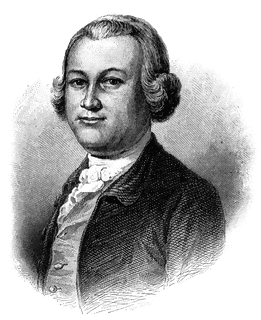
The sailor’s attorney was Robert Auchmuty (c.1722-1788, shown here as a young man, courtesy of Amherst College), who also had Crown appointments. Since Auchmuty was probably beyond Gailer’s price range, I suspect the Customs office helped pay his fees.

John Adams represented one of the defendants, the Boston tailor David Bradlee. Adams also copied Auchmuty’s initial filing into his “Pleadings Book,” just in case he needed to file a similar motion for another client. We’re lucky he did so because the original court file has been lost.

Gailer’s warrant said:
Attach &c. Eleazar Trevett Junior and Benjamin Trevett, Merchants, Daniel Vaun Mariner, all of Newport in the County of Newport and Colony of Rhode Island and Providence Plantation, and David Bradley, Pool Spear, Taylors, and David Provence Infant and Edward Mathews Mariner all of Boston in our County of Suffolk.

To answer unto George Gailer of Boston aforesaid Mariner, in a Plea of Trespass, for that the said Eleazar Trevett Jnr., Benjamin Trevet, Daniel Vaun, David Bradley, Pool Spear, David Provence, and Edward Mathews, at said Boston in the Evening of the twenty Eighth Day of October last, together with diverse other Persons to the said George Gailer unknown, with Force and Arms, an assault, on the Body of the said George Gailer did make, and then and there with Force as aforesaid did strip the said George Gailer naked, tar and feather his Skin, and carry the said George Gailer naked, tarred and feathered, as aforesaid in a Cart about said Boston for the space of Three Hours, and with Clubbs, Staves, and a hand saw did then and there strike him the said George Gailer, sundry heavy and grievous Blows, upon the said George Gailers naked Body, and greatly bruise, and wound him and hit him the said George Gailer diverse grievous Blows, with Stones:

By Reason of all which the said George Gailers Life was put into great Hazard and Danger, and greatly despaired of, and many other Enormities, and Cruelties, the said Eleazer Trevett Jnr., Benja. Trevett, Daniel Vaun, David Bradley, Pool Spear, David Provence, and Edward Mathews, with others unknown to the said George Gailer did then and there commit, on the said George Galer, against the Peace of our Lord the King and to the Damage &c. £2000.
This description of the assault differed in some details from what was in the newspapers. The warrant said the crowd “did strip the said George Gailer naked.” However, the Boston Post-Boy said “his Cloaths except his Breeches [were] pulled or torn off,” and other papers agreed. So this is an example of the period usage of “naked” not being stark naked.

On the other hand, the warrant described more violence than the newspapers, saying the crowd hit Gailer “with Clubbs, Staves, and a hand saw” and “Stones.” The press, particularly the Whig press, might have suppressed those blows, or decided they were few and exceptional and didn’t deserve mention. It’s also possible Gailer and Auchmuty pumped up those details because they were fighting a perception that a tar-and-feathering wasn’t a real assault. Yet that “hand saw” doesn’t seem like the sort of detail one could make up.

According to The Adams Legal Papers, Gailer’s case was initially “decided in the defendants’ favor on demurrer,” meaning the defendants didn’t address the truth of the allegation but argued that those actions weren’t enough to justify a legal judgment. Adams received 19s.4d. from Bradlee. Auchmuty filed an appeal in March 1770. None of the parties appeared when the case came up in the August 1771 term, and the case was dropped. I’ve never come across any other mention of George Gailer.

TOMORROW: An eyewitness account from a soldier.

Thursday, April 11, 2019

The “Hutchinson Letters” Published at Last

I’ve been tracing the maneuvers in 1773 around the “Hutchinson letters.” Benjamin Franklin sent those documents to the speaker of the Massachusetts house under conditions of secrecy. The Massachusetts Whigs nibbled away at the edges of that promise until in June they just decided to publish.

Edes and Gill issued the letters about Massachusetts in pamphlet form. (Their first edition omitted the letters from others about Connecticut and Rhode Island.) Isaiah Thomas’s Massachusetts Spy reprinted them all over the following weeks. Here is a British reprinting of the letters, plus a defense of them and an attack on Franklin for divulging them.

In order of publication, those documents were:
  • Lt. Gov. Thomas Hutchinson, 18 June 1768, on the Liberty seizure and riot.
  • Hutchinson, August 1768, on protests against the Customs Commissioners.
  • Hutchinson, 4 Oct 1768, on unrest and the landing of the regiments.
  • Robert Auchmuty to Hutchinson, 14 Sept 1768, warning about a death threat (enclosed with the above).
  • Hutchinson, 10 Dec 1768, on actions of the Massachusetts Council.
  • Hutchinson, 20 Jan 1769, on Parliament’s relationship to Massachusetts. (This is the letter that stated, “There must be an abridgment of what are called English liberties.”)
  • Hutchinson, 26 Oct 1769, on the non-importation boycott and Gov. Francis Bernard’s departure.
  • Secretary Andrew Oliver (shown above), 7 May 1767, on the problems of an elected Council, his salary, and other matters.
  • Oliver, 11 May 1768, on protests against the lieutenant governor and Customs Commissioners.
  • Oliver, 13 Feb 1769, with ideas for changing the Council to be independent of the lower house.
  • Oliver, 12 Aug 1769 from New York on colonial business, non-importation, and his appointment.
  • Customs Commissioner Charles Paxton, 20 June 1768 from H.M.S. Romney, on the Liberty riot. (Very short.)
  • Nathaniel Rogers (Hutchinson’s nephew), 12 Dec 1768, seeking Oliver’s position if Hutchinson moved up to become governor and Oliver moved up to become lieutenant governor.
As Hutchinson pointed out after the publication, his letters never proposed new laws or changes to the Massachusetts charter. (Oliver mused on such possibilities, and the letters from Rhode Island and Connecticut were open about change.) Hutchinson’s phrase “an abridgment of what are called English liberties” came after a lament about the distance between North America and London; in his mind, it was a statement of regrettable fact, not a prescription.

Neither Hutchinson nor Oliver suggested sending troops into Boston to keep order. As Hutchinson noted, his report on the Liberty riot couldn’t have reached London until the ministry already had those plans under weigh.

Finally, Hutchinson pointed out that in the year before these letters leaked, he had engaged in a public debate with the Massachusetts house about the relationship between the elected colonial government and the royal authorities, making the same points he had made in his letters. So how could he have engaged in a secret conspiracy?

Nonetheless, the letters destroyed Hutchinson’s credibility and political career in Massachusetts.

TOMORROW: What was wrong with the letters.

Sunday, January 21, 2018

“At my trial for caning Gill”

In April 1768 John Mein went on trial for assaulting rival printer John Gill. In fact, he faced two trials—in criminal and civil court.

On 19 April the local magistrates cited Mein for criminal assault and fined him 40 shillings, or £2. Not a huge amount, but a judgment that he had disturbed the peace of Boston.

At the same time, Gill sued Mein for £200 in damages. John Adams represented Gill. The case was tried on 28 April, and the 2 May Boston Post-Boy reported the verdict:

after a long Hearing the Jury found a Verdict in favour of the former [Gill], for one Hundred and thirty Pounds Lawful Money Damages, and Costs of Court. From which Judgment we hear both Parties appealed to the next Superiour Court. 
I’m skipping further ahead of the Sestercentennial anniversaries to finish this story. The appealed case came up in the March 1769 session of Massachusetts’s highest court. Benjamin Kent and Robert Auchmuty were Mein’s attorneys. On Gill’s side, Adams was joined by James Otis, Jr.

Kent was a Whig with many Loyalist relatives; though he stayed in Massachusetts through the Revolutionary War, in 1785 he went to spend his last years with them in Nova Scotia. Auchmuty was one of Boston’s leading attorneys supporting the royal government. Otis and Adams were of course active opponents of that government.

The John Adams Papers contain his notes from the trial, but those don’t provide a useful summary, with disconnected phrases like “Kick upon the A—se” and “Distinction between Bump and Tumour.”

The facts of the assault don’t seem to have been in doubt, or even the question of whether Mein was in the wrong. Rather, the question was how much was he in the wrong. Had he planned the attack for days? Had the Gazette provoked Mein, so Gill was partially at fault? How big was the stick, and how big was Gill?

In the end, the jury found for Gill but awarded him £75 and costs—a smaller award than before, but still a “Large Sum,” as Harbottle Dorr wrote. At some point Mein wrote that his decision to cane Edes or Gill had “cost me about £100 St[erling].” He filed for a new trial but later withdrew that motion. By November 1769 Mein had worse to worry about.

Mein later wrote, “Otis at my trial for caning Gill, bandied about this Liberty of the Press as the Salvation of America, and said, that in beating him I had endeavoured to shutt up that great Source of freedom.” Seeing Otis in court must have particularly irked Mein because he was convinced that “Americus,” the anonymous newspaper writer who had called him disloyal and set off the whole affair, was Otis himself.

Wednesday, March 11, 2009

Questions on a Silver Mug

Yet another news story with Revolutionary roots appeared in last Sunday’s Boston Globe, this time in the arts news. As Linda Matchan reported, officials in the Massachusetts Treasurer’s office found a mug made in the early eighteen century by Boston silversmith Andrew Tyler in an abandoned safe-deposit box. The Museum of Fine Arts has now acquired the item from the heir of the couple who had rented that box.

The article states:

The mug, it appears, was made by Tyler sometime in the early to mid-1700s for a highly-placed local judge named Robert Auchmuty Jr., famous for being one of the defense attorneys during the Boston Massacre, with co-counsel John Adams.

For reasons unknown, Auchmuty relinquished it. “He had to leave Boston in a hurry because he was a loyalist; he got the boot,” said Harris. “It’s possible the mug went from his family to mine when he had to leave. It might have been a fire sale situation.”

Somehow it ended up in the possession of Harris’s ancestor, Thaddeus Mason Harris, a Unitarian minister who grew up in Charlestown. During the Battle of Bunker Hill, the British burned Charlestown and the family fled from their home with only a few prized possessions, including the mug.
The source of that information appears to be the handwritten note found with the mug, which goes all the way back to...1976. And I see a number of reasons to do some more research. The details of that story don’t connect.

First, in the video that accompanies the Globe story, M.F.A. curator Gerry Ward estimates that Andrew Tyler made the mug about 1730; at the latest, he must have finished before 1741, when he died. The Robert Auchmuty described above was born about 1723, so he was still in his teens when Tyler made the mug. Perhaps the first owner was actually that man’s father, also called Judge Robert Auchmuty (but a judge on the Massachusetts Superior Court rather than the Vice Admiralty Court).

Yet another complication: Ward states on the video that the initials on the mug’s bottom are “M over T E,” and obviously expects those to be the initials of its first owner. So how is Auchmuty connected?

Then there’s the fact that the Loyalist Robert Auchmuty was living in Roxbury until 1774. The Harrises were living on the other side of Boston and the other side of the Charles River. It seems unlikely that their paths would casually cross, and I don’t see any sign of a family relationship.

The Harris family fled from Charlestown before the Battle of Bunker Hill, as did most of their neighbors; nobody wanted to be caught in the war zone. This is how the move is described in what appears to be the earliest biography of Harris, a letter written in 1849 by a clerical colleague:
After the first hostile demonstrations on the part of the mother country, at Lexington, fears were entertained for the safety of Charlestown; so that, just before the battle of Bunker Hill, Mr. [William] Harris fled, with his family, in the hope that they might somewhere find a refuge from the threatening danger.

Accordingly, with a few necessary articles of clothing, such as they could carry in their hands, they set out on foot,—Thaddeus, then not quite seven years old, leading his twin sisters next in age to himself, the father and mother each carrying a child, and an aged grandmother also making one of the company. They spent the first night at Lexington with a remote relative [another biography says at Munroe’s Tavern]; and, while there, an empty wagon was about leaving, in which they bespoke a passage to any place to which the owner was bound.

Accordingly, they were carried to Chookset, part of Sterling, where Mr. Harris took a small house, and supported his family by keeping a district school. Meanwhile, he went to Charlestown, and brought away a few articles of value which he had left behind. But soon the Battle of Bunker Hill took place, Charlestown was laid in ashes, and the house of Mr. Harris, with whatever of its contents remained, was demolished.

Shortly after this, he joined the Army as Captain and Paymaster; and, on a visit to his family, died of a fever, October 30, 1778, aged thirty-four years.
So even if William Harris did acquire the silver mug before Bunker Hill, it wasn’t there during the battle.

Furthermore, those biographies go on to describe Thaddeus Mason Harris’s poverty after his father died: living with one relative or benefactor after another, begging lunch from schoolmates after giving his own food to his mother, and making brooms, axe-handles, and cat-gut to pay his way toward Harvard. If the family had recently acquired a silver mug with no sentimental value, why didn’t they sell it?

It seems more likely to me that Harris came by the mug in middle age, when he was a minister in Dorchester. During that time he wrote many books and was a leading Freemason. He later served as Librarian of the Massachusetts Historical Society. If I’d had a bit of old silver from Roxbury to sell, the Rev. Mr. Harris might well have struck me as a likely customer.