J. L. BELL is a Massachusetts writer who specializes in (among other things) the start of the American Revolution in and around Boston. He is particularly interested in the experiences of children in 1765-75. He has published scholarly papers and popular articles for both children and adults. He was consultant for an episode of History Detectives, and contributed to a display at Minute Man National Historic Park.

Subscribe thru Follow.it


•••••••••••••••••


Showing posts with label Oxenbridge Thacher. Show all posts

Wednesday, September 30, 2015

A Momentous Day for Samuel Adams

A couple of days ago, I listed Boston’s three representatives to the Massachusetts General Court as of 25 Sept 1765.

Under the pre-Revolutionary Massachusetts constitution, Boston could elect four representatives. (That still left its population underrepresented compared to the much smaller rural towns.) But one of the men Bostonians had elected in May, the young attorney Oxenbridge Thacher, had died unexpectedly on 9 July.

On the morning of 27 September, therefore, Boston had a special election in Faneuil Hall to fill Thacher’s seat. The town records say that the meeting began with a prayer by the Rev. Samuel Checkley. The selectmen then asked for all white male Bostonians who met the higher property requirements for a General Court election to vote by noon.
the Inhabitants withdrew & brought in their Votes for a Representative, and upon counting and sorting them it appeared that the number of Votes were 572 of which

Note that Adams did not yet have the wealth to be accorded the honorific “Esq.” Nor did he have a mathematical majority, though he had a clear plurality.

The selectmen then organized a second round of voting. That time Adams received 265 votes out of 448 and “was duly Elected.”

Thus, four days after Adams had drafted Boston’s special instructions to its legislative representatives, he became one of those representatives. He made the short walk over to the Town House where the General Court was meeting and was sworn in that afternoon.

Whereupon Gov. Francis Bernard announced that sadly this legislative session was conflicting with important court dates and keeping some gentlemen away, so he had no choice but to adjourn the Massachusetts General Court until 23 October. That would be after the Stamp Act Congress in New York, and only about a week before the Stamp Act was supposed to take effect.

Thus ended Samuel Adams’s first day as a Massachusetts legislator.

Wednesday, March 09, 2011

John Adams Looks Back on the Writs of Assistance Case

The reason we remember the February 1761 “writs of assistance case” without really remembering what writs of assistance are, I think, is not because of James Otis, Jr. It’s because of John Adams (shown here, courtesy of the Massachusetts Historical Society).

Adams was in the courtroom as a young lawyer in training. He took notes on the attorneys’ speeches and probably wrote up an “abstract” by 3 April, when his diary quotes some teasing from Col. Josiah Quincy of Braintree about it. Over the next decade Adams’s summary circulated in the Boston legal community.

In 1773, after Otis had fallen into intermittent mental illness, an Adams trainee named Jonathan Williams Austin published a version of the abstract in the Massachusetts Spy. Decades later, Adams complained that Austin had stolen the document and added erroneous commentary.

On 3 July 1776, as Adams told his wife Abigail about the Continental Congress’s vote for independence the previous day, he added:

When I look back to the Year 1761, and recollect the Argument concerning Writs of Assistance, in the Superiour Court, which I have hitherto considered as the Commencement of the Controversy, between Great Britain and America, and run through the whole Period from that Time to this, and recollect the series of political Events, the Chain of Causes and Effects, I am surprized at the Suddenness, as well as Greatness of this Revolution. Britain has been fill’d with Folly, and America with Wisdom, at least this is my Judgment.—Time must determine.
So Otis’s argument did hold great meaning for him.

In the quarter-century that followed, Adams drafted the Massachusetts constitution, served as a diplomat in Europe, and was elected Vice President and then President of the United States. After being turned out of office, he looked back on his career, first in anger and then, in his manuscript “Autobiography,” with a little more nostalgia.

Around 1804 Adams once again described the writs of assistance case. But this time, more than four decades afterward, he declared that Otis’s arguments had made him foresee the same split with Britain whose suddenness had “surprized” him in 1776:
In February Mr. James Otis Junr. a Lawyer of Boston, and a Son of Colonel Otis of Barnstable, appeared at the request of the Merchants in Boston, in Opposition to the Writ. This Gentlemans reputation as a Schollar, a Lawyer, a Reasoner, and a Man of Spirit was then very high. Mr. [James] Putnam while I was with him [as a clerk] had often said to me, that Otis was by far the most able, manly and commanding Character of his Age at the Bar, and this appeared to me in Boston to be the universal opinion of Judges, Lawyers and the public.

Mr. Oxenbridge Thatcher whose amiable manners and pure principles, united to a very easy and musical Eloquence, made him very popular, was united with Otis, and Mr. [Jeremiah] Gridley alone appeared for [Customs official James] Cockle the Petitioner, in Support of his Writ.

The Argument continued several days in the Council Chamber [of the Town House], and the question was analized with great Acuteness and all the learning, which could be connected with the Subject. I took a few minutes, in a very careless manner. . . . I was much more attentive to the Information and the Eloquence of the Speakers, than to my minutes, and too much allarmed at the prospect that was opened before me, to care much about writing a report of the Controversy.

The Views of the English Government towards the Collonies and the Views of the Collonies towards the English Government, from the first of our History to that time, appeared to me to have been directly in Opposition to each other, and were now by the imprudence of Administration, brought to a Collision. England proud of its power and holding Us in Contempt would never give up its pretentions. The Americans devoutly attached to their Liberties, would never submit, at least without an entire devastation of the Country and a general destruction of their Lives. A Contest appeared to me to be opened, to which I could foresee no End, and which would render my Life a Burden and Property, Industry and every Thing insecure.
As with many of Adams’s anecdotes, the story eventually came down to:
  1. making the right choice despite the many formidable obstacles and opponents ranged against…
  2. John Adams.
Because Adams didn’t write his autobiography for publication, his view of Otis’s 1761 argument as the start of America’s Revolution remained a private opinion.

That changed in 1817, when a Virginia lawyer named William Wirt published his best-selling biography of Patrick Henry.

TOMORROW: “Virginian geese are always swans.”

Saturday, February 26, 2011

James Otis Tries a New Type of Politics

In 1760, Boston’s four representatives to the lower house of the Massachusetts General Court were John Phillips, Royall Tyler (father of the author who took the same name), Thomas Flucker, and Samuel Welles.

In early 1761, Flucker moved to Charlestown. Phillips, who had served off and on for decades, apparently decided not to run again; he had by far the highest vote total in 1760, and I know no reason he wouldn’t have been reelected.

That opened up two slots for other gentlemen. At a town meeting in May 1761, the qualified voters chose:

Boston’s merchants, and the mariners and businessmen who depended on them, no doubt trusted Cushing and Otis to represent their interests.

Before that moment, Otis had filled appointive offices in the royal patronage system rather than elected offices that depended on maintaining popularity with the voters. These were two parallel tracks for rising within government in the eighteenth-century British Empire. As a brilliant, learned man who was sometimes snobbish and moody, Otis made a better fit for the patronage track. Royall Tyler reportedly had to give him tips on winning over voters.

But Otis had apparently soured on the patronage system when the new governor, Francis Bernard, had dismissed the previous governor’s promise to appoint James Otis, Sr., as chief justice. He resigned his royal appointment in the Vice Admiralty court system and offered his services to the Boston merchants. That party in return supported his election to the Massachusetts House, where the senior Otis was already a representative for Barnstable and the Speaker.

The legislative records aren’t as clear as we might want, but they say that the younger Otis began to serve on lots of committees, a sign of influence. Within a short time he was recognized as a leader of the “country party” or Whigs who usually opposed the royal governor’s policies. Cushing also rose in the House, becoming Speaker in 1766. (Oxenbridge Thacher, Otis’s co-counsel in the writs case, would join them in the House in 1763, but died in 1765 before the Revolutionary arguments really heated up.)

TOMORROW: The next round of the writs of assistance argument.

Friday, February 25, 2011

The Press Response to the Writs of Assistance Argument

Given how much American chroniclers have made of James Otis, Jr.’s arguments against writs of assistance, we might expect writers of his time to have a lot to say about the case. But in fact it received virtually no attention in the press in 1761.

In his 1939 article on “Writs of Assistance as a Cause of the Revolution,” Oliver M. Dickerson wrote:

Careful search of these [newspapers] discloses no general information about applications for writs of assistance nor much discussion of the question of issuing them, except that contained in the Journal of the Times [a series of essays published in 1768-69]. So far, no contemporary pamphlet that has come to light has been devoted mainly to a discussion of writs of assistance. On the other hand, there are many such pamphlets dealing with practically every other issue connected with the British treatment of the American colonies.
With digital databases now available, I decided to check Dickerson’s findings. I searched for “James Otis” and “Oxenbridge Thacher” in newspapers and pamphlets published in 1761. I searched for “writ of assistance,” “writs of assistance,” and, given the quirks of O.C.R. scanning, “writ of afsiftance.” And indeed there’s practically nothing in that year. The pertinent hits are:
  • In the 9 Mar 1761 Boston Post-Boy, Otis swore under oath that he had not written a recent newspaper satire on “Charles Froth, Esq.”—Customs official Charles Paxton. This suggests the lawyer had gotten a reputation for attacking the Customs office.
  • In the 7 Dec 1761 Boston Gazette, an essay signed “A Fair Trader” complained that the Customs office in Boston was much stricter than those in other ports. Among the problems:
    WRITS OF ASSISTANCE are now established and granted to the Officers of the Customs, who were tho’t by many Persons, to have had full Power enough over us before.—If it be said that all this is no more than the Law prescribes, I again ask, Whether the Law is carried to these Extremities in any other Province?
    This essay is quoted in M. H. Smith’s The Writs of Assistance Case, published in 1978.
  • Newspapers and legislative records note the election of Otis to the Massachusetts General Court as a representative of Boston in the middle of that year.
  • [ADDENDUM: A different type of search turned up a report on the second and decisive court session about this case in November, again from the Boston Gazette.]
Some historians say Boston newspapers might not say much about local events since the printers expected readers to have already heard the news. There were fewer than 8,000 adults in town, after all, and the newspapers were weeklies. But there’s nothing at all in the newspapers for other colonies, either.

Otis’s argument simply wasn’t big news in 1761. Only in the following years, as he and his Whig colleagues expanded their argument against Parliament making laws for the colonies, did it take on wider significance.

TOMORROW: James Otis’s political career and writings.

Thursday, February 24, 2011

“The Writs Were Ordered to Be Issued”

Yesterday I quoted from James Otis, Jr.’s argument in the writs of assistance case, as set down afterward by John Adams. Otis and his colleague, Oxenbridge Thacher, represented Boston’s merchants in arguing that the Massachusetts court should not issue an open-ended writ allowing the local Customs office to search anywhere for smuggled goods.

They lost.

For Chief Justice Thomas Hutchinson (shown here as a younger man), the case hinged on whether his court was a “Court of Exchequer” and whether similar courts in England issued writs of assistance. Hutchinson, in addition to being a probate judge and Lieutenant Governor, was the colony’s leading historian. Referring to himself in the third person, he provided this account of the case:

The court was convinced that a writ, or warrant, to be issued only in cases where special information was given upon oath, would rarely, if ever, be applied for, as no informer would expose himself to the rage of the people.

The statute of the 14th [year of the reign] of Charles II. authorized issuing writs of assistance from the court of exchequer in England. The statutes of the 7th and 8th of William III. required all that aid to be given to the officers of the customs in the plantations, which was required by law to be given in England. Some of the judges, notwithstanding, from a doubt whether such writs were still in use in England [because of an article reprinted from a London magazine], seemed to favour the exception, and, if judgment had been then given, it is uncertain on which side it would have been.

The chief justice was, therefore, desired, by the first opportunity in his power, to obtain information of the practice in England, and judgment was suspended. At the next town [where the court met], it appeared that such writs issued from the exchequer, of course [i.e., as a matter of course], when applied for; and this was judged sufficient to warrant the like practice in the province. A form was settled, as agreeable to the form in England as the circumstances of the colony would admit, and the writs were ordered to be issued to customhouse officers…
The Massachusetts court issued writs of assistance to Customs officials in that province. The court in New Hampshire, which usually followed Massachusetts’s lead, did the same.

However, as Oliver M. Dickerson described in “Writs of Assistance as a Cause of the Revolution,” his chapter in Richard B. Morris’s The Era of the American Revolution, the judges in other American colonies resisted the Customs service’s requests for open-ended writs. Judges delayed rulings, they sent for advice from London and then ignored the results, they asked other colonies’ courts what they had done, they lost the paperwork, they reworded the writs to be less general.

Furthermore, in Boston the Customs officials had a hard time enforcing their writ, particularly in an attempted search of merchant Daniel Malcom’s warehouse in 1766. Malcom refused to unlock a room for the searchers, no justice of the peace would cooperate, and a grumpy crowd gathered.

Charles Townshend’s Revenue Act of 1767, which established new taxes, also explicitly authorized writs of assistance. The Customs Commissioners based in Boston had forms printed up and distributed to other colonies. But they still didn’t get the broad powers they sought. Though the Massachusetts court had decided otherwise, American society came to regard open-ended writs as unconstitutional.

Eventually Otis and Thacher’s argument became institutionalized in the U.S. Constitution’s Fourth Amendment:
The right of the people to be secure in their persons, houses, papers, and effects, against unreasonable searches and seizures, shall not be violated, and no Warrants shall issue, but upon probable cause, supported by Oath or affirmation, and particularly describing the place to be searched, and the persons or things to be seized.
The new republic thus rejected Hutchinson’s fear that “a writ, or warrant, to be issued only in cases where special information was given upon oath, would rarely, if ever, be applied for.”

TOMORROW: The political effect of the writs case.

Wednesday, February 23, 2011

In a Boston Courtroom, 250 Years Ago Today

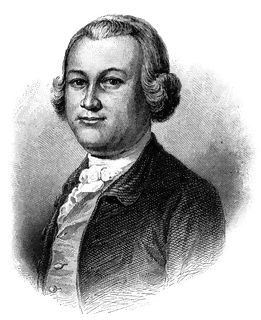
On 23 Feb 1761, two and a half centuries ago, James Otis, Jr. (shown here), and Oxenbridge Thacher stood before the top court of Massachusetts and argued that the colonial government did not have the constitutional power to grant the Customs service a “writ of assistance.” Representing the government in what is now the Old State House was Attorney General Jeremiah Gridley, who had trained both his opponents.

Otis and Thacher’s clients were the import merchants of Boston. At best, those men comprised a narrow special interest. At worst, they were a bunch of privileged whiners trying to stymie the lawful authorities’ power to curb their habitual smuggling.

Otis himself had worked for the royal government not long before, as Advocate General in the Vice Admiralty Court. He switched sides, everyone acknowledged, at least in part because the new governor, Francis Bernard, had not given his father the judicial appointment that the previous governor had promised.

A writ of assistance was general and open-ended. Having received one, Customs officials did not need to provide evidence of what smuggled goods they were looking for and where. And a writ of assistance lasted until the king died—which is why the writs issued under George II (1683-1760) were no longer valid.

Young lawyer John Adams took notes on the case, which survive in sketchy form, and afterward wrote out a more detailed and dramatic abstract of the event. That quoted Otis making this case against the writ:

In the first place, the writ is universal, being directed “to all and singular Justices, Sheriffs, Constables, and all other officers and subjects;” so, that, in short, it is directed to every subject in the King’s dominions. Every one with this writ may be a tyrant; if this commission be legal, a tyrant in a legal manner also may control, imprison, or murder any one within the realm.

In the next place, it is perpetual; there is no return. A man is accountable to no person for his doings. Every man may reign secure in his petty tyranny, and spread terror and desolation around him.

In the third place, a person with this writ, in the daytime, may enter all houses, shops, &c. at will, and command all to assist him.

Fourthly, by this writ not only deputies, &c., but even their menial servants, are allowed to lord it over us. Now one of the most essential branches of English liberty is the freedom of one’s house. A man’s house is his castle; and whilst he is quiet, he is as well guarded as a prince in his castle. This writ, if it should be declared legal, would totally annihilate this privilege.
Having invoked class privilege against “menial servants,” Otis went on to warn, “This wanton exercise of this power is not a chimerical suggestion of a heated brain.” Loyalists complained that Otis did have an overheated brain, and by the end of the decade he actually had a mental breakdown. But the writs of assistance case had started an argument that eventually led to American independence.

TOMORROW: The outcome and results of the Massachusetts writs of assistance case.