J. L. BELL is a Massachusetts writer who specializes in (among other things) the start of the American Revolution in and around Boston. He is particularly interested in the experiences of children in 1765-75. He has published scholarly papers and popular articles for both children and adults. He was consultant for an episode of History Detectives, and contributed to a display at Minute Man National Historic Park.

Subscribe thru Follow.it


•••••••••••••••••


Showing posts with label Nathaniel Shaw. Show all posts

Sunday, August 11, 2024

“Arrived here a Sloop from Bermuda”

As I quoted yesterday, on 4 Aug 1775 Gen. George Washington wrote to the governor of Rhode Island about what he’d heard about Bermuda from a man he called “One Harris.”

The editors of The Revolutionary Correspondence of Governor Nicholas Cooke identified Harris as “Captain Benjamin Harris,” but I don’t see what they based that on. I can’t find other mentions of Benjamin Harris in connection with Rhode Island or Bermuda.

I found clues in newspapers pointing in another direction. Rivington’s New-York Gazetteer for 15 June reported: “sloop Bittern, Harris, [cleared for] Bermuda.” And on 27 July: “Bittren, Harris, Bermuda” was among the inward entries, the only one from that island. The 31 July New-York Gazette reported that sloop as “Brittain, W. Harris.”

In addition, the 24 July New-York Gazette reported:
Friday Night last [i.e., 21 July] arrived here a Sloop from Bermuda: By Letters from thence we learn, that the Inhabitants of that Island are greatly alarmed at the present Situation of publick Affairs, being under the most dismal Apprehensions of Starving; to prevent which they have passed a Law, that no Provisions should be sent off the Island at any Rate whatsoever; and were about dispatching a Vessel to Philadelphia, to request the Honourable the Continental Congress to take their Case into their most serious Consideration.
That was reprinted in the 27 July New-York Journal and from thence in the 2 August Massachusetts Spy and the 3 August New-England Chronicle.

Thus, we have a ship’s captain named “W. Harris” arriving from Bermuda on a ship named something like the Bittern, probably bringing political news, in time to make his way to Gen. Washington’s headquarters in Cambridge with an offer.

Another clue about Harris appears in Gov. Cooke’s 8 August response to Washington saying that he didn’t know where the man was. Washington’s agent Elisha Porter was “bound as far as New-London to endeavour to meet with him,” indicating that people perceived Harris as most likely to surface in New London, Connecticut.

That took me to my favorite smuggling merchant, Nathaniel Shaw of New London. His letter book shows he employed two captains named William Harris in the early 1770s. He wrote sometimes of William Harris, sometimes William Harris, Jr., and most often simply ”Harris.”

The 10 May 1771 New-London Gazette reported among the ships cleared out of that harbor “Sloop Bittren, Harris [to] New York.” On that same say Shaw sent a letter to Peter Vandervoort in New York with a shipload of molasses overseen by “Wm. Harris Junr.” The 6 Dec 1770 Pennsylvania Journal likewise links a “W. Harris” with the “Sloop Bittern” traveling between New York, Philadelphia, and New London. Several newspapers in 1770 render Harris’s ship as the “Bittren.”

Two years later, the 23 Apr 1773 New-London Gazette shows “Capt. William Harris, late of New-London,” had died and one of the estate administrators was “William Harris”—no doubt formerly Jr.

Thus, I propose that the “One Harris” who visited Gen. Washington in August 1775 with a proposition regarding gunpowder was William Harris of New London, Connecticut, a ship captain recently returned from Bermuda on a sloop called something like the Bittern.

COMING UP: Mission to Bermuda.

Friday, February 07, 2020

Mr. Shaw and Mr. Dumaresq

While Nathaniel Shaw, Jr., of New London, Connecticut, was speculating on the likelihood of war by buying gunpowder in the Caribbean in early 1775, as discussed here, he was still broadening his commercial network.

In particular, he made a new contact in Boston, a merchant of Huguenot descent named Philip Dumaresq (1737-1801). On 15 Mar 1775, Shaw wrote to Dumaresq:
A few days agoe our Mutual Friend Thomas Mumford shew me a Letter from you recomending to send a Vessell to Cohassett Rather then Salem with West India Goods for the Boston Markett.

I have by the bearer James Angell in the Schooner Thames Shipt a Cargo of Brown Sugars Consisting of Sixty seven hogsheads and two teirces, which Sell for my Accot. They Just now came in from Hispaniola, and I believe are of a good quality, we have not made any report at our Custom House and must leave the whole matter relative to the entry with you and paying the Duties, and would have you manage the matter so as to pay as little as possible for on that strong my buissiness with you with turn, and if I find you can do better or as well as any other Port, its very probably I shall send you Severall Cargoes during this Summer. . . .

Mr. Ferrebault who is on board the Schooner as a French Capt. has about one thousand wt. of Coffee which you will be so kind as to assist in Landing &c.
The next day Shaw sent a copy of that letter with another, talking about the possibility of future business. He concluded, “Let me hear from you the return of the post, with the price Current, Politiks &c.”

Capt. Angell returned on 9 April. Dumaresq wrote back that same day, indicating he had been too sick to go out for a while. Shaw replied on the 12th with a nudge to sell the sugar soon. “I shall want to pay about Six hundred pounds L[awful] Money ye. 1st. of next month and hope you’l be in Cash by that Time.”

Then the war broke out. But Shaw continued to manage this deal as if there wasn’t a battle front between him and his partner. On 18 September, Shaw told his contacts in Philadelphia: “I have Two Thousand pounds worth of Sugar their in Boston in Philip Dumaresque hands and I make no Doubt but I shall be able to git the Money Unlless Dumarisq Should prove Dishonest.”

Shaw’s outreach to Dumaresq is striking because Dumaresq was a known Loyalist. In May 1774 he signed the Boston merchants’ addresses to outgoing Gov. Thomas Hutchinson and incoming Gov. Thomas Gage. In June he signed the Loyalists’ protest against the Boston town meeting.

The Whigs responded with a broadside listing all of the “Addressers” and belittling them. That sheet called Dumaresq a “Factor,” or wholesaler, rather than a merchant. More important, the Patriots encouraged people to stop doing business with those men. John W. Tyler’s Smugglers and Patriots quotes Henry Bromfield at the end of October 1774: “The Country Traders carry abot. with them a printed List of the Names of the Addressers to Gov’r Hut’n & dare not buy a single piece of Goods of any of them.”

Nathaniel Shaw was a fervent Patriot. He was especially opposed to the Crown’s customs duties, and back in 1769 he’d even instigated a riot in Newport against the Customs service. From 1776 through the end of the war he would work as the naval agent in New London for both the state of Connecticut and the Continental Congress.

But Shaw evidently didn’t think a little thing like politics should get in the way of asking Philip Dumaresq to land his Haitian sugar at Cohasset and get him the best price for it.

Thursday, February 06, 2020

“Agree for the Powder to be brought Down to the Mole”


The start of the Revolutionary War changed New London merchant Nathaniel Shaw, Jr.’s business environment.

For one thing, military supplies were much more valuable. On 25 Apr 1775 Shaw asked his connection in New York for “Five Hundred wt. of Powder, fifteen Hundred Flints and Eighteen Hundred weight of Lead.” But those things were already too scarce on the continent.

According to Robert Owen Decker’s The Whaling City: A History of New London, Shaw also urged the Connecticut government to order 400-500 barrels of gunpowder from him. He strongly supported the Patriot cause, even funding the colony’s delegates to the Continental Congress, but he also had a business to run.

On 11 May the colony treasurer placed its order: only 300 barrels. Shaw replied four days later, “you may Depend on my Supplying you with the Quantity of Powder you Mention.” He already had a captain in the Caribbean, John Mackibbin, with a line of credit and instructions to buy whatever gunpowder he could find.

The new book Two Revolutionary War Privateers, by William and Virginia Packwood, reports that on 29 May Shaw sent another captain, William Packwood, back out to the West Indies on the sloop Macaroni.

Mackibbin returned to Long Island Sound in the sloop Black Joke in July. He brought back “10000 Gallons Melasses, 15 Thousand wt. of Coffee, 26 Thousand of Sugar”—but no mention of gunpowder. Shaw dispatched him to Philadelphia on 12 July with “Orders to take the Sugar and Coffee on Shore without paying the Dutys and if it Can be avoided not to pay any for the Melasses.” Business as usual for Shaw so far.

But there was a new wrinkle. Shaw feared that after 20 July Mackibbin would not be able to “Clear out for N London” and perhaps not for any “Forreign Port.” The royal government was about to clamp down on trade with Connecticut for joining the attack on Boston.

Shaw therefore told his captain that his first course should be to load up with flour and barrel staves and sail for Haiti by 20 July. If Mackibbin couldn’t do that, he should try for some other port in the Caribbean, sell the ship for £300, or come home “in Ballast without Clearing out and Get me Two Thousand feet of Good Long Yellow Pine Plank.”

As for what Capt. Mackibbin should do in Haiti, Shaw wrote: “Purchase Gun Powder & Return as Soon as you Can. If that Article is not to be had Purchase Brown Sugar and Coffee. Dont keep this Letter on Board for Fear of Accidents but burn it.”

Five days later, Shaw sent another letter after Mackibbin:

I am Inform’d that there is a Large Quantity of Powder Arived at the Cape And I would have you in Case you Can Clear go Directly for the Cape and when you Arrive there you may Very Easily know wether you Can have Liberty to Trade there or not And if you Can Purchase Powder to the Amount of your Cargoe, and if you Cannot trade there you Can Agree for the Powder to be brought Down to the Mole
The “Cape” meant Cap-Haïtien and “the Mole” meant Môle-Saint-Nicolas at the end of the same peninsula. In other words, Shaw told Mackibbin that if he couldn’t load gunpowder openly at the main port, he should arrange to pick it up at a more secluded spot.

TOMORROW: Mr. Shaw’s new contact in Boston.

Wednesday, February 05, 2020

Trading for Gunpowder Just Before the War

Last year I wrote about the New London, Connecticut, merchant Nathaniel Shaw, Jr., and his many ways of evading Customs duties on molasses and other goods.

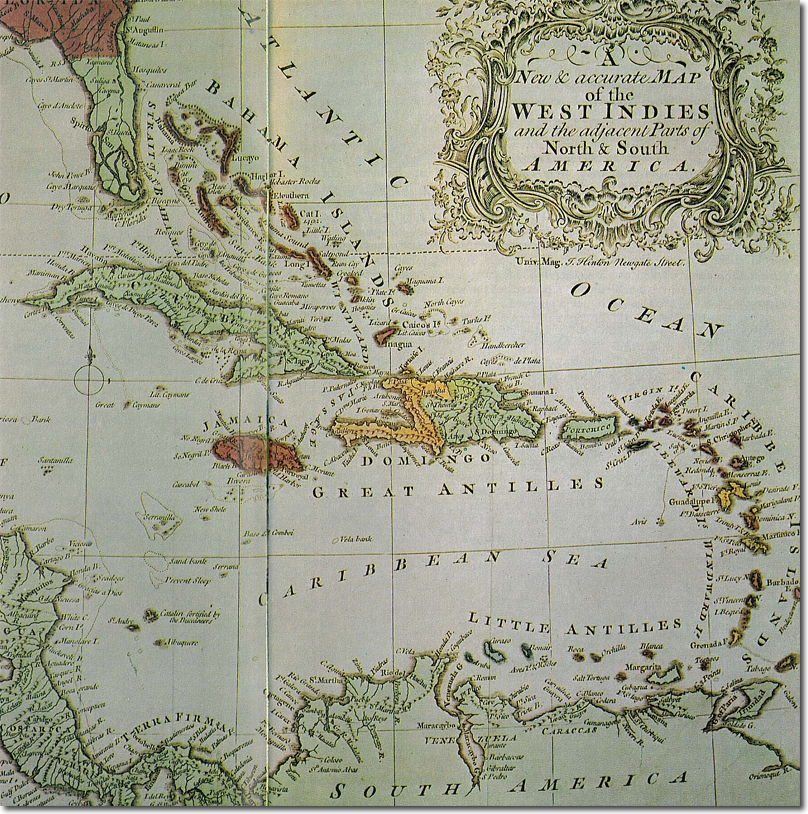
Shaw’s experience moving molasses from the Caribbean to mainland North America was useful as New England went to war in 1775. The army outside Boston needed gunpowder and weapons, things that were on sale in West Indies as long as Americans had money to pay for them and ships to carry them past Royal Navy patrols.

In fact, Nathaniel Shaw started to trade in military supplies even before the war began. On their website the authors of a new book, Two Revolutionary War Privateers: William and Joseph Packwood of Connecticut, describe the voyage that the older of those two brothers undertook on Shaw’s orders:
Capt. William set sail on 7 Feb 1775 on the Macaroni with orders to obtain as much gunpowder and arms as he could. He visited many Caribbean islands in his search. After a three-week time period, Capt. William was at Anguilla (British) which is 230 miles east of Puerto Rico. . . .

Unable to purchase gunpowder at most places he stopped, Capt. William made his way down the Leeward Islands to St. Eustatius (Dutch) on March 1, Martinique (French) on March 4, and Dominica (French until 1763, then British) on March 6. . . .

Capt. William then went to Guadeloupe (French) on March 7, back to St. Eustatius on March 9, and finally to Haiti (French) on March 15. During the last half of March, he went back and forth between two of the major trading ports in Haiti: Môle Saint-Nicolas on the northwest tip of the island and Cap-Haïtien (called Cap François at the time) on the north coast midway to the Dominican Republic, the Spanish part of the island. He returned to St. Eustatius on April 9 and then went back down to the Môle on April 16.
Back in Connecticut, Shaw was keeping a keen watch on the markets. On 6 April, he wrote to a merchant in Guadeloupe that gin was selling slowly in New York and “Nothing will command cash but Molas. and Powder.” Two days later, after a request that Samuel Holden Parsons passed on for Roger Sherman, Shaw ordered “fifteen Tons of Lead” from his usual trading partners in Philadelphia.

On 25 April, soon after New London received word of the fighting in Massachusetts, Capt. Packwood returned to port. Shaw immediately wrote to Gov. Jonathan Trumbull:
Agreable to your Desire I have Sent up Eighty Three Barrels of Powder to Colo. Jed. Huntington Containg about 108 Each

the Remainder is in this Town I hourly Expect Thirty Two Barrels more that I have Account of the Capt. having it on bord

the Remainder of what Moneys was in My hands Capt William Packwood left with Capt. Jno. Mckibbin who is in One of my Vessels in the West Indies to Lay out in the first Powder that Arives, he says that a large Quantity was Daly Expected

he purchased all that Could be had and thought it best to push home with this Rather than Tarry Longer—this Quantity he Obtain’d through the Influence of the Famous Palunkey (who was An Old Commander of a Private Tear the Warr before Lasts) who Prevailed with the Governour of the Cape to take it out of the Kings Store—

In Short Packwood Says the French Seem to be Disposed in the Islands to Assist in this way as Much as in their power, I Intend he Shall Sail Again for the Cape Next Week and I Don’t Imagine he will be Gone More than Six weeks If you Intend to have any more Money Laid out in that way it will be a good Oppertunity 
The same day, Shaw told his New York connection that Packwood had brought back “fifty One Hogsheads and Eleven Terses of Mollasses and four hogsheads of Cocoa.” That voyage wasn’t just about military supplies. And Shaw hadn’t lost his usual “hope you’l Save the Dutys” by evading the Customs men.

TOMORROW: Placing a bigger order.

Saturday, August 31, 2019

“Cheat them much as you can of ye Duties”

The Connecticut merchant Nathaniel Shaw, Jr., shipped a lot of molasses to merchants in New York and Philadelphia. Since there was very little sugar cane grown around New London, he was buying that commodity in the Caribbean—mostly from French and Spanish colonies.

Under the Sugar Act of 1764, every gallon of molasses imported into British North America carried a duty of 3 pence. (There were duties on other goods as well.) Ships had to carry papers declaring how much molasses and other stuff they carried. When a crew landed cargo at a particular port, the Customs office there collected the duty and “cleared” for shipment anywhere else within the empire. 


Shaw’s letters show he was constantly betting on which port would offer the best price for his molasses. The duty was the same in every port, but Shaw also did his best to minimize the tax he had to pay. And he was blatant about evading duties.

Here are samples from Shaw’s correspondence with his main trading partners showing the many tricks he and his captains used.

On 9 June 1766 to Peter Vandervoort at New York:
(…I want [Abijah] Bebee to to Land his Cargoe without Entring and Return to New Londn. and take another Cargoe of molasses on Board & Return to New York with the Same Clearance if you think it may be done, wich I leave to you) for I Cannot Clear out any more Molasses att the Custom House haveing all Ready Cleard as much as have pd. the Dutys for
Two shipments using the same certificate of duties paid.

On 14 July 1766 to Vandervoort:
I have shipt you by the bearer Abijah Bebee Ten hogsheads and Five Terses of Molasses wich is not Cleared in the Custom House and would have you do the best in Landing and Disposing of it
On 18 July 1766 to Vandervoort:
I have by the Bearer Capt. [William] Hancock shipped you as pr the Inclosed bill of Lading thirty Four Casks of Molasses wich I have Clear’d att the Custom house att about sixty Gallon. they being very large Casks I would have you dispose of them before Hancok hauls into the Dock and then have them Carried off Immediately, as I Imagine if any of the Custo. House Officers should see them they would take notice of their being very large and Possible have them Gauged Again, wich I should not Choose to have done.
Underreporting the size of the casks and working fast so the authorities wouldn’t notice.

On 1 July 1767 to Thomas and Isaac Wharton of Philadelphia:
I…should have wrote you before but have been Endavoring to find what Pretentions your Collector had for obliging you to pay 1d. Sterg. pr Gallon on the Molasses after it had paid the duty in this Port, and am Inform’d by Persons who know as much about Acts of Parliment as Mr. [John] Swieft that it is not the Intention of the Act that Molasses should pay the Duty more than Once, and I should Imagine that when Mr. Swieft finds (wich is Certainly Facts) that no Other Collectr. on the Continent takes the duty but himSelf he will Repay you the money back Again on that Accott.

I shall let the matter Rest a little longer, and if I Find that he Continues to keep the Duty, I shall Imploy an Attorney to git it from him att Common Law and make no Doubt but I shall be Able to Recover it.

If Molasses should take a Rise let me know it and if I should have any Arive will order it to you without Entring of it hear.
Threatening to sue the Customs service for collecting duties twice because he cared so much about following the law. Also, not paying duties in the first place.

On 5 Oct 1769 to Vandervoort:
I have also by Capt. [Edward] Tinker shipt Six hogsheads of Rum and Four Terses for Mr. John Wattles which he would have you forward as pr the Inclos’d Directions and send Ten Keggs of Brandy as I did not Choose to send any by Tinker. I hope you’l have the Terses taken out Soon as they may appear Suspicious.
Unloading quickly before officials could notice.

On 14 Feb 1770 to Vandervoort:
Yesterday Capt. [Joseph] Latham arived in a Sloop of mine from Cape Francoise and I am now Loading Harris with molasses and Sugars for N Y, the Sugars shall Clear as Seads.
On 14 May 1771 to the Whartons:
Inclosed is a bill of lading of 45 hhds. & 9 teirces of Melasses, and Ten hhds. of Sugar by Capt. Powers. . . . Their is only two hogsheads of Sugar cleared out, and you must get the Remainder on shore in the best manner you can. I have put 19 bags Coffee on board which is cleared out as Cocoa, you must manage that in the best manner you can.
Mislabeling cargo, and getting casks “on shore in the best manner you can.”

On 17 May 1771 to the Whartons:
I have by the bearer Capt. Edwd. Tinker in the Sloop Sally, Shipt you seventy four hogsheads of Melasses, and thirteen hogsheads Sugar, which dispose of for my Accott. The Sugar is in Melasses Hogsheads & you must Land them in the Safetest manner you can, for I Could not Clear them out.
11 Nov 1772 to the Whartons:
I Should have wrote you by the last Post but was att New Port on a very Disagreable Errand. A Brigg of mine from Guadalupe with Two hundred hogsheads of Melasses, by Stress of Weather was drove into New Port and the Custom House Officers Oblig’d him to Enter his Cargoe and the Stupid fellow Reported only Seventy hogsheads and they have made a Seizure of the Remainder. I have Sent a Petition to the board of Commissioners att Boston praying that it might be Admitted to an Entry. How farr they will be prevaild on, time only will Discover. In Case its Condemn’d they flatter me that I Shall have it att About Seven pence Sterling pr Gallon.
Even if the Newport Customs office confiscated the 130 extra hogsheads, officials suggested that at auction he should be able to buy that molasses back at a good price.

On 2 Jan 1773 to Vandervoort:
I wrote Messrs. Whartons for a full Load for [Edward] Chappell, and I now send him with a Load of Sugars and have only Clear’d out Seventeen hogsheads and think the best plan will be for him to enter at New York and apply for Liberty to take in those twenty Casks he brought down before, and git Certificates for abought Twenty more and go on to Phila. or if you think their is no danger let him go on with his Clearance for the 17 hhds. but am really afraid of the Consiquence and think it best to Clear out some more at N York.

In Case Chappell cannot git up to Phila. by reason of the Ice, I would have him return to N. York, and if you can not get 48/ pr Ct. for his Sugars, I should be glad to have him Cleared out for Boston, and let him take out a new Register in his own name as I do not choose to have the Sloop go their with the old Register.
Duplicate paperwork.

On 13 July 1774 to Vandevoort:
The bearer [Capn?] Tinker has on board about twenty thousand Gal Melasses in the Brig Mermaid wich you must dispose off on the best terms you can for my Interest. We have reported 150 hhd & 50 Teirces. I beg you will Cheat them much as you can of ye Duties.
Shaw and Tinker had reported 15,000 gallons in hogsheads and another 3,300 in the smaller casks called tierces, or about 10% short of what they actually had brought in. So any way that Vandervoort could “Cheat” on the duties was added profit.

Given Shaw’s normal way of doing business, Capt. William Reid probably had good reason to be suspicious when he saw two of the merchant’s ships rendezvousing in Long Island Sound on 17 July 1769. Once Reid had seized those ships, Shaw came roaring into Newport to get them back.

It’s possible that Shaw didn’t plan to extend his repertoire of resistance to include holding Reid hostage, inciting a riot, ruining the Customs sloop, and absconding with his sloop. But that’s what he and his men and the Newport crowd ended up doing.

Friday, August 30, 2019

“I am as Inocent of Destroying the Sloop as Either of you”

In 1933, the New London County Historical Society published the second volume of its collections, titled Connecticut’s Naval Office at New London During the War of the American Revolution.

The Continental agent in that port was Nathaniel Shaw, Jr. (1735-1782). As an addendum to the collection of public papers, the society’s editor and honorary president, Ernest E. Rogers, included a transcript of Shaw’s letterbox as a merchant in the years before the war.

That source from Shaw’s own hand confirms his connection to the ships involved in the Liberty riots in Newport, Rhode Island, and New London, Connecticut.

On 12 June 1769, Shaw wrote to a man he called Theopulas Backe: “Sir, Inclosed is a letter from Capt. Joseph Packwood which he desir’d might be forwarded to you. He is now in the West Indias, and when he will Return is Uncertain.” Packwood returned to Long Island Sound with Haitian sugar and molasses the next month.

Eight days later, Shaw wrote to his regular trading partners in Philadelphia, Thomas and Isaac Wharton:
I wrote you ye 16 Inst. by Capt. Edwd. Tinker ye Sloop Sally who had on Board 121 Casks of Melasses, who was to Proceed to N. York & in Case ye price of Melasses was not Equal to what you wrote [me?] by the Post, I gave him Orders to Proceed to Philadelphia & deliver his Cargoe to you.
The Customs sloop Liberty seized Tinker’s Sally and Packwood’s Thames in July. Shaw and Packwood went to Newport to get them back. And one riot later, they went home.

As I reported yesterday, in September the New London Customs office seized the Sally again.

Here’s what Nathaniel Shaw had to say about that situation in a 14 Sept 1769 letter to John and George Erving of Boston:
Gentlemen, I Received yours of the 28th Ulto. and am very much Oblig’d to you for your Advise in Regard to the Prosecution that is Intended Against me.

Att Present I Cant Conceive on what Accott. they Intend to trouble me, as I am as Inocent of Destroying the Sloop [Liberty] as Either of you, and can make it Appear so to the Sattisfaction of any Court or Jury in this Colony, and I am of the Opinion if I can do that, it will be Suffecient and In Case they are Determined to have the Matter try’d in Boston att a Court of Admiralty, should be glad you would Inform me in your next what method they are to take to Oblige Either Packwood or me to Appear their or if it goes Against us by Default what Plan they are to Persue to get the Money. Att Present we have no Judge of ye Admiralty in this Colony and I beleive no Person hear would att this time Except of it.

Mr. [Duncan] Stewart has Seiz’d a Sloop which he Suspects is the Sloop that was Carried of[f] att N Port the Night the Liberty was Destroy’d. It is now Seventeen days Since the Seizure was made and he has done nothing towards having her Libel’d. Neither can he git any advise from the Commisoners what steps to take with her, he has no Evidence hear to Prove this to be the Sloop, nor Cant have any, unless Capt. [William] Read or some of his People should come hear, & I beleive it will not be Convenient for them to make their appearence very Soon and haveing the Sloop detain’d so long must Consequently Create an Expense which must fall some where,

I Proposed to Mr. Stewart to have ye Sloop Appriz’d as she now is & give him Security for ye Vallue In Case she be Finally Condemn’d, that we might go on with her Repairs as she wants much before she is in a Condition for the Seas, I should be glad you would Consult some Person who can Advise me in this matter, what steps to take for I Suppose Mr. Stewart will not do any thing untill he has Orders from ye Commisoners.
Shaw’s letterbook doesn’t tell us directly whether Collector Stuart accepted his proposal. But he must have gotten his sloop back because on 17 May 1771 he wrote to the Wharton brothers again:
I have by the bearer Capt. Edwd. Tinker in the Sloop Sally, Shipt you seventy four hogsheads of Melasses, and thirteen hogsheads Sugar, which dispose of for my Accott.
Shaw insisted he was innocent of destroying the Liberty, that the Customs sloop hadn’t caught his Sally, and by extension that he wasn’t in the business of smuggling molasses.

TOMORROW: What Shaw’s other letters have to say about that.

[The photo above, courtesy of Historic Buildings of Connecticut, is Nathaniel Shaw’s house, now owned by the New London County Historical Society.]

Thursday, August 29, 2019

“Having made Seizure of a Sloop named the Sally”

As I’ve been relating, July of 1769 was not a good month for the royal Customs service in New England.

On 19 July, a Newport mob had ruined the Customs patrol ship Liberty after threatening its captain and crew. The next day, with no armed vessel to stop them, sailors “rescued” a sloop named Sally that the Liberty had seized. The captain of another ship detained at the same time, the brig Thames, successfully demanded that his vessel be released for lack of evidence.

On 25 July, a smaller mob in New London beat up one Customs officer and intimidated others. And on 31 July, the hull of the Liberty caught fire and burned to the waterline, rendering it beyond repair.

It took a while for the Commissioners of Customs in Boston to respond, but in August they made a move. On 14 August this advertisement appeared in the Newport Mercury:
WHEREAS William Reid Commander of the Sloop Liberty, employed in the Service of his Majesty’s Customs, having made Seizure of a Sloop named the Sally, Edward Finker Master, belonging to New-London, loaded with a Cargo of prohibited Goods, carried the same into the Harbour of Newport, Rhode Island, where a great Number of People, riotously and tumultuously assembled together, in the Evening of the 19th of July last, and having, by Force and Arms, attacked and secured the said Captain Reid and his Men, and taken Possession of both Vessels; they set Fire to, and sank the Liberty, and carried off the Sloop Sally:

For the apprehending, and bringing to condign Punishment, the Persons concerned in this daring and atrocious Outrage, The Commissioners of his Majesty’s Customs do hereby promise a Reward of One Hundred Pounds Sterling, to any Person or Persons who shall inform against any of the Offender or Offenders (except Nathaniel Shaw, Joseph Packwood and —— Angel;) to be paid on his or their Conviction.

By Order of the Commissioners,
RICHARD REEVE, Sec’ry.
This advertisement and Capt. Reid’s report to the head office referred to the captain of the Sally as Edward Finker. However, other sources make clear his name was Edward Tinker. A handwriting error, or had he given the authorities a false name?

As for the other men named in the ad, Nathaniel Shaw, Jr., was the owner of the Thames and the Sally. Joseph Packwood was captain of the Thames. James Angel or Angell worked for Shaw as a captain after 1774; at this time he might have been a mate. The parenthetical phrase with their names is placed ambiguously, but I think the commissioners meant those three were ineligible for the reward since they had carried out the crime.

As good bureaucrats, the commissioners also set out to close the books on the Liberty project. On 4 September, this ad ran in the Boston Evening-Post:
All Persons who have any Demands for Stores, Carpenter’s Work, Provisions, &c. upon Account of the Sloop Liberty, lately employed in the Service of his Majesty’s Customs, are hereby desired to send in their Accounts forthwith to Messrs. Green & Russell, Printers at Boston. Sept. 2. 1769,
Green and Russell were the printers of the Boston Post-Boy, which got the bulk of the Customs office printing business—at least until John Mein came to town. It’s striking that they were collecting bills for work on the Liberty rather than the Customs staff, but probably more artisans felt safe walking into their print shop than into the Customs house on King Street.

According to Joseph R. Frese’s article, in all the Customs service paid £980 to fit out the Liberty as a patrol vessel, plus £371 for “maintenance.” To be sure, most of that money went to shipwright Robert Hallowell, brother of Customs Commissioner Benjamin Hallowell.

Then the Customs service caught a break—and a ship. The 11 September Boston Evening-Post reported:
We hear from Norwich, that last Wednesday se’nnight a small Sloop was seized there by Duncan Stewart, Esq; Collector at the Port of New London, upon information that it was the same Sloop lately seized by Capt. Reid, in the Sloop Liberty, and carried into Newport, and thence rescued.
The Customs service had the Sally in custody again.

TOMORROW: Nathaniel Shaw wanted his sloop back.

Wednesday, August 28, 2019

New London’s Liberty Riot

Newport, Rhode Island, wasn’t the only New England town that saw disturbances connected to the Customs sloop Liberty in July 1769. There was also violence in New London, Connecticut.

In fact, the whole affair started with action off New London. Treasury Department documents that Joseph R. Frese cited in this article from the Colonial Society of Massachusetts reveal more details than I knew last week.

On the morning of 16 July, Capt. William Reid of the sloop Liberty stopped two vessels in Long Island Sound about three miles from the New London lighthouse. One was the brig Thames, commanded by Joseph Packwood. The other was the sloop Sally, commanded by Edward Tinker. Both those ships were based in New London, but the Thames was nominally sailing from Haiti to New York.

As some New England newspapers reported, Reid suspected that Packwood had unloaded some of his Haitian rum and sugar onto Finker’s sloop so it could be landed secretly on the Connecticut coast and the Customs department couldn’t collect duties on it. Then he’d deliver the rest in New York.

Reid put his own men onto the brig and sloop and led the little fleet into Newport. Packwood, Finker, and most of their crewmen had to make their way home in boats. Soon after Packwood landed, he and the owner of the Thames, Nathaniel Shaw, Jr., set out for Newport. We know what happened there on 19 July. By the next day, the Liberty was wrecked, the Thames released for lack of evidence, and the Sally illegally “rescued.”

Back in New London, the waterfront crowd went hunting for the local Customs officers whom they held responsible for those seizures. Deputy Collector John Miller and Comptroller Thomas Moffatt reported that on 24 July “several People” threatened a tidesman named Barnabas Willson. They wrote, “on this occasion We said what We then thought was proper to him & took such steps as inclined Us to hope and beleive that no mischief would happen to him, but We were mistaken if not deceived.” Dr. Moffatt had been the victim of mobbing during Newport’s Stamp Act riots, so he should have known better.

Whatever “steps” those officials took, it wasn’t enough for Willson’s sake. In “the twilight of the Evening of the 25th,” the crowd came looking for him again, as well as another tidesman named John Bloyd. The Customs officers wrote of Bloyd:
not finding him at home they suspected he was in the House of Mr Collector [Duncan] Stewart where they repaired and demanded him but being denied and refused admittance by a Maid Servant from the Window of an upper Chamber they broke forcibly into the House search’d every where and found him on the House top, from which they led him through the Street near the Episcopal Church and there questioned him concerning the Information given to Captain Reid and chiefly about some Rum seized & afterwards stolen at East Haddam a year and a half ago then they dismised him without further Injury
The crowd turned back to Willson. That man himself later told justice James Murray of Boston:
they seized this Deponent Drag’d him thro’ the Streets, strip’d him of his Cloaths, tied him to a sign Post (having cut off his Hair) and then gave him Thirty two severe lashes with a Whip.
By then it was “about Eleven OClock at night.” Some of the rioters went to find Thomas Dare, the Customs office surveyor—a social step up from the tidesmen. Those men took Dare to the place where they had tied up Willson. They “questioned him concerning the late seizure and seemd disposed to Use him very roughly, but were prevented by the Interposition of some who either rescued or beg’d him off.”

Finally, the New London crowd attacked the top local Customs official symbolically, the same way Bostonians had done in June 1768 and Newporters had done a few days before. The men
repaired to Mr Stewart’s Wharf seized the Boat hauld her ashore hoisted her sails with all Appurtenances except the Iron Ballast which they threw on shore, then drag’d her in triumph to a rising ground near the Town where they burnt her, on the Morning of the 26th very early
That makes a total of four burned boats, with the Liberty itself still to come.

Miller and Moffatt reported that “poor Willson set out on foot for Boston who can inform your Honors more exactly of this Mob and of what has been said and done to him.” In Boston, Willson testified to Justice Murray and reported to the Commissioners of Customs, who gave him £2.5 for his troubles.

Surveyor Thomas Dare “thought it best to retire for the present,” his colleagues reported, though by the end of 27 August they expected him to “return here this day and We have some assurance that he will not be insulted.”

TOMORROW: The Customs service strikes back.

Monday, August 26, 2019

“They must be Sent directly, or by God, I should never See the Morning”

Last week I guessed that the Boston Chronicle’s 24 July 1769 account of Newport’s Liberty riot reflected the perspective of William Reid, commander of that sloop for the Customs Commissioners.

It turns out we have Capt. Reid’s description of the event in his own words, preserved and published in Connecticut. Dated 21 July 1769, Reid testified:
On the Evening of the 19th Inst. between Seven & Eight OClock, as I was going down the Long Wharfe to go on Board the Sloop Liberty, A Vessell then under my Comand, employed in the Service of the Revenue, I was, of a sudden, surrounded by a great Number of Men, some of which seized hold of me,

upon asking what they wanted I was answered that I was a Damn’d Rascal, & that they had now caught me, I asked what I had done to any of them, they Answered that I had Seised many of their Vessels & by God I should now pay for all,

the first Person that I knew in the Mob was Jos: Packwood, Master of the Brigantine Thames, A Vessell which I had detained, he told me that some of my People, on Board of the Brigantine had used him very Ill,

soon after Nathl. Shaw, Owner of Brigantine Thames came up to me, & told me that I had not five minutes to Live, if I did not order Two Frenchmen on shore, which was then on Board of the Sloop Liberty, that I had taken out of the Sloop Sally, a Vessell then under Seisure,

I told them I had no design in keeping those Frenchmen, & that they should come on Shore, provided the Mob would not hurt them, which they declared they would not, they were brought on shore,

the Sd. Packwood then mentioned to the Mob that John Carr second Mate of the Liberty had used him ill & had ordered the People on Board of the Liberty to prevent his going on Shore in the Brigantine’s Boat, by Firing at him, & further said, that they did fire at him, & that he wanted them to be brought ashore to be delivered up to a Magistrate,

the Mob, then with Threats of Violence, against my Life, Insisted, that I should Order Said Carr & John Freeman Pilot to be brought to Justice,

I proposed to send them on Shore in the Morning, but was answer’d they must be Sent directly, or by God, I should never See the Morning,

being in this Defenceless condition, I found myself under the Necessity of Complying with every thing they had a Mind, to propose, & accordingly ordered them on Shore,

as Soon as they came the Sd. Packwood again Addressed himself to the Mob & told them there was another Mate, that had fired at him, from on Board the Sloop Sally,

The Mob ordered that he might be bro’t also, which was accordingly done.

I desired that they would let me go on Board of the Liberty, & that if there was any Person on Board, which had been guilty of any Indiscretion, I would deliver him up to Justice directly.

They told me I should not go off the Wharf Alive nor any of my People, if I attempted to go, & insisted, that there was another Man on Board, which was concerned in firing at Capt Packwood, & that they would have him on Shore likewise, they then Man’d two Boats, one of which put off to go on Board to search for the aforesd. Man,

[Joseph] Adams then Comanding Officer on Board of the Liberty, called to me, to know, if they should go on Board,

as I thought to refuse, their going on Board, would perhaps exasperate the Mob to some Acts of Violence against the Sloop Liberty I told him to permit them which he did,

the Boat then returned with Two of the Men, that went in her, & one of mine, the Mob then seemed more Satisfied,

I asked them again to let me go on Board my Vessell, which they refused. But told me I might go to my Lodgings, about 11 oClock, I got clear of the Mob & went directly to Charles Dudley Esqr. Collr. of His Majesty’s Customs for his Assistance who advised me to apply to the Govr. [Joseph Wanton] which I did by Letter requesting His Honor to use his Authority in preventing the further Violence of the Mob, against the Sloop Liberty, & the two aforementioned Vessels.

About four O’clock in the Morning, as soon as I thought the Mob was disposed, I went to go on Board of the Sloop Liberty, But found her cut from her Anchors, & laying on Shore, with her mast cut away by the Deck, her Sails & Rigging all Cut to pieces. Two of her Guns, all her Swivels & small Arms, hove over Board her Bottom Scuttled, her two Boats Burn’d, my Cabbin tore all to Pieces, & all my Furniture Cloaths Papers & every thing belonging to me Destroyed.
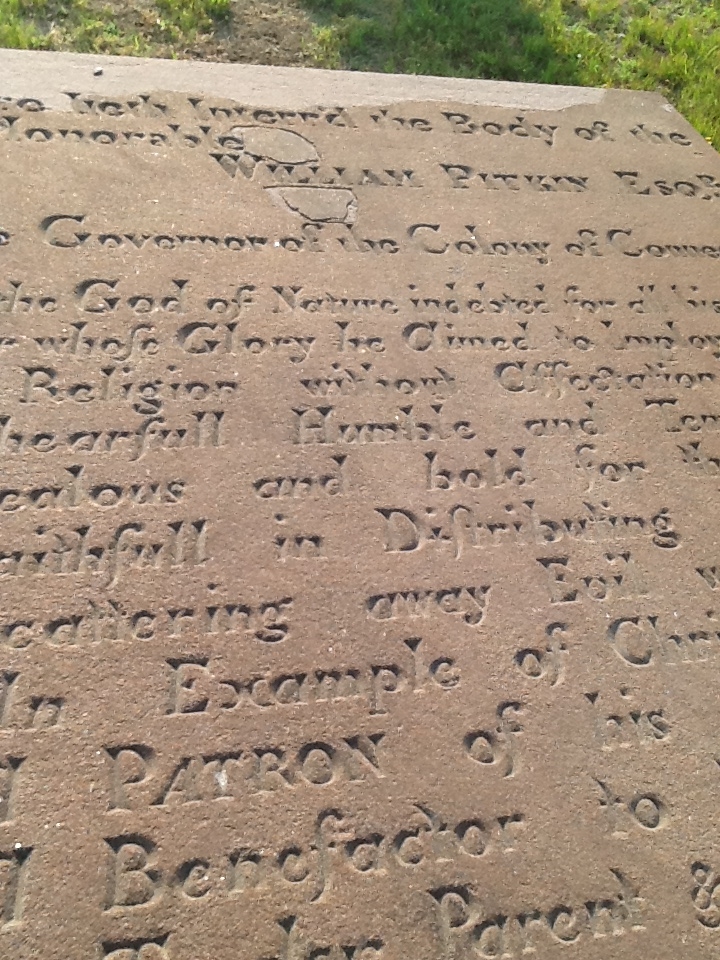
Duncan Stuart and Thomas Moffatt, the top two Customs officials in New London, had the number-three man, surveyor Thomas Dare, carry Reid’s testimony to Hartford. They wanted William Pitkin, governor of the colony, to help in prosecuting Shaw and Packwood.

According to the governor’s files, “Govr Pitkin gave a general prudent Answer to the foregoing Matters, that entirely satisfied the Officers of the Customs at New London.” Which suggests he didn’t help that much, but the Customs officials had little opportunity to appeal because Pitkin died on 1 October.

(The picture above shows Gov. Pitkin’s grave, as photographed by Lori for Find-a-Grave. It’s quite wordy. It describes Pitkin as “Zealous and bold for the Truth, Faithfull in Distributing Justice, Scattering away Evil with his Eye…”)

COMING UP: The Customs service strikes back.