J. L. BELL is a Massachusetts writer who specializes in (among other things) the start of the American Revolution in and around Boston. He is particularly interested in the experiences of children in 1765-75. He has published scholarly papers and popular articles for both children and adults. He was consultant for an episode of History Detectives, and contributed to a display at Minute Man National Historic Park.

Subscribe thru Follow.it


•••••••••••••••••


Showing posts with label architecture. Show all posts

Friday, January 02, 2026

The New New-Gate Prison

Last month I broke off a series of postings about three men Gen. George Washington sent to Simsbury, Connecticut, to be locked up in the New-Gate Prison.

Now I’m returning to that topic, but first I’m going back to fill in the background of that prison.

In the eighteenth-century British Empire, convicted criminals didn’t usually get sentenced to extended prison terms, with the perpetrator housed and fed by the state.

Instead, the most serious offenses, from murder down to major or repeated property crimes, were deemed worthy of death. Lesser infractions might bring corporal punishment like whipping or public exposure. (For assaults, it was often up to the victim to sue for damages.)

In October 1773 the Connecticut legislature voted to convert an unprofitable copper mine into a prison to house criminals for long periods. Henceforth, men convicted of burglary, robbery, and counterfeiting would be confined underground for up to ten years, or for life if they had already been convicted once. They were expected to work the mine. By modern standards that was harsh, but in this era it was an almost experimental reform.

The colony paid to build a blockhouse over the vertical entrance to the mine and to dig out living quarters below. As “Master or Keeper of said prison,” the legislature appointed John Viets (1712–1777), who ran a nearby tavern, shown above. He was a former Simsbury selectman and militia captain, respected in the community. He hired guards, many appearing to be laid-off miners; they were expected to train the prisoners in digging.

The new prison was dubbed New-Gate, after a famous jail in London. Those two places had little in common, but Americans didn’t know many other lock-ups to compare theirs to.

On 9 Dec 1773, a court in New Haven handed down the first sentence sending a man to New-Gate Prison.

TOMORROW: The first prisoner.

Thursday, November 27, 2025

A Tight Squeeze for the 1780–81 School Year

When we left the Boston selectmen yesterday, a town meeting committee had just told them that they’d heard the widow Rebecca Holbrook might have a room in her house suitable for teaching handwriting and arithmetic to 70–80 boys.

Since Widow Holbrook’s late husband and his brother had both been masters of the South Writing School, she would surely be willing to host scholars from that school while it was repaired after a fire, right?

The selectmen delegated two of their number, Gustavus Fellows and Tuthill Hubbard, to confer with Rebecca Holbrook. On 12 April they reported back “that Mr. [Samuel? Mrs.?] Holbrook was out of Town & they were of opinion that said Room would not accommodate the Schoolars of the South part of the Town, without very great expence.”

“Very great“ was the same level of expense that had prompted the selectmen to reject refitting the laboratory building as a school. With the war and wartime inflation both raging, the selectmen very much wanted to avoid spending a lot.

So the selectmen and town came to a decision about what to do with the South Writing School: nothing.

At least that’s how I interpret the record, which doesn’t include any moment of decision but shows the results. The boys appear to have been crowded into the town’s two other Writing Schools, on Queen Street and in the North End. The charred building was apparently left alone.

Normally in early July the selectmen led a big committee of officials and eminent male citizens on a visit to each of the schools. This was an end-of-school-year ritual, an occasion for the Writing School boys to show off their skills and for the Latin School boys to recite. The parents of the Latin School boys who were graduating after the full course of study (only about a third of those who had entered seven years before) joined the town notables for a dinner in Faneuil Hall.

I see no record of that ceremony in 1780—another likely sign of wartime austerity. The selectmen’s records say they visited the schools on 6 July, but there’s no list of invitees. That page left space for the count of boys in the South Latin School, North Latin School, Writing School on Queen Street, and North Writing School—but those spaces are blank. And the South Writing School wasn’t mentioned at all.

On 11 July 1781 the custom was back on, and the count was:
  • South Latin School: 91 scholars
  • North Latin School: 39
  • Queen Street Writing School: 270
  • North Writing School: 271
Back in 1773, the three Writing Schools held 674 students. Evidently Boston’s population was still low enough that all the Writing School boys could squeeze into two buildings.

But that population was growing. Inflation leveled off with the arrival of hard money from France. Bostonians wanted to go back to normal—even if that might cost a bit.

In May 1781 the town meeting authorized paying “Three hundred Pounds old Currency towards purchasing Repairs for South Writing School.” The next month, the selectmen reached an agreement with an experienced writing master to reopen that school, sixteen months after the fire.

John Vinal was moving back from Newburyport.

COMING UP: Vinal in the new republic.

Wednesday, November 26, 2025

“To accommodate the Youth of the South part of the Town with a School House”

As March 1780 began, the selectmen of Boston were looking for two new schoolmasters and one temporary schoolhouse.

Before the war, men tended to serve as schoolmasters for many years. There was more churn among the ushers, or assistant teachers—they probably had so little chance of advancement that they took jobs in other towns.

By 1780 the wartime economy was causing problems for everyone, but especially men who provided services in return for set salaries. The town provided extra grants (of paper money), but it also paid late, so the teachers were struggling.

William Bentley had taught at the North Latin School for three years, starting as usher in 1777 and becoming master in 1779. But on 23 Feb 1780 parents told the selectmen that he would leave “next Satturday.” A couple of years later Bentley became a minister in Salem, a job more to his liking. (He kept it for more than thirty-five years.)

Fortunately, the North Latin School usher, Aaron Smith, could keep the lessons going there. He and two other men immediately applied for the job of master. Furthermore, that public school was the smallest in Boston—only 39 boys attended as of July 1781.

On 8 March, Smith promised the selectmen that as master he would stay for at least twelve months, so the selectmen gave him the job. One problem solved! (Smith did serve through the end of the 1780–81 school year before leaving.)

The South Writing School presented a bigger difficulty. The night before the selectmen heard about Bentley’s departure, that schoolhouse had caught fire. Then Master Samuel Holbrook resigned, as described yesterday. I can’t be sure, but it looks like he took his usher with him.

There were probably over 150 boys attending the South Writing School—a drop from before the war, when the town routinely counted over 200, but still too many to let loose unsupervised on the town.

At the time, a schoolhouse was a large room with long desks and benches for all those boys. The master and usher needed their own desks, and the room needed a stove and a firewood supply, but that was about it. No chalkboards, bookshelves, or other special pedagogical equipment. The town just need to find a big room unoccupied during the day.

On the morning after the fire, the selectmen delegated two of their number, Nathan Frazier and Harbottle Dorr, “to apply to the Overseers of the Poor, for the use of the Workhouse Hall for Mr. Holbrooks Scholars.” At best that might have been a short-term remedy.

On 1 March, the selectmen added John Preston to that committee and sent them to ask whether the “Labretory” could become the new Writing School. After all, it was right next to the fire-damaged building.

A week later those selectmen reported:
That Colo. [William] Burbeck has the care of it at present for the use of the State—that he came in possession of it under Colo. [Thomas] Crafts—

that the Land on which it is built belongs to the Town, Major [Adino] Paddock building on it first—

That it will answer for a School, tho not without a very great expense to the Town in fitting it up in a proper manner.
So the town could demand the property back, kick out the artillerists in the middle of a war, and refit the building with a lot of money—which it didn’t have. Not a practical solution. 

On 13 March, Boston embarked on its annual town meeting to elect new officials. One item on that meeting’s agenda was “what is necessary to be done to accommodate the Youth of the South part of the Town with a School House.” Eventually, on 21 March, the meeting chose a committee to tackle that problem, headed by militia colonel Josiah Waters. John Preston wasn’t reelected as a selectman, but he was put on that committee, so he couldn’t escape the problem.

The schoolhouse committee submitted their first report on 24 March. It was “Recommitted,” or rejected, and the town meeting record doesn’t even say what they suggested. On 4 April they told the meeting:
That upon enquirey they had found that the Widow Holbrook had a Room which would accomodate about Seventy or Eighty Scholars, and that they were of Opinion that if this Room could be obtained it would be best to hire it for a School
This was Rebecca Holbrook, widow of the late Abiah Holbrook and sister-in-law of Samuel Holbrook. So she knew what a writing master needed in order to teach.

The town meeting quickly approved that idea and directed the selectmen “to agree with Mrs. Holbrook for said Room as they shall Judge for the Interest of the Town.”

TOMORROW: The cheapest solution.

Monday, November 24, 2025

The Laboratory beside Boston Common

As described in The Road to Concord, Boston’s South Writing School shared a fenced-in yard with the militia train’s newer gunhouse.

In September 1774, the two small brass cannon stored in that gunhouse disappeared, even as British regulars stood guard at its door.

Frustrated Royal Artillery men hauled away the rest of the train’s equipment. Then came the outbreak of war, the siege, the evacuation. And Boston had it gunhouse back.

Except it didn’t have the train’s guns anymore. The town meeting sent a committee of Thomas Crafts, Paul Revere, and Thomas Marshall to ask Gen. George Washington for those brass cannon, but they were already on their way to the New York theater.

The state military establishment scrounged up more cannon, mostly old iron guns abandoned by the British military. But those weapons were in demand, needed to arm ships and guard the harbors. Leaving them in a building beside the Common didn’t make sense.

What do you do with a gunhouse that has no guns to house? We can see the answer in a report in the 15 Aug 1776 New England Chronicle about how the town celebrated the eleventh anniversary of the first Stamp Act protest: “a Detachment of the Train of Artillery, with two Field Pieces, marched from the Laboratory into King-Street.” 

The gunhouse was turned into a “Laboratory” or workshop for making weapons, especially artillery equipment. On 3 December the Massachusetts House formally discussed how “to have a laboratory established,” but even before its committee finished its work the 27 Jan 1777 Boston Gazette was telling readers to find Col. Thomas Crafts “at the Laboratory” if they wanted to store their gunpowder.

Crafts had been second-in-command of the train before the war. He’d tried for the rank of artillery colonel in the Continental Army in late 1775 but was rebuffed. Massachusetts then made him colonel of its own artillery regiment, and that job included overseeing the Castle and “the Laboratory on the Common.”

The man running that workshop was William Burbeck (1715–1785, represented above by his gravestone on Copp’s Hill). He had been storekeeper of ordnance at Castle William until the war broke out, then slipped away to become lieutenant-colonel and second-in-command of the Continental artillery regiment under Col. Richard Gridley.

At the end of the siege of Boston, Burbeck informed Gen. Washington that his commission came from Massachusetts, not the Continental Congress. He would therefore stay in Massachusetts, not heading down to New York (or serving further under Col. Henry Knox, thirty-five years his junior).

Burbeck immediately went to work improving Massachusetts’s military supplies. By 18 Apr 1776, the Massachusetts General Court discussed how to supply him “with Powder, wherewith, to prove the Cannon lately Cast for the Use of the Colony.” A year later, he was chosen as the Continental agent to inspect gunpowder.

In the spring of 1778 the state legislature approved regulations for the laboratory in Boston, and that October it unanimously chose Burbeck to be “Comptroller of the Laboratory.” 

A year later, the legislature appointed Burbeck captain-lieutenant of the Castle (under John Hancock as captain of the castle, who was soon more busy as governor). Burbeck remained comptroller of the laboratory, but in early 1782 the General Court determined that work had “greatly decreased,” so it adjusted his pay accordingly while still making him responsible for the facility.

These days we might raise questions about having a weapons workshop, possibly used for testing gunpowder, right next to a school. But the people of newly independent Boston didn’t see a problem. What could go wrong?

TOMORROW: Fire!

Friday, November 21, 2025

The End of the Jacob Osgood House

In 2012 and again in 2023 I reported on the deterioration of the Jacob Osgood House in Andover.

Parts of that building may have dated to 1699, but its historic significance arose from being where James Otis, Jr., died in 1783.

This month the Andover News website reported that the town had demolished the Osgood house as a safety hazard.

The owner of the building died last year. She had never lived there but used the property to store more than 100 tons of stuff she’d accumulated at other places and couldn’t bear to part with. By 2023 the house was flagged with a sign warning emergency personnel that it was too dangerous to enter.

Andover was able to preserve one artifact from the house: the granite back step where Otis was standing when lightning hit the building, traveled down a beam, and went through his body. It appears here in a photo by Brian C. Mooney.

According to the Andover News, “Before demolition, the stone was removed to a temporary location near the arch at West Parish Garden Cemetery, awaiting relocation to a permanent home in the cemetery.” (Otis’s body was interred in the Old Granary Burying Ground in Boston.)

For more on why James Otis went to Andover while dealing with mental illness, read Lucy Pollock’s article for Revolutionary Spaces. Otis first moved to the town in 1778 to be under the care of Dr. Daniel How, and How’s house still stands in the same neighborhood as the late Osgood house.

Monday, October 20, 2025

A New Schoolmaster for a New Town

In January 1764 the Massachusetts General Court passed a law allowing part of the town of Newbury to split off as the new town of Newburyport.

The new town held its first meeting on 8 February, choosing a clerk, selectmen, and other officials. The inhabitants also chose a committee to determine what schoolhouses the children needed. They decided to keep paying the masters of the Newbury grammar and writing schools for now.

In March that committee recommended:
that at least three large schools should be provided and maintained in sd. Town, viz: one Grammar school not far from the Revd. Mr. [John] Lowel’s meeting house, and two reading, writing & arithmetick schools, one of them adjoining to Queen street, Ordua Lane, or Bartlet’s Lane, preferring the latter, and the other adjoining or near Cross street or Elbow Lane.
That summer, the town bought some land on what is now Winter Street, beside Route 1, and started building a schoolhouse.

To oversee that school the selectmen hired John Vinal, usher of Boston’s South Writing-School. They offered him £80 per year, significantly more than he had been earning in Boston though less than what the bigger town’s schoolmasters earned. In addition, each pupil was to bring “two pistareens” to pay for firewood used during the year.

The selectmen announced: “Boys that can read in a Psalter will be received and carefully taught Reading, Writing & Arithmetick.” The school would meet 8 A.M. to noon and 1 to 4 P.M.

Vinal’s school opened on Monday, 5 November, with the Rev. Mr. Lowell and the selectmen present. Given that Newbury’s youth usually celebrated Pope Night with a big procession and bonfire, I imagine that student body was rather antsy that day.

John Vinal continued to look for ways to supplement his salary. The town needed to survey the “common and undivided land” near the Frog Pond, and in 1771 Vinal produced the map shown above, shared by History Newburyport. Around the pond it shows a burying-ground, a potash house, a ropewalk, a powderhouse, and a windmill.

TOMORROW: Vinal’s lessons.

Thursday, October 02, 2025

“A fine set of 8 Bells were brought hither”

On 25 July 1745 the Boston News-Letter reported the arrival of a new type of sound in Boston—or at least the potential for one.

The newspaper said:
Last Week a fine set of 8 Bells were brought hither in a Vessel from Bristol, designed for Dr. [Timothy] CUTLER’s Church at the North Part of this Town: We hear the largest of them is near 1500 Weight, and the whole Set about 7000.
That was Christ Church, now also known as the Old North Church. Its steeple was also the tallest in town. As an Anglican place of worship, it could be fancier than the several Congregationalist meetinghouses with their single bells.

The church’s website states:
Old North has a total of 8 bells, each cast to ring at a different pitch. The treble bell, or #1, is the smallest bell and weighs in at about 620 lbs. The largest is the tenor, or #8, which weighs about 1,500 lbs. Each bell is hung inside a wooden wheel and frame, with ropes attached that extends to the bell-ringing chamber two floors down.
Each bell has a unique message cast in its metal:
  • 1: “Abel Rudhall of Gloucester, cast us all, Anno 1744.”
  • 2: “Since generosity has opened our mouths, our tongues shall ring aloud its praise. 1744.”
  • 3: “The subscription for these bells was begun by Iohn Hammock and Robert Temple, Church Wardens, Anno 1743; completed by Robert Ienkins and Iohn Gould, church Wardens, Anno 1744.”
  • 4: “William Shirley, Esq., Governor of the Massachusetts Bay, in New England. Anno 1744.”
  • 5: “God preserve the Church of England. 1744.”
  • 6: “We are the first ring of bells cast for the British Empire in North America. A.R. 1744.”
  • 7: “This Church was founded in the year 1723. Timothy Cutler, DD, the first Rector, A.R. 1744”
  • 8: “This peal of eight bells is the gift of a number of generous persons to Christ Church, in Boston, N.E. Anno 1744.”
“A.R.” usually meant “in the year of his reign,” referring to the current king, but here it appears to be used as a synonym for “A.D.”

Abel Rudhall (1714–1760) was the head of a family firm that cast bells in Gloucester from 1684 to 1835. According to Wikipedia, his grandfather had invented a way of “tuning bells by turning on a lathe rather than the traditional chipping method with a chisel.”

Those bells were designed to be rung together, but that required a group of bell-ringers.

TOMORROW: You rang?

Monday, August 04, 2025

“The most profitable Business he could at present Employ himself about”

Here’s another transcribed letter from the Papers of John Hancock.

Thomas Cushing, having been replaced as a Massachusetts delegate to the Continental Congress in favor of Elbridge Gerry, was back home in Massachusetts as a member of the Council.

On 4 Apr 1776, less than a month after the British military evacuated Boston, Cushing wrote to Hancock:
Some time before you wrote to me concerning Your Brother [Ebenezer Hancock], I had not been unmindful of him, I saw him at Watertown & he told me he should like to be Employed if possible in that town in writing for the Council or House, as he should in that Care be near his family & could often Visit them, I accordingly made Enquiry after some Employ of this Sort for him & sspoke to divers Members of the Council & it appeared to me that there would soon be an opening for him –

a few days ago I saw him at Boston and told him what you hard wrote me concerning him & what prospect I thought there was of his being Employed, he told me he was oblidged to me, but it would not suit him & tarry at Watertown now as the Town of Boston was again retured to its Inhabitants, that he had found all his goods & merchandize were safe and in good Condition, that he determined to return to Boston & that he apprehended that the most profitable Business he could at present Employ himself about was in attending to the Sale of his Goods, in which I think he judged wisely. I give you joy that his Goods are Safe
John eventually got Ebenezer the job of a deputy paymaster of the Continental Army. As a result, Ebenezer sometimes had huge sums of silver money from France under guard in his Boston home.

Ebenezer Hancock’s house in downtown Boston is now on the market. It’s being promoted as John Hancock’s house because the older brother owned it, but he’d inherited a lot of property in Boston. Ebenezer, who had received a smaller bequest from their uncle, ran into business reverses and went bankrupt in 1769. According to W. T. Baxter’s article on Ebenezer’s bankruptcy, John helped him out with “rent-free premises.”

Eventually, Baxter noted, the property flowed the other way. Gov. Hancock died intestate, so Ebenezer inherited a third of his fortune, including the stone mansion on Beacon Hill.

Friday, June 20, 2025

The Last Years of Henry Howell Williams

I’ve written before about how Henry Howell Williams came from a wealthy, well-connected Roxbury family.

Close relatives married members of the Crafts, Dawes, Heath, and May families, all prominent in republican Boston.

Though in 1787 he told Henry Knox that he’d been “reduced to beggary” by his losses in the spring of 1775, Williams actually appears to have maintained a genteel lifestyle.

By 1784, as I wrote back here, Williams was once again living on Noddle’s Island, employing enough laborers that they needed their own building. An 1801 survey of the island labeled his rebuilt home as a “Mansion House.”

Williams also had the resources to keep petitioning one level of government after another, cajoling supportive letters from various officials. In 1789, the state of Massachusetts granted him £2,000.

Four years later, Williams bought the Winnisimmet ferry from the family that had run that concession for decades. He upgraded it and made good money for a decade crossing the Mystic River.

In 1797, Williams’s eldest daughter Elizabeth (1765–1843, shown here in a portrait by Gilbert Stuart) married Andrew Sigourney, who became the treasurer of Boston. His daughter Harriet married a son of John Avery, the state secretary. Other Williams siblings married another Sigourney, another Avery, and a couple of Williams cousins.

In that decade, Henry Howell Williams moved his family off of Noddle’s Island to mainland Chelsea. One of his last public acts, in January 1802, was to petition the state legislature to compensate him for the income he’d lose after a consortium built a bridge across the Mystic.

Williams didn’t live to see that bridge. He died in December 1802 after “three months confinement.” Lengthy death notices appeared in the Columbian Centinel and Massachusetts Mercury, obviously written by relatives and friends. They praised him as a generous host, a vigorous farmer, and a beloved family patriarch. (Notably, they make no mention of any service to the republic during the war.)

As I mentioned above, Williams’s daughter Harriet married John Avery’s son, John, Jr. In 1800, the next year, they had a son, also named John. And then in October those parents were lost at sea. Little John was raised by relatives, perhaps maiden aunts. He wouldn’t have remembered his grandfather, but he would have grown up on stories about him.

In particular, young John probably heard about the building on the Noddle’s Island farm that had once been a barrack for the Continental Army in Cambridge, and about how his grandfather’s livestock had gone to feed those troops. Putting those facts together in the most complimentary way probably gave rise to what Avery told William H. Sumner later in life: that his grandfather had been some sort of quartermaster supplying the army, and that the barrack had been a reward from the Continental commander, George Washington himself. Contemporaneous records tell a different story.

The third John Avery showed Sumner the file of documents his grandfather had collected to make his case for compensation. In 1911 another heir, Henry Howell Williams Sigourney, donated those papers to the Massachusetts Historical Society. They’re what got me started on this series about one long-extended outcome of the Battle of Chelsea Creek.

Thursday, June 12, 2025

“The Continental Barracks on Noddle’s Island”

As soon as the siege of Boston ended, the Massachusetts government moved to fortify Noddle’s Island and other spots in Boston harbor.

On 6 Apr 1776, the lower house of the General Court formed a “Committee for fortifying the Harbour of Boston” and told those members
immediately to take a View of Noddle’s-Island, and report to this Court what Time it will probably take a Regiment, consisting of Seven Hundred and Twenty-eight Men, to perform the Business of Fortifying said Harbour.
Twelve days later the house empowered that committee
To purchase on the best Terms they may be had, eight Hundred Feet of the Continental Barracks (provided their Cost, with the Expence of removing and rebuilding them, shall in the Opinion of the Committee, be less than the Value of new ones) and cause them to be removed to, and re-built on Noddle’s-Island
The Council approved that plan the next day. Until John Hancock took office as an elected governor in 1780, the Council would serve as both the upper house of the legislature and the executive branch of the state government, carrying out legislative policies.

The barracks were assembled on Jeffries’s Point, the southwestern corner of the island. It looks like that building housed provincial soldiers while they built the harbor fortifications, but not year-round.

Those barracks were put to another use in 1780, after French warships started arriving in Boston harbor. That summer Thomas Chase, the state’s deputy quartermaster general, wrote to the Council:
The Commanding Officer of the French Troops has applyed to me for a Hospital for the sick, and as there is Continental Barrack on Noddles Island, suitable for that purpose, and as Mr. [Henry Howell] Williams owns the Soil, and I suppose he will make Objection to their going into Barracks, I pray your Honors would be pleased to give Orders that they shall not be molested in said Barracks.
Chase’s colleague from the “Loyall Nine” fifteen years earlier, John Avery (shown above), had become the state secretary. He reported this action by the Council on 15 July:
Read & Ordered — that Col. Thomas Chace, D.Q.M.G., be, and hereby is directed to take Possession of the Continental Barracks on Noddle’s Island for the Use of the sick Soldiers on Board the Ship Le isle de France, arrived this morning from France, belonging to his most Christian Majesty.
The local historian William H. Sumner, having accepted family lore that Gen. George Washington had given Henry H. Williams barracks from Cambridge before leaving New England in April 1776, concluded that these barracks converted into a hospital must have been a second building. But, as I wrote yesterday, there’s no evidence for such a grant. Nor any mention of multiple barracks on Noddle’s Island.

Furthermore, Chase didn’t write about Williams as having a home on the island, only as protective of his “Soil” there. Chase clearly expected Williams to interfere with turning the barracks into a hospital for the French, so the state explicitly approved his plan. That action suggests the Patriot government still didn’t trust Williams to cooperate with the war effort.

TOMORROW: Where was Henry Howell Williams during the war?

Wednesday, June 11, 2025

Henry Howell Williams as a Quartermaster?

In his 1858 History of East Boston, William H. Sumner wrote, “I think [Henry Howell Williams] was a quartermaster-sergeant in the army” during the siege.

To research that book, Sumner relied on Williams family sources. He wrote favorably of Williams and included the portrait of the man shown here. So that impression probably came from descendants.

In fact, the Continental Congress didn’t establish the rank of quartermaster sergeant until July 1776.

As for the possibility that Williams helped in supplying the Continental Army around Boston less formally, I’ve found no contemporaneous documentation for that. Unless, of course, we count how the Massachusetts government commandeered his livestock for the public benefit.

Adm. Samuel Graves did claim that the destroyed property on Noddle’s Island belonged to “a notorious Rebel then in Arms.” But there’s no evidence for Williams joining the Massachusetts or Continental army. We shouldn’t rely on Graves’s self-justifying account for what was happening on the other side of the siege lines.

Sumner linked Williams’s alleged work for the army to how he obtained some property from the Continental authorities after the siege:
In partial compensation for this destruction of private property was the gift of the barracks at Cambridge, after the army quitted it, by General [George] Washington, to Mr. Williams. . . . The barracks were removed to the Island, and part of them used for a house, which Mr. Williams erected over the old cellar, to be used as tenements for his workmen, and for barns and sheds for the sheep and cattle, at the westerly slope of Camp hill.
Again, I’d like to see contemporaneous evidence for such a gift. Gen. Washington was careful to work with the Continental Congress and local governments in managing public assets, so such a grant should have left a paper trail. The documents I’ve found suggest another story.

[The search function for Founders Online has slowed down considerably in the past month. On 19 May the U.S. government issued an acknowledgment of “periodic degraded performance owing to extreme spikes in traffic caused by excessive website crawling, associated with content scooping from AI platforms and other indexers.” This slowdown coincided with the D.O.G.E. takeover of federal government computer networks. Given that new agency’s faith in A.I. programs, that could be related to the “scooping.”]

TOMORROW: The barracks on Noddle’s Island.

Tuesday, March 18, 2025

William Browne, John Glover, and a Farmhouse in Swampscott

Save the Glover is a campaign by several historic organizations in Swampscott and neighboring towns to preserve an eighteenth-century farmhouse.

The house was originally built in the third quarter of the 1700s by William Browne (1737–1802), a wealthy and respected lawyer. It was his country estate since he already owned a mansion in Salem, as well as part of a family seat in what’s now Danvers.

Browne was elected to the Massachusetts General Court in 1762. Though he joined the Customs service in 1762 as collector for the port of Salem, he favored local merchants enough to keep getting reelected—until he voted to rescind the Circular Letter of 1768.

After that, Browne was firmly on the side of the royal government. Gov. Thomas Hutchinson rewarded him with appointments: as colonel of the Essex County militia, as judge in the county court, and eventually as the last royal appointment to the Massachusetts superior court in 1774. That same year, the London government named him to the mandamus Council.

Refusing to resign from the Council made Browne unpopular locally. Dozens of militia officers refused to serve under him. He moved to Boston late in 1774, to Britain in 1776, and to Bermuda as royal governor in 1781. The state of Massachusetts confiscated Browne’s real estate, including that country house and land.

Gen. John Glover (1732–1797) of the Continental Army bought the property and moved in with his second wife in 1782. He lived there for the rest of his life, welcoming fellow veterans and serving in local offices.

In 1793 the Rev. William Bentley recorded how “the general received us with Great Hospitality” when a committee came through to settle the boundaries of Marblehead, Salem, and Lynn. Glover evidently felt he still lived in Marblehead, but surveyors determined that his house stood in a narrow splinter of Salem which later became part of Swampscott.

The property remained a farm through the nineteenth century. The photo above shows how it looked about 1910. In the twentieth century, the original house became the core of a larger inn and then restaurant, both named, in fine Colonial Revival fashion, for Gen. Glover. For the last thirty years or so, however, that complex has been abandoned.

Originally the Save the Glover campaign sought to preserve the house from being taken down for a new residential development (to be called Glover Residences, naturally). However, the developer has scrapped that project. Now weather and decay are the biggest dangers to the Glover house.

Monday, January 13, 2025

“Growing Up in the Gore Family” in Waltham, 19 Jan.

On Sunday, 19 January, I’ll speak at Gore Place in Waltham on “Growing Up in the Gore Family: Class and Conflict in Revolutionary Boston.”

That estate was built by Christopher and Rebecca-Payne Gore in the early republic after they returned from a diplomatic mission. Christopher had made his fortune as an early corporate lawyer, setting up some of the region’s first large industrial companies.

Among those companies was a glass factory co-owned by Christopher’s older brother Samuel and their twice-over brother-in-law Jonathan Hunewell. That factory supplied the glass for the mansion’s first windows.

But I’m going to talk about the American Revolution before America’s Industrial Revolution. As the event description says:
Christopher Gore grew up in a family on the verge of entering Boston’s genteel class. The Gores were active in the Revolutionary resistance—organizing protests at Liberty Tree, hosting spinning bees for Daughters of Liberty, and even being hurt in a riot before the Boston Massacre. But as that conflict heated up, Christopher’s father chose to side with the royal government and left America in 1776. This talk explores the difficult choices that one family worked through.
If that sounds staid, rest assured there’s bloodshed, bigamy, effigies, and weapons theft along the way.

This event is scheduled to start at 3:00 P.M. After we’re done with questions, attendees will have a chance to walk through the mansion. The cost is $10, free to Gore Place members and through Card to Culture. Reserve tickets through this link.

Friday, January 10, 2025

“He has by him a large Quantity of Patent Medicines”

Yesterday’s posting introduced the character of John Newman, a doctor from Rhode Island who came to Salem in 1790 to treat cancer patients.

The earliest glimpse of this man that I’ve found is from 1777, when he bought land in Newport. In the following years, Newman built a house on that land, which in 1782 he sold to the William Terrett, a British-born maker of leather breeches and gloves.

As of 2003, the Magazine Antiques stated that that house still stood, albeit at a different location in Newport. But Google Street View is showing me a vacant spot at that address.

It’s significant that when Newman bought and built his house, the British military held Newport.

Our next sighting of the man is an ad in the 13 July 1782 Newport Mercury:
Dr. JOHN NEWMAN,
Living in Ferry Wharf Lane, informs the Public, that he has by him a large Quantity of Patent Medicines, such as

GENUINE Turlington’s Balsam of Life, Elixir Salutis, Hill’s Balsam of Honey, Hooper’s Pills, Anderson’s Scots ditto, the Essence of Pepper Mint, best of Rose’s Teeth Powder, with Brushes, and Essence of Pearl for cleaning the Teeth and preventing the Scurvy; also, an elegant Assortment of Perfumery for the Ladies, with a variety of other Articles too tedious to be enumerated in a News Paper.

N.B. Said Newman extracts Teeth with giving but very little Pain; also cures the venereal Disease, by a Method lately found out, without the Patient’s altering his or her way of living, or taking any Mercury, and the cure perfected in a very short Time.
Those medications had been invented in Britain. Hooper’s Female Pills and Turlington’s Balsam, for instance, had received their royal patents in 1743 and 1744, respectively. Dr. John Hill was still active in Britain, marketing his Balsam of Honey.

Since the U.S. of A. was still at war with Britain 1782, how was Newman obtaining “GENUINE” supplies of all these medications?

In September, the state charged Newman with leaving Newport on 1 August without authorization and going to British-occupied New York. He was “convicted of an illicit correspondence with the enemy, and sentenced to be fined and imprisoned.”

TOMORROW: Pleading his cases.

Wednesday, December 11, 2024

Christopher Machell and Crackenthorpe Hall

This post is about the life of British army officer and disabled artist Christopher Machell, mostly because I can’t resist the chance to type the phrase “Lancelot Machell of Crackenthorpe Hall.”

That was the name of the officer’s grandfather. The Machell family seat was that big manor house in Crackenthorpe (shown here), a village in the western English county of Westmorland (now Cumbria).

The Machells had owned that property since the late Middle Ages, rebuilding and remodeling it multiple times in the 1600s.

Lancelot Machell and his wife Deborah had fourteen children between 1708 and 1726, ten of them girls. Of the four boys, three died while still very young.

That left Richard Machell, born in 1713, as the heir to Crackenthorpe. He married Mary Gibson in 1732, and they soon started to have children. But Richard followed an unusual path for a landed gentleman: he joined the church and in 1739 became rector of St. Peter’s Church in Great Asby.

The elder Lancelot Machell and his wife Deborah both died in 1767. While retaining his ecclesiastical post, the Rev. Richard Machell moved into Crackenthorpe Hall with his family. The following year, he joined in an agreement to divide Crackenthorpe common among seventeen proprietors, coming away with 238 of its 526 acres.

The minister’s first son Hugh had died after a day. His oldest surviving son and heir was another Lancelot Machell, born in 1741. Among the younger children was Christopher, born in 1746. He needed a profession, and at age twenty-two he became an ensign in His Majesty’s 15th Regiment.

I discussed what I could find of Christopher’s military career yesterday. He was a lieutenant as of 1771, a captain in 1775, and deployed to America in 1776. Later sources say he was wounded in the “Battle of New York” and lost his left arm, but he remained on the regimental roll until 1789, when he retired with the rank of major.

Christopher Machell married Ann Scott in late 1783. According to Irish Watercolours and Drawings by Anne Crookshank and the Knight of Glin, Maj. Machell was in Ireland in the mid-1780s, painting landscapes “in monochrome or grisaille” with “no interest in figures.” His pictures of the land around Dublin, County Antrim, and County Down are in the National Gallery of Ireland.

The Rev. Mr. Machell died in February 1786. Lancelot Machell became the owner of Crackenthorpe Hall and that big estate. But not for long. In August, he advertised the manor and its attendant properties for sale. An agent for the Earl of Lonsdale bought everything for £12,000.

Family tradition would say Lancelot “lost a bet to Lord Lonsdale of nearby Lowther Castle and put the estate up for sale to pay for it.” The first Earl of Lonsdale does have some crazy stories attached his name (keeping his late mistress’s body in her bed until the smell became so bad he had it put in a glass-topped coffin, fighting a duel with a guard captain because he didn’t like being told to stay away from a London riot), but gambling doesn’t loom large.

Maj. Christopher Machell reportedly objected to this sale and asked his brother to sell him Crackenthorpe Hall and a bit of land around it. (There was no way he could have matched the earl’s price for all the property.) But it was too late. Lancelot moved onto property he inherited from his mother and died in April 1788, leaving most of his remaining wealth to Christopher.

Maj. Machell settled his family in Beverley, in the county of Yorkshire. (In other words, he moved clear across England, but across the narrowest part of England.) As I wrote yesterday, Machell gained the rank of lieutenant colonel as an inspector of militia in 1807, so his descendants remembered him as “Colonel Machell.” An article in the 1886 Transactions of the Cumberland and Westmorland Antiquarian & Archaeological Society quoted one of his sons recalling him this way:
He was highly endowed with mental and personal qualities of no slight pretension, an admirable draughtsman, a good musician, a skilful botanist, and possessing a wonderful amount of varied and accurate information. In person he was above the ordinary standard being 6 foot 2 inches in height, and built in fair proportion, so that his strength and activity were very great, and even up to the time of his death he never was bowed down by decrepitude, nor did his sight fail him.
The Historical Account of the Herbarium of the Yorkshire Philosophical Society describes a painting of “the gallant colonel seated, and resting his arm upon a volume of his ‘Hortus Siccus’,” or plant list. A biography of his grandson, explorer Thomas Machell, by Jenny Balfour-Paul describes the colonel’s “armless sleeve pinned up” in this portrait. He died in 1827 at the age of eighty.

Christopher and Ann Machell had five sons who reached adulthood. Three joined the British army, and a fourth was a banker. The fifth tried the Royal Navy but then followed his grandfather’s path, became a minister, and produced the family’s only male heirs.

One of that man’s younger children, James Octavius Machell, proved to be a very successful racehorse breeder. So successful that he made enough money to buy back Crackenthorpe Hall from the latest Earl of Lonsdale in 1877. He added another wing to the manor, called the “Victorian Wing” but shaped along Georgian lines to blend with the rest.

If you’re Anglophilic enough to have enjoyed this trip through one line of British landed gentry, you may be interested to know that that wing of Crackenthope Hall is available for rentals and occasions.

Thursday, December 05, 2024

Checking Out the Cherubs at Old North Church

Old North Illuminated has announced that its project to conserve cherubs painted high on its interior walls in the 1700s is going faster than expected.

Each cherub, originally painted by John Gibbs, has proved to have a different facial shape and expression. The craftspeople expect to reveal all sixteen of the faces.

People can learn more in this GBH News interview with lead conservator Gianfranco Pocobene.

Visitors to the Old North Church can enjoy a closer view of the paintings by purchasing slots on a “Cheeky Cherub” tour. The church’s interpreters will lead that group up to the balcony (meaning there are stairs to climb) and discuss how these figures fit into the church’s original design scheme.

The “Cheeky Cherub” tour is available at different times and on different days. It costs $10 and includes regular admission to the church sanctuary. Tours are booked through this website.

Finally, there’s a live online event about the cherubs next week.

Wednesday, 11 December, 7 to 8 P.M.
Uncovering Our Angels: Paint Restoration at Old North Church
Gianfranco Pocobene, the lead conservator of the historic paint restoration project at Old North, will discuss the techniques, tools, and technology that have allowed his team to penetrate layers of white overpaint to reveal the beautiful artwork hidden underneath. He will share photos of the newly revealed angels, discuss theories as to how the angels were painted in the 1700s and why they were painted over, and answer your questions about the project.

Born in Italy and raised in Canada, Gianfranco Pocobene has spent decades working in art conservation for prestigious institutions like the Isabella Stewart Gardner Museum and the Harvard Art Museums. Some of his most significant projects include the restoration of the John LaFarge murals at Trinity Church, Boston, the Women’s Gallery mural at Vilna Shul, Beacon Hill, Puvis de Chavannes’ Philosophy mural at the Boston Public Library, and Benjamin Constant’s mural at the Ames-Webster Mansion, Boston.
Register for that talk through this webpage.

Wednesday, December 04, 2024

The Clough Family Bible Comes to Old North

Recently descendants of Ebenezer Clough, the brick mason who built Christ Church (now better known as Old North), donated a family Bible to the institution.

Even before the church went up in 1723, Clough built some nearby residences. One of them was bought for the church in 1959 and now houses offices, store rooms, a gift shop, and the Edes & Gill printing office. That building now carries the builder’s name, pronounced cluff.

The Bible is about as old as that building, printed in London in 1715. A few decades later, Ebenezer and Thankful Clough’s son John started to use it to record family events, including his own birth (retrospectively, of course), his marriage in 1745, and the births (and deaths) of his children.

As the Boston Globe reported and the photo above shows:
While modern Bibles often include pages set aside for family records, Colonists had to improvise, writing in any blank space, even on the title page, where the Clough family Bible records the death of a child by smallpox in 1792.
That volume traveled with members of the family to the Midwest. Eventually they began to pronounce that surname clow. The old family Bible descended into the hands of Harry Bulkeley of Galesburg, Illinois.

Bulkeley was a Resident Circuit Judge of Knox County. He’s also a big history buff, portraying Ulysses S. Grant at Civil War reenactments, leading graveyard tours, and writing opinion pieces for the local newspaper.

Visiting a daughter in Massachusetts about twenty years ago, Bulkeley saw the name of Ebenezer Clough on a plaque at the Old North complex and recognized it from the family history. Eventually he and his relatives decided to donate the Bible to the church to preserve and share with new generations of visitors.

Sunday, November 10, 2024

Helping to Shape Two Gifts for Revolutionary History Fans

I autograph copies of my book The Road to Concord for people who order through The History List. Sometimes I also help out polishing the details of its products for fans of the American Revolution.

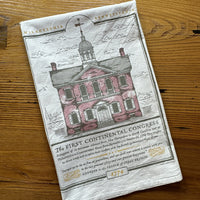
One of the recent items I advised on is this handsome portrait of the handsome Carpenters’ Hall in Philadelphia by artist and calligrapher Larry Stuart. It’s available as a print, a tea towel, and a magnet.

Two hundred fifty years ago this year, Carpenters’ Hall hosted the Continental Congress. That body was later renamed the First Continental Congress since a follow-up gathering at the nearby Pennsylvania State House ended up lasting for years and overshadowing its namesake. (So much so that that building is now Independence Hall.)

That created a challenge for how to explain the historic significance of what happened in Carpenters’ Hall in 1774. Conveying the mindset of that year meant not reading the First Continental Congress through the lens of the Second. Thus, we usually think the first Congress had delegates from twelve of the “thirteen colonies,” but there were open invitations to more than thirteen, and thirteen didn’t become a meaningful number for another few years.

Likewise, it seemed important to describe the First Continental Congress not as laying the groundwork for independence but as trying to resolve the dispute with Britain while avoiding independence and/or war. I found a quotation from the Congress’s address to the people of Great Britain which summed up the message of 1774:
Permit us to be as free as yourselves, and we shall ever esteem a union with you to be our greatest glory and our greatest happiness
(Of course, in the original eighteenth-century prose, that’s only a fragment of a much longer sentence.)

In addition, The History List just announced its advent calendar, conceived by proprietor Lee Wright.

This calendar counts down the days to 25 December because that was the night Gen. George Washington launched the attack on the Crown forces at Trenton, crossing the Delaware as depicted in the main image. Each window in that picture opens to a new image of some object associated with that event.

For this item, I drafted a brief description of how December 1776 was going for Washington. (Not well.) 

I don’t see any money from my little contributions to History List products, but every so often I do get ice cream.

Wednesday, October 30, 2024

“For the workmen here to go on with building barracks”

Like Richard Lechmere, quoted yesterday, the merchant John Andrews watched the conflict over housing the king’s troops in Boston in the fall of 1774.

Unlike Lechmere, Andrews leaned a little toward the Whigs. He, too, had protested the Boston committee of correspondence’s actions earlier in the year, but in a more mild way. He supported resistance against the Crown—as long as it didn’t threaten his business or his health.

In writing to his relative in Philadelphia on 25 September, Andrews emphasized how the people of Boston weren’t making life easy for the soldiers. He didn’t want people in other colonies to get the idea that Bostonians weren’t worthy of their support.
The example of our worthy brethren of New York, in not letting their vessels for Government service, as well as that their Carpenters would not engage in any work for ’em, has induc’d the country people to think seriously whether they were right in supplying with timber, joice, and Straw for the Barracks here.

They accordingly met and determin’d in ye. negative; sent committees to the severall contractors to let them know if they supply’d any further they would incur the resentment of the whole country; and at the same time signified to our committee of correspondence that they did not think it eligible for the workmen here to go on with building barracks or preparing houses for the reception of the troops, as we might possibly, by persisting, not only incur blame from our sister colonies, but essentially affect the union now subsisting between town and country; which circumstance caus’d the Committee to get together Saturday P.M., when they pass’d a vote, that it was not prudent for ye. workmen to go on with ye. frames, &ca., nor in any shape to contribute towards the accommodation of the soldiery, as they might themselves give offence to their country brethren.

The purport of which coming to the Governor [Thomas Gage], he sent his compliments to the Select men, and beg’d their attendance at six o’clock this evening, when he requested of them that they would not take any measures to prevent the workmen from going on with the barracks.

They reply’d it was not in their power to influence the country, and it lay principally with them whether the workmen should proceed or not: that they themselves were dispos’d to have the barracks go on, as they conceiv’d it much more for the benefit of the town (if the Soldiery must be here) to have them kept together, rather than to be scatter’d over the town, as in that case it would be a very difficult matter to keep them in order.

The Governor seem’d a great deal worried about ye. affair, and am told that in the course of the conversation he express’d himself thus—“Good G—d! for G—d’s sake, Gentlemen! they have got two months work to do, and the Soldiers ought to he in barracks in one. Do consider, Gentlemen!”—Thus the tables are in some measure turn’d. Formerly they solicited the Governor, but now it seems he solicits them.
As Andrews pointed out, that discussion happened on a Sunday, when Bostonians weren’t supposed to do any business unless it was really urgent.

TOMORROW: Trying to strike a bargain.

Tuesday, October 29, 2024

“The barracks that were begun now stand still”

Richard Lechmere was a friend of the royal government with a country estate in Cambridge.

In the summer of 1774, the ministry in London appointed Lechmere to the new mandamus Council. He accepted the post and for his safety moved into Boston.

Lechmere continued to support Gov. Thomas Gage’s administration, as shown in a letter he wrote to his London mercantile contacts on 28 September, published by the Massachusetts Historical Society:

Some time ago Capt. Mitchel left with me about 4000 feet plank, board measure, which I sold to the contractor for building barracks, who sent a cart to the wharfe for them. They got one load into the street, and the populace pull’d them out of the cart, and left them in the street ’till towards evening when a party of soldiers were sent to take them up, which was done without any interruption, but in the night all the rest of the plank were split in peices, and thrown into the water and lost.

This was the first instance of attempting to oppose the building the fortification at the Neck and barracks for the troops. They have since done every thing in their power to oppose and obstruct every measure of governmt. for the safety, as well as convenience of the troops, and finally have prevented the tradesmen from working for them, so that the barracks that were begun now stand still.

I have let them have my distill house, which was fitting for them, and in good forwardness for their reception, and will contain one regiment. By this step, selling the plank to them, accepting the office of a Councillor, my connection with the navy and army, together with my being an Addresser, Protestor against the Committee of Correspondence, and a variety of other incidents, has render’d me one of the most obnoxious of all the friends of government. This scituation, you must be sensible, is not the most desirable, especially to a person who very lately was, I may venture to say, as much esteem’d by the people as almost any private gentleman in town. . . .

They have gone so farr as to prohibit any person’s supplying the government with materials for the King’s service. They have burnt several loads straw at Roxbury, as they were coming in for the troops, and for a day stopp’d the butcher from bringing in beef and other provissions for them, but this last circumstance they soon found wou’d not do, for by this step they wou’d starve six or eight of their own party to one of the other, and that the General wou’d take possession of all the provissions and grain in the town.

They really act like distracted men more than reasonable beings, and seem at their wit’s end, what will become of them when a sufficient number of troops can be got here. By some parts of their conduct one wou’d imagine they were endeavourg. to bring things to extremities before a reinforcement can arrive, but are afraid to make the first attack, and by every act of insolence and impudence they seem to be contriving to provoke the General and troops to commence hostilities, but they, with that calmness and prudence that does them honor, carefully avoid, and put up with many insults and abuses ’till they may be sure of success, both in the town and in the country.
With every regiment in North America headed for Boston and the New England winter coming on, Gen. Gage was feeling pressure to find housing for his troops.

TOMORROW: Calling in the selectmen.