


J. L. BELL is a Massachusetts writer who specializes in (among other things) the start of the American Revolution in and around Boston. He is particularly interested in the experiences of children in 1765-75. He has published scholarly papers and popular articles for both children and adults. He was consultant for an episode of History Detectives, and contributed to a display at Minute Man National Historic Park.

Subscribe thru Follow.it


•••••••••••••••••


Showing posts with label William Dunlap. Show all posts

Sunday, April 02, 2017

The Tragedy of André
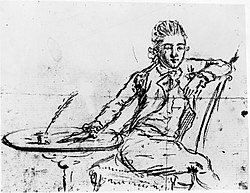
Speaking of William Dunlap’s tragedy André, my friend John W. Kennedy has created an online text of that play by transcribing the 1798 edition and annotating it. You can find it all here.

Kennedy writes:
William Dunlap (1766–1839) dominated American theatre in his day as no one else ever did but David Belasco. He was born in Perth Amboy, and the family later moved to New York City. There is a pretty, but questionable, legend to the effect that he may have seen some of the theatrical productions in occupied New York in which John André had a hand.

He traveled to England in 1784 to study with Benjamin West, as was practically de rigueur for aspiring young American painters, but seems to have chiefly fallen in love with the theatre there. Upon his return to America in 1787, his first thought was to write an imitation of Royall Tyler’s hit, The Contrast, and Dunlap’s The Modest Soldier or Love in New York was accepted, though never produced.

But he continued to write, and was soon successful enough to be asked in 1796 to become managing partner in the Old American Company, so called because it was the return of the American Company, founded in 1752, which had retreated to the West Indies in 1778 after Congress had outlawed theatrical performances as incompatible with the war effort. André is one of the plays of this portion of his career.
The result was a tragedy with a “curiously Greek construction—it is written in scenes for two or three, places all the physical activity offstage, takes place in only a few hours’ time, and really wants only a chorus to be perfectly Athenian.”

Dunlap’s blank-verse text is accompanied by several supplemental texts:
Here’s a sample from the play, as the character identified only as “the General” laments in Act 5 that he must let Maj. André’s execution proceed:
O what keen struggles must I undergo!
Unbless’d estate! to have the power to pardon;
The court’s stern sentence to remit;—give life;—
Feel the strong wish to use such blessed power;
Yet know that circumstances strong as fate
Forbid to obey the impulse. O, I feel
That man should never shed the blood of man.
And here’s a discussion by Elfin Vogel and Michael Bettencourt of the challenges of staging André.

Saturday, April 01, 2017

“General Washington was represented”?

I was preparing something else for today, but then the André Resource tweeted about William Dunlap’s 1798 tragedy André. The introduction for a modern edition says it’s the only play to depict George Washington on stage during his lifetime (and even then the character wasn’t named in the original text).

In reply, I noted that in January 1776 the British army staged Gen. John Burgoyne’s short play The Blockade of Boston in Faneuil Hall. I wrote about its interrupted debut here, here, and here. The play finally came off on 22 January.

Burgoyne may have portrayed Washington in his play. It was, after all, a satire on the Continental army besieging Boston at the time. But we can’t be sure because no text has survived.

We know the play depicted at least one general since Lt. William Feilding described its sole performance this way:
The Characters of the Yankee General and Figure of his Soldiers is inimatable, the Genl: a man who can’t Read but can Speachifie, and tell his Soldiers they are to obey the Voice of the People in the streets, the Joy the Rebells are in, in reading the Resolves of the Mayor and City of London in favor of the Con-ti-nen-tal Congress in Phi-li-del-phi-a pa-per is truly Characteristick.
Of course, at the time New England had the highest rate of literacy in the British Empire. But for Burgoyne and Feilding, a “Yankee General” couldn’t have had the education of a British aristocrat.

One source says that in The Blockade of Boston “General Washington was represented as an uncouth countryman, dressed shabbily, with large wig and long rusty sword.” That description has been quoted or paraphrased in many histories, as recently as this decade. However, its source was the “Diary of Dorothy Dudley,” a historical fiction written for the Centennial by Mary Williams Greeley.

That passage of the “Dudley diary” was thus a hoax inspired by a Continental escapade aimed at upsetting a British satire—and it’s fooled many authors. Which all adds up to an appropriate topic for this date.

Wednesday, August 20, 2014

A Child’s Memories of the Doctors’ Riot of 1788

A few days back I mentioned William Alexander Duer’s New-York as it Was, During the Latter Part of the Last Century, published in 1849.

Duer (shown here in a copy of a daguerreotype) was born in 1780, son of the British-born Patriot politician William Duer and grandson of the Continental general William Alexander, Lord Stirling.

Duer called the doctors’ riot of 1788 the “public occurrence that made the earliest, if not the deepest impression upon my memory.”

His retellings of events included details he couldn’t have been privy to at the time, and thus must have heard secondhand or taken from previous accounts. But he also described some dramatic moments that he or his family personally witnessed, recalled with the enthusiasm of a seven-year-old.

For example, the clash of an upper-class militia company on horseback and the crowd:
Never shall I forget the charge I saw made upon a body of the rioters by [Capt. John] Stakes’s light-horse. From our residence opposite St. Paul’s, I first perceived the troop as it debouched from Fair, now Fulton-street, and attacked the masses collected at the entrance of the “fields,” whence they were soon scattered, some of them retreating into the church-yard,—driven sword in hand through the portico, by the troopers striking right and left with the backs of their sabres.
And the wounding and care of Gen. Steuben:
The Baron de Steuben was struck by a stone which knocked him down, inflicted a flesh wound upon his forehead, and wrought a sudden change in the compassionate feelings he had previously entertained towards the mob. At the moment of receiving it, he was earnestly remonstrating with the Governor against ordering the militia to fire on the people; but, as soon as he was struck, the Baron’s benevolence deserted him, and as he fell he lustily cried out, “fire! Governor, fire!”

[Footnote:] Upon the occasion mentioned in the text, he was brought bleeding into my father’s house, accompanied by most of the cortege which had assembled at the gaol, and there being no surgeon to be had, my mother [Catherine Duer] staunched his wound, of which the old soldier made very light, and bound up his head. After his departure, Governor [George] Clinton amused the company by relating the above anecdote.
Duer thus left us both a delicious story about Steuben and the provenance for it: from Gov. Clinton to his mother and thence to him.

Another eyewitness, not so young, was William Dunlap (1766-1839), whose history of New York was posthumously published in 1840. He wrote that during the doctors’ riot, “The house of Sir John Temple, the British consul, in Queen Street, was with difficulty saved. It was said ‘Sir John’ was misinterpreted ‘Surgeon.’”

Temple was James Bowdoin’s son-in-law, a friendly Customs official in Boston before the Revolution, and the most likely conduit for Gov. Thomas Hutchinson’s letters to Benjamin Franklin. However, I can’t find any confirmation from Temple’s published papers for his house being mobbed in 1788.

TOMORROW: What about the medical student who started all the trouble?