J. L. BELL is a Massachusetts writer who specializes in (among other things) the start of the American Revolution in and around Boston. He is particularly interested in the experiences of children in 1765-75. He has published scholarly papers and popular articles for both children and adults. He was consultant for an episode of History Detectives, and contributed to a display at Minute Man National Historic Park.

Subscribe thru Follow.it


•••••••••••••••••


Showing posts with label Jonas Obscow. Show all posts

Thursday, March 12, 2020

Jonas Obscow, Natick Indian and Continental Soldier

Jonas Obscow (also spelled Obsco and Obscho) was born in Natick on 5 June 1739. The town’s vital records don’t identify his parents, but a man of the same name—presumably this baby’s father—died in 1745. His probate file, approved by Judge Samuel Danforth, said the most valuable part of his estate was 27 acres of land.

Four years later, in June 1749, Thaddeus Mason of Cambridge put young Jonas’s name on a list of Indians in Natick, “old and young,” separate from all other family groups.

On 27 Apr 1764, Jonas Obscow married Mary Speen, born to Abraham and Rachel Speen in 1738. “Abram Speen, wife and one child” had also appeared on the Mason list, and some of the late Jonas Obscow’s land bordered on Abraham Speen’s land, so the couple no doubt knew each other well.

The Obscows had three children recorded in the Natick record over the next few years:
  • Mary, born 18 Nov 1765
  • Abraham Speen, born in Walpole, 22 Dec 1767
  • Zurvia, born 4 Feb 1770 and dying exactly two months later
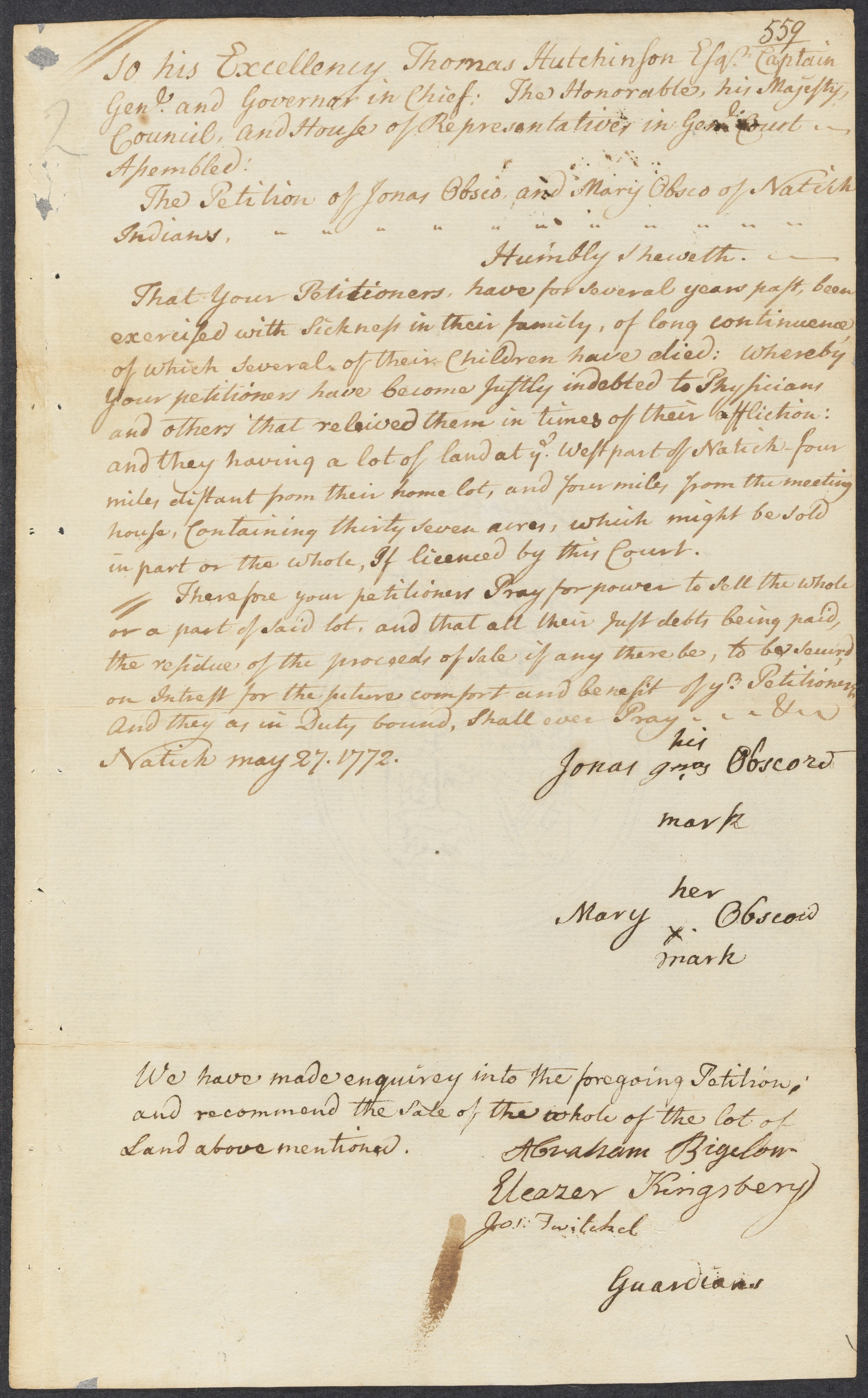
In May 1772, the Obscows petitioned the Massachusetts General Court to permit the sale of some of their property. Their plea said that they had “for several years past, been exercised with Sickness in their family, of long continuance, which several of their Children have died.” Now “indebted to Physicians and others who relieved them in times of their affliction,” they wanted to sell “a lot of land at ye. West part of Natick four miles distant from their home lot, and four miles from the meeting house, Containing thirty seven acres.”

The Obscows had to petition the legislature before selling any land because, as Natick Indians, they needed the approval of guardians for the tribe appointed by the province. This provision was no doubt instituted with the goal of protecting Native people from being gouged. Of course, it made them dependent on the good will of the white men appointed as their guardians. The Obscows signed their petition with their marks. Three guardians of the Natick Indians signed as well. The General Court approved the sale.

In May 1775, Jonas Obscow joined the Massachusetts army, enlisting in the company of Capt. Joseph Morse within Col. John Paterson’s regiment. Obscow served in the siege of Boston at least through November, when he received a bounty coat. Military service meant income and food, but it also meant leaving Mary and whatever children were still alive back in Natick.

Jonas Obscow also enlisted for a 1777 campaign against the British in Rhode Island. Around that time his marriage with Mary was ending.

In 1783 Mary Obscow petitioned for state approval to sell her own land. That petition said she and Jonas had had four children, “But one now living about 15 years of age”—probably Abraham Speen Obscow. Mary went on to say that Jonas “Left your Petitinor & Child about 7 years ago & married unbenone to your Petitioner.” Mary had suffered from from “great Sickness & other misfortune of Broken Bones &c.,” putting her in debt to “doctr’s & Nursing &c.” The legislature granted that petition.

As of October 1788, Mary Obscow was dead, though the guardians for the Natick Indians were still selling her land “for the purpose of paying her Just Debts, & for the benifit of her Heir at Law.” One guardian held £5.12s.9d. from that estate in 1790, when Abraham Speen Obscow had presumably come of age.

In 1789 a man named Abel Perry petitioned the state to allow the guardians to look into and approve Jonas Obscow’s sale of twelve acres to him. Many Natives in New England’s “praying towns” lost the land assigned to them in just this gradual way, as debts forced them to sell off their property.

In 1796, the selectmen of Natick described Jonas Obscow as “an Indian man who is blind and is also wholly unable to go by reason of the Rheumatism and has not Estate to support him.” They were petitioning for state money to feed and house Obscow and other poor people, including Caesar Ferrit. The Natick officials argued that their town, originally founded for Indians who had converted to Christianity, deserved special consideration since Natives were exempt from local taxes but still sent their children to town schools.

The Natick selectmen also pointed out that Indians “have taken in negros…with whom they marry and have children,” and then “Said children when of age suppose them selves Exempted from all Taxes.” In other words, they would have preferred for those people of both Native and African ancestry to be classified as Negro so they were taxable. If, however, the state hinged special grants to Natick based on its large Native population, the selectmen would no doubt have wanted those same people counted as Indian.

Jonas Obscow died in Natick on 13 Nov 1805, at the age of sixty-six.

Wednesday, February 04, 2015

Eager to Enlist, Yet Easily Overlooked: Eastern Massachusetts Indians in Combat in 1775

Today I’m pleased to share an essay from guest blogger David K. Thomas, a student at Colby College in Maine.

Isaac Comecho. Thomas Cognehew. Alexander Quapish. Joseph Paugenit. Fortune Burnee, Jr. These are not household names. But they are among the many American Indians from eastern Massachusetts who rushed to enlist when hostilities commenced in 1775. Each saw action in the Greater Boston area alongside his white and black neighbors.

The exemplary service of Stockbridge Indians from western Massachusetts and a lack of accessible documentation makes it easy to overlook these eastern Massachusetts Indians’ contributions.

Several dozen Indians from eastern Massachusetts were in action in 1775—while Indians were officially exempt from service. In fact, two hundred Indians from eastern Massachusetts—more than a third of all Indian males—eventually saw combat during the Revolutionary war in nearly all of the conflict’s major campaigns.

These included Mashpees and other Wampanoag Indians from dwindling reservations at Herring Pond, Plymouth, Dartmouth, and elsewhere. Aquinnah Wampanoags from Martha’s Vineyard also served. Nipmucs and Massachusett Indians such as the Naticks and the Ponkapoags—the remnants of Christian “Praying Town” communities—also enlisted. The tribal affiliations of other Indians remain unknown.

Military service provided a respite from a life spent wandering in search of farm work, whaling, or toiling as servants. Indian soldiers hoped that their service would lead to better times and improved treatment. Perhaps this explains why Eastern Massachusetts Indians fought so bravely in the opening battles of America’s war of independence.

Indian soldiers from Massachusetts hastened to enlist when the first Revolutionary shots were fired in 1775. Isaac Comecho, a Natick Indian, was present on the Battle Road between Lexington and Concord on April 19, 1775. Thomas Cognehew, a Mashpee Indian from Sandwich, also “marched on the alarm of April 19, 1775.” A struggling farmer, the Nipmuc Fortune Burnee, Jr., of Grafton, officially enlisted on April 26, 1775, a week after the Battles of Lexington and Concord (see Burnee’s name on a pay petition here).

Some Indians, like Henries Vomhavi (profiled on Boston 1775 in 2009) participated in raids on British posts. Less than two months later, sixteen Indians fought at the Battle of Bunker Hill. Five were from Massachusetts. These men included Natick Indians Alexander Quapish and Joseph Paugenit. Quapish served in Cambridge in 1775, but sickened and died early the next year.

Paugenit was the son of a wounded French and Indian War veteran. His surname is a shortened form of an Indian word for “codfish.” He later saw action at the Battles of Harlem Heights in 1776 and Saratoga in 1777. He died in a military hospital in Albany before the end of 1777, at just 23 years old. An exact death toll for Indian patriots remains unclear, but these deaths strained already struggling Indian communities.

Indians in the army camp at Cambridge in 1775 no doubt met Stockbridge Indians, Connecticut Indians, maybe even Indians visiting from Maine. They may have even been detached to pick off of British sentries and to join an Indian-led attack on British barges sounding the mouth of the Charles River.

In the short term, there were clear financial incentives to join the American cause in the starting phases of the Revolutionary War. Some Indians, like the debt-ridden Jonas Obscow, who had buried three sick children in the years prior to 1775 (as he and his wife wrote in a 27 May 1772 petition to the province), were all but forced to join the Continental Army out of economic necessity.

From the start of the Revolution, all enlisted Massachusetts Patriots of color found generous enlistment bounties and pay equal to that of white soldiers. Moreover, Indians received either a “bounty coat” or the equivalent in cash from the Continental Army. For instance, Wampanoags Samuel James and Robert Pegin, both of Bridgewater, received their bounty coats in December 1775.

Despite the initial reluctance of the Continental Congress to employ Indian (and African American) soldiers, in December of 1775, Massachusetts officials called on Indian soldiers “in the case of real necessity.” New England Indians became more prevalent in the Continental Army.

The services of Eastern Massachusetts’ Indians in 1775 proved to be only the beginnings of many distinguished military careers. Yet despite their services and sacrifices, little improved for these Native Patriots or their Indian communities after the war.

Recent developments, particularly several ceremonies in Natick in the 2000s, have resulted in renewed attention to Massachusetts Indians’ contributions to the American cause and represent an increased interest in their service and contributions.

The major sources for information on Native soldiers in the first year of the Revolutionary War include George Quintal, Jr., Patriots of Color: “A Peculiar Beauty and Merit”; the Massachusetts Soldiers and Sailors of the Revolutionary War series; and the National Society of the Daughters of the American Revolution, Minority Military Service, Massachusetts: 1775-1783.

This article is a nice match to Thomas’s professor Daniel J. Tortora’s article at the Journal of the American Revolution today, tracking Native American soldiers from Massachusetts through the war. Thanks to both men for the contribution!