J. L. BELL is a Massachusetts writer who specializes in (among other things) the start of the American Revolution in and around Boston. He is particularly interested in the experiences of children in 1765-75. He has published scholarly papers and popular articles for both children and adults. He was consultant for an episode of History Detectives, and contributed to a display at Minute Man National Historic Park.

Subscribe thru Follow.it


•••••••••••••••••


Showing posts with label Susannah Linzee. Show all posts

Wednesday, June 19, 2024

John Linzee and “the appearance of mental derangement”

On 4 Oct 1792, about two months after giving birth to her tenth child in Boston, Susannah Linzee died. She was thirty-eight years old.

That baby, named George Inman Linzee, died the following 21 March.

His next oldest sister, Mary Inman Linzee, died on 18 May.

Within a year, retired Royal Navy captain John Linzee had lost his wife and their two youngest children. He was still responsible for six older children.

(The oldest, Samuel Hood Linzee, was by then a lieutenant in the Royal Navy. He had gotten a head start in the seniority system by being listed as his father’s servant and senior clerk aboard H.M.S. Falcon in 1775, when he was less than two years old.)

The death of Linzee’s wife also led to him losing his house on Essex Street in Boston. The merchant John Rowe had left it to his niece Susannah in his will, but only after the death of his widow, Hannah Rowe.

Rowe had her own house nearby, but she decided to reclaim this one now that Susannah hadn’t survived to inherit it. In July 1794 the widow told the court she owned the
House & Land…demised to the said John Linzee for a Term that is past, after which it ought to return to her again, but the said John Linzee still withholds the said House & Land & their appurtenances
She sued the retired captain for £1,000. Sheriff Jeremiah Allen certified that he had “attached a chair as the property of the within named John Linzee and left a summons at his last and usual place of Abode.”

John William Linzee’s 1917 history of the family reprints a couple of documents from that court case but doesn’t show how it was resolved. He declared, “this disagreement was of short duration,” pointing to how Hannah Rowe left bequests to the Linzee children. However, that will was written in 1803, after John Linzee had died. It would be just as consistent with Hannah Rowe strong-arming him out of the scene and raising her great-nephews and great-nieces herself.

In fact, there’s evidence that the death of his wife cast Linzee into a depression that alienated him from people. The merchant Samuel Breck, who praised the captain as “a good officer” in earlier years, recalled:
At her death the eccentricities of the captain assumed the appearance of mental derangement. He retired to a small box in the neighborhood of Milton, where he lived entirely by himself, rode out armed, and tapped his cider-cask by firing a ball into the head.

As he was seldom to be seen at home, he fixed a parcel of hooks in his kitchen for the butchers to hang their meat on, giving a standing order to put daily a joint upon one of the hooks. It so happened on one occasion, when he was detained in Boston about a fortnight by sickness, that he found on his return home fifteen or sixteen pieces of meat hanging around the walls of his kitchen.
Linzee died in 1798. He left his estate, worth almost $18,000, to his children and grandchildren and asked to be buried next to his wife.

The Linzees’ oldest daughter, Hannah, married Thomas C. Amory. Their son John Inman Linzee served as treasurer of Massachusetts. A granddaughter married a grandson of Dr. John Warren, a great-granddaughter married a grandson of Paul Revere, and, as I wrote here, another granddaughter married a grandson of William Prescott.

Tuesday, June 18, 2024

“Delivered to said linzee two hundred and seven sheep”

In January 1791, Capt. John Linzee, R.N., wrote that in the following month he planned to make his second return to Boston since the end of the American War.

As I described yesterday, Linzee’s wife, the former Susannah Inman, had settled in that port with most of their children in a house left to her by the merchant John Rowe.

According to Royal Navy records, John Linzee resigned from the service in September 1791. (Other sources say he retired after events of the following year, but this looks more authoritative.)

The captain settled in Boston, and Susannah Inman gave birth to a son on 7 Aug 1792.

After that, John Linzee went through a string of hardships.

First, on 30 August, Joseph Tucker of Dartmouth sued the captain for the cost of sheep he had collected back on 1 May 1775. In September, Suffolk County sheriff Jeremiah Allen reported arresting Linzee on a writ, though he let the man go on bail.

At first Linzee argued that he had been and remained “a Subject of the King of Great Britain and not a Citizen of this Commonwealth,” so the case should be handled in the federal system. The Barnstable County court refused.

Ebenezer Meiggs of Rochester provided the most coherent description of the dispute:
I being at one of the Elizabeth Islands Called Peek [Penikese? Pasque?] in Company with Joseph tucker of Dartmouth I heard one John Linzee a Captain of a brittish ship of war bargain with said tucker for two hundred and seven sheep for which he agreed to give two dollars for Each sheep besides or without the wool

accordingly the said tucker delivered to said linzee two hundred and seven sheep on board his ship and as the said Linzee was in a hurry to gett them a board he ordered them to be got aboard before they ware all Shorn Promissing said tucker that he would take his shearers on board the ship next morning and that they might take the wool of them or he would Pay the value of it

accordingly the sheep ware Put on board with the wool on as many as one hundred and I helped get them on board but the next morning the said Linzee hove up and went off without fetching the Shearers on board or Paying for the sheep
Linzee denied ever having made such a deal.

Back on 31 May 1775, islander Elisha Nye had lodged a similar complaint against Capt. Linzee for taking sheep and calves off “one of the Elizabeth Islands, commonly called Naushan [Nashawena].” Like Tucker, Nye felt that he and Linzee had agreed on terms, only for the navy to grab livestock and sail away. That complaint went to the Massachusetts committee of safety and then into a file, and it doesn’t appear to have come up during Tucker v. Linzee.

Undoubtedly in May 1775 Capt. Linzee was acting on behalf of the Crown. His assignment was to collect food for the besieged Boston garrison. By coming to live in Massachusetts with his wife and children, however, the retired captain had made himself vulnerable to a personal lawsuit.

In May 1793, a Barnstable County jury found against Linzee and ordered him to pay Tucker £150 and costs.

According to family historian John William Linzee, “the debt was paid by Captain Linzee out of his own private purse, and there is no evidence that he was ever reimbursed by the English government.” Neither is there documentation in that history of Linzee’s payment, however.

But by 1793 that court case was the least of the captain’s troubles.

TOMORROW: Deaths in the family.

Monday, June 17, 2024

Capt. John Linzee’s Ties to Boston

This is the anniversary of the Battle of Bunker Hill in 1775.

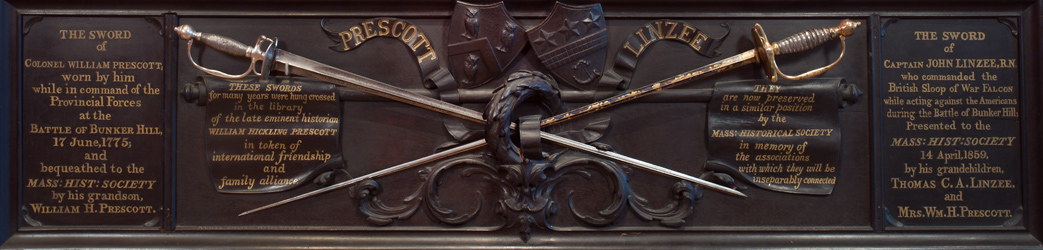
Among the Massachusetts Historical Society’s unique artifacts from that event are the crossed swords of Col. William Prescott from the provincial troops and Capt. John Linzee from the Royal Navy, as highlighted here.

Those weapons were donated by the historian William Hickling Prescott, his wife Susannah, and her cousin. William was a grandson of the colonel. Susannah was a granddaughter of the captain.

Though born in England and serving the king, Capt. Linzee had strong ties to Boston. In 1772, while master of H.M.S. Beaver, he married Susannah Inman of Cambridge, favored niece of John and Hannah Rowe.

The Linzees started having children. The first was born in Plymouth, England; the second back in Boston during the siege; the third on the Delaware River, reportedly during a battle which it didn’t outlive.

The Linzees’ fourth child was born at Barbados, the next four in Plymouth. The captain had a busy war.

Susannah Linzee’s father, Ralph Inman, had left Boston in the evacuation of 1776. Her stepmother, Elizabeth (Murray Campbell Smith) Inman, never left. She kept hold of their property, which is how he could return to his Cambridge estate when the fighting died down.

John Rowe also never left. When that merchant died in 1787, he bequeathed Susannah Linzee some Boston property. She came back to America, and the Linzees’ ninth child was born in Boston in 1789.

The following September, Capt. Linzee sailed H.M.S. Penelope into Boston harbor, writing to Gov. John Hancock that he intended to salute the flag of the U.S. of A. with thirteen guns if the battery at the Castle would reciprocate.

Linzee’s letter also mentioned his “exceeding ill State of Health,” and indeed he was so sick the Penelope sailed away without him while he recuperated in his wife’s house. A few months later, however, Capt. Linzee was back “in perfect health” on his ship along with his two eldest sons.

In the following years, things started to go wrong for Capt. Linzee.

TOMORROW: A British officer in Boston.

Friday, December 25, 2020

A “very Cheerfull” Christmas at the Rowes’

The merchant John Rowe was one of Boston’s leading Anglicans, so he celebrated Christmas while his Congregationalist neighbors generally ignored the holiday.

Here’s how Rowe described 25 Dec 1770 in his published diary, 250 years ago today:
Christmas Day — I dined at home with Capt. John Linzee Mr. John Lane, Dr. Miller Joseph Golthwait Mr. Inman, Mrs. Rowe, Miss Lucy Flucker & Sucky Inman — The same Company staid & spent the afternoon & evening & wee were very Cheerfull.
That’s a lot of different surnames, but I can map close relations among many of those people. “Mrs. Rowe” was the diarist’s wife, of course, the former Hannah Speakman.

Before Hannah’s sister Susannah died in 1761, she had married Ralph Inman (1713-1788, shown above courtesy of the Harvard Art Museums). The Inmans’ daughter “Sucky” or Susannah (1754-1792) lived in Boston with her aunt and uncle Rowe, and her father had come in from Cambridge for this holiday.

John Linzee (1743-1798) was a captain in the Royal Navy who would spend increasing time at the Rowes’ house in 1772. Finally that summer he married Susannah Inman, then eighteen years old. Later he participated in the Battle of Bunker Hill and some other naval actions during the siege of Boston.

Lucy Flucker (1756-1824) was probably at this party as a teen-aged friend of Sucky Inman. She spotted Henry Knox in a militia parade in 1773 and married him the next year. She thus got to see the war from the other side.

Joseph Goldthwait (1730-1779) was a former major in the provincial army who became commissary to the royal troops in 1768 and filled other posts in military administration afterward. He died of illness in New York during the war.

John Lane was a London merchant and “Old Friend” of Rowe’s. Depending on what “Old Friend” meant, they may have met as young men when Rowe was still in England or recently when “John Lane, jun.” visited Boston and New York in 1764-65. Lane came back to Boston in August 1769 “in the Nassau very unexpected,” Rowe wrote, and he stayed until July 1771, regularly appearing in Rowe’s diary. In March 1771, for example, Rowe came home to find Lane and another man singing and playing his niece’s spinet.

Lane’s family firm, called Lane, Son & Fraser in this period, did a lot of business with Rowe and other New England merchants. They even owned ships together, including the Eleanor, one of the vessels at risk in the Boston Tea Party. After Capt. Linzee married Sucky Inman, Rowe wrote: “I gave Capt. Linzee a Letter with Orders to draw on me every New Years Day Twenty Pounds Sterling, taking the money of Messrs. Lane Son & Fraser for my acct.”

In 1786 John Lane came back to Boston with his son, apparently planning to settle permanently. In 1790 Lane, “now resident at Boston,” filed a lawsuit to seize a vessel that Lane, Son & Fraser had invested in. But the next mention of the firm in the Boston newspapers, in the 14 June 1793 Argus, said the firm had gone bankrupt in London.

Dan Byrnes has striven to collect and parse information about Lane, Son & Fraser because of an Australian connection, as this webpage shows, but it doesn’t make anything clearer for me. It’s likely there were two or three generations of men named John Lane (Jr.) who have to be sorted out.

That leaves only Dr. Miller to be accounted for. That name doesn’t appear among the local physicians of this period. It’s possible he was a surgeon attached to the Royal Navy or even the 14th Regiment of Foot, stationed at the Castle.