J. L. BELL is a Massachusetts writer who specializes in (among other things) the start of the American Revolution in and around Boston. He is particularly interested in the experiences of children in 1765-75. He has published scholarly papers and popular articles for both children and adults. He was consultant for an episode of History Detectives, and contributed to a display at Minute Man National Historic Park.

Subscribe thru Follow.it


•••••••••••••••••


Showing posts with label Samuel Hall. Show all posts

Sunday, August 16, 2026

“May God preserve this second Sodom”

On 25 May 1775, one week after the New-England Chronicle’s initial, hazy report on the fire that started in the 65th Regiment’s barracks, printers Samuel and Ebenezer Hall returned to the subject with a longer dispatch.

This article started by summarizing the account of how the fire started and listing a few damaged buildings. It continued:
The following Letter contains an Account of the Transactions of the Military at the Fire; and will give the Public some Idea of the present wretched Police of that once well governed Town.

Extract of a Letter from Boston.

“I propose to give you a circumstantial Account of the late Fire, previous to which please to observe, that for ten Days past, a Report has been propagated, that the Liberty Party intended to set Fire to the Town in different Places as soon as the greater Part of them had got out.

The General [Thomas Gage] took the Alarm, and took the Engines under Guard, and appointed new Captains; the late Engine Men took umbrage at it; but to the Point.---

I being informed that Barrack was on Fire, ran through the Street crying Fire, (as no Bells rang) but was stopped by a Man who told me it was the Officer’s Order not to cry Fire, one having threatened to beat the Man’s Brains out that did. The Drums all this Time beating to Arms.

When I came to the Fire I found no engine there. Applying to one of the late Engine Men to know the Reason, was informed that he had applied for the Engine, but the Bayonet was pointed at him, and he was told that he must apply to some Officer for an Order before he could have it.

After this fatal Delay the Engines appeared with the new appointed Captains and military Firewards, and a miserable figure they cut, the former not knowing how to obey if the latter had known how to command.---

Upon the whole, it appears to me as plain as the meridian Sun, had the Engines been on the old Footing, the Fire would have been put out, and *twenty thousand Pounds Sterling Loss prevented. Let that be as it may, I will venture to say, had the Fire broke out in the Center of the Town it would have laid it in Ashes, in the Direction it took to the Water. May God preserve this second Sodom from the Fate of the First.”

* The whole Loss is thought to be £40,000 Sterling.
After that Hall printed the complete list of property losses that had already appeared in the Newport Mercury and other papers. That list included: “50 Barrels of Flour, belonging to the Donation Stock, destroyed.” That stock was food donated to feed the poor of Boston since the previous year’s Port Bill.

That contemporaneous account was rewritten for the Saturday Morning Transcript of 15 Mar 1834 under the headline “Fire Reminiscences: No XVI.” The best new line put into the original voice was: “I asked the reason of such extraordinary delay, and was told by an Engineman that he had been to his Engine, but the bayonets were too thick.”

That text in turn was printed with small changes in Arthur Wellington Brayley’s A Complete History of the Boston Fire Department in 1889.

As a first-person account, it was more dramatic than the list of burned buildings alone. At the same time, the writer and printers had a political message about how military occupation was damaging the community.

TOMORROW: Back to Benjamin Davis.

Saturday, August 15, 2026

Spreading the News of the Spread of a Fire

We can see the spread of news in the spring of 1775 through articles on the fire in Boston on the night of 17–18 May 1775.

The first printed report appeared in Samuel Hall’s Cambridge-based New-England Chronicle on 18 May, in the middle of other local news:
A terrible Fire broke out in Boston about 9 o’Clock last Evening, and raged a long Time. We hear it began just above the Draw Bridge, and burnt along the Town-Dock. A great Number of Buildings are doubtless consumed; but it is not possible to collect the Particulars for this Paper.
That same dire but vague paragraph was reprinted in Hartford on 22 May, Portsmouth on 26 May, and Philadelphia on 29 May.

Ebenezer Watson’s Connecticut Courant of Hartford confirmed that report in the 22 May issue by also quoting “a Letter from a Gentlemen in Cambridge…dated May 18”:
They had a great Fire in Boston last Night---it appeared to be between King-Street and the Market---it continued all night, and is not yet extinguished. What has really happened, is to us uncertain, as yet.
James Rivington chose to run the latter item in his 25 May New-York Gazetteer.

Meanwhile, on 22 May Solomon Southwick’s Newport Mercury offered an extract from “a manuscript account of the fire which happened in Boston last Wednesday night”:
The fire began in the barracks, under the arch formerly improved by Benjamin Davis, about half after eight o’clock, 17th May.—The soldiers were receiving some cartridges, by which means one took fire, and communicated to many more, which immediately set fire to the room.
That account then listed many property owners starting with John Hancock and including “a cooper’s shop, owned by Eliakim Hutchinson, adjoining the town dock, improved for barracks.” It concluded:
Instead of ringing the bells as usual, the soldiers beat to arms, by which means the people were in great confusion, not being used to such signals in time of fire.

N.B. The inhabitants took particular care to save the goods in Mr. Hancock’s store.
Curiously, in his 26 May New-Hampshire Gazette Daniel Fowle printed a version of that same detailed report on page 1 even as on page 3 he ran the New-England Chronicle’s first story saying it was “not possible to collect the Particulars for this Paper.”

John Holt put the “manuscript account” in his New-York Journal on 1 June with the dateline “CAMBRIDGE, May 12”—an obvious error since the fire hadn’t yet occurred then. Presumably Holt’s shop should have printed 19, 21, or 22 May, getting one digit wrong or transposing them.

No newspaper was published in Cambridge on those dates, suggesting Holt indeed took that text from a manuscript, not from a preceding newspaper. In addition, that text never appeared in the New-England Chronicle, the only newspaper then published out of Cambridge.

That strongly suggests that the Patriot authorities in Cambridge, perhaps Boston town officials in exile, sent their own quasi-official report on the fire out to newspapers in other colonies.

TOMORROW: A more pointed description.

Tuesday, March 17, 2026

“This Convinced me that they were Actually fled”

Gen. John Sullivan of New Hampshire wrote this description of how experienced the end of the siege of Boston for John Adams:

We Saw the Ships under way about 8 in the morning and the River full of Boats with Armed Soldiers. This gave an Alarm as Some Suspected they were about to Land at Dochester but having a full view of them with a Glass from Plowed Hill I found they were going on board the Ships.

I then took my Horse and Rode Down to Charlestown Neck where I had a Clear view of Bunkers Hill. I Saw the Sentrys Standing as usual with their Firelocks Shouldered but finding they never moved I Soon Suspected what Regiment they belonged to and upon taking a Clear view with my Glass found they were only Effigies Set there by the flying Enemy. This Convinced me that they were Actually fled for if they meant to Decoy us they would have taken away Every appearance of Men.

By this time I was Joined by Colo. [Thomas] Mifflin who with my Brigade Major [Alexander Scammell] agreed to go up[;] Sending two persons Round the works to Examine whether there was any of them in the Rear of the works while we went up in the front. I at the Same time Sent for a Strong party to follow us on to the Hill to assist us in Running away (if necessary).

We found no persons there and bravely Took a fortress Defended by Lifeless Sentries. I then brought on the party to Secure what we had So bravely won and went Down to the other works where we found all Abandoned but the works not Injured in any part.

We hailed the ferry Boat which came over and Informed us that they had abandoned the Town. We then gave Information to the General who ordered me with the Troops under my Command to take possession of Charlestown and General [Israel] Putnam with 2000 men to take possession of the works in Boston
Samuel Hall’s New-England Chronicle for 21 March offered the public this account of the action at the other end of Boston on the Neck:
About the same time General [Artemas] Ward, attended by about 500 troops from Roxbury, under the command of Col. Ebenezer Learned, (who unbarr’d and opened the gates) entered the town on that quarter, Ensign [Samuel] Richards carrying the standard.

The command of the whole being then given to General Putnam, he proceeded to take possession of all the important posts, and thereby became possessed, in the name of the Thirteen United Colonies of North-America, of all the fortresses in that large and once populous and flourishing metropolis, which the flower of the British army, headed by an experienced General, and supported by a formidable fleet of men of war, had, but an hour before, evacuated in the most precipitate and cowardly manner.
That’s rubbing it in, don’t you think?

TOMORROW: Ens. Richards’s perspective.

Monday, November 11, 2024

Looking at Lexington and Concord through Eighteenth-Century Eyes

Last month Alexander Cain at Historical Nerdery announced a resource for people researching the Battle of Lexington and Concord ahead of next spring’s Sestercentennial: a list of links to eyewitness accounts of the day.

That listing will be very useful, and it can grow. Perforce these are texts that have been digitized in one way or another. I’m sure that more lurk within books, newspapers, and letters. It’s a matter of ferreting them out and/or digitizing them in usable forms.

For instance, here is the list’s link to Gen. Thomas Gage’s instructions to Lt. Col. Francis Smith for the march to Concord on 18–19 April.

We also have what appears to be Gage’s notes or first draft of those instructions, quoted in General Gage’s Informers (1932) by Allan French. A digital version of that book can be borrowed from the Internet Archive, at least for now. Look on pages 29–30.

Since the Massachusetts Historical Society has scanned merchant John Rowe’s diaries, we can see his response to the news coming into Boston here. A transcription of what a descendant thought were the most important parts of that diary was published a century ago. Among the details one can find only in the handwritten journal is that on 20 April Capt. John Linzee, R.N., dined and spent the evening at Rowe’s house after fending off an attack on his ship on the Charles River.

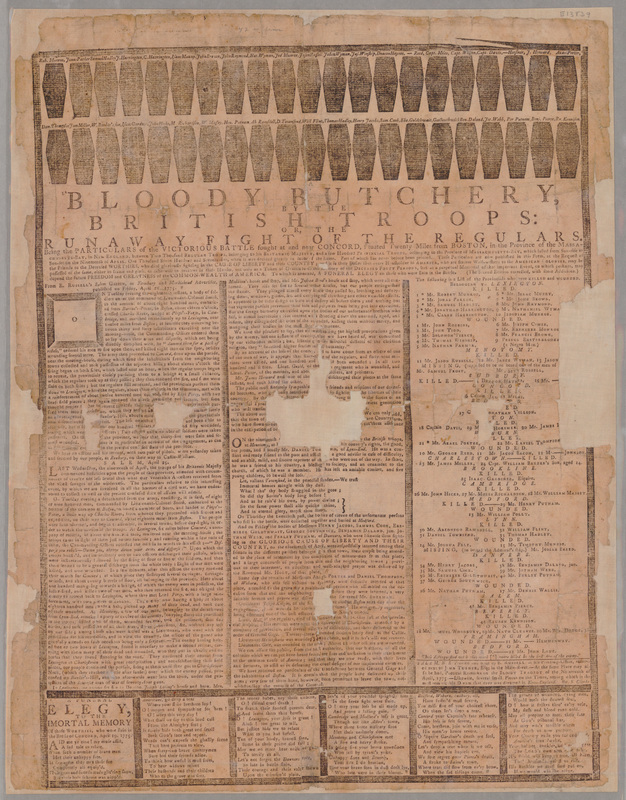
It’s possible to identify the sources of some anonymous accounts. One resource on the list, Ezekiel Russell’s “Bloody Butchery by the British Troops” broadside, includes text headlined “SALEM, April 25.” Those paragraphs commence: “LAST Wednesday, the nineteenth of April, the troops of his Britannic Majesty commenced hostilities upon the people of this province…”

The preceding paragraphs come with a source citation—not coincidentally, to Russell’s own Salem Gazette newspaper. But Russell didn’t give his competition publicity by revealing that he took the second and longer passage from Samuel Hall’s Essex Gazette for 25 April. That text was later imperfectly transcribed in Peter Force’s American Archives.

The 3 May Massachusetts Spy on the list includes an unsourced story about what happened “When the expresses [from Boston] got about a mile beyond Lexington.” That story matches one that William Dawes’s family recalled hearing from him, revealing that Dawes was probably printer Isaiah Thomas’s source.

Among the lately revealed visual resources is this hand-drawn map in the Library of Congress. I’m convinced by Ed Redmond’s hypothesis that Ens. Henry DeBerniere created this map ahead of the march to Concord. It thus offers a look at what British army officers knew of the countryside west of Boston. (I discussed details of that map starting here.)

TOMORROW: A source from May 1775.

Sunday, May 19, 2024

“The taste of their fish being altered”

Just because the British Empire was sliding toward internal warfare in 1774, that was no reason to stop laughing about the news.

Here are a couple of items that appeared in New England newspapers 250 years ago.

The first must have originated in a London newspaper. The earliest North American reprinting I’ve found is in John Dunlap’s Pennsylvania Packet on 18 Apr 1774. Four days later it appeared in both Isaiah Thomas’s Massachusetts Spy and Timothy Green’s Connecticut Gazette of New London, followed by other papers.

Jan. 28. Letters from Boston complain much of the taste of their fish being altered: Four or five hundred chests of tea may have so contaminated the water in the harbour, that the fish may have contracted a disorder not unlike the nervous complaints of the human body. Should this complaint extend itself as far as the banks of Newfoundland, our Spanish and Portugal fish trade may be much affected by it.
Needless to say, even 340 chests of tea dumped off Griffin’s Wharf weren’t really enough to affect the New England fisheries.
Earlier this month artist Cortney Skinner shared this clip from the 9 May 1774 Boston Gazette. It appeared on page 3 right after a political essay and right before the many mercantile ads it resembled.

This notice reads:
WANTED immediately,
A long, strong BOOM,
that will reach from Cape-Cod to Cape-Ann.———
Any Person having such an One to dispose of, will meet with a good Price, by applying to
N***H.
N. B. The Distance is only 18 Leagues.
This was a poke at Lord North’s plan to close Boston harbor to shipping. Unofficial hints of the Boston Port Bill had started to arrive, and Edes and Gill wanted readers to laugh at the folly of that policy.

The same satirical ad appeared the next day in Samuel and Ebenezer Hall’s Essex Gazette of Salem.

Then the text was reprinted (though no longer looking like an advertisement) in the 16 May New-York Gazette, the 18 May New-Haven Post-Boy and Pennsylvania Journal, and the 23 May Newport Mercury. For readers without so much maritime experience, the capper became “The Distance only 54 miles.”

When the Royal Navy and Customs service really did shut down the port of Boston in June, though, suddenly the situation didn’t seem so laughable.

Tuesday, July 25, 2023

The Journey of Phillis Wheatley’s First Published Poem

As related in yesterday’s posting, a storm in September 1767 pushed a schooner packed with whale oil onto Cape Cod.

But that ship wasn’t lost, the cargo was preserved, and nobody died. Not much drama after all.

Nonetheless, the stories of two survivors—evidently Nantucketers Stephen Hussey and Richard Coffin—contained enough emotion to inspire John Wheatley’s enslaved teen-aged servant Phillis to write 24 lines of poetry (plus a prose interlude).

Titled “On Messrs. Hussey and Coffin,” that poem appeared in Samuel Hall’s Newport Mercury on 21 Dec 1767—the first recognized publication by Phillis Wheatley. You can read the lines here alongside Amelia Yeager’s essay about the publication for the Newport Historical Society.

David Waldstreicher starts his new study of the poet, The Odyssey of Phillis Wheatley, with this poem and returns to it often as a touchstone of her work, particularly for her braiding of classical and Calvinist motifs and her ocean imagery.

The poem and its publication raise some small questions beyond the identity of the two men, discussed yesterday. One is why Hussey’s name appears first in the poem’s title and in the anecdote published with it in the newspaper even though Coffin was the ship’s captain and the only person named in the reports of the grounding.

I suspect this was a matter of personality. Hussey seems to have been a sociable man, connecting the Boston and Nantucket business communities before the war; serving in Whig political gatherings; speaking for Nantucket businessmen to both the British and Patriot governments during the war (islanders wanted to stay neutral for both economic and religious reasons); and eventually taking a post with the federal Customs bureau. I suspect he just told the story better.

Another question is whether Phillis Wheatley and the family who owned her sought this publication. I think the answer to that is clear in how the poem appeared in the Boston Post-Boy when that newspaper reprinted it on 11 Jan 1768. The “Wheatley” name was eliminated:
  • “belonging to one Mr. Wheatley of Boston” became “belonging to a Gentelman [sic] of Boston”
  • “being at Mr. Wheatley’s, and, while at Dinner” became “being at Dinner”
  • The name at the bottom of the poem changed from “Phillis Wheatley” to simply “PHILLIS.”
Obviously printers John Green and Joseph Russell thought the Wheatleys didn’t want their surname linked to the poem. They may even have heard directly from the family. However supportive of their protégée and property the Wheatleys became later, at the start of 1768 they were still reticent about what we’d call publicity.

I suspect that’s why this poem didn’t appear in a Boston newspaper until after it could be credited as “From the Newport Mercury.” John Wheatley was a wealthy merchant who occasionally advertised, the sort of gentleman local newspaper printers would want to keep happy.

Still, someone must have circulated the poem privately in manuscript for it to get from Boston to Newport. That might have been the Wheatleys, sharing the news among friends and expecting it to stay private. Conversely, the poem might have been spread by Hussey and Coffin within their Quaker network. (I doubt the teen poet had developed her own out-of-town network yet.)

I tested a couple of other possible explanations for the first publication in Rhode Island:
  • Did the Newport Mercury run poetry while the Boston papers weren’t yet in that habit? No, Boston printers shared a lot of poems in the 1760s.
  • Was Capt. Coffin’s near-shipwreck bigger news in Rhode Island than in Boston since it involved a Nantucket ship? Not only is Nantucket closer to Newport, but both places had large Quaker communities. However, Samuel Hall didn’t pick up the Boston reports about the schooner grounding. (The Providence Gazette for 10 October did carry the second item, reporting Coffin’s ship was safe.*)
In the end, I think someone in Newport who didn’t know the Wheatleys learned about the poem and the story behind it, and asked the local printer to publish it. Hall in turn was beyond John Wheatley’s reach.

What would have prompted such a Newporter to send to poem to Hall? That person was clearly struck by how the author was “a Negro Girl,” and enslaved at that. That’s not merely a footnote to the poem; it’s in the preface, the implicit reason for printing it.

Even the name “Phillis Wheatley” at the bottom of the poem might be significant. Many other early publications credited the poet only by her first name. For example, Ezekiel Russell’s broadside of her elegy to the Rev. George Whitefield said: “By PHILLIS, a Servant Girl of 17 Years of Age, Belonging to Mr. J. WHEATLEY, of Boston.” By 1770 the Wheatley family had become comfortable having their names attached to such publications, but the prevailing style was still not to formally acknowledge enslaved people’s surnames.

Those details make me think whoever asked Hall to print the poem wanted readers of the Newport Mercury to know an enslaved girl had written it—and perhaps to see that that girl was an individual. And, though nothing about the presentation commented on the injustice of slavery, was it possible to avoid that thought?

(* In the database that I access through Genealogy Bank, the 10 October and 3 October Providence Gazettes are mushed together. Looks like something went wrong when they were photographed for microfilm.)

Monday, July 24, 2023

The Mystery of Phillis Wheatley’s First Published Poem

Earlier this month the Newport Historical Society shared Amelia Yeager’s essay on a question about the career of Phillis Wheatley: Why did the teenager’s poetry first appear in print in the 21 Dec 1767 Newport Mercury rather than a Boston newspaper?

Yeager phrases the question as “Why would Phillis Wheatley publish her first poem in a Newport paper rather than one of the many newspapers local to Boston?” She writes of printer Samuel Hall’s choice “to accept the poem,” as if it had been a submission to a literary magazine.

As much as I’m all for recognizing the agency of enslaved people, I doubt the young poet had much say in that matter. Not only was she enslaved, but she was still in her early teens. Furthermore, in a society without copyrights, writers rarely had control over where their words might appear in print. In modern terms, printers compensated young creatives with exposure.

In the Newport Mercury Hall prefaced this poem with the cover message he had received:
To the PRINTER.

Please to insert the following Lines, composed by a Negro Girl (belonging to one Mr. Wheatley of Boston) on the following Occasion, viz. Messrs Hussey and Coffin, as undermentioned, belonging to Nantucket, being bound from thence to Boston, narrowly escaped being cast away on Cape-Cod, in one of the late Storms; upon their Arrival, being at Mr. Wheatley’s, and, while at Dinner, told of their narrow Escape, this Negro Girl at the same Time ’tending Table, heard the Relation, from which she composed the following Verses.
That paragraph wasn’t written from the perspective of the “Negro Girl” herself, or even from the family of her legal owner John Wheatley, identified unfamiliarly as “one Mr. Wheatley of Boston.” Rather, it’s the voice of someone who heard this fascinating anecdote and wanted to pass it on. (To be sure, anyone in the Wheatley family could have adopted that persona, but it doesn’t match how they presented her later work.)

Likewise, Yeager also writes:
Later in her life, Wheatley would have difficulty placing poems for publication; it was only with patronage from England that her first and only book of poetry was published.
Again, I think that misinterprets the situation by viewing it through the lens of hopeful writers in a more recent environment. Wheatley had many poems printed in Boston in the early 1770s. She was recognized locally. What she wanted, understandably, was to be paid for her writing—and to minimize the publication costs that authors usually assumed for a first edition.

By that time, Phillis Wheatley was five years older, with several publications under her belt, including an elegy on the Rev. George Whitefield that had been reprinted in multiple cities and formats (with no payment to her). By 1772, sources say, she was making decisions about her authorial career despite still being enslaved.

Wheatley’s first attempt to publish a collection for sale was to solicit subscriptions for a collection to be printed by Ezekiel Russell, as I discussed back here. John Andrews’s letters indicate that some Americans did pledge money for that crowdfunding effort. But then, that merchant wrote, Wheatley was “made to expt [expect] a large emolument if she sent ye copy home [i.e., to Britain], which induced her to remand yt of ye printer & dld [delivered] it Capt [Robert] Calef.” In other words, she still had prospects in Boston, but she had better prospects in London.

TOMORROW: My thoughts on why this early poem appeared in Newport before Boston.

Thursday, April 30, 2020

“A certain Number to be employed in cleaning the Streets”

My curiosity about how colonial Boston periodically coerced free black men into mending town highways began years ago when I came across an item in the New-England Chronicle and Essex Gazette printed on 24 Aug 1775.

[That issue covered 17-24 August while the next covered 24-31 August, so it’s not the issue now dated 24 August in the Readex newspaper database.]

At that time, printers Samuel and Ebenezer Hall had brought their press down from Salem to Cambridge and were publishing just behind the siege lines for the Continental Army and its supporters. During the siege they reported about what they heard from the besieged capital, as in:
We are informed that the Negroes in Boston were lately summoned to meet at Faneuil-Hall, for the Purpose of chusing out of their Body a certain Number to be employed in cleaning the Streets; in which Meeting Joshua Loring, Esq; presided as Moderator. The well known Cesar Meriam opposed the Measure, for which he was committed to Prison, and confined till the Streets were all cleaned.
One possibility is that this event never happened, or was distorted beyond the facts by the time the news reached Cambridge. I haven’t found mentions of it in any other source. But there aren’t many sources on civilian life in Boston at this point in the siege. I think this event did happen because of the specific names involved, and it reflected an attempt by Loyalists to resume “normal” life in Boston.

Those men convened something approximating a town meeting in Faneuil Hall. Most of Boston’s selectmen had remained in the town to preserve the community, but without town clerk William Cooper they didn’t keep normal records. Selectman Timothy Newell’s surviving diary focused on military developments and didn’t mention this gathering.

The men who came to Faneuil Hall elected Joshua Loring, Sr., as moderator, as a normal town meeting would do. He was no longer an inhabitant of Boston, having moved out to Roxbury in 1752 (his house shown above), but the Whigs had set a precedent for meetings of the Body of the People with everyone welcome.

The gathering then tried to reinstate the custom of drafting free black men to repair the roads, with a little alteration: the white men reportedly summoned all the town’s black men and told them to choose who had to do this work. But that system of forced labor hadn’t really been workable for decades.

The New-England Chronicle credited “The well known Cesar Meriam” with protesting the measure. This was Caesar Marion, a formerly enslaved blacksmith in the North End. He had worked for a white blacksmith named Edward Marion. In 1769 Edward promised to manumit Caesar in his will and leave him all his tools and the use of his shop, assuming he provided for Edward’s widow Mary. In Boston’s 1771 tax list, Caesar Marion was listed as a property-owner.

The New-England Chronicle printers expected their readership of Boston neighbors and refugees to recognize Caesar Marion’s name. Apparently he was prominent in town, possibly a leader in the town’s African community. Certainly at this moment he took the lead in protesting for them.

Joshua Loring’s son Joshua, Jr., was Gov. Thomas Gage’s new sheriff, overseeing the jail. The news item says that the Loyalists locked up Marion to keep him quiet and as a sort of hostage to force other men to clean the roads. Peter Edes, stuck in the Boston jail that summer and keeping a diary, didn’t describe Caesar Marion being “committed to prison.” But perhaps it wasn’t long before “the Streets were all cleaned.”

After the siege ended, Massachusetts revised its militia laws. With a war on, and black men serving in the Continental Army, the government no longer saw value in excluding blacks from militia service. That erased the justification for making them work for free on the highways, and this legal custom disappeared for good.

Saturday, October 08, 2011

Benjamin Russell, thirteen-year-old company clerk

When we left thirteen-year-old Benjamin Russell yesterday, he and some schoolmates had walked out of Boston behind Col. Percy’s reinforcement column on 19 Apr 1775, and stayed in Cambridge while the British troops continued west. At the end of that exciting day, the boys discovered that they couldn’t get back into Boston. And, we can presume, their families were discovering that they had disappeared.

Russell later wrote that he and his chums “could not inform our parents of the situation.” Of course, over the next several weeks people got passes to go into Boston, the two competing military authorities exchanged written messages, and friends and relatives sometimes met at the lines to share news.

Young Benjamin and friends knew how to write. They had just come from the Queen Street Writing School, after all. They were sleeping at Harvard College, where, Russell later recalled, Samuel Hall had set up a printing press issuing “streams of intelligence, and those patriotic songs and tracts which so pre-eminently animated the defenders of American liberty.” They surely could have gotten some pens and paper.

In fact, by late June, according to Russell’s account, the boys had been drafted as company clerks.

It fell to my lot to become the clerk of the company of Connecticut troops commanded by Captain [Daniel] Putnam, a nephew or son of the General [Israel Putnam, shown above]. We were stationed with other troops on Prospect Hill, where the General was in command.
Obviously, Benjamin and the other boys were having too much fun to tell their parents, and risk being told to do something else. They even got to watch some military action. When they heard cannonading on 17 June, they hiked over to Charlestown. According to eulogist Francis Baylies:
Several of the boys…crossed and recrossed the neck during the battle—that same neck over which an American officer told General Putnam no one could cross and live. General Putnam, who was a great favorite with the boys, in his eccentric movements on his “long-tailed Connecticut horse, often came near us,” says Major Russell, “and then we cheered him with an huzza for Old Put.”
But fun like that couldn’t last, as Russell explained:
One day [in August] I was returning from the Commissaries’ depot, with the weekly provisions of the company, having four men with me, and I met my father and uncle, who had just escaped from Boston. My father had not seen or heard of me since the 19th of April. He was so rejoiced to see me, that he was about to shake me for not writing to him.

One of the soldiers took fire—“Don’t shake that boy, Sir,” said he, “he is our clerk.”
Benjamin explained his situation. His father hauled him off immediately to Gen. Putnam. The general discharged the boy into his father’s custody—honorably, he said.

The next day, John Russell took his son to Worcester and indentured him to a young printer who had moved his Massachusetts Spy out there: Isaiah Thomas. (For Russell’s recollection of working for Thomas, see this posting.) Benjamin Russell didn’t officially enlist in the Continental Army until July 1780, at the age of eighteen.

Saturday, September 13, 2008

A Cancer Case from 1799

On 2 Aug 1802, the Connecticut Courant newspaper ran this article by Capt. Samuel Hall, then sixty-seven years old and living in East Haddam. He described Dr. John Pope, born in Boston in 1769 to John and Hannah Pope, a Quaker couple who had both listed themselves in town directories as “cancer doctors.”

About the year 1789, when living in Plainfield, in the state of Connecticut, I discovered a small spot on the calf of one of my legs, from which I soon began to experience considerable inconvenience. This spot gradually and regularly increased, till a malignant tumour formed under it, and the surface became covered with a dry scab.

The sore now became virulent and troublesome, and I applied for medical assistance. The best advice that could be obtained in that vicinity was improved; but without any beneficial effect. Eminent practitioners were procured from some distance from my residence: They pronounced the disorder a cancer; and applied every method of cure within their knowledge, yet all their exertions were vain, every mode of treatment proved ineffectual, and every experiment failed. My disorder increased to an alarming degree, baffling all medical skill, and my case becoming desperate, my physician totally gave me over and declared that I must die.

I then resigned all expectation of being restored, settled my earthly affairs, and gave myself up for a speedy dissolution. While I lay principally confined to my bed in hopeless anguish, suffering in my imagination the approaches of death, I was informed of Doct. John Pope of Providence, who it was said was eminently skilled in the cure of cancers. I was advised by my friends, one in particular (Mr. Smith, who had experienced the cure of the same disorder) to make immediate application to Doct. Pope for assistance. . . .

I accordingly applied to him on the 14th of June, 1799. The Doctor examined my complaint, but gave me small encouragement of relieving me. He considered the cancer as having advanced to such a state of inveteracy, and so radically fixed in my constitution, as to have become very doubtful of cure; and it was with reluctance that he attempted the cure at all.

The tumour had now become so enormously increased as to be full as big as a four pound shot [i.e., cannonball], the surface entirely ulcerated, and was declared by every one to be a perfect rose cancer. My ancle, leg, knee and thigh were so much swollen as to be almost twice their natural size; and below my knee nearly all the way of a bigness. My leg was of a dark purple, very angry, and covered with watry blisters and scabs, which extended above my knee. My appetite was lost, my body emaciated, and my constitution so much impaired, that when I arrived at Providence, it was with extreme difficulty that I could support myself on my feet.

I was in this situation when Doct. Pope undertook the cure. By his attention and skill, I was, to the astonishment of every one, in about four months entirely cured of the cancer, and restored to my natural health. The tumour and the virulence of the cancer became totally dispelled, and my blood so entirely purged of all cancerous humors, that I have since enjoyed my health in as great perfection as at any time previous to the first appearance of the cancer.

I consider not only the health, but the life which I now enjoy, under God to be wholly owing to the skill and attention of Doctor Pope. To his care I shall therefore recommend all persons who are in danger of the fate, from which I have been thus surprizingly rescued.
Unfortunately, Hall didn’t describe Dr. Pope’s treatment—probably because the doctor wanted to keep those methods proprietary.

In Medical Common Sense (1868), Dr. Edward B. Foote wrote:
a rose cancer...looks at first very like a rose-bud, and, as it enlarges, opens and expands like a rose. This generally attacks the womb, vagina, and nose, but may locate in any other part of the system. It is very painful, and sometimes grows to an immense size.
These days, we don’t have to wait for cancers to appear outside the body, but try to catch and treat them at the cellular level. As a result, the medical terminology has changed, and cancers are identified by the types of cells they grow from, not by their outer appearance.

Capt. Samuel Hall, formerly of Plainfield, lived another decade and died at age seventy-eight in Brutus, New York, according to the 5 July 1813 Connecticut Mirror.

TOMORROW: A traditional physician responds to a cancer doctor.