J. L. BELL is a Massachusetts writer who specializes in (among other things) the start of the American Revolution in and around Boston. He is particularly interested in the experiences of children in 1765-75. He has published scholarly papers and popular articles for both children and adults. He was consultant for an episode of History Detectives, and contributed to a display at Minute Man National Historic Park.

Subscribe thru Follow.it


•••••••••••••••••


Showing posts with label Boston Common. Show all posts

Friday, January 23, 2026

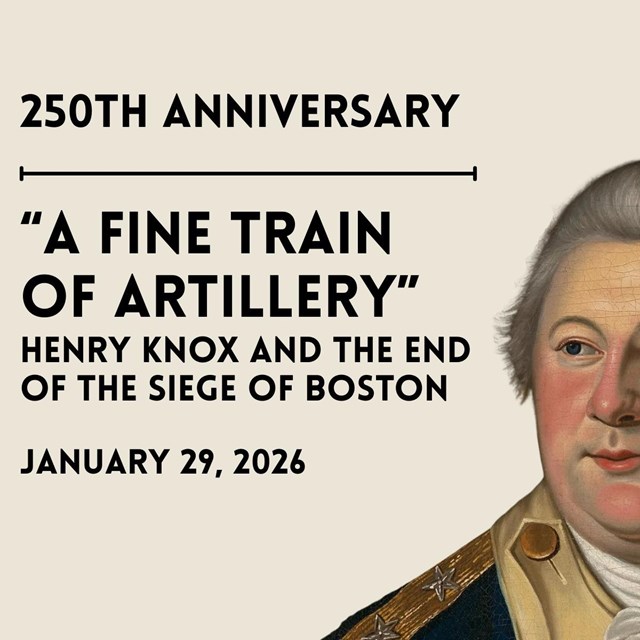
“A Fine Train of Artillery” Talk in Cambridge, 29 Jan.

On Thursday, 29 January, I’ll contribute to the discourse about Col. Henry Knox’s artillery trek with the talk on “‘A Fine Train of Artillery’: Henry Knox and the End of the Siege of Boston” at the Longfellow House–Washington’s Headquarters National Historic Site in Cambridge.

In the past few months I’ve already shared my take on the myths and realities of the Knox saga, and on Knox’s political profile before the war and how that might have contributed to his rise to command the artillery regiment.

For this new talk, therefore, I’m focusing on what Knox accomplished on his first military mission and how that affected the siege of Boston. Here’s our event description:
On January 18, 1776, Gen. William Heath wrote, “Col. Knox, of the artillery, came to camp. He brought from Ticonderoga a fine train of artillery.” Those 58 guns would nearly double the size of the Continental artillery force. But Gen. George Washington and his commanders still had to figure out the best way to use their new ordnance before they could drive the British military out of Boston.
Gen. Washington’s first proposal appears in his 18 February letter to John Hancock as chairman of the Continental Congress:
The late freezing Weather having formed some pretty strong Ice from Dorchester point to Boston Neck and from Roxbury to the Common, therby affording a more expanded and consequently a less dangerous Approach to the Town, I could not help thinking, notwithstanding the Militia were not all come In, and we had little or no Powder to begin our Operation by a regular Cannonade & Bombardment, that a bold & resolute Assault upon the Troops in Boston with such Men as we had (for it could not take Many Men to guard our own Lines at a time when the Enemy were attackd in all Quarters) might be crown’d with success . . .

from a thorough conviction of the necessity of attempting something against the Ministerial Troops before a Re-inforcement should arrive, and while we were favour’d with the Ice, I was not only ready, but willing and desirous of making the Assault; under a firm hope, if the Men would have stood by me, of a favourable Issue; notwithstanding the Enemy’s advantage of Ground—Artillery—&ca.
An infantry charge across the flat ice of the inner harbor against the British army’s fortified batteries on the Common and in the South End. What could go wrong?

This talk is due to start at 6 P.M. It’s free and open to the public, but because of limited seating the site asks people to register in advance. We’re working on how to record and/or livestream the talk as well.

Saturday, August 09, 2025

“Lt. Coll. Walcott now excuses it”

As I’ve been discussing, a British army court-martial ordered Lt. Col. William Walcott to be reprimanded on the Common in front of the second brigade of British troops in Boston on 17 Apr 1775.

Part of that ceremonial punishment might have been for Ens. Robert Patrick, the young officer Walcott had yelled at and struck, to draw his hand across the regimental commander’s face, thus making things even.

Though a couple of other young officers, Lt. John Barker and Lt. Frederick Mackenzie, wrote the long court-martial verdict into their diaries, neither man described seeing that embarrassing punishment. And Mackenzie was in the second brigade, so he would have been on the Common.

Perhaps that detail was too small to mention. Or maybe it never happened, and the sources from the early 1800s are wrong.

We do know there was another wrinkle in Lt. Col. Walcott’s penalty. He was supposed to be “Suspended for the Space of three Months.” However, Gen. Thomas Gage’s orders for 18 April state:
The Commander in Chief is pleas’d to take off the Suspension ordered upon Lt. Coll. Walcott from this Day inclusive; It having Appeared thro’ the course of the tryal, that Ens. Patrick did behave disrespectfull to his Commanding Officer, but it not being inserted in the Crime, the Court did not proceed upon it, & Lt. Coll. Walcott now excuses it, And will not bring it to a Tryal; but the Commander in Chief thinks proper to Warn Ensign Patrick to behave with more respect for the future to his Commanding Officer.
Thus, although the court martial acquitted Ens. Patrick of “Quarrelling,” “giving a blow,” and “giving…a Challange to fight,” he could still have been brought up on charges of being “disrespectfull.”

But Lt. Col. Walcott decided to let that charge lie. Maybe the family relationship between the two men reported by Lt. Mackenzie was a factor. Maybe this forbearance let Walcott show he was behaving as a proper officer again.

As for Gen. Gage, he was about to send 700 or so soldiers to Concord that evening, with another 1,200 to follow them a few hours later. He needed all his regiments working as efficiently as possible, and that meant keeping Lt. Col. Walcott on the job.

The 5th Regiment took casualties on 19 April, and more at Bunker Hill. Ens. Patrick was promoted to lieutenant on 22 November. He was still at that rank in the 1778 Army List.

Lt. Col. Walcott continued to command the regiment as its official colonel, Earl Percy, handled higher responsibilities. In January 1777 Gen. Sir William Howe gave him responsibility for negotiating exchanges of prisoners of war with Gen. George Washington’s military secretary, Robert Hanson Harrison. In October, Walcott was wounded at the Battle of Germantown, and he died on 16 November.

Friday, August 08, 2025

“Ordered to draw his Hand across the Face of his Lieutenant Colonel”

As quoted yesterday, on 15 Apr 1775 a court-martial sentenced Lt. Col. William Walcott to be reprimanded in front of the entire second brigade of the British army in Boston.

Walcott had struck a young officer in his regiment, Ens. Robert Patrick. The military court deemed that behavior “unmilitary & ungentleman like.” Regimental commanders weren’t supposed to slap down that far.

Another possible detail of the sentence didn’t make it into Gen. Thomas Gage’s general orders, however. Some sources say that the court or the brigadier who both presided over it and commanded the brigade, Gen. Robert Pigot, told Ens. Patrick to swipe his hand across Lt. Col. Walcott’s face in return for the lieutenant colonel striking him.

The earliest I’ve found that detail mentioned is a book published in Bristol in 1806: The Singular and Interesting Trial of Henry Stanton, Esq., of the 8th. (or King’s) Regiment: On Charges for Unofficer-like Behaviour, as Preferred Against Him by Lieutenant Colonel Young, Commanding the Said Regiment. Tried by a General Court-Martial Held at Doncaster, August 14, 1805, and several subsequent Days.

In the course of the arguments, someone stated:
Lieutenant Colonel Walcot, of the 5th. Regiment of Foot, encamped in Boston, North America, in 1775, was suspended for Six Months, for striking Ensign Patrick, of the same Regiment; who was ordered to draw his Hand across the Face of his Lieutenant Colonel, before the Whole Garrison, in return for the Insult he received. Notwithstanding he had challenged Colonel Walcot.

This was tried before an Honourable Court Martial, Brigadier General Pigot, President.
Those words appear between quotation marks, but I haven’t found their source.

Ten years later, E. Samuel published An Historical Account of the British Army: And of the Law Military, as Declared by the Ancient and Modern Statutes, and Articles of War for Its Government with a Free Commentary on the Mutiny Act, and the Rules and Articles of War; Illustrated by Various Decisions of Courts Martial.

That book stated in a footnote:
A remarkable instance of this kind occurred in the late war in America. Lieutenant-Colonel Walcot, of the 5th regiment of foot, while encamped near Boston, was so unfortunate, in a hasty and intemperate moment, to be moved to strike a subaltern (Ensign Patrick) under his command; and notwithstanding the latter had challenged him, the lieutenant-colonel was brought to a court martial, of which Brigadier-General Pigot was president, for the offence, when the court, after due consideration, suspended him from pay and allowances for six months, and was further pleased to order that Ensign Patrick should draw his hand across the face of the lieutenant-colonel before the whole garrison, in return for the insult he had received.
Samuel’s publication was authoritative enough that the anecdote appeared in several more histories of the British army, the 5th Regiment, dueling, and courts martial over the next century.

As I said above, the detail of Ens. Patrick touching Lt. Col. Walcott’s face does not appear in the general orders describing the outcome of the case. Furthermore, the court martial officially acquitted Patrick of challenging Walcott, contrary to the later descriptions of the punishment.

Neither of the British army officers who followed this case in their diaries—Lt. John Barker and Lt. Frederick Mackenzie—described seeing Ens. Patrick carry out this action. But perhaps another contemporaneous source will surface.

Paradoxically, this alleged detail of the Walcott case has gotten more discussion in print than the verdict in Gen. Gage’s official announcement. It’s in the literature as an unusual but still precedented measure the British army has taken to encourage good behavior in officers.

TOMORROW: Suspended.

(The picture above shows an officer from an Irish volunteer regiment being manly about 1780.)

Thursday, August 07, 2025

“Agreeable to the Sentince of the General Court Martial”

As described yesterday, in March 1775 Lt. Col. William Walcott came to blows, and nearly to a pistol duel, with Robert Patrick, an ensign in his regiment and a young relative.

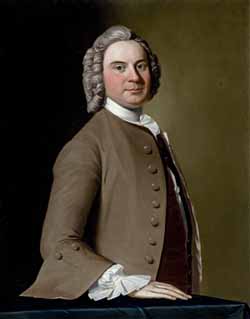
Walcott was overseeing the 5th Regiment while its colonel, Earl Percy, was in charge of the British army’s first brigade in Boston. The 5th was assigned to the second brigade under Brig. Gen. Robert Pigot (shown here).

Pigot also presided over a court-martial trial of the two feuding officers starting on 26 March.

The always cranky Lt. John Barker wrote in his diary on 30 March: “A General Court Martial has been sitting some days to try Lt. Cl. Walcott; and Ensn. Patrick of the 5th; it’s thought it will be a tedious one.”

Gen. Thomas Gage’s orders for 15 April announced the outcome:
The Genl. Court Martial of which Brigr. Genl. Pigot is President for the Tryal of Lt. Coll. Walcot & Ensign Patrick of the 5th Regt. of Foot, for Quarrelling, & the Consequences that ensued, which were reported to be blows given & a Challange to fight, is of Opinion, that the said Lt. Coll. Walcott is guilty, first of Quarrelling with Ens. Patrick, Secondly of making use of Menaceing, Reproachfull and Abusive Language, thirdly of giving a blow to & drawing his Sword on the said Ens Patrick on the Publick Parade in presence of the Officers of the Regt. when Addressing the former as Commanding Officer, which Conduct the Court considers, as highly prejudicial of good order & Military Discipline, as well as ungentleman like, which the Court finds to be a breach of the 1st Article of the 7th Section, & of the 3d Article of the 20th Section of the Articles of War, therefore Sentence the said Lt. Coll. Walcott to ask Ensign Patrick’s Pardon, at the head of the 5th Regt. (the 2d. Brigade under Arms) for the insult given him, & then & there to be Repremanded for the unmilitary & ungentleman like behavior, & also to be Suspended for the Space of three Months.

The Court Acquits Lt. Coll. Walcott of giving Ens. Patrick a Challange to fight, It is further the Opinion of the Court Martial, that Ens. Robt. Patrick is not guilty, either of Quarrelling with Lt. Coll. Walcott on the Evening of the 23d of March, or of giving a blow, And it Appearing also to the Court, that the evidence produced does not prove Ens. Patrick guilty of giving Lt. Coll. Walcott, a Challange to fight.

The said Ensign Patrick is Acquitted of every part of the Charge exhibited against him.

The Commander in Chief Approves of the above Sentence. . . .

The 2d. Brigade to be under Arms on Monday Morning at 11 O’Clock on the Common when the Brigadier Commanding the 2d. Brigade will repremand Lt. Coll. Walcott Agreeable to the Sentince of the General Court Martial.
Because that ruling was in Gage’s 15 April general orders, adjutant officers copied and carried it to every regiment in Boston.

Lt. Barker copied the text into his personal diary, underlining the phrase “then & there” to emphasize how Lt. Col. Walcott would have to eat crow in front of the whole brigade.

Lt. Frederick Mackenzie likewise recorded the verdict in his diary and (ever efficient) added that the reprimand was to take place on 17 April.

TOMORROW: A gesture of reconciliation?

Wednesday, August 06, 2025

“They agreed to fight with Pistols”

What were officers of the British army in Boston thinking about in the weeks leading up to 18 Apr 1775?

Judging by the word count of what they wrote in their general orders and diaries, they were closely watching the fallout of a dispute between two officers in the 5th Regiment.

On 23 March, Lt. John Barker of the 4th recorded:
another duel stop’d between the Lt. Col. [William Walcott]…and Ensn. [Robert] Patrick of the same [regiment]; some words passing between them, the Lt. Cl. struck Mr. P——k in the face upon which they both immediately drew their Swords, but the other Officers interfering it was put a stop to ’till the Rolls were call’d when they both went to the Common, where they agreed to fight with Pistols which Mr. Patrick went for and upon his return was met by an Officer of the Regt. who by some means took the Pistols and fired ’em in the air, which alarmed the Guard which turned out and took him Prisoner and carried him to Lord Percy who put him in arrest, then went to Col. Wallcott and put him in arrest likewise; there the affair rests.
Three days later, Lt. Frederick Mackenzie of the 23rd wrote:
There was a dispute lately on the Evening parade of the 5th Regiment, between Lieut Colo. Walcott, and Ensign Patrick of that Corps, at the close of which the former struck the latter, and drew his Sword upon him, which occasioned a Challenge; but the Officers having interfered, and the matter having been reported to Genl. [Thomas] Gage, he ordered them both to be put under arrest, and tried by a General Court Martial

Ensign Patrick is related to the Lieut Colonel.
Mackenzie was a reliable veteran officer, so his statement about the two men being related is probably correct, but I haven’t been able to find more details.

Lt. Col. Walcott was born around 1742 and had been with the 5th Regiment since 1760, joining as a captain. Ens. Patrick had arrived in July 1771.

TOMORROW: The verdict.

[The picture above shows the uniform of an officer in the 5th Regiment as of 1792.]

Monday, May 12, 2025

“Townspeople took four brass cannon”

Here are all the entries from Thomas Newell’s 1774–74 diary that pertain to artillery and thus show the coming of war.
  • 4 June 1773: “King’s birthday; general training; the grandest appearance ever known in these parts.”
John Rowe wrote about this same militia exhibition in honor of the king:
Colo. [John] Hancock & Company of Cadets, Major [Adino] Paddock & Artillery, Colo. [John] Erving & the Regiment, Colo. [David] Phipps & Company all made their appearance in the Common — Such a Quantity or Rather Multitude of People as Spectators I never saw before, they behaved very well.
Phips commanded the horse guards.
  • 1 July: “Major Paddock’s son drowned at Cambridge River.”
Adino Paddock was a coachmaker as well as commander of Boston’s militia artillery company. His son John was a student in Harvard College’s class of 1776, carrying the family’s hopes to secure their rise into gentility, when he died at age seventeen.
  • 15 September: “General training.”
  • 22 September: “General training for the last time this year.”
  • 12 November: “Workmen began to set another row of elms in the common.”
Paddock instigated the planting of trees along Tremont Street, opposite his coachyard. Years after he had left Boston as a Loyalist, those would still be called the “Paddock elms.”

Gen. Thomas Gage arrived as the new royal governor in May 1774, and the following summer was punctuated by the arrival of more army units, including companies of Royal Artillery:
  • 2 July: “A.M. Artillery from Castle William landed, with eight brass cannon, and encamped in the common. 258 sheep given for the relief of this town by the town of Windham, in Connecticut. (I cut my hair off.)”
  • 6 August: ”The Scarboro. man-of-war arrived, nine weeks from England; P.M. three transports from Halifax, with the 59th Regiment on board, and company of artillery, and brass cannon, eight days out.”
  • 7 August: “A.M. three transports from New York with the Royal Regiment of Welsh Fusileers and detachment of Royal Artillery, and a quantity of ordnance stores, &c.”
  • 8 August: “Company of artillery landed; encamped in common.”
Soon after Gage put the Massachusetts Government Act into effect, he had his soldiers remove militia gunpowder from the storehouse in Charlestown. That set off a big reaction in the countryside:
  • 1 September: “This morning, half after four, about 260 troops embarked on board thirteen boats at the Long Wharf, and proceeded up Mystic River to Temple Farm, where they landed; went to the powder-house on Quarry Hill, in Charlestown bounds, from whence they have taken 250 half-barrels of gunpowder, the whole store there, and carried it to the castle. A detachment from this corps went to Cambridge and brought off two field-pieces.”
  • 2 September: “From these several hostile appearances, the county of Middlesex took the alarm, and on last evening began to collect in large bodies, with their arms, provisions, and ammunitions, &c. This morning some thousands of them advanced to Cambridge, armed only with sticks. The committee of Cambridge sent express to Charlestown, who communicated the intelligence to Boston, and their respective committee proceeded to Cambridge without delay. Thomas Oliver, S[amuel]. Danforth, J[oseph]. Lee, made declaration and resignation of a seat in the new constituted council, which satisfied the body. At sunset, they began to return home. At dark, rain and thundered very hard.”
That “Powder Alarm” uprising prompted Gen. Gage and Adm. Samuel Graves to strengthen Boston’s military defenses against attacks from land.
  • 3 September: “Four large field-pieces were dragged from the common by the soldiery and placed at the only entrance into this town by land. The Lively frigate, of twenty guns, came to her mooring in the ferry-way between Boston and Charlestown.”
  • 5 September: “Artillery training.”
  • 15 September: “Last night all the cannon in the North Battery were spiked up: it is said to be done by about one hundred men (who came in boats) from the man-of war in this harbor.”
  • 17 September: “Last night, townspeople took four brass cannon from the gun-house near very near the common.”
Newell conflated two events in that last entry. Maj. Paddock’s militia artillery had two gunhouses, each containing one pair of small cannon. As other sources show, persons unknown spirited away the two cannon in the old gunhouse on the night of 14–15 September. When Royal Artillery officers opened the new gunhouse on 17 September, they discovered its two cannon were gone, too.

Newell’s diary entry shows that many Bostonians knew about those events even though they were never reported in the newspapers or in Gen. Gage’s letters to the government in London.
People had tried to smuggle these guns up the Charles River, but their boat got hung up on the dam that formed the Mill Pond and they had to abandon it.
  • 3 October: “Artillery training for the last time this year.”
Since the train’s weapons had vanished, and most of the company’s men were refusing to serve under Maj. Paddock, there probably wasn’t a lot of artillery training accomplished that day.
  • 22 October: “This morning, about 7 o’clock, after three days’ illness, Mr. William Molineaux died, in the fifty-eighth year of his age. (A true son of liberty and of America.) It may with truth be said of this friend, that he died a martyr to the interest of America. His watchfulness, labors, distresses, and exertions to promote the general interest, produced an inflammation in his bowels, of which he died. ‘Oh, save my country, Heaven,’ he said, and died.”
Molineux was involved in many acts of resistance, and among the last was buying four cannon from Duncan Ingraham, Jr., in September or October 1774. Those guns were sent out to four rural towns to be equipped for use by spring. 
  • 23 October: “This day four transports arrived here from New York, with a company royal artillery, a large quantity of ordnance stores for Castle William, three companies of the Royal Regiment of Ireland, or the 18th Regiment, and the 47th Regiment on board.”
This one document thus shows us both sides of the political conflict preparing for military action—with cannon.

Ultimately those efforts led to the British army’s march to Concord and to war. I’ll tell that story at the Scituate Historical Society this week.

Thursday, 15 May, 7–8:30 P.M.
Secrets on the Road to Concord
G.A.R. Hall, 353 Country Way, Scituate

Admission is $15, or $10 for society members. Reservations are recommended, but payment will be accepted at the door. I look forward to meeting folks there.

TOMORROW: Thomas Newell and the tea.

Sunday, December 31, 2023

Ending the Year by Burning Tea

In my write-up of the Charlestown tea burning, I mixed up the date of the town meeting when everyone agreed to stop selling tea (28 Dec 1773) with the date the townspeople burned their stocks of tea (31 December, or 250 years ago today).

That in turn led to misdating when a crowd from Boston confiscated Ebenezer Withington’s tea in Dorchester.

I’ve corrected those postings.

To my chagrin, I found that I’d actually flagged a source to discuss on this date, but while traveling during this holiday season I overlooked that draft.

So here is a timely account of the events of 31 Dec 1773 from our old friend, merchant John Rowe:
The People of Charlestown collected what Tea they could find in The Town & burnt it in the View of a thousand Spectators.

There was found in the House of One Withington of Dorchester About half a Chest of Tea

the People gathered together & took the Tea Brought it into the Common of Boston & Burnt it this Night about Eleven of Clock—

This is Supposed to be part of the Tea that was taken out of the Ships and floated over to Dorchester—
Rowe’s recounting (probably second-hand) adds a couple of details to the newspaper report: the large crowd in Charlestown and a more precise timing of the tea-burning on Boston Common.

Overall, these incidents show that, despite fears of how the London government would react to the destruction of East India Company property, Bostonians were closing out the year by getting more strict about enforcing their tea boycott on everyone.

Friday, December 29, 2023

“A Number of the Cape or Narragansett-Indians” in Dorchester

On 31 Dec 1773, as recounted yesterday, Charlestown burned its tea at high noon. Everyone could see that happen, but of course bonfires are even more visible at night.

As that action took place across the Charles River north of Boston, another drama was playing out to the south in Dorchester.

Last year I quoted sources about the search for tea that survived destruction in the harbor, floated across to the Dorchester shore, and was reportedly being sold by a man named Withington.

After searching two houses (with the assent of two homeowners named Withington), a crowd said by local Samuel Pierce to be “from Boston” found the rumored tea at the home of Ebenezer Withington.

Leaving Dorchester to deal with the man through its town meeting, the Bostonians carried that tea back to Boston and used it to fuel their own bonfire after dark on Boston Common.

When the Boston Gazette reported on this event on 3 Jan 1774, it said the search had been carried about by “a Number of the Cape or Narragansett-Indians.” This was, I believe, the first time the press had referred to the men destroying tea not merely as dressed like Indians but actually as Indians (wink, wink).

When Edes & Gill first reported on the destruction of the East India Company tea, their 20 December Boston Gazette printed two accounts which described the actors quite differently.

The story on Page 3 said the raiders were “A number of brave & resolute men, determined to do all in their power to save their country from the ruin which their enemies had plotted.” That account treated those men as respectable members of Massachusetts society, taking collective civic action.

However, “An Impartial Observer” on page 2 described “a number of persons, supposed to be the Aboriginal Natives from their complexion,” and later referred to those people as “Savages.” These destroyers came from outside civilized society, so Boston couldn’t be held responsible for their action. That approach prevailed in the following months.

The Boston Gazette’s account of events on 31 December showed that dichotomy. North of Boston, the people of Charlestown acted through their town meeting, through collective boycotts, and at high noon. South of Boston, “the Cape or Narragansett-Indians” carried out intimidating actions, destroyed imperial property, and acted in the dark.

Friday, September 08, 2023

Bates “at the Bottom of the Mall in Boston”

When we last checked in with equestrian Jacob Bates, on 27 Aug 1773 the Boston selectmen denied his request “to erect a Fence in the Common which will inclose about 160 feet of Ground in order to show his feats in Horsmanship.”

Nonetheless, on 6 September, the Boston Gazette ran this notice:

Mr. BATES, (allowed by the greatest Judges in the Manly Art he professes, to excel any HORSEMAN that ever attempted any Thing of the Kind) on Wednesday next, if good Weather, if not the Friday following, will perform on one, two, and three Horses, at the Bottom of the Mall in Boston.

TICKETS for the first Place at one Dollar each, and for the second Three Shillings, to be had at Col. Ingersol’s, Mr. Bracket’s, and at the Place of Performance.
An even larger advertisement appeared the same day in the Boston Post-Boy:
HORSEMANSHIP,
By Mr. BATES,
The Original PERFORMER;
Who has had the Honour of performing before
THE Emperor of Germany, the Empress of Russia, and King of Great-Britain, the French King, the Kings of Prussia, Portugal, Sweden, Denmark, and Poland, and the Prince of Orange; Also, at the Courts of Saxony, Bavaria, Brunswick, Mecklenburgh, Saxe-Gotha, Hilbourghausen, Anspach, and every other Court in Germany; at all which he received the greatest APPLAUSE, as can be made manifest by the Certificates from the several Courts, now in his Possession, and is allowed, by the greatest judges in the MANLY ART he professes, to excel any Horseman that ever attempted any Thing of the Kind.

On WEDNESDAY,
the 8th September Instant,
If good Weather, if not, the Friday following,
He will perform on ONE, TWO, and THREE HORSES, at the Bottom of the MALL, in BOSTON.

The Doors will be opened at Three o’Clock, and he will mount precisely at Four.

The Seats are made proper for LADIES and GENTLEMEN.

He will take it as a particular Favour, if Gentlement will not suffer any Dogs to come with them.

TICKETS for the First Place at One Dollar each, and for the Second, Three Shillings Lawful Money, to be had at Colonel INGERSOL’s, in King-street, Mr. BRACKETT’s in School-street, and at the Place of Performance.

No Money will be taken at the Doors, nor Admittance without Tickets.
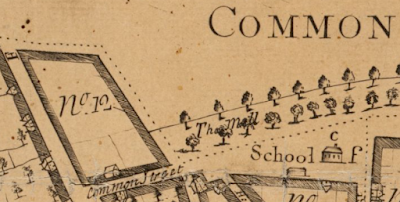
Obviously Bates had found a place to erect his fence anyway. The Mall was part of the Common, defined since the early 1700s by two rows of trees planted by the selectmen’s order along Tremont Street (then also called Common Street). The “Bottom of the Mall” was most likely privately owned land at the southern end of those trees in an area of town still not densely populated.
On Wednesday, 8 September, two and a half centuries ago today, the weather in Boston was good. Bates and his horses performed their show.

TOMORROW: Mr. Bates apologizes.

Sunday, August 27, 2023

Jacob Bates and the Boston Selectmen

On 27 Aug 1773, 250 years ago today, Jacob Bates met with the Boston selectmen.

As I discussed back here, Bates had become celebrated on continental Europe for feats of horsemanship. There was even a German print devoted to him and his horses.

In late 1772 Bates arrived in Philadelphia. He placed notices in newspapers from 2 September to 2 November.

Then the performer moved on to New York from June through early August 1773.

Unlike some traveling performers who could roll into town, find a tavern to host them, and quickly start shows in a courtyard, Bates had to set up a large space to ride in, plus an enclosure around that space to prevent people who hadn’t paid from seeing. That’s what he wanted to talk to the selectmen about on that Friday.

In that discussion were John Scollay, Timothy Newell, Thomas Marshall, Samuel Austin, and John Pitts. (John Hancock and Oliver Wendell were absent.)

The town’s official records say:
Mr. Jacob Bates a famous Horsman, attended & craves leave of the Selectmen to erect a Fence in the Common which will inclose about 160 feet of Ground in order to show his feats in Horsmanship—
Boston was notoriously hostile to theater and suspicious of anything that smacked of it. Traveling performers did come through, such as the rope-flyer John Childs and the musician James Joan. However, they had to navigate local rules and not disrupt life for too long.

Did the selectmen find Bates’s request to fence off part of the fifty-acre Common for a show of horsemanship reasonable?
his request was not granted.
COMING UP: Getting back on his horse.

Monday, December 12, 2022

“They found part of a half chest which had floated”

A natural question after hearing the stories of chests from the Boston Tea Party floating across the bay to the Dorchester shore is whether that was even possible.

The men and boys of the Tea Party worked hard to break open all the chests, pour out the tea leaves, and even then make sure those leaves got submerged in the salt water. Could a container of tea have escaped their attention?

In fact, there’s good evidence from 1773 for a small chest making it across the water with some drinkable tea inside.

Samuel Pierce of Dorchester wrote in his diary for 30 December:
There was a number of men came from Boston in disguise, about 40; they came to Mr Eben Withington’s down in town, and demanded his Tee from him which he had taken up, and carried it off and burnt it at Boston.
The merchant John Rowe recorded the same event from his Bostonian perspective the next day:
There was found in the House of One Withington of Dorchester about half a Chest of Tea—the People gathered together & took the Tea, Brought it into the Common of Boston & Burnt it this night about eleven of Clock

This is supposed to be part of the Tea that was taken out of the Ships & floated over to Dorchester.
On 3 Jan 1774, Edes and Gill’s Boston Gazette laid out the story that the town’s Whig leaders wanted people to know:
Whereas it was reported that one Withington, of Dorchester, had taken up and partly disposed of a Chest of the East-India Company’s Tea: a Number of the Cape or Narragansett-Indians, went to the Houses of Capt. Ebenezer Withington, and his Brother Philip Withington, (both living upon the lower Road from Boston to Milton) last Friday Evening, and with their consent thoroughly searched their Houses, without offering the least offence to any one.

But finding no Tea they proceeded to the House of old Ebenezer Withington, at a place called Sodom, below Dorchester Meeting House, where they found part of a half chest which had floated and was cast up on Dorchester point. This they seized and brought to Boston Common where they committed it to the flames.
Pierce identified the men enforcing the tea boycott as “from Boston,” but the Gazette referred to them as “Cape or Narragansett-Indians.” This is an early example of the Whigs realizing that referring to the men who destroyed the tea as unrecognizable Natives let everyone maintain deniability.

There were many Withingtons in Dorchester, obviously. The Gazette emphasized how two Withingtons of the higher class—the militia captain and his brother—had done nothing wrong and were eager to cooperate with the searchers.

“Old Ebenezer Withington” didn’t come off as well. This is the only reference I’ve found to a place in eighteenth-century Dorchester being called “Sodom.”

On the same day that issue of the Boston Gazette appeared, old Ebenezer Withington had to answer to the Dorchester town meeting.

TOMORROW: The town takes a stand.

Monday, October 10, 2022

“Leave to dig up a portion of Boston Common”


On 28 Sept 1852, the Boston Herald reported on the meeting of the Boston City Council. The very last petition taken up, at the end of a long paragraph, was:
John Griffin for leave to dig up a portion of Boston Common for the purpose of finding hidden treasure, buried there by his father in 1837.
That was inaccurate. On the same morning the Boston Post revealed that the treasure Griffin sought went all the way back to the Revolution.

The Boston Post article was widely quoted and paraphrased, as in this item from the Daily Evening Transcript for that date:
Treasure Buried on Boston Common. A Mr. John Griffin petitioned the city government yesterday for permission to dig a hole on Boston Common, six feet in diameter, for the purpose of obtaining $1000 which he asserts his father, John Griffin, who served in the army in the war of the Revolution, secreted during the “troubled times” preceding said war. Griffin says he is poor and wants the money bad. The petition was referred to the committee on the common.
One of those newspapers caught the eye of Jonathan Hill, as he described for the Vita Brevis blog of the New England Historic Genealogical Society last month. Folks at the Boston City Archives found Griffin’s petition, which specified that his namesake father had died in Nottingham, New Hampshire, in 1837.

Griffin also promised that his father had given him “full directions and measurements from standing monuments” to the burial spot, which was “seated in a path on the said Common,” so a dig wouldn’t disturb the trees or turf. (It would, of course, disrupt pedestrian traffic along that path.)

John Griffin didn’t uncover that treasure, however. The council’s committee rejected his request. No one has yet found further newspaper reports on Griffin, either supporting his request or critiquing it as a con or a delusion. The Post story was reprinted in New Hampshire, where people might have had a different perspective on Griffin, but I didn’t find any followup.

Using census records, Hill found a John Griffin living in Nottingham and then in Orleans County, Vermont, whose family details match the petitioner’s claim. He was very poor until his death twenty years after his petition.

Hill wasn’t able to find corroboration for Griffin’s story about his father. There’s no surviving record of a senior John Griffin dying in Nottingham in 1837. Several John Griffins served in the Continental forces, including a handful from New Hampshire, but there’s not enough detail to connect any of this story.

The lack of evidence in U.S. pension files seems significant. If the elder John Griffin was a Continental Army veteran who survived until 1837, then he had the opportunity to apply for a federal pension, but no John Griffin did.

Finally, there are logical questions about Griffin’s story. In “troubled times,” wouldn’t $1,000 be even more useful to keep around instead of burying? Wouldn’t it be safer to hide treasure on private property rather than a path on the common, where any burying would be publicly visible and many people might go over or dig in the ground?

Of course, if this were a short story, the Boston City Councilor who refused to let John Griffin dig just wants the poor man’s treasure for himself. He goes out to the Common late at night with a shovel. With great and unaccustomed effort, the politico excavates the spot where Griffin’s directions led. After a night of blisters and dirt, he unearths a metal box—only to be stopped by the Boston police. The officers are ready to send him home, but he insists on taking the box, arguing his way into an arrest. And when the box is finally opened, it turns out to contain $1,000 in Continental paper money from 1781.

Wednesday, September 07, 2022

“A Letter, which was thrown into both the Camps”?

As I’ve peered at that September 1774 newspaper item allegedly alerting British soldiers to the troublemakers in Boston, I’ve been trying to figure out if it contains any internal clues about its source.

One detail is that the New-York Gazetteer said the letter was “thrown into both the Camps.” (In the Boston Evening-Post, where the printers were trying to save lines, that was changed to “thrown into the Camps.”)

What two army camps in Boston did the original publication refer to? In that period Bostonians usually spoke of there being only one camp:
  • “LOST in the Rear of the Camp on the Night of the 24th of July…,” said an advertisement in the 11 August Massachusetts Spy.
  • The Evening-Post’s 5 September report on the “Powder Alarm” said Benjamin Hallowell “ran on foot to the camp,” and then a local was “observing the motion in the camp.”
  • The same issue said the army had strengthened the guard on the Neck with “an additional number of Men from the Camp.”
  • That same day, the Boston Post-Boy reported the execution of Pvt. Valentine Duckett “in the rear of the Camp.”
  • On 6 October the Massachusetts Spy described picking up a document “under the great tree near the camp.”
Longer references make clear that “the Camp” was on the Common.

To be sure, other soldiers were camping elsewhere. According to the 11 August Boston News-Letter, the 52nd Regiment of Foot had just arrived from New York and “encamped on Fort-Hill.” But I found no newspaper references to a ‘camp on Fort Hill,’ nor any mention of ‘the camps’ in Boston aside from the article in question.

Therefore, whoever wrote this text appears to have had some knowledge of Boston in the late summer of 1774, specifically that different parts of the British army were camped at different places, but that person wasn’t speaking like a Bostonian.

TOMORROW: The missing name.

Tuesday, January 25, 2022

“The attempt had for several weeks been expected”

In the first half of the nineteenth century, American historians continued to write about the start of the Revolutionary War, of course.

But those authors didn’t dig into the question of whether someone close to Gen. Thomas Gage had leaked his plan for a march to Concord, as hinted by the passage from Charles Stedman’s book that I quoted yesterday.

Around the fiftieth anniversary of the event, there was a back-and-forth between Elias Phinney of Lexington and Ezra Ripley of Concord over where militiamen returned the first significant fire at the redcoats. That dispute produced eyewitness testimony from aged veterans, revealing that both towns were on alert well before the Patriot alarm riders from Boston arrived because of previous reports about British activity and the sight of army officers on horseback.

Likewise, James T. Austin’s Life of Elbridge Gerry (1828) offered evidence that members of the committee of safety were watching for Gage to act. It included documents confirming how the British army officers that Gage sent out to stop alarm riders actually provoked an alarm.

In his History of the Siege of Boston (1849), the Charlestown historian Richard Frothingham published Richard Devens’s description of the committee’s activity and of the lights in Old North Church as seen from the opposite shore. That account lined up well with Revere’s.

Frothingham quoted Stedman’s story but not the detail of Gen. Gage telling only one other person besides Col. Percy about his plan. Instead, he emphasized how Massachusetts Patriots had gathered multiple signs that the army was about to act even as the general considered his planning secret.

As a result, the most authoritative American historian of the time, George Bancroft (shown above), presented events this way in his 1860 History of the United States from the Discovery of the American Continent:
On the afternoon of the day on which the provincial congress of Massachusetts adjourned, Gage took the light infantry and grenadiers off duty, and secretly prepared an expedition to destroy the colony’s stores at Concord. But the attempt had for several weeks been expected; a strict watch had been kept; and signals were concerted to announce the first movement of troops for the country. Samuel Adams and [John] Hancock, who had not yet left Lexington for Philadelphia, received a timely message from [Dr. Joseph] Warren, and in consequence, the committee of safety removed a part of the public stores and secreted the cannon.

On Tuesday the eighteenth, ten or more sergeants in disguise dispersed themselves through Cambridge and further west, to intercept all communication. In the following night, the grenadiers and light infantry, not less than eight hundred in number, the flower of the army at Boston, commanded by the incompetent Lieutenant Colonel [Francis] Smith, crossed in the boats of the transport ships from the foot of the common to East Cambridge. There they received a day’s provisions, and near midnight, after wading through wet marshes, that are now covered by a stately town, they took the road through West Cambridge to Concord.

“They will miss their aim,” said one of a party who observed their departure. “What aim?” asked Lord Percy, who overheard the remark. “Why, the cannon at Concord,” was the answer. Percy hastened to Gage, who instantly directed that no one should be suffered to leave the town. But Warren had already, at ten o’clock, despatched William Dawes through Roxbury to Lexington, and at the same time desired Paul Revere to set off by way of Charlestown.

Revere stopped only to engage a friend to raise the concerted signals, and five minutes before the sentinels received the order to prevent it, two friends rowed him past the Somerset man of war across Charles river. All was still, as suited the hour. The ship was winding with the young flood; the waning moon just peered above a clear horizon; while from a couple of lanterns in the tower of the North Church, the beacon streamed to the neighboring towns, as fast as light could travel.
Quite dramatically rendered, and Bancroft skipped right over the question of whether anyone leaked Gage’s orders.

TOMORROW: New sources and new suspicions.

Monday, January 24, 2022

“The general said that his confidence had been betrayed”

Earlier this month I noted the American Revolution Institute’s article about a likely caricature of Gen. Thomas and Margaret Gage published in London in 1776.

Comments on that post raised the question of when historians started to consider the possibility that Margaret Gage had betrayed her husband by leaking his plans for the 18 Apr 1775 expedition to Concord to the Patriots.

Not that anyone involved in that discussion believed that theory. Rather, we were just wondering when it arose and what evidence, if any, supported it.

By the end of the eighteenth century there were three readily available printed sources speaking to this question. The first was the Rev. William Gordon’s History of the Rise, Progress, and Establishment, of the Independence of the United States of America, published in London in 1788. Gordon knew the Boston Whigs well and was particularly close to Samuel Adams. He wrote of April 1775:
The grenadier and light infantry companies were taken off duty, upon the plea of learning a new exercise, which made the Bostonians jealous that there was some scheme on foot. A daughter of liberty, unequally yoked in point of politics, sent word, by a trusty hand, to Mr. Samuel Adams, residing in company with Mr. [John] Hancock, at Lexington, about thirteen miles from Charlestown, that the troops were coming out in a few days. Upon this their friends at Boston were advised to move out their plate, &c. and the committee of safety voted [18 April], “that all the ammunition be deposited in nine different towns. . .”

Mr. Adams inferred from the number to be employed, that these [military stores] were the objects, and not himself and Mr. Hancock, who might more easily be seized in a private way, by a few armed individuals, than by a large body of troops, that must march for miles together under the eyes of the public. . . .

When the corps was nearly ready to proceed upon the expedition, Dr. [Joseph] Warren, by a mere accident, had notice of it just in time to send messengers over the Neck and across the ferry, on to Lexington, before the orders for preventing every person’s quitting the town were executed.
I quoted from the 1801 edition, which differs a little in punctuation but not wording from the original.

Gordon described two pieces of information reaching two different Patriots. First, Adams outside Boston heard from a sympathetic woman with a Loyalist husband that a march would happen “in a few days.” There’s no clear hint that woman had inside information; instead, Gordon pointed to the orders for the flank companies, which lots of people heard about.

The Patriot leadership had already acted on that advice when Warren “by a mere accident” heard the march was imminent just in time to send messengers—we now know these were William Dawes and Paul Revere—out to Lexington.

From the British side, former officer Charles Stedman’s 1794 History of the Origin, Progress, and Termination of the American War confirmed that Gen. Gage was focused on Concord and tried to keep the mission secret:
In war there is nothing that so much avails as secresy of design and celerity of execution: Nor, on the contrary, so hurtful as unnecessary openness and procrastination. General Gage on the evening of the eighteenth of April told lord Percy, that he intended to send a detachment to seize the stores at Concord, and to give the command to colonel [Francis] Smith, ”who knew that he was to go, but not where.” He meant it to be a secret expedition, and begged of lord Percy to keep it a profound secret.

As this nobleman was passing from the general’s quarters home to his own, perceiving eight or ten men conversing together on the common, he made up to them; when one of the men said—“The British troops have marched, but they will miss their aim.”

“What aim?“ said lord Percy.

“Why,” the man replied, ”the cannon at Concord.”

Lord Percy immediately returned on his steps, and acquainted general Gage, not without marks of surprize and disapprobation, of what he had just heard. The general said that his confidence had been betrayed, for that he had communicated his design to one person only besides his lordship.
I broke Stedman’s single long paragraph into shorter paragraphs for easier reading.

Clearly Col. Percy was Stedman’s source for this story. And clearly Percy believed Gage’s plans had leaked, presumably through that “one person” (or maybe Gage hadn’t been as circumspect as he claimed).

Gage and Percy might not have guessed correctly about a leak. The man speaking on the Common might have been speculating about what the British goal was, based on the number of soldiers who were departing. After all, Adams had reportedly made the same guess.

One more early printed source was Paul Revere’s letter to the Rev. Dr. Jeremy Belknap about the opening of the war, published in the Massachusetts Historical Society’s Collections series in 1798:
The Saturday night preceding the 19th of April, about 12 o’clock at night, the boats belonging to the transports were all launched, and carried under the sterns of the men of war. (They had been previously hauled up and repaired.) We likewise found that the grenadiers and light Infantry were all taken off duty.

From these movements, we expected something serious was to be transacted. On Tuesday evening, the 18th, it was observed, that a number of soldiers were marching towards the bottom of the Common. About 10 o’clock, Dr. Warren sent in great haste for me, and begged that I would imediately set off for Lexington, where Messrs. Hancock and Adams were, and acquaint them of the movement, and that it was thought they were the objects. When I got to Dr. Warren’s house, I found he had sent an express by land to Lexington—a Mr. William Dawes.
Belknap cleaned up some of Revere’s spellings before publishing. See the original here. Revere’s letter was reprinted in the Worcester Magazine and Historical Journal in 1826 and in the New England Magazine in 1832.

Thus, before the turn of the nineteenth century historians had sources close to the action revealing that:
  • The commander and second-in-command of the British troops thought the secret plan for the march had leaked, despite only three people knowing about it.
  • Bostonians had actually been talking about the likely plan for days, based on publicly visible signs; Samuel Adams had deduced the general’s goal; and the committee of safety was acting on that warning.
  • Warren sent Dawes and Revere to Lexington based on the mistaken idea that “the objects” of the march were Adams and Hancock; in other words, whatever last-minute information the doctor received “by a mere accident,” that source did not tell him that Gage was focused on Concord.

TOMORROW: The view from the mid-1800s.

Sunday, December 26, 2021

“I sincerely thought I was serving the interest of my country”

Yesterday I followed the narrator of The Wonderful Appearance of an Angel, Devil and Ghost through his encounter with an Angel early on the morning of 15 Oct 1774.

The next stretch of the little book begins:
I continued in my chamber till ten o’clock, my usual hour of rising, then came down and desired my breakfast might be got ready by my return, which would be in about half an hour.
I fully sympathize with the man as a late riser, but can’t imagine going out in the morning without having had breakfast.

Later, the narrative shows the gentleman starting midday dinner at 4:00 P.M., and the editor adds a footnote to assure readers this is common “for these kind of gentry.” That suggests readers of 1774 would have found the character’s habits unusual but not impossible to believe.

The narrator continues:
Afterwards I took a walk (which hath lately been my practice) round the camp in the common, having a card of permission…
There was indeed a contingent of the British army camped on Boston Common; this was the first time I recall reading about a “card of permission” letting civilians walk around that camp.

The gentleman asks a “Captain ———” about any mysterious noises the night before. The captain responds, “you know you was very drunk last night.” Another officer steps in to say, “I was in company with him, and assisted in carrying him part of the way home.” A colonel invites the narrator to dine with him the next day. These details show that the narrator is friendly with the army in October 1774, and thus a Loyalist.

The narrator’s politics come to the foreground in the following pages. He rereads “the late acts of parliament” but “could not discover…that the parliament had any design of distressing the people of America.”

At 12:30 A.M., the gentleman hears “a most terrible shout,” and a Devil appears at his bedroom door. (This apparition carries a book and halter, as shown in the accompanying woodcut, but those details are never significant in the text, suggesting the booklet was written around illustrations printer John Boyle had on hand.) This Devil says he has been ordered there by the Angel “to converse with you concerning the crimes you have been guilty of towards your country.”

The gentleman insists he is “one of the best friends the country has.” As an example, he mentions writing letters to London supporting laws “whereby the inhabitants of the American colonies might be upon an equal footing with their brethren in Great-Britain.” A footnote to this line says acidly, “In regard to TAXES, I imagine.”

The Devil and the man discuss the Stamp Act, Declaratory Act, Townshend duties, and the destruction of the tea. The gentleman complains about how mobs attacked “our late worthy governor H[utchinson], lieutenant-governor O[liver], the honourable Mr. H[allowell], Justice S[tory], &c.” The booklet thus lays out the preceding nine years of conflict through Loyalist eyes, concluding that the Patriots “will expose themselves to the severest punishment in this world, and to damnation in the next.”

The editor pushes back against this view in the footnotes, but the Devil simply tells the gentleman he’s wrong. If he continues to stick to that political position, he’s bound for hellish torment. Rather than try to tempt the man into further wrongs, this unusual Devil says, “I conjure you desist, before it is too late.”

The next night the gentleman receives his third supernatural visitor, a “GHOST of one of my deceased ancestors” (shown here). This specter voices a standard argument of the New England Patriots, still echoed today: that the early English settlers, “for the sake of of enjoying that liberty which was denied them at home, were content to leave everything else that was dear behind, and seek it in the hospitable wilds of America.” The sacrifices of that generation gave the people of 1774 “their liberties and properties,” which they had to preserve and pass on.

The Ghost thus shames his descendant, and the gentleman finally bursts out:
VENERABLE SHADE! ’Tis true, (with shame I acknowledge it) I have gone on in the way you have described; but believe me, I never till the last night had the least apprehension that I was doing wrong, I sincerely thought I was serving the interest of my country.
The narrative closes with its central character “determined, if I could withstand the shining temptation, to be once more an honest man.”

The supposed editor then adds a paragraph hoping the man’s repentance sticks, and the publication ends with thirteen lines about the reality of hell from the British poet Elizabeth Rowe.

All in all, the booklet leaves me wondering about its intended audience. Though there are a couple of hints that the gentleman was paid by a secret cabal to promote stricter laws on America, it never shares details of that conspiracy or how it worked. Instead, it presents the main character as sincere in his belief that obeying those laws is the colonists’ best course. Was this written for other Loyalists who needed converting? For Patriots who enjoyed the sight of an opposing gentleman scared into submission? Did its author mean to change anyone’s mind or confirm readers’ righteousness?


Friday, April 05, 2019

“If genuine, they must be private Letters”

When we left the Massachusetts General Court on 2 June 1773, members of the lower house had voted overwhelmingly to condemn a collection of letters from Gov. Thomas Hutchinson, Lt. Gov. Andrew Oliver, and others as intended “to overthrow the Constitution of this Government, and to introduce arbitrary Power into the Province.”

The next day, the house chose a committee of nine to prepare a longer response to those letters. At its head were Thomas Cushing, Samuel Adams, and John Hancock, of course. Also on that Thursday, the Massachusetts Spy reported on the house vote—and reported in dire tones about “extraordinary discoveries…which will bring many dark things to light.”

That brought a note to the chamber from Gov. Hutchinson, carried by provincial secretary Thomas Flucker. Hutchinson declared, “I have never wrote any public or private Letter with such Intention…” He asked to see a transcript of the house proceedings. (It had met as a committee of the whole to keep the most serious discussions private.) And he asked to know what letters the legislators were talking about.

That afternoon the house voted to give Hutchinson the dates of the letters “Provided his Excellency will order to be laid before this House Copies of all the Letters of the same Dates written by his Excellency relating to the publick Affairs of this Province.”

The next day was King George III’s birthday. There was a militia parade on the Common and down King Street, with Hancock leading the Cadets, Adino Paddock the artillery train (both units with musical bands), and Henry Knox appearing as a junior officer of the new grenadier company. Cannon were fired in all the town batteries, Castle William, and the navy ships in the harbor.

At noon, Gov. Hutchinson and the Council toasted the king in one chamber of the Town House while the house toasted him in another. In the evening there were fireworks.

On Saturday, the house sent a committee with the dates of the letters and renewed its request for all letters Hutchinson had written on those dates. The governor later called this “a very rude resolve.” It presented him with two possible traps. First, any deviation between the letters that the legislators had and his drafts or copies might be spun as deceptive. Second, the house was asking for more letters than it had on hand.

The Monday newspapers reported on the exchange between the house and the governor. It wasn’t until Wednesday, 9 June, that Hutchinson responded:
I find by the Dates of the Letters with my Signature that, if genuine, they must be private Letters wrote to a Gentleman in London, since deceased; that all, except the last were wrote many Months before I came to the Chair [i.e., while he was still lieutenant governor]; that they were wrote not only with that Confidence which is always implied in a friendly Correspondence by private Letters, but that they are expressly confidential; notwithstanding which, they contain nothing more respecting the Constitution of the Colonies in general than what is contained in my Speeches to the Assembly, and what I have published in a more extensive Manner to the World; and there is not one Passage in them which was ever intended to respect, or which, as I am well assured, the Gentleman to whom they were wrote, ever understood to respect, the particular Constitution of this Government as derived from the Charter.
In those details, Hutchinson was correct. The letters had gone to Thomas Whately, a British official who died in 1772. Hutchinson had spoken openly and at length to the General Court about how colonial legislatures had to be subordinate to Parliament. His letters didn’t recommend changes to the Massachusetts charter—but other letters in the collection did, and by this point people were viewing them all as a whole.

TOMORROW: The question of publication.

Wednesday, February 06, 2019

Two Looks at Revolutionary New England

This week the Journal of the American Revolution published back-to-back articles about Revolutionary New England.

First, Derek W. Beck adapted material from his book The War Before Independence, 1775-1776 to discuss “Henry Knox’s ‘Noble Train of Artillery:’ No Ox for Knox.”

As Beck says, most of the pictures of the mission to bring cannon and mortars from Lake Champlain to the siege of Boston show men prodding oxen through snow. But the documentary record shows Knox renting horses for most of the trip.

The next day, Prof. Len Travers shared “Casualty Of Revolution: The Sad Case of Betty Smith.” Tracing a woman named Elizabeth Smith in eighteenth-century America is a formidable challenge, but this one made herself notorious. She first shows up in the diary of young Anna Green Winslow, as Travers explains:
Smith may have been a servant for the Winslow family at some time. That’s at least one way of explaining Anna’s reference in a letter to her mother on February 25, 1771: “Dear mamma,” she began, “I suppose that you would be glad to hear that Betty Smith, who has given you so much trouble, is well & behaves herself well. & I would be glad if I could write you so.” The next word, of course, was “but.”

For Betty had fallen into bad company—the very worst kind, some would have said. “But the truth is,” Anna continued, “no sooner was the 29th Regiment encamp’d upon the common [in 1768], but miss Betty took herself among them (as the Irish say) & there she stay’d with Bill Pinchion & awhile.”
Next Smith fell into crime, followed by stops at the whipping-post, the Castle, the workhouse, and back to jail. She tried to escape in the worst possible way, only to be convicted of theft again in March 1772 and sent to the gallows.

Betty Smith wasn’t sent off to be hanged, even though theft was still potentially a capital crime. Instead, she had to stand on the gallows with a noose around her neck and then be whipped again as a reminder to behave better.

Beside Smith stood a man named John Sennet, convicted of having sex with an animal on Boston Common. Again, earlier in the century other men and boys convicted of that crime had been executed (along with the unfortunate animals). Though still founded on painful corporal punishment, the colonial justice system became less harsh over time.

Travers’s short article doesn’t discuss another source on Betty Smith, a broadside poem probably sold on the day that she and Sennet stood on the gallows. Anthony Vaver shared that doggerel on Early American Crime. It includes this verse put into the mouth of John Sennet:
Though Murd’rers pass with crimes of deeper hue,
Thieves and house-breakers always have their due.
Cushing has eas’d the former from their fate,
But vengeance always does on Villains wait.
I suspect “Murd’rers…eas’d…from their fate” refers to Ebenezer Richardson, who had been convicted of murdering Christopher Seider in 1770 yet still not sentenced as Massachusetts’s royal judges awaited a pardon from London.

Those lines point to Judge William Cushing, and an earlier verse puns on the name of Judge Nathaniel Ropes. Both men had been appointed to the court after Richardson’s trial, but they weren’t helping to hang him. Boston’s Whigs wanted to keep that injustice in front of people’s eyes, and Betty Smith’s time on the gallows provided an opportunity.

Wednesday, November 14, 2018

The Execution of Richard Eames

As described yesterday, on 22 Oct 1768 a general court martial in Boston convicted Pvt. Richard Eames of the 14th Regiment of desertion. A week later, the court sentenced the soldier to death.

“Some of the first ladies among us presented a petition for his pardon” on 30 October, the Boston Whigs’ “Journal of Occurrences” later reported. The town politicians managed to bring Eames’s case back to their main cause: “it was his first desertion, and in a time of peace, and which could not have happened had he been quartered agreeable to act of Parliament on Castle-Island.”

But the army command, headed by Gen. Thomas Gage, wanted to discourage other soldiers from deserting. The issue of the Boston Chronicle printed on 31 October reported that Eames
is ordered to be shot on the Common this afternoon, between the hours of 8 and 12 o’clock.—All the troops in town were ordered into the Common this morning by 6 o’clock, to attend the execution.
The regiments marched onto the Common “drumming the dead beat.” Eventually Eames was brought out “dressed in white,” accompanied by the chaplain of his regiment, reported in different sources as named Palmer or Palms.

A firing squad lined up. Eames “appeared very penitent,” the Boston News-Letter stated. The muskets fired, and Eames’s body collapsed. The Whigs wrote:
The regiment then marched round the corpes as it lay on the ground, when it was put into the coffin, which was carried by his side into the Common, and buried in a grave near where he was shot, and the church service read over him.
Some later accounts say Ames’s body was buried where it lay, but this wording suggests it was moved to the Common burying-ground.

(Local newspapers called the soldier “Ames,” but David Niescior reports that army records call him “Eames.”)