J. L. BELL is a Massachusetts writer who specializes in (among other things) the start of the American Revolution in and around Boston. He is particularly interested in the experiences of children in 1765-75. He has published scholarly papers and popular articles for both children and adults. He was consultant for an episode of History Detectives, and contributed to a display at Minute Man National Historic Park.

Subscribe thru Follow.it


•••••••••••••••••


Showing posts with label Samuel Austin. Show all posts

Friday, April 24, 2026

William Jackson in and out of the Boston Jail

One month after he’d decided to sail out of Boston with his goods, the brazier William Jackson was locked up in the town jail, suspected of stealing from his fellow merchants.

Cdre. John Manley had captured him on the Elizabeth. Crowds in Newburyport, Salem, and Boston had jeered him. The Massachusetts Council had ordered him into prison.

Bostonians already had some reasons to dislike Jackson. The great fire of 1760 started in his shop. He defied the non-importation movement in 1770, and on top of that he hosted Capt. Thomas Preston before the Massacre.

Then in 1774 Jackson signed the complimentary Addresses to Govs. Thomas Hutchinson and Thomas Gage. He stayed in town when war broke out. He joined the Associators, the Loyalist militia formed in Boston during the siege, though he tried to explain that away:
General [William] How…isued a Proclamation for the Inhabitants to Associate themselves and bear Arm’s in defence of the Town, being what I did not thing [think] was my duty I did not sing [sign],

sometime After he Isued another recommending to the Inhabitants to Associate themselves for preserving the peace and good Order of the Town by preventing any Riotous doings by the Soldier’s or other’s which I thought Incumbent with every good Citizen to comply
The Patriot government naturally looked askance at any “associators” who fell into its hands.

At the same time, William Jackson had some local support. Unlike Crean Brush and the other merchants locked up alongside him, Jackson had grown up in Boston. His mother Mary and older brother James still lived there. His shop sign, the Brazen Head, was a long-time landmark for locals and visitors.

The jailers had been ordered not to let Jackson have pen and paper, but he could ask his family for help. He stated, “after my Committment my brother wrote Mr [Joshua] Wentworth for my Baggage.”

More surprisingly, other members of Boston’s business community spoke up for him. I already quoted Isaac Smith, Sr.’s comment that he hadn’t really done anything bad. A few years back, Chris Hurley told me that Jackson garnered letters of support from selectmen John Scollay and Samuel Austin, printer John Gill, and other Patriots. (Among those names is John Peters, who could be the future husband of Phillis Wheatley.)

Later William Jackson would tell the Loyalists Commission that he was let out of jail after 126 days, or in August 1776. Some of his fellow prisoners would be locked up for much longer.

TOMORROW: Back to Cape Ann.

Wednesday, April 08, 2026

“The officer (Crean Brush) who took my goods”

As quoted back here, on 10 Mar 1776 Gen. William Howe authorized Crean Brush to seize linen and woolen goods inside Boston to ensure they would be carried out of town and not fall into the hands of (or be sold to) the rebel army.

By that point, most of the wealthy people inside besieged Boston were Loyalists, and they planned to leave with the British military. But many adherents to the Patriot cause had left their goods in the town months before. And a few men had stayed to look after their property, their family, or their constituents.

Selectman Samuel Austin was in the last category. Nine years later he told John Adams, who had once employed his son as a law clerk and was now the U.S. of A.’s minister to Great Britain, what he remembered about those days:
I apprehend it needless to Say anything about the Rude, and insulting behavior of the officer (Crean Brush) who took my goods, all which I was oblidg’d to Submit to.—

Suffice it to say that on the 11th. March 1776 Crean Brush, an officer appointed by Genl. How, and by his written Orders…did by force and Arms, with near Twenty Soldiers, with their Guns and Bayonets enter my House and took from me in goods & Merchandize to the amount of Two Thousand Four hundred and Thirty Pounds 18/7 Neat Sterling Cost, to which I have aded Fifty per ct. Advance, which would not pay the Insurance & Freight, as also Interest on the same, untill paid. . .

I had an Opportunity of Conversing with [Gen. Howe] on the Subject of taking my goods from me in the manner he did, He Expressd himself with great Surprize and Indignation, that I should even think he mean’t to Alienate the Property of my goods, by no means he said, he mean’t no such thing, on the Contrary, he assured me in the most Sollemn manner my goods should all be Returnd me again, or the Cash paid for them. He aded it was a Common thing for an Army when Retreating and another army Pursuing, for the Retreating Army to take from the inhabitants, every thing that might any ways be servicable to the Pursuers, but that as soon as the Confusion was over, the inhabitants had their goods Return’d or the money paid them, to the amount of what was taken away, and this he Asur’d me should be the case with mine.—

He said further that what he had done was in Conformity to orders Rec’d from the Minster, to Prevent the Rebels as he calld them from being benifitted by them. Accordinly in a letter he writes Lord Dartmouth (which I have seen) given him an Accot. of Evacuating the Town, he has these words, “all the Woolen good also, that I could find Room for belonging to those who chose to stay behind, the want of which is more distress to the Enemy than any other Article whatever, has been shipd, Inventories of them taken in the best manner Possible, and Put under the Charge of proper persons, in order hereafter to be stor’d.”

Agreeable to this, is his Orders to Crean Brush when he took the goods (Coppy of which you’ll have withe Papers sent you from Congress) in which are these words, “You are hereby Authorizd, and Requir’d to take into your Possession, all such goods as Answer this discription, to give Certificates to the owners that you have Reciev’d them for their use, and will deliver them to the owners orders, Unavoidable Accidents Excepted.”

Both the above Extracts, Plainly Evince, that it was never the intention, or design either of Genl. How or the Minister, that such goods so taken, should be look’d upon as forfited goods, on the Contrary, they were to be inventoried and Stored, and taken Proper care of, for the bennefit of the owners, and to be deliverd to their Orders, all which is Exactly agreeable to Genl Hows declaration to me, that they or the money should be Return’d.
Austin’s point in 1785 was that the British government still owed him for the value of his confiscated goods. London merchants were pushing him to repay his debts from before the war, so he wanted that money—or he wanted to be able to tell those creditors that they should go after their own government for repayment instead of him.

TOMORROW: More complaints about Crean Brush.

Sunday, August 27, 2023

Jacob Bates and the Boston Selectmen

On 27 Aug 1773, 250 years ago today, Jacob Bates met with the Boston selectmen.

As I discussed back here, Bates had become celebrated on continental Europe for feats of horsemanship. There was even a German print devoted to him and his horses.

In late 1772 Bates arrived in Philadelphia. He placed notices in newspapers from 2 September to 2 November.

Then the performer moved on to New York from June through early August 1773.

Unlike some traveling performers who could roll into town, find a tavern to host them, and quickly start shows in a courtyard, Bates had to set up a large space to ride in, plus an enclosure around that space to prevent people who hadn’t paid from seeing. That’s what he wanted to talk to the selectmen about on that Friday.

In that discussion were John Scollay, Timothy Newell, Thomas Marshall, Samuel Austin, and John Pitts. (John Hancock and Oliver Wendell were absent.)

The town’s official records say:
Mr. Jacob Bates a famous Horsman, attended & craves leave of the Selectmen to erect a Fence in the Common which will inclose about 160 feet of Ground in order to show his feats in Horsmanship—
Boston was notoriously hostile to theater and suspicious of anything that smacked of it. Traveling performers did come through, such as the rope-flyer John Childs and the musician James Joan. However, they had to navigate local rules and not disrupt life for too long.

Did the selectmen find Bates’s request to fence off part of the fifty-acre Common for a show of horsemanship reasonable?
his request was not granted.
COMING UP: Getting back on his horse.

Friday, July 14, 2023

Boston’s Town Meeting on the Fourth Day of the War

As quoted yesterday, on 3 Apr 1775 the Boston town meeting voted to continue their work by adjournment on 17 April.

By that date, town clerk William Cooper had slipped out of town with the official records. Also unavailable were Samuel Adams, chosen moderator of that meeting, and selectman John Hancock.

I’ve found no record of a notice that Bostonians would not meet that day, nor indication that they tried. The following day, Gen. Thomas Gage set his plan for the Concord expedition in motion, and the day after that the province was at war.

The first indication of another town meeting appeared in Isaiah Thomas’s Massachusetts Spy, newly moved to Worcester, on 3 May. After a detailed account of the first day of fighting, that paper stated:
It is now thirteen days since Boston was entirely shut up. The Sunday after the battle there were but two or three religious assemblies that met in Boston. In the Forenoon there was a town meeting, at which a Committee, consisting of the Select-Man, were chosen to wait upon General Gage, in order to get permission for the inhabitants to remove out of town with their effects.
A more detailed and apparently more accurate account appeared in the Boston Gazette on 26 June. This report used the legal formula of Boston’s other town meetings, and it’s clear the selectmen were involved, so this appears to meet all the criteria to be an official meeting.
Boston, ff. At a Meeting of the Freeholders and other Inhabitants of the Town of Boston legally warned, on Saturday the Twenty second day of April, A. D. 1775.

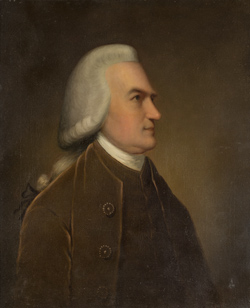
The Hon. JAMES BOWDOIN, Esq [shown above]; was chosen Moderator.

The Moderator informed the town that the present meeting was in consequence of an interview between his excellency General Gage and the Selectmen, at his desire, and mentioned the substance of the conversation that pass’d; and also that the Selectmen with the advice and assistance of a number of gentlemen had prepared several votes, which they thought it might be proper for the town to pass—And which in conjunction with the assurances that had been given to his excellency by the selectmen, they apprehended from the interview aforesaid, would be satisfactory to his excellency——

Whereupon,
The Hon. James Bowdoin, Esq; Ezekiel Goldthwait, Esq; Mr. Henderson Inches, Mr. Edward Paine, Mr. Alexander Hill, together with the selectmen, viz. John Scollay, Esq; Mr. Timothy Newell, Mr. Samuel Austin, Thomas Marshall, Esq; & Mr. John Pitts, were appointed a committee to consider of this important matter, and were desired to report as soon as may be.

The said Committee made report, and after some debate, the two following votes passed unanimously, viz.

His excellency General Gage in an interview with the selectmen, having represented that there was a large body of men in arms assembled in the neighbourhood of this town, with hostile intentions against his majesty’s troops stationed here, and that in case the troops should be attacked by them, and the attack should be aided by the inhabitants of the town, it might issue in very unhappy consequences to the town.

For prevention whereof, his excellency assured the selectmen, that whatever might be the event of the attack, he would take effectual care, that the troops should do no damage, nor commit any act of violence in the town; but that the lives and properties of the inhabitants should be protected and secured, if the inhabitants behaved peaceably; and the selectmen in behalf of the town engaged for the peaceable behaviour of the inhabitants accordingly:

In confirmation of which engagement—Voted,
That as the town have behaved peaceably towards the troops hitherto, they hereby engage to continue to do so; and the peace officers, and all other town officers, are enjoined, and the magistrates, and all persons of influence in the town, are earnestly requested to exert their utmost endeavors to preserve the peace of the town:

The Town at the same time relying on the assurances of his excellency, that no insult, violence or damage shall be done to the persons or property of the inhabitants, either by the troops or the kings Ships, whatever may be the event of the attack his excellency seems to apprehend; but of which attack we have no knowledge or information whatever, as all communication between the town and country has been interrupted by his excellency’s order, ever since the collection of the body aforesaid.

Whereas the communication between this town and the country both by land and by water is at present stop’d by order of his excellency General Gage, and the inhabitants cannot be supplied with provisions, fuel and other necessaries of life; by which means the sick and all invalids must suffer greatly, and immediately; and the inhabitants in general be distress’d, especially such (which is by much the greatest part) as have not had the means of laying in a stock of provisions, but depend for daily supplies from the country for their daily support, and may be in danger of perishing, unless the communication be opened:

Therefore, Resolved,
That a committee be appointed to wait on his excellency General Gage, to represent to him the state of the town in this regard, and to remind his excellency of his declarations in answer to addresses made to him when the works on the neck were erecting, viz. “That he had no intention of stopping up the avenue to the Town, or of obstructing the inhabitants or any of the country people coming in or going out of the town as usual;” that “he had no intention to prevent the free egress and regress, of any person to and from the town, or of reducing it to the state of a garrison; that he could not possibly intercept the intercourse between the town and country;” that “it is his duty and interest to encourage it; and it is as much inconsistent with his duty and interest to form the strange scheme of reducing the inhabitants to a state of humiliation and vassalage, by stopping their supplies,”—

Also, to represent to him, that in consequence of these repeated assurances of his excellency, the fears and apprehensions of the inhabitants, had generally subsided, and many persons who had determined to remove with their effects, have remain’d in town, whilst others largely concern’d in navigation, had introduced many valuable goods, in full confidence of the promised security:

That the Town think his Excellency incapable of acting on principles inconsistent with honor, justice and humanity, and therefore that they desire his excellency will please to give orders for opening the communication, not only for bringing provisions into the town, but also, that the inhabitants, such of them as incline, may retire from the town with their effects without molestation.

The same Committee were appointed to wait upon the General with the foregoing votes.

Then the meeting was adjourned to Sabbath morning, ten o’clock.
The town was reminding Gen. Gage of all the promises he’d made in the preceding months of keeping life as normal as possible. Of course, now there was a besieging army outside (“a large body of men in arms assembled in the neighbourhood”). How would the general respond?

TOMORROW: Sunday meeting.

Thursday, July 13, 2023

The Gap in the Town Clerk’s Records

The official published records of the town of Boston say that on Monday, 3 Apr 1775, the inhabitants held a meeting in Faneuil Hall.

With Samuel Adams busy at the Massachusetts Provincial Congress at Concord, that meeting chose Samuel Swift to preside in his place.

Voters filled some offices that the men they elected in the preceding month had declined. For instance, this town meeting chose the sons of William Molineux and Royall Tyler to be clerks of the market, an entry-level job for young gentlemen.

The other agenda item was collecting a tax approved in July 1774 “for the Relief of the Poor”—a response to the Boston Port Bill. A committee recommended naming collectors, but the citizens put off a decision until their next gathering.

To get around the Massachusetts Government Act’s limit on town meetings without Gov. Thomas Gage’s approval, the citizens then voted to adjourn to 17 April. As long as they kept the same meeting going by adjournment, they were within the law, right?

If a town meeting took place as scheduled on that day, it wasn’t recorded on the following page. That’s because the town clerk, William Cooper, slipped out of Boston around 10 April. He was apparently acting in response to intelligence that the secretary of state, Lord Dartmouth, had recommended to Gage that he start arresting leaders of the rebellion in Massachusetts.

Cooper took the notebooks that recorded town meetings with him. Some of the selectmen remained in town: Timothy Newell, John Scollay, Thomas Marshall, and Samuel Austin. In the following months, as Newell’s journal shows, they tried to document the damages and injustices of war and to stand up for their fellow citizens.

According to Cooper’s records, the next Boston town meeting took place in Watertown on 5 March. This was the annual oration in memory of the Boston Massacre, delivered that year by the Rev. Peter Thacher. That was, of course, the same day the British army saw the Continental fortifications on the Dorchester heights, so Thacher’s speech probably didn’t command people’s total attention.

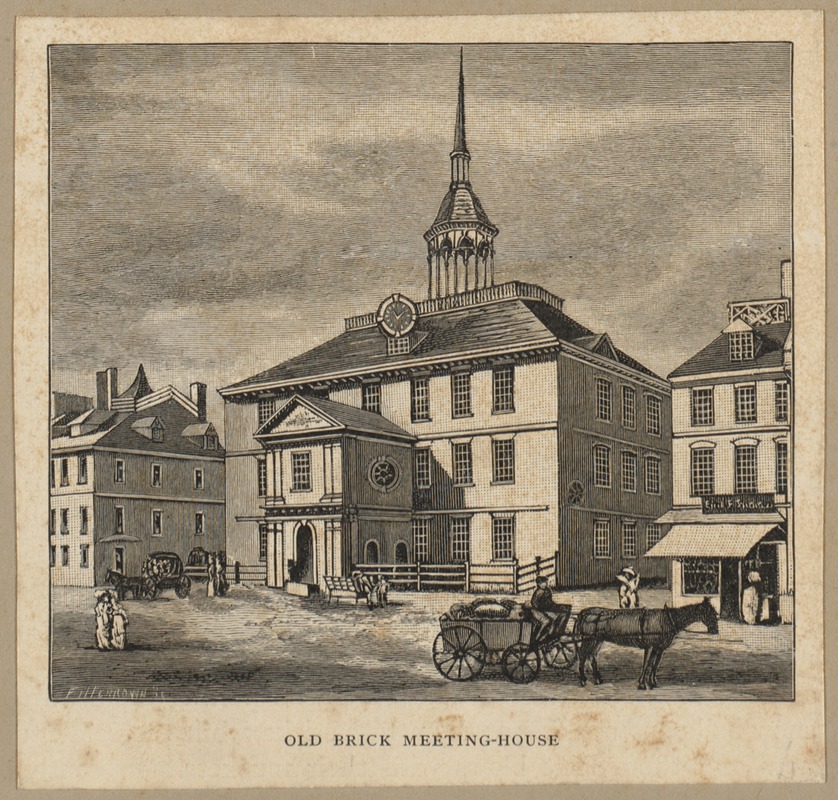
The British military sailed away on 17 March. Bostonians gathered for another town meeting twelve days later, on 29 March. They met in the Rev. Dr. Charles Chauncy’s church, the “old Brick Meeting House” (shown above). The main order of business was to elect officials for the upcoming year, starting with the town clerk. William Cooper continued to fill that role until his death in 1809.

However, there were at least two town meetings held inside besieged Boston that never got recorded in Cooper’s notes.

TOMORROW: The first lost meeting.

Tuesday, March 21, 2023

“They Stole many things & plunder’d my Store”

John Rowe reported that Monday, 11 Mar 1776, brought “Gloomy heavy Weather,” and his mood wasn’t any better.

The day before, as quoted yesterday, Gen. William Howe issued a proclamation requiring everyone with “Linnen and Woolen Goods” to turn them over to the evacuating army lest they fall into Continental hands.

That proclamation promised that the New York merchant Crean Brush (shown here) “will give a Certificate of the Delivery, and will oblige himself to return them to the Owners.” But if people didn’t comply, they risked being treated as rebel sympathizers.

Rowe appears to have been surprised that this proclamation applied to him, too. His 11 March diary entry says:

This morning I Rose very Early and very Luckily went to my Warehouse

when I Came there I found Mr. Crian Brush with an Order & party from the Genl. who were just going to Break Open the Warehouse which I prevented by Sending for the Keys & Opening the Doors—

They took from Mee to the Value of Twenty Two hundred & Sixty Pounds Sterling According to the best Calculation I Could make in Linnens Checks Cloths & Woollens—

This Party behaved very Insolently & with Great Rapacity & I am very well Convinc’d exceeding their orders to a Great Degree They Stole many things & plunder’d my Store. Words cannot Describe it

This Party consisted of Mr. Blasswitch who was one of the Canceaux people [i.e., an officer on H.M.S. Canceaux] Mr. Brush the Provost Mr. [William] Cunningham A Refugee Mr. [James or Peter] Welch The Provost Deputy—A Man nam’d [William] Hill & abo. fifteen Soldiers—with others—

I Remained all Day in the store but Could not hinder their Destruction of my Goods This day I Got a piece of Bread & one Draft of Flip

I Spent the Evening at home with Mr. [Samuel] Parker Rich’d Green Mr. [Jonathan] Warner of Portsmouth who assisted Mee very much with Mrs. Rowe & Jack Rowe

They are making the Utmost Speed to get away & carrying Ammunition Cannon & every thing they Can away taking all things they meet with never asking who is Owner or whose Property making havock in Every house & Destruction of All kinds of Furniture

There never was Such Destruction & Outrage committed any day before this Many other People have suffer’d the Same Fate as Mee— Particularly—
Mr. Saml. Austin Mr. John Scolly Capt. [Samuel] Partridge Capt. [Samuel] Dashwood Mr. Cyrus Baldwin The Widow [Mary] Newman
In May 1776, Austin, Scollay, Partridge, Dashwood, and Rowe petitioned the Continental Congress to speak up for them about their confiscated goods. But there was a war on.

Nine years later, in 1785, Rowe, Partridge, Dashwood, and Austin sought help from Gov. James Bowdoin and American minister John Adams in gaining redress from Britain. (I don’t know why Scollay dropped out; he was still alive at the time.)

Responding to a similar claim from Dr. Thomas Bulfinch, Adams wrote back on 13 Oct 1786:
I have not yet presented any of these Claims at Court, because there is not even a Possibility of their being regarded— . . . I frankly own I do not think, that the Dignity or the faith of the United States ought ever to have been compromised in these Matters—
If those Boston merchants had left with the British military, they might have regained their property after landing in Halifax. But they did, after all, show themselves to be rebel sympathizers.

TOMORROW: A receipt, and more disorder.

Thursday, October 20, 2022

Three Cousins Named Jonathan

As I wrote yesterday, Jonathan Williams, Esq., merchant and town official in Boston, married Benjamin Franklin’s niece Grace Harris in 1746. They had a son named Jonathan in 1750.

Jonathan, Jr., went into business, starting with a trip to London to make contacts. While there he lived with his great-uncle Franklin and helped to keep the man’s accounts.

Boston newspaper advertisements say Jonathan, Jr., arrived back in Boston in September 1771 with “English Goods” and “Bohea Tea” to sell.

In April 1773 the young merchant wrote to Franklin from Boston, angling for part of the East India Company tea franchise for himself and his father. That was before the Tea Act became controversial. By the end of the year, Jonathan, Sr., had taken a prominent role in how Boston organized to stop any tea from being landed.

Jonathan, Jr., set out from Boston again in May 1774, allowing him to be in London late that year. His correspondence with his great-uncle Franklin shows he traveled around the British Isles through October, making contacts among rich businessmen and noble families.

Jonathan, Sr.’s sister Mary married Samuel Austin, another Boston merchant and official. They had a son in 1751 whom they named Jonathan Williams Austin. He went to Harvard College (shown above), graduating in 1769. While studying law under John Adams, he was a witness at the Boston Massacre trial, which these days would be flagged as a honking conflict of interest.

In April 1773 the Massachusetts Spy published a version of James Otis’s argument in the 1761 writs of assistance case. Adams later wrote that this text was based on his notes, which Austin “stole from my desk and printed in the Massachusetts Spy, with two or three bombastic expressions interpolated by himself.”

By that time, Jonathan Williams Austin had moved out to Chelmsford to establish his own practice. In late 1774 that town elected him as a delegate to the Middlesex County Convention and then to the Massachusetts Provincial Congress.

Jonathan, Sr., and Mary’s brother John Williams also had a son named Jonathan, born in 1753. He went to Harvard College, class of 1772. Then he followed his Austin cousin’s career path by becoming a clerk for John Adams. His correspondence with Adams shows he was in Massachusetts in the fall of 1774.

That gives us some of the data we need to interpret these entries from Josiah Quincy, Jr.’s journal of his trip to London in 1774:
November 17. Proceeded to London, where I arrived about 11 oClock a.m. . . . Was waited upon by Messrs. Thomas Bromfield, and Edward Dilly, and Mr. Jonathan Williams—from all of whom I received many civilities. . . .

November 18. This morning Jonathan Williams Esqr., Inspector of the Customs in the Massachusetts Bay[,] waited upon me and we had more than an hour [of] private conversation together.
In the Colonial Society of Massachusetts multivolume publication of Quincy’s writings, the note for this passage identifies Jonathan Williams as:
Benjamin Franklin’s grandnephew. His father John, a wealthy Boston merchant and Patriot leader, had married Franklin’s niece, Grace Harris. The younger Williams studied law under John Adams’s tutelage and was then living in London with his great-uncle, his post as a customs inspector in Massachusetts essentially a sinecure.
That note conflates the two cousins named Jonathan Williams. The one born in 1750 was Franklin’s grandnephew, but the one born in 1753 was Adams’s law student. Only the first could have been in London in late 1774. The note also misstates the name of that eldest cousin’s father, the “wealthy Boston merchant and Patriot leader”—that man was also named Jonathan. The youngest cousin’s father was named John.

But the biggest error came earlier. I puzzled over this passage and other documents for weeks, trying to reconcile odd details. And I finally decided that the most likely explanation is that Josiah Quincy met with two different men and wrote down the wrong name for one of them.

TOMORROW: Who was “Mr. Inspector Williams”?

Wednesday, October 19, 2022

Identifying Benjamin Franklin’s “Cousin Williams”

A couple of weeks back I dissected the records of Josiah Quincy, Jr.’s 1774–75 visit to Britain, and in those postings I now believe I misidentified a man.

I think I erred because of an error in the notes to Quincy’s London journal as edited by Daniel R. Coquillette and Neil Longley York for the Colonial Society of Massachusetts. And I think Coquillette and York erred because of an error by Josiah Quincy, Jr., himself.

So let’s go back to the start of the eighteenth century. When Benjamin Franklin was a boy, he was already an uncle. That was because little Ben was the youngest son of the second marriage of Josiah Franklin (1657–1745). That man had had seven children by his first wife, starting in 1678 before the family moved to Massachusetts.

Baby Ben was thus almost thirty years younger than his oldest half-sibling, and the earliest half-siblings married and had children as he was growing up. When Ben was six years old, his half-sister Anne (1687–1729) married William Harris, and when Ben was twelve that couple had a baby named Grace (1718–1790). Grace was thus a niece of young Benjamin Franklin.

In 1746 Grace Harris married a man named Jonathan Williams. At this point the situation becomes confusing because there were two prominent men named Jonathan Williams in mid-1700s Boston, and authors have amalgamated the records of their lives. As a result, at Founders Online the editors of the Franklin Papers and the Adams Papers disagreed on when the Jonathan Williams who married Grace Harris was born and died.

The Adams Papers at one point said that man “(d[ied]. 1788),” probably based on a report in the Massachusetts Centinel of 29 Mar 1788 that “Deacon Jonathan Williams” had just died at age 88. The records of the First Meetinghouse say “Jonathan Williams (Son of the late Deacon Williams)” was himself chosen a deacon in 1737, and he appeared in those papers through 1776. However, that deacon’s widow was named Sarah, according to her own death notice in the 16 Sept 1789 Centinel.

On 14 Apr 1790 the Centinel reported the death of “Mrs. GRACE WILLIAMS, aged 71, the consort of Jonathan Williams, Esq. of this town, merchant.” That woman’s given name indicates she was Franklin’s niece. Her husband survived her for a few years, moving to his son’s home at Mount Pleasant near Philadelphia. Then the 1 Oct 1796 Columbian Centinel reported the death there of “Jonathan Williams, Sr., formerly a reputable merchant in this town [Boston].”

Therefore, after going back and forth on the question many times, I’ve decided that the Franklin Papers were correct in saying that the Jonathan Williams connected to the Franklin family lived “1719–1796.” (The Adams Family Correspondence volumes adopted these dates, too.) I can’t find confirmation for the birth year but can say that, contrary to many profiles of him, this man wasn’t the son of the Deacon Jonathan Williams who appeared in Samuel Sewall’s diary.

The Jonathan Williams who married Grace Harris was a successful merchant and Boston town official, thus earning the suffix “Esq.” As a Whig, he served on some town committees and in November 1773 moderated of one of the extra-legal tea meetings in Old South.

Franklin used this merchant Jonathan Williams as his business agent in Boston, referring to him as “Cousin Williams” and “Loving Cousin” since our language doesn’t have a specific term for a niece’s husband. However, when he was feeling conspiracy-minded, Thomas Hutchinson described that Williams as “a Nephew of Doctor F———ds,” making the relationship closer than it really was.

Now here’s where it gets more confusing. Jonathan Williams, Esq., had a brother named John (d. 1791). In 1767 Franklin told his son William that this man was “brother to our cousin Williams of Boston.” John Williams went to work for the Customs service in the late 1760s, though he ended up feuding with his superiors and spent most of the 1770s trying to go over their heads in London.

And here’s where it gets even more confusing. Both brothers, Jonathan Williams and John Williams, had sons in the 1750s whom they named Jonathan. So did their sister Mary, who married Samuel Austin. Two of those three first cousins named Jonathan studied law under John Adams. A different two spent years in France during the Revolutionary War. And two died during the war.

So who met with Josiah Quincy in London in 1774?

TOMORROW: Sorting through the Jonathan Williamses (and John).

Friday, March 27, 2020

“The Grand Jury haveing found bills against them”

As I recounted back here, the Suffolk County grand jury inquiring into the Boston Massacre took a lot of testimony about whether people had fired down at the crowd from the Customs House behind the soldiers.

The foreman of that grand jury was William Taylor of Milton. (At the time, Suffolk County included all of present-day Norfolk County, so most of its population was outside Boston.)

According to A. K. Teele’s History of Milton, Taylor was born in Jamaica in 1714. His older brother John became Milton’s minister in 1729, and William went into business as a merchant in Boston, living on Cornhill near the Old Brick Meeting-House.

(It looks like another William Taylor was warden at King’s Chapel early in the century, and another William Taylor was a sea captain sailing in and out of the harbor, and another William Taylor had a mercantile store on Long Wharf and became a Loyalist.)

The Rev. John Taylor died in early 1750, and William advertised many times in the Boston newspapers over the next few years to sell and then rent property in Milton. He described that estate as “suitable for a Gentleman’s Seat, being but 8 Miles from the Town of Boston.” Also in the 1750s he paid Joseph Blackburn to paint his portrait, shown above.

William Taylor was active in Boston’s militia regiment, rising to the rank of lieutenant colonel in December 1764. He also held offices in the Ancient and Honorable Artillery Company and served for one year as a fireward.

In late 1765, Col. Taylor remarried, to the widow Sarah (Cheever) Savage. The following summer, the Taylors left Boston, apparently moving to that “Gentleman’s Seat” in Milton. His name then appears mainly in advertisements promoting land in Pownalborough, Maine. Thus, while Taylor was a country gentleman as he led the grand jury in 1770, he had close ties to the Boston elite.

After war broke out in 1775, soldiers broke into Gov. Thomas Hutchinson’s uninhabited mansion in Milton and found a trunk of letters, among other things. Col. Taylor took charge of that property. The letters went into the Massachusetts state archives while other goods “were sold at auction, at the barn of Col. Taylor.” This William Taylor died in 1789.

Hutchinson singled out another member of this grand jury as influential: “Mr Sam Austin of Boston.” Samuel Austin was a merchant and active Whig, playing a prominent role in the march on Hutchinson’s home earlier in 1770. In 1773 Austin was elected one of Boston’s selectmen, a position he held until the end of the siege.

One of Samuel Austin’s sons was Jonathan Williams Austin, who graduated from Harvard in 1769 and started clerking for John Adams that August. The younger Austin was also a witness at the Massacre trials, identifying Pvt. William Macauley.

In their deliberations, the grand jury led by Col. Taylor decided to believe the young French servant Charles Bourgate and the people who testified to seeing flashes from the Customs House windows. They therefore rejected the testimony of the men Bourgate accused. According to an anonymous Crown informant:
Notwithstanding [John] Munro & [Edward] Manwarring proveing a perfect Alibi they were this day (27th March) committed to Jail, as was also Green’s son and Thomas the manservant—the Grand Jury haveing found bills against them, as seven people positively swore to guns being fired that night out of the Custom House Windows.
Thus, 250 years ago today, the response of the grand jury to hearing Hammond Green, Thomas Greenwood, and others testify that there was no conspiracy to shoot people from the Customs House was to indict those men as being part of the conspiracy.

TOMORROW: The real villain—or the real target?

Saturday, January 25, 2020

Confrontation at Governor Hutchinson’s House

When we left the “Body of the Trade” in Faneuil Hall yesterday, Whig leader William Molineux had just threatened to storm out of the meeting and kill himself.

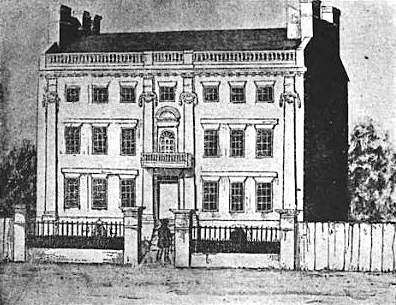
Molineux wanted to lead the body to Thomas Hutchinson’s mansion in the North End (shown here) and confront the lieutenant governor’s sons, Thomas, Jr., and Elisha, about their plan to leave the non-importation agreement.

Josiah Quincy, Jr., warned that marching on the acting governor’s house was tantamount to treason. Molineux’s radical colleagues disagreed, but the rich merchants and town officials—even John Hancock—were still reluctant. Or maybe they just disliked Molineux’s confrontational approach.

Molineux’s dramatic gesture was met by an equally dramatic response from the radical Dr. Thomas Young, according to a Crown report now in Harvard’s Houghton Library:
Dr. Young call’d out stop Mr. M[olineu]x stop Mr. M[olineu]x for the love of God stop Mr. M[olineu]x. Gentlemen, If Mr. M[olineu]x leaves us we are forever undone, this day is the last dawn of liberty we ever shall see.

Mr. M[olineu]x was upon this prevail’d upon to return and the following Persons agreed to serve on their Committee vizt. Mr. M[olineu]x Deacon [William] Phillips, [James] Otis, S[amuel]. Adams and Saml Austin
That group was still mostly politicians, not merchants, but they were all upper-class. And they weren’t going alone.
about 1/2 past 2 o’Clock the above persons attended by upwards of 1000 people of much the same stamp of those who waited upon [William] Jackson the day before, set out for the Lt. Govr’s house, when they came before the door the Lt. Govr. open’d one of his Windows and ask’d of them what they wanted;

M[olineu]x replied that it was not him but his Sons that they desired to see—

the Lt. Govr. addressing himself to the whole spoke to the following purport, Gent. do you know that I am the representative of the King of Great Britain the greatest monarch on earth, and in his name require you to desperse—
Which is of course the exact thing that Quincy had warned could happen. But Molineux wasn’t deterred.
about this time his Sons came also to the window when M[olineu]x read to them the vote No. 1 and the demand which immediately follows it [as quoted yesterday]—

the Sons answer’d that they had nothing to say to them—

the Lt. Govr. asked for a Copy of the vote but was told by M[olineu]x that he was intrusted with only the original and was not at liberty to give a copy.
That document could, of course, have been evidence in a trial.
The Lt. Govr. also observ’d to Otis that he was greatly surprised to see him there, who cou’d not be ignorant of the illegality of such proceedings, and further added that he had there in his Eye six or seven People who had been accessory to the pulling down of his house—
That was back in August 1765 during the Stamp Act riots. Hutchinson, who was also a historian, never forgot.

The crowd retired from that house but visited the other defiant importers: Jackson, Nathaniel Cary, Benjamin Greene, Theophilus Lillie, John Taylor, and the governor’s nephew Nathaniel Rogers. They “receiv’d no satisfactory answer from any one of them.” Most didn’t even open their doors. Lillie said that “he had nothing left but his Life, which he would deliver up if they pleas’d.”

Molineux and the “Body of the Trade” seemed to be stymied. According to the Crown informant:
This Evening the friends of Government thought they had gain’d a compleat victory, and numbers of the most considerable Merchts. in the British trade who had hitherto been silent could not help publickly declaring that they now hoped they were releas’d from their bondage as they were convinced should the Hutchinsons, Jackson, and others mention’d before, stand out for a few days that great numbers would join them
Was this the end of non-importation?

TOMORROW: A private deal.

Wednesday, April 12, 2017

The Secret of Sagittarius’s Letters

Boston’s Whigs drove the printer John Mein out of town in 1770. A bunch of merchants confronted him and his partner, John Fleeming, on the street at the end of October 1769.

The printers pulled out pistols to defend themselves, and one went off harmlessly. Then tailor and militia colonel Thomas Marshall—who hadn’t even been part of the original crowd, just angered by the shot—swung a shovel at Mein close enough to cut his coat.

While Mein went into hiding, John Hancock jumped at a letter from the Longman publishing firm in London asking him to help collect on debts that the printer owed. Hancock went to court and seized Mein’s press and other property.

Mein retreated to London. In 1774 he wrote a series of essays about Boston politics for the Public Ledger under the pseudonym “Sagittarius,” informing British readers about the people who were causing such a crisis in the empire.

Those essays were collected in a book with a title page that reads:
Sagittarius’s Letters and Political Speculations.

Extracted from the Public Ledger;
inscribed to the very loyal and truly pious Dr. Samuel Cooper, pastor of the Congregational Church in Brattle Street. . . .

Boston
Printed: By Order of the Select Men, and sold at Donation Hall, for the Benefit of the Distressed Patriots.
MDCCLXXV.
Bibliographers appear to accept that information as accurate. However, I haven’t found any reference to the book in the records of the Boston selectmen. And it would be unusual for them to put public money toward printing these letters with no refutation since they’re nothing but bitter and often personal attacks on Boston’s political leaders. For example:
The Selectmen of Boston, who have fomented so many dagerous [sic] and traiterous insurrections, and who have given such continued trouble to our supreme legislature, are after all the most ignorant, assuming, and despicable fellows in the Creation. One of them is a Bankrupt Merchant [John Scollay]; a second a noble Tinman [Timothy Newell]; a third, an old retailer of Wine and Cyder, but who now acts as Shopman to his wife [Samuel Austin?]; a fourth, that poor plucked gawky, Orator [John] Hancock; and a fifth, a redoubtable Taylor…
That last was Mein’s old foe Thomas Marshall.

It strikes me that the whole “Printed: By Order of the Select Men…” line was a joke parodying the Massacre anniversary orations, which the selectmen really did pay to have printed. Mein wrote plenty about how stupid and dangerous that tradition was.

Likewise, the dedication to the Rev. Dr. Cooper drips with sarcasm. And there was no site called “Donation Hall”; that was probably a sneering reference to Faneuil Hall, where a town committee collected donations for the poor after the Boston Port Bill.

So if the printing information is unreliable, was this book really printed in Boston, or was it imported from London, New York, or another city? It’s hard to imagine a market for the material outside of Massachusetts, but perhaps someone connected to the royal government thought it was valuable to spread around. Whoever set the type inserted a lot of errors (which might have annoyed Mein, his Boston Chronicle newspaper being well set).

TOMORROW: Sagittarius’s gossip about John Hancock.

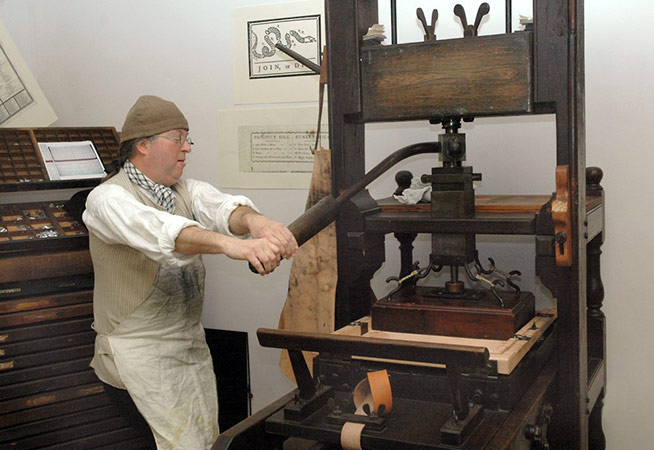
[The photograph above shows Gary Gregory of the Edes & Gill Print Shop in the North End.]

Wednesday, November 05, 2014

The End of Pope Night in Boston

As I’ve discussed under the label of Pope Night, the 5th of November was a big holiday in colonial Boston. That was when Boston’s young men and teen-aged boys showed their loyalty to Britain by parading through the streets with effigies of the Pope and the Devil, hanging the enemies of the year in effigy, and brawling after sundown.

That anti-Catholic pageant wasn’t any trouble until American Patriots started to seek to support of Catholics. One of the first people to recognize the potential problem was Gen. George Washington, who on 5 Nov 1775 chided his officers and troops for considering “that ridiculous and childish Custom of burning the Effigy of the pope.” At the time, Gen. Richard Montgomery and Col. Benedict Arnold were hoping to win over the French Catholics of Canada.

But that invasion fell apart, and by November 1776 Boston’s youth went back to their traditional Pope Night celebrations. Then in early 1778 the new U.S. of A.’s diplomats spoiled the fun by convincing the French government to enter the war. The French navy arrived off New England’s coast in the middle of the year. So suddenly Bostonians were supposed to be nice to Catholics again.

The joint American and French attempt to dislodge the British from Newport ended in failure, and then the fleet moved up to Boston. There was a lot of friction between those sailors and marines and the locals. As Christian McBurney describes in his recent Journal of the American Revolution article, “Why Did a Boston Mob Kill a French Officer?”, that conflict came to a head when, well, a Boston mob killed a French officer.

The local authorities quickly moved in to quell that fighting and repair relations with the French commanders. But the next 5th of November approached less than two months later. Those officials worried that Pope Night would rouse passions again. Therefore, they clamped down, at every level.

The Massachusetts Council, which was exercising executive power in the state in the absence of a governor, passed a resolve against Pope Night. Then the seven elected Boston selectmen, including John Scollay, Samuel Austin, and Harbottle Dorr, met on the 5th, and they invited the town’s magistrates in as well:

The Justices attended according to the invitation of the Selectmen to consult the best methods to prevent any Exhibitions this Evening agreable to a Resolve of the Council transmitted to the Selectmen, Yesterday.
All those branches of government working together managed to suppress Pope Night at last. And it doesn’t seem to have come back in Boston again. Some of the rituals resurfaced around Christmas, others on Halloween. But the next time Boston newspapers reported on “Pope’s Day,” it was as a quaint pre-Revolutionary custom.

Sunday, March 17, 2013

“The Agreeable Sight of a number of ships leaving”

This being Evacuation Day, I’m quoting all of Col. Jedidiah Huntington’s letter to his father back in Connecticut about that turning-point:
Roxbury Camp 17th March 1776

Hond. Sir,—

This morning we had the Agreeable Sight of a number of ships leaving the Town of Boston with a large number of Boats full of Soldiers, about ten of Clock several Lads came to our out Centries and informed us that the Troops had intirely left the Town and that the Selectmen were coming out to see us, soon after we had the Pleasure of seeing Messrs. [Samuel] Austin, [John] Scolly, [Thomas] Marshall &c—they had an Interview with the General [Ward or Washington?] & gave him the best Intellegence they could concerning the state of the Town & the Intentions of the Enemy—

the Enemy are now all laying between the Castle & Light House in full View from the Town and make a very formidable Appearance, we shall keep a sharp look out till they are out of Sight at least—the Talk of the Town is that the Troops are gone to Hallifax—the Country ought to be well on their Guard in every Place where it is likely they will make a Descent—

I expect most if not all the established Regiments will be ordered from this Station as soon as the Enemy are gone from the Bay—where my Destination will be I know not I hope it will give me an Opportunity of seeing Norwich—my Love & Duty to Mother & all & remain Your dutifull & affectionate son

J Huntington
The comment on “several Lads” who came out to the sentries appears to be the sole basis of statements like this in Richard Ketchum’s Decisive Day:
…a pack of little boys burst out of doors, ran screaming and yelling down Orange Street toward the town gates, and pelted across Boston Neck toward Roxbury, somehow darting in and out between Lieutenant [Jesse] Adair’s booby traps. Shouting with glee, the youngsters raced up to the rebel outposts and breathlessly delivered the news that Boston was free at last.
And from David McCullough’s 1776: “In no time small boys came running across the Neck from Boston to deliver the news that the ‘lobster backs’ were gone at last.”

I’d love to find an account from one of those boys, but it might tell quite a different story from the explosion of youthful energy Ketchum pictured. The word “Lads” could apply to older teenagers, for example.

I quoted the selectmen’s perspective on their errand here.

TOMORROW: Lt. Adair and the booby traps.

Friday, March 07, 2008

The Selectmen Plead for a Cease Fire

On the day after the British military command decided to evacuate Boston as quickly as possible, selectman Timothy Newell described their haste in his journal:

The last night and this day the Troops are very busily employed in removing their stores, cannon, ammunition—some of the Dragoons on board, the Refugees &c. &c., in shipping their goods &c.

The Selectmen write to the commanding officer at Roxbury, at the earnest desire of the Inhabitants and by permission of Genl. [William] Howe as follows.
To the Commanding Officer at Roxbury.
Boston March 8th 1776.

As his Excellency Genl. Howe is determined to leave the Town with the troops under his command, a number of the respectable Inhabitants, being very anxious for its preservation and safety, have applied to General [James] Robertson for this purpose, who at their request have communicated the same to his Excellency Genl. Howe, who has assured him, that he has no intention of destroying the Town, unless the Troops under his command are molested, during their embarkation, or at their departure by the armed force without; which declaration he gave General Robertson leave to communicate to the Inhabitants. If such an opposition should take place, we have the greatest reason to suspect the Town will be exposed to entire destruction.

As our fears are quieted, with regard to General Howe’s intentions, we must we may have some assurances, that so dreadful a calamity may not be brought on by any measures without. As a testimony of the truth of the above we have signed our names to this Paper, carried out by Messrs. Thomas and Jonathan Amory, and Peter Johonnet, who have at the earnest entreaties of the Inhabitants, through the Lieut. Governor [Thomas Oliver] solicited a flag of truce for this purpose.

[signed]
1 John Scollay
2 Timothy Newell
3 Thomas Marshall
4 Samuel Austin
These selectmen had remained in Boston through the siege with the hope of preserving people and property, and now they faced threats both from the angry departing British troops and the American artillery. These men were staunch Whigs, but not everyone trusted their accommodations to the military authorities. In July 1775, Joseph Greenleaf had even referred to Gen. Thomas Gage’s “tools the S——t-men” in a letter to his brother-in-law, Robert Treat Paine.

It’s interesting that the selectmen didn’t go out to the lines themselves. Perhaps the general wouldn’t allow them to. Instead, of the men who delivered their letter to the American lines, Peter Johonnot was a Loyalist and the Amory brothers had tried to stay neutral, and thus would all return to Boston.