J. L. BELL is a Massachusetts writer who specializes in (among other things) the start of the American Revolution in and around Boston. He is particularly interested in the experiences of children in 1765-75. He has published scholarly papers and popular articles for both children and adults. He was consultant for an episode of History Detectives, and contributed to a display at Minute Man National Historic Park.

Subscribe thru Follow.it


•••••••••••••••••


Showing posts with label Canada. Show all posts

Saturday, August 08, 2026

“Fell in with two Arm’d Schooners”

Yesterday I wrote about Benjamin and Edward Davis, two brothers who were mercantile partners in Boston until religion and Revolutionary politics split them apart.

Benjamin became a Sandemanian, devoutly guided not to oppose British Crown policies by, for instance, signing on to the non-importation boycotts.

Edward remained an Anglican, attending Trinity Church. By late 1774 the Whigs coopted him into helping to enforce their strongest boycott, the Continental Association.

Both brothers remained in Boston during the siege. But when the British military evacuated, Edward stayed while Benjamin sailed away to Halifax, Nova Scotia. In April 1776 the Patriot authorities ordered magistrates to question Edward about his loyalty, but evidently he passed muster.

Around the start of July, Benjamin Davis boarded the ship Peggy, headed for New York. Along with him came his son Benjamin, Jr., who turned twenty that year; an enslaved man; half a dozen other Loyalist men; and a few Loyalist women.

Evidently those refugees saw business opportunities supplying the huge British and Hessian army assembling at New York. The Peggy was loaded with provisions, including 2,648 “mutton hams,” 311 “tierces salted beef,” fish, flour, snuff, cloth, stockings, and a large quantity of alcohol in various forms.

The Peggy also carried six 3-pounder and two 2-pounder cannon. It sailed in convoy with dozens of other merchant ships and troop transports, all escorted by two Royal Navy warships. The sea voyage probably seemed safe.

We have the ship captain’s account of what happened next:
I James Kennedy, Master of the Ship Peggy, in the Merchant Service, declare that I left Hallifax about the first Inst. [i.e., of this month] under Convoy of the Renown of Fifty Guns, with a Fleet of sixteen [torn] Transports containing the 42nd & 71 Scotch Regiments & Fraziers new rais’d Regiment, about 3000 in all, & three Large Ships with Hessian Troops on board, about 600 in all, & one Ship with 5 companys of English foot Guards, & four Victualling Ships, the whole Fleet bound for New York.

Off Nantucket Shoals we fell in with the Flora Frigate of Thirty Guns & four Transports with Highland Troops, these had been in Boston Bay, where they got information from a Fisherman that the Town was Evacuated, on which they Stood for Hallifax untill they met with us, they then joyn’d our Fleet for New York.

The Scotch Troops were all to be of Coll [Archibald] Campbells division (of the Grand Army in America, the whole of which Army I was informd, would by the last of July, amount, to 50,000.) the Hessian Troops left England about the 12th of May, some of the Officers informd me they came out with 304 Sail under the Command of Commodore Hawtham [William Hotham], on board of whom were 10,000 Foreign Troops & some English Troops (number unknown).

last Fryday sennight [19 July] in a gale of wind & thick weather I lost the Fleet & on monday [22 July] I fell in with two [American] Arm’d Schooners, Capts. [John] Skimmer & [Samuel] Tucker, to whom I surrendered after a short engagement, in which I had only one man Wounded.

The day after the Fleet left Hallifax, I saw from my Deck forty Sail of Ships standing in for that Harbour, & which I suppose to be part of the Fleet under Commodore Hawtham.
Skimmer commanded the Franklin and Tucker the Hancock, schooners originally launched under the authority of the Continental Army commander. They were now sailing for Massachusetts.

The Patriot authorities who took Capt. Kennedy’s deposition were evidently pumping him for intelliegence on what other British ships and troops were out there rather than details of his engagement with the schooners.

For Benjamin Davis, all that mattered now was that he was a prisoner of the state he’d left four months before.

TOMORROW: The gingerbread man.

Monday, May 04, 2026

The Hill Brothers Settle in Canada at Last

On 27 Apr 1782, Elizabeth Hill died, “greatly lamented by her Family and Neighbours,” the New-York Gazette reported two days later.

In that news item her husband, John Hill, had “Esq.” after his name, a genteel reflection of his service to the Crown inspecting the Brooklyn ferry.

Also by that time, the Americans had won the war. Gen. Guy Carleton was about to be appointed commander of the British forces, charged with holding things together till the end. Gen. George Washington’s Continental Army was pressuring New York City, but not trying anything too risky. Lt. Col. Benjamin Thompson was getting his combat experience by leading dragoons on Long Island. But basically people were waiting for the final peace terms to be settled.

John’s brother Richard led one of the first contingents of Loyalists to leave New York, embarking in June 1783. He was in Carleton, Nova Scotia (which would become St. John, New Brunswick), in September when he wrote back to John about a ship captain named John Mason who had tried to make off with the vessel under his command.

Richard Hill was described as the first Loyalist to build a frame house in the town of Digby, Nova Scotia. He became a justice of the peace and a vestryman.

John Hill and his family evacuated New York late in 1783, eventually joining his brother in Digby. By the next year, John had remarried. His household consisted of him, his wife, a child over age ten, and three “servants” over age ten.

In 1786 the Loyalists Commission held hearings at Halifax. John Hill applied for “half pay, as a Quarter Master, but was told by their Honors that Pensions, and Half Pay, was to be Settled in England.” Four years later he was in London, petitioning for support for himself and his brother. Returning to Digby, he managed a store and was first treasurer of the local Freemasons’ lodge.

People think that Richard Hill died around 1803, three years after his wife Jane (her gravestone shown above).

John died on 23 Nov 1817—forty years after he had been released from the Boston jail, accused of helping to loot the town during the evacuation.

Friday, May 01, 2026

”No other Crime, but retaining their Allegiance to the King”

We left John Hill, his wife Elizabeth (?), and his daughter in the Boston jail in February 1777, suspected of “being Enemical to the States” and “attempting to Carry Intillegence to the Enemy.”

The next trace of Hill that I’ve found is from John Noble’s article “Some Massachusetts Tories” for the Colonial Society of Massachusetts in 1900:
At the July [court] Term, 1777, John Hill of Boston recovers judgment in a plea of the case against Crean Brush for £2.8s.10d lawful money, and costs.
Did Hill sue Brush, his employer during the evacuation from Boston, for some loss? Or was this another John Hill?

There’s firmer information from John Howe’s Newport Gazette, published in the British-occupied city on 20 Nov 1777:
By Mr. JOHN HILL, who left Boston the 15th of October, we learn, that Dr. [Benjamin] Church, Mr. John Dean Whitworth, of the Queen’s Rangers, and a Number of others, are yet confined in Boston; Dr. [Mather] Byles is confined in his own House; and upwards of 70 Persons, who can be charged with no other Crime, but retaining their Allegiance to the King, and Attachment to that happy Constitution under which they were born, and from which they have enjoyed the most solid and inestimable Blessings, are now confined on board a Prison Ship in that Harbour.—

He also adds, that almost every Goal in New England is filled with these unhappy People.

Mr. Hill has also favoured us with the current Prices, in Lawful Money, of the following Articles, at the Time he left it:
Beef, — — 0.1.3
Mutton, — — 0.1.6
Butter, — — 0.4.0
And so on through a list of other meats and foods, alcohols, sugars, teas, and cordwood to shoes for men (£2.2/pair) and women (£1.10/pair).

Presumably Howe was making the point about price inflation in Continental-governed areas, but we’d have to find pre-war costs for comparison.

Years later John Hill told the Loyalists Commission, as recorded by Todd Braisted:
That on the 17th of March 1776, he left Boston, with the Royal Army; but was taken at Sea, by the Rebels, . . . himself, his Wife, & Daughter was carried back to Boston, and he confined in Prison 19 months; they were all tried For their lives, but not Condemned.

In November 1777, they were Exchanged, went to Halifax, and afterwards to New York
Hill’s memory was off by just a few weeks. It’s possible he didn’t remember the port his family came through, or that the Hills went from Newport to Halifax. Adding to the confusion on that point, on 16 Oct 1777 the Independent Chronicle reported that “a Cartel” ship “with upwards 130 Prisoners on board” had sailed the previous day from Boston for Halifax. 

By whatever route they left New England, John Hill, his wife, and his daughter eventually returned to New York, the city he’d been chased out of in the spring of 1775. But now it was held by the British military.

TOMORROW: Inspector Hill.

Monday, April 20, 2026

“Such Cost and Charge as hath arisen by their being brought before the General Court”

On 13 Apr 1776, the Massachusetts General Court decided that “Caleb Wheaton and others [well, other men], who were taken aboard the brig,” should be brought to its meeting-place in Watertown ”for Examination.”

Four days later, as quoted yesterday, the Marblehead committee of correspondence wrote to say they now thought two of Wheaton’s sons—Joseph and Caleb, Jr.—had stolen a local man’s boat about six weeks before. That apparently focused the legislators’ attention on the family.

On 19 April the Council and the House named members to a joint committee to question the Wheatons.

Four days later, those members determined that Caleb Wheaton, Sr., had been “an Associator”—a member of the Loyalist militia—inside besieged Boston. Furthermore, he had been “in other Instances unfriendly to American Liberty,” perhaps a reference to his work as a Customs officer in Maine, or his statements supporting Parliament back in early 1775.

But the two legislative houses disagreed about what to do with the Wheatons. The published record of the Massachusetts House, readable here, says simply that the Council approved the first recommendation from the committee and the assembly didn’t concur.

Peter Force’s American Archives, evidently based on more complete manuscript records from the Council, revealed more details. The committee recommended
that the said Caleb Wheaton give bond to the Treasurer of this Colony for the sum of three hundred Pounds, with sufficient surety for his future good behaviour, or be confined in some Jail within this Colony until he shall find such surety; or if the said Wheaton shall think proper, and shall procure his passage for himself and family to Nova-Scotia, he may have liberty to remove there on his own expense, provided he will give his promise in writing, not to bear arms against the United Colonies.

And that the said Caleb Wheaton, Jun., and Joseph Wheaton, upon their giving their written paroles not to bear arms against the United Colonies, nor any way to aid or assist the enemies of said Colonies, and they paying the expense of being brought before this Court, may be discharged.
After the lower house said that wasn’t good enough, two more legislators were added to the joint committee, and they went back to rethink their recommendation.

The next day the Council approved a revised proposal:
  • All three Wheatons would be responsible for a £500 bond.
  • They not only had to promise not to fight the colonies, but also “not correspond with any of the Enemies of America.”
  • They had to “pay such Cost and Charge as hath arisen by their being brought before the General Court.” 
  • If any of those conditions weren’t met, they would be “committed to close confinement.”
There was no more mention of letting the Wheaton family resume their trip to Nova Scotia.

On 25 April the House considered those strictures and agreed. (Its journal says “close Imprisonment” instead of “close confinement,” if that matters.)

The committee report on that measure, signed off by Caleb Cushing of Salisbury for the Council, Perez Morton as Council secretary, and James Warren as speaker of the house, went up for auction last year.

Caleb Wheaton came back on 4 May with a petition to the House
setting forth that he has been apprehended as inimical to his Country, that he is released by giving Bonds, and is now in low Circumstance; and praying therefore that he may be enabled to recover his Household Furniture, Provisions, &c. on board the Brig Elizabeth, at Portsmouth; whereby he may support himself and Family.
The assembly gave Wheaton “Leave to withdraw his Petition.” In other words, it said no.

The Massachusetts legislature, especially the lower house, was in no mood to do any favors to Loyalists. In fact, the Wheatons even had to pay the costs of being transported to the General Court. And it appears Caleb, Sr., later told the British government that he was locked up for three months. The Wheatons’ case reflects a popular mood in the spring of 1776 that affected other Loyalists as well.

TOMORROW: William Jackson returns to Boston.

Tuesday, April 14, 2026

Tracking the Wheaton Brothers

Winthrop Sargent, Sr.’s list of civilian men captured on the Elizabeth on 2 Apr 1776 and brought into Gloucester included (in his unique spelling):
  • Kalep Whitten – Bad Man…
  • Calep Whitten ju
  • Joseph [Whit]ten
  • John Whitten
I discussed Caleb Wheaton of Machias, Maine, yesterday. E. Alfred Jones’s Loyalists of Massachusetts states that he and his wife Mary had sixteen children, but not all survived to adulthood. The genealogies I’ve found are contradictory and confusing.

According to one family researcher whose work is shared here, those other three Wheatons were all boys born on New York’s Long Island:
  • Caleb, Jr., on 20 July 1753.
  • Joseph on 30 Dec 1754.
  • John on 9 Aug 1756.
Jones’s Loyalists says Caleb and John were both born in 1757 and thus probably twins. Other records put Joseph’s birth in 1755. But let’s agree they were all around twenty years old in 1776 when Massachusetts authorities took them into custody.

Not all three Wheaton sons were of legal age in 1776. But they were all prime age to be soldiers, which is probably what mattered for Sargent. Sisters and younger brothers didn’t make the list.

To jump ahead, Caleb, Jr., and John would have standard trajectories as young American Loyalists. By 1777 they made their way to British-occupied New York City and joined provincial regiments fighting for the king. Caleb became a lieutenant, John a captain. At the end of the war they settled in Canso and Cape Breton, Nova Scotia, respectively.

The only odd blip in those brothers’ story was that when Caleb, Jr., married Sally Bryant in November 1792, the couple was in Boston’s Trinity Church (shown above). 

Joseph Wheaton followed a different course, one that took him to the U.S. Capitol.

TOMORROW: Defection.

Monday, April 13, 2026

Caleb Wheaton “industriously vindicating the Measures of the Ministry”

In yesterday’s discussion of how the Massachusetts legislature dealt with Loyalists captured on the Elizabeth in April 1776, I left out Caleb Wheaton and his sons: Caleb, Jr.; Joseph; and John.

That’s because their story is complex and detailed enough to deserve a few postings on their own. And even then there will be holes and mysteries.

Vital records of Rehoboth show Caleb Wheaton born there in 1713. There were lots of Wheatons in that region, however, including across the nearby border in Rhode Island. Unfortunately for us, that means there were other men with the same name moving in and out of the eighteenth-century record.

Documents in Caleb Wheaton’s filing to the Loyalist Commission in 1784 show that he served in the Massachusetts army raised by Gov. William Shirley to hold Annapolis Royal in 1744. Later he was “Commandant of St. George’s Fort in the Eastern Part of the Province of Massachusetts,” now Thomaston, Maine.

Customs Commissioner Charles Paxton certified that his agency made Wheaton “a preventive Officer at Machias in which he conducted himself faithfully and diligently to the Acceptance of the Board.” That couldn’t have been a full-time position, given the size of trade in the region.

By 1774, Wheaton owned 200 acres in Machias, Maine, where he lived, and 173 more acres in Dedham. Capt. Solomon Smith wrote that he “was Situated in the most advantagest place for traid in the harbour of Machias.” Wheaton’s family consisted of a wife and nine children, some grown.

That year, Caleb Wheaton testified, he was “obliged to fly from his Estate and Property…on Account of his Attachment to the British Government.”

The 13 Feb 1775 Newport Mercury ran these two articles:
Rehoboth, February 3, 1775.

A Number of the Inhabitants of this Town assembled on Monday last [28 January], to enquire into the Conduct of Mr. Caleb Wheaton, who lately came here from the Eastward, and who had rendered himself obnoxious, by openly espousing & vindicating the Plan of Despotism now carrying on against the Colonies. A Committee was appointed to wait on him, and after making an Acknowledgment of his Villany, asking Forgiveness, and promising Amendment, he was ordered to depart the Town in twelve Hours. . . .

PROVIDENCE, Feb. 4.

Mr. Caleb Wheaton, who some Time since was obliged to quit this Town for industriously vindicating the Measures of the Ministry, returned here from Rehoboth the Beginning of this Week, which Place he had likewise been obliged to leave; and Yesterday a Number of the Inhabitants paid him a second Visit, to remind him of their former Request, when he thought proper to make a precipitate Flight.—So many all the Enemies to America become destitute of a Resting-Place for the Soles of their Feet.
The reference to “the Eastward” makes me think these items referred to Caleb Wheaton, Sr., from Maine.

Like other New England Loyalists, Wheaton found protection in army-occupied Boston. Gen. Thomas Gage certified that “he was employ’d as an Officer of Guides in the Kings Service.” According to E. Alfred Jones’s Loyalists of Massachusetts, “By orders of General Sir William Howe he pulled down the Old North Meeting House,” which happened on 16 Jan 1776.

TOMORROW: The Wheaton brothers.

Monday, March 30, 2026

“The Prospect of this Country is very Sterile”

Capt.-Lt. Archibald Robertson, British military engineer, sailed out of Boston harbor on 25 Mar 1776.

Robertson’s ship was an army transport called the Thames. It was in the first contingent of vessels heading for Halifax—forty-nine in all, per his count.

Three days later, Robertson recorded in his diary, the Thames crew spotted Cape Sable, the island at the southernmost corner of Nova Scotia. The next day, the ship “made the light house west of the harbour of Halifax and came to an Anchor about 2 o’clock off Chebucto point in the harbour.”

On 30 March, 250 years ago today, Robertson’s ship moored alongside a wharf, and Loyalist refugees presumably started to disembark at their new home.

The young officer examined his new base with an eye for its defenses. He wrote:
The Prospect of this Country is very Sterile and unimprovable, The Bay very good and extensive and if the Ground was Cultivated or Capable of being so would be very beautifull.

The Town which is long and Stragling built of wood on the side of a hill, and the Dock Yard, are so Commanded by Different heights that it appears to me to be impossible to fortify them without a Multiplicity of Works and more troops than could possibly be spared.

The Ships in the Harbour opposite the Dock Yard could Easily be drove away from either side and the Dock Yard destroy’d from the East side which is not above 1400 Yards across.
Adm. Molyneux Shuldam, Gen. William Howe, and most of the rest of the evacuation fleet arrived from Boston on 2 April.

The picture above is Robertson’s “Sketch of the Harbour & Town of Halifax with our fleet turning up,” now in the collections of the New York Public Library.

Friday, March 27, 2026

“Here I took my leave of that once happy country”

Even after the destruction of Castle William, described yesterday, Judge Peter Oliver’s ship Pacific remained in Boston’s outer harbor, waiting for the right weather.

On 24 March, Oliver recorded, the night was so cold “that the vessell’s bows and cables were loaded with ice.”

The next day the winds were more favorable. A packet ship sailed for London, carrying Oliver’s son Peter, Jr., and his wife Sally; Sally’s brother Thomas Hutchinson, Jr., and his wife Sarah (who was also the judge’s niece); and their children among the passengers. At the same time, the “first Division” of the Loyalist fleet headed toward Halifax.

Still, Oliver’s ship remained. On 26 March he was rowed over to H.M.S. Renown and dined with “Commodore [Francis] Banks,” that ship’s captain.

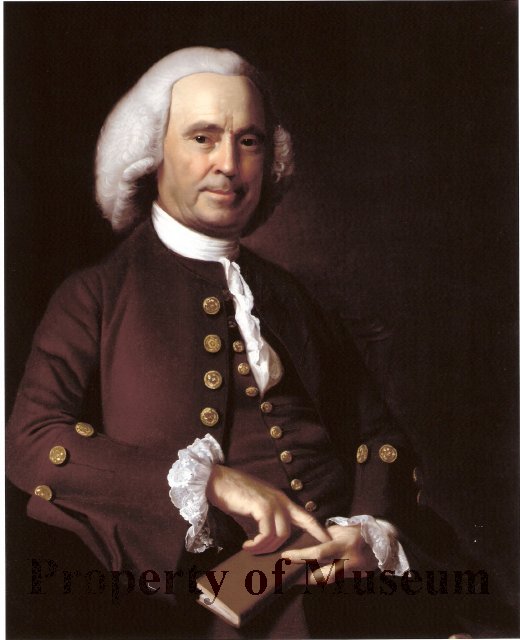
On 27 March, 250 years ago today, Adm. Molyneux Shuldam (c. 1717–1798, shown above) was ready to sail, his flagship H.M.S. Chatham leading a fleet of Royal Navy warships, army troop transports, and merchant vessels to Nova Scotia. But first he wrote out orders for Capt. Banks:
You are hereby required and directed to employ His Majesty’s Ship under your Command, in such manner as you shall judge best, either by Cruizing or Anchoring occasionally in preventing all communication or Commerce with the Town and Harbour of Boston; And whereas many Vessels are daily expected here with Stores and Provisions for the use of His Majesty’s Fleet and Army, which are in extreme want of them; You are to take under your Command the Ships and Vessels mentioned in the Margin and employ them in Cruizing between the Latitudes of Cape Cod, and Cape Anne at such distance from the Shore, where they are most likely to fall in with the above Expected Vessels, which you are to direct them to see in safety to Halifax, and then return to you.

You are also hereby required and directed on the Arrival of any of His Majesty’s Ships and Vessels at Nantasket (except those you have Orders to take under your Command) to give their Commanders Orders to proceed immediately to join me at Halifax, or where ever else you shall from good Authority hear I may be.

You are to take, sink, burn, or destroy, all Rebel Armed Vessels you may meet with, and to continue upon this Service till further Order, Governing yourself in the Executing of it, by the General Code of Orders and Instructions, you have already received from me, sending all Vessels you may seize or detain to Halifax, to be proceeded against according to Law, and giving me an Account of your Proceedings by all opportunities that offer.
The naval ships that the admiral listed in the margin were the frigates Lively, Niger, and Fowey; the sloop Swan; the brigs Hope and Bolton; and the schooner Dispatch. That flotilla would remain to limit New England shipping.

Judge Oliver wrote in his diary for that day:
I sailed from Nantasket, abt. 3 o’clock, afternoon, in the 2nd and last Division of the fleet, about 70 sail, for Hallifax, under convoy of the Chatham, Admiral Shuldham, and of the Centurion, Capn. [Richard] Braithwaite.

Here I took my leave of that once happy country, where peace and plenty reigned uncontrouled, till that infernal Hydra Rebellion, with its hundred Heads, had devoured its happiness, spread desolation over its fertile fields, and ravaged the peacefull mansions of its inhabitants, to whom late very late if ever, will return that security and repose which once surrounded them; and if in part restored, will be attended with the disagreeable recollection of the savage barbarities, and diabolical cruelties which had been perpetrated to support rebellion, and which were instigated by Leaders who were desperate in their fortunes, unbounded in their ambition and malice, and infernal in their dictates.

Here I drop the filial tear into the Urn of my Country.

O fortunatos nimium, sua si bona norint—Nov-Anglicanos!

And here I bid A Dieu to that shore, which I never wish to tread again till that greatest of social blessings, a firm established British Government, precedes or accompanies me thither.
Oliver’s Latin riffed off of one of Virgil’s lines in Georgics, saying that the farmers (or New Englanders) would count themselves lucky if only they knew how good they had it.

Peter Oliver was one of the wealthier Loyalists, as well as having a royal appointment (and salary). He soon moved on from Halifax to London, where he lived the rest of his life until 1795.

Oliver’s diary of departing Massachusetts was published in a volume of his friend and in-law Thomas Hutchinson’s diary and letters. Oliver also left of bitter, detailed, and gossipy account of the coming of the Revolution, written in the early 1780s and finally published in 1961. (Highly recommended.)

Wednesday, March 25, 2026

“Near or quite fifty Sail are got out to Sea”

Lt. Nahum Ward, son of Gen. Artemas Ward, carried Gen. George Washington’s letter (quoted yesterday) to Josiah Quincy, Esq. (shown here), of Braintree on 24 Mar 1776.

The squire, encouraged, started to make detailed notes about what the British fleet was doing out on the Nantasket Road, the shipping channel in the outer harbor.

“The Admiral [Molyneux Shuldam] has a Signal now flying at his main top mast Head,” Quincy wrote the next day, 250 years ago today. “I wish it was in my Power to construe it.” Yes, that would have been more helpful.

But then he saw movement.
11 OClock. This Moment an Explanation of the above Signal occurrs: Part of the Fleet are come to Sail: I shall proceed, journalwise, to inform your Excellency of their Movements, ’till the Bearer, who is gone to see Colo. [Benjamin] Tupper, returns.

1 OClock They are still coming to sail: near or quite fifty Sail are got out to Sea; about half of them Brigs, Schooners, and Sloops; one or two Frigates, and the remainder Transport Ships; their Course shaped for Cape Cod: May not this Division be bound for Martha’s Vineyard, and the Islands in that Sound to procure fresh Provision for the Fleet, which is to rendevous at Hallifax, and from thence to proceed to Quebec?

3 OClock My Servant, who was directed to take an Account of the Number that have sailed, informs me, there are in all fifty two: One transport Brig: is just arrived: . . .

5 OClock The Adml has just now hoisted another Signal a Pendant under his Flagg two more Ships are under Sail going out of the Harbor: 7 O’Clock, Mr Ward & Colo. Tupper are just arrived: They are of Opinion, that the Ships which sailed to Day, have carried off the Tories, and are bound with them to Lewisburgh.

Tuesday Morng [26 March] Mr Ward’s tarrying in Town, gives me a further Opportunity to inform your Excellency that the Fleet, consisting of about 100 Sail, chiefly large Ships, remain as they were last Night.

10 OClock The same Signal is now flying at the Admiral’s Main top mast Head as was hoisted yesterday morning: Scarce hoisted before it was lower’d again, & in abt ½ an hour a blew [blue] flag is flying at mizen Top mast Head and a Pendant at his mizen Peek.

11 O’Clock The above Signals are changed, for a red Ensign hoisted just under his Mizen Yard: A signal is just now hoisted upon the Top of the Light House, for Vessels in the Offing; and immediately followed, by a blew broad Pendant from the middle of the Tower: In less than 10 Minutes the Signal first mentioned vizt a Pendant is flying from his main top mast Head.

12 O’Clock A red Ensign is now flying at his mizen top mast Head; a blew Ensign at his starboard mizen Shrouds, and a pendant thrown out between, by hand, & immediately taken in again.

2 OClock The 60 gun Ship in King Road is come to Sail & going down to Nantasket: The Admiral’s red Ensign is struck; the blew one remains: a large transport Ship and a Brig are just arrived within the Light.
Quincy wasn’t sure all that detail could be useful, but he promised Washington he’d keep sending it until the general said otherwise. He really wanted to be part of the effort to defeat the British.

About half of the fleet had moved off, heading for the safe port of Halifax, Nova Scotia. Most of the rest would follow by the end of 26 March. A few warships stayed behind to patrol Boston harbor.

TOMORROW: Aboard one of those ships.

Monday, March 23, 2026

“The troops quitting the town was a beautiful sight”

From yesterday we continue with Robert Woolf’s reminiscence of being a teen-aged businessman caught in the siege of Boston in the spring of 1775:
I had not been many days settled with the family of a gentleman in the custom house when, early on the morning of June the 17th (1775), we were awakened by a smart cannonade from one of the ships of war!

This was no less than the prelude to the famous and bloody battle of Bunker’s Hill, so well recorded in all the public documents of the time that it requires no comment. I, however, lost a valuable friend, Major [John] Pitcairn, killed on the field, and the cries and groans of the great number of wounded brought into the town, as they passed our house, were heart-rending.

Affairs now remained quiet until the following year, the town strictly blockaded by the Americans, the troops and remaining inhabitants suffering many privations up to the beginning of March, 1776. Then began a heavy cannonade and bombardment, many of the shot falling so close to my quarters that we were obliged to remove to a more distant part of the town, and soon afterwards orders were issued by the Governor [actually Gen. William Howe] for the troops and loyal inhabitants to evacuate the place.

This was accordingly done without molestation by the enemy, and all embarked safely in transports provided for the occasion. The troops quitting the town was a beautiful sight, the whole coming off at one and the same time by signal!
I hadn’t seen anyone praise the British soldiers’ departure that way before. In fact, contemporaneous sources are clear that the some troops went on board ships days before others. Perhaps Woolf was remembering one particular day, such as the last embarkation on 17 March, and all the redcoats left in town at that time.
All then proceeded to Halifax, Nova Scotia, which, being a small place, caused no little confusion. The troops, however, remained but a few days [more like weeks] and then proceeded to attack the Americans at New York, leaving two battalions in Halifax, with whom I was stationed, and became one of the mess of the second battalion, and there I remained for two years, thus having an opportunity of exploring some parts of that wild and (at that time) unsettled country, the extensive and impenetrable woods coming within two miles of the town.

At last we embarked for England with part of the marines, and after a most boisterous passage (at one time being five days unable to carry any sail, or to cook any victuals) we landed safely at Plymouth, where I remained a week, and then, proceeding to Portsmouth, a few days more saw me safely set down again in London! October, 1778.
By 1779 Woolf moved on to India, eventually becoming accountant-general for the East India Company. He married Anna Maria Smart, whose father painted the miniature of her shown above. They had nine children.

In 1848 a granddaughter of the couple moved to the province of New Brunswick, bringing some family papers and art. That’s why the portrait is in the National Gallery of Canada and Woolf’s memoir was published by the Women’s Canadian Historical Society despite having no mention of women.

Wednesday, February 18, 2026

A Last Word on Basile Boudrot

Whenever I recount a story at length, I like to add some new sources, connections, or interpretations. I don’t want to just repeat what other writers have said.

But when I started researching suspected murderer Basile Boudrot, I couldn’t find that sort of material. I felt so stymied that I thought I’d have to confine the story to my Ko-fi updates, where I’ve started to share loose ends and research in progress. 

Ultimately, I spotted enough sources to fill the past several postings. But like everyone else who’s written about this case, I hit a brick wall in August 1776, when the Continental Congress voted to send Boudrot to Massachusetts.

As my closing thoughts, I’ll offer this scenario for how the sources fit together. Bear in mind that this is only one possible reconstruction, perhaps tinged by a fiction writer’s search for plot twists, liable to be upended with a single new document. But here goes.

February 1772: Capt. Thomas Parsons and his eight-man crew sail a schooner (name unknown) out of Newburyport, headed for the Caribbean.

March 1772: Parsons’s ship founders in a storm that blows a lot of vessels north. Meanwhile, Basile Boudrot boards a ship in France, heading to Nova Scotia. Along the way he opens a letter from his relative Marguerite Landry to the D’Entremont family, describing where their relatives hid money as the British expelled Acadians almost twenty years before.

April 1772: Boudrot reaches Nova Scotia and registers for his land grant on St. Marys Bay. But first he follows the directions in the Landry letter and unearths “1004 pieces of money.” Meanwhile, people in Newburyport worry about Thomas Parsons’s ship; no one reports seeing it in the Caribbean.

May 1772: Boudrot visits the D’Entremonts in Pubnico, assuring them that Marguerite Landry and her family are in good circumstances in France. Then he takes off for the province of Canada, abandoning his land since he’s already found a fortune with much less work. Benoni d’Entremont gets suspicious and writes to Landry in Cherbourg.

Summer 1772: The D’Entremonts ask questions in Nova Scotia about Boudrot. Passing ship captains from Massachusetts, including Hector McNeill, ask questions about the missing schooner. Locals talk about Basile Boudrot suddenly having a lot of money and no good explanation for it.

Fall 1772: Folks in Newburyport piece together information and conclude that Basile Boudrot was behind the disappearance of Parsons’s schooner, that he got suddenly rich from plundering that ship after killing all its crew.

Spring 1773: Marguerite Landry writes to the D’Entremonts from Cherbourg, describing the buried money and reporting that French sea captains have spotted Basile Boudrot in North America. In Massachusetts, the Parsons family presses for an inquiry into the alleged attack on the schooner.

Late 1773: Basile Boudrot has spent through most of his windfall. He picks up whispers that the D’Entremonts and Yankee mariners are all hunting him. He adopts the alias “Dugan” to work on ships around Montréal, Lake Champlain, and points west.

Fall 1775: Americans invade Canada, besieging Québec. Massachusetts mariners Hector McNeill and William Farris leave the city and go to work for the Continental Army.

Spring 1776: As the Continentals withdraw to Montréal, McNeill spots “Dugan” working on another supply ship. McNeill identifies this man as Basile Boudrot and demands his arrest.

Summer 1776: The Continental Army holds Boudrot prisoner in New York City until the Congress endorses Gen. Samuel Holden Parsons’s plan to send him to Massachusetts to stand trial.

Fall 1776: Soon after Boudrot reaches Massachusetts, the authorities realize the accusation against him doesn’t hold water: he wasn’t even in North America when Thomas Parsons’s ship disappeared. Out of embarrassment, they drop the case and never mention it again. People in Newburyport persist in believing that Nova Scotians plundered the schooner. Basile Boudrot disappears once more.

[The photograph above shows Smuggler’s Cove park on St. Marys Bay, Nova Scotia. Nothing says “law-abiding maritime community” like naming a place Smuggler’s Cove.]


Tuesday, February 17, 2026

“A Difficult Case” in Late 1776

As recounted yesterday, in August 1776 the Continental Congress voted to send Basile Boudrot to Massachusetts to be tried for murdering Thomas Parsons and his crew or, failing that, to send him to Nova Scotia for trial.

There were some problems with that plan. As John Adams said, “It is a difficult Case.”

Yet the Congress had little choice. Just that month, its members had signed the Declaration of Independence, which complained about the king (among other things) “depriving us in many cases, of the benefits of Trial by Jury.” So the new American union had to provide Boudrot with a jury trial.

Was Essex County the right venue, even if Capt. Parsons had sailed from Newburyport? One fundament of British law was that the accused should be tried in the jurisdiction where the crime was allegedly committed. And the accusation against Boudrot was that he’d attacked Parsons’s ship up at St. Marys Bay.

Again, the Declaration might come into play. Another of its grievances was that the king was “transporting us beyond Seas to be tried for pretended offences.” The Continental Army had transported Boudrot out of Canada down to New York, and now was sending him to Massachusetts. But really he should be tried in Nova Scotia.

That of course raised practical problems. Would Nova Scotia authorities share the Continental leaders’ wish to try Basile Boudrot, pushed by the desire of the victim’s brother, Gen. Samuel Holden Parsons of the Continental Army? How would that conversation go?
“So you want us to take this man and put him on trial for plundering a ship from Massachusetts four years ago?

“Yes!”

“Will you also send us Captains Nicholasson Broughton and John Selman, who plundered our Charlottetown just last year?”

“Oh, no, no, no.”

“Ah.”

“That happened during the war, you see.”

“The war that’s still going on.”

“Yes. But our commander-in-chief didn’t let those two men back into our army!”

“So you have them in jail, awaiting trial?”

“Er, no. They’re officers in the Essex County militia.”
And speaking of practical matters, even as the Congress in Philadelphia laid out this plan for dealing with Boudrot, the Continental commanders in New York were seeing the harbor fill up with Royal Navy ships and army transports. On 27 August, the British and American armies clashed in the Battle of Brooklyn. About a month later, the redcoats were on Manhattan Island, and New York City was burning.

Given all that, it’s not so surprising that Basile Boudrot’s paper trail ends. American Patriots felt obliged to try him in the proper legal venue, but preserving the paperwork to get him there might not have been the highest priority.

I hold out hope that an archive in Massachusetts, or in Nova Scotia, contains more clues to Boudrot’s fate. Perhaps as “Boudreau,” or “Dugan” (his reported alias), or “the Acadian” (as American generals referred to him). But given the murky case, his use of aliases, the fog of war, and the passage of time, I don’t hold out much hope.

TOMORROW: One scenario.

Monday, February 16, 2026

“An Order to try one Basil Bouderot, Accused of Murther”

According to the New-York Journal article I quoted yesterday, on 10 July 1776 Basile Boudrot was sent from New York to Newburyport to stand trial for murdering Thomas Parsons and his crew in Nova Scotia four years earlier.

But it appears that rendition wasn’t official; it may never have happened at all. Although newspapers in Massachusetts reprinted the New York article, none confirmed that Boudrot actually arrived in the commonwealth.

Instead, the next document in this case is a letter from Thomas Parsons’s brother, Samuel Holden Parsons, to John Adams. The two men had been at Harvard College together. Parsons was now a respected colonel in the Connecticut Line of the Continental Army.

On 24 July, Col. Parsons wrote to Adams from New York:
The Unhappy Fate of my Brother about 4 Years ago occasioned my prefering a Memorial to Congress for an Order to try one Basil Bouderot, Accused of Murther and Robbery, in the Province of the Massachusetts Bay; The Propriety of the Application I am in some Doubt of; whither it should be to Congress or to your Provincial Legislature. I beg you Sir to take the Memorial, make such Alterations as you think proper, or if not proper to be Preferd to Congress advise me in what Way to proceed to Avenge my Brother’s Death.
That memorandum has been lost, alas. All we have in the Continental Congress’s records is that the file was referred to a committee of Thomas Jefferson, James Wilson, and Roger Sherman the next day.

On 3 August, Adams wrote back: “Your Memorial has been duely attended to, and is under Consideration of a Committee. It is a difficult Case.” But for several days, nothing happened except that Parsons was promoted to brigadier general.

On 16 August, Adams got himself “added to the Committee to whom were referred the Letters and Papers respecting the murder of Mr. Parsons.” Five days later, that committee offered its recommendation, which the Congress adopted:
Resolved, That Bazil Bouderot…be sent to the state of Massachusetts bay, and there delivered to the council of the said state, and that it be recommended to the said council to proceed against the said Bazil Bouderot according to the laws of their state; but, if they have no law by which crimes committed out of their state may be tried within the same, that then they confine the said Bazil Bouderot, until the situation of public affairs will admit his being removed to Nova Scotia, where the crime is alleged to have been committed, and there submitted to a fair trial, according to the ancient laws of that province.
That wording suggests that Boudrot had not actually been sent from New York in July, but would be now. Or maybe this resolve made an earlier action official, legally turning over the case, and the prisoner, to one of the new states. The Congress record thus offers another place to look for more documents, in the archive of the Massachusetts Council.

Because that’s where the trail ends. The Congress never took up the case again. The editors of the Washington Papers found no more traces. The editors of the Adams Papers wrote:
This episode remains a mystery. . . . The full story was in a memorial Parsons sent to Congress, but this has not been found, and the ponderous Life and Letters of Samuel Holden Parsons by Charles S. Hall, Binghamton, 1905, does not even mention the matter.
TOMORROW: A change of venue?

Saturday, February 14, 2026

“Appointed to the command of the Schooner Isabella”

In the April 1776 letter from Capt. Hector McNeill to Col. Benedict Arnold (shown here) that I quoted yesterday is the line, “My William Farris is Saild for you I hope you will be kind to him.”

William Farris was twenty-three years old that year, having been born in Belfast in 1753. He came to Newburyport at the age of twelve. Then he went to sea.

In an 1832 pension application, quoted in John J. Currier’s History of Newburyport, Mass.: 1764-1905, Farris described what he did at the start of the war:
he was at Quebec as first officer of the Ship Mary Ann, belonging to Boston, in the summer of the year 1775, and there made arrangements with Captain Hector McNiel, and was under further engagement with him for a voyage and as first Officer of a vessel, in the Merchants service with him, and while thus engaged, and before the lading of the vessel, information was received of an expedition undertaken by General Arnold, in the service of the United States, who was then on his way through the woods.

To the best of his remembrance, General Arnold appeared with his Army in the month of November of that year [14 Nov 1775], and immediately thereupon a proclamation was issued by Lieutenant Governor Crambries [Hector Theophilus Cramahé] requiring every Individual in the City to take arms in its defence, or depart therefrom within three days, and declaring all who did not thus manifest their allegiance Rebels and Spies.

Your petitioner did not hesitate to make his election, but immediately procured a passport, leaving all his effects behind him, excepting only such few articles as were necessary for a change, and those contained in a single handkerchief, left the City, and proceeded to join the standard of his country, under General Arnold, who was then at about thirteen miles distance; he was favorably received by the General, and was immediately stationed by him at a place called Point aux Trembles, and there given in charge the care of several vessels, which had been captured from the British, and placed in a small creek at that place; from these vessels various articles which were considered useful and necessary for the American Army were selected and sent down from thence by land.

At this place he was stationed during the whole of the following Winter, having with him an officer from General Arnold’s Army, and a few soldiers, for the protection of this property. On the breaking up of the ice in the spring following, he was sent across the river to direct some Canadians, who were employed for that purpose, in making a number of sweeps, or large bars, for the use of gondolas, which were to be employed in transporting heavy cannon, and as soon as the Ice was sufficiently cleared away he was appointed to the command of the Schooner Isabella, one of the prises which had been captured from the British, mounting four carriage guns, and with this vessel was ordered for Montreal, as a transport, with supplies for the American army.

On arriving at said Montreal, it was found that General Arnold had been superceded in the command at Quebec [by Gen. David Wooster], and that information had been received of the arrival of a British fleet, upon which General Arnold immediately ordered all the materials which were considered useful and proper for the American Army to be selected, and these were laden and put on board the said Schooner, which was then under the command of your petitioner, and General Arnold, Colonel [Aaron] Burr, and several other officers of the American Army took passage in said Schooner with him and went down to the River Sorcel, where reinforcements for the Army were arriving, and at that place said Schooner was hauled in near the banks, and the General and all his officers continued on board several days, having no convenient place on shore for their accommodation.

When it became necessary to leave the said Schooner, there appearing no further use for her, or for the services of your petitioner at that place, he procured a passport from Colonel Burr, with which about the middle of June, 1776, he proceeded for the United States, with a view of entering the Navy, having been employed in the service of the United States, having the charge of said prises, and in the command of said Schooner, the full term of seven months.
I quote that at length because it offers a picture of the environment in which Capt. McNeill spotted the man he identified as Basile Boudrot.

In addition, Farris offers a link between McNeill, his mentor in Québec, and Newburyport, the port that Thomas Parsons had sailed from on his last voyage.

TOMORROW: Transporting the prisoner.

Friday, February 13, 2026

“He Now Passes by the Name of Dugan”

On 29 Aug 1775, Capt. Hector McNeill arrived in Québec on board another captain’s ship from Dominica. He brought false news of a battle at Roxbury where “most of the light horse were killed.”

Having been born in Ireland and raised in Boston, McNeill was then living in Québec with his daughters while carrying on trade with New England. His son Hector, Jr., based in Marblehead, had enrolled in Col. John Glover’s regiment.

A few months later, Col. Benedict Arnold and Gen. Richard Montgomery arrived at the walls of Québec with Continental troops. Lt. Gov. Hector Theophilus Cramahé ordered all able-bodied men to help defend the city or leave. The captain made his way to Arnold and started to carry supplies for the Continentals.

Though we usually tell the story of the American invasion of Canada with a climax and swift end in December 1775, the campaign went on for several more months, so McNeill had lots of work to do.

In the spring of 1776, the captain recognized a man aboard another ship, presumably also working for the Americans. On 25 April, McNeill at Pointe-aux-Trembles sent an urgent message to Col. Arnold, who was on the same island at Montréal:
This will be handed you by Major [Zachariah] Dubois, and is to Request the favour of you to Arrest, & Confine in Jail a certain acadian Whose proper Name is Basiell Boudrott, he Now Passes by the Name of Dugan and is the Mate of the Schooner Providence Commanded by Capt. Palmer,

I am bold to charge this fellow above named with the Murder of Capt. Thomas Parsons of Newbury Port, & his whole Crew at or near Cape St Mary’s in the Bay of Funda in the Month of March 177[2], I have been upon the look out for this chap ever Since & Now Providentially have found him, I am Sure he is the Principall of that gang of Villians who murderd Capt Parsons, & his crew, 9 in Number, & plundered first, afterwards burnt his Vessell—

I hope I need not urge you to Confine, & keep him close untill he can be Sent to New England, as Piracy, & Murder are Crimes which all good Men Should Endeavour to Prosecute & punish, I inclose you a Letter for the Owners of Capt Parsons his Vessell Which I beg you will read, Seal, & forward to the place of its distination—

My William Farris is Saild for you I hope you will be kind to him—as for your Capt Palmer—he has Sickened Me; of all Men to dispatch or manage affairs I Never Mett with worse hands then himself & his Lieut,—

I hear your wound is broke loose Which gives Me real Sorrow—you Must be Carefull of it or it may yet cost you dear

For heavens Sake do not Neglect to Secure the aforementioned Basiell Boudrot, for he is a Vile Murderer

May heavens preserve you in that Nest of Tory Scoundrels & grant you Wisdom & Fortitude to mannage them as they deserve
McNeill sent the same request to Gen. David Wooster. On 26 April, Wooster assured him: “I shall write Genl Arnold concerning the Acadien & also to arrest Palmer.”

TOMORROW: Sailing for Arnold’s army.

Thursday, February 12, 2026

“Cast away upon the Isle of Sable”

There are a lot of unanswered questions about the disappearance of Capt. Thomas Parsons, his ship, and his crew in early 1772.

As colonial newspapers show, shipwrecks happened all the time. The rocky shores of Nova Scotia were notorious for their dangers.

For example, on 16 Sept 1773, the Massachusetts Spy ran this report from John Callahan, just arrived from London:
Capt. Callahan, last Thursday se’nnight, went on shore at Cape Sable, where he saw the Wreck of a Snow, New-England built, Pink Stern, called the Kitty, loaded with Lumber, had all her Cargo on board, but her Sails, Rigging and Crew gone.
That might seem mysterious, even suspicious. But back on 10 May the Boston Post-Boy had reported:
A Fisherman, who arrived here last Week, informs, that the Snow Katy, Capt. Major, from this Port for Newfoundland, is cast away upon the Isle of Sable: The Vessel and Cargo is entirely lost; the Captain and Mate, with great Difficulty saved their Lives, and the Remainder of the Crew, (five in Number) perished.
In the case of Capt. Parsons’s schooner, within a year New Englanders suspected he’d met with foul play. What led them to that conclusion? Unfortunately, our sources don’t say.

Those sources do raise some geographic questions about this voyage. One is why, if Capt. Parsons was heading from Newburyport to the Caribbean, he’d ended up far north. Perhaps that was a way of catching trade winds. Perhaps a storm had pushed his ship off course. Perhaps people didn’t remember his destination accurately. Or perhaps Parsons’s ship was returning from the islands and overshot Cape Cod because of weather.

The March 1773 news item quoted here said a schooner had been lost “near Cape-Sable,” which is the southernmost corner of the Nova Scotia peninsula. In Newburyport people came to believe Parsons had met his fate at “St. Mary’s,” which must mean St. Mary Bay’s at the westernmost corner. Was that close enough to count as “near Cape-Sable” to a New Englander?

Yet another mystery: Near the mouth of St. Mary’s Bay sits the village of Comeauville, where Basile Boudrot was granted 300 acres in May 1772. That was three months after Capt. Parsons reportedly left Newburyport, and in that season Boudrot was supposedly busy digging up buried money. Yet somehow the people of New England came to believe that Basile Boudrot was responsible for the death of Capt. Parsons and his crew.

TOMORROW: Spotting the culprit?

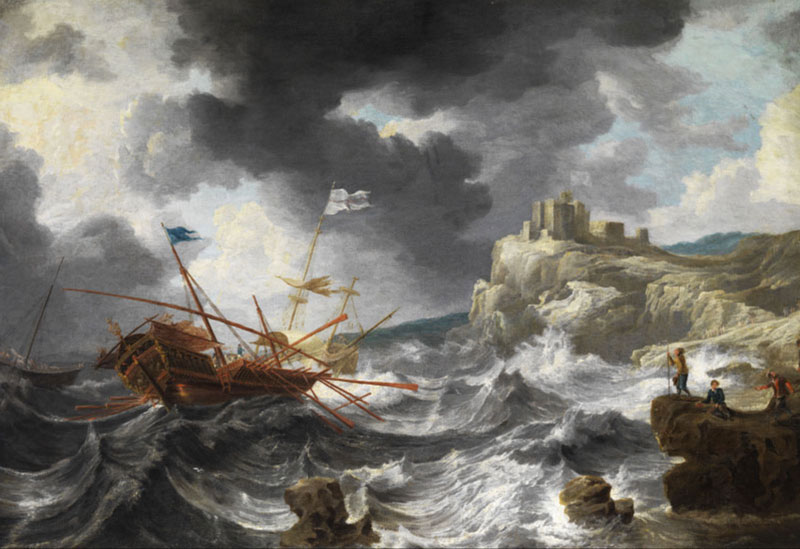
[The picture above is Bonaventura Peeters’s “Shipwreck,” ca. 1652, courtesy of the Journal of Historians of Netherlandish Art.]

Wednesday, February 11, 2026

“The supposed Plunder of the Cargo and burning of the Vessel”

Alas, the first newspaper printed in Newburyport, Massachusetts, Henry-Walter Tinges’s Essex Journal and Merrimack Packet, wasn’t founded until the end of 1773.

That means we don’t have published accounts of ships coming and going from that port in 1772, or stories on topics of local interest.

It’s possible a historian digging into the local sources like Alexander Cain will uncover a contemporaneous source on what happened to Capt. Thomas Parsons in 1772. But for now the closest he’s found is the lore published by Joshua Coffin in A Sketch of the History of Newbury, Newburyport, and West Newbury, from 1635 to 1845:
February 10th [1772]. Captain Thomas Parsons sailed from Newburyport, in a schooner, for the West Indies; was wrecked at St. Mary’s, Nova Scotia. It was supposed that he, with all his crew, eight in number, were massacred by the inhabitants there, after plundering the vessel, and setting it on fire.
We don’t know the name of Parsons’s ship or of his crewmen. Coffin also offered no sources—no indication of how the news got back to Newburyport, or when. I suspect that for months people thought the schooner had been lost at sea. Then something—the sight of a burned wreck, a bit of loot, seamen’s gossip—made people suspect there had been foul play.

On 11 Mar 1773, more than a year after Capt. Parsons’s departure, the Boston News-Letter ran this item:
We are informed, that the Accounts sent from hence of the Loss of a Schooner, belonging to Newbury, near Cape-Sable, and the supposed Plunder of the Cargo and burning of the Vessel if not the Murder of the Crew, had been received by the Governor of Nova-Scotia, and that there would be the strictest Inquiry and Prosecution by the Authority of that Province.
That was reprinted in the following weeks in the Essex Gazette of Salem and in Connecticut newspapers. (Capt. Parsons had brothers and other relatives in Connecticut who might be interested.)

It’s not certain that news item referred to rumors about Capt. Parsons’s ship, but the details are similar, and I’ve found no other possible cases. That suggests the suspicions about what happened in Nova Scotia built up over time until someone demanded an investigation.

Unfortunately, I also haven’t found any follow-up stories. Because of national boundaries, I can’t search the Halifax Gazette. Government archives in Nova Scotia might hold information. In early 1773 the royal governor, Lord William Campbell, was busy chasing smugglers and securing a better berth for himself in South Carolina, but maybe he did start an inquiry. Or at least file the “Accounts” from Massachusetts.

It’s also conceivable that some archive in the Caribbean holds a clue. Did Capt. Parsons sail to an island successfully only to run into difficulty on the way back? If he was on some sort of smuggling voyage, what sort of records would he have left?

TOMORROW: Probing the mystery.

Monday, February 09, 2026

Basile Boudrot and “1004 pieces of money”

According to the Musée des Acadiens des Pubnicos website, Basile Boudrot was born in 1739 in Port Royal, which the British had renamed as Annapolis Royal, Nova Scotia, in 1713.

War broke out between the British and French Empires in the 1740s and again in the 1750s. At some point the Boudrot family moved to Cherbourg, France. Basile’s father was a mariner, and the young man worked as a fisherman “now and then.”

In 1764 Basile married Magdelene d’Entremont in Cherbourg. She, too, had roots on Nova Scotia, in Pubnico on the southeastern shore.

Four years later, the lieutenant governor of Nova Scotia, Michael Francklin, signed a charter creating the settlement of Clare in the easternmost corner of the peninsula. That area was set aside for French-speaking Acadians.

Three important things happened to Basile Boudrot in 1772. First, the Musée des Acadiens des Pubnicos tells this story:
It was in April when he left [France] with a letter from his sister[-in-law] Marguerite Landry for her brother-in-law in Pubnico, asking him to send her the money which had been hidden at the “Cabanaux.”

On his way to Acadia, Basile opened the letter and went right straight to the spot indicated where the money had been hidden and unearthed “1004 pieces of money.”

Then he went to Pubnico and told the d’Entremont bothers that their relatives in France were well provided for, having received money from “the town-hall and a quarter out of two vessels.” Thus, he was going to keep the money. It is obvious that he did not give them Marguerite’s letter.

He left Pubnico on May 7 and disappeared forever. In a letter, we read that some captains from Cherbourg had seen him several times “in America” without saying exactly where.

A few days after Basile had left, Benoni d’Entremont wrote to his sister-in-law Marguerite Landry and told her about the visit that he and his brothers had received from Basile Boudrot. Marguerite answered April 20, 1773, telling of the letter she had entrusted him with and of the lies he had told of her being well provided for, and these the whole story of Basile’s “prevarication” came to light.
Benoni d’Entremont (1745–1841) had spent his adolescence in Marblehead, Medfield, and finally Walpole, Massachusetts, having been expelled from Acadia with his family after the capture of Louisbourg. His father died in 1759 and was reportedly buried in Roxbury. After years as “French neutrals,” the rest of the family returned to Nova Scotia.

Back to Basile Boudrot. According to Isaiah W. Wilson’s A Geography and History of the County of Digby, Nova Scotia (1900), in May 1772 the government of Nova Scotia granted him 300 acres on St. Mary’s Bay within the Clare settlement. Today the village of Comeauville claims him as a founder.

I have questions about how those events fit together, assuming all the details are correct. Did Boudrot use the money he unearthed to buy that land? The timing would be tight if he left France in April and completed the real estate deal by the end of May. Or did he return to Nova Scotia to settle on a land grant and as a bonus stumble onto buried treasure?

Pubnico and Comeauville are more than fifty miles apart, but there weren’t a whole lot of people living on eastern Nova Scotia at that time. Did the D’Entremonts really never hear about Boudrot living in the same province?

As for the third event in 1772, that’s coming up later this week.

TOMORROW: Parson Parsons’s sons.

Wednesday, January 21, 2026

“Also embarked Colonel Richard Prescott”

In late 1774 the British 7th Regiment, known as the Royal Fusiliers, was stationed southwest of Montréal, guarding the frontier of the British Empire.

But its commanding officer, Col. Richard Prescott (shown here), wasn’t with them.

The 17 October New-York Gazette reported:
On Thursday Morning last Major General [Frederick] Haldimand embarked on board the Transport named the Countess of Darlington, attended by Major of Brigade [Thomas] Moncrieff, Capt. Thomas Gamble, Assistant Quarter-Master General, Captain [Dietrich] Brehm, Aid de Camp, and Captain [Francis] Hutcheson;

with General Haldimand also embarked Colonel Richard Prescott of his Majesty’s Royal Fusileers, a Company of the Royal Artillery, with a large Quantity of Ordnance Stores for Castle-William.
Also headed to Boston were the 47th Regiment, three companies of “the Royal Regiment of Ireland” (18th), an artillery company, and artificers to build barracks.

Those transport ships arrived on Sunday, 23 October, as reported four days later in the Boston News-Letter. This was part of Gen. Thomas Gage’s military build-up after the “Powder Alarm.” Indeed, by the end of the year the 7th would be one of the few regiments in North America not stationed inside Boston.

Col. Prescott was still in Boston when the war began because on 12 June 1775 Gen. Gage wrote to the Secretary of War, Viscount Barrington, that “Colonel Prescot, now declared Brigadier,…is going to Canada to Assist General [Guy] Carleton.”

In addition, this 1905 publication by the Canadian Archives stated that Gage sent the same news that day to Lord Dartmouth, the Secretary of State: “The Colonel Prescott goes immediately to Canada to assist General Carleton, for I hear the Rebels, after surprising Ticonderoga, made Incursions, and committed Hostilities upon the Frontiers of the Province of Quebec…” I haven’t found a copy of that letter in Gage’s papers at the Clements Library, but its online database and transcriptions are still a work in progress.

Thus, through the first half of October 1774 Col. (later Gen.) Richard Prescott was in New York, where Hugh Gaine printed A Letter from a Veteran, to the Officers of the Army Encamped at Boston, as discussed here.

Prescott then sailed north. Eight days after he arrived, booksellers Cox and Berry advertised that pamphlet for sale in Boston.

As a senior officer in Gage’s force, particularly one not engrossed in the daily duty of his regiment, Prescott had the motive and opportunity to pen advice from a “Veteran” to younger officers. He was much closer to the situation in Boston than his younger brother Robert.

When William Tudor, Jr., recorded that people said A Letter from a Veteran was written by “General Prescott,” he most likely meant Richard Prescott.

Thank you for your attention to this matter.