






“A Difficult Case” in Late 1776
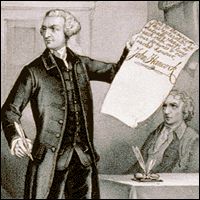
There were some problems with that plan. As John Adams said, “It is a difficult Case.”
Yet the Congress had little choice. Just that month, its members had signed the Declaration of Independence, which complained about the king (among other things) “depriving us in many cases, of the benefits of Trial by Jury.” So the new American union had to provide Boudrot with a jury trial.
Was Essex County the right venue, even if Capt. Parsons had sailed from Newburyport? One fundament of British law was that the accused should be tried in the jurisdiction where the crime was allegedly committed. And the accusation against Boudrot was that he’d attacked Parsons’s ship up at St. Marys Bay.
Again, the Declaration might come into play. Another of its grievances was that the king was “transporting us beyond Seas to be tried for pretended offences.” The Continental Army had transported Boudrot out of Canada down to New York, and now was sending him to Massachusetts. But really he should be tried in Nova Scotia.
That of course raised practical problems. Would Nova Scotia authorities share the Continental leaders’ wish to try Basile Boudrot, pushed by the desire of the victim’s brother, Gen. Samuel Holden Parsons of the Continental Army? How would that conversation go?
“So you want us to take this man and put him on trial for plundering a ship from Massachusetts four years ago?And speaking of practical matters, even as the Congress in Philadelphia laid out this plan for dealing with Boudrot, the Continental commanders in New York were seeing the harbor fill up with Royal Navy ships and army transports. On 27 August, the British and American armies clashed in the Battle of Brooklyn. About a month later, the redcoats were on Manhattan Island, and New York City was burning.
“Yes!”
“Will you also send us Captains Nicholasson Broughton and John Selman, who plundered our Charlottetown just last year?”
“Oh, no, no, no.”
“Ah.”
“That happened during the war, you see.”
“The war that’s still going on.”
“Yes. But our commander-in-chief didn’t let those two men back into our army!”
“So you have them in jail, awaiting trial?”
“Er, no. They’re officers in the Essex County militia.”
Given all that, it’s not so surprising that Basile Boudrot’s paper trail ends. American Patriots felt obliged to try him in the proper legal venue, but preserving the paperwork to get him there might not have been the highest priority.
I hold out hope that an archive in Massachusetts, or in Nova Scotia, contains more clues to Boudrot’s fate. Perhaps as “Boudreau,” or “Dugan” (his reported alias), or “the Acadian” (as American generals referred to him). But given the murky case, his use of aliases, the fog of war, and the passage of time, I don’t hold out much hope.
TOMORROW: One scenario.

No comments:
Post a Comment