






“Acts of government could be resisted when they threatened the essential rights”
He’s the author of respected books of Revolutionary-era history, including Original Meanings: Politics and Ideas in the Making of the Constitution (winner of the Pulitzer Prize for History in 1997), James Madison and the Creation of the American Republic, and Revolutionaries: A New History of the Invention of America.
In other words, Rakove has worked largely in political history and how the Framers translated ideas into laws and policies for the new nation. When he uses the term radical, as in his 2020 book Beyond Belief, Beyond Conscience: The Radical Significance of the Free Exercise of Religion, he’s talking about the ideas of the Founders in their eighteenth-century context, not about the importance of now noting how hierarchical those men’s lifestyles were.
That’s something to bear in mind while reading Rakove’s essay for the Washington Monthly earlier this month, “Playing the Grinch at America’s 250th Birthday Party.”
In that essay Rakove writes:
Last June, I attended a conference on The American Revolution and the Constitution held at the American Enterprise Institute in Washington. It was the seventh of eight conferences that AEI has been holding on the 250th anniversary of independence. Given its conservative orientation, any conference sponsored by AEI would predictably take a celebratory turn, and so did this one. My own paper on “The Invention of American Constitutionalism” fits well within that framework. . . .That link leads to Rakove’s article from last June, “It’s Not Just a Constitutional Crisis in the Trump Era. It’s Constitutional Failure.” Having spent a career studying how the Constitution was supposed to work, he’s watching it not work that way at all.
Yet at the conference dinner that followed, I became the grinch who wanted to rob the other happy campers of their semiquincentennial joy. Yuval Levin, our gracious host and convenor, started our post-dessert conversation by asking me, “What do you think the celebration of the 250th anniversary of independence will be like?”
“I think it is going to be a complete disaster,” I replied, and offered a few reasons to support that view. The most important one, directly relevant to our subject, was that the constitutional system is lurching toward collapse and outright failure.
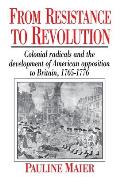
Rakove discerns some hope in what his graduate-school colleague Pauline Maier described as “extra-legal resistance” in her excellent book From Resistance to Revolution:
In the colonies as in Britain, communities believed that certain acts of government could be resisted when they threatened the essential rights and interests of the king’s subjects. Various kinds of uprisings, riotous events, and militant protests did occur during the colonial era of our history. From the perspective of imperial officials representing the British crown, these protests were illegal acts to be repressed or punished. Ship captains in the Royal Navy believed they were acting legally when they forcefully impressed sailors for their warships. Merchant seamen, shipyard workers, or ordinary individuals innocently strolling the streets thought otherwise. When anti-impressment riots occurred, they enjoyed the community’s full support.The protesters aren’t the only people behaving outside the law, however. The Trump administration continues to put unconstitutional pressure on Minneapolis, this past week announcing a freeze on paying for medical benefits for anyone in the state of Minnesota. It’s tried that tactic before through the Department of Agriculture, and been stopped by federal courts, repeatedly. That sort of tyrannical action naturally prompts protests.
This tradition was well established before the Stamp Act Crisis of 1765 disrupted imperial politics. Some of the earliest protests against the Stamp Act were indeed too violent. It was one thing to intimidate individuals who thought they had received lucrative appointments as stamp collectors into resigning their commissions. That was the easiest way to halt the enforcement of the Stamp Act. It was another matter entirely to ransack the residences of royal officials, notably including the Boston mansion of Thomas Hutchinson, lieutenant governor and chief justice of Massachusetts. . . .
In the past few weeks, Minneapolis has become our Boston, and its citizens have become modern Sons of Liberty. Far more important, they and their counterparts in other communities have unknowingly revived the strategy of resistance that American communities deployed between the Stamp Act Crisis of 1765 and the crisis of independence. Blowing whistles, tailing ICE and Border Patrol vehicles, blaring airhorns outside the hotels where their agents are hopefully spending sleepless nights—these are modern versions of the extra-legal resistance that Maier described.

No comments:
Post a Comment