J. L. BELL is a Massachusetts writer who specializes in (among other things) the start of the American Revolution in and around Boston. He is particularly interested in the experiences of children in 1765-75. He has published scholarly papers and popular articles for both children and adults. He was consultant for an episode of History Detectives, and contributed to a display at Minute Man National Historic Park.

Subscribe thru Follow.it


•••••••••••••••••


Showing posts with label John Ragg. Show all posts

Wednesday, March 27, 2024

The Last Glimpses of Lt. Ragg

Yesterday’s posting took Lt. John Ragg of the British marines to Middletown, Connecticut, as a prisoner of war along with his servant, Pvt. Benjamin Jones, in September 1776.

I’ve looked for records of what happened next, without success. I assume there must be some paperwork at the Continental or local level, but not published.

It appears that the lieutenant was exchanged for an American officer taken prisoner that fall, and there were a lot of those.

The next sign of Lt. Ragg is in the 12 May 1777 issue of the New-York Gazette and Weekly Mercury, printed by Hugh Gaine inside the Crown-held city. An advertisement for Maj. Robert Donkin’s Military Collections and Remarks, to be printed by Gaine later that year, listed “Marines, Lieut. Ragg” among the subscribers.

Then the man drops out of my sight again until toward the end of the war.

Lt. Ragg had a brother named Andrew, who became the Customs service controller of Customs on the Pocomoke River in southern Maryland in May 1766. When the war broke out the local authorities detained him, then let him out as long as he didn’t cause trouble and paid heavy taxes.

On 5 Feb 1779, Andrew Ragg asked the Maryland government to allow him and his young daughter Anne to return to Britain. On 31 March, Ragg filed a deposition promising not to give intelligence to the enemy, and that same day the state Council granted permission to travel to New York.

Evidently the Raggs didn’t go to New York until 1780. Anne was then nine years old. To the British authorities they characterized their journey as an “escape.”

The little family got on board a ship to Britain, but during the voyage Andrew Ragg fell overboard and was drowned. John Ragg, by then a captain in the marines, petitioned the government to support his niece on 24 Apr 1781.

The last sign I’ve found of John Ragg is that “Captain Ragg, of the marines,” was listed as wounded while serving on H.M.S. Magnificent in the Battle of the Saintes in April 1782.

After the war, Ragg might have gone home to Aberdeen, Scotland. He was living in that city in February 1767 when he was listed as a witness in a court case recorded in the city’s Enactment Book (notes in P.D.F. form here).

That book also lists “Andrew Ragg, late apprentice to William Brebner, merchant,” among the genteel young men accused of a breach of the peace in April 1763. Was this the future Customs officer? Those men “bound and enacted themselves that they shall behave themselves regularly, soberly and discreetly” and got off.

In any event, that’s all I’ve been able to uncover about Lt. John Ragg, remembered in the Shaw family lore as the lieutenant named Wragg who so angered young Samuel Shaw.

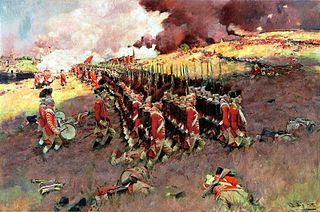
(The painting above shows H.M.S. Magnificent among the Royal Navy warships capturing two French vessels at the Battle of the Saintes.)

Tuesday, March 26, 2024

Lt. Ragg in Captivity

The Battle of Brooklyn on 27 Aug 1776 didn’t end well for the Continental Army. Gen. Sir William Howe’s forces inflicted heavy casualties and drove the Americans off Long Island.

At eight o’clock that evening, Gen. George Washington’s military secretary, Robert Hanson Harrison (shown here), wrote to John Hancock as chair of the Continental Congress:
a Smart engagement ensued between the Enemy and our Detachments, which being unequal to the force they had to contend with, have sustained a pretty considerable loss—At least many of our Men are missing, among those that have not returnd are Genls [John] Sullivan & Lord Stirling

The Enemy’s loss is not known certainly, but we are told by such of our Troops that were in the Engagement and that have come in, that they had many killed and wounded—Our party brought off a Lieutt, Sergt, and Corporal with 20 privates prisoners.
Sullivan and Stirling were prisoners, but at least they survived. Hundreds of other Americans were dead.

Continental commanders hoped this would prove to be a Pyrrhic victory for the Crown, like Bunker Hill. Gen. Henry Knox wrote to his wife Lucy, “The enemy lost nearly 1000 kill’d among whom was General [James] Grant and Capt. [Andrew] Neilson of the 52d.”

In fact, Gen. Howe reported only 63 dead from the Crown forces, and fewer than 400 casualties in all. Gen. Grant was fine; a lieutenant colonel of the same name died.

Later American writers seeking actions to praise in that battle had to content themselves with gallant ways to lose. The noble sacrifice of the Marylanders holding off the enemy! The sly evacuation across the river to Manhattan!

Among the few solid successes Knox could firmly claim was, “We took a Lt. Ragg whom I knew at Boston and 25 Grenadiers of the marines.” And even that overstated the details slightly. Harrison’s numbers were closer.

Lt. John Ragg had led Sgt. David Wallace, Cpls. Thomas Pike and Edward Gibbon, and twenty marine privates into captivity because he and his superiors had mistaken the Delaware Continentals for Hessians.

Behind the American lines, on 29 August Gen. William Heath ordered Lt. Nathan Umstead to conduct those prisoners of war to Fairfield, Connecticut.

A month later, Thaddeus Burr of the Fairfield committee of inspection wrote back to Gen. Washington, reporting that they had sent Ragg and his servant, Pvt. Benjamin Jones, on to Middletown. The other twenty-one men were taken to Wallingford and “placed in the Parishes in the interior part of the County agreable to Rules of Congress.”

There was just one more thing, Burr told the commander-in-chief: Who would pay for “the charges of marching them”? The committee had fed those prisoners for eleven days and paid “a Sergeant and Six from our Battery…a penny a Mile” to lead them on to Wallingford. How was the town to be reimbursed £14.6.½?

The Washington Papers editors wrote, “No reply to that letter has been found.”

TOMORROW: The last of Lt. Ragg.

Monday, March 25, 2024

Two Lieutenants and the Battle of Brooklyn

On the afternoon of 27 Aug 1776, British and Hessian soldiers under Gen. James Grant advanced on a Continental force, including men from Delaware and Maryland, under Gen. William Alexander, Lord Stirling (shown here).

Lt. John Ragg of the British marine grenadiers led twenty men forward from the right flank of the Crown forces. His orders were “to speak to” the commander of a unit in blue coats, thought to be Hessians, and tell them to stop firing at their own side.

Meanwhile, Lt. William Popham was one of the American officers trying to hold the left side of their line with a company of “awkward Irishmen and others.” Coming from the Delaware regiment, those soldiers were dressed in blue coats.

You can guess what happened. As Popham told it, “Capt. Wragg [sic] and 18 men, supposing us to be Hessians by the similarity of our dress, approached too near before he discovered his mistake.”

The Delaware Continentals took the marines as prisoners. The Americans stripped the British of their guns, Popham taking charge of Ragg’s weapons.

Decades later Popham reported:
I was immediately ordered with a guard to convey them across the creek in our rear to our lines. On descending the high ground we reached a salt meadow, over which we passed, though not miry, yet very unfavorable to silk stockings and my over-clothes.
Popham was a Princeton College graduate eager to look like a gentleman.

As the party crossed the meadow, the British started to fire cannon in their direction. Lt. Ragg stopped moving, “in the hope of a rescue.”

Popham ordered Ragg to “march forward instantly, or I should fire on him.”

Ragg started moving again. But then a new obstacle appeared:
When we got to the creek, the bank of which was exceedingly muddy, we waded up to our waists. I got in after my people and prisoners, and an old canoe that had been split and incapable of floating except by the buoyancy of the wood, served to help those who wanted help to cross a deep hole in the creek, by pushing it across from the bank which it had reached.

I had advanced so far into the mud, and was so fatigued with anxiety and exercise, that I sat down on the mud with the water up to my breast, Wragg’s fusee, cartouch-box, and bayonet on my shoulder; in which situation I sat till my charge were all safely landed on the rear.
Gen. Grant continued to press forward with his 7,000 men, more than twice the British force in the Battle of Bunker Hill. However, that was just a diversion.

Gen. William Howe had sent many more of his troops on long flanking march to the right. They moved through an unguarded pass and hit the Americans from an unexpected direction. In fierce fighting, almost the whole Continental force was driven back to Brooklyn Heights.

Stirling ordered most of his men back as well, keeping a contingent of Maryland soldiers as the rear guard. He led them in two counterattacks on the Crown forces while other Americans withdrew as best they could.

At the end of the day, the Continentals had lost more than 2,000 men. Nearly all the Maryland rear guard was dead. Stirling was a prisoner.

Gen. Howe reported 64 killed, 293 wounded, and 31 missing—including Lt. Ragg and his marines.

TOMORROW: The end of Lt. Ragg’s war?

Saturday, March 23, 2024

Lt. Ragg in the Assault on Brooklyn

In June 1776, Lt. John Ragg of the marines was in Halifax, Nova Scotia, with the rest of the British military force evacuated from Boston.

In July, Ragg was in the fleet of forty-five ships that started unloading British soldiers onto Staten Island, New York.

More troop transports and Royal Navy warships arrived from other parts of the empire. By the end of July, Adm. Lord Richard Howe was overseeing more than one hundred ships while Gen. Sir William Howe commanded 32,000 soldiers.

Those numbers continued to grow in early August. Among the new arrivals were 8,000 Hessian soldiers.

On the morning 22 August, 4,000 redcoats moved onto Long Island. This was significantly more than the British force in the Battle of Bunker Hill, but it was only an advance guard, about a tenth of Howe’s entire land army.

The Americans drew back. By the end of that day, the British had landed 15,000 men at Gravesend Bay, with 5,000 more to follow a couple of days later.

The two armies dug in warily for the next two days. The Americans held the Brooklyn and Guan Heights, guarding the main passes.

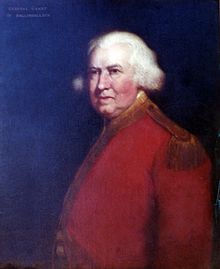
Late in the evening of 26 August, Gen. James Grant (1720–1806, shown above) sent a force of about 4,000 British and Hessian men forward against the Continentals. The first major skirmish was around the Red Lion Inn. The British captured the American commander, Maj. Edward Burd, and sent his forces fleeing.

Gen. Samuel Holden Parsons of Connecticut managed to gather Continental troops along the Gowanus Road and to send for reinforcements. Gen. Stirling arrived with about 1,500 men from Maryland and Delaware. Under his command, the Continentals moved back toward the Red Lion Inn.

Meanwhile, Gen. Grant’s Crown troops were also growing, up to 7,000. That force included the 2nd battalion of marines.

According to a letter written on 4 September by a British officer to a friend in Aberdeen, and published in the Scots Magazine, the marine battalion “was sent from our right to support Gen. Grant.”

In the fighting on 27 August, those marines came under “several fires” from a unit dressed in blue uniforms with red facings. Those were the colors of some Hessian regiments while most of the Continental Army had no uniforms at all, so the British officers assumed that was friendly fire.

Lt. Ragg and twenty men from his grenadier company were “sent out to speak to” those Hessians.

TOMORROW: They weren’t Hessians.

Friday, March 22, 2024

Lt. Ragg and “A Crime of the greatest Magnitude”

The wound that Lt. John Ragg suffered at the Battle of Bunker Hill wasn’t bad enough to knock him out of the marines.

He recovered, remained in besieged Boston, and evacuated to Nova Scotia in March 1776 along with the rest of the British military.

On 6 June, Gen. William Howe’s general orders stated:
A Crime of the greatest Magnitude, Viz.: that of striking an Officer, having been committed by John Browning, Private Soldier of the 23d. Regiment, and the time and Situation of the Army not permitting, at present, the holding of a General Court Martial, It is the Commander in Chief’s order that the Prisoner be continued in Irons on board Ship until he can be tried by a General Court Martial.
In his 2007 book Fusiliers, Mark Urban revealed (in an endnote) that the officer Pvt. Browning struck was Lt. John Ragg.

Ordinarily Browning would have been court-martialed in Halifax, but Howe needed the 23rd and all other available forces to attack New York that summer. The fleet departed three days after his order. The private remained a prisoner below decks. Lt. Ragg and his grenadier company sailed normally.

Browning’s court martial took place on Staten Island in July. Urban writes:
With evidence sketchy to back a lieutenant’s claim that he had been hit, Browning was acquitted of the capital charge but was found guilty of insulting a serjeant, for which he was ordered to receive 200 lashes. However, General Howe reviewed the case and waived he corporal punishment, arguing that if Browning was acquitted of the more serious offence there was no point in chastising him at all.
Browning’s attack was the third time in about a year and a half that Lt. Ragg had gotten into a conflict bad enough to get into the historical record. First young Samuel Shaw, then Lt. John Clarke, and here Pvt. John Browning.

To be sure, Ragg himself wasn’t officially blamed for any of those disputes. He was the alleged victim in both courts-martial.

Nonetheless, I can’t help but wonder if Gen. Howe decided to let Browning off with time served (in irons) because he’d come to view Ragg as a magnet for trouble, someone who made people angry.

TOMORROW: Ragg as the empire strikes back.

Thursday, March 21, 2024

Two Lieutenants and the Battle of Bunker Hill

Lt. John Ragg of the Royal Navy’s marines entered our scene back here, in an anecdote from the Shaw family of Boston about how he got into an affair of honor with twenty-year-old Samuel Shaw.

I suspect that conflict happened before the war began, while Ragg, Maj. John Pitcairn, and perhaps other officers were boarding with the Shaw family in the North End.

It definitely happened before the Battle of Bunker Hill because Pitcairn died of his wounds that day, and the anecdote credited him with mediating the dispute.

By the date of that battle, Lt. Ragg had gotten into another argument, this time with one of his fellow British officers.

Lt. John Clarke was a veteran marine, having “served thirty six years with great credit” according to Adm. Samuel Graves. That said, Clarke had become a second lieutenant only in 1757 and a first lieutenant in 1771 (with a brief retirement on half-pay in between). He was assigned to H.M.S. Falcon.

According to British military documents that Allan French quoted in an article for the Colonial Society of Massachusetts, on the evening of 19 April (i.e., the day the war began) Clarke got drunk.

Lt. Clarke was arrested “for being very much in Liquor and unfit for Duty on the Morning of the 20th of last April, for breaking his Arrest, and for grossly abusing and challenging Lieutenant John Ragg of the Marines to fight.”

On 7 June, Graves wrote, Clarke was “tried and dismissed for being in Liquor upon duty on the 19th of April last.” The admiral ordered the former lieutenant back to England.

Then, on 17 June, came the big battle in Charlestown. Lt. Ragg’s grenadier company was in the thick of the fight. Gen. Thomas Gage’s report included this casualty list from the first battalion of marines:
1st battalion marines. — Major Pitcairn, wounded, since dead; Capt. Ellis, Lieut. Shea, Lieut. Finnie, killed; Capt. Averne, Capt. Chudleigh, Capt. Johnson, Lieut. Ragg, wounded; 2 sergeants, 15 rank and file, killed; 2 sergeants, 55 rank and file, wounded.
While Lt. Ragg recovered from his wound, former lieutenant Clarke traveled back to London on H.M.S. Cerberus, which also carried Gage’s report.

Not being in the Battle of Bunker Hill, or even in the British military at the time, didn’t stop Clarke from publishing An Authentic and Impartial Narrative of the Battle when he arrived back in London. That short book, credited to “John Clarke, First Lieutenant of Marines,” was one of the first descriptions of the battle to reach print and went through a second edition in London before the end of the year.

Many historians have tried to rely on Clarke’s Narrative, which offered details not found elsewhere, like Gen. William Howe’s speech to his soldiers and a description of Dr. Joseph Warren’s death. But ultimately most authors realized that Clarke was just piecing stuff together and making it up. French concluded, “it seems likely that it was written to relieve the tedium of his voyage to London, from such material as he could gather from his own observations and from the talk of the ship’s company.”

Despite his dispute with Ragg, Clarke described the first battalion of marines “behaving remarkably well, and gaining immortal honour, though with considerable loss, as will appear by the number of the officers killed and wounded.”

TOMORROW: Lt. Ragg, back in the fight.

Thursday, March 14, 2024

The Politics of Francis Shaw

As I discussed yesterday, despite how Josiah Quincy characterized the situation in his biography of Samuel Shaw, the Shaw family was not forced to host British marine officers under the Quartering Act.

Rather, in all likelihood, the merchant Francis Shaw (1721–1784) chose to rent rooms to Maj. John Pitcairn, Lt. John Ragg, and perhaps other men.

We don’t have enough sources about Francis Shaw to know what his motivations might have been: money, a sense of obligation or deference to the military, a wish to mollify the royal authorities?

Shaw wasn’t a Loyalist. He didn’t sign either of the addresses to the royal governors in 1774, nor leave town at the evacuation in 1776. In preceding years, he hadn’t stood up to complain about any of the Whigs’ measures.

Nor, however, was Francis Shaw an active Patriot. He had joined the Boston Society for Encouraging Trade and Commerce back in the early 1760s. That was an early chamber of commerce, speaking for the merchant community, and it opposed the Sugar Act and what its members saw as overeager enforcement of that law. In 1770 the Boston town meeting added Shaw’s name to a committee to promote non-importation, particularly by not selling tea.

But other than those moments, the name of Francis Shaw doesn’t appear in connection with Whig politics. He didn’t dine with the Sons of Liberty in 1769. He wasn’t on the committee to promote the Continental Association of 1774. (He may have been a member of the St. Andrew’s Lodge of Freemasons, meaning he knew some Whig leaders, but wasn’t forward in supporting them. Or that Freemason might have been Francis Shaw, Jr.)

The town meeting elected Shaw as a fireward in the North End in 1772. The North End Caucus endorsed his reelection the next year, and he kept at that job until 1784. Boston thanked him for his long service a few months before he died. But that was an apolitical job.

My impression is that Francis Shaw chose to stay out of the larger debate. His son Samuel, in contrast, was fervent for the Patriot cause in 1775. We can see hints of that difference in the anecdote about Samuel getting into an argument with Lt. Ragg, quoted back here.

Francis Shaw had chosen to host British marine officers. The anecdote suggests he didn’t speak out against Ragg calling Americans “cowards and rebels” and then apparently moving toward a duel with twenty-year-old Samuel. The father didn’t, for instance, demand that his tenant leave his son alone—or if he did, it didn’t become part of the family lore. It was up to Maj. Pitcairn to calm matters.

Furthermore, I think the evidence suggests Francis Shaw told his son not to join the Continental Army. Only on his twenty-first birthday, when he was no longer legally under his father’s control, did Samuel leave Boston and seek a commission in the artillery regiment.

Once that happened, letters show that Francis Shaw supported his son, financially and otherwise. After the siege, the merchant served on Boston committees to collect taxes and record citizens’ military service. He may have invested a bit in privateers (or this could have been a man of the same name from Salem). In sum, Francis Shaw became a Patriot, even if he didn’t start out as one.

COMING UP: Lt. Ragg’s war.

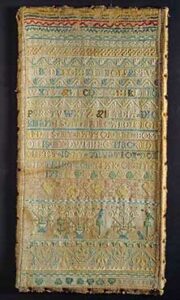
(The picture above, courtesy of Old North, shows a sampler made by twelve-year-old Lydia Dickman in 1735. Nine years later she married Francis Shaw. They had one child together, but Lydia died in 1746 and her son the following year. Francis Shaw remarried and had more children, including Samuel. The sampler is now in the collection of the National Museum of American History.)

Tuesday, March 12, 2024

“Arrangements for a duel were in preparation…”

Earlier this month I had an online discussion with Kevin M. Levin, creator of Civil War Memory (now on Substack) and author of an upcoming book on Col. Robert Gould Shaw.

It concerned a passage from the third Josiah Quincy’s biography of Samuel Shaw (1754–1794, shown here)—Continental officer, early American diplomat, and brother of Col. Shaw’s great-grandfather.

I discussed that passage years ago in a comment but never in a posting until now. It describes young Shaw’s experience in 1774–75, when he was twenty years old:
The northern part of Boston, where he resided, was also the abode of some of the most active and ardent spirits who gave character and impulse to the first movements of the American Revolution.

Troops, sent from the parent state to awe the colonies into submission, and parading the streets of Boston, were continual causes of excitement and anger; giving intensity to feelings which it was difficult to restrain, and impossible to allay. Boston being at that time regarded by the British as a garrison town, the officers of the army were billeted on the inhabitants. The house of Francis Shaw was assigned for quarters to Major Pitcairn and Lieutenant Wragg.

A tradition in the family states, that, the latter having at the table, in the presence of Samuel Shaw, spoken of the Americans as “cowards and rebels,” he immediately resented the reproach, and transmitted to the lieutenant a challenge. While arrangements for a duel were in preparation, the fact came to the knowledge of Major Pitcairn, who interfered, and, either by influence or authority, obtained from the lieutenant such an apology for the offence as Mr. Shaw was willing to accept, and the affair was thus terminated.

On the 2d of October, 1775, Samuel Shaw attained the age of manhood, and, with the assent of his father, immediately took measures to insure his enrolment in the army, then collecting at Cambridge under the auspices of Washington.
The immediate question was: Who was this “Lt. Wragg”? I looked in published Army Lists from the 1770s and found no officer with that last name. But there was a Lt. John Ragg in the marines. So that must have been the man sharing quarters with Maj. John Pitcairn.

Pitcairn arrived in Boston in November 1774, part of Gen. Thomas Gage’s build-up of the royal military after the rest of the province slipped out of his control in September. Ragg presumably arrived at the same time, though it’s conceivable he came with another set of marines in March 1775.

Although this anecdote appears in Quincy’s book after mentions of the Battles of Lexington and Concord and Bunker Hill, it definitely didn’t happen that late. Pitcairn died from his wounds right after the second battle. The story feels like something that would have happened before the shooting war actually began, during the tense winter of 1774–75.

TOMORROW: Reading between the lines.