J. L. BELL is a Massachusetts writer who specializes in (among other things) the start of the American Revolution in and around Boston. He is particularly interested in the experiences of children in 1765-75. He has published scholarly papers and popular articles for both children and adults. He was consultant for an episode of History Detectives, and contributed to a display at Minute Man National Historic Park.

Subscribe thru Follow.it


•••••••••••••••••


Showing posts with label Susanna Wooldridge. Show all posts

Wednesday, May 17, 2023

A Commonplace Article on Phillis Wheatley

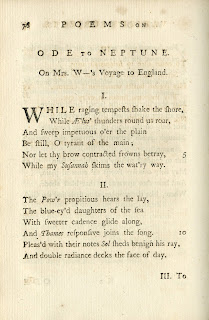
Yesterday my article “Phillis Wheatley’s ‘Mrs. W—’: Identifying the Woman Who Inspired ‘Ode to Neptune’” appeared on Commonplace, the web magazine on early America.

This year marks the sestercentennial of the publication of Wheatley’s Poems on Various Subjects, Religious and Moral.

That anniversary has prompted a lot of new scholarship, including David Waldstreicher’s biography, a reissue of Vincent Carretta’s biography, and the issue of Early American Literature I linked to yesterday. This article is my small contribution to that work.

Some folks might spot how I developed this article from material originally posted here on Boston 1775 in 2015. Since this blog could disappear with the flick of a switch at the Alphabet corporation, I looked for a more lasting place to share those findings.

It’s gratifying to see this article on Commonplace since I’ve been reading that web magazine for over twenty years now. In citing that site, I always have trouble remembering how to spell the title, and it turns out there’s a good reason for that: “Commonplace originally launched in 2000 as Common-Place: The Journal of Early American Life.”

The founding editors were Jane Kamensky and Jill Lepore, and the original institutional sponsor was the American Antiquarian Society. Today it’s an initiative of the Omohundro Institute of Early American History and Culture as well as the A.A.S. It no longer follows the model of academic journals with a collection of articles all published together each quarter, but rolls out material weekly and in a newsletter for subscribers. On this article I had the benefit of working with editor Joshua Greenberg and copyeditor Jordan Taylor, and I can recommend the process.

Thursday, August 20, 2015

The Rise and Fall of Thomas Wooldridge

Thomas Wooldridge (often called Woolridge) returned to London by September 1773, having cultivated a relationship with Secretary of State Dartmouth and made contact with merchants in multiple North American ports. Through his father-in-law, William Kelly, he already had excellent connections among the London merchants investing in the American trade.

Kelly took ill and died in 1774, and Wooldridge, still in his mid-thirties, stepped up to become a spokesman for London’s American traders. In the months when Parliament voted on its Coercive Acts, that interest group was lobbying hard for a peaceful end to the American crisis.

The merchants’ strategy seems to have been to argue that a rupture with the colonies would be bad for their nation’s economy and their own—but that they shouldn’t have to reveal how much loss they were personally exposed to, lest their creditors lose faith in them. Wooldridge met with Edmund Burke in January 1775 and with Josiah Quincy, Jr., the next month. In 1778 he testified to Parliament about losses to American privateers.

By then Wooldridge was an alderman of the City of London, elected in 1776 for the district called the Bridge Ward Within (shown above in 1720). He remained in that post until February 1783, though not always comfortably.

In 1777 Wooldridge was chosen sheriff of London and Middlesex, but that September he declined the office because of financial reverses. That same year, he declared bankruptcy. Wooldridge found a sympathetic audience in London. The same issue of the London Magazine that reported his resignation and the ensuing debate went on to say:
Last Thursday at a meeting of the creditors of a North American merchant, the state of his affairs was laid before them, by which it appeared, that his present situation could not in the least degree be imputed to any misconduct of his own, but totally owing to the present unhappy state of affairs in America. It appeared there is now due to the house 70,000l. from that quarter, and that the demand upon the house is no more than about 27,000l. It was agreed that a letter of credit be given to the said gentleman for three years; that his affairs should be put under the inspection of five trustees, and that he should assist in getting in his effects, allowing him a stipend of 500l. per ann. for his time, trouble, and the maintenance of his family, house rent, &c.
That merchant may well have been Wooldridge himself.

That same year, Wooldridge spoke out against the prosecution of the Rev. William Dodd for forgery. Later he signed one of the petitions Lord George Gordon circulated protesting the granting of political rights to Catholics. When in 1780 that movement provoked anti-Catholic riots in London, however, Alderman Wooldridge sent letters to Lord Jeffery Amherst requesting troops to keep peace in his district.

Britain lost the war, of course, and that result sunk Wooldridge’s prospects, whether because his firm’s debts became uncollectible or because the peace revealed that his finances were far worse than he’d represented. Wooldridge was imprisoned for debt in 1783 and had to declare bankruptcy again the next year.

This time, the City wasn’t forgiving. To lose one fortune was a misfortune; to lose it again looked like mere carelessness, or worse. Furthermore, according to Ben Saunders’s article “The Swindler Detected,” the city government determined that Wooldridge had been maintaining himself by submitting false expenses, skimming fines, and forcing defendants into military service, pocketing recruiting fees.

After a raucous meeting of the aldermen, Wooldridge’s voters stripped him of his post, an unprecedented step that prompted him to sue to get it back. That effort failed, though his wife Susanna continued to receive substantial sums from the aldermen’s budget for years afterward, “independent of her husband, for the support of herself and her children.”

Wooldridge’s reputation was ruined from then on. The City Biography of 1799, which was full of unabashed gossip about London politicians, stated of Wooldridge:
He was at one period regarded as a mouth-piece to the City, and if he had possessed capacity equal to his effrontery, it is probable he would have made a considerable figure. Impudence made him, and caused him to be unmade, an Alderman; but he had no talents beyond those that commonly fall to the lot of Aldermen.
In the new U.S. of A., lawsuits over the property and debts of William Kelly, his sons, and Thomas Wooldridge continued for years, such as this 1795 case in Pennsylvania. As for Wooldridge himself, at some point he went back to America. He was in Boston by late 1793, when a couple named a child after him. And he died in Boston by 4 Jan 1794, as reported in the Columbian Centinel, and was buried out of King’s Chapel. The 6 January Boston Gazette reported the death “In this town, Thomas Wooldridge, Esq. aged 54, late an Alderman of the city of London.”

Wednesday, August 19, 2015

Phillis Wheatley and Susanna Wooldridge

Yesterday I proposed that Phillis Wheatley wrote her “Ode to Neptune” about Susanna Wooldridge (sometimes spelled “Woolridge”). Here’s my argument.

On 29 Aug 1771, the New-York Journal ran this piece of news from London:
Saturday last was married, Thomas Wooldridge, Esq; Provost Marshal General, and Receiver General of his Majesty’s province of East-Florida, also Fort Adjutant and Barrack-master of Fort St. Marks, to Miss Kelly, daughter of William Kelly, Esq; of John street, Crutched Friers.
“Crutched Friars” was a newly fashionable neighborhood in the City of London near Tower Hill, named after a monastery closed by Henry VIII and burned in the Great Fire. Kelly later moved into “The Crescent” nearby, shown above in its modern form.

That wedding notice was meaningful for New Yorkers because the bride’s father did a lot of business in the city, and in America. William Kelly was a partner of Abraham Lott, treasurer of New York colony. He invested in the Great Dismal Swamp Company. In the summer of 1773, the East India Company invited Kelly along with select other merchants to discuss shipping tea to America. His business associates and executors included Brook Watson of shark fame.

Kelly’s August 1774 will, written when he was “in Bath for the recovery of a Numbness that has attacked me in my feet,” gives the name of the daughter who married Thomas Wooldridge as Susanna. It also indicates that before the marriage Kelly had promised Wooldridge “£3,000 in lands in the Provinces of New York and New Jersey” while arranging £2,000 for Susanna “free from the debts and control of her husband.”

Thomas Wooldridge has already made an appearance on Boston 1775. My description of him back then was based on his correspondence with the Earl of Dartmouth, mostly about patronage positions in Florida mentioned in the wedding notice above. In 1772 Wooldridge was back in America, traveling around and currying favor by sending Dartmouth various dispatches, an effort that promised to pay off when the earl became Secretary of State.

Among the people Wooldridge met in America, as I described before, was Phillis Wheatley. On 24 Nov 1772 he sent Dartmouth a letter telling how she’d answered his challenge to compose a poem as he watched. He enclosed the result, “To the Earl of Dartmouth,” and Wheatley’s personal letter. Those documents are dated 10 October—the same date as her “Ode to Neptune.” Later that month, he stood sponsor for a baby during a baptism at King’s Chapel and then he went back to New York to write his report to Dartmouth.

I don’t have evidence that Thomas Wooldridge had brought his bride to America and that she was planning to sail back home to London toward the end of 1772. But I think that was the case. She’s certainly a “Mrs. W——” who could be addressed as “Susannah.” Perhaps Susanna Wooldridge came to Boston with her husband and met Wheatley. Perhaps Thomas asked the enslaved poet for a special composition which he could bring back to his wife in New York. But this seems like a more logical story for that poem than that Wheatley wrote it for Susannah Wheatley (who never sailed abroad) or Patience Wright (who never went by “Susannah”).

Under my scenario, “Ode to Neptune” isn’t Phillis Wheatley’s plea for smooth sailing for her beloved mistress or for an artistic colleague, but a well-crafted commission in classical style created for a well-connected patron. Wheatley was adept at that aspect of an eighteenth-century author’s life, just as she was adept with words.

TOMORROW: Thomas and Susanna Wooldridge in London during the war.

Tuesday, August 18, 2015

The Mystery of “Mrs. W——”

Yesterday I quoted Phillis Wheatley’s “Ode to Neptune,” published in London in 1773 with the subtitle “On Mrs. W——’s Voyage to England” and dateline “Boston, October 10, 1772.”

For readers seeking to identify “Mrs. W——,” the poem offers some internal clues:
  • Her last initial was W, of course, and she was almost certainly married and alive in October 1772.
  • Later the poem addresses her as “my Susannah.”
  • She was about to make a voyage across the ocean to the Thames River in England.
Given the first two clues, most people’s first guess is that Phillis wrote this poem to her mistress, Susannah Wheatley. Except that other evidence strongly suggests that Susannah Wheatley never went to England.

Phillis Wheatley almost certainly addressed her mistress in another poem titled “A Farewel to America. To Mrs. S. W.” But that was when Phillis was about to sail to London and Susannah was staying behind in Boston.

The next guess is based on notes in a copy of Phillis Wheatley’s 1773 book of poetry owned by the American Antiquarian Society. Beside the “Farewel” poem someone penned “Mrs. Susannah Wright,” and then a different someone penciled, “eminent for her Wax Works etc.”

Scholars agree that the “Mrs. S.W.” mentioned in “A Farewel” is Susannah Wheatley. So some have argued that the notes in that A.A.S. copy were actually meant for another poem—namely, “Ode to Neptune.” A woman named “Susannah Wright” who traveled to England in late 1772 would fit all the internal clues. However, no one has identified such a woman or linked her to the Wheatleys.

The “eminent for her Wax Works” line has prompted other interpreters to assert that Wheatley addressed her “Ode to Neptune” to Patience Wright (shown above), who indeed became famous on both sides of the Atlantic for her wax likenesses of people. Wright was in Boston in the early 1770s, and, like Wheatley, she created a tribute to the Rev. George Whitefield.

Patrick Moseley wrote a whole article in New Essays on Phillis Wheatley (2011) about the relationship of Patience Wright and Phillis Wheatley as two women seeking sustenance and respect from their arts in the pre-Revolutionary British Empire. But there remain some inconvenient facts:
  • Patience Wright sailed for England in February 1772, months before Phillis Wheatley wrote her poem about “Mrs. W——” embarking.
  • Wheatley’s poem clearly addresses its subject as “Susannah.”
  • There’s no evidence Wheatley and Wright had any relationship aside from those notes in the A.A.S. copy, which have no source, get Wright’s name wrong, and are attached to a different poem written for someone else.
So here’s my contribution to Wheatley scholarship: The “Mrs. W——” mentioned in “Ode to Neptune” was Susanna Wool(d)ridge, daughter of London merchant William Kelly.

TOMORROW: Who?!