J. L. BELL is a Massachusetts writer who specializes in (among other things) the start of the American Revolution in and around Boston. He is particularly interested in the experiences of children in 1765-75. He has published scholarly papers and popular articles for both children and adults. He was consultant for an episode of History Detectives, and contributed to a display at Minute Man National Historic Park.

Subscribe thru Follow.it


•••••••••••••••••


Showing posts with label Hezekiah Wyman. Show all posts

Sunday, September 14, 2025

“Lost and Legendary Riders” in Boston on 16 Sept.

On Tuesday, 16 September, I’ll deliver a talk for the Paul Revere Memorial Association on “Lost and Legendary Riders” from the 19th of April in ’75.

The event description says:
Beyond Paul Revere and his companions, Americans have passed along stories of other notable riders on April 19, 1775. Historian J. L. Bell investigates the facts and fiction behind such figures as Hezekiah Wyman, the dreaded “White Horseman;” Abel Benson and Abigail Smith, children said to have helped raise the alarm in Middlesex County; and Israel Bissell, the post rider credited with carrying news of the fight all the way to Philadelphia.
I’ve spoken on this topic before, but I’ve collected new information on some of those figures—and on some of the real people around them.

This event is free and open to the public. It will start at 6:30 P.M. in Smith Commons on the 5th floor of Sargent Hall, Suffolk University, 120 Tremont Street in Boston.

That’s a short walk from the King’s Chapel Burying Ground, where every years thousands of visitors pay respects to the very real rider William Dawes, who was never actually buried there and thus might also qualify as “lost.” Dawes was first buried in what’s now called the Central Burying-Ground on the Common and then moved to Forest Hills in Jamaica Plain in 1882. The William Dawes grave near King’s Chapel was his father’s.

Here are the upcoming lectures in the same series at Suffolk University.

Tuesday, 30 September, 6:30 P.M.
William Dawes’s Midnight Ride
William Dawes Schulz, journalist

Tuesday, 21 October, 6:30 P.M.
Who Cares About the Midnight Ride?: Perspectives on an American Legend
Moderated by Dr. Noelle Trent, Museum of African American History, Boston
Ahsante Bean, Creator and Storytelling Strategist
Dr. Eileen Ka-May Cheng, History Faculty, Sarah Lawrence College
Kerry Dunne, History & Social Studies department head, Lexington High School

Tuesday, 28 October, 6:30 P.M.
Who Was Paul Revere, Really?
Dr. Robert Martello, Professor of the History of Science & Technology, Olin College of Engineering
Dr. Jayne Triber, Independent Scholar
Nina Zannieri, Executive Director, Paul Revere Memorial Association

Other organizations sponsoring this series are GBH, the Suffolk University History Department, Old North Illuminated, Lexington History Museums, Evanston History Center at the Charles Gates Dawes House (Evanston, IL), and Made by Us, with funding from the Lowell Institute.

Saturday, January 03, 2015

“Sergeant Smith and His White Horse”

In Anecdotes of the American Revolution, published in 1845, the anonymous compiler John Lauris Blake included this story titled “Sergeant Smith and His White Horse”:

At the very first exhibition of American courage, which proved so fatal to the British troops in their excursion to Lexington and Concord, Sergeant Smith showed himself a skilful marksman. Learning from rumor, which seemed to have spread that night with a speed almost miraculous, the destination of the detachment, he arose from his bed, equipped himself with cartridges and a famous rifle he had used at Lovell’s fight at Fryeburg, saddled his horse, and started for Lexington meeting-house. Meeting with a variety of hinderances, and twice escaping narrowly from some straggling parties of the red-coats, it was late when he arrived on the ground, and the troops were already on their rapid retreat towards Boston.

Learning that the people were all abroad, lining the fences and the woods to keep up the fire upon the enemy, he started in pursuit, and in the course of a few miles, on riding up a hill, he found the detachment just before him. Throwing the reins upon his horse, and starting him to full speed, he rode within a close rifle-shot and fired at one of the leading officers. The officer fell; and the sergeant, retreating to a safe distance, loaded his rifle again, and again rode up and fired, with equal success. He pursued the same course a third time, when the leader of the retreating body ordered a platoon to fire at him.

It was unavailing, however; and a fourth, fifth, and sixth time, the old rifle had picked off its man, while its owner retreated in safety.

“D—n the man!” exclaimed the officer, “give me a musket, and I'll see if he bears a charmed life, if he comes in sight again.” It was but a moment, and again the old white horse came over the brow of a hill. The officer fired, but in vain; before the smoke of his charge had cleared away, he too had fallen before the unerring marksman, and was left behind by his flying troops.

When the day had closed, the wounded were collected by the neighbors upon the road, and every kindness rendered to them. The officer was not dead, and on being laid upon a bed where his wounds could be examined, his first question, even under the apprehension of immediate death, was, “Who was that old fellow on the white horse!”
Longtime Boston 1775 readers will recognize this anecdote as a rewrite of “The White Horseman,” a “legend” that appeared in the Boston Pearl literary magazine in 1835. There were no mounted riflemen active on 19 Apr 1775, much less fifty years earlier at “Lovewell’s Fight” in Maine.

In the first published version of this tale, the old fellow was named “Hezekiah Wyman.” There were men named Hezekiah Wyman in Middlesex County in 1775, and scholars have tried to identify one of them with the man in the story. But as this republication shows, back in 1845 authors didn’t view the details of the tale as historical. “Hezekiah Wyman” could become “Sergeant Smith” as long as the core of the story remained entertaining.

Friday, April 08, 2011

“Lost & Legendary Riders” in Beverly, 25 April

We’ve entered the Patriots Day season in Massachusetts, with many events linked to the Battle of Lexington and Concord. Among them, I’m pleased to announce, will be:

The Lost and Legendary Riders of April 19th
Monday, 25 April, at 9:30 A.M.
Beverly Public Library
Beyond Paul Revere and his companions, Americans have passed along stories of other notable riders on April 19, 1775. In this illustrated lecture I’ll explore the facts and fiction behind Hezekiah Wyman, the dreaded “White Horseman”; Abel Benson and Abigail Smith, children said to have helped raise the alarm in Middlesex County; and Israel Bissell, the post rider credited with carrying news of the fight all the way to Philadelphia.

I delivered an earlier version of this talk at the Old South Meeting-House last fall. This will be my first public appearance on the North Shore. I plan to dress warmly.

For less important events, such as the annual battle reenactment involving hundreds of participants, see the Battle Road website and Boston National Historic Park’s events listing. Events at National Park Service sites could of course be affected by the House of Representatives’ government shutdown. [ADDENDUM: I hear that the Meriam's Corner Exercise scheduled for Saturday, 9 April, in Concord has been canceled due to uncertainty about the federal lands, but that the town’s Patriots Day Parade and Dawn Salute will go on.]

Since Patriots Day is the start of Massachusetts’s April school vacation, many historic sites and museums, such as the Paul Revere House, have extra programs for kids and families that week. Local sites would not be affected by problems in the federal government.

Thursday, September 02, 2010

Facts, Fables, and Fiction about “Paul Revere’s Ride”

On the remaining Wednesdays in September, the Paul Revere Memorial Association [i.e., the Paul Revere House, getting fancy] is presenting a series of lectures on the theme “One Hundred and Fifty Years of ‘Paul Revere’s Ride’: Facts, Fables and Fiction.”

These lectures will start at 6:30 P.M. each Wednesday at the Old South Meeting House on Washington Street in Boston. The series is free to the public, thanks to a grant from the Lowell Institute. Here are the topics.

Wednesday, 8 September
Listen, My Children: Paul Revere’s Ride in Poetry and Legend
Using new research, historian and author Charles Bahne [a Boston 1775 guest blogger] will examine how Henry W. Longfellow created one of America’s most enduring legends—a tale which, like all legends, often strays from the truth. What did Longfellow know when he wrote the poem? Why did he include some details, and ignore or omit others? What about William Dawes and Samuel Prescott? Included in the program will be a world-premiere: the first-ever public reading of Longfellow’s complete first draft, including an entire stanza which was later deleted, and has never been published.

Wednesday, 15 September
The Lost and Legendary Riders of April 19th
Beyond Paul Revere and his companions, Americans have passed along stories of other notable riders on April 19, 1775. Historian J. L. Bell [that’s me!] investigates the facts and fiction behind such figures as Hezekiah Wyman, the dreaded “White Horseman”; Abel Benson and Abigail Smith, children said to have helped raise the alarm in Middlesex County [and never explored on Boston 1775]; and Israel Bissell, the post rider credited with carrying news of the fight all the way to Philadelphia.

Wednesday, 22 September
“A Friend” of Paul Revere: The Role of Family Histories in the Ongoing Mystery of Who Hung the Lanterns in Old North Steeple, April 18, 1775
On April 18, 1875, in front of a packed house at Boston’s Old North Church, Samuel Haskell Newman presented his family’s account of the night of April 18, 1775. Specifically, he identified his father, Robert Newman, as the man who hung the lanterns in Old North steeple on that historic night. One year later, in July, 1876, Reverend John Lee Watson of Orange, New Jersey, argued in a letter to the Boston Daily Advertiser that it was his relative, Captain John Pulling, who hung the signal lanterns. Old North Foundation historian and educator Bob Damon will evaluate these competing narratives and explore the important role that family histories play in our understanding of history.

Wednesday, 29 September
Revering America: The Politics of Remembering the Revolution
Henry Wadsworth Longfellow was not the first, nor by any means the last, to make use of Revolutionary War history for other purposes. Just this past spring, George Pataki launched an anti-health care petition drive called RevereAmerica, from Boston’s Paul Revere Mall. Americans have always put the past to political ends. Jill Lepore, Kemper Professor of History at Harvard University and New Yorker staff writer, will discuss the fraught relationship between reverence and revolution.

Sunday, June 27, 2010

“Numbers of Them Were Mounted”

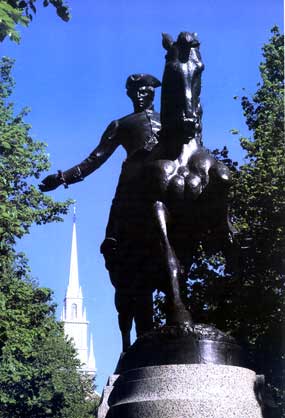
As I described in my first posting about Hezekiah Wyman, the great power of his legend is how it describes the fear of the British soldiers each time they spot the white-haired farmer on his white horse, riding closer for another shot. To quote from “The White Horseman”:

“Ha!” cried the soldiers, “there comes that old fellow again, on the white horse! Look out for yourselves, for one of us has got to die, in spite of fate.” And one of them did die, for Hezekiah’s aim was true, and his principles of economy would not admit of his wasting powder or ball.
Descriptions of such British fears and the nickname “Death on the pale horse” remain in the story as retold more calmly in Henry Smith Chapman’s History of Winchester and David Hackett Fischer’s Paul Revere’s Ride. That emotion is what made the tale stick in my mind the first time I read it.

But what evidence supports those statements? None of those tellings and retellings cite any specific accounts from British soldiers, prisoners, deserters, letters, memoirs, or newspapers. In fact, back in 1835 when the Hezekiah Wyman legend was first published as “The White Horseman,” historians had very few eyewitness accounts of the Battle of Lexington and Concord from the British side. Even now, we have several from officers, but almost none from enlisted men.

And to my knowledge, none of the surviving accounts mentions the soldiers fearing a man on a white horse. There’s a single statement about mounted provincials, from Lt. Frederick Mackenzie of the 23rd Regiment, first published in 1926:
Those Rebels who came in from the flanks during the march, always posted themselves in the houses and behind the walls by the roadside, and there waited the approach of the Column, when they fired at it.

Numbers of them were mounted, and when they fastened their horses at some little distance from the road, they crept down near enough to have a Shot; as soon as the Column had passed, they mounted again, and rode round until they got ahead of the Column, and found some convenient place from whence they might fire again.

These fellows were generally good marksmen, and many of the used long guns made for Duck-Shooting.
While acknowledging “generally good marksmen,” Mackenzie didn’t describe any of those men as noticeably deadly. He didn’t describe men firing with their guns laid across their saddles. He didn’t describe a white-haired rider on a white horse. In sum, there’s no British evidence for the parts of the story that make Hezekiah Wyman seem special.

As I’ve noted, there was a Hezekiah Wyman with a white horse who lived within riding distance of the fighting. But there’s no contemporaneous evidence or reliable family lore that he took part in the battle.

There are hints that the author of “The White Horseman” was aware of some Middlesex County oral traditions about 19 Apr 1775. But even if a story was going around about an old marksman striking fear into soldiers as “Death on the pale horse,” that was inspired by what Americans wished the British had felt. At most, the real Hezekiah Wyman would have been riding along with a bunch of other farmers on horseback, creeping down to a house or wall near the road, and shooting with “generally good” results.

In the end, I don’t see big contradictions or anomalies in the tale of Hezekiah Wyman to show that it must be fiction. But it’s not up to us to disprove any story we inherit from the past. The weight of the evidence has to be there for us to believe it. Barring new discoveries, I think the evidence for this tale is too light to shift it from literary legend to historical episode.

(Photo above by Alex Starr, via Flickr under a Creative Commons license.)

Saturday, June 26, 2010

Oral Tradition or Coincidence?

I started digging into the legend of Hezekiah Wyman after reading the brief description of that episode in David Hackett Fischer’s Paul Revere’s Ride and later the original version, “The White Horseman” from 1835.

How, I wondered, did that purple legend, which didn’t even retell the story of the shooting on Lexington common correctly, get into so many history books? Could there nonetheless have been a real person behind the unreal tale?

A family named Wyman settled in Woburn in the early 1600s, and they had lots of male descendants. As a result, by the late 1700s you couldn’t throw a stone in parts of Middlesex County without hitting a Wyman. In the published vital records of Woburn, the list of marriages involving people named Wyman runs from the bottom of page 313 to the top of page 324.

Therefore, if an author sat down to write a fictional story about a Middlesex County farmer in 1775, and wanted a name that sounded believable, he (or she) could do a lot worse than to choose the surname Wyman.

As for the given name Hezekiah, in a study titled “Continuity and Discontinuity in Puritan Naming: Massachusetts, 1771,” Prof. Daniel Scott Smith found that Hezekiah was the 62nd most common name in his sample of taxpayers. As a comparison, the 62nd most common name for American men born in 1950—i.e., men who would be the same age as the fictional Hezekiah Wyman today—is Samuel. Not uncommon at all. (Though I have to acknowledge that the distribution of names across the population wasn’t the same.)

The name Hezekiah apparently lost popularity in America in the early 1800s. Out of a sample from the 1850 census list of 30,000 names of males born between 1800 and 1830, Douglas Galbi found fewer than 30 named Hezekiah. Of course, that was a national sample, not limited to New England, but the trend seems solid. (Presently Hezekiah is bouncing around the 900th spot as most common name for male babies in America.)

Thus, calling a character Hezekiah would signal early-19th-century readers that he dated from a previous era, the time of their grandfathers.

I therefore hypothesized that whoever wrote “The White Horseman” came up with the name Hezekiah Wyman along those lines, as a fictional character meant to evoke the old men of Revolutionary days.

Later in the nineteenth century, after the story’s original literary context in The Boston Pearl had faded away, new authors rediscovered “The White Horseman” and went looking for Hezekiah Wyman. And they found him! Okay, he wasn’t a sixty-year-old from Lexington; he was a fifty-four-year-old from what became Winchester. (Or that man’s son, from Weston.) And they found no contemporaneous evidence for a Wyman riding on 19 Apr 1775. But they were able to correct the later versions of the story that said Hezekiah was eighty years old.

Given the frequency of the names Wyman and Hezekiah, however, how unlikely was it to find a man of that name within riding distance of the Battle Road? The real Hezekiah Wyman’s 1779 will shows that he had a “white mare” (which he used with a “Horse cart”) and a “Gun.” But again, lots of established Massachusetts farmers had horses and guns.

Was the identification of the hero of “The White Horseman” with Hezekiah Wyman of Woburn like connecting the grave of Israel Bissell out in Hinsdale with a post rider on 19 April—a name that, simply by coincidence, matched an unreliable document?

Or was there some truth to the “White Horseman” legend, however its author had dressed up the details? Supporting this possibility is how the story alluded to the documented ambush of British supply wagons in Menotomy, apparently using local oral traditions not fully set down until almost thirty years later. So had the author heard a tale about a rider named Hezekiah Wyman, and decided to run with it?

In the end, I came back to the original appeal of the story.

TOMORROW: At last, the British army perspective.

Friday, June 25, 2010

The Legend of “The White Horseman”

I believe “The White Horseman,” the earliest printed tale of Hezekiah Wyman, is an example of a lost literary genre called a “legend.” Washington Irving launched this form in American literature with such tales as “The Legend of Sleepy Hollow” (1820). The genre’s ingredients include a historical setting, a spooky atmosphere (whether or not events are actually supernatural), and a tone of inevitable moral judgment.

Other early American authors who used the form include:

  • William Austin, “The Man with the Cloaks: A Vermont Legend” (1836).
  • Nathaniel Hawthorne, “Legends of the Province House” in Twice-Told Tales (1837).
  • Robert Montgomery Bird, “The Legend of Merry the Miner” (1838).
  • George Lippard, Washington and His Generals; or, Legends of the Revolution (1847).
You might guess that I chose those titles because they include the actual term “legend,” but there are many other examples of the form. Probably the highest achievement within the genre is Hawthorne’s The Scarlet Letter.

The people who wrote legends and probably most of the people who originally read them understood those stories to be fictional. (Especially the ones that involved little men bowling ninepins, of course.) Some authors might have been inspired by historical episodes, but they added too much fiction for the result to be believed.

When those authors remained famous, as Irving and Hawthorne did, their legends were republished under their names, and American readers continued to recognize those tales as fictional. However, when an author was forgotten, his work was easily reprinted and retold without credit or context. In some cases, new authors took those legends to be fact.

For example, some of Lippard’s legends of Revolutionary Philadelphia, such as the Liberty Bell being rung to signal independence, got into the history books. His tale of a mysterious man orating to the Continental Congress continued to circulate as fact at the highest levels of American society into the late 1900s. Lippard appears also to have started the story, mentioned in the last Presidential Inaugural Address, that Gen. George Washington ordered Thomas Paine’s Common Sense to be read to the entire Continental Army (though he might have thought that was accurate, based on his interpretation of a Paine biography).

The fact that legends often included names that grounded them in real places and events furthered that confusion. One local example is the series of tales about “Peter Rugg, the Missing Man.” The Boston lawyer William Austin wrote those stories for The New England Galaxy starting in 1824. They were reportedly a major influence on Hawthorne, and later on Edward Everett Hale’s Man Without a Country.

Austin included some details that seemed authentic, most notably a man from Menotomy named Cutter. That was a common surname in that village; everyone in greater Boston probably knew a man from Menotomy named Cutter. (As I’ve noted, “The White Horseman” also mentions an Ammi Cutter from that village.) Nonetheless, Austin made up the whole story of Peter Rugg.

By the end of the nineteenth century, Austin was forgotten. The story of Peter Rugg was still being retold—as history, or at least as ancient New England folklore. Alexander Wollcott felt he had to write an article setting the record straight.

TOMORROW: So if “The White Horseman” was a legend, where does that leave Hezekiah Wyman of Woburn?

Wednesday, June 23, 2010

The Gun at Wyman House

As I noted back here, when Isaac Chauncey Wyman died in 1910, he left most of his fortune to his alma mater, Princeton College. Newspapers immediately reported that the bequest could be worth up to $10 million. Within a few weeks that figure came down to $2 million. Still, in 1910 that was real money.

Along with Wyman’s money and far-flung real estate, Princeton received some of his antiques, including the gun he told people his grandfather had owned. Woburn researcher Chris Hurley found it mounted alongside a powder horn and sword in a display case in Wyman House, a university residence (shown above) that happens to stand on part of the Revolutionary battlefield.

From lock to mouth the barrel appears to be four feet long. I have no idea if this gun actually dates from the Revolution, or has any other identifying marks. However, Chris Hurley noted that the sign mounted in the same room has this to say:

JOHN WYMAN of Salem, Massachusetts, who had used this musket and powder horn in the French and Indian War, gave them to his son Isaac Wyman in 1776 and gave Washington £8000 to equip the brigade in which his son enlisted

ISAAC WYMAN, his son, when a boy of sixteen, carried this musket, powder horn, and sword here on this field where he fought in the Battle of Princeton under Washington, January 3, 1777.

ISAAC CHAUNCEY WYMAN, Isaac Wyman’s son, Princeton 1848, died at an advanced old age on May 18, 1910, and bequeathed most of his estate to the Graduate College, which stands on the battlefield of Princeton.
Just two years before, Genealogical and Personal Memoirs Relating to the Families of Boston and Eastern Massachusetts said that Isaac Chauncy Wyman’s paternal grandfather was Hezekiah Wyman, not John. The memoir of him published in 1910 by the New England Historic Genealogical Society says the same. (Those two volumes were produced under the supervision of the same man, so they’re not independent sources.)

It’s possible that the Princeton sign is mistaken about the grandfather’s first name. But the £8000 gift to Washington is a new detail, not in any other article about the Wymans that I’ve found. (Nor is there any mention of it in Washington’s papers or other sources.)

The Princeton sign also says that Isaac Wyman was “a boy of sixteen” at the Battle of Princeton on 3 Jan 1777, meaning he was almost certainly born in 1760. Which conflicts with both birth years stated in the Wyman genealogies published between 1895 and 1910.

So it looks very much like Isaac Chauncey Wyman had no idea who his paternal grandfather was, but believed he must have been a hero in the French & Indian War and the Revolutionary War, and carried that gun.

Similarly, it looks like Isaac Chauncey Wyman had very little idea who his father was, but believed he must have been a hero of the Revolutionary War, and carried that gun.

Isaac Chauncey Wyman was obviously not a reliable source of family lore about Hezekiah Wyman, or anyone else. He may well not have even been descended from that man. Thus, what he or his biographers wrote has little or no bearing on the question of what Hezekiah Wyman did on 19 Apr 1775.

[ADDENDUM: After a reader request, I’m posting a photo of the musket in its case by Chris Hurley, with permission from folks at Princeton. Click on the picture for a larger image. Obviously, this isn’t an ideal way to examine a gun, but it’s the best we can do from afar. And the likelihood that Hezekiah Wyman used this gun to pick off regulars on 19 Apr 1775 is infinitesimal anyway.]

TOMORROW: Closing remarks on Isaac Chauncey Wyman.

Tuesday, June 22, 2010

“Together with My Gun”

Back to the truth and fictions of Hezekiah Wyman. As I’ve noted, there was a fifty-four-year-old man named Hezekiah Wyman living in south Woburn (now Winchester) in 1775. Those details don’t exactly match the sixty-year-old Hezekiah Wyman living in central Lexington in “The White Horseman.” But was he close enough to have been that fictional story’s inspiration?

Earlier in this series I reported how Chris Hurley, who researches Woburn’s Revolutionary history, supplied me with a quotation from Hezekiah Wyman’s will confirming that he did indeed have a white horse when he died in 1779. That same will confirms that he had two others things which some sources ascribe to him.

First, Hezekiah listed his children as “my Sons Hezikiah, Seth, Daniel, Isaac & Joseph &...my Daughter Susanna.” The eldest son I’ve already mentioned as on the list of Weston militiamen who marched on 19 Apr 1775. The two genealogies of Isaac Chauncey Wyman I quoted back here both say he descended from Hezekiah through a son named Isaac, and this will confirms that there was such a son. (It doesn’t offer information about that son’s birth date, however.)

Furthermore, the will give son Daniel, in addition to the livestock already listed, “my Horse cart, & all my husbandry Utensils, together with my Gun.” So Hezekiah Wyman definitely owned a gun in 1779.

According to Genealogical and Personal Memoirs Relating to the Families of Boston and Eastern Massachusetts (1908), Hezekiah “bequeathed outside his family the gun he carried” on 19 Apr 1775, but Isaac Chauncey Wyman bought it back. So there’s a contradiction there.

Perhaps by “outside his family” Isaac Chauncey Wyman meant out of his own particular line. Indeed, if his grandfather’s gun was in the hands of a cousin, that would make it more plausible that he could buy back the very same musket about a century later.

What’s more, Chris Hurley has tracked down the musket that Isaac Chauncey Wyman owned. In New Jersey.

TOMORROW: The story that musket tells.

Tuesday, June 15, 2010

“The Gun He Carried on that Eventful Day”

Normally the people most eager to preserve and retell the stories of a man’s heroism in the Revolutionary War are his descendants. The case of Hezekiah Wyman is unusual in that a heroic story about him was widely published and republished starting in 1835, but there was no family lore about him in print until sixty years later.

Isaac Chauncey (or Chauncy) Wyman (1827-1910, shown here) was an attorney in Salem. He never married, and left over two million dollars to his alma mater, Princeton. (This bequest turned out to affect Woodrow Wilson’s political career in a backhanded way, but that’s a different story.) Edward Wall’s Reminiscences of Princeton College, 1845-1848 contains an unflattering and rather sad profile of this Wyman. A member of the New England Historic Genealogical Society, he appears to be the source of statements about his family history published around the turn of the last century.

An 1895 volume of The Bench and Bar of the Commonwealth of Massachusetts, collecting profiles about lawyers for sale to those same lawyers, says this about Isaac Chauncey Wyman:

His father [Isaac] was born in Cambridge, January 1, 1762, and died in Salem in 1836, having been present at the battles of Lexington and Bunker Hill and at the siege of Boston, acting as a substitute for an uncle who was a lieutenant colonel under General [John] Stark, and afterwards serving until the end of the war.

Isaac, the father, was the son of Hezekiah Wyman, a soldier in the army of General [James] Wolfe, who was born in Woburn and was the fifth son of Capt. [Seth] Wyman, memorable for the conduct of “Lovewell’s Fight” and who died of wounds received in that affair.
Lt. Col. Isaac Wyman (1724-1792) of Keene, New Hampshire, did indeed serve under Stark from 23 Apr 1775 to the end of that year. He then returned to New Hampshire and became a colonel in the state militia. His son Isaac (1756-1835) received a pension for Revolutionary military service.

I have no idea why this lieutenant colonel would need a “substitute,” and doubt anyone would have seen a thirteen-year-old boy as a fair replacement. Possibly the author meant “subordinate” or “subaltern”—but I’m not finding records to match that.

Capt. Seth Wyman (1686-1725) was indeed celebrated for “Lovewell’s Fight,” a guerilla battle with Pequawket fighters in the Maine woods in 1725 which sounds like a dreadful affair all around. He didn’t die of his wounds, but of dysentery on a subsequent mission.

I’ll address the other statements about Hezekiah and Isaac Wyman as they appear in more detail in volume 4 of Genealogical and Personal Memoirs Relating to the Families of Boston and Eastern Massachusetts (1908). This series, edited by William Richard Cutter [him again!], combined family lore and genealogical research. Like the book on lawyers, the series was probably financed by the families it discussed.

The entry on the Wyman family describes Hezekiah this way:
He was a soldier in the French and Indian war, and was in General Wolfe’s army at the battle of Quebec. Tradition has it that he pointed out the secret path that led to the Heights of Abraham, by which the British and Americans were led to the plateau, met the French on equal footing and conquered the city.

In recognition of his services in this campaign he was granted a manor in New York, but never claimed his grant, and it was finally taken up by squatters.

When the revolution came he marched with his company on the Lexington alarm and took part in the fighting at Concord, April 19. 1775. When he died he bequeathed outside his family the gun he carried on that eventful dav, but it is now in the possession of his grandson, Isaac Chauncy Wyman, of Salem.

He was fifty-five years old at the time of the battle, and lived but a few years afterward. A picture of him, seated upon a white horse, is preserved in the public library at Woburn. His home was in Cambridge, Massachusetts, in later years.
I can’t find Hezekiah Wyman listed as a veteran of Wolfe’s campaign against Quebec, or elsewhere in the French and Indian War. In 1890 the Winchester Historical Society published a list of the town’s veterans of that war, and it doesn’t include him.

A “manor in New York” should be well documented. But the only land grant connected to Hezekiah Wyman that I can find was in Massachusetts. In its 1772-73 session, the legislature granted “Hezekiah Wyman of Woburn” and his brother Ross some land in reward for their father Seth’s services in 1725. The province had granted Seth land which turned out to be over the New Hampshire border. In compensation, Ross and Hezekiah were allowed to develop 500 acres in western Massachusetts instead.

As for Hezekiah Wyman pointing out the secret path up the cliffs to Quebec, that’s an incredible feat for someone who’d never been in the area, isn’t it?

Most interestingly, this family lore says Hezekiah Wyman “marched with his company on the Lexington alarm.” It doesn’t mention him riding a white horse alone, though obviously that story had made it to the Woburn public library. Isaac Chauncey Wyman had supposedly brought his grandfather Hezekiah’s gun back into the family, presumably by buying it—yet his lore makes no mention of extraordinary marksmanship.

The same entry states that Hezekiah’s son Isaac was born in 1756, not 1762, which makes service in the siege of Boston much more likely—unless the genealogists simply confused him with his New Hampshire cousin. Further statements about Isaac:
He was an active and influential patriot in revolutionary days, and a distinguished military figure. He was with his father in the battle of Concord, and rose step by step to the rank of colonel of a cavalry regiment, or horse troops, as they were called. . . .

Colonel Wyman acquired military habits of arbitrary thought and action during the war, and was rather austere and stern. In business he commanded, and his word was law… Like most of the Continental army officers, he was a Free Mason.

He married, July 2, 1820, Elizabeth Ingalls. born in Lynn, January 19, 1789, daughter of Henry Ingalls, an officer at one time of the famous frigate “Constitution.”
I can’t find any mention of an officer on the Constitution named Henry Ingalls.

The only Revolutionary War officer named Isaac Wyman, “horse troops” or not, was the older man from New Hampshire. It’s possible that Isaac Chauncey Wyman’s father achieved the rank of colonel in the militia during peacetime, as stated in a 1910 N.E.H.G.S. obituary. It’s also possible that’s just one more unverifiable thing he said.

One final curiosity about these entries is that, although they give a detailed portrait of Isaac Wyman’s personality, they don’t offer a specific date of death. The latter doesn’t even state a definite year: “about 1836.” That suggests there was some rupture in the family. Several issues of the Salem Gazette in November 1836 carried an advertisement dated the first of that month saying Isaac’s widow Elizabeth had been appointed to administer his estate, meaning he’d died intestate. Isaac Chauncey Wyman was then only eight or nine.

So what can we conclude from Isaac Chauncey Wyman’s family lore?
  • He really, really wanted to have ancestors with distinguished military records.
  • A lot of the information he passed on can’t be confirmed from reliable sources.
  • Despite his hunger for ancestral glory and his low standards of evidence, Isaac Chauncey Wyman didn’t think of his grandfather as the legendary “White Horseman.”
Instead, this Wyman imagined his grandpa Hezekiah and his father Isaac marching together on 19 Apr 1775.

COMING UP: After a pause for Bunker Hill, some concluding thoughts on Hezekiah Wyman.

Monday, June 14, 2010

Young James Russell and a Load of Green Peas

Aside from David Kinnison, who appears to have been ready to tell any Revolutionary story if it would get him a dinner in Chicago around the year 1850, did anyone claim to have actually seen Hezekiah Wyman shooting British soldiers on 19 Apr 1775?

In 1864, the Rev. Samuel Abbott Smith of Arlington believed he had identified such a witness. In his history of that village’s experiences on the first day of the Revolutionary War, Smith wrote:

Through their whole retreat the British had noticed one man in particular, whom they learned especially to dread. He was an old, gray-haired hunter, named Wyman of Woburn, and he rode a fine white horse. He struck the trail as they left Concord, and would ride up within gunshot, then turning the horse throw himself off, aim his long gun resting on the saddle, and that aim was death. They would say, “Look out, there is the man on the white horse.”

He followed them the whole distance, and James Russell, the father of James Russell, Esq., then a boy of a dozen years, from behind a house on Charlestown street, saw him gallop across the brook and up the hill, pursued by a party of the flank guard who kept the plains midway between Charlestown and Main streets. He turned, aimed, and the boy saw one of the British fall. He rode on, and soon the same gun was heard again, this time also with deadly effect.
Smith’s footnotes indicated that he’d heard about Wyman from two people:
  • “James Russell, Esq.,” a former state senator who died in 1863.
  • Thomas Hall, who had married a granddaughter of the Hannah Adams driven from her home on 19 Apr 1775.
Of course, given how widely “The White Horseman” had been reprinted by 1864, lots of people had read about Hezekiah Wyman picking off redcoats with his long gun. The published tale could have supplemented, enhanced, or even launched Arlington’s oral traditions. How, for instance, was twelve-year-old James Russell able to identify the “old, gray-haired hunter” by name if he’d simply seen the man ride past at a distance?

On the other hand, since the published tales said Wyman was from Lexington, how did Smith’s version identify him as “Wyman of Woburn,” the only town with a documented older Hezekiah Wyman?

Was the first James Russell a reliable witness? Arlington vital records say that he was born in April 1763 and died in 1846. He married Rebecca Adams in 1783 (not the daughter of the Hannah Adams mentioned above). James and Rebecca Russell had their first child six months later, and their second son James in 1788. They thus had plenty of time to pass on Revolutionary stories to their kids.

Perhaps too much time. Here’s another Russell family tale, preserved in the second volume of Historic Homes and Places and Genealogical and Personal Memoirs Relating to the Families of Middlesex County, Massachusetts (1908), edited by William R. Cutter, descendant of yet another Arlington family.
[James Russell] was twelve years old at the time of the battle of Bunker Hill. The day of the battle he and a younger brother drove to Salem with a load of green peas and sold the produce, but the boys were held up by British soldiers at the spot now known as Medford Square, in Medford, and ordered to help carry the dead and wounded from the battle field. The boys had no liking for the dreadful work, and seized an opportunity to make their escape.
How could British soldiers, dying by the score to win the Charlestown peninsula, get to Medford Square? Could these two young boys have ended up on the British side of the siege lines? Was this story garbled in transmission? If so, what does that say about other tales this man’s son passed on in his old age?

TOMORROW: The Wyman family’s own stories.

Sunday, June 13, 2010

Hezekiah Wyman in His Eighties

In September 1855 the United States Magazine of Science, Art, Manufactures, Agriculture, Commerce & Trade, which obviously didn’t have enough topics to cover, printed a new version of “The White Horseman” with two major changes:

  • The story now said white-haired rider Hezekiah Wyman was “nearly eighty” and “eighty last November.” Those numbers were mutually contradictory, and they added twenty years to Wyman’s age in the 1835 original.
  • The commander of the militia on Lexington common was called “Captain Parker.” He was also “bayoneted in his tracks,” thus combining attributes of two real men: Capt. John Parker and his cousin Jonas Parker, who died from bayonet wounds. (Dramatic photo above of the 2008 reenactment of that killing by Joanne Rathe for the Boston Globe.)
This revamped version of “The White Horseman” was reprinted the following year in John R. Chapin’s The Historical Picture Gallery, or, Scenes and Incidents in American History, which promised “Interesting and Thrilling Narratives from the Written and Unwritten, Legendary and Traditionary, History of the United States.” The story was subtitled “A Reminiscence of Lexington Battle Ground,” implying that Wyman’s adventure was true.

In 1861 the story of eighty-year-old Hezekiah Wyman reappeared in Thrilling Adventures among the Early Settlers, published by the John E. Potter company of Philadelphia. That book’s title page promised:
Desperate Encounters with Indians, Tories, and Refugees; Daring Exploits of Texan Rangers and Others, and Incidents of Guerilla Warfare; Fearful Deeds of the Gamblers and Desperadoes, Rangers and Regulators of the West and Southwest; Hunting Stories, Trapping Adventures, etc., etc., etc.
As a result of such reprinting, by the 1860s lots of Americans knew the story of Hezekiah Wyman. In fact, Charles Bahne found that Henry W. Longfellow’s first draft of “Paul Revere’s Ride” included a stanza referring to Wyman’s white horse. The poet didn’t retell the whole story; rather, he expected his readers to recognize the allusion. (Those lines disappeared before publication, presumably because they would have distracted from the poem’s main story, about another rider.)

When Longfellow wrote in 1860, Charlie notes, more people had probably read about Hezekiah Wyman’s ride on 19 Apr 1775 than about Paul Revere’s.

TOMORROW: But had anyone gathered more evidence in favor of the story?

Saturday, June 12, 2010

David Kinnison “saw the old man on his white horse”

Soon after “The White Horseman” appeared in the Boston Pearl and Literary Digest in 1835, it was reprinted in several newspapers. Over the next few years that tale of mounted sharpshooter Hezekiah Wyman cropped up in other periodicals as their editors scrounged for material. Those republications removed “The White Horseman” from its original context in a literary magazine.

In 1851, Henry C. Watson gave the Wyman story wider circulation by including it in his book The Yankee Tea-Party; or, Boston in 1773. This book is set up as a conversation between some admiring young men and a bunch of very old and talkative Revolutionary War veterans. Jonas Davenport, who “lived near Lexington,” and David Kinnison introduce the Wyman tale this way:

”I can tell you folks of something more about that retreat from Concord,” continued Davenport. “The story is generally known up around the country here, but some of you may not have heard it. It’s about old Hezekiah Wyman, who gained the name of ‘Death on the pale horse.’”

“I heard the story, and saw the old man on his white horse,” remarked Kinnison; “but it will interest the young men, no doubt—so drive on.”
Davenport then goes into a shortened version of the Wyman tale, skipping over the fictional young militia captain named Roe but using a lot of the original language without credit to the Pearl. This version ends with Kinnison saying: “I knew the old fellow well. He had the name of being one of the best shots around that part of the country. I should never want to be within his range.”

Davenport appears to be fictional. Kinnison (or Kennison) was a real man who arrived in Chicago about 1848 claiming to have been born in 1736 and to be the last survivor of the Boston Tea Party. He lived off people who believed him until he died in 1852, some thirty years younger than he claimed to be. In the twentieth century writers published some thorough debunking of his claims, but he nevertheless continues to appear on lists of Revolutionary veterans. Kinnison’s picture appears above, courtesy of Find a Grave.

Watson’s statement that Kinnison claimed to have seen “the old man on his white horse” doesn’t indicate anything about the accuracy of the Wyman story. But it shows that by 1851 lots of people had heard the tale and believed it to be authentic.

TOMORROW: And then Hezekiah Wyman’s story got better.

Friday, June 11, 2010

The Documented Life of Hezekiah Wyman

There really was a Hezekiah Wyman in Middlesex County on 19 Apr 1775. In fact, there were two, father and son.

The son was born in Woburn in 1747 and married in Weston in 1770. Daniel S. Lamson’s History of the Town of Weston (1913) lists this Hezekiah Wyman as marching with the Weston militia company on 19 April and serving seven days in all. But he was only twenty-eight years old, presumably far from having white hair. So we have to focus on his father.

At the start of this series of postings, what seems like so many weeks ago, I quoted David H. Fischer’s Paul Revere’s Ride: “On the morning of April 19, 1775, Hezekiah Wyman turned fifty-five.” I suspect that was a misreading of a sentence in Henry Smith Chapman’s History of Winchester (1936): “Hezekiah was fifty-five on the morning of the Lexington alarm.” Chapman meant only that Wyman was that age, not that he turned fifty-five on 19 April.

But Chapman’s math was wrong. The vital records of Woburn, published in 1890, say that Hezekiah Wyman was born on 5 Aug 1720. He was therefore fifty-four years old during the Battle of Lexington and Concord. Not “sixty years last November,” as “The White Horseman” says.

This Hezekiah Wyman was also living in the southern part of Woburn, which later became Winchester. But according to “The White Horseman,” he lived within sight of Lexington common: “the window of [his] house overlooked the ground where these murders were committed.”

Samuel Sewall’s History of Woburn (1868), one of the best nineteenth-century local histories of Middlesex villages and towns, has only one thing to say about this Hezekiah Wyman’s military service. As of 1777 he had been called up for service, but had either served or paid for a substitute. Sewall recorded no details about him on 19 Apr 1775, and his name doesn’t appear on the muster lists of Woburn’s companies that day.

Is there any detail that the real Hezekiah Wyman of Woburn shares with the hero of “The White Horseman”? Chris Hurley kindly sent me this quotation from Wyman’s will, which is docket #25880 in the Middlesex County Probate records:

I give unto my son Daniel my pair of red Oxen, my Stears coming two Years old, one red & two speckled Cows, & three Heifers one coming three, & two coming two years old, and my white mare
So Hezekiah Wyman really did have a white horse. He wrote that will shortly before dying in 1779.

TOMORROW: The literary life of Hezekiah Wyman.

Tuesday, June 08, 2010

“An old woman, called Mother Barberick”

“The White Horseman,” the 1835 story in The Boston Pearl and Literary Digest, describes the surrender of a bunch of British soldiers on 19 Apr 1775 this way:

The party of soldiers who had the baggage in charge, ran to a pond and plunging their muskets into the water, surrendered themselves to an old woman, called Mother Barberick, who was at that time digging roots in an adjacent field. A party of Americans recaptured the gallant Englishmen from Mother Barberick, and placed them in safe keeping.
This was supposed to have happened in the western village of Cambridge called Menotomy, yet there’s no one in the Cambridge or modern Arlington records named “Barberick.”

But there is a family named Batherick, Bathrick, and Baverick, depending on the document. When the Rev. Samuel Abbott Smith collected versions of this incident in 1864, and Dr. Benjamin and William R. Cutter wrote their family and town histories around the same time, they all called the old woman “Mother Batherick.” They also said she had been out digging dandelions when the redcoats approached her. Other authors found that last detail too hard to believe.

In 1900, Edward Wheelwright of the Colonial Society of Massachusetts guessed that this old woman was Ruth Batherick, born Ruth Hook and married to John Batherick in 1747, when she was about thirty. That was six months after the death of his previous wife and seven months before the birth of their first child. Ruth and John’s first three children died before the age of seven, but Lydia (born 1752) and Ruth (born 1754) survived.

John Batherick died in 1769, leaving his widow and children from two marriages, who all seem to have been poor. One of his grandchildren was Phebe, born in 1757; according to Wheelwright, she was “bound out to John Wilson at the age of seven years” and continued to work for that extended family until she died in 1837. On 25 Sept 1773 John’s daughter Lydia Batherick gave birth to a son named as “Melotto” in the town records; that child was probably bound out as well.

The widow Ruth, who was Phebe’s stepmother and Lydia’s mother, died in the Cambridge poorhouse on 18 Sept 1795, aged 78.

Wheelwright knew Phebe Batherick when he was a child, and remembered her “compounding a nauseous liquid which she called dire drink and in which dandelions was one of the ingredients.” The term “dire drink” was a common form of “diet drink,” which Dr. Samuel Johnson defined as “medicated liquors; drink brewed with medicinal ingredients.” John Locke used the term metaphorically. William Thomas Brande’s 1842 Dictionary of Science, Literature, & Art defines diet-drinks as:
Alterative decoctions taken in considerable quantities; such as decoction of sarsaparilla, sassafras, dandelion, &c.
So it would have been quite easy for people who knew Phebe Batherick to imagine her step-grandmother out collecting dandelions on 19 Apr 1775. And perhaps she was.

Wheelwright said Phebe Batherick often spoke of her own memories of 19 April. In a 1880 speech John W. Candler also described hearing stories “from an old nurse, Phoebe Bathrick, of West Cambridge, who was sixty-two years a servant and dear friend in our family.” Candler recalled:
Before I was able to read the history, we children gathered about her, long years ago, to listen to her vivid recital of what that revolutionary year witnessed. We were with her when she was awakened in the night by the heavy tramp of the Redcoats as they passed my grandmother’s home on the road to Lexington. We were with her in the morning when the children were crowded into the ox-cart, and carried down to Spy Pond, away from the main street; and we were with her again in the day when she went back to look at the Redcoats with their glistening bayonets. And we went with her to see the dead soldier lying in the ditch, and when the sun went down we were taken back to the house that had been sacked by the British troops.
Though no one recalled Phebe talking about her step-grandmother capturing redcoats, she definitely contributed to Menotomy’s oral history of the Revolution.

The author of “The White Horseman” linked his (or her) story of Hezekiah Wyman to that tradition by stating that Wyman helped to ambush the British supply wagons and scare the soldiers into surrendering. The magazine tale called the old woman “Mother Barberick,” suggesting its writer was working off an oral tradition, not from a written source or close contact with the Bathericks.

So was that writer using already circulating stories to make a fictional hero named Hezekiah Wyman seem more real? Or was Wyman’s tale, like those of Ammi Cutter and Batherick, actually rooted in preceding tradition, and the writer embellished it?

COMING UP: Tracking Wyman from Lexington and Cambridge to Woburn.

Monday, June 07, 2010

Ammi Cutter and the Old Men of Menotomy

Yesterday I quoted the part of “The White Horseman,” the earliest known story about Hezekiah Wyman on 19 Apr 1775, which makes it also the earliest known story about Ammi Cutter on that same day.

We know that there really was a man named Ammi Cutter in the western part of Cambridge, now called Arlington. The Independent Chronicle newspaper for 1-8 Feb 1776 has an advertisement from “Ammi Cutter of Menotomy” about a two-year-old red steer he’d found.

Ammi Cutter (1733-1795) was a miller and farmer on his third wife, the former Hannah Holden. Like Asahel and Abigail Porter, the Cutters got married in Samuel Perley’s church in Seabrook, New Hampshire; Massachusetts couples went to that neighboring colony if they wanted to marry quickly with no questions asked. In Ammi’s case, the questions would have been:

  • Isn’t Hannah the younger sister of your second wife, who died sixteen months ago?
  • Are you sure you’ll be able to get home before the baby comes?
The marriage took place on 27 Oct 1774. Hannah gave birth to Joshua Cutter on 1 December.

There was, in fact, another Ammi Cutter in Menotomy at the time: the first one’s son (1755-1830). He was “a large man, broad in chest,” who at nineteen almost certainly marched with the town’s regular militia company on 19 Apr 1775. According to the family history, he “is said to have disabled three British foemen on the retreat from Concord.”

And that leads us from the written vital records into unverifiable oral traditions. In his early forties (and with an infant at home), the older Ammi Cutter was reportedly exempted, along with other older men, from marching off to confront the redcoats. Instead, he and a bunch of “exempts,” some of them war veterans, stayed in Menotomy and ambushed a British supply convoy.

How did that story come down to us? The first hint comes in “The White Horseman,” which credits “Ammi Cutter” with masterminding the attack. That 1835 story says, “Ammi had planted about fifty old rusty muskets under a stone wall, with their muzzles directed toward the road.”

A more detailed story appears in the Rev. Samuel Abbot Smith’s history of west Cambridge on 19 Apr 1775, published in 1864. Based on interviews with local residents about what they’d heard growing up, Smith said that the “old men…in all about twelve” chose David Lamson to lead that attack, but he credited Cutter with being part of it. For different parts of that story Smith cited Dr. Benjamin Cutter (1803-1864), the older Ammi’s grandson; Mrs. Lydia Peirce, actually alive in 1775; a Miss Bradshaw, granddaughter of the parish minister in 1775; and Col. Thomas Russell, grandson of Jason Russell.

Smith told two other stories involving Ammi Cutter, citing Dr. Cutter. The same stories appear in two books the doctor drafted and his son William R. Cutter finished: A History of the Cutter Family in New England (1871) and History of the Town of Arlington (1880). According to those books: That makes Ammi Cutter appear crucial to much of what happened in Menotomy on 19 Apr 1775. It may be safer to say that his family was crucial in preserving and publishing the town’s stories.

Because of the contemporaneous reports and the number of people in Arlington who recalled hearing about the event, it’s clear that a group of Menotomy men did ambush British supply wagon. (The “Old Men of Menotomy” historical marker appears above, courtesy of the Historical Marker Database.) Ammi Cutter was most likely in that group, and his family definitely passed down the tale.

One descendant, also named Ammi Cutter and born in 1777, became a prominent merchant in Boston and a captain in the town militia. If he told the story about his grandfather on lots of occasions in Boston, it could have become a well-known anecdote of 19 Apr 1775, attached to the name Ammi Cutter, even before it was printed. And that’s just as “The White Horseman” presents it.

COMING UP: What about “Mother Barberick”?

Sunday, June 06, 2010

“Lingered for a Moment to Aid in a Plot”

In summarizing “The White Horseman,” the first published account of Hezekiah Wyman’s ride on 19 Apr 1775, I left out part of a paragraph that describes what he did in (west) Cambridge:

Hezekiah had only lingered for a moment to aid in a plot which had been laid by Ammi Cutter, for taking the baggage waggons and their guards. Ammi had planted about fifty old rusty muskets under a stone wall, with their muzzles directed toward the road. As the waggons arrived opposite this battery, the muskets were discharged, and eight horses, together with some soldiers, were sent out of existence. The party of soldiers who had the baggage in charge, ran to a pond and plunging their muskets into the water, surrendered themselves to an old woman, called Mother Barberick, who was at that time digging roots in an adjacent field. A party of Americans recaptured the gallant Englishmen from Mother Barberick, and placed them in safe keeping.
This apparently refers to an incident reported as early as April 1775 in Massachusetts newspapers:
At Menotomy, a few of our men attacked a party of twelve of the enemy, (carrying stores and provisions to the Troops,) killed one of them, wounded several, made the rest prisoners, and took possession of all their arms, stores, provisions, &c., without any loss on our side.
The Rev. William Gordon (shown above) also described that episode in his 1788 history of the Revolution:
Before they [the redcoats] reached this place [Menotomy], a few Americans, headed by the Rev. Mr. [Phillips] Payson, of Chelsea, who till now had been extremely moderate, attacked a party of twelve soldiers, carrying stores to the retreating troops, killed one, wounded several, made the whole prisoners, and gained possession of their arms and stores, without any loss whatever to themselves.
”The White Horseman” thus connects its hero, Hezekiah Wyman, to an already known anecdote of 19 Apr 1775.

In doing so, the writer drops a couple of names: “Ammi Cutter” and “Mother Barberick.” The text doesn’t introduce Ammi Cutter with any detail, implying that readers should already recognize him. The narrator, so overwrought in other passages, goes into little detail about this capture of wagons and men, again implying that many readers had already heard the full story. Did the writer pose Wyman next to those figures to add verisimilitude to an otherwise long-haired and overly interesting narrative? That’s a common tactic for writers of historical fiction.

Yet as far as I can tell, the piece in The Boston Pearl was the first printed source to describe the soldiers dunking their muskets and surrendering to an old woman, and the first to attach the names of “Ammi Cutter” and “Mother Barberick” to the attack. Perhaps there’s an earlier publication that doesn’t show up in the digital databases I searched. But that situation implies that the author of “The White Horseman” did draw on at least one circulating oral tradition about 19 Apr 1775.

TOMORROW: Ammi Cutter and the “Old Men of Menotomy.”

Saturday, June 05, 2010

Hezekiah Wyman “Picking Cherries”

When we last left Hezekiah Wyman in “The White Horseman” (1835), he had assembled his rusty-barreled musket, mounted his white horse, and rode out to kill British regulars.

According to that story, Wyman’s first kills are on the road between Concord and his own town of Lexington. Then the withdrawing redcoats meet up with Earl Percy’s reinforcements, and the combined forces “kept off the Americans with their artillery while they took a hasty meal,” which agrees with historical accounts of the day. (Curiously, Wyman shows no worry about his aged wife, last seen in their house within sight of Lexington common.)

Then the regulars resume their march east, and Wyman resumes his sniping:

…the powerful white horse was seen careering at full speed over the hills, with the dauntless old Yankee on his back.

“Ha!” cried the soldiers, “there comes that old fellow again, on the white horse! Look out for yourselves, for one of us has got to die, in spite of fate.” And one of them did die, for Hezekiah’s aim was true, and his principles of economy would not admit of his wasting powder or ball.
It wasn’t just revenge driving Wyman—it was good old Yankee thrift!

There’s a short interlude in Cambridge that I’ll get to tomorrow, and then “The White Horseman” ends:
Even after the worried troops had entered Charlestown, there was no escape for them from the deadly bullets of the restless veteran. The appalling white horse would suddenly and unexpectedly dash out from a brake, or from behind a rock, and the whizzing of his bullet was the precursor of death. He followed the enemy to their very boats; and then turning his horse’s head, returned unharmed to his household.

“Where have you been, husband?”

“Picking cherries,” replied Hezekiah—but he forgot to say that he had first made cherries of the red coats, by putting the Pits into them.
Ba dump bump!

There’s evidence for riders harassing the British troops on their way east from Lexington, but I know of nothing to support the notion of mounted snipers continuing to attack those soldiers after they reached the easily-guarded Charlestown peninsula and prepared to board boats to Boston. That last scene’s impossible to believe, and few authors repeat it.

If that text was all there was to Hezekiah Wyman, people would have little problem taking his story as fiction. It appeared in a literary magazine, the writer made no claims about truth or sources, and the action and details are clearly chosen for narrative effect.

“The White Horseman” takes the prevailing American understanding of the Battle of Lexington and Concord—that the Middlesex farmers were peaceful until roused by an invasion of bloodthirsty soldiers, and then they became frightfully efficient warriors—and boils it down into a single figure. That’s what H. W. Longfellow did in his poem “Paul Revere’s Ride.” That’s often what a lot of good historical fiction does.

Yet there’s still the possibility that “The White Horseman” was a fictionalized, exaggerated version of a real incident. Paul Revere really did warn a lot of Middlesex villages and farms, for instance. Back in April I analyzed the story of Samuel Whittemore, another old man credited with shooting more than his share of British soldiers. The Whittemore story seems outlandish, was exaggerated in some details, and grew more impressive as time went on. Yet its core looks accurate.

So is there any evidence that the writer of “The White Horseman” drew on little-known anecdotes from local history? And is there any evidence to support Wyman’s existence and activity on 19 Apr 1775?

TOMORROW: Wyman in West Cambridge.

(Powerful white horse photographed by PhotographyGal123, via Flickr under a Creative Commons license.)

Friday, June 04, 2010

“An Old Man by the Name of Hezekiah Wyman”

As I discussed on Tuesday, the story about Hezekiah Wyman that appeared in The Boston Pearl and Literary Digest in 1835, titled “The White Horseman,” isn’t accurate history. The story’s first main character, a young militia captain named Roe who dies on Lexington common, is fictional.

However, the story is still based on history. The anonymous author was obviously inspired by what he (or she) had read about the actual shooting on Lexington common on 19 Apr 1775. Could that writer have also borrowed details of the actual Hezekiah Wyman’s activities?

If so, “The White Horseman” certainly built on those details in a high literary style. The paragraph that tells us of the death of “Captain Roe” continues:

There was an old man by the name of Hezekiah Wyman, the window of whose house overlooked the ground where these murders were committed; and no sooner did he see his brave countrymen fall, than he inwardly devoted himself to revenge the unhallowed slaughter.

“Wife,” said he “is there not an old gun barrel, somewhere in the garret?”

“I believe there was,” said she, “but pray what do you want with it?”

“I should like to see if it is fit for service,” replied he, “If 1 am not mistaken, it is good enough to drill a hole through a rig’lar.”

“Mercy on me, husband! are you going mad? An old man like you—sixty years last November—to talk of going to war! I should think you had seen enough of fighting the British already. There lies poor Captain Roe and his men bleeding on the grass before your eyes. What could you do with a gun?”

The old man made no reply, but ascended the stairs, and soon returned with a rusty gun barrel in his hands. In spite of his wife’s incessant din, he went to his shop, made a stock for it, and put it in complete order for use. He then saddled a strong white horse, and mounted him. He gave the steed the rein, and directed his course toward Concord.

He met the British troops returning, and was not long in perceiving that there was a wasp’s nest about their ears. He dashed so closely upon the flank of the enemy that his horse’s neck was drenched with the spouting blood of the wounded soldiers. Then reining back his snorting steed to reload, he dealt a second death upon the ranks with his never failing bullet. The tall gaunt form of the assailant, his grey locks floating on the breeze, and the color of his steed, soon distinguished him from the other Americans, and the regulars gave him the name of “Death on the pale horse.”
Obviously we’re in the realm of myth here. Wyman makes his own weapon from “an old gun barrel” and a new wooden stock. He must not have been shooting lately—yet he turns out to be a crack marksman, commanding a “never failing bullet,” and never getting hit himself. And all to avenge an “unhallowed slaughter” that takes place outside his very window.

I see Mel Gibson in the role, once all his hair turns white. Then again, he’s already tried this character in The Patriot; that movie wasn’t historically accurate, but it matches the tone of this story, doesn’t it?

TOMORROW: Hezekiah Wyman finishes his ride.

Tuesday, June 01, 2010

The Mythical Captain Roe

I’ve been quoting from “The White Horseman,” an item that appeared in The Boston Pearl and Literary Digest on 22 Aug 1835. The first scenes of this story focus our attention on an unnamed girl and her beloved, a young militia officer called Captain Roe. He is killed in the British volley on Lexington common.

Except that no captain was killed on Lexington common; Capt. John Parker was in command, and survived. No one named Roe was killed, wounded, or, so far as we know, standing on Lexington common. No American named Roe was killed in battle anywhere on 19 Apr 1775.

A couple of months ago some researchers suggested to me that “Roe” could be a corruption of the name “Munroe.” There was a militia officer named Munroe killed at Lexington: Ensign Robert Munroe. However, while the story’s “Captain Roe” is a young unmarried man, Robert Munroe was sixty-two years old with a wife and grown children.

Other details of the start of “The White Horseman” don’t match the historical record, either. “Cambridge boys” did not march to Concord before the British troops. “Many squads of Americans” did not rush west past the Lexington militia. The British musket balls hit far fewer than “nearly half” of those men.

In sum, “The White Horseman” is not historically accurate. The unnamed “Soldier of the Revolution” who wrote it didn’t even try to be as historically accurate as possible; it wouldn’t have been hard in Boston in 1835 to find the names of the first casualties at Lexington, or to read accounts of the fight assembled by Elias Phinney or others.

The Boston Pearl writer fictionalized the famous story of the shooting at Lexington with new characters, details, and dialogue, in order to lay out a sentimental tale of young lovers torn apart by the nasty redcoats. Which naturally raises the question of what other details from “The White Horseman” we’re meant to believe.

COMING UP: Hezekiah Wyman enters the scene.