J. L. BELL is a Massachusetts writer who specializes in (among other things) the start of the American Revolution in and around Boston. He is particularly interested in the experiences of children in 1765-75. He has published scholarly papers and popular articles for both children and adults. He was consultant for an episode of History Detectives, and contributed to a display at Minute Man National Historic Park.

Subscribe thru Follow.it


•••••••••••••••••


Showing posts with label weapons. Show all posts

Thursday, June 11, 2026

Remembering the Battle of Bunker Hill This Week

Next week brings the 251st anniversary of the Battle of Bunker Hill, and the Charlestown Historical Society and partner organizations have planned several events to commemorate it.

On Saturday, 13 June, there will be an Author & Historian Symposium in the lodge beside the Bunker Hill Monument. Among the scheduled speakers from 10 A.M. to 4:30 P.M. are:
  • Timothy Reardon on the Brothers of the Battle of Bunker Hill descendants group 
  • James Philbrick on his ancestor, David Howe
  • Joni and Christine Parker on their ancestor, Benjamin Parker
  • Christian Di Spigna on Dr. Joseph Warren
  • J. L. Bell on the “whites of their eyes” quotation
  • Joe Bagley on archeology in Charlestown, including the dig completed the day before
  • Julie Hall on how public relations shaped the American Revolution
Throughout the day family artifacts, letters, journals, ephemera, and other historic items will be on display for visitors. A musket demonstration by the National Park Service is scheduled for 4:30.

Charlestown’s annual Bunker Hill Day Parade will be on Sunday, 14 June, from 12:30 to 4:30 P.M. I understand through other sources that there will also be a sidewalk demonstration against White House censorship of signs quoting later generations on the monument inside the lodge, as discussed here.

On Tuesday, 16 June, the society, the city of Boston, and GBH will cohost a community viewing of the Bunker Hill portion of Ken Burns, Sarah Botstein, and David Schmidt’s documentary series The American Revolution. Some of the historians, archeologists, and descendants from Saturday will be on hand, as well as Donald R. Ryan, biographer of William Prescott. That discussion will take place from 6 to 8 P.M. in the street-level meeting room of the Bunker Hill Museum.

On Wednesday, 17 June, the Bunker Hill Monument Association will have its annual meeting at 11 A.M. in the museum. Prof. Robert Allison from Suffolk University will speak on “The Importance of the Left Flank and the Rail Fence.” This event is open to B.H.M.A. members and invited guests only.

Finally, from 3:30 to 5 P.M. that Wednesday, the annual Remembrance Ceremony on the monument grounds will be open to the public.

Tuesday, June 02, 2026

Cutting Remarks

Here’s another data point on the phrase “Tarleton’s quarter(s)” in the early American republic.

This item that appeared in the Centinel of Freedom newspaper, published in Newark, New Jersey, on 4 Dec 1798.

Original and True.

AFTER the battle of Cowpens, in which [Banastre] Tarleton’s dragoons were so roughly handled by the Americans, he drew up his men, and riding in front of the line, communicated to them strict order to give no quarter thereafter.

A short time after, in an action where the American militia threw down their arms and begged for their lives, one of them answered, “aye, aye! we’ll give you quarter; but as we are in something of a hurry, we’ll only halve you now, and quarter you as we come back:” and so hewed them down with their sabres.

“This naivete passed from mouth to mouth, and excited laughter in the midst of carnage! Were these men or fiends?”
This anecdote reflected the American memory of Tarleton and his men as monsters. There’s no evidence from the British side that the lieutenant colonel gave such an order, nor any evidence from wartime for this remark by one dragoon.

Notably, this tale was set after the Battle of Cowpens in January 1781. David Ramsay’s history, quoted yesterday, stated that the phrase “Tarleton’s quarters” arose after the Battle of Waxhaws more than six months earlier.

This article used an older sense of “naïveté,” meaning not the quality of being naïve but an action or remark arising from that quality. Not that I picture those dragoons as naïve.

Friday, May 29, 2026

Meeting the Real Samuel McClellan

Yesterday’s post introduced Samuel McClellan (1730–1807) of Woodstock, Connecticut, the captain of a militia troop of horse in 1774.

McClellan was a shopkeeper and landowner in his small town. After the Revolutionary War he became a brigadier general in the state militia.

The McClellans remained locally important, and one of his great-grandsons was Gen. George B. McClellan of the Union Army and the 1864 Presidential race.

As often happens in that situation, Samuel McClellan’s descendants were influential enough to get their understanding of his role in the Revolution into local histories and biographical profiles when primary sources were hard to consult. For example, the 1902 National Cyclopedia of American Biography said:
On Oct. 13, 1773, he was commissioned captain of a fine troop of horse, raised in the towns of Pomfret, Woodstock, and Killingly, and led it Boston on receipt of the news of the battle of Lexington. He passed through the battle of Bunker hill uninjured, and in commemoration of that his wife planted three elm trees in front of residence, which attained great size and were standing when Gen. George B. McClellan visited Woodstock in 1884.
Ellen Douglas Larned’s History of Windham County, Connecticut: 1760–1880 says there were originally four elms.

The latest version of that lore is Samuel McClellan’s Wikipedia page, which as of this week says:
In 1775 Major Samuel McClellan led 184 men at the Battles of Lexington and Concord. He played a prominent role in the Battle of Bunker Hill, and after achieving the rank of lieutenant colonel in 1776, colonel in 1777, and brigadier general of the 5th Brigade in 1779, his regiment of the Connecticut Militia was stationed near New Jersey. McClellan was solicited by General George Washington to join the Continental Army and was offered a commission, but his domestic and business affairs compelled him to refuse.
That overstates the facts in multiple ways, starting with how McClellan wasn’t commissioned a major in the militia until October 1775.

News of the outbreak of war in Massachusetts didn’t reach Woodstock until 20 April, after the fighting was over, so there was no way men from that town were “at the Battles of Lexington and Concord.” Col. Israel Putnam was one of the first men from Connecticut to respond. On 21 April he wrote from Concord to say that the Massachusetts Provincial Congress hoped that Connecticut would send 6,000 men for “a standing Army.”

Putnam added as a postscript: “The Troops of Horse are not expected to come until further notice.” But Capt. McClellan had already led his 184 mounted men north into Massachusetts. That’s shown by Connecticut records of militia service, as tabulated here.

However, those same records also show that McClellan was paid for only eight days of service. Like most of his neighbors, he went home when it was clear the emergency had passed. Some men stayed or returned and enlisted in what became the New England army. McClellan didn’t.

There’s no evidence putting McClellan at the Battle of Bunker Hill or on the siege lines around Boston at the time. That undercuts the claim he “played a prominent role” in the battle, but it does explain how he remained “uninjured.”

Later in the war McClellan did mobilize with his militia regiment for short assignments in the Northern Department. He also served in the Connecticut assembly and as a commissary. In that last capacity his name comes up in Washington’s papers, but there’s no direct written solicitation from the commander for McClellan to join the Continental Army.

McClellan apparently left a fowling-piece, made by the Massachusetts gunsmith Joel White, equipped with a bayonet mount and bearing the initials “SMC.” That’s been displayed as a weapon from the Battle of Bunker Hill. McClellan may well have carried it during the Revolutionary War, but not at that fight.

Monday, May 25, 2026

“The services of their father in repairing certain cannon”

Preserved Clap was born in Hadley, lived in the part of that town which became Amherst, and ultimately died at age eighty up the Connecticut River in Claremont, New Hampshire.

His headstone appears here courtesy of Find a Grave. His wife Eunice’s stone is nearby.

Clapp probably had earlier ties to that region. The Preserved Clap listed as serving in 1775 in a provincial company recruited largely from Bolton was said to come from Charlestown, New Hampshire, next to Claremont.

There’s also this curious anecdote related by Jaazaniah Crosby in his History of Charlestown in New Hampshire (1833):
On the 18th of June, 1756, while Lieut. Moses Willard was endeavoring to extinguish the fire, which had been kindled in his fence, he was attacked by the Indians, and killed behind the barn of the late Capt. John Willard, and near the academy. At the same time, his son Moses was wounded in the hip by a spear, which is said to have remained in the wound till after his retreat into the fort. It is further said that a Mr. Preserved Clap carried the same spear into the revolutionary war.
Preserved and Eunice Clap’s son Roswell was living in Claremont by 1790, per the first U.S. Census.

Dr. Clap’s children followed in his footsteps in at least one way: asking to be paid for his inventions during the Revolutionary War.

In 1837, the U.S. Senate took up “the petition of Roswell Clapp and Charlotte Reed, children and heirs of Preserved Clapp, praying compensation for the services of their father in repairing certain cannon belonging to the United States.” That referred to work sixty-one years before, just after the siege of Boston.

And the Clap family kept up that plea until 1841, thirty years after the doctor had died.

Saturday, May 23, 2026

“The consideration of the Petition of Preserved Clap”

In the spring of 1776, Dr. Preserved Clap was forty-five years old. He had a wife and young children back in Amherst. And in Boston he was being hailed as a “Genius” for his idea of how to put damaged cannon back to work. So he stayed.

Though he used the title ”Doctor” and was identified by the Rev. Samuel Cooper as “a Country Surgeon,” I haven’t come across any example of Clap performing medicine. But he threw himself into mechanical tasks.

The authorities put Clap in charge of a team to salvage as many of the artillery pieces the British left behind as they could. Those men appear to have worked into the summer, and then Clap petitioned the Massachusetts General Court for pay.

On 16 September that legislature put into its record:
MEMORIAL of PRESERVED CLAP Overseer. of the Men employed in opening, and stocking the Cannon at Boston, and Castle William.
setting forth
That he and the Men attended that service, for the term of Time specified, for which he, nor they have received any pay therefore the memorialist prays, that the Honorable Court would give him an Order upon the Treasurer for the State aforesaid for the Amount of his Account. or otherwise relieve him as shall seem meet.

The Committee to whom was referr’d the consideration of the Petition of Preserved Clap, have attended that Service, and beg leave to Report by way of Resolve.

several other Accounts exclusive of said Clap’s accompanying this petition, the Committee did not take into consideration as said Clap had no orders to receive the amount of the same,

said Committee do not know of any further service for said Clap.

Resolved that there be paid out of the Publick Treasury of this state to Preserved Clap Forty Three Pound one shilling & Tenpence in full for his within account

and whereas Said Clap Says that he has envented a machine for Boreing Cannon, which may be improved to the grate advantage of this State, therefore

Resolved, That if Said Clap will exhibet a Plan, or Modle of Said Machine, to Hugh orr Esqr and others, a Comtee. for Casting Large Cannon So as to Satisfy them of its Superior utility, upon their report thereof to this Court there Shall then be granted to him Such a Sum for his envention as may appear to be adequate to its Superior usefulness.
Hugh Orr (1715–1798) had come to Massachusetts from Scotland in 1737, settling in Bridgewater after a couple of years. There he built a forge and the first known trip-hammer in British America. Though Orr’s main product was farming implements, at times of war he shifted his works toward making weapons, including muskets in 1748.

In 1776, Orr was representing Bridgewater in the General Court and working to set up a cannon manufactory. Naturally, the legislature set Dr. Clap to him. However, there’s no evidence anything came of that.

Two months later, on 14 November, the Independent Chronicle newspaper ran this notice:
BOSTON, November 11, 1776.

THIS may certify, that Doctor Preserved Clap, has opened the cannon at Castle-William that were spiked up by the enemy; and is the real inventor of a carriage, whereby the cannon that had their trunnions broken off, by this new invented carriage the guns are rendered serviceable, which otherwise would have been useless.

Attest, RICH. GRIDLEY, Chief Engineer.
I looked to see if there was any competing claim to have invented that method of mounting guns in 1776, but I couldn’t find one. Dr. Clap really wanted public credit for his ideas.

TOMORROW: Making a national case.

Sunday, May 17, 2026

“There is something off about this sword”

Earlier this year the Sandwich Enterprise shared a story by Cearra O’Hern about the identification of an artifact at the Pilgrim Hall Museum.

The article focuses on Michael L. Welch, Jr., who uses first-person interpretation of Revolutionary figures in teaching history at the Sandwich Middle School.

The article explains:
Welch primarily portrays Major General James Warren, a leading revolutionary in Massachusetts who also served as president of the Massachusetts Provincial Congress during the American Revolution. Welch heard that the Pilgrim Hall Museum in Plymouth had Warren’s sword

“I connected with the curator, who was very helpful in lining up a time to go in and look at the sword,” Welch said. “I was given the attribution of the sword, how the sword was passed down through the Warren family and donated. I photographed it extensively, I scanned it, I made a 3D rendering of it, and the whole time I am looking at this sword, I am like, ‘There is something off about this sword.’”

Welch had seen a sword like Warren’s before, which was believed to date back to 1764-1765. As he continued to examine its pommel, guard and counter-guard, Welch determined the sword was not a general’s sword; it was a mass-produced sword made much later, after the American Revolution.

Welch identified the sword as a Model 1796 Hanger carried by British sergeants, a discovery that “broke his heart,” as he did not want to say anything to the Pilgrim Hall Museum.
The photo above, which the museum shared on social media a few weeks before this article appeared, may show one of those awkward moments when Welch looked at the sword and wondered about sharing doubts with curator Anne Mason.

After confirming his assessment with an expert, Welch did indeed discuss those findings with Mason and her colleagues. The museum will add that information to its files and assess how it displays the hanger. As Welch points out in the article, the fact that this sword was made in 1796 doesn’t mean it wasn’t owned by James Warren; his son James, Jr. (1757–1821), a Continental Marine officer who lost a limb in 1781; or another member of the family. It just doesn’t go back as far as the Revolution.

Friday, April 10, 2026

“With an Irony which inflamed their resentments”

As Crean Brush was seizing linen and woolens for the British military in March 1776, some of the wealthy merchants who owned that cloth complained to Gen. William Howe’s headquarters.

Brush responded with a memo to Gen. James Robertson, who was overseeing the evacuation:
if any Articles were removed which did not answer the description [in Howe’s order] the Parties are only to blame they being repeatedly called on to declare the Contents of each which they obstinately refused—

These People your Memorialist are irritated against him but your Memorialist begs leave to assure your Honor he is fully able to prove that his Conduct toward them was governed with politeness coolness & moderation

true it is that when attempts were made to engage his attention in tedious dissertations on Magna Charta & the rights of British Subjects with intent to retard him in the execution of his Office he did interrupt such Harangues & with an Irony which inflamed their resentments complimented them on their Eloquence which had in Town Meetings been so successful as to throw all America into confusion but that I was upon Business which I was determined to execute without interruption—

The Goods I received from the Stores were taken on board & stowed away with all the care & attention my peculiar Situation would possibly admit and I solemnly aver that from the 5th to the 13th March my own Assiduity was so great that I did not in any one Night allow Myself more than two Hours Sleep…
With the help of his assistants plus “two boys and a man” on board the Elizabeth, Brush managed to pack that brig. Some of Cyrus Baldwin’s goods went onto the Minerva.

At some point Brush’s assistants—Charles Blasquet, Richard and John Hill, and David Cunningham—appear to have asked what arrangements he’d made to get them and their families out of Boston. To his credit, he didn’t just ask what arrangements they’d made for themselves. Instead, Brush recognized that they’d “neglected their own Concerns to serve Government at my request.”

Crean Brush hustled those men and their families onto the Elizabeth into “a small space between Decks.” He later told Gen. Howe they had all brought their own provisions so they “cannot be the least convenience to any Person on board.” Basically, he asked for forgiveness instead of permission.

Brush’s memos to Robertson and Howe, published in the Naval Documents of the American Revolution, document the hurry and disorder of the evacuation. He was managing goods that merchants had asked him to store, goods that he’d seized from Patriots who had left Boston, the cloth that he’d been commissioned to keep out of rebel hands, and his own property. And he was trying, at least on paper, to keep these all separate and safely stored.

Conflict continued even on the Elizabeth. Brush had loaded nineteen barrels of flour on board, on “Major Hutchinsons orders”—I think this was Maj. Frances Hutcheson of the 60th Regiment, the army paymaster. Brush told Robertson:
the second Barrell which was opened I sent for some [flour] which when discovered by Mr [Caleb] Wheaten he imperiously flourished [his sword] over me while in Bed & told me he was surprized at the assurance I dared to shew in giving directions to have any,

Upon which I told him he was an insignificant inpertinent Puppy.

Captain [Peter] Ramsey at that instant came in declared he would not hear one word of the occasion which provoked me to use the words I have mentioned but that if I uttered three words more he would send me Prisoner on board the Commodore—
While dealing with such quarrels, Capt. Ramsey got the Elizabeth out of Boston harbor with the rest of the evacuation fleet by the end of March.

And on 2 April three American schooners captured the ship.

TOMORROW: In custody.

Thursday, April 09, 2026

“This Party behaved very Insolently & with Great Rapacity”

Samuel Austin, quoted yesterday, wasn’t the only Boston merchant to complain about how Crean Brush had confiscated cloth in March 1776.

Capt. Samuel Dashwood also groused about Brush. As cited by Eric Wiser, the captain described how Brush pushed through the back door of his house, strode past the family, and opened their front door for his assistants. At the end of the day, Dashwood determined he was missing nine trunks and two chests of silks and cloth.

Dashwood made a point that Brush had been wearing a sword (as many gentlemen did). “If any person should presume to interrupt,” Dashwood quoted his unwanted visitor saying, “[soldiers] would thrust their bayonets into such a person.”

Capt. Dashwood wasn’t above violence himself, though. Back in 1769, he was among the merchants who challenged printers John Mein and John Fleeming on King Street. And the next year, during an anti-import protest, Theophilis Lillie described Dashwood as “in a great rage, challenging me to come out of my house and he would break my neck, my bones, and the like.”

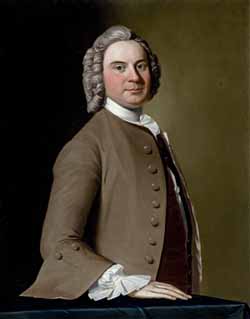
While Dashwood was a virulent Patriot, John Rowe (shown above) was a trimmer, trying to stay neutral. He lamented the outbreak of war, lived in Boston through the siege, and then chose to remain as the king’s military left. But he also objected to Brush’s actions.

I quoted Rowe’s complaints about how Crean Brush seized property on 11 March back here. At that time I assigned “Mr. Hill” the first name William, but now I think it was more likely either Robert or John.

The next day Rowe collected a receipt for his goods from Brush but wrote, “[I] dont expect—much Good from it.”He told his diary, “This Party behaved very Insolently & with Great Rapacity & I am very well Convinc’d exceeding their orders.”

The next few days were even worse, however. Rowe found other men breaking into his warehouses and stealing more goods, not just the cloth that Gen. William Howe had authorized Brush to take. And of course those men left no receipts at all.

Between Rowe’s diary, documents that Brush signed, and postwar legal filings, we can identify a few more people besides those I’ve already discussed who lost property to Crean Brush’s team: selectman John Scollay, Capt. Samuel Partridge, “Widow [Mary?] Newman,” “John Barret & Sons,” and Dr. Thomas Bulfinch.

TOMORROW: Brush’s response.

Sunday, March 29, 2026

“After this they went to it with their fists”

Here’s an example of how Gen. John Burgoyne’s diary of the late 1775, just brought to light, offers new detail on life inside besieged Boston.

We’ve long known that in August 1775 Adm. Samuel Graves (shown below) and Customs Commmissioner Benjamin Hallowell (shown at right) got into a fistfight. In 1929, Allen French delivered a whole paper on this incident to the Massachusetts Historical Society.

The two men had already butted heads over the unloading of a merchant ship. One report suggests that Hallowell had critiqued the way Graves deployed warships during the Battle of Bunker Hill. But the immediate conflict was over hay growing on Gallops Island in the outer harbor.

Hallowell had purchased the right to harvest that hay. Graves wanted that hay, or at least half of it, for the navy. (Or maybe he wanted half the value of the hay for himself.) Hallowell secured permission from Gov. Thomas Gage to harvest. Graves refused to allow haying on the islands, and he had warships.

Hallowell sent increasingly angry letters to the admiral. Graves sent no replies. Hallowell took that silence as a sign of disrespect, and he was probably right.

The next time the commissioner saw Adm. Graves, on Milk Street on 11 August, he demanded the sort of answer that he, “as a gentleman, had a right to expect."

A letter sent from Boston on 19 August and printed in the 21-23 Sept 1775 London Chronicle stated:
To this civil question, the Admiral replied in his usual style; and while the Commissioner was whispering a challenge to him, returned a blow in the face.

Though Mr. Hallowell was unarmed, the Admiral had recourse to his sword, on which the former rushed upon him, forced it from him, broke it over his knee, and then flung it in Greaves’s face; after this they went to it with their fists, but were soon parted.—

The Admiral has come off with a black eye. He has not yet proposed a renewal of battle, probably preserving himself for the Yankies, who have already carried off all his fresh stock, burnt his hay on the islands, and destroyed the light-house twice under his very nose.
Over the next couple of days Graves’s nephew, Capt. Thomas Graves, R.N., twice challenged Hallowell on the admiral’s behalf. Another nephew, Capt. Samuel Graves, R.N., hit the commissioner on the back of the head with a cane, and Sheriff Stephen Greenleaf had to separate the men. Hallowell declared he wouldn’t duel on instructions from Gen. Gage—at least not with anyone but the admiral.

According to a 21 August letter from Capt. Samuel Graves summarized in the Dartmouth Manuscripts, the dispute was heard by a court martial. The board faulted the admiral for “An error in judgment for disobedience of orders and neglect of duty.”

Our most detailed description of this fight comes from Hallowell, and most of the other sources sympathize with him, too. (Given the commissioner’s snappish temper, that shows how many people disliked Adm. Graves.) At least a couple of those sources say the admiral came away with a black eye, suggesting the commissioner got the better of the fight.

Per Andrew O’Shaughnessy, Gen. Burgoyne called the whole incident “shameful” and recorded that Hallowell suffered a black eye, too.

Prof. O’Shaughnessy will share more details about the Burgoyne diary and how it came to light in an online “fireside chat”/Zoom webinar on 15 April at 6 P.M. Harvard time.

Tuesday, December 30, 2025

“Everything he can to build a standing army that he can use domestically”

Earlier this month, Prof. Noah Shusterman, author of Armed Citizens: From Ancient Rome to the Second Amendment, shared an essay through H.N.N. titled “Deploying Federal Troops to U.S. Cities Is a Second Amendment Issue.”

Here’s a taste:
The Second Amendment was meant to prevent events like the Boston Massacre… The amendment was meant to prevent the government from turning its military into an occupying force, as the British were doing when they began stationing troops in Boston. It is also what our current president is trying to do when he sends federal troops into Los Angeles. Or Portland. Or Chicago. Or, eventually, New York and Boston.

The courts have been treating those deployments as Tenth Amendment issues, or as potential violations of the 1878 Posse Comitatus Act, but back when the Bill of Rights was written, the domestic deployment of federal troops was the Second Amendment issue. And if the courts understood that, we would be in much less of a mess right now. In 2025, the amendment might be about privately owned guns, but when the Bill of Rights was ratified in 1791, it was about the military — specifically, the threat that a nation’s military could pose to its own people, as it had in Boston during the 1770s, when the British government began stationing troops there. . . .

In the years immediately following independence, neither the state militias’ shortcomings on the battlefield during the Revolution, nor the Continental Army’s successes, made Americans any less wary of peacetime standing armies. Leaders of the founding generation still believed that because a professional soldier relied on his job for his livelihood, his allegiance was to his commander, not his nation. (The current commander-in-chief recently endorsed this view, albeit unknowingly, when he told an audience of military leaders that “if you don’t like what I’m saying, you can leave the room. Of course, there goes your rank, there goes your future.”) . . .

In Second Amendment terms, this president is doing everything he can to build a standing army that he can use domestically against his own population. If the Second Amendment’s self-proclaimed supporters both inside and outside the courts appreciated the significance of these policies, and how contrary they are to the amendment’s original goals, the nation might be in a better place right now. In deploying federal police and military units as an occupying force, the president is doing precisely what the amendment was meant to prevent.
I write this from Washington, D.C., where the President has summoned over 2,600 National Guard troops from multiple states. While traveling to libraries, I see small groups of young people in uniform pulled away from their homes and jobs to stand around in subway stations and parks. Courts have disagreed about the constitutionality of that order and others, with the President getting even more deference than usual in the federal district.

The President claims this authority based on laws speaking of “invasion” and “rebellion,” neither of which applies, and he also claims he’s acting against “crime.” This same President is a convicted criminal who pardoned about 1,600 people for attacking the U.S. Capitol on his behalf in January 2021.

Saturday, December 20, 2025

“I can recollect something of their faces…”

As recounted yesterday, immediately after the Boston Massacre, town watchman Benjamin Burdick went up to the soldiers and examined their faces so he could identify them later.

That didn’t actually turn out to be helpful.

When he was called to testify at the soldiers’ trial in November, Burdick had this exchange:
Q. Did you see any of these prisoners in King street the night of the 5th of March?

A. Not that I can swear to as they are dressed. I can recollect something of their faces, but cannot swear to them.

When I came to King-street, I went immediately up to one of the soldiers, which I take to be that man who is bald on the head, (pointing to [Edward] Montgomery). I asked him if any of the soldiers were loaded, he said yes. I asked him if they were going to fire, he said yes, by the eternal God, and pushed at me with his bayonet, which I put by with what was in my hand.

Q. What was it?

A. A Highland broad sword.
John Adams’s notes on this exchange echo some details:
I went up to one that I take to be the bald man but cant swear to any. I askd him if he intended to fire. Yes by the eternal God. I had a Cutlass or high Land broad sword in my Hand.
In an earlier deposition Burdick said that the soldier he spoke to was “the fourth man from the corner, who stood in the gutter.”

However, multiple other witnesses agreed that Pvt. Montgomery was on the right end of the grenadiers’ arc (James Bailey, Jedediah Bass), and that the man in that position was the first to fire (Bailey, Bass, James Brewer, Thomas Wilkinson, Nathaniel Fosdick, Joseph Hiller). The watchman himself described the first shot coming from “the right hand man,” not the men closest to him. So the soldier Burdick spoke to wasn’t Montgomery, despite all his effort to memorize the men’s faces on King Street.

Burdick’s testimony does offer us some details about the soldiers in the courtroom. As defendants, those men were “dressed” differently from how they appeared on 5 March—differently enough for Burdick to say he could no longer recognize any of them with certainty. That suggests the soldiers were no longer wearing their full uniforms.

In addition, Montgomery wasn’t wearing a wig or hat since Burdick (who, incidentally, had been trained as a barber and peruke-maker) saw that he was “bald.”

Saturday, November 29, 2025

Slocum’s “Authentic Narrative”

In 1844, John Slocum published An Authentic Narrative of the Life of Joshua Slocum: Containing a Succinct Account of His Revolutionary Services through a printer in Hartford.

This book fit into a growing genre: memoirs of unheralded Revolutionary War veterans looking back from old age. The most vital of these was Joseph Plumb Martin’s Narrative of Some of the Adventures, Dangers and Sufferings of a Revolutionary Soldier (1830), but I have a fondness for The Revolutionary Adventures of Ebenezer Fox, of Roxbury, Massachusetts (1838).

U.S. pension laws had encouraged veterans to write down their memories in order to authenticate their claims. I posit that that led men toward composing and then publishing these longer autobiographies. 

Joshua Slocum had died in 1816, at about the age of fifty-six, so he didn’t feel that impetus. Instead, his son John set down the veteran’s stories, shifting between third person, first person, and quoted documents.

Or so John Slocum claimed. He acknowledged pulling large sections of the book from other sources, such as the chapter on the capture of Fort Ticonderoga, which his father had no part in. But in truth he borrowed a great deal more. Over and over, the details in this Authentic Narrative just don’t add up, exposing a later perspective shaped by borrowed details and wishful thinking.

The book starts out by saying: “The subject of this sketch was born in the town of Franklin, Franklin county in the State of Massachusetts, in 1760.” The town of Franklin was never in Franklin County, and neither of those places legally existed in 1760. It’s possible Joshua Slocum was born in the town of Wrentham, which calved off Franklin during the war; there was a Slocum/Slocomb family there, but his birth doesn’t appear in the surviving vital records.

On the day after the town received news of the fighting at Lexington, the Authentic Narrative says, the “Franklin company” set out toward Boston. By the time those men made camp, “The intelligence of the surrender of Ticonderoga and Crown Point, with all their valuable stores, had already reached Roxbury.” That would mean the company took more than a month to travel fifty miles.

Somehow Joshua Slocum wrote a dramatic letter to his Loyalist father from Roxbury on 16 June 1775 but was also in one of the regiments based north of the Charles River that fought the Battle of Bunker Hill the next day.

In fact, Joshua was wounded—but he refused to leave his post! And a good thing, too:
Among the [British] killed was Major [John] Pitcairn, one of the flower of their army. I shall always believe that it was my rifle that sent him to his final account—for, as the enemy ascended the hill, I selected an officer answering his description, for a target, and as I took good aim, and my rifle seldom missing its object, I am very certain I killed him.
This account, then, is yet another claim to have killed Maj. Pitcairn. The narrator almost always refers to his weapon as a “rifle,” though such guns were almost unknown in New England at the time.

A month later, the narrator claims to have been about to volunteer for Col. Benedict Arnold’s expedition to Québec when he received a letter from a family friend dated 20 July. Since Arnold started to recruit in early September, that letter must have traveled even more slowly than the “Franklin company.”

The letter invited Slocum to leave the Continental Army camp, go out to the recruiting station at Worcester, and become a clerk in the friend’s company. Like most armies, the real Continentals frowned on soldiers deciding all by themselves where they’ll serve, but that’s what this account said Slocum did. 

And on it goes. Massachusetts Soldiers and Sailors of the Revolutionary War states that a Joshua Slocumb of Franklin served in the Rhode Island campaign of 1779–80. Ironically, the Authentic Narrative never mentions Rhode Island—most likely the one stint of military service by John Slocum’s father.

In 1882 Dr. Charles Elihu Slocum published A Short History of the Slocums, Slocumbs and Slocombs of America. Ordinarily such family histories are credulous toward sources that offer information and reflect well on members of the clan. But Dr. Slocum wrote of the Authentic Narrative:
This little book—of which but few copies can now be found—is written in a style interesting to the young, but it is open to criticism in some of its references to contemporaneous history.
In other words, don’t believe a word of it.

TOMORROW: The arrival of Washington through Slocum eyes.

Friday, October 31, 2025

“Sparking the Revolution” conference in Springfield, 20–21 Nov.

On 20–21 November the Springfield Armory will co-host the 2025 Fall Conference of the Firearms Research Center, on the topic of “Sparking the Revolution: Flintlocks, Gunpowder, and Policy in America’s War for Independence.”

The Firearms Research Center is based at the University of Wyoming law school. It states its mission as “to foster a broad discourse and produce meaningful change in how firearms are discussed and understood.”

The conference will open the afternoon of Thursday, 20 November, with a reception and fireside chat on the theme “Exercising the Bruen Test: A Study in the Modern-Day Debate on the Second Amendment.”

“Examining Revolutionary-era topics through the lens of today’s constitutional debates” will be Firearms Research Center director George Mocsary, Megan Walsh of the Gun Violence Prevention Law Clinic at the University of Minnesota, and moderator Ashley Hlebinsky, the center’s executive director.

The “Bruen test” is the outcome of a 2022 U.S. Supreme Court decision that stated the constitutionality of gun restrictions must be “consistent with the Nation’s historical tradition of firearm regulation.” Since there isn’t a consistent, unchanging, and non-discriminatory tradition of firearm regulation, judges have struggled to understand and apply that test. The Brennan Center for Justice says it’s unworkable. In a follow-up case this year, United States v. Rahimi, the nine Supreme Court justices issued seven opinions to tweak the Bruen language.

That opening session is scheduled to take place at the Springfield Armory National Historic Site. As a National Park Service unit, that’s currently closed because of the lapse in Congressional funding with almost all the employees furloughed. I suppose that location may change before 20 November.

On Friday, 21 November, the conference will move across the street to Springfield Technical Community College’s Scibelli Hall. That day’s program will include these parts.

Panel 1: Disarmament and the Revolution
  • Bob Cottrol, George Washington University
  • E. Gregory Wallace, Campbell University
  • James Slaughter, Marshall University
Guns of the American Revolution
Erik Goldstein, Colonial Williamsburg

The Earliest Days of Springfield Armory
Alex Mackenzie, Springfield Armory

Panel 2: The Colonial Militia
  • Jody Madeira, Indiana University
  • Joyce Malcolm, George Mason University
  • Alexander Cain, Author, We Stood Our Ground
Creating an Arsenal of Liberty
Andrew Fagal, Princeton University

Early Ballistics of the American Revolution
Joel Bohy, Antiques Roadshow

Find the full schedule here. Anyone can register to attend all of the sessions for free either in person or virtually.

Monday, September 15, 2025

Revolutionary Talks This Week in Dedham and Westford

Here are a couple more Revolutionary lectures coming up this week.

Wednesday, 17 September, 7:00 P.M.
Bullet Strikes from the First Day of the American Revolution
Joel Bohy
Dedham Museum, 612 High Street

In 2013, Joel Bohy began a collaboration with conflict archaeologist Dr. Douglas Scott to better understand the ammunition found during archaeological investigations on former battlegrounds. This morphed into live-fire research and the study of the extant battle-damaged structures and objects from April 19, 1775.

From the Elisha Jones house in Concord, through Lexington and the Jason Russell house in Arlington, Massachusetts—where Dedham soldiers fought—the two carefully studied all the surviving bullet strikes and bullet-struck objects. Using modern forensic techniques adapted to historical studies and live-fire validation, Bohy and Scott tell the story of the brutality of the fighting on the first day of the American Revolution as British forces retreated to Boston.

Joel Bohy is the owner of J.Bohy Historical Consulting. He is an arms & militaria specialist at Blackstone Valley Auctions and an appraiser on the PBS TV series Antiques Roadshow.

Admission is $10, free to museum members. This event will be recorded by C-SPAN for its America 250 series and by DedhamTV.

Thursday, 18 September, 7:00 P.M.
The Plight of the Loyalist in Massachusetts
Larry Kerpelman
Westford Museum, 2 Boston Road

It’s been said that history is written by the victors, so it’s not surprising that the story of Loyalists to the Crown who lived in the American colonies is not as widely known as that of the Revolutionary War’s victors, the Patriots. As the drumbeat to independence grew louder, Loyalists faced their Patriot neighbors’ scorn and the agonizing decision of whether or not to flee their towns and homes. Various historians have estimated that between 60,000 and 100,000 people fled the colonies by the time “America’s first civil war” ended. Dr. Kerpelman will present a picture of how ordinary Massachusetts Loyalists and their Patriot neighbors interacted with one another during the fraught period between the 1750s and the 1790s.

Larry C. Kerpelman, Ph.D., is a freelance writer and communications professional from Acton, Massachusetts. Upon retiring as Vice president and Director of Corporate Communications after 30 years with the Cambridge public policy research and consulting firm Abt Global, he turned to researching, writing, and speaking on singular moments in American history. His work has appeared in American History, American Heritage, The Boston Globe, The Rochester Review, and The Chronicle of Higher Education, among other publications. He holds a B.A. from the Johns Hopkins University and a Ph.D. from the University of Rochester.

Suggested Donation for this lecture of $10 per person.

Tuesday, September 02, 2025

“This Hawkshaw drew his sword upon us”?

Last week I wrote about some letters entrusted to Dr. Benjamin Church on 21–22 Apr 1775 which ended up in the files of Gen. Thomas Gage.

We have evidence that Gage or his staff actually read those letters for the intelligence they contained—because they got someone in trouble.

Thomas Hawkshaw was a lieutenant in the 5th Regiment of Foot, having served at that rank since 1771. He was involved in or witness to several conflicts in the first months of 1775.

In late January, Don Hagist reminded me, Lt. Col. George Maddison presided over an army court of inquiry into the actions of Lt. William Myers of the 38th. Myers testified that on 20 January two local men had baited him by calling, “The General was a Rascal” and even “The King was a Rascal.” After Myers “knocked down the man who had spoke in this manner,” the town watch showed up, bringing on a bigger confrontation.

Lt. Hawkshaw was among the witnesses in that inquiry. So, however, were more than twenty other army officers, a former army officer, seven enlisted men, two watchmen, and two civilians. That inquiry ended without apparent action on 28 January.

Four days later, on 1 February, Benjamin Alline and Philip Bass filed a complaint to Lt. Col. William Walcott of the 5th about Lt. Hawkshaw. According to Bass, he was escorting a young woman south of Liberty Tree about 9:30 P.M. the previous night, and Hawkshaw and another officer accosted them. After that confrontation, Bass went to an apothecary for a cut on his arm.

Lt. John Barker wrote in his diary for that day: “Lieut. H–ks–w of the 5th put under Arrest for having been concerned in a Riot yesterday evening, in which an Inhabitant was much wounded by him; it is supposed He will be brought to a Court Martial.”

Hawkshaw insisted, however, that he’d been in bed by 9:00 P.M. There’s no record of a formal army inquiry, so perhaps he found witnesses to confirm that and the locals had to let the matter drop.

Years back Prof. Gene Tucker of Temple University sent me transcriptions from the reminiscences of a Revolutionary War veteran named Samuel Cooper (1757-1840). He recounted several anecdotes about conflicts in Boston, but the details don’t match contemporaneous accounts, suggesting that Cooper was working with secondhand knowledge and faulty memory.

One incident stands out because Cooper said he was personally involved in it:
A party of young men, consisting of Benj. Eustis, his brother Geo[rge]., Jno. Cathcart, Ben Hazzard, Tim Green, Jim Otis, & myself had assembled about 9 o[’]cl[oc]k in the even[in]g at the corner of one of the streets, when we were approached by several officers, among them was a Lt. Hawkshaw of the 5th. We were comm[an]d[ed]. to disperse & go home & on our declining to do so this Hawkshaw drew his sword upon us but he had hardly time to raise it before he was disarmed by some of our party & the sword broken over his head; the rest of his associates withdrew.
Cooper didn’t specify when this happened, and frankly I doubted it happened as he described. In some of these fights an officer might lose his sword, as Ens. Henry King did in the January fracas. But this quick Yankee triumph sounds too good to be true, and no other report matches it.

Lt. Hawkshaw seems to have been very visible during those months in Boston. People complained about him by name while not identifying other officers who were with him. Or possibly Hawkshaw had become unpopular with the locals because of his testimony in the Myers inquiry, so people were eager to cast blame on him. But he was never brought to a court-martial.

In early April the lieutenant testified in the army inquiry about the dispute between his regimental commander, Lt. Col. Walcott, and Ens. Robert Patrick, discussed here.

And then came the Battle of Lexington and Concord.

TOMORROW: Shot in the face.

Wednesday, August 06, 2025

“They agreed to fight with Pistols”

What were officers of the British army in Boston thinking about in the weeks leading up to 18 Apr 1775?

Judging by the word count of what they wrote in their general orders and diaries, they were closely watching the fallout of a dispute between two officers in the 5th Regiment.

On 23 March, Lt. John Barker of the 4th recorded:
another duel stop’d between the Lt. Col. [William Walcott]…and Ensn. [Robert] Patrick of the same [regiment]; some words passing between them, the Lt. Cl. struck Mr. P——k in the face upon which they both immediately drew their Swords, but the other Officers interfering it was put a stop to ’till the Rolls were call’d when they both went to the Common, where they agreed to fight with Pistols which Mr. Patrick went for and upon his return was met by an Officer of the Regt. who by some means took the Pistols and fired ’em in the air, which alarmed the Guard which turned out and took him Prisoner and carried him to Lord Percy who put him in arrest, then went to Col. Wallcott and put him in arrest likewise; there the affair rests.
Three days later, Lt. Frederick Mackenzie of the 23rd wrote:
There was a dispute lately on the Evening parade of the 5th Regiment, between Lieut Colo. Walcott, and Ensign Patrick of that Corps, at the close of which the former struck the latter, and drew his Sword upon him, which occasioned a Challenge; but the Officers having interfered, and the matter having been reported to Genl. [Thomas] Gage, he ordered them both to be put under arrest, and tried by a General Court Martial

Ensign Patrick is related to the Lieut Colonel.
Mackenzie was a reliable veteran officer, so his statement about the two men being related is probably correct, but I haven’t been able to find more details.

Lt. Col. Walcott was born around 1742 and had been with the 5th Regiment since 1760, joining as a captain. Ens. Patrick had arrived in July 1771.

TOMORROW: The verdict.

[The picture above shows the uniform of an officer in the 5th Regiment as of 1792.]

Tuesday, August 05, 2025

“On the Alarm being given…”

The Massachusetts Patriots weren’t the only folks building an alarm system over the winter of 1774–75.

On 30 December, Gen. Thomas Gage set out this plan for his garrison in case they were attacked from the countryside:
The Alarm Guns Will be Posted at the Artillery Barracks, the Common & the Lines, the Alarm given at either of those places, is to be repeated at all the rest, by firing three Rounds each.

On the Alarm being given the 52d Regt. is immediately to Reinforce the Lines, leaving a Captain & 50 at the Neck, The 5th Regt. will draw up between the Neck Guard & the Liberty Tree.

The 4th or Kings own Regt. will Reinforce the Magazine Guard with a Captain & 50 and with the Remainder draw up under Bartons Point.

The 43d Regt. will join the Marines & together defend the Passage between Bartons Point & Charles Town Ferry.

The 47th Regt. will draw up in Hanover Street securing both the Bridges over Mill Creek.

The 59th Regt. will draw up in the Front of the Court House.

The 3 Companies of the 18th Regt. joined by those of the 65th Regt. the 10th 23d & 38th Regts will draw up in the Street between the Generals House & Liberty Tree.

Majors [William] Martins Company of the Royal Regt. of Artillery will move with expedition to the Lines, Reinforcing the Neck with one Commission’d Officer 2 Non Commission’d & 12 Men the Remainder of the Royal Regt. of Artillery will get their Guns in order & wait for orders.

If any Alarm happens in the Night, the Troops will March to their Post without Loading, & on no Account to Load their Firelocks, it is forbid under the Severest Penalty to fire in the Night, even if the Troops should be fired upon, but they are to Oppose & Route any body that shall dare to Attack them (with their Bayonetts) And the greatest care will be taken that the Countersign is well known to all the Corps & Small Parties, Advanced, that in case of meeting they should know their friends & not Attack each other in the Night thro’ Mistake.

The Officers Commanding Regts will Reconoiter the Streets leading from their Quarters, to their Respective Alarm Posts. & fix upon the Streets they intend passing thro’, each taking a different Route.
Bartons Point was the northwest tip of the town, sticking out into the Charles River. It’s striking that the army adopted the designation “Liberty Tree” for the big elm in the South End, despite its political origin.

Gen. Gage’s plan was never implemented, of course. On 20 Apr 1775, he stated: ”All former Orders Respecting Alarm Posts to be Cancel’d, & the Regts. to form in their Barracks.”

Monday, May 19, 2025

Visiting Henry Howell Williams on Noddle’s Island

For the last third of the eighteenth century, Henry Howell Williams (1736-1802) leased Noddle’s Island in Boston harbor for farming.

Williams married Elizabeth Bell, daughter of the previous lessee, in 1762, and they moved onto the island. They had a large house on the western end.

The Williamses started raising a family there: six children born between 1765 and 1772, and another due to arrive on 6 July 1775.

Henry Howell Williams’s runaway advertisements in the Boston newspapers showed his household sometimes included other people as well: an eighteen-year-old Irish servant named Joseph Sullivan in 1764; a twenty-three-year-old “Negro Girl Servant, named PHILLIS,” in 1778.

Williams periodically advertised a stallion raised on the island as available “to cover.” That horse was named “the Young Barbe.”

In several summers Williams ran ads chastising people for coming onto the island to shoot birds, enumerating the harm they did:
  • “killed a Number of my Sheep” (1768).
  • “treading down the Grass on the mowing Ground” (1769).
  • “to conceal it, throw the [dead] Sheep into the Wells or Pond Holes” (1769).
  • “putting my Family in Danger of their Lives” (1770).
  • “bringing on Dogs, and driving my Stock from one End of the Island to the other” (1772).
The apex of these complaints appeared in August 1784:
the 9th Inst. as a number of men were mowing, a scoundrel of a gunner fired his piece and covered one of the men with a shower of small shot, which providentially did but little damage
Williams forbade other people from hunting on Noddle’s Island. Of course, the fact that he kept placing the ads meant people kept ignoring his ban.

I didn’t find any notices about hunting from Henry H. Williams in 1773. But the 26 July Boston Evening-Post ran this news item:
Last Saturday…Afternoon, Mr. Henry Knox, of this Town, Stationer, being a Fowling on Noddles Island, in discharging his Piece at some Game, it burst near the Breech, whereby his left Hand was shattered in a very dangerous manner; his little Finger entirely tore away, and the two adjoining ones were obliged to be cut off at the middle Joints, his Thumb and Fore Finger only remaining, and his Hand being otherwise so much hurt that it is feared whether even these will be saved.
I quoted the letter Knox wrote to one of his surgeons in the following March back here.

It’s possible that Henry H. Williams had given Knox special permission to go hunting on Noddle’s Island that July. And it’s possible Williams heard about the young bookseller’s accident and muttered, “Serves him right.”

Friday, March 14, 2025

“1775: A Society on the Brink” Conference in Concord, 11–12 Apr.


On 10–11 April, the Concord Museum will host a conference, organized with the David Center for the American Revolution at the American Philosophical Society and the Massachusetts Historical Society, on the topic “1775: A Society on the Brink of War and Revolution.”

The full schedule is available here.

The conference will start with a reception on Thursday evening, followed by a keynote discussion at 7 P.M.:

From Boycotts to Bullets: Was the Outbreak of the American Revolution Inevitable?
  • Serena Zabin, Carleton College
  • Robert A. Gross, University of Connecticut, Emeritus
  • Katherine Grandjean, Wellesley College
On Friday, 11 April, the day will be devoted to five paper sessions, each seventy-five minutes long and featuring three papers by scholars ranging from graduate school to emeritus rank. A panel moderator will offer commentary and coordinate questions from the floor. One of those panels stands out for me—I’m sure you’ll see why.

9 A.M.: Faith and Ideas

10:30 A.M.: Communities in Crisis
  • Donald Johnson, North Dakota State University, “From Observers to Generals: The Transformation of Local Committees at the Outset of the Revolutionary War”
  • Sarah Pearlman Shapiro, Brown University, “Care Work Vulnerabilities and Sexual Assault in 1775 Boston”
  • Kevin M. Sweeney, Amherst College, Emeritus, “The Guns of April: Kinds and Quantities of Firearms Kept and Borne in 1775”
  • Comment: J. L. Bell, Boston1775.net
1:30 P.M.: The Coming of War

3:00 P.M.: Myth, Material, and Memory

4:15 P.M.: Concluding Remarks

The conference registration is only $20 and includes the Thursday evening reception and a boxed lunch on Friday. All attendees must register in advance. I hope to see some of you there!

Thursday, February 20, 2025

“The Only Method to secure peace in the Town”?

At the end of his 23 Apr 1775 letter to George Rogers, and in a second, undated letter preserved in the same archive, Lt. John Bourmaster, R.N., turned from reporting stories he’d heard from army officers back to a topic he was experiencing first-hand: what it was like inside besieged Boston.

Bourmaster wrote:
The number of the Country People who fired on our Troops might be about 5 Thousand ranged along from Concord to Charlstown but not less than 20 Thousand were that day under Arms and on the March to join the Others. their loss we find to be nearly on a footing with our own
This count of militiamen who had turned out was reasonably accurate. However, the Crown had lost about three times as many men killed, wounded, or missing as the provincials.
three Days have now pass’d without communication with the Country; three more will reduce this Town to a most unpleasent situation; for there dependence for provision was from day to day on supply from the Country that ceasing you may conceive the consequences.

preparations are now making on both sides the Neck for attacking and defending the Hampshire and Connecticut Militia have join’d so that Rebel Army are now numerous. Collins is well and stationed between Charls Town and the end of this Town to assist in the defence. The General [Thomas Gage] and Earl Percy shall have the perusal of your Letter.
John Collins and Bourmaster had both been lieutenants on HMS Valiant years earlier. Collins had become commander of HMS Nautilus, which arrived in Boston harbor in early April.

Under the date of 20 April, Adm. Samuel Graves wrote in his Narrative:
The Captain of the Nautilus off the Magazine point, was directed to arm a flat bottomed Boat, and with the assistance of Boats from other Ships to take care that Guard should be rowed every night as high up the [Charles] River as possible.
In his later letter, Bourmaster discussed Gage’s quandary of how to deal with Boston’s civilian population. Was it safer to let them leave or to keep them in town to forestall a provincial attack, knowing most were hostile to the occupying army and had militia training?
Propositions have been made on the part of the General to the Select Men for disarming the Inhabitants but this I find they are unwilling to comply with; so that if we begin at the Lines we shall have it on both sides of our Ears they being at least 3000 strong in Town, with Arms in their possession; a pretty pass we are come to, Ah poor Old England how my heart feels for her present dishonourable situation—
Ultimately Gage and the selectmen reached a deal: once Bostonians had stored their firearms in Faneuil Hall, they could leave. Later Gage curtailed the departures, prompting complaints. Later still, Gen. George Washington grew suspicious of people leaving the town, worrying they were meant to spread smallpox or collect information.

Bourmaster shared his own idea for how to deal with this set of zealous civilians:
The following I have proposed as the Only Method to secure peace in the Town there are Churches and meetings sufficient to contain all those before mentiond, they with the Select Men, and Preachers, should be put in their at daylight in the Morning, their doors well secured, a strong guard round each, with Bagonets fixt; and then would I begine the Attack on Roxbury and Open a way again for us besieged Britons, but this is only a little presumption in an Old Valiant who becaus he has seen great things don expects to see such days again.
That plan was never implemented, of course.

Again, the surviving text of Bourmaster’s letters, as copied for the Marquess of Rockingham, was published in the William & Mary Quarterly in 1953.