J. L. BELL is a Massachusetts writer who specializes in (among other things) the start of the American Revolution in and around Boston. He is particularly interested in the experiences of children in 1765-75. He has published scholarly papers and popular articles for both children and adults. He was consultant for an episode of History Detectives, and contributed to a display at Minute Man National Historic Park.

Subscribe thru Follow.it


•••••••••••••••••


Showing posts with label Newton. Show all posts

Thursday, March 20, 2025

Abraham Fuller and “the exact records of the military stores”

Yesterday I quoted a description of the Rev. Jonathan Homer of Newton late in life, by the poet and doctor Oliver Wendell Holmes.

Homer’s writings include a “Description and History of Newton, in the County of Middlesex,” published in the Collections of the Massachusetts Historical Society in 1798. And that article includes an anecdote related to the British army expedition to Concord 250 years ago next month.

In writing about the local politician Abraham Fuller (1720–1794), Homer said:
To him, as principal of a committee of the Provincial Congress at Concord, were committed the papers containing the exact records of the military stores in Massachusetts at the beginning of 1775. Upon the recess of the Congress, he first lodged these papers in a cabinet of the room which the committee occupied.

But thinking afterwards, that the British troops might attempt to seize Concord in the absence of the Congress, and that these papers, discovering the public deficiency in every article of military apparatus, might fall into their hands, he withdrew them, and brought them to his house at Newton.

That foresight and judgment, for which he was ever distinguished, and which he displayed in the present instance, was extremely fortunate for the country. The cabinet was broken open by a British officer on the day of the entrance of the troops into Concord, April 19, 1775, and great disappointment expressed at missing its expected contents.

Had they fallen into their hands, it was his opinion, that the knowledge of the public deficiency might have encouraged the enemy, at this early period, to have made such a use of their military force, as could not have been resisted by the small stock of powder and other articles of war which the province then contained. He considered the impulse upon his mind to secure these papers, as one among many providential interpositions for the support of the American cause.
Fuller was indeed a member of a Massachusetts Provincial Congress committee appointed on 22 Mar 1775 “to receive the returns of the several officers of militia, of their numbers and equipments,” plus inventories of the towns’ “stock of ammunition.”

He wasn’t the senior member, named first and thus by tradition the chair. All the others—Timothy Danielson of Brimfield; Joseph Henshaw of Leicester, Spencer, and Paxton; James Prescott of Groton; and Michael Farley of Ipswich—were colonels in the Massachusetts militia while Fuller was still a major. But he lived the closest to Concord, so it makes sense he felt responsible for securing the committee’s sensitive records.

(I should note that at this time, the congress included both Abraham Fuller from Newton and Archelaus Fuller from Middleton, and that spring both men held the militia rank of major. Sometimes clerk Benjamin Lincoln remembered to identify which “Major Fuller” the congress meant, and sometimes not. In this case, the official record dovetails with Homer’s story.)

Another version of this anecdote appears in the family genealogy Records of Some of the Descendants of John Fuller, Newton, 1644–1698, published in 1869 by Samuel C. Clarke:
Judge Fuller was a very earnest patriot before the Revolution, and it is told that previous to the fight at Concord, fearing that the British might destroy the County Records at that place, he rode over from Newton the day before the fight, and carried away the most valuable of the papers in his saddlebags to his house in Newton.
Interestingly, in a footnote Clarke quoted Homer’s text, which says Fuller hid sensitive records for the whole province, making his action more important. Yet Clarke stuck to what seems to be the family’s idea that those were only “County Records.” In a way they were, since the militia regiments were organized at the county level.

Clarke’s version also said that Fuller wanted to prevent the British regulars from destroying those records rather then to prevent those soldiers from reading them. That seems more in keeping with the Patriot mindset in early April 1775. They thought they were preparing well for war, not woefully deficient, and feared the army might destroy their means of self-governance.

All that said, I’ve never come across evidence that the British troops in Concord were looking for Provincial Congress records. Gen. Thomas Gage didn’t gather any intelligence about where those documents were kept or put them on his list of what the regulars should look for. No British officers on the march described such a search.

I therefore think that everything Homer wrote about “a British officer” breaking into the cabinet because he “expected” to find records inside is probably imaginary.

Fuller took care to keep those papers away from the army, just as Paul Revere and John Lowell took care to move John Hancock’s trunk into the woods at Lexington, and just as Azor Orne, Elbridge Gerry, and Jeremiah Lee took care to hide from the troops passing by their tavern in west Cambridge. But that doesn’t mean those careful actions thwarted the British mission in any way. We like to think our actions have an effect on the world.

(The photo above, courtesy of Find a Grave, shows the Fuller family tomb in Newton’s east burying-ground. It’s about half a mile from my house.)

Wednesday, March 19, 2025

“The procession of the old clergymen who filled our pulpit”

Back in January I quoted Dr. Oliver Wendell Holmes on one of the impressive clergymen who came to preach in his father’s pulpit in Cambridge while he was a boy.

Young Oliver was born in 1809 in the house that had belonged to the Harvard College steward Jonathan Hastings. In 1775 the Massachusetts committee of safety and Gen. Artemas Ward took it over as the first rebel headquarters of the war.

In The Poet at the Breakfast Table, Holmes described some ministers whose names I know because they wrote recollections about the Revolutionary period when they themselves were boys.

Holmes recalled the Rev. Thaddeus Mason Harris (1768–1842) of Dorchester this way: “already in decadence as I remember him, with head slanting forward and downward as if looking for a place to rest in after his learned labors.”

The Rev. David Osgood (1747–1822) has made only one appearance in Boston 1775, guarding his privilege to perform all marriages in his town. Holmes recalled him as “the most venerable David Osgood, the majestic minister of Medford, with massive front and shaggy over-shadowing eyebrows.”

Holmes’s longest profile limned the “attenuated but vivacious little Jonathan Homer of Newton, who was, to look upon, a kind of expurgated, reduced and Americanized copy of Voltaire, but very unlike him in wickedness or wit.”

Homer (1759–1843) was minister of the first congregation in Newton, where Homer Street preserves his name. Holmes went on:
The good-humored junior member of our family [Holmes himself?] always loved to make him happy by setting him chirruping about Miles Coverdale’s Version, and the Bishop’s Bible, and how he wrote to his friend Sir Isaac (Coffin) about something or other, and how Sir Isaac wrote back that he was very much pleased with the contents of his letter, and so on about Sir Isaac, ad libitum,—for the admiral was his old friend, and he was proud of him.
Homer and Coffin had been classmates at the South Latin School, one becoming an American clergyman and the other a British admiral. Coffin’s recollections of life in that school were invaluable to me in writing about its culture.
The kindly little old gentleman was a collector of Bibles, and made himself believe he thought he should publish a learned Commentary some day or other; but his friends looked for it only in the Greek Calends,—say on the 31st of April, when that should come round, if you would modernize the phrase.
In other words, that magnum opus’s day of publication would never arrive.

Monday, February 13, 2023

“We had not one half lb: of powder left that night”

Returning to Dr. Benjamin Church’s intelligence report dated 24 Sept 1775, he had a couple more things to say about the Continental Army’s gunpowder shortage.

Having addressed that topic at length at the start, Church returned to it with this remark:
If you will believe me Mr. Pidgeon the Commessary General then, now declairs that we had not one half lb: of powder left that night the bunker hill was taken and had you pursued, the Camp must have been broken up—this they Confess.
John Pigeon was a Boston merchant and insurance broker who had moved out to Newton several years before the war. (I wish I knew where he and his family, as Anglicans, went to church. There weren’t a lot of options in rural Massachusetts. Did he ride to Cambridge or into Boston?)

As a country gentleman, Pigeon pushed his new town toward supporting the Whig cause. He bought the local militia company two cannon. He served in the Massachusetts Provincial Congress, becoming clerk of the committee of safety in November 1774, commissary of stores in February 1775, and commissary of the provincial army as it officially formed on 19 May.

During the Battle of Bunker Hill, Pigeon was, as Church wrote, “the Commessary General then.” He submitted a resignation shortly afterward, only for the provincial congress to reject it on 20 June. Gen. Artemas Ward sent Pigeon a letter listing the army’s needs ten days later. Pigeon responded by requesting a larger staff. James Warren decided he was becoming “petulant.”

A few weeks later the Continental Congress took responsibility for the New England army and appointed Joseph Trumbull, son of Connecticut’s governor, as commissary general. Pigeon soon went home, which caused problems toward the end of the year when the army needed his account books.

Church’s 24 September letter suggests that he had been in touch with Pigeon recently, and that Pigeon felt the New England army’s supply chain hadn’t been working back in June.

Another remark on gunpowder from later in the letter:
I heard General [John] Sullivan say at a Court of inquiry where I was that had they only powder Sufficient they would keep up a Continual fire on the town, and force you and your ships to go off, but says he what can we do without it, and that it was a happy thing that General [Thomas] Gage was not made acquainted with our matters.
By writing that, Church was of course making Gen. Gage acquainted with the gunpowder situation. The British commanders knew that they were in no danger of “Continual fire.”

TOMORROW: Internal disputes.

Sunday, April 17, 2022

Beck’s Blow-by-Blow Analysis

A century after Frank Warren Coburn shared his conclusions about which town militia companies fought the British troops at the Battle of Lexington and Concord, Derek W. Beck produced a new analysis.

Coburn sorted out the action by the towns where fighting occurred. In Igniting the American Revolution, 1773–1775, Beck focused more closely on individual skirmishes. Here’s his analysis about which towns’ companies joined the fighting and where.
Coburn listed the Watertown company as entering the fray in Arlington. Beck described those men following an order from Gen. William Heath and sticking near the bridge over the Charles River in Cambridge. In his memoir, Heath wrote (speaking of himself in the third person):
From the committee, he took a cross road to Watertown, the British being in possession of the Lexington road. At Watertown, finding some militia who had not marched, but applied for orders, he sent them down to Cambridge, with directions to take up the planks, barricade the south end of the bridge, and there to take post; that, in case the British should, on their return, take that road to Boston, their retreat might be impeded.
Watertown had an unusually large number of men under Capt. Samuel Barnard, so it’s possible some of them went into the fight on the north side of the Charles while others held the bridge. But Col. Percy avoided any confrontation at the river by turning east from Cambridge toward Charlestown. (Beck suggests the Watertown men might have then come up from the bridge to fight.)

Another town Coburn listed as taking part in the battle but Beck found no place for is Newton. Coburn wrote that three Newton companies joined the fight at Lexington, citing mainly Samuel F. Smith’s town history.

Smith gave a lot of space to a narrative passed down in the Jackson family, which actually says the Newton men started fighting in Concord and carried on all the way to when the redcoats got into their boats at Lechmere’s Point in Cambridge—which never happened.

However, Smith and another local historian, Francis Jackson, also printed a story about Capt. Jeremiah Wiswall’s company, how his seventy-five-year-old father insisted on marching along, and how the old man was shot in the hand. I quoted those passages back here.

It strikes me as potentially significant that two of the Newton companies said they “Marched from Newton to head quarters at Cambridge” while the third, Capt. Wiswall’s, went “upon the Alarm in Newton to Lexington.” That third muster roll includes “Mr. Noah Wiswall,” the captain’s father. Contemporaneous accounts do list Noah Wiswall among the wounded provincials.

All told, I therefore lean toward including Capt. Wiswall’s Newton company among the units that actually engaged the British troops in either east Lexington or west Cambridge. I’m not sure about the other two seeing combat, and the muster rolls contradict the Jackson family tradition.

[Full disclosure: I’m from Newton.]

Sunday, June 06, 2021

“I told Cushing as Ruggles told Tyler”

Yesterday I quoted a long anecdote that John Adams wrote out in 1789 about a discussion between two Massachusetts politicians seventeen years earlier.

The specifics of Adams’s anecdotes aren’t always reliable when he was trying to make a point about politics or personalities or, in this case, both.

Adams dated that exchange to 1772. At that time one of the men he quoted, Timothy Ruggles, no longer had a seat in the Massachusetts General Court. He lived in Hardwick, in western Worcester County. The Boston merchant John Rowe recorded several encounters with Ruggles in the late 1760s but none in the early 1770s, suggesting he didn’t routinely visit the coast. So how likely was Ruggles to be socializing with Royall Tyler and other Boston Whigs in 1772?

As it turns out, however, Adams also left us solid evidence that he had heard (or heard about) that exchange between Ruggles and Tyler by the end of 1772.

On 1 Jan 1773, Adams recorded this event in his diary:
This Evening my Friend Mr. [Samuel] Pemberton invited me and I went with him, to spend the Evening with Jere. Wheelwright. Mr. Wheelwright is a Gentleman of a liberal Education about 50 Years of Age, and constantly confined to his Chamber by Lameness. A Fortune of about two hundred a Year enables him to entertain his few Friends very handsomely, and he has them regularly at his Chamber every Tuesday and Fryday Evening.
Wheelwright (1717-1784) was a wealthy heir who graduated from Harvard College in 1736. On receiving his master’s degree three years later, he delivered a speech against slavery, its effect diluted by being in Latin. After that he enjoyed a long life of wealthy obscurity, keeping out of religious and political controversies. Among Wheelwright’s properties were “the Hills at New-Boston,” which we now call the crest of the Beacon Hill neighborhood, and settlements in New Hampshire and Maine.

In Sibley’s Harvard Graduates, Clifford K. Shipton wrote:
About 1770 one of Wheelwright’s legs was so badly broken by the upsetting of his riding chair that he was confined to his chamber for the rest of his life. Having an income of about £200 a year, he moved into comfortable quarters in Newton from which, during his remaining years, he surveyed the world with intelligent curiosity.
Wheelwright kept notes on current events in his almanac diaries for more than forty-five years. Only one folder’s worth of that work survives at the Massachusetts Historical Society. He never married or had children.

Back to Adams’s diary entry, which describes a New Year’s visit to Wheelwright’s house. (Shipton identified “Mr. Swift” as John Swift, Harvard 1733; Adams doesn’t mention that man in his papers while Samuel Swift was a good friend and a link between him and Wheelwright, so I put Samuel Swift in this party.) Adams wrote:
The Speaker [Thomas Cushing], Dr. [Joseph] Warren and Mr. [Samuel] Swift were there— And We Six had a very pleasant Evening. Our Conversation turned upon the Distress of Rhode Island [during the Gaspee investigation], upon the Judges Dependency [salary grants from the tea tax], the late numerous Town Meetings, upon [William] Brattles Publication in [Richard] Drapers Paper [the Boston News-Letter] of Yesterday, and upon each others Characters. We were very free, especially upon one another.

I told Cushing as Ruggles told Tyler, that I never knew a Pendulum swing so clear.

Warren told me, that Pemberton said I was the proudest and cunningest Fellow, he ever knew.

We all rallied Pemberton, upon the late Appointment of Tommy Hutchinson [the governor’s son] to be a Judge of the common Bench, and pretended to insist upon it that he was disappointed, and had lost all his late Trimming, and Lukewarmness and Toryism.

Warren thought I was rather a cautious Man, but that he could not say I ever trimmed. When I spoke at all I always spoke my Sentiments. This was a little soothing to my proud Heart, no doubt.
Thus, by the time of this gathering Adams definitely knew that Ruggles got off a good line about Tyler and was happy to borrow it to tease Cushing. Perhaps the original conversation happened earlier than 1772, and perhaps it didn’t really start with Dr. Thomas Young, but it happened.

Now I can’t imagine anything more antsy for John Adams than waiting for his colleagues to tease him and having to chuckle about it.

Monday, February 15, 2021

The Guns that Didn’t Bark

One of my big unanswered questions about the Battle of Lexington and Concord on 19 Apr 1775 is why the provincial forces didn’t deploy any of the cannon they had just spent months collecting and preparing for a fight.

The guns that James Barrett had been overseeing in Concord were probably unavailable after being rushed into hiding-places in other towns. But what about the rest?

We can assume that the men of Lexington and Cambridge, towns along the British route, didn’t want to see an all-out battle along one of their main roads, with houses and possibly civilians nearby. Better to hurry the redcoats along than to make them desperate and angry with artillery.

But what about Watertown, which had actually deployed two cannon on 30 March, according to a British army captain? Jonathan Brown was “captain of the train”—Watertown’s own militia artillery company. The town wasn’t on the regulars’ route but was close enough to reach the road from Concord with mounted cannon. But there’s no mention of the Watertown guns coming out.

What about Newton, where a shot from one of the two cannon John Pigeon had given to the town summoned the militia company on 19 April? Those men reportedly gathered beside the cannon and then marched off to confront the king’s troops, leaving their most powerful weapons behind.

Other towns had also formed artillery companies, but those men marched out with muskets. Lt. Edward Thoroton Gould reported hearing cannon used as alarm guns during the march west, but neither he nor any other British officer saw them.  

Indeed, out of the scores of Massachusetts militia units that mustered independently on 19 April, sometimes zealously and sometimes after long conversations among local leaders, I haven’t found any that brought out their cannon as well. I haven’t read even a mention of that as a possibility under discussion.

Uncounted numbers of veterans of the 19th of April left descriptions of that day, some immediately and some decades later. In 1775 there may have been pressure not to mention the province’s artillery because that would acknowledge the countryside had prepared for war. Eventually, however, men did speak of topics that had been politically awkward before. Yet no one talked about cannon.

One possible explanation is that those artillery pieces weren’t as ready for combat as people had been saying. Back in February, representatives from four towns described the four iron cannon as “Nearly Compleated,” but 99% done isn’t done, especially if you’re going into combat. Provincial records show people were still scrambling to finish equipping some pieces in late April and May.

In particular, militia officers may have felt they didn’t have enough gunpowder for an artillery engagement, and the supply they did have was better divvied out to infantrymen. Or they might not have had the horses necessary to drag iron cannon across country and into battle—which farmer was willing to risk his livestock? For that matter, did the provincials dare to risk the guns themselves when there was probably bigger fighting ahead?

I suspect another factor is that on 19 April the men of Massachusetts weren’t yet ready to make an all-out attack on the king’s soldiers. Did they really want to wipe out hundreds of their fellow subjects? Instead of halting and capturing the expedition, wasn’t it better to keep it moving back toward Boston? Like a dog chasing a car, the Massachusetts militiamen wouldn’t have known what to do with that column if they’d caught it.

Saturday, July 06, 2019

The Natick Community and the Watertown Dam

Last month the Junto blog shared an interesting essay by Zachary M. Bennett, “Damming Fish and Indians: Starvation and Dispossession in Colonial Massachusetts.”

Bennett writes:
Compared to other Native Americans in southern New England, the Ninnimissinuok community of Natick, Massachusetts seemed to have secure footing going into the eighteenth century. Located only fifteen miles outside of Boston on the Charles River, Natick was the largest community of Native American converts to Christianity—or “Praying Indians”—in mainland New England with a population exceeding two hundred persons. These Praying Indians owned their land in corporation to safeguard their enclave against land hungry colonists. . . .

In 1738, colonists downstream in Watertown raised a dam several feet on the Charles River that blocked migrating sea-run (anadromous) fish. Spring fish runs were of vital importance to Natick. Native people depended on these fish for half their yearly supply of animal protein and were also an important fertilizer for New England’s notoriously thin soil. Although Massachusetts law required the operators of the Watertown Dam to allow fish to pass by building a fish ladder, on the Charles River corrupt local officials looked the other way. Natick’s Praying Indians protested. . . .

To placate Indian petitioners, the [Massachusetts General Court] committee ordered that portions of the Watertown Dam punctured by the winter ice not be repaired until May, giving migrating fish a slightly lower structure to scale. This was a deceiving concession because the General Court granted dam owners full discretion to adhere to this judgement: if they deemed the water too low to power their mills sufficiently, only the approval of five selectmen from Watertown and adjoining Newtown [sic]—communities directly invested in the smooth running of these mills—was required to raise the dam during the May fish run. . . .

For Natick, the loss of river fish a few years before the outbreak of King George’s War in 1744 was particularly bad timing. Nearly all able-bodied Praying Indian men served in this conflict and they suffered significantly higher mortality rates than their Anglo comrades in arms.
In addition, Daniel Gookin wrote in 1792, the Natick soldiers “brought home a mortal disease, of which twenty three died in the year 1759.”

As a result of those factors, Bennett writes, “land sales in the community rose 150% in the 1740s.” Gookin reported: “In the year 1763, according to a census then taken, there were thirty seven Indians only in Natick; but in this return, probably the wandering Indians were not included.” By 1792, he judged that “The Indians in Natick are now reduced to one family of five persons, and two single women.” Of course, many more people of Natick descent were still living in Massachusetts—but they were no longer recognized as Indians or no longer had their own land in Natick to live on.

Thursday, July 13, 2017

John Pigeon’s Petulance and Property

I was tracing the political career of John Pigeon, a Boston merchant who retired to Newton a few years before the Revolution. In the early months of 1775 he went from clerk of the Massachusetts Provincial Congress’s committee of safety to commissary of stores to commissary general of the Massachusetts army.

And within two months Pigeon decided that job was too much for him. On 20 June he petitioned to be allowed to resign. The congress instead adopted this recommendation from a committee:
Resolved, That Mr. John Pigeon, commissary general, requesting a dismission from his said office, being under a mistake, have liberty to withdraw his petition; that the conduct of said commissary general in his office, has been such as to merit the approbation of this Congress, and of the public in general; and that said John Pigeon be desired to attend his business as commissary general in the service of this province.
The legislature agreed to assist Pigeon by appointing a deputy commissary for every regiment, adding considerably to its payroll. On 25 June Pigeon told the committee of safety that he also needed a “supervisor” near each of the main camps of the American army, in Cambridge and Roxbury. Men
whose duty it shall severally be, constantly to attend said camps and examine into the supplies of each Regiment, to see that such supplies are properly delivered out in time, quantity, and quality, and timeously to advise the Commissary-General when and what articles of supplies are wanted at the respective camps, and also to take care that the empty casks are saved and returned to the Commissary-General’s office for further service.
Gotta collect those empties.

Three days later, at Pigeon’s request, the congress appointed a committee to examine his account books. This was a common way to respond to accusations of malfeasance or other criticism.

And Pigeon was getting criticism. After the Battle of Bunker Hill the army had spread out, putting more men on Prospect and Winter Hills to prevent any redcoats from charging off the Charlestown peninsula. That made it harder to supply every regiment. On 30 June Gen. Artemas Ward wrote to Pigeon:
There, are now on Prospect Hill nearly four thousand men, who at present are obliged to come to the store in [Harvard] college, for all the provisions they stand in need of. If they can be supplied with provisions at the hill, it will tend much to the safety of the lines there, for a great number of the men are now obliged daily to leave the lines that they may convey provisions to others upon the hill; and the milk especially, when it is conveyed from the store in college to the hill, is unfit for any person in camp to eat; therefore, if possible, it must be altered.
The next day, the commissary general gave the congress a list of twenty-six men he wanted appointed deputies.

But by then, apparently, Pigeon had damaged his reputation with his colleagues. On 9 August James Warren, president of the congress, told John Adams, “his temper is so petulant, that he has been desirous of quitting for some time, and, indeed, I have wished it.”

The Continental Congress’s takeover of the New England army offered a way to resolve this situation. On 19 July the Congress in Philadelphia appointed Joseph Trumbull, politically well connected and already in camp as commissary for the Connecticut troops, to be commissary general of the whole army. On 12 August the Massachusetts General Court responded by passing this resolve:
all Contracts made by our Committee of Supplies, for Victualling said Massachusetts Army, are terminated; and the Commissary General of said Continental Army, is to be considered at Liberty to purchase Supplies for Victualling said Army, of such Persons, and in such Way and Manner as he shall see fit.
Pigeon might have stayed on as Trumbull’s deputy or the Massachusetts government’s liaison to his office. Members of his staff continued to work for the army. But his accounts for the Cambridge and Roxbury stores and his ledger stop abruptly in early August, even before the legislature’s vote. (Thanks to Stephanie Dyson at the Massachusetts Archives for sending those links.)

By November 1775 the Massachusetts government was treating Richard Devens, a reliable member of the committee of safety from Charlestown, as its head commissary. No one’s found a date for his official commission; Devens seems to have slid into the office after working on other assignments, but by the end of the year he had the title.

And on 9 December, the legislature had to resolve:
Whereas, John Pigeon, the late Commissary of the Forces raised by this Colony, keeps his books at some distance from the Army, by reason whereof the Officers of the Army are prevented from settling their Rolls as ordered by this Court:

Therefore, Resolved, That the said Pigeon be, and he hereby is directed to furnish the Officers of said forces with such Accounts as said Pigeon is possessed of, necessary to the making up their Rolls at Cambridge, and that he be desired to attend there, to settle said Accounts, as long as his presence there may be necessary.
That order might be why the state archives now contains some of Pigeon’s accounts. Then again, a couple of later resolutions suggest that the legislature had to guess about what to pay men for work in the commissary department, so Pigeon may not have turned over all his records.

John and Jane Pigeon’s only daughter, Patience, died in Newton in 1777 at age twenty-four. Their sons John, Jr., and Henry both married in 1790 and started having children. Then Henry died in 1799; John, Sr., in 1800; and John, Jr., in 1801. Widow Jane Pigeon passed away in 1808.

Pigeon’s estates in Newton became the town’s poor farm for a while. But one grandson born in 1799, the Rev. Charles Dumaresq Pigeon, remembered that property fondly. He bought land in the “Riverside” area in 1846, convinced a railroad to build a stop there, and recruited other clergymen to retire nearby. The result was the genteel suburb that the Rev. Mr. Pigeon dubbed Auburndale.

Monday, July 10, 2017

John Pigeon Becomes Massachusetts Commissary

As I wrote yesterday, in 1768 the Boston merchant and insurance broker John Pigeon retired to a farm estate in Newton. But in 1773, as he neared his fiftieth birthday, he became politically active in his new town. The next fall he was elected to the Massachusetts Provincial Congress and became clerk of its committee of safety.

Starting in November 1774, that committee and the parallel committee on supplies secretly began to collect artillery for a provincial army outside royal control. Some seaside towns and the Boston militia train had already secured their ordnance. To gain control of that process, the committees had to contact the people holding those weapons, find others willing to loan guns they owned, and prepare them all for battle.

Pigeon worked not just at the provincial level but locally. On 2 Jan 1775 he presented his neighbors in Newton with two cannon (size and source unknown). Local historian Francis Jackson summarized the town meeting’s response this way:
Nathan Fuller, Amariah Fuller and Edward Fuller were chosen to obtain subscriptions to mount the two field pieces.

Voted, to raise men to exercise the field-pieces, and Captain Amariah Fuller, Captain Jeremiah Wiswall, and Major Benjamin Hammond, were chosen a committee for that purpose, and instructed them to raise a company of Minute Men, consisting of thirty-two men, besides the officers; and that said Minute Men meet once a week, during the Winter season, half a day, for exercise; and all that attend, shall be paid eight pence each.
With those actions, Newton was going to war.

On 22 February, the committee of safety made Pigeon its commissary of stores as well as its clerk. Of course, members put as little in writing as possible. For instance, on 17 April Pigeon wrote to the Worcester militia captain Timothy Bigelow:
Sir:—

The committee desired me to write you, to desire the favor of your company, next Wednesday, the 19th instant, at Mr. [Ethan] Wetherby’s, at the Black Horse, in Menotomy, on business of great importance.

Sir, your most humble servant,
J. PIGEON, Clerk.

P. S. The committee meet at ten o’clock.
Needless to say, that meeting didn’t take place. Pigeon was soon sending out more committee orders to move gunpowder, cannon, oatmeal, rice, and raisins around eastern Massachusetts.

The emergency of 19 April brought out the militia. (One chronicler wrote that Newton’s alarm signal was a shot from Pigeon’s cannon.) Over the next few weeks some of those men returned home while others stayed, unsure of their command structure or pay. Gen. Artemas Ward urged the congress to enlist soldiers for the rest of the year. Such an army also needed an administrative structure and a supply chain.

On 19 May the congress created the post of commissary general:
Resolved, That Mr. John Pigeon be, and he hereby is appointed and empowered, as a commissary for the army of this colony, to draw from the magazines, which are or may be provided for that purpose, such provisions and other stores as, from time to time, he shall find necessary for the army; and he is further empowered, to recommend to the Congress such persons as shall be necessary, and as he shall think qualified, to serve as deputy commissioners: and said deputy commissioners, when confirmed by the congress for the time being, shall have full power to act in said office, and are to be accountable to the commissary for their doings; also, said commissary is empowered to contract with, and employ, such other persons to assist him in executing his office, as shall be, by him, found necessary; and his contracts, for necessaries to supply the army, during the late confused state of the colony, shall be allowed; and the committee of supplies are hereby directed to examine, and if they find them reasonable, considering the exigencies of the times, to draw on the treasury for payment of the same.
Pigeon had already appointed four deputies at Roxbury, Medford, Watertown, and Waltham back on 7 May. The army had two big storehouses at Cambridge and Roxbury for the army’s two wings. In addition, Joseph Trumbull had arrived from Connecticut as that colony’s commissary. With New Englanders largely united behind the war and the region’s farmlands and roads safe from any British attack, food was not hard to find.

Pigeon also remained involved with the army’s armaments. On 24 June, the committee of safety assigned artificers to work “in Newton, in buildings of Mr. John Pigeon,” on cannon and other military stores. But by then, it appears, the job of commissary was proving too much for him.

COMING UP: Mr. Pigeon’s petulance.

Sunday, July 09, 2017

John Pigeon Retires to the Country

John Pigeon (1725-1800) was a prominent Boston merchant specializing in dry goods, meaning cloth and clothing.

Pigeon married Jane Dumaresq, from a wealthy Huguenot family, in 1752. He was an Anglican, a warden of Christ Church in the North End.

In the 1750s Pigeon ran notices in the Boston News-Letter and Boston Evening-Post announcing what people could buy “At his Shop near Doctor [John] Clark’s” on Fish Street in the North End. These were long advertisements in small (italic) type listing a broad assortment of cloths with now-unfamiliar names, subtle variations on types of handkerchiefs, and garments of many sorts.

As was typical at the time, Pigeon didn’t confine himself to one line. He also offered “Cheshire cheese, starch, best London pipes,…Philadelphia flour, rice, English west-india rum, New-England cheese, indigo, sugars, cocoa, coffee, whale-bone and turpentine.”

In 1762 Pigeon shifted his business. The 25 October Evening-Post stated:
This is to give Public Notice, That the Underwriters at Mr. John Welsh’s Insurance Office, North-End of Boston, have removed a little further to the Northward, to a New Insurance Office, just opened by Mr. John Pigeon, where he lately kept Shop; and where constant Attendance will be given by said Pigeon, to any Gentleman that will favour him with their Business, and the Business transacted with the greatest Dispatch and Fidelity.
Going into the insurance business didn’t mean Pigeon got out of shopkeeping entirely, however. On 18 Feb 1765 he advertised that “At the Insurance-Office in Fish-Street” people could buy “A small Parcel of choice CYDER, Anchors, Deck and Sheathing Nails, and English GOODS at the cheapest Rate.” On 30 September he offered a schooner, “80 or 90 Tons, nine Months old”; a sloop; salt; fish; anchors; and shoes, as well as those “English GOODS.”

Pigeon showed other signs of prosperity, admirable and regrettable. He was elected one of Boston’s wardens, responsible for enforcing the Sabbath. He was also a slave owner. In 1753 his servants Manuel and Dinah got married. In 1763 Pigeon advertised for the return of another slave named Zangoe, “a middling sized Fellow, about 28 Years old, speaks broken English, but can talk pretty good French.”

Because Pigeon sold so many things, possibly on behalf of others, it’s not clear whether the “convenient Dwelling House with a Shop” that he offered on 29 Sept 1766 was his own. That property came with “a good large Yard and Garden, a Barn, Warehouse and Wharf, situate in Boston, near the Hay-Market,” plus three people, “Two Negro Men and one Negro Woman.”

By 1768, Pigeon had moved out to Newton. In May he asked readers of the Boston News-Letter and Boston Chronicle to alert him to any debts he still owed through “Mr. Nathaniel Barber, at the Insurance Office.” He was by then “but seldom in Boston.” Pigeon had retired to the life of a country gentleman.

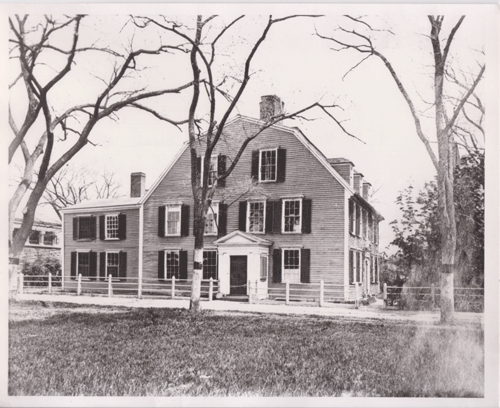
Pigeon bought a house and land in Newton in 1769, then 60 acres and another house in 1770, and the house shown above in 1773. It’s possible he was moving around, but he also had two young sons—Henry and John, Jr.—to set up eventually. So maybe those other properties were meant for them.

Newton had no Anglican church for the family. The Pigeons took in John Marrett (1741-1813), a 1763 graduate of Harvard College, probably as a tutor for those boys. After trying for other pulpits, Marrett was installed in 1773 at the Woburn parish that became Burlington. He was a Congregationalist, and it seems significant that John Pigeon, Jr., went to the Presbyterian college at Princeton in May 1773 rather than Harvard, which was closer and more welcoming for Anglicans.

In January 1774, Newton’s town meeting named John Pigeon to its new committee of correspondence, headed by Edward Durant. That September, Pigeon chaired the committee to instruct the town’s representatives to the Massachusetts General Court, including Durant. He joined those men in the first Massachusetts Provincial Congress the following month.

At the congress, one of Pigeon’s committee assignments was assessing the financial losses caused by the Boston Port Bill. His familiarity with Boston business suited him for that. On 29 October, he was also elected to the congress’s crucial committee of safety. Four days later, at that committee’s first meeting, he was chosen clerk. That put John Pigeon right in the middle of Massachusetts’s preparations for war.

TOMORROW: Pigeon as commissary.

Saturday, July 08, 2017

“The Road to Revolution in Newton,” 11 July

On Tuesday, 11 July, I’ll speak at the Newton Free Library on the topic “The Road to Revolution in Newton.”

This will be another talk based on The Road to Concord with a local twist:
In September 1774 the farmers of Middlesex County rose up and ended royal government in most of Massachusetts. For the next seven months, Patriot activists and the British governor raced to seize artillery. Cannon disappeared from ships, shore batteries and even armories under redcoat guard. In Newton, citizens voted to form their own artillery company. 
Over the next couple of days I’ll consider the rise and fall of the man who donated the cannon for that company, John Pigeon.

This talk is special to me since I grew up in Newton and live there now. In fact, I found the first intriguing tidbits of information about cannons being stolen from Boston armories under redcoat guard in the Newton Free Library’s fine regional history collection. (No matter that the accounts in nineteenth-century chronicles like The Hundred Boston Orators and Tea Leaves are riddled with misinformation it took me years to sort out.)

This event is co-sponsored by Historic Newton. It will start at 7:00 P.M. in the auditorium of the library at 330 Homer Street. There’s ample free parking, and I’ll have books to sell and sign.

Tuesday, December 22, 2015

Massachusetts Marriages in 1765

After reading about the idea that Massachusetts couples timed their marriages to avoid paying the Stamp Tax after 1 Nov 1765, I started to think about how to test whether that report was accurate.

I decided to go to Familysearch.org, the genealogy site built by the Latter-Day Saints, and run numbers there. Since the Boston Gazette item on couples marrying before the law took effect mentioned Marblehead, I asked to see all 1765 marriages in Marblehead in that database without regard for names. Then I asked for the same information about every other year in the 1760s. I recorded the number of listings that popped up each time.

That’s a crude way of estimating the number of marriages in each year. For one thing, each marriage is listed twice, once for the bride and once for the groom. The database is bound to have even more duplicates because of spelling oddities, couples hailing from different towns, and other factors. But I figure that the same problems affect every year of data about equally, so the relative numbers should be reliable. (Unless there’s some strange shift in the measurements I don’t know about.)

Then I mapped the numbers across the decade and graphed the results:

Gosh. Something strange sure happened in Marblehead in 1765. The number of listings was trending down from 1761, as young men started coming back from war and then the post-war economy set in. But listings made a big jump in 1765, and had a big tumble in 1766. That’s consistent with the idea that in mid-1765 couples planning to get married over the next eighteen months decided to do so sooner rather than later.

I then looked at the number of listings in a couple of other towns by the same method. In the smaller, inland town of Newton, there was a similar jump in listings in 1765, but it wasn’t quite as pronounced.

Out west in Springfield, the number of listings was only a little higher than the previous year and remained at the same level the next year.
Researchers who want to spend more than half an hour with the data could surely generate much more solid results and perhaps see trends. But based on this dip into the data, I’d say it looks like the Stamp Act really did affect Massachusetts couples’ marriage choices, at least within a day’s ride of Boston.

Friday, August 29, 2014

Looking for Samuel Adams’s Family

I’ve been writing about Samuel “Rat-trap” Adams, a well-known character in Boston who died in 1855. He was honored as a survivor of the Revolution, and he owned a red and white striped flag that he said had been flown from a pole on Essex Street beside Liberty Tree.

Adams’s 1855 death notices say he was ninety-six years old, implying he was born around 1759. But I haven‘t found a period record of his birth or baptism. Boston vital records were unfortunately spotty.

The New England Historical and Genealogical Register has published two items about “Rat-trap” Adams’s ancestry, both hearsay rather than original records, but at least they’re starting-points.

In the mid-1800s a man named John Haven Dexter wrote in a copy of the 1789 Boston directory beside the name of Samuel Adams, a “truckman” on “Elliot-street”: “the well-known Wire Worker, brother of Abraham—was the father of Mrs. Wm. Fenno, confectioner and keeper of a Hotel.—Died [blank]. He kept a wharf bottom Cross Street 1794.—Town Crier 1800.” The same directory listed Abraham Adams as a leather-dresser.

And shortly after Adams’s death the Register published a death notice that said: “Mr. Adams was a wire-worker by trade, and born at the North End, as we have heard from himself. His father (Benjamin) was of the Newbury family of Adams, and his mother was Abigail, dau. of Capt. Caleb Kendrick, of West Newton.”

Both Boston and Newton vital records show Benjamin Adams and Abigail Kenrick married in 1747. A 1753 mortgage to James Bowdoin identifies Benjamin Adams as a cordwainer, or shoemaker. The 11 Nov 1788 Massachusetts Gazette ran a death notice for Benjamin Adams, aged sixty-four (other papers said sixty-five), and said that the funeral would be from the home of his son Abraham Adams on Newbury Street. Abraham Adams was a leading leather-dresser in Boston at the end of that century, dying in 1806 at age fifty-six. So those two Register statements fit together with period sources.

Complicating matters, the Newton records also show a Benjamin Adams marrying Sarah Burridge (or Burrige or Burrage) in 1755. A Genealogical History of Robert Adams, of Newbury, published by a descendant in 1900, assumes that’s the same Benjamin Adams. That author concludes that Abigail died before 1755 and that Samuel’s mother was Sarah, his father’s second wife. Notably, that book also says “Rat-trap” Adams died in 1796, which we know is untrue, and that his children were born in Newbury rather than Boston. Weighing the evidence, it looks like two different men named Benjamin Adams came to Newton and married two different women eight years apart. As for that book’s statement that Samuel was born 7 June 1759, it would be nice to know the source since its other statements are so unreliable.

There’s a stone in the Copp’s Hill Burying Ground (shown above, courtesy of Find-a-Grave) memorializing Abigail and Eunice, wife and infant daughter of Benjamin Adams, who died 17 Jan 1764. That matches a town report of “Mrs. Adams” contracting smallpox. So was that Samuel’s mother, dying when he was four years old? The Register did say Adams claimed to have been born in the North End, where that burying-ground is.

The 1796 Boston directory lists Samuel Adams as a “truckman and lighterman”—someone in the business of moving goods, either in trucks or in small barges. That matches with his reported ownership of a wharf. By 1800 Samuel was listed as “town-crier” and living at “No. 71 Newbury Street.” Abraham was at number 72. There’s also a record of them doing a real-estate transaction together in 1798.

We do have records of:
  • Samuel Adams’s marriage to Catherine Fenno on 8 Mar 1781.
  • Catherine’s baptism at Old South on 6 Feb 1763, making her eighteen at her wedding.
In addition, the genealogy mentioned above lists their children as Benjamin Franklin (1782), Catherine (1783), Catherine Noyes (1785), Nancy (1787), John Fenno (1789), Samuel (1791), Elizabeth (1793), and Harriet (1796). Boston records show Catherine Noyes Adams married her cousin William Fenno in 1806.

Unfortunately, what I’m really looking for is a record of Samuel’s birth. Boston’s published town records and the Churches of Boston CD-ROM don’t contain any baptism or birth records for Benjamin Adams’s family.

As it is, we have only Samuel Adams’s own statements in the mid-1800s about how old he was. That number did creep up for some other survivors of the Revolution. George R. T. Hewes believed he was over one hundred when he revisited Boston, and he was still in his early nineties. Newspapers said Samuel Whittemore was ninety-nine when he died, and he was really ninety-six. A few years’ difference doesn’t mean much when you’re ninety, but it means a lot when you’re in your teens. Samuel Adams’s stories about being part of political meetings in pre-Revolutionary Boston would be hard to believe if he was only, say, eleven years old in 1773 instead of fourteen.

TOMORROW: Samuel Adams’s petition to the state.

Monday, August 19, 2013

Ceremony for Noah Wiswall of Newton, 7 Sept.

Noah Wiswall of Newton was born in 1699, but age didn’t stop him from turning out during the militia alarm on 19 Apr 1775. In his Life of the Rev. Joseph Grafton, Late Pastor of the First Baptist Church, Newton, MS. (1849), S. F. Smith recorded this tradition from a descendant:

After the companies of men, including his own sons, had gone towards Cambridge, he started on foot and alone to follow them, on the day of the battle of Lexington, saying, “I wish to see what the boys are doing.”

Standing with some Americans not far from the field, three British soldiers came in sight. He immediately pointed them out to his companions, saying, “if you aim at the middle one, you will hit one of the three.” The American did so and was successful; the other two fled.

But that which was remarkable is that as he held out his hand to point towards the Britons, a ball fired from some quarter passed directly through it. He coolly bound up the hand with his handkerchief, picked up the gun of the fallen regular, and returned home with it as a trophy.
Francis Jackson’s History of the Early Settlement of Newton, published five years later, quotes that anecdote and adds of Wiswall:
He was Selectman three years; one of the early Baptists in Newton, having been bap. 1754, and one of the founders of the Baptist Ch. in Newton, 1780. The first meetings of the Ch. were held at his dwelling house [near Crystal Lake]. He gave the land on which their first M. H. was erected. . . .

He was then [in 1775] 76 years old: It may seem incredible that a man of his years could have performed the march and endured the fatigues of that day, but the roll of the East Newton company, in the battle of Lexington, now in the office of the Sec. of State, of Mass., and sworn to by the Capt. of that company, before Judge Fuller, shows that he was with the company, and not only he, but Ebenezer Parker, then 78 years old, and Dea. Jonas Stone, Dea. David Stone, Dea. William Bowles, and several other aged men, were volunteers in the ranks of the company on that day.
Wiswall was the only Newton man whom the Massachusetts Provincial Congress listed as wounded on the first day of the war. He survived the whole war and died in 1786.

On 7 September, there will be a ceremony at the Wiswall Tomb in Newton’s South Burying Ground on Winchester Street. This is meant to honor Wiswall and disabled American veterans (though I don’t see anything in the traditions to suggest that Wiswall considered himself disabled by his wound). The event is open to the public, and Gardner’s Regiment of reenactors will be among the honor guards.

Tuesday, May 21, 2013

Maps of the 1700s at the Boston Public Library

The Norman B. Leventhal Map Center at the Boston Public Library is hosting an exhibit titled “Charting an Empire: The Atlantic Neptune in two parts this year. As the exhibit explains:

The period following the French and Indian War (1754-1763) was a time of change and discovery in North America. In this display of charts, views, and maritime objects, we look at the decade following the war, when Britain set out to accurately chart the coast and survey the inland areas of their new resource-rich empire in Atlantic Canada, as well as the eastern seaboard extending from New England to the West Indies. The resulting charts were published collectively by Joseph Frederick Wallet Des Barres in The Atlantic Neptune, a maritime atlas which set the standard for nautical charting for nearly half a century.
Through 28 July, the map center will exhibit Des Barres’s maps and charts of Atlantic Canada. From August through 3 November it will exhibit the pages on the eastern seaboard of what became the U.S. of A.

Connected to that exhibit, this evening, 21 May, at 5:30 P.M., the map center hosts a lecture on “Mapping the Revolutionary War in Virginia” by William Wooldridge. This event was organized by the Boston Map Society and takes place in the library’s Glass Orientation Room. Wooldridge will also sign copies of his book Mapping Virginia, from the Age of Exploration to the Civil War. The library asks people to reserve a seat by emailing maps@bpl.org.

If that’s not enough maps, Historic Newton is hosting an exhibit called “Mapping a New Town: 1714-1874” at its Jackson Homestead and Museum. For more information, visit Historic Newton.

Monday, February 25, 2013

Visiting the Durant-Kenrick House on Film, 28 Feb.

On Thursday, 28 February, at 7:00 P.M., Historic Newton and the Newton Free Library are sponsoring a free showing of the documentary “The Durant-Kenrick Homestead: A House of Many Stories.” The event description says:
Built in 1734 and continuously occupied for nearly 275 years, the Durant-Kenrick House is Newton’s connection to many of the pivotal events of American history. This new documentary by award-winning historical documentarian Joe Hunter tells the story of the house and its occupants. Through the stories of the house’s residents, we wrestle with the fundamental questions they spent their lives answering: What is liberty? What is our responsibility to defend it? Who is a citizen?

Following the showing, Historic Newton Director Cindy Stone and other project representatives will offer more insight into the history of the house and discuss its current transformation into an educational center.
I wrote about the history of this house back in April 2012. It seems significant not because what happened there affected lots of other people but because its “many stories” reflect important trends and shifts in early American life. The movie will be shown at the Newton library, at the corner of Homer and Walnut Streets.

Saturday, April 07, 2012

Howe Explores the Durant-Kenrick House in Newton, 12 Apr.

On Thursday, 12 April, Historic Newton will sponsor a free lecture by Jeffery Howe, Professor of Fine Arts at Boston College, about the city’s Durant-Kenrick House. Howe created this digital archive of American architecture that I’ve periodically dived into.

The Durant-Kenrick House was built in 1732 by a blacksmith and merchant named Edward Durant (1695-1740), who moved out from Boston with his family and enslaved servants to enjoy the life of a country gentleman. Howe’s talk, titled “A New Refinement: the Durant-Kenrick House in the Context of Colonial Housing,” will examine it as a sign of domestic trends:

At its construction in 1734, the Durant-Kenrick house represented an important new stage in the evolution of colonial architecture, falling between the simplicity of 17th-century building and the social aspirations of later Georgian mansions.
During the Revolutionary War the house was the home of the merchant’s son, also named Edward Durant (1715–1782). He was a Harvard graduate and local political leader, moderating Newton town meetings and serving as selectman and legislator. Durant’s son Thomas was a militia lieutenant in 1775, and his son Edward became a doctor, serving as a regimental surgeon and dying on a privateer.

Edward Durant also provided space in his house for a grammar school in the early 1760s. Old Massachusetts law required towns of a certain size to have such a school to prepare boys for careers in the ministry, but rural towns usually tried to avoid the expense of an extra building for only a few scholars.

All that said, the site’s major importance came in the early republic after it passed to the Kenrick family, who developed the largest nursery in New England. The Kenricks supplied American estate owners with fruit trees, ornamental trees, and flowering plants, and eventually currants and currant wine.

The Fiske Center for Archaeological Research at the University of Massachusetts–Boston has been excavating the Durant-Kenrick site, with periodic reports. Carl M. Cohen has also tracked activity at the house since its owners donated it Historic Newton (a city agency) in 2010.

Howe’s talk will begin at 7:00 P.M. in the Newton Free Library’s auditorium. It’s free and open to the public.

Tuesday, January 31, 2012

Benjamin Carp on Revolutionary Networking in Newton, 13 Feb.

On Monday, 13 February, at 7:00 P.M., Prof. Benjamin Carp of Tufts will speak on “‘Our United Sentiments’: Boston, Newton, and the Cause of Liberty” at the Newton Free Library. The library’s description:
Boston is famous as the vanguard of the American Revolution—but the Revolution would have been impossible without the men and women of rural Massachusetts. This talk explores the revolutionary network that linked Boston and its neighbors, including Newton. The leaders of the resistance against Great Britain made a massive effort to galvanize Massachusetts. The Durant family and their community offer a window into the inner workings of the Revolution.
This talk is free and open to the public.

I like how that description treats Newton as a typical example among rural towns rather than trying to make a case that it was special. Every so often Boston 1775 has taken issue with a Massachusetts town’s claims of unusual Revolutionary significance, whether it’s having a large militia contingent or hoisting a rare flag or being the resting-place of Benedict Arnold’s widow.

All those towns participated in the Revolutionary movement, to be sure. Some did have distinctions. But too often local authors haven’t realized or acknowledged how many towns reacted to British imperial policy in much the same way. It was that rural solidarity which made the movement so powerful.

(The handsome image of the stairwell in the Newton Free Library above comes from Elisif Photography, specializing in architectural images.)

Monday, November 28, 2011

Dig at the Durant-Kendrick Homestead

Yesterday’s Boston Globe included a regional story on an archeological dig in Newton, at the Durant-Kendrick Homestead.

I’d never heard of this site. Growing up in Newton, as my friend Jack Riccardi has said, means you learn on school field trips that the Jackson Homestead is the center of U.S. history, perhaps followed by Independence Hall and the White House. But Historic Newton, guardian of the Jackson Homestead, also spearheaded the study of the Durant-Kendrick site.

Of the main house there, the Globe states:
The circa-1730s structure is endowed with centuries of history.

For starters, Edward Durant III - whose father built the house, which originally sat on 97 acres along with several outbuildings and barns - was involved in numerous town committees that responded to national issues when the Colonies were on the verge of the Revolutionary War, according to the research of independent scholar Mary Fuhrer.

The Kenrick family, who took over ownership in 1790, operated the largest plant nursery in New England from the site, according to [Historic Newton director Cynthia S.] Stone. They had around 200 species of pear trees, and varieties of apples, flowers, berries, and ornamental trees. They sold plants to people throughout the country, changing the landscape of the United States, Stone said. . . .

Throughout this process, their biggest discovery was the sunken dairy, with its brick floors and walls. It was likely used in the late 18th or early 19th century for processing milk into butter or cheese, Beranek said, then was filled in during the 1850s with construction rubble and trash.
The project is headed by Christa M. Beranek of the Fiske Center for Archaeological Research at the University of Massachusetts, Boston. The artifacts are now being analyzed, and there are plans for a report and an exhibit at Historic Newton.

I find that Edward Durant’s floor stencils from around 1780 have inspired some modern decorating products.

Sunday, September 18, 2011

Exploring Colonial Nonantum Hill, 25 September

On Sunday, 25 September, Historic Newton is offering a tour exploring the colonial and Revolutionary history of the city’s Newton Corner village. (As folks around here know, Newton is divided into innumerable villages, each with its own ZIP code, character, and one-hour dry cleaner. Except Waban, which has a two-hour dry cleaner.)

The agency’s description says:
Colonial Nonantum Hill: “Praying Indians” and Revolutionaries: Come explore Newton Corner’s Colonial history with Historic Newton staff members Sarah Cole and Jennifer Hance as they lead a trip back in time to 17th and 18th centuries. Discover the complicated history of John Eliot’s “praying Indian” settlement and hear about Newton families who participated in the birth of their new nation.
The event begins at 2:00 P.M. at the Durant-Kenrick House (shown above), 286 Waverly Avenue, and is scheduled to last three hours. It is free to all.