J. L. BELL is a Massachusetts writer who specializes in (among other things) the start of the American Revolution in and around Boston. He is particularly interested in the experiences of children in 1765-75. He has published scholarly papers and popular articles for both children and adults. He was consultant for an episode of History Detectives, and contributed to a display at Minute Man National Historic Park.

Subscribe thru Follow.it


•••••••••••••••••


Showing posts with label Richard Dana. Show all posts

Sunday, January 28, 2024

“An ancedote of a hair’s breath escape” from George R. T. Hewes

It’s not that surprising that the two books based on the memories of George Robert Twelves Hewes, A Retrospect of the Boston Tea-Party (1834) and Traits of the Tea Party (1835), contain anecdote after anecdote placing Hewes at major events in pre-Revolutionary Boston.

After all, people’s memoirs often play up their role in history or their knowledge of events.

What’s remarkable about the Hewes books is that contemporaneous documents often bear out the little shoemaker’s memories. Details he recalled six decades later turn out to be consistent with the records of the time.

For both those books Hewes described how he had gotten into an argument with a Customs officer and suffered an injury, prompting his fellow Bostonians to attack that man. He had his own riot in pre-Revolutionary Boston!

Yet, as the account from the Massachusetts Spy shows, that’s exactly what happened on 25 Jan 1774. Hewes’s memories weren’t fully accurate—for example, he recalled this confrontation happening before the Boston Tea Party instead of six weeks after it. But they’re impressivelt consistent.

Here’s how James T. Hawke recorded Hewes’s memory in A Retrospect of the Boston Tea-Party:
One day, said he, as I was returning from dinner, I met a man by the name of John Malcom, who was a custom-house officer, and a small boy, pushing his sled along, before him; and just as I was passing the boy, he said to Malcom, what, sir, did you throw my chips into the snow for, yesterday?

Upon which Malcom angrily replied, do you speak to me, you rascal; and, as he raised a cane he had in his hand, aiming it at the head of the boy, I spoke to Malcom, and said to him, you are not about to strike that boy with your cudgel, you may kill him; upon my saying that, he was suddenly diverted from the boy, and turning upon me, says, you d——d rascal, do you presume too, to speak to me?

I replied to him, I am no rascal, sir, be it known to you; whereupon he struck me across the head with his cane, and knocked me down, and by the blow cut a hole in my hat two inches in length.

At this moment, one Captain [Isaac?] Godfry came up, and raising me up, asked who had struck me; Malcom, replied the by standers, while he, for fear of the displeasure of the populace, ran to his house, and shut himself up.

The people, many of whom were soon collected around me, advised me to go immediately to Doctor [Joseph] Warren, and get him to dress my wound, which I did without delay; and the doctor, after [he] dressed it, observed to me, it can be considered no misfortune that I had a thick skull, for had not yours been very strong, said he, it would have been broke; you have come within a hair’s breath of loosing your life.

He then advised me to go to Mr. [Edmund] Quincy, a magistrate, and get a warrant, for the purpose of arresting Malcom, which I did, and carried it immediately to a constable, by the name of Justine Hale [sic], and delivered it to him, to serve, but when he came to the house where Malcom was locked up, it was surrounded by such a multitude he could not serve it.

The people, however, soon broke open the door, and took Malcom into their custody. They then took him to the place where the massacre was committed, and their flogged him with thirty-nine stripes. After which, they besmeared him thoroughly with tar and feathers; they then whipped him through the town, till they arrived at the gallows, on the neck, where they gave him thirty-nine stripes more, and then, after putting one end of a rope about his neck, and throwing the other end over the gallows, told him to remember that he had come within one of being hanged. They then took him back to the house from whence they had taken him, and discharged him from their custody.

The severity of the flogging they had given him, together with the cold coat of tar with which they had invested him, had such a benumbing effect upon his health, that it required considerable effort to restore his usual circulation. During the process of his chastisement, the deleterious effect of the frost, it being a cold season, generated a morbid affection upon the prominent parts of his face, especially upon his chin, which caused a separation and peeling off of some fragments of loose skin and flesh, which, with a portion of the tar and feathers, which adhered to him, he preserved in a box, and soon after carried with him to England, as the testimonials of his sufferings in the cause of his country.

On his arrival in England soon after this catastrophe Malcom obtained an annual pension of fifty pounds, but lived only two years after to enjoy it.

On relating this adventure, the very excitement which the affront must have wrought upon him, evidently began to rekindle, and he remarked with emphasis, I shall carry to my grave the scar which the wound Malcom gave me left on my head; and passing my finger over the spot to which he directed it, there was obviously such a scar, as must have been occasioned by the wound he had described.
Hewes’s knowledge was of course more accurate about his own experiences than other details. Malcolm was awarded a sinecure but not a pension, and he lived many more than two years.

A year after that first book, Hewes sat for more interviews with the Bostonian journalist Benjamin Bussey Thatcher, and those conversations produced this version:
John [Malcom]…lived (says Mr. Hewes) at the head of Cross Street, where he worked in some capacity for a man by the name of Scott, when one day, as Hewes was returning from dinner to his shop, (for he continued at hard work all this time—as industrious and as impartial as ever,) he met Malcom at the mouth of the street.

He was engaged in an altercation with a boy who was dragging a hand-sled before him—the snow being a foot deep, or more, on the ground. The lad complained of his having turned over his chips, the day before, into the snow, and wanted to know what good that could do him.

“Do you talk to me in that style, you rascal!” said Malcom; and he was raising his cane, to give emphasis to his answer, over the boy’s head, just as Hewes came up. The latter was unarmed, and small, but it was no way of his, cost what it might, to see foul play. He stepped up to Malcom without ceremony, and warned him not to strike the lad with that cudgel. Malcom, in a rage already, now left his smaller game, and fronted Hewes:

”And do you presume to insult me, too, you scoundrel!—what have you to do with it?”

“I am no scoundrel, Sir,” said Hewes,—“and be it known to you”—

Malcom, at this, levelled a blow with his cane, which struck Hewes over the top of his head, cutting a hole two inches long through his hat, and brought him to the ground.

One Captain Godfrey came up at this moment, and helped him to rise. There was a bad wound on his temples, and the blood ran down his face in streams. “Who did this?” cried Godfrey, in a voice of thunder.

Hewes was known for a good Son of Liberty, as well as Malcom was for a Tory, and the by-standers, who were fast gathering by this time, quickly interfered. Malcom contrived to get a weapon into his hand and keep them at bay, till he could flee to is house, where he fastened himself in.

Hewes, meanwhile, had gone to Dr. Warren (Joseph) [footnote: in Orange-Tree Lane.] who was a relative (his grandmother’s sister’s son) and an old acquaintance of his; and the Doctor, after dressing his head, had advised him to get a warrant out against Malcom. He got one, accordingly, of Justice [Richard] Dana.

Constable Hale undertook to execute it. He found the house surrounded by a crowd of people. Malcom, from his back window, begged him to let him alone till morning, as he was afraid they would tear him to pieces, if he ventured out. He concluded to do so, and Hewes went away with him.

This, probably, only made the matter worse. The people became more furious, while Malcom, on the other hand, armed himself to the teeth, with sword, pistols, and broad-axe, took possession of the upper story, and threatened destruction to the first person who trespassed on the premises.

An acquaintance of his got in at the back-door, at length, by deceiving his wife, by a stratagem induced him to put his weapons by, seized him by the back in that condition, and hallooed to the people, who stood waiting to help him, which they did with a relish. They got a horse-cart, and lowered him out of the window by ropes into that.
This detail about the window appeared in the 27 January Boston News-Letter, but that newspaper retracted it the next week. According to Hewes, he had left the scene by that time. So either he heard a rumor of Malcolm being lowered out a window or read it in a newspaper, or Thatcher found the detail in the newspaper or some report based on it and inserted it into the book.
They called for feathers, and two pillow-cases-full were shortly produced—probably from Malcom’s own stores. They started for Henchman’s Wharf, and there took in a quantity of tar, the purpose of which…was soon explained by their stripping poor Malcom naked above the breast, and plastering over his upper extremities.

Thence they carted him to Butcher’s Hall [i.e., the Customs house]; thence to Shubael Hewess,’ who kept a butcher’s-market at that period on the Main Street, in a wooden house near the Old South Church, with a jutting upper story, which still stands there (and was pointed out by our veteran, on his last visit to the city.)

Here, as in King Street, a flagellation was tried. Then, they drove to Liberty-Tree—to the gallows on the Neck—back to the Tree—to Butcher’s Hall again—to Charlestown ferry—to Copp’s Hill,—flogging the miserable wretch at every one of these places, if not some more—a fact which the papers of the day overlook, for obvious reasons, though the Gazette acknowledges that he was “bruised” in such a manner “that his life is despaired of.”

Hewes states that when they left him at the door of his own house, after a four-hours’ torture, the poor creature was almost frozen, and was rolled out of the cart like a log. Dr. [Silvester] Gardiner, who met Hewes soon after, told him that it took three days to get his blood into circulation again; adding, in the same breath, the consolatory compliment, that he, as the cause of it, would infallibly be hanged, and ought to be.

The Doctor…was doubtless ignorant of one or two things which it is but justice to his patient to mention. Hewes could not be blamed, certainly, for complaining to the Justice and taking the warrant, had he done it at his own suggestion, instead of Dr. Warren’s, or any body’s else. The assault was unprovoked and outrageous; and the wound so serious that the indentation it made in his skull is as plainly perceptible to this moment as it was sixty years ago. Indeed, as the Doctor told him when he dressed it, it was within one of his life. “Cousin Hewes,” said he, good-humoredly, “you are the luckiest man I know of, to have such a skull—nothing else could have saved you;” and nothing else did. It was the narrowest of all his dodgings of death.

Nor was he accessory in any way to the disgraceful treatment which Malcom received; so far from it, that when he first heard of his miserable situation, his instant impulse was to push after the procession as fast as he could, with a blanket to put over his shoulders. He overtook them at his brother’s house and made an effort to relieve him; but the ruffians who now had the charge of him about the cart, pushed him aside, and warned him to keep off.

Malcom recovered from his wounds, and went about as usual. “How do you do, Mr. Malcom?” said Hewes, very civilly, the next time he met him. “Your humble servant, Mr. George Robert Twelves Hewes,” quoth he—touching his hat genteelly as he passed by. “Thank ye,” thought Hewes, “and I am glad you have learned better manners at last.”

Nor was that the only benefit which accrued to this unfortunate politician. The frost caused an affection which caused a considerable portion of the skin to peel off. This, with a quantity of the Tar and feathers that adhered to him, it is understood he carefully preserved, boxed up, and carried with him to England, as a testimonial of his sacrifices for the royal cause.
Hewes’s memory appears to be the only source for the statement that Malcolm preserved samples of his own skin (though Ann Hulton did write that “They say his flesh comes off his back in Stakes [steaks]”). Again, it’s not clear how Hewes would know that as a fact without any other record of it surviving. But authors love to include it.

Again, on details of his own experience, Hewes could be remarkably reliable. For example, there’s the constable he summoned to serve a writ on Malcolm, noted as “Constable Hale” and “Justine Hale” (which historian Alfred F. Young guessed was a typo for “Justice Hale”). Among the men the Boston town meeting elected as constables in 1773 was Augustus Hail.

Friday, May 15, 2020

Another Boston Town Meeting, “all in very good order”

On 15 May 1770, 250 years ago today, Bostonians convened in Faneuil Hall for another town meeting session.

That gathering was meant to finish up some business from the week before, as discussed starting here, and the year before.

The first order of business was to hear from the school committee. At this time Boston didn’t have a regularly elected or appointed school committee. Instead, the seven selectmen invited a long list of leading gentlemen to accompany them as they visited the town’s five schools in early July, at the end of the regular school year.

In 1769 the committee included eight members of the Council, the four General Court representatives, the twelve Overseers of the Poor, ten ministers, and twenty-four other men, as shown here.

That committee probably watched the grammar school boys recite in Latin and/or Greek and observed the writing school boys’ handwriting samples. I don’t know whether all fifty-odd gentlemen went to each school or whether they broke out into teams.

That committee reported back to the town at this May meeting—ten months later, and a week after the town had approved the schoolmasters’ salaries. They told the citizens at Faneuil Hall that the gentlemen had
found the South Grammar School had 142 Scholars; the North Grammar School 60 Scholars; the South Writing School 203 Scholars; the North Writing School 253 Scholars; the Writing School in Queen Street 251 Scholars; all in very good order.
As I discussed back here, the system educated slightly over 200 grammar-school boys and more than 700 writing-school boys, but the town paid the masters of the grammar schools significantly more.

The town meeting then moved on to financial matters. A committee reported on its review of town treasurer David Jeffries’s accounts. Another committee reported on the accounts of the Overseers of the Poor. The meeting voted to raise £4,000 for poor relief in the coming year—a major expenditure, but not as large as in other years.

Then the big guns came out. The committee to instruct the town’s newly elected representatives to the Massachusetts General Court delivered its report of what issues those politicians should raise with the royal governor. Although the first man named to that committee was justice Richard Dana, a manuscript of its report survives in the handwriting of member Josiah Quincy, Jr., indicating that the young lawyer drafted the report. That was just weeks after Quincy had defended Ebenezer Richardson, and he was on the defense team for the Boston Massacre trials as well.

The document started by saying there was “great reason to believe, that a Deep laid & desperate plan of Imperial despotism has been laid, and partly executed, for the extinction of all civil liberty.” More specifically, the problems were “holding the General Court at Harvard College” (an ongoing that merited several long paragraphs of precedents and argument), “The despicable situation of our provincial militia,” and “the unwarrantable practise of ministerial instructions to the Commanders in Chief of this Province.”

As solutions, the committee sought measures “to increase population, incourage industry and promote our own manufactures”; a “firm and lasting union of the Colonies”; and an “endeavor to revive the antient method of appointing the Attorney General,” presumably not leaving that choice up to the royal governor.

The town meeting unanimously approved that lengthy report and asked that it be printed in the newspapers, confirming that it was a document for public consumption.

Finally, one of the Overseers of the Poor elected in March, Thomas Tyler, had died. This meeting quickly elected Samuel Abbott as a replacement. Then the citizens adjourned, thinking that they had done all the work they needed for a long while.

Saturday, May 09, 2020

“Strict adherance to the design of the Townˇ

At 3:00 P.M. on 8 May 1770, after their midday dinners, the white, propertied men of Boston returned to Faneuil Hall to resume their town meeting.

Having elected their representatives to the Massachusetts General Court, they named a committee to write instructions for those gentlemen. Such instructions had become a useful way for the Whigs to make political statements about the big issues of the day.

The first man named to that committee was Richard Dana. Traditionally that made him the committee head and the principal author of its report. Dana was a magistrate respected for his legal knowledge, suggesting that the meeting expected such issues to arise in the upcoming legislature.

The other committee members were attorney Josiah Quincy, Jr.Dr. Joseph Warren; selectman Joshua Henshaw; and attorney Benjamin Kent. It’s notable that Quincy had just represented Ebenezer Richardson at his murder trial, yet the town still felt he was worthy of the public trust.

Another item on the agenda involved the Short Narrative of the Horrid Massacre. The committee who had written that report on the Boston Massacre, including newly returned representative James Bowdoin and Dr. Warren, “presented an Appendix to said Narrative.” That was the collection of depositions the authors had used as evidence, starting here.

The town meeting officially “accepted” that appendix. Which avoided hassle because those depositions had already printed with the report and sent off to sympathetic figures in Britain, and William Molineux had mailed a copy to special prosecutor Robert Treat Paine.

The men then voted “that the Thanks of the Town be and hereby are given to said Committee for their strict adherance to the design of the Town in their appointment; and for their perfecting the Business in so correct and masterly a manner.”

The meeting also discussed two property issues. Several inhabitants had asked “that the Selectmen may be empowered to make sale of several pieces of unimproved Land.” And Jacob Emmons asked “that the Town would make him satisfaction for the damage he has or may sustain by the taking away of his Lands in Paddys Alley for the enlarging of a Street.”

The voters took different approaches to these problems. On the first, they named a committee to handle the matter, as usual. On the second, they decided Emmons hadn’t followed proper procedure and gave him “leave to withdraw his Petition”—meaning a definite no.

TOMORROW: The schoolmasters’ salaries.

Monday, March 30, 2020

Capt. Preston and the Town of Boston

On Monday, 12 Mar 1770, one week after the Boston Massacre, the Boston Gazette ran this letter:
Boston-Goal, Monday, 12th March, 1770.

Messieurs Edes & Gill,

PERMIT me thro’ the Channel of your paper, to return my Thanks in the most publick Manner to the Inhabitants in general of this Town—who throwing aside all Party and Prejudice, have with the utmost Humanity and Freedom stept forth Advocates for Truth, in Defence of my injured Innocence, in the late unhappy Affair that happened on Monday Night last: And to assure them, that I shall ever have the highest Sense of the Justice they have done me, which will be ever gratefully remembered, by

Their most obliged and most obedient humble Servant,

THOMAS PRESTON.
Preston was of course the army captain jailed after the Massacre.

In the initial coroners’ inquests and newspaper reports, some witnesses declared that they hadn’t seen Preston give a clear order to his men to fire, or that many other people in the crush on King Street were yelling the word “Fire!” Some added that Preston definitely stopped the soldiers from firing a second time by knocking their muskets up.

Other witnesses, to be sure, said that they had heard and seen Preston give the order to fire. The prints soon to be published by Henry Pelham and Paul Revere depict that. The legal case against Preston was based on that testimony.

By writing this letter, Preston sought to keep the first group of witnesses on his side, to ensure the populace understood his guilt was not clear, and perhaps to break down the stark division between army and civilians. By running the letter, printers Edes and Gill were pleased to show how Preston recognized Boston as a fair-minded town.

Hovering over Preston’s head was the historical memory of John Porteous, a captain of the Edinburgh City Guard who was convicted in 1736 of ordering soldiers to fire at a riotous crowd, killing several people. When it became clear that the royal government planned to reprieve him, a local mob broke into the jail and lynched Porteous, as depicted above.

Preston of course didn’t want that to happen to him. The Boston Whigs didn’t want that to happen, either. They wanted to show the rest of the British Empire that their town was peaceful and law-abiding when not flooded with troops. Providing Preston with a fair trial was the way to do that. The captain’s public thanks to “the Inhabitants in general of this Town” seemed to endorse their position.

The Whigs didn’t know that two days later Preston completed a much longer piece of writing, eventually published under the title of the “CASE of Capt. Thomas Preston of the 29th Regiment.”

It portrayed Boston in a very different light:
IT is Matter of too great Notoriety to need any Proofs, that the Arrival of his Majesty’s Troops in Boston was extremely obnoxious to it’s Inhabitants. They have ever used all Means in their Power to weaken the Regiments, and to bring them into Contempt, by promoting and aiding Desertions, and with Impunity, even where there has been the clearest Evidence of the Fact, and by grossly and falsly propagating Untruths concerning them.

On the Arrival of the 64th & 65th, their Ardour seemingly began to abate; it being too expensive to buy off so many; and Attempts of that Kind rendered too dangerous from the Numbers.—But the same Spirit revived immediately on it’s being known that those Regiments were ordered for Halifax, and hath ever since their Departure been breaking out with greater Violence.

After their Embarkation, one of their Justices, not thoroughly acquainted with the People and their Intentions, on the Trial of the 14th Regiment, openly and publicly, in the Hearing of great Numbers of People, and from the Seat of Justice, declared, “that the Soldiers must now take Care of themselves, nor trust too much to their Arms, for they were but a Handful; that the Inhabitants carried Weapons concealed under their Cloaths, and would destroy them in a Moment if they pleased.”
Lt. Alexander Ross reported hearing justice of the peace Richard Dana give such a warning.
This, considering the malicious Temper of the People, was an alarming Circumstance to the Soldiery. Since which several Disputes have happened between the Towns-People and Soldiers of both Regiments, the former being encouraged thereto by the Countenance of even some of the Magistrates, and by the Protection of all the Party against Government. . . .

The Insolence, as well as utter Hatred of the Inhabitants to the Troops, increased daily; insomuch, that Monday and Tuesday, the 5th and 6th instant, were privately agreed on for a general Engagement; in Consequence of which several of the Militia came from the Country, armed to join their Friends, menacing to destroy any who should oppose them. This Plan has since been discovered.
Preston thus suggested a conspiracy theory to rival the Whigs’ suspicions about the Customs Commissioners with a whiff of treason stirred in.

The “Case” the captain was making appears to be for a royal pardon to rescue him and his men from an unjust death sentence in a hostile province:
And this must be the fate of all the unhappy Soldiers confined with me. In short with such Jurors and Witnesses we have nothing better to expect than to be sacrifyc’d as a terror to all others who would oppose the people, however wrong. . . . The Commanding Officer with the Officers of both the two Corps and every other dispassionate man here have approved of my conduct and hope it will also deserve the attention of His Majesty.
Capt. Preston’s essay was one of the documents that Customs Commissioner John Robinson was carrying to Britain in late March 1770, 250 years ago. Convinced by Preston’s letter that he felt locals were treating him fairly, the Boston Whigs had no idea of his range of feelings about their town.

Monday, March 23, 2020

The Superior Court “Overawed”

Even as the royal army and the town of Boston took steps to respond to the Boston Massacre in March 1770, a third institution was moving, albeit more slowly: the Massachusetts court system.

Under the provincial charter, governors appointed the judges in consultation with their Council. Judges served as long as they wanted. That meant the judiciary leaned toward the establishment and the Crown.

In fact, the Chief Justice of the Massachusetts Superior Court was still Thomas Hutchinson, the acting royal governor. He had stopped exercising that judicial role, however, so the acting chief was Benjamin Lynde of Salem (1700-1781, shown here).

The court was scheduled to start sitting in Boston on 20 Mar 1770, but Judge Lynde’s diary shows that he didn’t arrive (with his enslaved servant Primus) until the following afternoon. Then on 22 March, “Two of the Judges being sick, the Court came to a Determination to adjourn to the 2d. Tuesday in June,” according to a report to Crown officials.

The Boston Whigs had anticipated that possibility. As I noted back here, the town meeting had already discussed now judges falling ill would delay the murder trials of Ebenezer Richardson and the soldiers involved in the Massacre. They didn’t want that.

On 22 March or the next day, some of the town’s leading Whigs went to the courthouse. The informant stated:
a committe consisting of Ad[am]s Mol[ineu]x, War[re]n H[ancoc]k & others waited upon them in court, and in a very pathetic Speech, made by Mr. A---s, Represented the necessity of proceeding to the trial of the Criminals this Term, particularly those concerned in the late bloody Massacre. . . .

Numbers even of the Sons of L----y were shocked to see their Sup-----r C---t overawed and insulted in this manner.
The Superior Court remained in session, but it did business slowly, starting with the civil cases.

Also on 23 March, or 250 years ago today, Boston Whigs revived the case against Customs officer Edward Manwaring for shooting at the crowd during the Massacre. As I’ve been tracing, that case rested on the testiomony of Manwaring’s young French servant, Charles Bourgate.

Charles had told his story to a shopkeeper on 6 March, then denied it to a magistrate, then retold it to that magistrate, was then refuted by an alibi witness named John Munro, then accused Munro of being complicit, and was finally refuted by a second alibi witness. Since his first testimony, Charles had been in the Boston jail, either for perjury or for his own protection—the courts would sort out which.

According to Lt. Gov. Hutchinson:
Mr. [Richard] Dana, a Justice zealous for the cause of Liberty, had examined the boy and was so fully convinced of the falsity of his evidence that he would not issue a warrant for apprehending the persons charged. . . . Among other reasons given for the refusal of the Justice to issue his warrant it was said that the facts to which the boy swore were of such a nature that it was impossible they should have escaped the observation of the great number of other persons present
More radical Boston Whigs disagreed. They had a handful of witnesses ready to testify they’d observed shots come from the second floor of the Customs House during the Massacre, just as Charles claimed.

On 23 March, magistrates John Hill and John Ruddock took down the French boy’s sworn story, presumably in the jail. Also present to attest to the boy’s mark were Dr. Elisha Story, Ruddock’s son-in-law, and Edward Crafts, brother of coroner Thomas Crafts. All those men were strong Whigs.

The justices duly recorded that “Edward Manwaring, Esq; and John Munroe…were notified and present; and interrogated the deponent.” But the boy stuck to his tale.

This deposition would go into the town’s Short Narrative of the Horrid Massacre report. It would also go to the grand jury, which didn’t need warrants or judges to indict people and put them in jail.

Sunday, March 15, 2020

“Both he and the boy were at Home that Evening”

An anonymous letter now part of the Sparks Manuscripts at Harvard relates what happened when Justice Richard Dana (shown here) gave Customs surveyor Edward Manwaring a chance to respond to his young servant Charles Bourgate’s accusation.

That letter says:
a little French boy servant to Manwarring the tide Surveyor, declared that he at the Desire of his Master, and several other Gentlemen, who were that night in the board room, fired three guns from one of the windows & that a number more, were fired by other people——

Manwarring was Immediately summon’d before them, but on his proving by the evidence of Mr. [John] Munro that both he and the boy were at Home that Evening, he was acquitted, & the boy retracting every word he had said was committed to Jail—
Munro was a notary public. He died in January 1775 at age thirty-nine, so he didn’t get to be on any Loyalist lists.

Young Charles had another trick up his sleeve the next morning, though.
day on the boys declaring [i.e., One day on, the boy declaring] that both Manwarring & Munro were that night at the Custom House, both were Summon’d before the Justices & Munro’s affadavit set aside, he being now a party—
Munro couldn’t be an alibi witness for Manwaring because they were allegedly in on the crime together. But then Manwaring pulled out another name.
but a third person who happened to be that Evening in company with them, appear’d & Confirmed, what Munro had the day before advanced, & they were dismissed and the boy remanded back to prison.—
I’ll share that witness’s testimony tomorrow.

For now, we leave young Charles Bourgate back where we picked up his story yesterday: he was in jail and discredited. Lt. Gov. Thomas Hutchinson wrote:
Mr. Dana, a Justice zealous for the cause of Liberty, had examined the boy and was so fully convinced of the falsity of his evidence that he would not issue a warrant for apprehending the persons charged.
Manwaring was free, and he set about writing to the Boston Gazette.

TOMORROW: Michael Angelo Warwell?

“The flashes of two guns fired from the Custom-house”

Soon after Charles Bourgate reaffirmed his earlier story of being made to shoot down at the crowd during the Boston Massacre, the Boston Whigs (William Molineux in particular) got the young servant in front of a magistrate.

This time that magistrate was Richard Dana, a higher authority than Edmund Quincy, the official who had collected Bourgate’s testimony. Quincy was merely a justice of the peace. Dana was a justice of the peace and of the quorum, which I think means that some level of the county court couldn’t meet without him.

The notion that one or more people shot at the crowd from the Customs House behind the soldiers actually had some support. A young gentleman named Jeremiah Allen stated that he was on the balcony of Joseph Ingersoll’s Bunch of Grapes tavern (shown above) during the incident.
he heard the discharge of four or five guns, the flashes of which appeared to be to the westward of the centry box; and immediately after, he the deponent heard two or three more guns, and saw the flashes thereof from out of the house now called the Custom-House, as they evidently appeared to him, and which he the said deponent at the same time declared to the aforesaid Molineux and [John] Simpson, being then near him, saying to them, at the same time pointing his hand toward the Custom-House, there they are out of the Custom-House.
The “aforesaid Molineux” was William Molineux, Jr., son of the Whig leader. He no doubt passed Allen’s story on to his dad, who then went looking for confirmation.

Other witnesses would soon tell even more damning stories. Those later quoted in the town’s report were:
  • George Coster, sailor from Newfoundland: “the deponent heard the discharge of four or five guns more, by the soldiers; immediately after which the deponent heard the discharge of two guns or pistols from an open window of the middle story of the Custom-house, near to the place where the sentry box was placed, and being but a small distance from the window, he heard the people from within speak and laugh, and soon after he saw the casement lowered down”
  • Cato, enslaved servant to postmaster Tuthill Hubbart: “he stood near the sentry box and saw the soldiers fire on the people, who stood in the middle of said street; directly after which he saw two flashes of guns, one quick upon the other, from the chamber-window of the Custom-house; and that after the firing was all over, while the people were carrying away the dead and wounded, he saw the Custom-house door opened, and several soldiers (one of whom had a cutlass) go into the Custom-house and shut the door after them”
  • Samuel Drowne, shop assistant to a stationer on Cornhill: “during the time of the soldiers firing, the deponent saw the flashes of two guns fired from the Custom-house, one of which was out of a window of the chamber westward of the balcony, and the other from the balcony, the gun which he clearly discerned being pointed through the ballisters, and the person who held the gun in a stooping posture, withdraw himself into the house, having a handkerchief or some kind of cloth over his face.”
All those witnesses would testify before Justice Dana and Justice John Hill on 16 March. Their stories might have been circulating even before then.

Faced with Charles Bourgate’s accusation, Dana summoned Edward Manwaring and asked him how he responded to what his servant had said.

COMING UP: A singing alibi?

Friday, January 24, 2020

William Molineux and “the legality of the proceedings”

On the morning of 18 Jan 1770, Boston’s Whigs thought that Lt. Gov. Thomas Hutchinson’s sons, Thomas, Jr., and Elisha, had agreed to put their inventory of imported tea into the hands of the committee enforcing the non-importation boycott.

That would be a big win for the radicals who were pushing non-importation as a way to oppose the Townshend duties. It looked like their big public meeting in Faneuil Hall had worked.

But then the Hutchinsons shifted. According to an anonymous Crown informant, “This morning Trucks were sent down by the committee to the Governors house to bring up the Tea, but the sons by this time had alter’d their mind and refused delivering it up.”

Back in Faneuil Hall, the Whigs were continuing the previous day’s meeting by adjournment—“and the number was larger than before,” the Boston Gazette claimed. Around noon they heard about the Hutchinsons’ new stance. Other merchants were already defying the committee. This trend had to be stopped.

The radical leader William Molineux read a motion condemning the Hutchinsons and other merchants defying the boycott:
by this their unjustifiable and perfidious conduct, [they] have forfeited all confidence, esteem and favour, from the Merchants & others their fellow-citizens and countrymen,…[and] have acted in conjunction with placemen, pensioners, and other tools and dependants, upon a firm and settled plan to entail upon the present and future generations, BONDAGE, MISERY and RUIN.
The “Body of the Trade” approved that language unanimously.

The meeting then turned to appointing a committee to “orderly and decently repair” to those importers’ shops, read the resolution, and demand that they turn over their goods. And things got heated.

In 1770 Josiah Quincy, Jr. (shown above), was a rising young lawyer from Braintree. Just three months before, he  had married Abigail Phillips, daughter of the meeting moderator, William Phillips. Quincy was usually a strong advocate for Whig policy. But this afternoon he saw danger. According to that Crown informant:
[Quincy] stood up and declared that their going in a Body to the Lieut. Governors house to demand the Goods from his Sons was an Act of high treason and that the Hutchinsons whose name they had long had reason to dread had laid this trap in order to ensnare them.
Confronting the Hutchinsons at their father’s house was legally different from how Molineux had led men to the shop of William Jackson the day before, Quincy warned. Lt. Gov. Hutchinson was now the acting governor, and thus the representative of the king in Massachusetts. Confronting him in a crowd was tantamount to open rebellion against the Crown.

Other men at the meeting disagreed:
M[olineu]x and [Samuel] Adams insisted on the legality of the proceedings: the former observing that he could compare the Signers of the Non Importation agreement to nothing but a flock of sheep, six of whom had broke out of the fold, and that he was sorry to say that unless these were brought back all the rest were ready to follow their example, that they seem’d to wish for an opportunity—

[Town clerk William] Cooper next spoke as follows, that the people of New England had all along taken the lead, and should they now give up their name which had hitherto been highly esteem’d, not only throughout the Colonies but throughout the whole world, would be for ever detested & abhorred—

Quincy still persisted in his opinion, and offered to support what he had said by the best authorities in the Law—also appealing to Justice [Richard] Dana & Mr. [James] Otis; the former gave no answer, the latter made a speech upon the occasion, but no body could understand from what he said whether he condemned or approved of the measure—

M[olineu]x at last seem’d to give up the point of Law but insisted be that as it would, that as there was no other way of getting redress they ought therefore to prosecute their scheme—

Doctor [Thomas] Young next spoke to the follg. effect, that such people as counteracted the general measures should be depriv’d of existence, and that it was high time for the People to take the Govermt. into their own hands, to whom it properly belong’d.
The most aggressive Whigs thus insisted on confronting the Hutchinsons in the name of the people, whatever the legal niceties. But they still needed support from wealthy merchants and officials to look as respectable as possible. And those gentlemen were wary.
Quincy’s speech seem’d to alarm almost every person of the meeting insomuch that it was with the utmost difficulty they could get any person to serve on the committee to go to the Lt. Governors house—several persons were voted by the populace but declined acting: amongst these were John Hancock and Henderson Inches. Philips and Otis also at first refused but were afterwards perswaded to accept—

M[olineu]x who little expected this opposition, and finding matters likely to go against him, stood up upon a Bench an exclaim’d to the following effect, is this the way I am to be serv’d; I am surprised, greatly surprised to see you Gent. so backward, for my part I could spend the last Drop of my blood to save the liberties of my Country; but as I find those very People who were bound to support me now about forsaking me, I will no more interest myself with your Affairs; and jump’d down from the Bench on which he stood seemingly in a violent aggitation declaring he would go home, and he did not know what might be the consequences, insinuating that he would cut his throat:
Molineux had trouble distinguishing his own interests from the public good. This made him throw himself into what he thought were worthwhile causes. It also meant he took any opposition or obstacle to those causes as personal affronts, as on this afternoon. And he was apparently willing to suggest he might kill himself.

TOMORROW: Everybody calm down.

Tuesday, December 03, 2019

“Treading the reforming justice out of me”

Yesterday we bravely accompanied James Murray, a justice of the peace known to be friendly to the royal government, into Faneuil Hall as two Whig magistrates heard a charge against William Burnet Brown for helping to assault James Otis, Jr., in September 1769.

According to a letter Murray wrote at the end of the month, selectman Jonathan Mason chided the crowd for jostling him, even if everyone knew he was no fan of Otis.

Then, lending me his hand, [Mason] helped me over the door into the selectmen’s seat. Before I got down from the seat I was hiss’d. I bowed. I was hiss’d again, and bowed around a second time. Then a small clap ensued. Compliments over, I sat down.

The justices asked me up to the bench. I declined.
The justices of the peace presiding at this session were Richard Dana and Samuel Pemberton. Murray had the status to sit beside them and render judgment—but of course he knew he would be outvoted.
The examination of some evidence [i.e., witness] was continued, and, being finished, the justices thought fit to bind over Mr. Brown. He lookt about for bail. No one offered but I.
According to Dr. Thomas Young, the printer John Mein also offered to be one of Brown’s “sureties.” That of course didn’t make Mein any more popular with the crowd. (This was several weeks before he was driven into hiding, as discussed here.)

Murray insisted that his offer to put up bail for Brown didn’t mean he supported one side of the the British Coffee-House brawl:
Here I desired the justices to take notice that I did not mean by this offer to vindicate what Mr. Brown had done, but only to stand by him now the torrent was against him. The recognizance taken, the justices desired the people to disperse, for that Mr. Brown had complied with the law; but the crowd, intending more sport, still remained.

As I was pressing out next to Mr. Dana, my wig was pulled off, and a pate, clean shaved by time and the barber, was left exposed. This was thought a signal and prelude to further insult, which would probably have taken place but for hurting the cause.

Going along in this plight, surrounded by the crowd, in the dark, Lewis Gray took hold of my right arm and Mr. William Taylor of my left, and supported me, while somebody behind kept nibbling at my sides and endeavoring to trip me; for the pleasure, as may be supposed, of treading the reforming justice out of me by the multitude.

Mr. [Gilbert or Louis] Deblois threw himself in my rear, and suffered not a little in my defence. Mr. G. Hooper went before, and my wig, disheveled, as I was told, was borne on a staff behind.

The gentlemen, my friends and supporters, offer’d to house me near the Hall, but I insisted on going home in the present trim, and was by them landed in safety, Mr. Gray and others having continually thus admonished my retinue in the way, “No violence, or you’ll hurt the cause.”
Gray, Taylor, and the Debois brothers were all Boston merchants who became Loyalists during the war. Taylor eventually moved back to Massachusetts.

I’m guessing that “Mr. G. Hooper” was George Hooper (1747-1821), a son of the late Rev. William Hooper of Trinity Church. Murray promised to look after that family when the minister died in 1767.

Murray had lived for decades in North Carolina, and he probably helped the Hooper brothers set themselves up in that colony. Oldest surviving brother William, having studied law under Otis, started a practice in Wilmington. He became politically active and eventually signed the Declaration of Independence.

George Hooper followed William to the Wilmington area by the 1770s, worked as a merchant, and held some local offices. In 1780 he was suspected of having Loyalist sympathies and left for Charleston, South Carolina. Since that city had fallen into British hands, that looks like the sort of thing a Loyalist would do. But Hooper’s brother and father-in-law, both active Patriots, advocated for him and he managed to come back to Wilmington after the war. Eventually he was the first president of the Bank of Cape Fear.

Murray’s experience on 6 Sept 1769 might have been the inspiration for this engraving, which appeared in James S. Loring’s Loyalists of Massachusetts. Having tried to describe the situation with detached wit, the justice wouldn’t have appreciated this depiction.

Monday, December 02, 2019

“For being accessory in beating Mr. Otis”

Back in September, before other Sestercentennial anniversaries came along, I started to explore the 5 Sept 1769 brawl in the British Coffee-House between James Otis, Jr., leader of the Boston Whigs, and John Robinson, one of His Majesty’s Commissioners of Customs.

As those two gentlemen were going at each other with canes and fists, other men intervened. The most energetic on Otis’s side was young John Gridley, identified here. On 6 September, Dr. Thomas Young wrote to John Wilkes that Gridley “had the ulna of his right arm fractured in the fray.”

The Whigs complained that several officers of the British army, navy, or Customs took Robinson’s side, but the one they named was William Burnet Brown, a native of Salem who had married and moved to Virginia. As I discussed here, he was probably visiting Boston to finish selling his New England property.

Interestingly, several recent authors credit Benjamin Hallowell, Jr., comptroller of the Boston Customs office, for breaking up the fight. I’ve read more anecdotes about Hallowell getting into disputes than stopping them, so this offers a novel perspective on him. Unfortunately, I haven’t been able to find the contemporaneous source for that detail.

Robinson went into hiding after the brawl, probably moving out to Castle William, the Customs officers’ usual refuge, which was now in army hands. That kept him beyond the reach of Whig magistrates or writs. Otis’s supporters therefore focused their legal efforts on William Burnet Brown. In fact, some people accused Brown of having attacked Otis himself.

On 6 September the merchant John Rowe wrote in his diary: “this afternoon the sheriff took Mr. Brown, Esq., formerly of Salem, for being accessory in beating Mr. Otis; he was carried to Faneuil Hall.” Sheriff Stephen Greenleaf was acting on a legal complaint sworn out by John Gridley, not making an arrest on his own authority the way police do now.

The magistrates overseeing the hearing at Faneuil Hall that evening were justices of the peace Richard Dana and Samuel Pemberton. Dana was a highly respected member of the Boston judiciary. Pemberton was a magistrate of long standing and a selectman. However, they were also both known for challenging Crown decrees and ignoring complaints from British officers. They were the Whig activists’ go-to magistrates, as the cases of Capt. John Willson, Ens. John Ness, and John Mein show.

In an attempt to counterbalance such magistrates, Gov. Francis Bernard had appointed James Murray (1713-1781) as a justice of the peace in the previous year. Murray was a Scottish gentleman who had settled in North Carolina in 1735, becoming a member of the governor’s council there. However, he didn’t do nearly so well financially as his little sister Elizabeth did in Boston, so in 1765 Murray moved north to join her.

In 1769 Elizabeth (Murray Campbell) Smith was widowed for a second time and decided to visit family in Britain, leaving her brother to manage her extensive property. They had already rented one large building to the British army; locals called that “Smith’s barracks” or “Murray’s barracks.” The public knew Justice James Murray supported the Crown in other ways.

On the evening of the 6th, Murray was taking a walk around the Town House when a gentleman named Perkins told him that Brown had been taken to Faneuil Hall. At the end of the month Murray wrote:
consulting my feelings for another's distress more than my own safety, [I] went directly to the Hall to attend the proceedings. Soon as the multitude perceived me among them, they attempted repeatedly to thrust me out, but were prevented by Mr. [Jonathan] Mason, one of the selectmen, calling out, “For shame, gentlemen, do not behave so rudely.”
What had started as a personal fight between two gentlemen had grown into a legal case. And now it was threatening to become a public fight that would make Boston look like a lawless place.

TOMORROW: Inside and outside Faneuil Hall.

Wednesday, October 30, 2019

“If he appeared abroad he should be made a Sacrifice”

As described yesterday, late in the afternoon of 28 Oct 1769, a group of Boston merchants approached the Boston Chronicle printer John Mein on King Street in Boston.

Mein was an increasingly vocal supporter of the royal government, in turn supported by contracts with the Customs service. The merchants were part of the non-importation movement boycotting British goods—except, as Mein’s newspaper revealed, when men who had signed onto that boycott imported goods anyway. One merchant, Samuel Dashwood, had particular reason to be upset with Mein, who had dubbed him “the Grunting Captain.”

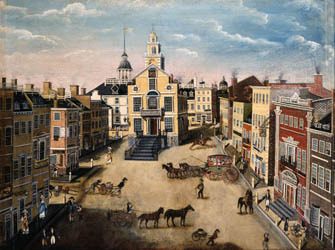
The conversation became a confrontation and quickly turned violent. Mein pulled out a pistol and backed toward the army’s main guard, where he could find redcoat protection. (It was in the building to the left of the Old State House in the Massachusetts Historical Society’s painting above.) As the printer reached the doorstep of that building, a tailor and militia officer named Thomas Marshall swung an iron shovel at his back. That’s when someone fired a shot.

According to Mein, the shot came from a pistol held by his printing partner:
Mr. [John] Fleeming, who was at a little distance, on seeing him [Marshall] coming up, run to us also, but before he came near Marshal had made the blow and was running off; however, Fleeming struck at him with a stick he had in his left hand, which just touched Marshals Back, Fleeming having missed his Blow reeled forwards, and in endeavouring to recover himself, grasping his hand close, a Pistol he had in his right hand accidently went off, but the ball went into ground & did no harm:
However, most people watching from King Street believed the shot came from Mein’s own gun. Even shopkeeper Elizabeth Cumings, who was on the printer’s side politically, wrote that he “fired a pistel he had in his hand, loded only with powder.”

Furthermore, the shot did cause a little damage. Merchant John Rowe wrote that Mein “wounded a Grenadier of the 29th Regiment in the Arm.” A report in the Boston News-Letter said the shot “tore the Sleeve of a Soldier’s Coat; but whether with a Bullet or only a Wad we cannot say.”

For that offense, some of the Boston Whigs rushed to sympathetic magistrate Richard Dana and secured a warrant to arrest Mein “for having put innocent People in Bodily Fear.”

The printer insisted the whole thing had been a set-up, the mob preconcerted:
their plan was to get me into the Custody of the Officer, & it being then dark, to knock on the head; & then their usual sayings might have been repeated again, that it was done by Boys & Negroes, or by Nobody.
Crown informant George Mason also reported hearing talk that once “Mr. Mein…was in Custody of the Civil Officers,…it was intended the Mob should rescue him from their hands, and deal with him as they themselves should think proper.” That was surely wild speculation, but the gunshot gave the Whigs all the legal reason they needed to pursue the man.

Once Justice Dana issued the warrant, Deputy Sheriff Benjamin Cudworth and a constable went into the main guard. Along with them went merchant William Molineux and officeholder Samuel Adams, both top Whig organizers. They spent “above an hour searching” before giving up.

Mein was hiding “above the room in the Garret,” he wrote. “I made my escape in a Soldiers Dress to Col. [William] Dalrymple’s.” From there he slipped “on board of his Majestys Schooner [Hope, commanded by] Lt. [George] Dawson,” later to “the Rose Man of War” under Capt. Benjamin Caldwell. Meanwhile, he wrote, the mob “went to the South End, attacked the House & Printing Office, broke open the great Gate, & our other Doors, and our Ware room:”

Mein had to lie low. Elizabeth Cumings declared, “the people are so exasperated they would sertenly kill him if he appered.” That year’s Pope Night processions on 6 November (because the fifth was a Sunday) featured Mein as the villain hanged in effigy. According to acting governor Thomas Hutchinson, Mein told him
he intended to pursue in the law the persons who had assaulted him; but he was unable to do it, having been threatened that if he appeared abroad he should be made a Sacrifice: And he therefore applied to me for protection and to call in the military power for that purpose.
Hutchinson declined to use military force that way and dissuaded Mein from suing. In a short time witnesses spoke up about the printer defending himself. According to province secretary Andrew Oliver, “Mr. Danas Son it is said was a Witness of the Transaction.” The warrant against Mein was withdrawn.

Nonetheless, the printer didn’t feel safe in Boston. Mein gave Fleeming a power of attorney to continue running the Boston Chronicle and the London Book-Store. He collected letters from Hutchinson to the Secretary of State, Lord Hillsborough; from magistrate James Murray to his sister, Elizabeth (Murray Campbell) Smith; and from secretary Oliver to Gov. Francis Bernard. He sailed out of Boston harbor on H.M.S. Hope on 17 November.

Though Mein still had property and legal entanglements in Boston, and he continued to write about Boston politics, he never returned to the town. The merchants had driven away their sharpest critic.

TOMORROW: More violence that same night.

Sunday, October 27, 2019

The Riot against the Neck Guard

I have still more to share about the Otis-Robinson brawl, but sestercentennial anniversaries are catching up, so I’ll have to get back to that story. That fight was just the start of an uptick of violence in the fall of 1769.

The next confrontation started on the night of 23 October, when a housewright and Whig activist named Robert Pierpont (also spelled “Peirpoint”) went to the British army guardhouse on Boston Neck. Pierpont owned land nearby, and he had already complained about soldiers stealing his firewood.

Under the Quartering Act of 1765, when the British government stationed soldiers in a town, the local government was supposed to supply housing and firewood. Boston had already balked at the housing back in 1768, and I don’t doubt they resisted supplying firewood as well. As the nights grew cooler, soldiers might not have worried about the such legalities.

The officers of the Neck guard sent Peirpoint away. Sgt. James Hickman and four men of the 14th Regiment later testified that the local man warned “he would go home where he had a brace of Pistols, would Load them and Fire at the first Soldier that came in his way belonging to the Guard.”

The next morning, a little before 10:00 A.M., a constable came to the guardhouse and asked for the officer in charge, Ens. John Ness. He brought a warrant from justice of the peace Richard Dana for “Stealing wood, assaulting, and knocking down one Robt Peirpoint,” in the ensign’s words.

Ens. Ness refused to leave his post until his shift was done. In other words, he placed the authority of the army over the authority of the local legal system. Instead, the young officer promised to obey the summons after he went off duty. The constable was satisfied with that. And really he didn’t have the force to make an army officer protected by armed soldiers do anything.

But there was force in numbers. Ness recalled: “Some minutes after, Peirpoint with a Number of People, came to the Front of the Guard room abusing, and pressing in upon the Centinels.” Ness assembled his whole guard with their bayonets fixed. For fifteen minutes there was a stand-off, during which “the Mob increased, keeping a little distance from us, throwing dirt, and Giveing a great deal of abuse.”

Then another squad of soldiers arrived to take over the post on the Neck. Ness formed his troops into lines to march them back to their barracks. The crowd, seeing no sign of the officer obeying the legal summons, grew angry. They started “Throwing Stones” at the soldiers. One man was hit “in the Face which made the Blood flow from his mouth and nose,” comrades recalled.

Ens. Ness declared:
In forming the Guard again, which by the Crowding in of the People had been divided, a Firelock, which had been loaded unknown to me went off, on hearing the report I turned about to the Guard, and gave positive orders for no Soldier to Load or Strike any of the Mob.
But that shot had hit the doorway of a forge where a young blacksmith named Obadiah Whiston was working. This was, as far as I can tell, the first gunshot in Boston’s Revolutionary history.

Enraged, Whiston ran after the squad to attack the soldier who had fired, Pvt. William Fowler. Ness said the blacksmith caught up opposite “the Officers Barracks of the 14th Regiment,” coming up on the right side of the troops. Fowler said Whiston “Struck him with a piece of a brick, which Cutt his head in a desperate manner, and for some time deprived him of his Sences.”

Whiston charged up a second time. Sgt. Hickman testified that he “placed the Butt end of my Halbred before him to hinder him from passing, but without striking or doing the said Whiston the least Violence.” Ens. Ness kept his soldiers moving, Fowler now staggering. He got the men “into the Barrack yard” and reported to the regimental commander, Col. William Dalrymple. Despite the crowd throwing rocks, despite Fowler’s musket firing, despite Whiston’s counterattacks, no one had been killed.

The conflict then moved to the courts. Ens. Ness reported to Justice Dana to answer Pierpont’s warrant. Meanwhile, Whiston hurried to a magistrate to swear out a complaint against Sgt. Hickman for assaulting him. The next day, Pvt. Fowler tried to start an action against Whiston, and Ness received a second summons, issued by Dana, John Ruddock, and Samuel Pemberton, for having his men fire on the people.

The proceedings that followed over the next few days showed how biased those Whig magistrates were against the soldiers. They tried to put off Fowler’s complaint. They ignored Pierpont shaking his fist and threatening Ness during the proceedings. They refused to hear testimony from soldiers. They declined to accept bail from a British officer and a Customs solicitor. When Sgt. Hickman was finally released, the crowd yelled, “Bail him with a Rope!” Soldiers said the hatter Thomas Handysyd Peck was particularly abusive. After officers complained about that behavior, Justice Dana declared “that he was deaf and could not hear…any abuse.

Eventually all those court cases fizzled out. But the Neck guard riot raised tensions in Boston in late October 1769, 250 years ago.

(The map above shows the British fortifications on the Neck during the siege of 1775-76. Back in 1769, there was just a gate and a guardhouse. And a pile of firewood.)

Sunday, October 20, 2019

“Too late to see your Friend Otis have a good Drubbing”

One of the more evocatively named citizens of Revolutionary Boston was a sea captain named Mungo Mackay (1740-1811).

According to family tradition, Mackay came from the Orkney Islands to Boston as a teen-aged cabin boy. He married Ruth Coney in 1764 and became a ship’s master the next year, trading with Newcastle and Tenerife. Soon he had a store on Long Wharf, and in 1768 he joined the St. John’s Lodge of Freemasons.

Mackay was another man who watched the John Robinson–James Otis fight from the open front door of the British Coffee-House, having been attracted by the noise. He could offer only a confused description of the action, not recognizing Robinson. He said he saw Otis “hustled back by the Crowd” and then “at least three [Sticks] over his Head, and the Blood running.”

Mackay’s testimony was most useful to the Whigs when he added:
I saw two Officers of the Navy talking together, one of whom said, “You have come too late to see your Friend Otis have a good Drubbing”, to which he replied, “I am very glad of it, he deserved it.”

I saw William Burnet Brown in the Room with a Whip in his Hand, who came up to Capt. [John] Bradford who was looking for Mr. Otis’s Hat & Wig, and asked him in a scornful Manner what he looked at him for, it appeared to me that he had a Desire to pick a Quarrel with Capt Bradford.
Bradford was another merchant captain and an active Whig. He was one of the Boston leaders who went out to deal with the “Powder Alarm” in 1774 and became the Continental government’s agent for the port of Boston during the war.

Mackay concluded his testimony by saying that almost all the men in the coffee-house were “Officers of the Army and Navy.” In other words, even if some men had been on Otis’s side, they were clearly outnumbered.

The Orkney-born captain swore to his affidavit “taken at the Request of James Otis, Esq;” in front of justices Richard Dana and Samuel Pemberton on 21 September, the same day as Thomas Brett.

As for Capt. Mungo Mackay, far from being only a pawn in the game of life, he’s managed to be remembered even in the age of Wikipedia.

TOMORROW: Who was William Burnet Brown?

Saturday, October 19, 2019

“Mr. Otis made a Trip (as they call it) at Mr. Robinson”

In the 25 Sept 1769 Boston Gazette, printers Benjamin Edes and John Gill ran two more eyewitness accounts of the fight between James Otis, Jr., and John Robinson.

One came from Thomas Brett, a merchant from Ireland. He said that on 5 September he was “in a Shop almost opposite the British Coffee-House” when he heard “an unusual Noise” that made him go look to see what was happening.

When I entered the Coffee-Room I perceiv’d two Gentlemen fighting with each other, the rest of the Company round them. I perceived several people rush upon Mr. Otis but in particular when Mr. Otis made a Trip (as they call it) at Mr. Robinson, which I believe would have brought him to the ground if he had not been supported by many people, who held him up.
Brett described John Gridley’s attempt to intervene, how “several people with Sticks struck” at him, and how he was shoved out of the building. Otis was shoved out at the same time, Brett said—a detail not in Gridley’s recollection.

And I don’t recall Gridley mentioning this moment, either:
Mr. Gridley in a short Time made his Appearance the second Time with his Arm (if I don’t mistake) tied up, and his Face very much disfigured with Blood, who said they were all a Pack of cowardly Rascals to take such an Advantage of a single Man, and told them altho’ one of his Arms were disabled, he would fight any cowardly Rascal of them all:
The Irish merchant also remarked on another man in the coffee-house, not previously mentioned:
I heard Mr. John Mein say that he was very glad if Mr. Otis had got much more; but said he was sorry for Mr. Gridley, as he believed he was an honest Fellow. I heard him say to some other Man he lost some Wine about it, but should pay it with the greatest Pleasure.
Mein, a Scottish bookseller and printer, had been carrying on a feud with Otis, Edes, and Gill since early 1768. That, too, had turned violent (Mein clubbed Gill because Edes had refused to confirm that a particular newspaper attack on Mein had come from Otis). So just as Mein was pleased to see Otis get beat up, Edes and Gill were probably happy to drag Mein into that affair.

“Upon the whole, as I was a Stander-by,” Brett concluded his affidavit; “in my Opinion there was foul Play shewn to Mr. Otis.” He signed that document on 21 September in front of justices Richard Dana and Samuel Pemberton, respectable officials who were always sympathetic to the Whig party line.

TOMORROW: Another witness, another accusation.

Sunday, October 13, 2019

“I rushed in between the said Otis and Robinson”

On 18 Sept 1769, the Boston Gazette’s front page featured an item of local news. Usually the Boston dispatches ran on page 3 or so, after reports reprinted from newspapers in other cities, because the local news was freshest. But Edes and Gill put this piece in type early on. They knew they had to run it.

The article was a legal affidavit from John Gridley, the young merchant who had thrust himself into the fight between James Otis, Jr., and John Robinson back on 5 September.

Gridley testified that he had been passing by the door of the British Coffee-House on King Street and saw Otis and Robinson “engaged in Discourse, and by their Words and Gestures he perceived they were in great Warmth.” They were talking about “a Gentleman’s Satisfaction” and agreed to go out of the room.

Gridley went on:
Mr. Otis on saying the last Words was retiring to go out at the Door which leads into the Entry, and was hindered by Mr. Robinson’s Attempt to take him by the Nose, which Mr. Otis prevented by holding his Cane before him.

Mr. Robinson then closed in upon said Otis and struck him with a Stick, which Mr. Otis returned with his Stick, and reciprocal Blows passed, which lasted about One Minute, and neither seemed to have the Advantage:

Then they were disarmed of Sticks, and engaged with Fists, which being perceived by some of the Spectators, (most of whom were of the Army, Navy and Revenue) they endeavoured by pushing and pulling the said Otis, to prevent his beating the said Robinson.

Immediately on seeing such foul Play (the Door of the Coffee-House being open as usual) I stepped into the Room and cried out, it was dirty Usage to treat a Man in that Manner; and on saying this, I rushed in between the said Otis and Robinson; but on going between them I felt some Person pull me by the right Shoulder, I instantly disengaged myself from the Person who had me by the Shoulder, and took Mr. Robinson by the Collar, and he, in twitching, and I in holding, tore his Coat, near or quite down to his Pockets:

I immediately received two Blows on my Head, with some Weapon from the right, by a Person who appeared standing on a Bench; the Blood which issued from my Wounds instantly filled my Eyes: I then lifted my right Hand to strike a Person who was pulling me, but who I could not see so as to know, by reason of the Blood which covered my Sight: As I lifted up my right Hand, I received a Blow from some Weapon just above the Joint of my Wrist Bone, which broke it.

I was then turned out out of the Coffee-Room Head and Shoulders by the said Persons, or some of them: I then went into said Room again, and was turned out by the Persons aforesaid: As I went in the last Time I took a Stick off the Floor (on which lay 5) hoping by that Means to find out at least one of those who had so basely and meanly abused me, that I might have reasonable Satisfaction:

I then went in at the Entering Door of the Coffee-House (not the Door which leads into the Coffee-Room) and met Mr. Otis, and told him he had better go into the front Room, set down and compose himself; which he did for about 2 Minutes: I also told him that I would defend him from any farther Abuse, as far as I was able; who replied “I am much obliged to you”—! A Person (unknown to me) told him he had better go and get his Wounds dressed; upon which he went off.—

He further saith, that after his receiving the Blows on his Wrist as aforesaid, he heard divers Voices hollow out, KILL-HIM! KILL-HIM! and I make no doubt they meant said Otis, as they were done beating me, and continuing to beat him when they thus cried out Kill Him! Kill Him!
That last detail of hearing people shout about killing was crucial to the Whigs’ claim that Otis’s enemies had tried to assassinate him in the coffee-house. It’s notable, however, that Gridley said nothing the attackers wielding “Cutlasses,” as stated in their first newspaper report of the brawl.

Gridley signed this affidavit on 13 September, eight days after the fight. The justices of the peace involved were Richard Dana and Dr. Belcher Noyes (c.1708-1785), both middle-of-the-road Whigs. In fact, Dana had overseen a hearing to arrest one of the men who had allegedly attacked Otis and Gridley. I’ll discuss that soon.

Gridley’s affidavit was in part a response to another account of the event that had already appeared in the newspapers—from the opposite side.

COMING UP: An innocent bystander?