J. L. BELL is a Massachusetts writer who specializes in (among other things) the start of the American Revolution in and around Boston. He is particularly interested in the experiences of children in 1765-75. He has published scholarly papers and popular articles for both children and adults. He was consultant for an episode of History Detectives, and contributed to a display at Minute Man National Historic Park.

Subscribe thru Follow.it


•••••••••••••••••


Showing posts with label Charles Willson Peale. Show all posts

Tuesday, September 26, 2023

Matthias Hammond’s House and Anne Proctor’s Doll

With all these stories about Founders’ children and dolls, I thought I should show an actual doll from the period.

The Hammond-Harwood House Museum stands in Annapolis, Maryland. The architect William Buckland designed it just before he died in 1774, and his assistant John Randall completed the building for a young tobacco planter named Matthias Hammond (1750–1786).

Hammond had just been elected to the Maryland General Assembly by Annapolis’s anti-taxation party. He was also a new member of the vestry of St. Anne’s Parish. With those responsibilities, he presumably wanted a house in town.

However, Hammond doesn’t appear to have ever lived in his Annapolis house for an extended period. Instead he stayed on his slave-labor plantation in what is now Gambril. He also never married, and thus never raised children in the house.

In 1926 St. John’s College bought the building to use as a museum, but ran into financial straits during the Depression. The Hammond-Harwood House Association formed in 1938 to maintain the site as an independent museum of architecture and the decorative arts.

Among the artifacts in the museum’s collection is this doll from a Baltimore family.

The museum’s webpage explains:
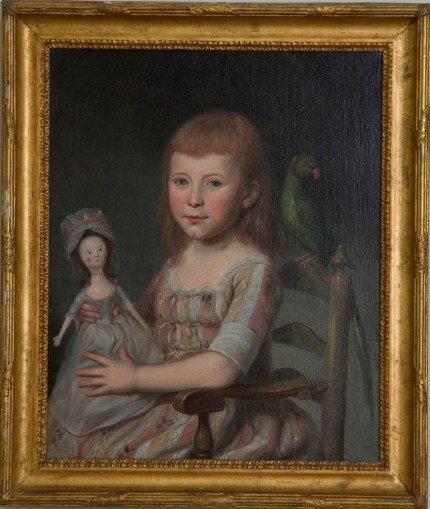
She is a Queen Anne style doll and dates to about 1785. She may have been made in England, starting as a block of wood and slowly taking shape as a carver turned the block on a lathe. It is easy to see why six-year-old Ann Proctor would have been attached to her, perhaps so attached that she insisted her doll be included in this portrait of her:
That’s a Charles Willson Peale painting from 1789. The museum notes that the doll is actually smaller than Peale painted it, so as not to distract from Anne (and her parrot). But clearly the doll had a lot of meaning for the Proctors.

Wednesday, May 10, 2023

Henry Knox in Miniature?

One of the big themes of my presentation at the Springfield Armory National Historic Site’s Henry Knox Symposium last weekend was that we shouldn’t keep repeating what older books have said about Henry Knox’s early life.

Instead, we should look at the surviving evidence and think about what makes sense, even if it contradicts statements those books make without offering documentary support.

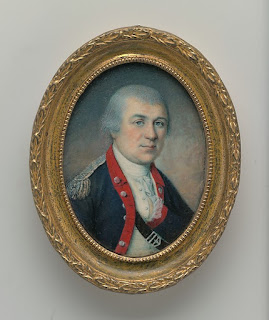
In that spirit, in my presentation I used this portrait of Knox from the collection of the Metropolitan Museum of Art, but I labeled it as “miniature said to show Henry Knox.”

That’s because I remembered hearing Matthew Keagle of Fort Ticonderoga, another speaker at the symposium, raise questions about this image a few years back.

I talked to Dr. Keagle again to make sure I get the details correctly as I take the liberty of repeating those questions. Basically, if we don’t repeat what older papers say about this portrait and look at its visual details, what does that evidence show us?
  • a plump man in a Continental Army uniform.
  • one epaulet, not two.
  • red facing lapels, not gold.
  • white waistcoat, not gold.
To be sure, it took a while for the Continental Army to develop uniform standards, but getting those details right mattered to Knox. He also the army as a colonel of artillery and was a general by the end of 1776, so the uniforms he wore reflected that high rank. The details of this picture don’t appear to match army standards.

The Met credits this miniature as a watercolor on ivory by Charles Willson Peale, who painted more portraits of Knox (two epaulets, gold facings and waistcoat, frankly fat) at the end of the war. This painting came to the museum as a gift in 1968 from J. William Middendorf, II, who was about to leave investment banking for work as a U.S. ambassador and Secretary of the Navy.

According to this catalogue of Middendorf’s collection as exhibited just before that gift, he had purchased the miniature from the estate of Philadelphia antiques dealer Arthur Sussel in 1959. And that seems to be as far back as the provenance goes. Perhaps there’s more in someone’s files.

Saturday, November 20, 2021

“I wish my wife and children out of the danger”

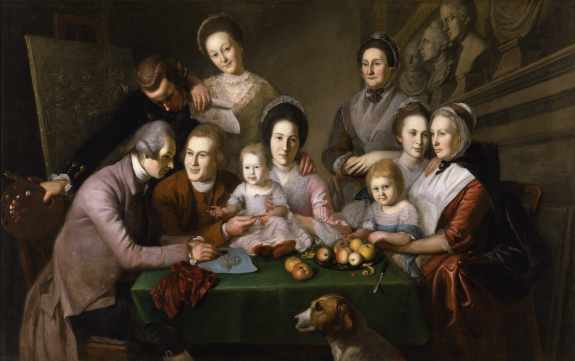
This is Charles Willson Peale’s painting of his family, now hanging at the New-York Historical Society. Peale is the man standing on the left, holding the artist’s palette in front of his unfinished canvas and looking at what his brothers are sketching at the table.

At the center of the picture sits the artist’s first wife, Rachel, with their fourth baby—the first to survive. At the time the family was living in Annapolis, Maryland.

Prof. Andrew Wehrman was startled to discover what happened to this family soon after Peale started to make this painting, as he wrote in a new essay at the Age of Revolutions:
Their fourth child Margaret brought them so much joy that Peale began painting one of his most famous works, The Peale Family, with Rachel and baby Margaret at the center. Before finishing the painting in the summer of 1772, and just after painting his first portrait of George Washington, Peale traveled to Philadelphia from Maryland in search of subjects to paint in the Colonies’ largest city.

Soon, tragedy struck. Peale read in the newspaper that smallpox had infected Annapolis, but, he wrote in a letter, “I have not heard in what house—(I have my fears) how dreadful the season, I wish my wife and children out of the danger of taking it.”

Neither Rachel nor baby Margaret had been inoculated and both caught the disease. Rachel recovered but Margaret did not. The Peales lost their fourth child, and it would be thirty-five years before Charles Willson could bring himself to revisit and complete The Peale Family.
Wehrman recounts how Peale went on to paint his baby, dressed in its shroud, and his grieving wife as a warning to other parents not to put off inoculation.

John Adams visited the artist’s studio and saw both pictures at a time he knew his wife and children were being inoculated in Boston.

Meanwhile, Gen. Washington was trying to figure out how to balance his soldiers’ demands for smallpox inoculation with the need to maintain army readiness.

Read the whole essay here. And get your booster shots.

Tuesday, June 29, 2021

A Peek at Peale’s Mastodon

Earlier this month, Ben at Extinct Monsters shared a report on Charles Willson Peale’s mounted mastodon skeleton, now on exhibit at the Smithsonian American Art Museum in Washington, D.C.

Ben wrote:
Exhumed in 1799 near the banks of the Hudson River and unveiled to the public on Christmas Eve, 1801, this was the very first mounted skeleton of a prehistoric animal ever exhibited in the United States. . . .

After Peale’s Philadelphia museum closed in 1848, the mastodon was sold and wound up at the Hessisches Landesmuseum in Darmstadt, Germany. There it remained for over 170 years, largely forgotten in its home country, until SAAM senior curator Eleanor Harvey had the idea to include it in a new exhibition. . . .

I spoke to Advait Jukar, a Research Associate with the National Museum of Natural History, about his involvement with the mastodon. He inspected the skeleton in early 2020, shortly after it arrived in Washington, DC. As a fossil elephant specialist, Jukar was able to determine that the mastodon was an adult male, and that about 50% of the mount was composed of real, partially mineralized bone.

Fascinatingly, most of the reconstructed bones were carved from wood. This was the handiwork of Rembrandt Peale (Charles’ son), William Rush, and Moses Williams. Most of the wooden bones were carved in multiple pieces, which were locked together with nails and pegs. The craftsmanship is exquisite, and the joins are difficult to make out unless you stand quite close. The mandible is entirely wood, but the teeth are real. These teeth probably came from a different individual—one tooth on the right side didn’t fit properly and was inserted sideways!

The mastodon at SAAM differs from the original presentation at Peale’s museum in a few ways. The missing top of the skull was once modeled in papier-mĂ¢chĂ©, but this reconstruction was destroyed when the Landesmuseum was bombed during the second world war. It has since been remodeled in plaster.

While the mastodon was never mounted with real tusks, the mount has traditionally sported strongly curved replica tusks, more reminiscent of a mammoth. While Rembrandt Peale published a pamphlet in 1803 suggesting that the mastodon’s tusks should be positioned downward, like a pair of predatory fangs [shown above], it’s unclear if the tusks on the skeleton were ever mounted this way. At SAAM, the mastodon correctly sports a pair of nearly straight replicated tusks, which curve gently upward. 
The exhibit that includes this mastodon, which is actually about the scientist Alexander Humboldt, will be up at the Smithsonian American Art Museum only until 11 July.

Friday, February 21, 2020

Peale’s Portrait of an Elderly Black Man

In the late nineteenth and early twentieth century, people believed this painting by Charles Willson Peale was a portrait of William Lee, enslaved at Mount Vernon for the last thirty years of George Washington’s life.

Peale and Lee did cross paths. Peale first visited Mount Vernon in the early 1770s, when Lee was a teenaged house servant. Peale returned thirty years later, as his biographer Charles Coleman Sellers wrote in 1947:
The travellers made a pilgrimage to Mount Vernon [in 1804], Peale full of reminiscences of his visits there in the General's lifetime. All that remained now of the family was one slave, old Billy Lee, Washington's body servant through the war, whom Peale found in an outbuilding, a cripple now, cobbling shoes. The two sat down alone together and talked of past days and of the important subject of good health.
Lee became free on Washington’s death, but he was disabled by bad knees and remained on the estate for the rest of his life.

Peale kept a diary in 1804, so I presume that was the basis of this vignette. It would be nice to know exactly what Peale himself wrote of his conversation with Lee.

C. W. Peale died in 1827 at the age of eighty-five. The museum he‘d assembled on the upper floor of what is now Independence Hall was broken up in 1854. In the ensuing sale a man named Charles S. Ogden bought a Peale painting of the young George Washington and what he thought was “a portrait in oil, by the same artist, of Bill Lee, familiarly known as ‘Billy,’ Washington’s favorite military servant during the war for Independence.”

That identification reflects how Washington’s celebrity made Americans fascinated in his former slaves—or supposed former slaves. In 1835 an elderly enslaved woman named Joice Heth played the role of Washington’s former nursemaid, over 160 years old, for paying audiences in New York. Until recently, a painting in a Spanish museum was widely but not wisely identified as showing Washington’s cook, Hercules Posey.

Sometimes those stories were more accurate. In 1845, a New Hampshire journalist interviewed Oney Judge, who had escaped from the President’s Philadelphia mansion in 1796.

In that atmosphere, people appear to have decided that the elderly black man Peale painted must have had some connection to Washington. Or maybe the exhibitors realized that making that claim made their painting and the museum more valuable. William Lee, by then mentioned in memoirs and popular histories as “Billy Lee,” was the most famous elderly black man from Mount Vernon, so people attached his name to the picture.

In 1892, Ogden donated the two paintings to the Historical Society of Pennsylvania. At some point, and I’m not sure when, scholars realized that the painting that Ogden believed showed William Lee was actually Peale’s 1819 portrait of a man named Yarrow Mamout. Peale described the sitting in detail in his diary.

Mamout had been born in Guinea, brought to Maryland as a slave, and freed around age sixty. He became a well known businessman and property owner in Washington, D.C. in the early republic. He maintained his Islamic faith, making this the first portrait of an individual Muslim American. In his eighties, Mamout claimed to be even older—140 years old, which was probably why Peale painted him.

In concentrating its holdings on documents, the H.S.P. transferred the Mamout painting to the Philadelphia History Museum and then recently assented to its sale to the Philadelphia Museum of Art, which owns other Peale portraits. But none of William Lee.


Saturday, July 13, 2019

Harvard Digital Collections from the Colonial Period

Last month the Harvard Gazette featured some treasures from the university’s Colonial North America collection, “approximately 650,000 digitized pages of handmade materials from the 17th and 18th centuries.”

Most of that material consists of manuscripts, but highlighted in this article are:
As I type, the collection’s front page features documents created by Dr. John Jeffries and the Rev. Thaddeus Mason Harris, two men from Revolutionary Massachusetts I don’t fully trust. But I can’t hold that against the university.

This week the university announced the launch of the larger Harvard Digital Collections, which contains the material from Colonial North America. That “provides free, public access to over 6 million objects digitized from our collections—from ancient art to modern manuscripts and audio visual materials.”

What’s more, this is the policy on copyright governing this material:
In order to foster creative reuse of digitized content, Harvard Library allows free use of openly available digital reproductions of items from its collections that are not under copyright, except where other rights or restrictions apply.

Harvard Library asserts no copyright over digital reproductions of works in its collections which are in the public domain, where those digital reproductions are made openly available on Harvard Library websites.
So if a person wanted an image of a certificate of initiation into the African Lodge of Freemasons, signed by Prince Hall, George Middleton, and other officers, one has merely to click.

Saturday, July 14, 2018

Online Collections of Engravings and Samplers

Here are a couple of online databases of visual interest.

The Anderson House library of the Society of the Cincinnati in Washington, D.C., has created an online collection of engravings and prints from and relating to the Revolutionary War. The website explains its contents:
Works of art on paper featuring engravings of Revolutionary War battle scenes, allegorical and commemorative prints, and portraits of original members of the Society of the Cincinnati. A significant collection of satirical prints includes caricatures of major figures on all sides during the Revolutionary War and political cartoons of relevant events of the longer Revolutionary era from the Seven Years' War through the War of 1812.

Highlights include: an extremely rare wartime mezzotint of George Washington by Charles Willson Peale; a pair of rebus letters skewering the Carlisle Peace commission; and images of leaders such as George III, John Wilkes, the marquis de Lafayette, and Louis XVI.
The website format lets viewers magnify the images to study details.

Turning from warfare to the domestic sphere, the Sampler Consortium unveiled the Sampler Archive, an online searchable database of American schoolgirl samplers and related embroideries. The archive begins with material from the Winterthur Museum, the D.A.R. Museum, and the Rhode Island Historical Society. Images from a dozen other collections and recent events will follow.

The samplers are catalogued with detailed information on their physical characteristics, history of the maker and her family, and provenance. The collection can be browsed according to the contributor, type of object, maker's age, place, and date.

As an example, the sampler shown above bears the name of "Nancy Tucker aged 8 1791." Curators at the D.A.R. Museum think it may have been made in Essex County, Massachusetts. Below an alphabet it bears the motto:
This Work In Hand my Friend may hav
When I am Dead And in My Grave
Which may have been meant well but rather reminds me of the dire warnings against theft that schoolboys used to write in their schoolbooks.

Friday, March 09, 2018

Peale Portraits of the Hancock Children Brought to Light

Last month Pamela Ehrlich published an article in Antiques & Fine Art magazine and at the Incollect site titled “A Hancock Family Story: Restoring Connections.”

Ehrlich wrote:
While researching portraits of Lydia [Hancock], I discovered a listing in the Smithsonian Art Inventories Catalog for an “unlocated” portrait miniature in oil [sic] of “Hancock, Thomas, Mrs. (Lydia Henchman)–Child” painted by Charles Willson Peale (1741–1827) in 1777. It was further identified as No. 354 in Charles Coleman Sellers’ Portraits and Miniatures by Charles Willson Peale (hereafter P&M). However, the death date was incorrect—Lydia Henchman Hancock died April 25, 1776. Furthermore, Peale could not have painted her as a child since she was twenty-seven years old when he was born.
That miniature was at the Rhode Island School of Design in Providence.

Investigating further allowed Ehrlich to identify the baby girl in that portrait as John and Dorothy Hancock’s daughter Lydia, named after her great aunt. Little Lydia died in 1777 at the age of only nine months.

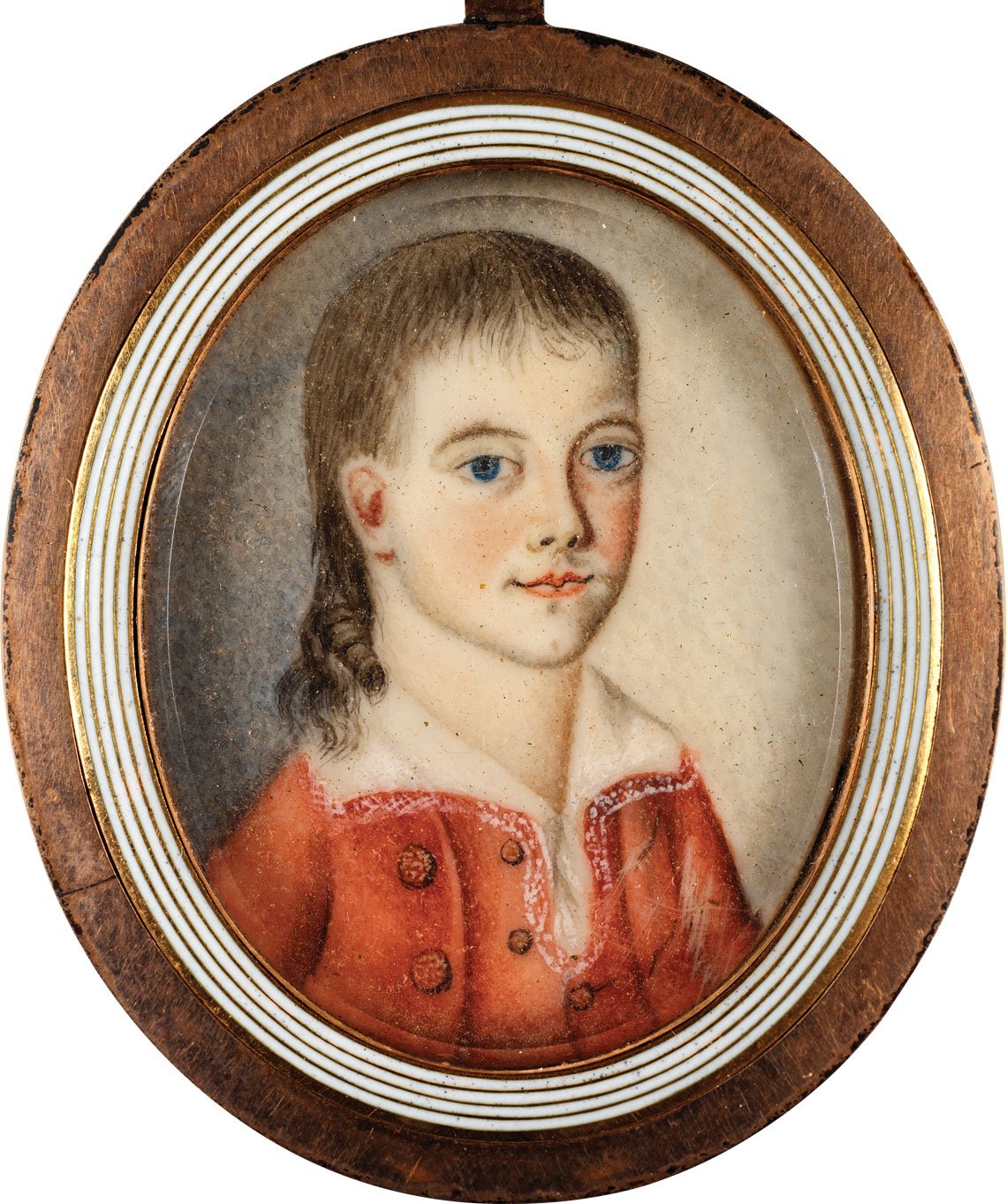
Furthermore, Ehrlich found a corresponding miniature of the Hancocks’ son John George Washington Hancock, shown above. (Terribly sad story of that boy’s death here.) And in the same purchase the art school obtained a Peale portrait of John Hancock himself, painted in the year he signed the Declaration of Independence. Read the article for the full story of the investigation, as well as the remaining mystery of a matching miniature of Dorothy Hancock.

Thursday, April 20, 2017

“Charles Willson Peale is literally wearing my pants”

There’s a lot of New England content in Philadelphia’s new Museum of the American Revolution, and a lot of New England talent behind it.

The Philadelphia newspapers explain:
Seventeen of the museum’s 32 human resin figures -- and two of its horses -- were dressed by the Randolph, Mass., historian, reenactor, and tailor Henry Cooke, who worked for more than a year with a dozen artisans to create the clothes. Two pairs of trousers in the exhibit are from Cooke’s reenactor wardrobe.

Charles Willson Peale is literally wearing my pants,” Cooke said, referring to a scene depicting James Peale seeing for the first time his brother Charles after the Battle of New York City.

The figures dressed in near-replicas are next to real items -- encased in protective glass -- from that era.

There’s a coat that once belonged to Lt. Col. Benjamin Holden of the Massachusetts militia, along with a New Hampshire soldier’s hunting shirt. (Washington eventually adopted the linen shirt as part of the Continental Army’s uniform because it was considered a sign of good marksmanship.)
In addition, the figures themselves are modeled after real people involved in Revolutionary reenacting, and others posed for photographs or films used in the exhibits and promotional material. Therefore, some of those faces might look strangely familiar.

Another item from New England is the blue riband that Gen. George Washington bought to distinguish himself from other officers toward the start of the siege of Boston. As I discussed back here, museum curator and historian Phil Mead spotted that in a Harvard museum, and it’s now on loan in Philadelphia.

Thursday, March 23, 2017

The Fame of the Virginia Riflemen


As I discussed at an event last week, the Continental Congress voted to raise rifle companies for the Continental Army in June 1775 even before it chose a commander-in-chief.

The first plan called for two companies from Virginia, two from Maryland, and six from Pennsylvania. The response from western Pennsylvania was so strong that by the end of the month, the Congress added two more companies from that colony.

Thus, about two-thirds of the riflemen who came to Cambridge in the summer of 1775 were Pennsylvanians. That surprised me because I’d read so much about Virginia riflemen.

So I went to Google Book’s Ngram viewer to see if my impression was off. I searched for the frequency of the phrases “Virginia riflemen,” “Pennsylvania riflemen,” and “Maryland riflemen” in literature between 1775 and 1860, stopping the search then so it wouldn’t be confused by results from the U.S. Civil War.

As you can see from the results, “Pennsylvania riflemen” showed up more often soon after those companies were formed. But then “Virginia riflemen” took over. The next century brought a printing boom, and in the 1820s and from 1840 on those Virginian troops were marching far ahead of the men from the other two colonies.

I’m not sure what to make of that. Certainly the most successful and famous rifleman of the initial regiments was Gen. Daniel Morgan of Virginia. But Lancaster County, Pennsylvania, was known for producing the actual rifles. Of course, John Adams would explain it by saying, “Virginian geese are always swan.”

In other riflemen research, at the Journal of the American Revolution Ian Saberton shared some sources about the marksmanship of those soldiers compared to British infantrymen. And here’s Hugh Harrington’s article on the work by David Rittenhouse and Charles Willson Peale to mount a telescopic sight on a rifle.

Saturday, January 14, 2017

Princeton in the Snow

I did some public history work last weekend: read in some books, participated in a meeting about this year’s Boston Massacre, drafted some Boston 1775 postings while sitting out the snow.

But I sure didn’t do what a bunch of dedicated reenactors and living historians did in central New Jersey. The Princeton Battlefield Society, Morven Museum & Garden, and Old Barracks Museum teamed with His Majesty’s 17th Regiment of Infantry, Charles Wilson Peale’s Company of Philadelphia Associators, historian Will Tatum, and other individuals to reenact the British army’s occupation of Princeton in 1776-77.

And then the snowstorm arrived. The same snow we got here in Massachusetts, but earlier. And my goodness, that was photogenic!

The image above appears in a Facebook gallery by Wilson Freeman of Drifting Focus Photography. I heartily recommend clicking through the whole gallery. If there are other online collections of photos from this event, please recommend them in the comments.

Here’s a report on the event from Kitty Calash. No fingers or toes were lost in the snow, it’s good to know. And the participants and local spectators seem to have enjoyed an unforgettable experience.

Friday, March 13, 2015

Has General Washington’s Riband Come Back Around?

Back in 2010 I wrote some articles about Gen. George Washington’s decision in July 1775 to adopt a blue sash or “ribband” across his chest as the sign of his rank in the new Continental Army.

It turns out that Washington’s riband might survive in the collections of Harvard University’s museums, having come back to Cambridge after passing through the hands of painter Charles Willson Peale, who owned a museum himself.

In this Common-Place article, Philip C. Mead of the Museum of the American Revolution writes of the general:

The decoration he chose, a blue silk moirĂ© ribbon worn across his breast, made allusions to both one of the traditional colors of Whigs, the British political party with which American Revolutionaries identified, and the aristocratic decorations of Europe. At first, he wore the ribbon regularly, and then only on ceremonial occasions and in battles, until he phased the decoration out in 1779, replacing it with stars on his epaulettes. Examples of Washington’s epaulettes have survived and appeared in several publications, but his silk ribbon has remained largely obscure among students of Washington objects and the American Revolution.

A recently re-examined silk moirĂ© ribbon in the collections of Harvard University’s Peabody Museum of Archaeology and Ethnology may well be the very ribbon depicted in the Washington portrait paintings by the Revolutionary artist Charles Willson Peale. It may even have been the one worn by Washington from 1775 to 1779 as referenced in various writings during the war. It may also be the ribbon displayed at Peale’s museum in the nineteenth century.
Harvard received the artifact in 1899 and immediately loaned it to the Old South Meeting-House, one of Boston’s historic sites most associated with the Revolutionary War. It stayed there until shortly after the Bicentennial. When it came back to Harvard, the cloth no longer had its label from Peale’s museum, and, more importantly, the cultural climate had changed since its first arrival. Both museum curation and historiography had become more professionalized, a process that encourages skepticism about the claims of tradition and enthusiastic amateurs. So was this artifact genuinely the general’s?

Mead’s investigation includes the process of making “watered” silk, how this riband compared to what Peale painted in the 1770s, why Washington stopped wearing the sash midway through the war, and how such an artifact does and doesn’t fit into the mission of the museums where it has appeared.

Now if this sash belonged to the Harvard Art Museums, it might be possible to request a personal examination through Harvard’s Art Study Center. But it came to the Peabody Museum. So I don’t know how it might be seen.

Friday, March 21, 2014

A Miniature Henry Knox

In Dealings with the Dead (1856), Lucius Manlius Sargent told this anecdote about the Rev. Mather Byles, Sr., a Loyalist minister who stayed in Boston after the siege and became notorious for being unable to resist a pun:
He was intimate with General [Henry] Knox, who was a bookseller, before the war. When the American troops took possession of the town, after the evacuation, Knox, who had become quite corpulent, marched in, at the head of his artillery.

As he passed on, Byles, who thought himself privileged, on old scores, exclaimed, loud enough to be heard—“I never saw an ox fatter in my life.” But Knox was not in the vein. He felt offended by this freedom, especially from Byles, who was then well known to be a tory; and replied, in uncourtly terms, that he was a “—— fool.”
That anecdote has been republished in biographies of both Knox and Byles, and in other books as well. It’s too good to resist.

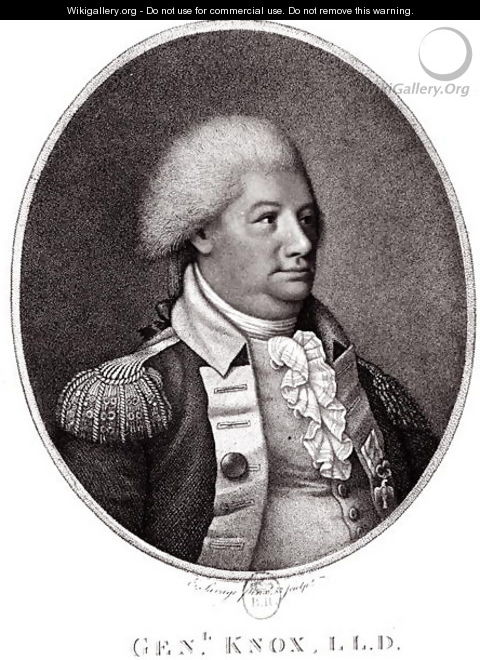
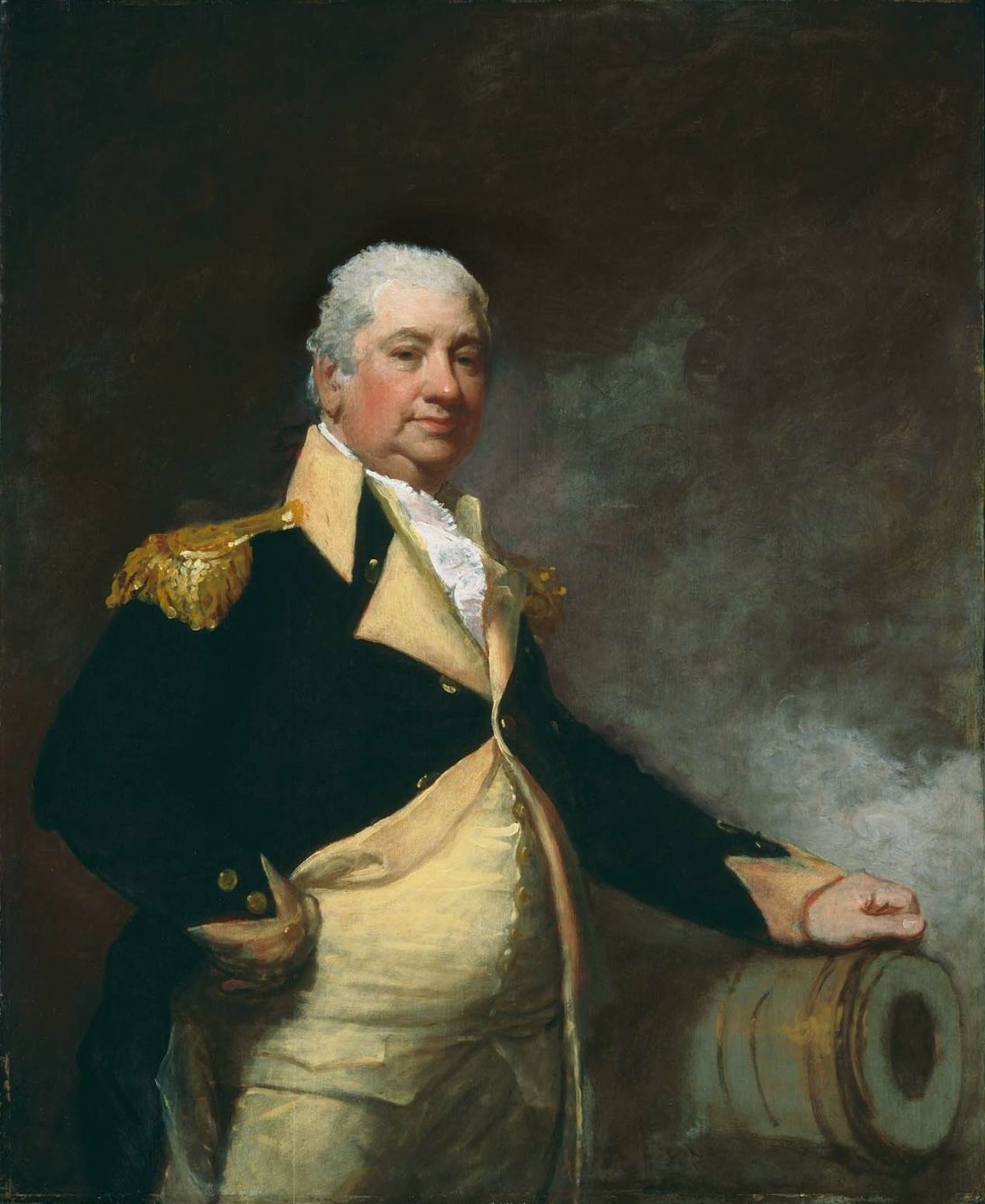
But I’ve long wondered whether Henry Knox was really that fat at the time. The picture above shows a miniature of Gen. Knox by Charles Willson Peale, dated 1778 and now in the collection of the Metropolitan Museum of Art. In this image Knox, while not miniature, doesn’t appear any fatter than many other gentlemen of his time.

When Peale painted Knox again around 1784, the general’s face had grown noticeably more jowly.

That might have been a peak point for Knox’s weight because on 18 May 1788 Abigail Smith wrote to her mother, Abigail Adams: “The General is not half so fat as he was.” (In his 1873 biography of the general, Francis S. Drake combined this remark with what Smith wrote about Lucy Knox on 15 June 1788.) At that time Smith was returning to America after some years in Europe, so she was comparing Knox in 1788 with him a few years earlier.

Knox’s later portraits by Edward Savage around 1790 and and Gilbert Stuart are also on the heavy side. (Mid-nineteenth-century American artists shaved down Knox’s belly like magazine art directors using Photoshop.) There’s no question Knox was a big man, but in 1776, when he was still in his mid-twenties, was he truly as fat as an ox?

Sunday, June 16, 2013

Sashes in Washington’s Early Military Career

I decided to use the Founders Online to further explore a topic I addressed earlier in the month: George Washington’s military sashes. In the mid-eighteenth century, a long sash was viewed as part of the necessary insignia of a genteel army officer.

When Washington threw himself into a military career in his early twenties, he ordered a “Rich Crimson ingr[ained] silk Sash,” as specified on this 23 Oct 1754 invoice.

The next year, as a volunteer aide de camp, Washington accompanied Gen. Edward Braddock’s expedition into the Pennsylvania wilderness—an expedition that reportedly ended with the commander being carried away, mortally wounded, in his sash. After his performance under fire, Washington was commissioned colonel of the Virginia troops.

Washington’s regard for the details of an officer’s uniform comes through clearly in his regimental orders for 6 July 1756, when he was commanding those provincial troops at Fort Cumberland:

Colonel Washington expressly orders, that no Officer do provide himself with any other kind of Clothes than those ordered the 17th of September last: as they will not be allowed to appear in them. Every Officer who has not complied with that order, to do it immediately—and they are all to procure Sashes, if to be had—They may be supplied with Hats, and waistcoat-lace, at Mr [Robert] Peters’s, Rock-Creek—and sword-knots…
Those orders treated sashes as not required but nonetheless very desirable. The young colonel was no doubt gratified that his attention to such details had earned the respect of regular British officers, as his friend George Mercer wrote him on 17 Aug 1757:
…we have been told here by the Officers that nothing ever gave them such Surprize as our Appearance at entering Hampton, for expecting to see a Parcel of ragged disorderly Fellows headed by Officers of their own Stamp (like the rest of the Provincials they had seen) behold they saw Men properly disposed who made a good & Soldier like Appearance and performed in every Particular as well as coud be expected from any Troops with Officers whom they found to be Gent. to see a Sash & Gorget with a genteel Uniform, a Sword properly hung, a Hat cocked, Persons capable of holding Conversation where only common Sense was requisite to continue the Discourse, and a White Shirt, with any other than a black Leather Stock, were Matters of great Surprize and Admiration & which engaged Them all to give Us a polite Invitation to spend the Evening, & after to agree to keep Us Company which they had determined before not to do—agreeable to what they had practised with the other Provincial Troops. We have lost that common Appellation of Provincials, & are known here by the Style & Title of the Detachment of the Virga Regiment.
Fifteen years later and happily retired from the field, Washington had Charles Willson Peale paint him with a military sash over his shoulder in 1772, as shown above.

COMING UP: Ordering sashes for another war.

Saturday, July 30, 2011

Washington Documents on Display for One Day Only

A loyal Boston 1775 reader alerted me to this event in Philadelphia.

The Historical Society of Pennsylvania will host a display of documents related to George Washington on one day only this week: Wednesday, 3 August, from 12:30 to 7:30 P.M. The display will include:

The H.S.P. event is free to all, and comes in conjunction with the exhibit “Discover the Real George Washington” at the National Constitution Center.

For those of us not able to visit Philadelphia on short notice, the society will make digital images of the documents and artifacts and create an online display by the end of the summer.

Tuesday, September 28, 2010

Washington for Sale to the Highest Bidder

Tomorrow Christie’s will auction this portrait of “George Washington at Princeton” by Charles Peale Polk (1767-1822). Polk used his uncle and mentor Charles Willson Peale’s 1787 portrait of Washington as the basis for the face, and made many copies of this image. This particular copy has been owned by the Historical Society of Pennsylvania, and is being sold to benefit the society and the Philadelphia History Museum now growing out of the Atwater Kent Museum.

In January 2009, Christie’s sold another version of the same portrait for over $600,000, well over the estimate. But then the buyer was Mount Vernon.

Thursday, March 11, 2010

“A Ribband to Distinguish Myself”

Does that look like a general? How can you tell? Well, yes, he is taller than most people, and he hasn’t got mud all over him. But the real tip-off is supposed to be the thin band of light blue cloth across his chest.

Yesterday I quoted Gen. George Washington’s orders to officers in the Continental Army around Boston to distinguish themselves with colored cockades on their hats. Nine days before that, he had addressed an even more pressing issue: making sure soldiers recognized him. The general orders for 14 July 1775 declared:

There being something awkward, as well as improper, in the General Officers being stopp’d at the out-posts; ask’d for passes by the Sentries, and obliged often to send for the Officer of the Guard (who it sometimes happens is as much unacquainted with the Persons of the Generals, as the Private Men) before they can pass in or out: It is recommended to both Officers and Men to make themselves acquainted with the persons of all the Officers in General Command, and in the mean time to prevent mistakes: The General Officers and their Aids-de-Camp, will be distinguished in the following manner.

The Commander in Chief by a light blue Ribband, wore across his breast, between his Coat and Waistcoat.

The Majors and Brigadiers General, by a Pink Ribband wore in the like manner.

The Aids-de-Camp by a green ribband.
The general had already expensed, on 10 July, “a ribband to distinguish myself.” Nowadays we usually spell that word “riband,” and we’re more likely to call that band of cloth a “sash” (as well as to expect it to say something like “Miss Rappahannock”).

Somebody apparently raised the issue of distinguishing major generals from their subordinate brigadier generals. The Boston theater had only two major generals, Artemas Ward and Charles Lee, and the latter was a notorious sloven when it came to dress and manners. [ADDENDUM: Oops! I was wrong. Ward and Lee were the first two major generals appointed by Congress, but by the time Washington was ordering ribands Israel Putnam had also received that rank.]

On 24 July the commander’s general orders included:
It being thought proper to distinguish the Majors, from the Brigadiers General, by some particular Mark; for the future the Majors General will wear a broad purple ribband.
TOMORROW: So did people pay attention to Washington’s color-coded system?

(The image above is a detail from Charles Willson Peale’s portrait of Washington at Princeton.)