J. L. BELL is a Massachusetts writer who specializes in (among other things) the start of the American Revolution in and around Boston. He is particularly interested in the experiences of children in 1765-75. He has published scholarly papers and popular articles for both children and adults. He was consultant for an episode of History Detectives, and contributed to a display at Minute Man National Historic Park.

Subscribe thru Follow.it


•••••••••••••••••


Showing posts with label Titus Hosmer. Show all posts

Wednesday, September 11, 2024

“The purport was, Boston was in action…”

One important element of the “Powder Alarm” of 1774 was that although the British army operation ended peacefully on the morning of 1 September, reports of what happened kept spreading for days.

And as those reports spread, they grew more dire.

Rev. Dr. Ezra Stiles recorded from an eyewitness that in Shrewsbury in the early morning hours of 2 September the rumor was “six men killed.”

Exaggerations like that brought thousands of Middlesex County militiamen into Cambridge that day. That event produced fear about more British military action, which apparently produced more rumors.

At noon on 3 September, Israel Putnam tried to rouse the militia around Pomfret, Connecticut, because of and with this news:
I have this minute had an express from Boston that the fight between Boston and Regulars [began] last night at sunset, the cannon began to and continued playing all night, and they beg for help
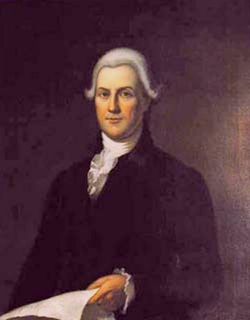
Early on 4 September, Titus Hosmer (shown above) in Middletown, Connecticut, was woken by the sheriff, who had received a letter from Putnam. Hosmer wrote:
The purport was, Boston was in action by the “troops sending out to seize all the powder in the country, especially at Framingham [sic] about 20 miles from Boston; which when discovered occasion’d the country people to collect and offer to rescue the powder [i.e., grab it back]. Six of the country people were shot dead at the very time, and many wounded—an Artillery planted at the Neck—the Ships were heard to fire all night of a Friday.
By noon that day, Hosmer heard a less drastic report via Hartford:
[William] Brattle at Cambridge, a high tory, had petitioned [Gen. Thomas] Gage for troops to protect him at his house, which Gage granted; a mob gathered and demand of Brattle to renounce his toryism or whatever you may term it; but after a short parley the troop fired, kill’d some right out, a large numr. wounded. No news from the town itself.
On Sunday, 4 September, the worst rumors reached Longmeadow, Massachusetts. The Rev. Stephen Williams heard that the Royal Navy was involved:
the Ships in ye Harbour—of Boston, & ye Army on ye Land Side were allso fireing upon ye Town so yt. it was like ye Town was Demolishd.
In Milford, Connecticut, young Joseph Plumb Martin heard the talk at church that Sunday afternoon and went to bed fearing redcoats would attack his family’s home before morning.

Of course, none of that happened. But it took a while for the real news to catch up.

TOMORROW: How the news reached the Continental Congress.

Monday, February 01, 2021

“Quite in the Land of Amaze

Yesterday we left Israel Putnam at noon on Saturday, 3 Sept 1774, sending letters to many other Connecticut militia officers, passing on dire news he had heard about Boston.

Putnam himself set off toward Boston on horseback with his local militia regiment, becoming part of what was later called the “Powder Alarm.” Meanwhile, his dispatches made their way across the colony.

The Middletown lawyer Titus Hosmer (1736-1780, shown here) left a detailed and dramatic account of the response along the Connecticut River south of Hartford in a letter to Silas Deane, apparently written on Sunday, 4 September:
This morning quite early I was call’d out of my bed by the Sheriff: “Where’s the Town Stock?

I honestly own’d there was not a pound of powder in my keeping; as for Ball and Flints they need not fear; but for Heaven’s sake, says I, what means this? Is Boston in action?

“O yes, terrible News; I suppose before this Boston is in ashes.”

My God! is it possible! But after a little more spit,—he show’d me a letter from Putnam; (by this time the people gathered from all quarters like a snowball;) the contents—was something—but, to puzzle any one, sufficient. The purport was, Boston was in action by the “troops sending out to seize all the powder in the country, especially at Framingham [sic] about 20 miles from Boston; which when discovered occasion’d the country people to collect and offer to rescue the powder. Six of the country people were shot dead at the very time, and many wounded—an Artillery planted at the Neck—the Ships were heard to fire all night of a Friday.”

Observe, this came from Windham by a Farmington man that was late from Boston. We expected Expresses every hour. Previous to this collection at yours and my house, which was a large collection from all parts of the parish, Mr. Sheriff had sent Loomis off for Mid[dletow]n.

Much was said; some were for pushing on to aid ’em at once; so much was said, I was obliged to send to Mr. Alsop a Wagon for powder, which he was good enough to let me have, and at this time it was friendly to me—for you are very sensible right or wrong we are obliged in some measure to follow the cry of the many.

A number went to Hartford for further intelligence. By this time a number were up from Rockyhill, but agreed to wait a little longer as further News seemed very requisite. At nine all dispers’d to their several homes, but every one very anxious, you may easily judge.

At 12 o’clock news from Hartford was nearly thus: ”Benjn. [sic] Brattle at Cambridge, a high tory, had petitioned [Gen. Thomas] Gage for troops to protect him at his house, which Gage granted; a mob gathered and demand of Brattle to renounce his toryism or whatever you may term it; but after a short parley the troop fired, kill’d some right out, a large numr. wounded. No news from the town itself.”

This, with many circumstances, leave us quite in the land of amaze—for the improbability that this should happen on Friday, and an Express follow on to overtake Hyde just before he came into Hartford, and Hyde not able to go any further, makes the whole a matter of doubt—but the town is in great ferment; some of this opinion, some of that, as various as the wind: but, as I observ’d before, all wear a dejected countenance, but resolved, if required, to pursue on. It’s said the Eastern people are already gone on arm’d—some from Farmington, and elsewhere. Great Heaven, where will these unhappy, truly melancholy affairs end!
The upper-class, educated, well-connected Hosmer was being pushed along by his yeoman neighbors. The society held him in enough high esteem to give him the responsibility of storing “Ball and Flints,” but he felt he had to defer to their fervor to add gunpowder and roll cartridges. Then the lack of confirmation from the usual official news carrier made people wonder if the original rumor was correct.

By the time the people of central Connecticut were having those conversations, Putnam had discovered that the rumor wasn’t correct. The royal army hadn’t fired on anyone. The navy hadn’t laid Boston in ashes. He turned around and led his men back to their farms.

But the alarm continued to ripple south through the colonies. Peter Force’s American Archives quotes a letter from New York describing Putnam’s news arriving there on 5 September. “Colonel Putnam, upon this advice, alarmed the whole country, and requiring them to arm themselves and take the road to Boston, which they actually did, insomuch that the Post says that the roads were covered with people.” But more accurate news followed.

Nonetheless, New England was soon on a war footing. I focused The Road to Concord on events in Massachusetts, but Connecticut, with its elected governor, had more freedom for official action. In October, the colonial assembly commissioned Putnam lieutenant-colonel of a regiment drawn from Windham County. People even began to speak of him as a potential general of a resistance army.


Friday, September 02, 2016

“An Intimation of the Bombardment of Boston”

Today is the anniversary of the militia uprising in 1774 that Richard Frothingham dubbed the “Powder Alarm” in his biography of Dr. Joseph Warren.

On 2 Sept 1774 up to five thousand Massachusetts militiamen crowded into Cambridge, forcing every royal appointee in town to resign or apologize.

That event demonstrated the end of royal rule in the province outside of Boston, a few harbor islands, and (later) parts of Marshfield—places where the British military was stationed.

Those militiamen were reacting to the British army’s seizure of gunpowder and militia cannon on 1 September. Or, to be more accurate, many of them were reacting to exaggerated accounts of the previous day.

A traveling merchant named McNeil told the Rev. Ezra Stiles that in Shrewsbury he was woken in the middle of the night by “somebody violently rapping up the Landlord, telling the doleful Story that the Powder was taken, six men killed.”

From Hartford, Titus Hosmer informed Silas Deane that “[William] Brattle at Cambridge, a high tory, had petitioned [Gen. Thomas] Gage for troops to protect him at his house, which Gage granted; a mob gathered and demand of Brattle to renounce his toryism or whatever you may term it; but after a short parley the troop fired, kill’d some right out, a large number wounded.”

The Rev. Stephen Williams, minister of Longmeadow, and his congregation heard that “the [Royal Navy] Ships in ye Harbour—of Boston, & ye Army on ye Land Side were allso fireing upon ye Town so yt. it was like ye Town was Demolishd.” [For more of the Williams diary, visit the Longmeadow Library. Thanks to Ray Raphael for pointing me to that source.]

And one of my favorite responses came from young Joseph Plumb Martin, then thirteen years old and living in Milford, Connecticut:

In the afternoon, one Sabbath day [4 Sept 1774], while the people were assembled at meeting, word was brought that the British (regulars, as the good people then called them) were advancing from Boston, spreading death and desolation in their route in every direction. . . .

I went out of the house in the dusk of the evening, when I heard the sound of a carriage on the road, in the direction of Boston; I thought they were coming as sure as a gun; I shall be dead or a captive before to-morrow morning; however, I went to bed late in the evening, dreamed of “fire and sword,” I suppose; waked in the morning, found myself alive, and the house standing where it did the evening before.
The dire rumors traveled at least as far as Philadelphia, where John Adams wrote about “an Intimation of the Bombardment of Boston—a confused account, but an alarming one indeed.” More accurate stories about what had happened in Cambridge followed, but by the time they arrived people’s thinking about the royal government had started to change.

I devote the first two chapters of The Road to Concord to the gunpowder seizure and Powder Alarm of September 1774 because they’re so important to the political shifts in New England and the start of the Revolutionary War that started.