J. L. BELL is a Massachusetts writer who specializes in (among other things) the start of the American Revolution in and around Boston. He is particularly interested in the experiences of children in 1765-75. He has published scholarly papers and popular articles for both children and adults. He was consultant for an episode of History Detectives, and contributed to a display at Minute Man National Historic Park.

Subscribe thru Follow.it


•••••••••••••••••


Showing posts with label Isaac Coffin. Show all posts

Monday, December 22, 2025

New Foreword for Stark’s Loyalists of Massachusetts

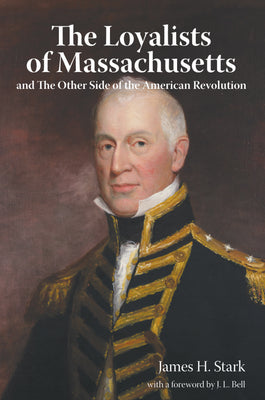
American Ancestors has just reissued James Henry Stark’s The Loyalists of Masssachusetts with a new foreword by me.

I came across a copy of Stark’s Loyalists of Massachusetts in my local library when I was early in my research on eighteenth-century Boston. I was struck by its combination of detailed research on exiled families and apparently still-hot resentment at how the whole Revolution thing turned out.

One notorious detail of this book is an illustration of Paul Revere on horseback—complete with fringed buckskin coat, beard, and vicious snarl.

In researching the publication of The Loyalists of Massachusetts for this foreword, I realized that Stark didn’t commission that and the other full-page illustrations. He reused them from an earlier history of the Revolution. He did, however, change the captions to make their message more pointed.

Stark published through his own printing company, which he had cofounded with a former “spirit photographer.” That gave him the freedom to devote hundreds of pages to “The Other Side of the American Revolution,” as his subtitle said.

I also looked into the reception of the book in 1910. Some reviewers thought Stark, a childhood immigrant from Britain, was too harsh on the Patriots. The press magnified that controversy. The argument became a front-page story in newspapers well outside New England as editors enjoyed the spectacle of elite Bostonians arguing over their ancestors’ actions.

Another of Stark’s interests was yachting. In fact, he was on a cruise when the controversy over his book broke out. I think he’d be pleased that the cover of this new edition shows Sir Isaac Coffin, alumnus of Boston’s South Latin School and admiral in the Royal Navy.

Wednesday, March 19, 2025

“The procession of the old clergymen who filled our pulpit”

Back in January I quoted Dr. Oliver Wendell Holmes on one of the impressive clergymen who came to preach in his father’s pulpit in Cambridge while he was a boy.

Young Oliver was born in 1809 in the house that had belonged to the Harvard College steward Jonathan Hastings. In 1775 the Massachusetts committee of safety and Gen. Artemas Ward took it over as the first rebel headquarters of the war.

In The Poet at the Breakfast Table, Holmes described some ministers whose names I know because they wrote recollections about the Revolutionary period when they themselves were boys.

Holmes recalled the Rev. Thaddeus Mason Harris (1768–1842) of Dorchester this way: “already in decadence as I remember him, with head slanting forward and downward as if looking for a place to rest in after his learned labors.”

The Rev. David Osgood (1747–1822) has made only one appearance in Boston 1775, guarding his privilege to perform all marriages in his town. Holmes recalled him as “the most venerable David Osgood, the majestic minister of Medford, with massive front and shaggy over-shadowing eyebrows.”

Holmes’s longest profile limned the “attenuated but vivacious little Jonathan Homer of Newton, who was, to look upon, a kind of expurgated, reduced and Americanized copy of Voltaire, but very unlike him in wickedness or wit.”

Homer (1759–1843) was minister of the first congregation in Newton, where Homer Street preserves his name. Holmes went on:
The good-humored junior member of our family [Holmes himself?] always loved to make him happy by setting him chirruping about Miles Coverdale’s Version, and the Bishop’s Bible, and how he wrote to his friend Sir Isaac (Coffin) about something or other, and how Sir Isaac wrote back that he was very much pleased with the contents of his letter, and so on about Sir Isaac, ad libitum,—for the admiral was his old friend, and he was proud of him.
Homer and Coffin had been classmates at the South Latin School, one becoming an American clergyman and the other a British admiral. Coffin’s recollections of life in that school were invaluable to me in writing about its culture.
The kindly little old gentleman was a collector of Bibles, and made himself believe he thought he should publish a learned Commentary some day or other; but his friends looked for it only in the Greek Calends,—say on the 31st of April, when that should come round, if you would modernize the phrase.
In other words, that magnum opus’s day of publication would never arrive.

Tuesday, December 19, 2023

“The house of a Tory, named Coffin”

As I quoted yesterday, in 1835 George R. T. Hewes told a story about Adm. John Montagu scolding the Bostonians who had just destroyed the East India Company’s tea and Lendell Pitts answering him.

That exchange took place, Hewes said, “at the house of a Tory, named Coffin, who lived at the head of the wharf.”

Montagu did have a connection with a Loyalist named Coffin. Nathaniel Coffin (1725–1780) was the cashier and receiver general in the Boston Customs Office.

Nathaniel’s son Isaac (1759–1839) joined the Royal Navy in 1772, and both the Naval Chronicle and Gentleman’s Magazine stated that Montagu sponsored the teenager’s commission. (Isaac Coffin went on to become an admiral himself.)

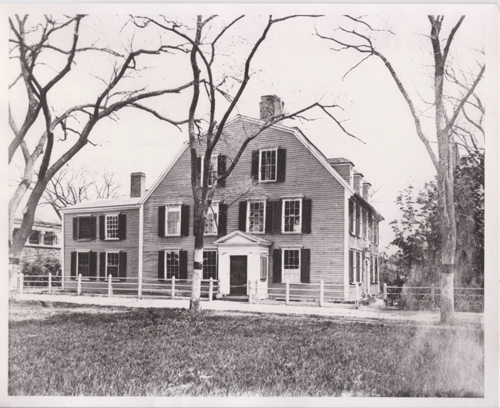
That said, Nathaniel Coffin’s house wasn’t at the head of Griffin’s Wharf. It was on the corner of Essex Street and modern Harrison Avenue. Though that estate was waterfront property, it didn’t abut Griffin’s Wharf.

We also have the evidence of Adm. Montagu’s report to his superiors in London, written on 17 Dec 1773. In that document, he said nothing about being in town to witness the destruction of the tea. It’s plausible that if he had been that close, the admiral wouldn’t have included that detail lest it raise questions about why he didn’t use his personal authority to stop the rioters.

But that scenario wouldn’t square with what Montagu did write in that report:
During the whole of this transaction neither the governor, magistrates, owner, nor the revenue officers of this place, ever called for my assistance. If they had, I could easily have prevented the execution of this plan, but must have endangered the lives of many innocent people by firing upon the town.
That sounds like Montagu was on his flagship, fully armed with cannon crew and marines who could shoot at the men on Griffin’s Wharf—at the risk of hitting the hundreds of other people watching them.

But if Montagu had been waiting for a request from the “governor, magistrates, [or] revenue officers” to use such force against the rioters, the last place he would have been would be in a house right beside that location and thus in firing range himself.

TOMORROW: And yet…

Thursday, June 15, 2017

A Coffin at Bunker Hill

Nathaniel Coffin (1725-80) was a merchant in Boston who in November 1768 took the job of Deputy Cashier to the American Board of Customs.

That shifted Coffin politically onto the side of the royal government. He would even report to his employers about Boston town meetings and private conversations with Whig leaders, but he never hid his distaste for protest and thus wasn’t really undercover.

With Coffin came his sons, John (1756-1838) and Isaac (1759-1839). They both joined the British military during the Revolutionary War and had long and distinguished careers. John became a general, judge, and legislator in New Brunswick. Isaac became an admiral, baronet, and Member of Parliament in England. Since this branch of the Coffin family still had relatives back in Massachusetts, they corresponded and visited with people in the U.S. of A. between and after the wars.

At the start of the war, it appears, John Coffin was a teenager helping to sail a troop transport ship. On 9 Jan 1819, Josiah Quincy (after he served in Congress but before he was elected mayor) recorded a story about Coffin in his diary:
In conversation with William Sullivan. He dined yesterday in company with General Coffin of the British army. Coffin said, that he had the command of the first boat (being then Lieutenant of a transport ship) which landed the advance of the first regiment of British grenadiers at the attack of Bunker’s Hill. As the boat touched the shore, a three-pound shot from the American lines passed lengthways over the boat, touched not a man, and beat out her stern.

Further service with his boat being thus rendered impracticable, Coffin took a musket, joined the assailants, and was in the midst of the battle. He said that he had been since that time in many engagements, but never knew one, for the time it lasted, so hot and destructive.
Quincy evidently wrote this down because “The anecdote proves what has been denied,—that artillery was used on the American side in the battle of Bunker’s Hill.” There’s ample evidence of such artillery from other sources, but American chroniclers had preferred to portray their side as total underdogs. In fact, the diary of Lt. Richard Williams tells us that the provincials were firing five-pound balls, even bigger than what Gen. Coffin described whizzing past him.

The biography of John Coffin published by his son in 1874 goes into more detail, though not necessarily more reliable detail. It said:
John…was sent to sea at a very early age, and served his time in a Boston Ship; being an active young man he soon rose in the estimation of his Captain: in due time became Chief-mate, and soon after was placed in command of the ship, at the early age of eighteen.

In 1774, Mr. John Coffin brought his ship to England; the following year the Government took her up amongst others for the conveyance of troops to America, where the war had commenced. He had on board nearly a whole Regiment with General Howse (in command of the troops), who was ordered out to supersede General [Thomas] Gage, at Boston.
We know Gen. William Howe actually arrived in Boston on 25 May 1775 aboard the Royal Navy ship Cerberus, along with Gen. John Burgoyne and Gen. Henry Clinton. Other ships and soldiers arrived around the middle of June, and Coffin may well have been working on one of those ships instead.
The vessel arrived at Boston, on the 15th of June, Mr. Coffin landed the Regiment immediately under Bunker’s Hill, and the action having already commenced (17th June, 1775), he was requested by the Colonel “to come up and see the fun;” the only weapon at hand being the tiller of his boat, he immediately (to use a nautical phrase) unshipped it, and with equal determination commenced laying about him, and shipped the powder and belt, and musket of the first man he knocked down, and bore an active part during the rest of the action.
This is even more dramatic than the anecdote Quincy recorded, but the only men who would have been within reach of Coffin’s tiller as he was really “laying about him” would have been British soldiers.
In consideration of his gallant conduct, he was presented to General Gage after the battle, and made an Ensign on the field; shortly after he was promoted to a Lieutenant, but still retained the command of his ship.
There’s no documentary support for any of that. John Coffin was commissioned as a captain in the Orange Rangers, a Loyalist corps, in 1777.

Sunday, November 16, 2008

A Digital Library from London

My last new online resource for the week is British History Online, a “digital library containing some of the core printed primary and secondary sources for the medieval and modern history of the British Isles...Created by the Institute of Historical Research and the History of Parliament Trust.” It looks especially useful for British history and genealogy, but I came across it while Googling for information on an American family.

Among the printed sources digitized on British History Online and available for free (as opposed to by paid subscription only) are the Journals of the Board of Trade and Plantations, the official notes of the board that governed commerce in the British Empire.

Those notes cover a meeting in February 1777 when the board members reviewed a:

Copy of a letter from Mr. Gridley to Mr. Read, relative to the sea cow fishery, and the annoyance given thereto by two New England schooners. Remarks upon the sea cow fishery.
The board met again in April 1777 and:
Read a memorial of Mr. Gridley, praying to be recommended for a grant of the Madelaine Islands in the Gulph of St. Lawrence, upon certain duties and conditions, for the purpose of carrying on the sea cow fishery.

Their lordships, agreable to a minute of the Board of the 6th of February, 1771, were of opinion, that such a grant ought not to be made without a valuable consideration being given to the Crown for the same.
Samuel Gridley had been petitioning that board for an exclusive right for his family to hunt seals and walruses on the Magdalen Islands since early 1763. He based his request on his Boston-born father’s service to the Crown in the wars against the French, as recorded in March 1772:
Read a memorial of Samuel Gridley of the city of Bristol, merchant, stating the services of his father Colonel [Richard] Gridley, and praying, that, in consideration of the great expence that both himself and his father have been at, and the losses they have sustained, in making establishments and carrying on these a cow fishery in the Magdalene Islands, the said islands may be granted to him in preference to any other person, or that the person, to whom they may be granted, shall be obliged to reimburse him for the very usefull and necessary buildings and improvements erected and made there.
The irony of Samuel Gridley’s 1777 complaint about “New England schooners” was that by that time his father had become a colonel in the Continental Army. Richard Gridley was in fact the first commander of the American artillery, starting in April 1775. He had fought in some of the early skirmishes of the war, laid out the redoubt on Breed’s Hill, and was wounded in the ensuing Battle of Bunker Hill. Samuel’s younger brother Scarborough was also an officer in that artillery regiment, though not a good one.

By 1777, the colonel had been kicked upstairs to a position as Chief Engineer for the Northern Department, replaced in the field with Henry Knox. Scarborough was out of the army altogether. But Samuel was still pushing for the Crown to grant him the sole right to hunt those walruses based on family loyalty.

He didn’t get it. Within a couple of years, I understand, Samuel made his way back to Massachusetts. The London government eventually granted those islands to another, more loyal son of Boston: Admiral Sir Isaac Coffin.

I have to thank David B. Ingram, an expert on the Gridley family, for this lead. He actually found all this stuff some years ago when it was available only in printed volumes or in the actual London archives. I was following up his lead about the New England schooners when Google brought me to the British History Online site, giving me another reason to be grateful to Dave.