J. L. BELL is a Massachusetts writer who specializes in (among other things) the start of the American Revolution in and around Boston. He is particularly interested in the experiences of children in 1765-75. He has published scholarly papers and popular articles for both children and adults. He was consultant for an episode of History Detectives, and contributed to a display at Minute Man National Historic Park.

Subscribe thru Follow.it


•••••••••••••••••


Showing posts with label William Gordon. Show all posts

Sunday, June 21, 2026

“The detachment marched upon this design to Breed’s hill”

After the British army drove provincial troops off the Charlestown peninsula on 17 June 1775, the Massachusetts committee of safety proposed an inquiry into what happened.

Nominally the committee wanted to respond to statements from Gen. Thomas Gage. But I’m pretty sure those politicians were also wondering what factors led to losing the Battle of Bunker Hill.

On 6 July the committee urged the Massachusetts Provincial Congress to form a committee to write this report. The next day, the congress handed that responsibility back to the committee of safety.

The committee then commissioned three Patriot clergymen—the Rev. Peter Thacher (1752–1802, shown here), William Gordon, and Samuel Cooper—to produce the report. Thacher’s draft was published by the American Antiquarian Society. The final report, dated 25 July, appears in the Adams Papers.

The report says that the New England commanders’ plan was to fortify Bunker’s Hill, near the Charlestown neck:
Genl. Gage had issued Orders for a Party of Troops under his Command, to post themselves on Bunkers Hill, a Promontory just at the Entrance of the Peninsula of Charlestown; upon which it was determined, with the Advice of this Committee, to send a Party who might erect some Fortifications upon said Hill and defeat this Design of our Enemies.
But that’s not what happened.

Thacher’s draft is transcribed as:
about 9 o clock in the evening the detachment marched upon this design to Breed’s hill situated on the further part of the peninsula next to Boston, for by a mistake of orders this hill was marked out for the entrenchment instead of the other hill.
Thacher initially finished that sentence to “the hill behind, Bunkers,” a perspective that conflicted with his earlier “the further part of the peninsula.” And should “next to” be “west of,” as in the final report?

After editing for clarity and brevity, the final language was:
just before 9 oClock they left Cambridge, and proceeded to Breeds Hill, situated on the further Part of the Peninsula West of Boston, for by some Mistake this Hill was marked out for the Entrenchment instead of the other…
That report thus officially distinguished between Bunker’s Hill and Breed’s Hill. As laid out in previous postings, the term “Breed’s Hill” hadn’t appeared in print until shortly after the battle. This report deemed that distinction significant—indeed, a matter of life and death.

Thus, the name “Breed’s Hill” for that part of Charlestown’s geography was solidified by the battle fought there and the need to discuss it. Before June 1775, that might have been the local name, or one of the local names, but it wasn’t on any map, any official document, or any known letter. By the end of July, the “mistake” about Breed’s Hill was on its way to being notorious.

TOMORROW: What difference does it make? 

Monday, June 01, 2026

When Did People Start Talking about “Tarleton’s Quarter”?

Last week saw the anniversary of the Battle of Waxhaws in South Carolina on 29 May 1780. That was a lopsided bloody victory for the British.

Todd Braisted, the historian of Loyalists, noted that many anniversary descriptions of that battle were stating that it gave rise to the sarcastic term “Tarleton’s quarter” for attacking foes trying to surrender, and that that phrase became a rallying-cry for Americans later in the war.

He asked on Facebook whether there is any contemporaneous evidence for that claim. The phrase doesn’t appear in American newspapers of the 1780s. No one was able to point to a letter using the term. If a phrase was really so widespread, why doesn’t it appear more often?

Steve Rayner found what might be the earliest print use of the phrase in Charleston author David Ramsay’s History of the Revolution of South-Carolina, vol. 2 (Trenton: 1785):
Lord Cornwallis bestowed on lieutenant colonel [Banastre] Tarleton the highest encomiums for this enterprize, and recommended him in a special manner to royal favour. This barbarous massacre gave a more sanguinary turn to the war. Tarleton’s quarters became proverbial, and in the subsequent battles a spirit of revenge gave a keener edge to military resentments.
At that time Ramsay was representing his state at the Confederation Congress, which was meeting in Trenton. That’s why this history of South Carolina wasn’t published in Charleston.

Three years later, the Rev. William Gordon (or his ghostwriter) lifted Ramsay’s sentences with minimal rewriting into The History of the Rise, Progress, and Establishment of the Independence of the United States of America, vol. 3 (London: 1788):
Lord Cornwallis bestowed on Tarleton the highest encomiums for this enterprise, and recommended him in a special manner to royal favor. Tarleton’s quarters is become proverbial; and in subsequent battles a spirit of revenge will give a keener edge to military resentments.
British supporters of the American republic picked up the phrase. The Scottish pamphleteer James Thomson Callender issued The Political Progress of Britain anonymously in Edinburgh in 1792. He started to revise and expand that text for a second edition but was arrested on 2 Jan 1793.

Callendar “with some difficulty made his escape” first to Ireland, then to America. Encouraged by Thomas Jefferson, he reprinted The Political Progress of Britain in Philadelphia in 1795. Later that year Callendar published a much expanded third edition, which on page 119 reels off a list of British government atrocities:
The peninsula within the Ganges, is the grand scene, where the genius of British supremacy displays its meridian splendour. Culloden, Glencoe, and Darien, the British famine of four years, Burgoyne’s tomahawks, Tarleton’s quarters, the Jersey prison-ship, and the extirpation of six hundred and fifteen thousand Irish men, women and children, dwindle from a comparison.
Callender evidently expected his readers (now primarily Americans) to recognize all those events without needing explanations. “Tarleton’s quarters” had indeed become proverbial, he believed.

That same year, back in London, William Belsham published his Memoirs of the Reign of George III, discussing the fight at Waxhaws in vol. 2:
This movement caused an immediate retreat of such corps as had been there collected for the relief of Charlestown. One of these was unexpectedly attacked and surrounded by Tarleton’s legion, which had marched one hundred and five miles in fifty-four hours. A very feeble resistance was made, and by far the greater part immediately threw down their arms, and begged for quarter: but a few continuing to fire, the British cavalry were ordered to charge, and a terrible slaughter was made amongst the unarmed and unresisting Americans; and from this time Tarleton’s quarter became proverbial.
That seems to be the first appearance of the phrase in a singular form, which became standard in American books in the next century.

The way Gordon and Belcham echoed Ramsay’s “became proverbial” wording shows that those authors, who had no ties to South Carolina, relied on Ramsay’s book. All traces of the phrase lead back to him.

Back in early 1780, Ramsay had been a military surgeon serving with the South Carolina militia. He was captured in the fall of Charleston and then held as a prisoner of war in Florida for nearly a year. Ramsay therefore didn’t have first-hand experience of how Patriots in the countryside reacted to the Battle of Waxhaws, but he undoubtedly knew people who were there.

It would be nice if we could find examples of people referring to “Tarleton’s quarter(s)” during the war, especially if we claim that phrase spread widely and inspired American fighters. It’s possible that Ramsay coined or refined the phrase to express how people had felt a few years before, or that he overstated how many people repeated it at that time. But we can be sure this phrase didn’t arise in the 1800s, unlike other oft-repeated tropes of the Revolution. 

Friday, March 06, 2026

“By ten o’clock at night the troops have raised two forts”

Yesterday I quoted Gen. William Howe’s report on how he discovered and responded to the Continental Army fortifications on the heights of the Dorchester peninsula.

From the American side, one of the chroniclers closest to the action was the Rev. William Gordon of Roxbury. In his 1788 history he offered a detailed account of the Continental operation, which I’ll quote at length.

Folks who dislike historians describing events in the present tense may need to grit their teeth for a while.
All things being ready on Monday [4 Mar 1776]; as soon as the evening admits, the expedition goes forward. The covering party of 800 men lead the way; then come the carts with the intrenching tools; after them the main working body of about 1200 under general [John] Thomas: a train of more than 300 carts, loaded with fascines; hay in bundles of 7 or 800 weight, &c. close the martial procession.

The bundles of hay are designed for Dorchester neck, which is very low, and exposed to be raked by the enemy; and are to be laid on the side next to them [i.e., towards Boston], to cover the Americans in passing and repassing. Every man knows his place and business. The covering party, when upon the ground, divides; half goes to the point nearest to Boston, the other to that next to the castle.

All possible silence is observed. But there is no occasion to order the whips to be taken from the waggoners, lest their impatience, and the difficulty of the roads should induce them to make use of them, and occasion an alarm. The whips used by the drivers of these ox carts, are not formed for making much noise, and can give no alarm at a distance. The men in driving their oxen commonly make most noise with their voices; and now a regard to their own safety dictates to them, to speak to their cattle, as they move on, in a whispering note.

There are no bad roads to require an exertion; for the frost having been of long continuance, they are so hard frozen as to be quite good. The wind lies so as to carry what noise cannot be avoided by driving the stakes and picking against the ground, (still frozen above eighteen inches deep in many places) into the harbour between the town and the castle, so that it cannot be heard and regarded by any who have no suspicion of what is carrying on especially as there is a continued cannonade on both sides.

Many of the carts make three trips some four; for a vast quantitiy [sic] of materials have been collected, especially chandeliers and facsines [sic]. By ten o’clock at night the troops have raised two forts, one upon each hill, sufficient to defend them from small arms and grape shot. The night is remarkably mild, a finer for working could not have been sellected out of the three hundred and sixty-five. They continue working with the utmost spirit, till relieved the Tuesday morning (March 5.) about three. It is so hazy below the height that the men cannot be seen, though it is a bright moon-light night, above on the hills.

It is some time after day break before the ministerialists in Boston can clearly discern the new erected forts. They loom to great advantage, and are thought to be much larger than is really the case. General Howe is astonished upon seeing what has been done; scratches his head and is heard to say, “I know not what I shall do; the rebels have done more in one night, than my whole army would have done in months.”
That last remark is the sort that New Englanders liked to tell themselves the British commanders had made, not questioning how anyone on their side of the lines could know. And who knows? It may even be true.

TOMORROW: Does the empire strike back?

Thursday, April 24, 2025

Esther Sewall and “the female Connections”

In the fall of 1774 and winter of 1775, Massachusetts attorney general Jonathan Sewall appears to have worked as an advisor to the royal governor, Thomas Gage.

With the courts closed by crowds and Gage’s authority confined to Boston, there wasn’t much else for Sewall to do.

There’s a renewed debate about whether Sewall wrote the “Massachusettensis” essays published in those months. Patriots of the time believed he did, but his former law trainee Ward Chipman described copying them out for another Loyalist lawyer, Daniel Leonard. In 2018 a team led by Colin Nicolson reported in the New England Quarterly that their linguistic analysis pointed the finger back at Sewall.

In early April 1775, a dispatch from Lord Dartmouth brought instructions to arrest the leaders of the Massachusetts Provincial Congress. Gen. Gage might well have discussed the legalities of such arrests with his attorney general.

The president of that congress was John Hancock. His fiancée, Dorothy Quincy, was the sister of Esther Sewall, the attorney general’s wife. On 7 April, James Warren wrote to his own wife:
The Inhabitants of Boston are on the move. H[ancock] and A[dams] go no more into that Garrison, the female Connections of the first come out early this morning and measures are taken relative to those of the last.
Dorothy Quincy was soon staying with Hancock and Samuel Adams at the parsonage in Lexington.

As discussed yesterday, though Esther Sewall was married to a leading Massachusetts Loyalist, she was still emotionally attached to her family, friends, and neighbors on the Patriot side. She might have heard her husband talk of Hancock and Adams being arrested. Any military operation to do that could put her sister in danger.

Esther Sewall therefore had a motive and possible means to be the “daughter of liberty, unequally yoked in point of politics,” who sent a warning that British soldiers might arrest Hancock and Adams, as the Rev. William Gordon later wrote. When I first discussed that question, I didn’t see how Esther would have had access to inside information. Jonathan’s work with Gov. Gage offers a possible answer. (And, we must remember, this “daughter of liberty” did not have information on Concord as Gage’s real target.)

A few months into the siege of Boston, Jonathan and Esther Sewall sailed for London. They remained yoked together for the rest of his life. But neither of them was happy. For most of those years Jonathan was seriously depressed, often confined to his bedroom. Esther was terribly homesick. Jonathan blamed Esther for his difficulties. Yet she stayed with him.

Esther Sewall made two trips back to Massachusetts, first in 1789 and then in 1797, the year after she became a widow. Her grown sons Jonathan and Stephen became important lawyers in Canada, and she settled in Montreal.

In 1809, Esther sued in Massachusetts court for her dower property, confiscated thirty years before as part of Jonathan’s assets. Though she didn’t live to hear about it, the state’s highest judges decided in her favor. Then the Massachusetts General Court passed a special law to compensate the man who’d bought that property for what he had to pay her estate. So the Massachusetts government ended up paying Esther Sewall money.

Tuesday, April 22, 2025

“A daughter of liberty, unequally yoked in point of politics”?

In his 1788 history of the American Revolution, the Rev. William Gordon shared this anecdote about what led up to the British army march on Concord:
A daughter of liberty, unequally yoked in point of politics, sent word, by a trusty hand, to Mr. Samuel Adams, residing in company with Mr. [John] Hancock at Lexington, about thirteen miles from Charlestown, that the troops were coming out in a few days.
Gordon was close to Adams, as other stories in his book indicate. Adams clearly knew the identity of this “daughter of liberty,” and Gordon might have known as well, but the book kept her name secret. Presumably she was still expected to appear loyal to a husband whose politics she didn’t share.

Some authors have taken this early statement as evidence that Margaret Gage might have leaked her husband’s plan for the march on Concord to Dr. Joseph Warren just before he dispatched William Dawes to Lexington. I don’t think that holds up to scrutiny, from several angles.

First, this “daughter of liberty” provided information to Adams, not Warren, and “a few days” before the march, not the evening it began. There’s no reason to believe those two informants were the same person—nor any indication that Warren’s source was a woman. (Once again, I think the doctor got the dope from William Jasper.)

Second, this “daughter of liberty” was worried that Hancock and Adams would be arrested, as was Warren, but someone truly privy to Gen. Thomas Gage’s plan would have known he was focused on the military supplies in Concord.

Third, while Margaret Gage expressed sadness at the prospect of war between Britain and the American colonies, she never showed any affinity for the Patriot cause. In fact, there doesn’t appear to be any evidence she ever even met Patriot leaders.

I think there are many stronger candidates to be this “daughter of liberty, unequally yoked in point of politics.” (Gordon took that phrase “unequally yoked” from Paul’s second epistle to the Corinthians.)

In my talk to the Colonial Society of Massachusetts last week, now viewable online, I shared my current idea of the most likely candidate.

TOMORROW: Gosh, this is suspenseful, isn’t it?

Saturday, April 05, 2025

Counting the “Loyall Nine”

In a 19 Dec 1765 letter divulging details about Boston’s latest Stamp Act protest, and earlier ones, Henry Bass wrote of the organizers as “the Loyall Nine.” He added:
And upon the Occasion we that Evg. had a very Genteel Supper provided to which we invited your very good friends Mr. S[amuel] A[dams] and E[des] & G[ill] and three or four others and spent the Evening in a very agreable manner Drinkg Healths etc.
On 15 Jan 1766 John Adams wrote in his diary:
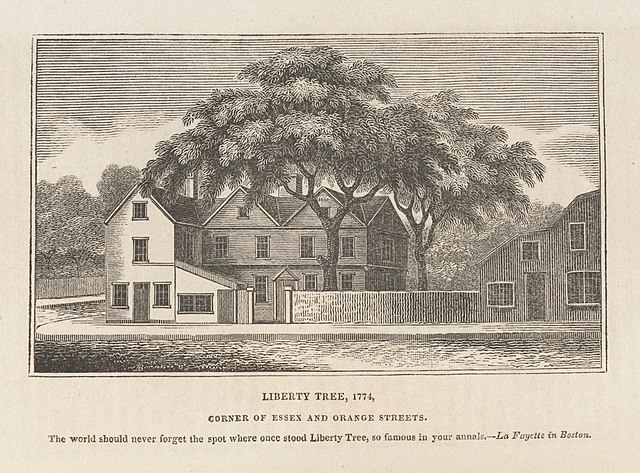
Spent the Evening with the Sons of Liberty, at their own Apartment in Hanover Square, near the Tree of Liberty. It is a Compting Room in Chase & Speakmans Distillery. A very small Room it is.

John Avery Distiller or Merchant, of a liberal Education, John Smith the Brazier, Thomas Crafts the Painter, Edes the Printer, Stephen Cleverly the Brazier, [Thomas] Chase the Distiller, Joseph Field Master of a Vessell, Henry Bass, George Trott Jeweller, were present.

I was invited by Crafts and Trott, to go and spend an Evening with them and some others, Avery was mentioned to me as one.
Finally, in 1788 the Rev. William Gordon wrote in his history of the Revolution about the first anti-Stamp protest, back in August 1765:
Messrs. John Avery, jun. Thomas Crafts, John Smith, Henry Welles, Thomas Chace, Stephen Cleverly, Henry Bass, and Benjamin Edes…provide and hang out early in the morning of August the fourteenth, upon the limb of a large old elm, toward the entrance of Boston, over the most public street, two effigies,…
Those sources, which were published in reverse chronological order, all seem to refer to the same group of men. The lists of names overlap—but not exactly.

Bass said there were nine men, and seemed to treat Samuel Adams, Edes, and Gill all as guests. Gordon named eight men, including Edes among them. John Adams also listed Edes in the group, and he treated George Trott, not on Gordon’s list, as in the group.

John Adams didn’t list Henry Wells from Gordon’s list (though Tea Leaves and some subsequent books misquote him as doing so). Instead, Adams named Joseph Field, saying he was a ship captain. According to mentions in the Boston press before he died in 1768, Henry Wells was also a ship captain. Would either of them have been in town long enough to help plan protests? 

It’s therefore difficult to say exactly who the “Loyall Nine” were, but there was definitely a political club supping at the Chase distillery near Liberty Tree and organizing the protests under that tree.

TOMORROW: A change of names?

Thursday, December 12, 2024

“You found the money and Sam Adams the brains”

For the first years of the Revolutionary War, Massachusetts continued to operate on the basis of its provincial charter.

The General Court was elected each year, starting in the summer of 1775, when it took over from the Provincial Congress. Its members chose a Council.

That Council exercised executive power, as the charter had specified for times when the royally-appointed governor and lieutenant governor were absent from the province. Which they were, for obvious reasons.

It took years, and two tries, before the towns of Massachusetts ratified a new constitution in 1780. That provided for a governor again—to be elected by the people rather than appointed.

On 19 October, the Rev. William Gordon of Roxbury wrote to John Adams, then on a diplomatic mission in Europe, about that choice:
Mr. [John] Hancock will be governour, unless Death should prevent it. I was employed by a Boston representative under the rose, to plead with Mr. [James] Bowdoin that pro bono publico [for the good of the public] he would condescend to serve as Lt. Govr.: I urged that plea, and encourage the expectation from his not declaring off, that, if the Genl. Ct. are pritty well agreed, he will not decline. He will be a good poize, and prevent undue influence and eccentric motions.

Some time back several persons dined together with the above mentioned, the conversation turned upon old matters, a country booby of a representative said, “ay I remember we used to say that you found the money and Sam Adams the brains.” A pause commenced for some minutes before the conversation was renewed. The poor mortal, upon being afterwards spoken to upon the impropriety of his remark, apologized by pleading, it was the truth and he thought there could be no hurt in speaking it.
This was during a rift between Hancock and Samuel Adams, with Gordon on Adams’s side and relishing anecdotes that made Hancock look foolish.

Hancock did indeed become governor less than a week later, but his lieutenant governor was Thomas Cushing. Bowdoin was the next elected governor, serving two difficult terms before losing to Hancock, who had decided he was healthy again. Eventually Samuel Adams became lieutenant governor under Hancock, and then succeeded him in 1793.

Friday, June 28, 2024

“A ministerial member pleaded a call of nature”

The Massachusetts House started its session on Friday, 17 June 1774, at 9:00 A.M.

The first action was a committee report on a land grant, which the legislators read and accepted.

Then came the all-important “Committee appointed to consider the State of the Province.” The House approved a motion “The the Gallaries be clear’d and the Door be shut.”

Ordinarily this step was to keep spectators away from sensitive discussions before official votes, so legislators could speak freely and discuss compromises. In this case, however, House clerk Samuel Adams and his allies also wanted to keep people in.

The Rev. William Gordon recounted:
They had their whole plan compleated, prepared their resolves, and then determined upon bringing the business forward. But before they went upon it, the door-keeper was ordered to let no one whatsoever in, and no one was to go out:

however, when the business opened, a ministerial member pleaded a call of nature, which is always regarded, and was allowed to go out.

He then ran to give information of what was doing, and a messenger was dispatched to general [Thomas] Gage, who lived at some distance.
Inside the Salem courthouse, the committee laid out their recommendations. First, the General Court would appoint five men to represent Massachusetts at an upcoming “Meeting of Committees from the several Colonies on this Continent”—what became known as the Continental Congress.

The designated men were:
At that moment Adams and Cushing were leading the discussion in the chamber. Bowdoin was home sick, Adams was in Boston, and Paine on his way back to Salem from Taunton with fellow legislator Daniel Leonard.

The House then approved paying £500 for those five men’s expenses traveling and staying wherever the congress met. Finally, with a lot more verbiage than I’ll reproduce, the chamber resolved that this “Meeting of Committees” was so important that it urged towns to come up with that £500 outside of the regular tax system in case the Council didn’t get around to approving this bill or the governor vetoed it.

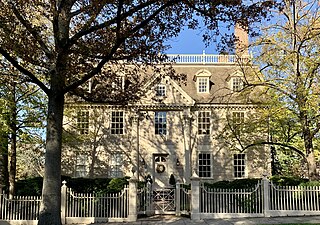
By this time word had reached Gage at the house he rented in Danvers (shown above at its new location). He knew what the General Court was up to.

TOMORROW: The key.

Wednesday, June 26, 2024

“Keep the committee in play, and I will go and make a caucus”

In addition to Robert Treat Paine’s recollection quoted here, the Rev. William Gordon’s early history of the American Revolution offers another peek at the delicate political maneuverings in Salem in June 1774.

Gordon wrote:
Mr. Samuel Adams observed, that some of the committee were for mild measures, which he judged no way suited to the present emergency. He conferred with Mr. [James] Warren of Plymouth upon the necessity of giving into spirited measures, and then said, “Do you keep the committee in play, and I will go and make a caucus against the evening; and do you meet me.”

Mr. Samuel Adams secured a meeting of about five principal members of the house, at the time specified; and repeated his endeavours against the next night; and so as to the third, when they were more than thirty; the friends of administration knew nothing of the matter. The popular leaders took the sense of the members in a private way, and found that they should be able to carry their scheme by a sufficient majority.
Adams and his team came up with a two-step plan.

First, the Massachusetts House would appoint delegates to a Continental Congress, an idea raised by the Providence town meeting, the Virginia House of Burgesses, and other political allies outside of the colony. The House would also alert all its counterparts of that step and urge them to participate as well.

But then there was the age-old question of how to pay for this. Sending five gentlemen to Philadelphia would cost upwards of £500. Any legislative action involving money, even if it passed the Council, could be vetoed by Gov. Thomas Gage.

The solution was to write a bill authorizing that expenditure of £500 and then adding this clause:
Wherefore this House would recommend, and they do accordingly hereby recommend to the several Towns and Districts within this Province, that each Town and District, raise, collect and pay, to the Honorable THOMAS CUSHING, Esq; of Boston, the Sum of FIVE HUNDRED POUNDS by the Fifteenth Day of August next, agreeable to a List herewith exhibited, being each Town and District’s proportion of said Sum, according to the last Province Tax, to enable them to discharge the important Trust to which they are appointed; they upon their Return to be accountable for the same.
Adams’s unofficial caucus managed to formulate that plan without official committee member Daniel Leonard or other Loyalists catching on.

The next problem was how to pass those resolutions through the House. As Paine wrote:
it was Considered that the regular Method was for the Committee on the State of the Province to make report of these doings as their Report; eight of that Committee were then present, but the ninth [Leonard] was known to be adverse to any Such measure & therefore could not be trusted, least the whole should be defeated by the Governor;…
If Gov. Gage learned about the measures that the House was discussing, he could use his constitutional authority to shut down the legislature entirely.

TOMORROW: The Bristol feint.

Wednesday, April 24, 2024

“Two rough stones mark the spot”

Back in 2013, Boston 1775 published a series of postings about the British soldiers killed at the North Bridge in Concord, and what happened to their bodies.

Based on reports from army officers, the royal authorities complained in print that a soldier left wounded at the bridge had been “scalped” and otherwise mutilated.

The Massachusetts Provincial Congress vigorously denied that charge. It published this deposition, taken down by justice of the peace Duncan Ingraham:
We, the subscribers, of lawful age, testify and say, that we buried the dead bodies of the King’s troops that were killed at the North-Bridge in Concord, on the nineteenth day of April, 1775, where the action first began, and that neither of those persons were scalped, nor their ears cut off, as has been represented.

Zechariah Brown,
Thomas Davis, jun.

Concord, May 11th, 1775.
Privately, however, militiamen who had been at the bridge deplored what they had seen. To begin with, that soldier had still been alive. Thomas Thorp of Acton recalled in 1835: “I saw him sitting up and wounded, as we had passed the bridge.” His killing “was a matter of horror to us all.”

In June 1775 the Rev. William Gordon acknowledged in print that “A young fellow…very barbarously broke his scull and let out his brains, with a small axe.” Gordon did not excuse that act, but he did insist it wasn’t scalping.

Still, Gordon’s source, the Rev. William Emerson of Concord, and other locals kept the young killer’s name secret. Charles Handley of Acton recalled: “The young man man who killed him told me, in 1807, that it had worried him very much; but that he thought he was doing right at the time.” It took more than a century before his name came out: Ammi White.

As for the dead soldiers, in 1827 the Concord minister Ezra Ripley wrote: “The two British soldiers killed at the bridge were buried near the spot where they fell, both in one grave. Two rough stones mark the spot where they were laid.”

In 1793 the town of Concord built a new bridge downstream. The span of the old bridge was dismantled, but some end portions remained. The pieces on the south side served as another landmark reminding locals where the two British men were buried.

TOMORROW: Erecting a monument.

Wednesday, April 17, 2024

Mercy Warren in History

Since I’ve been writing about the Warrens of Plymouth in 1775, it seems appropriate to mention that there’s a push to increase Mercy Warren’s visibility as the Sestercentennial proceeds.

Last month Nancy Rubin Stuart published this profile of Mercy Warren as “America’s First Female Historian” in the Saturday Evening Post.

Michele Gabrielson portrayed Warren in two episodes of the Calling History podcasts, which records first-person interpretations of historical figures.

And those folks and others launched a nonprofit organization called Celebrate Mercy Otis Warren, which can be found on Facebook.

One of that group’s goals is to have a bust of Warren installed in the Massachusetts State House, perhaps in the one empty spot in the senate chamber.

A bill promoting that plan has been moving through the legislature. As of today, the proposed language is:
The superintendent of state office buildings shall, subject to the approval of the State House Art Commission as to size and content, install and maintain in a conspicuous place of the Art Commission’s choosing in the State House, a memorial honoring Mercy Otis Warren, of Barnstable, Massachusetts, a leading author, playwright, satirist, and patriot in colonial Massachusetts, whose essays contributed to the creation of the Constitution’s Bill of Rights, and whose book, History of the Rise, Progress, and Termination of the American Revolution became this country's first published history of the American Revolution. Said memorial shall be the gift of Cape Cod artist David Lewis who will bear all costs associated with the creation, transportation, and installation of the artwork.
Lewis has already created a full-size statue of Warren shown above. It towers in Barnstable, the town where she was born.

Now I realize part of the Massachusetts legislature’s job is to boost the state’s products, but there were histories of the American Revolution published before Warren’s in 1805. At the time people pointed to David Ramsay’s History of the American Revolution from 1789. Michael Hattem’s superb chronology of the historiography likewise pairs Ramsay and Warren.

(A year even before Ramsay came the Rev. William Gordon’s History of the Rise, Progress, and Establishment, of the Independence of the United States of America. I suppose it doesn’t get counted as “this country’s first” because it was printed in Britain, and in some part written there. However, Gordon clearly composed a lot of material while living in Roxbury. Like Mercy Warren, he knew most of the local players.)

Of course, by coming later Warren’s book could cover the establishment of the federal government. Her final chapter describes the Shays’ Rebellion, the Constitutional Convention, and George Washington’s terms as President, with particular attention to the Jay Treaty. And then some remarks on John Adams that caused a deep rift between him and the Warrens.

I think that although Warren wrote history (just as she had earlier written poetry and closet dramas), her calling and strength were as an opinion writer. She didn’t disguise her feelings about Adams or the Federalist program overall. Writing in a Jeffersonian era, however, Warren was optimistic:
The wisdom and justice of the American governments, and the virtue of the inhabitants, may, if they are not deficient in the improvement of their own advantages, render the United States of America an enviable example to all the world of peace, liberty, righteousness, and truth.

Sunday, July 24, 2022

“Rather optimum conditions for a mid-June day”

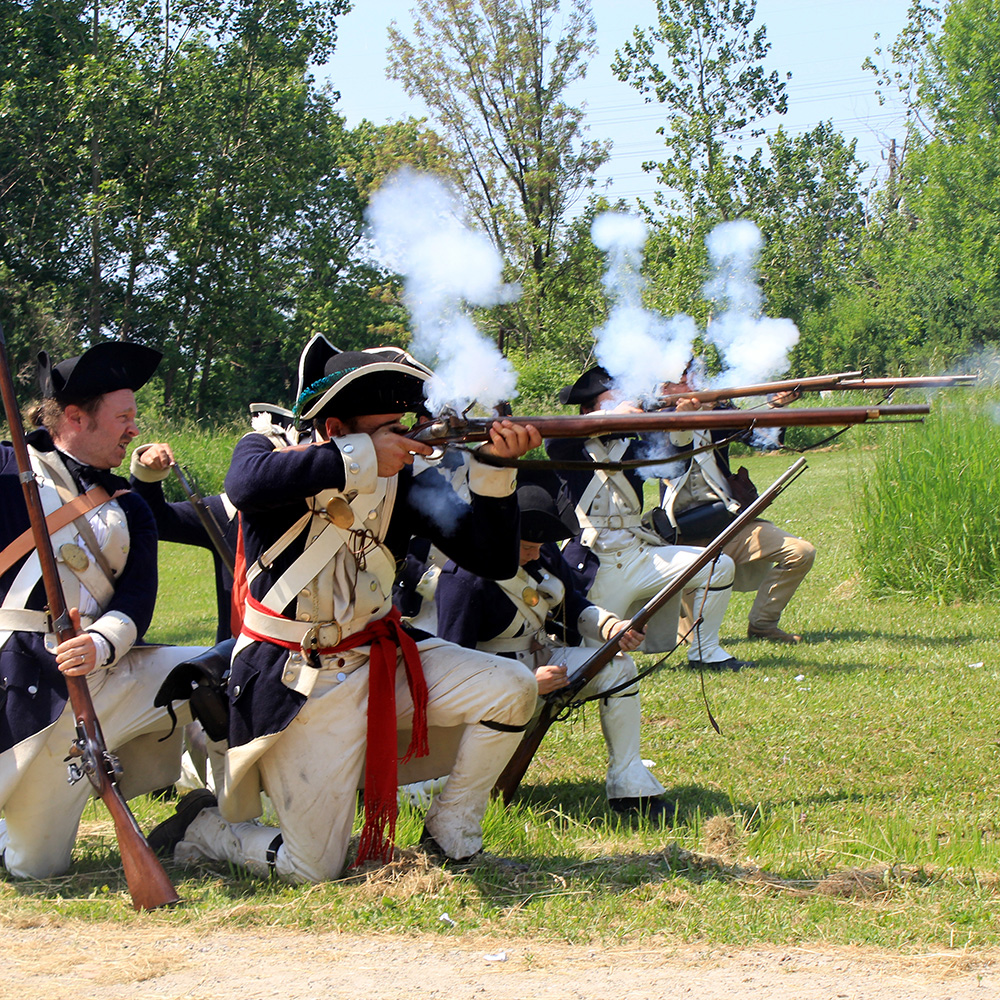
Yesterday I visited the reenactment of the Battle of Bunker Hill hosted by the American Heritage Museum in Hudson.

Today the whole thing happens again, and it’s supposed to be even warmer. Far warmer than the actual battle.

In The Weather Factor (1984), David Ludlum collected meteorological observations from 1775 and wrote:
As in the case of many other summertime battles fought long ago, the tradition gradually grew that it took place on “a very hot day.” A historian in 1788 declared the day of Bunker Hill was “exceeding hot.” Another, writing in 1833, told his readers, “The Battle of Bunker’s Hill, it will be recollected, was fought on one of the hottest days ever known in this country.”

To set the record straight, the engagement now known as the Battle of Bunker Hill was fought on the afternoon of June 17, 1775, under rather optimum conditions for a mid-June day—the ground was dry, the sky was clear, the temperature was warm but not excessively so, and the air was still relatively dry, though growing more humid hourly.

If the action had taken place a day or two later, conditions would have been much warmer, more humid, and the atmosphere more uncomfortable for the participants.
The first author Ludlum corrected was the Rev. William Gordon in his History of the Rise, Progress, and Establishment, of the Independence of the United States of America.

The second quotation came from Catherine R. Williams’s life of Stephen Olney of Rhode Island, paired with a similar life story in Biography of Revolutionary Heroes in 1839. Because the Rhode Island troops were then stationed on the southern wing of the siege lines, Olney was not actually involved in the battle.

Monday, January 31, 2022

“One of the flings of the time upon Mrs. Gage”

I went looking for the first author to argue that Margaret Gage betrayed her husband, Gen. Thomas Gage, by revealing his plan for the march to Concord in April 1775.

Instead, I found a series of authors, mostly American, denying the likelihood of that event and blaming the very idea on carping British army officers.

The earliest example I’ve seen so far is the Rev. Edward Everett Hale in The Memorial History of Boston (1881):

The General said that his confidence had been betrayed, for that he had communicated his design to only one person beside Lord Percy. This is one of the flings of the time upon Mrs. Gage, who was American born. The English officers who disliked Gage were fond of saying that she betrayed his secrets. But in this case, after eight hundred men were embarked for Cambridge, ten Boston men on the Common might well have known it; and the cannon at Concord were a very natural aim.
The Rev. Henry Belcher came closest to accepting the idea in The First American Civil War (1911):
Entertainments at Province House, where Madam Gage presided with the social adroitness and tact of a lady of high New Jersey family, were crowded with uniformed men from both fleet and camp. Yet suspicion attended this lady as being not too loyal to her husband’s party and to the King. It was hinted that the Governor was uxorious, and had no secrets from his wife, who passed word to the spies swarming outside.
After quoting local merchant John Andrews on officers complaining Gage was “partial to the inhabitants,” Belcher wrote, “The Governor’s partiality is alleged to have been largely due to his wife.” Belcher didn’t make any effort to refute those allegations, but he didn’t explicitly adopt them, either.

In the same year, Allen French’s The Siege of Boston echoed Hale while adding another motive for the officers to spread the rumor—to deny “Yankee shrewdness”:
The student of the time sees in this story a side-thrust at Mrs. Gage, on whom, as an American, the officers were ready to blame the knowledge of secrets which were gained by Yankee shrewdness alone. In this case we have seen that it was Gage that betrayed himself to the eyes of [Paul] Revere’s volunteer watch.
Fourteen years later, French wrote in his sesquicentennial The Day of Lexington and Concord:
It has been frequently said that the “one person only” was the general’s wife who told his plans to the Americans. A basis for this conjecture has been seen in the statement in Reverend William Gordon’s “History”, that “a daughter of liberty, unequally yoked in point of politics”, had previously sent warning to Adams in Lexington. But this was not necessarily Mrs. Gage, nor was Stedman’s “one person only” necessarily a woman. No other hint has come down that Mrs. Gage was untrue to her husband’s fortunes. It is wiser to leave such a speculation to those who like romance, and find the true explanation of the discovery of Gage’s plans in more natural causes.
Nonetheless, when Esther Forbes wrote Paul Revere and the World He Lived In in 1942, she uncritically repeated a basic premise of the theory, that Thomas Gage had shared his top-secret military plan with Margaret: “Only two people were told the destination of the regulars—Lord Percy and Gage’s own wife.”

In a note, Forbes explained: “The story is that Gage believed it was his American wife who had betrayed him, she being, as an early historian has it, ‘unequally yoked in point of politics’ to her famous husband. This version seems to be gossip started by Gage’s own officers, who did not like him and wanted to throw suspicion upon him and his wife.” She did not, however, cite specific examples.

The story was thus still in the air in 1948 when John R. Alden published General Gage in America. He wrote:
One question which has been posed again and again and which some writers have attempted to answer must be treated here, for it involves the loyalty of Margaret Gage to Britain and to her own husband. It has often been stated that Margaret Gage may have furnished information of the general’s plans for April 19 to the American leaders.
Alden provided the strongest counterargument yet, while also acknowledging that Gen. Henry Clinton, whose papers were yet unpublished, had written that Gage was betrayed in some way.

Unless another argument comes to light, the first historian to really point the finger at Mrs. Gage, not just to say that British army officers did so, was David H. Fischer in Paul Revere‘s Ride (1994). Even before that book, however, the idea of Margaret Gage as the Patriots’ source had endured for decades despite no one prominently speaking up for it.

TOMORROW: The curious appeal of a spurious idea.

Monday, January 24, 2022

“The general said that his confidence had been betrayed”

Earlier this month I noted the American Revolution Institute’s article about a likely caricature of Gen. Thomas and Margaret Gage published in London in 1776.

Comments on that post raised the question of when historians started to consider the possibility that Margaret Gage had betrayed her husband by leaking his plans for the 18 Apr 1775 expedition to Concord to the Patriots.

Not that anyone involved in that discussion believed that theory. Rather, we were just wondering when it arose and what evidence, if any, supported it.

By the end of the eighteenth century there were three readily available printed sources speaking to this question. The first was the Rev. William Gordon’s History of the Rise, Progress, and Establishment, of the Independence of the United States of America, published in London in 1788. Gordon knew the Boston Whigs well and was particularly close to Samuel Adams. He wrote of April 1775:
The grenadier and light infantry companies were taken off duty, upon the plea of learning a new exercise, which made the Bostonians jealous that there was some scheme on foot. A daughter of liberty, unequally yoked in point of politics, sent word, by a trusty hand, to Mr. Samuel Adams, residing in company with Mr. [John] Hancock, at Lexington, about thirteen miles from Charlestown, that the troops were coming out in a few days. Upon this their friends at Boston were advised to move out their plate, &c. and the committee of safety voted [18 April], “that all the ammunition be deposited in nine different towns. . .”

Mr. Adams inferred from the number to be employed, that these [military stores] were the objects, and not himself and Mr. Hancock, who might more easily be seized in a private way, by a few armed individuals, than by a large body of troops, that must march for miles together under the eyes of the public. . . .

When the corps was nearly ready to proceed upon the expedition, Dr. [Joseph] Warren, by a mere accident, had notice of it just in time to send messengers over the Neck and across the ferry, on to Lexington, before the orders for preventing every person’s quitting the town were executed.
I quoted from the 1801 edition, which differs a little in punctuation but not wording from the original.

Gordon described two pieces of information reaching two different Patriots. First, Adams outside Boston heard from a sympathetic woman with a Loyalist husband that a march would happen “in a few days.” There’s no clear hint that woman had inside information; instead, Gordon pointed to the orders for the flank companies, which lots of people heard about.

The Patriot leadership had already acted on that advice when Warren “by a mere accident” heard the march was imminent just in time to send messengers—we now know these were William Dawes and Paul Revere—out to Lexington.

From the British side, former officer Charles Stedman’s 1794 History of the Origin, Progress, and Termination of the American War confirmed that Gen. Gage was focused on Concord and tried to keep the mission secret:
In war there is nothing that so much avails as secresy of design and celerity of execution: Nor, on the contrary, so hurtful as unnecessary openness and procrastination. General Gage on the evening of the eighteenth of April told lord Percy, that he intended to send a detachment to seize the stores at Concord, and to give the command to colonel [Francis] Smith, ”who knew that he was to go, but not where.” He meant it to be a secret expedition, and begged of lord Percy to keep it a profound secret.

As this nobleman was passing from the general’s quarters home to his own, perceiving eight or ten men conversing together on the common, he made up to them; when one of the men said—“The British troops have marched, but they will miss their aim.”

“What aim?“ said lord Percy.

“Why,” the man replied, ”the cannon at Concord.”

Lord Percy immediately returned on his steps, and acquainted general Gage, not without marks of surprize and disapprobation, of what he had just heard. The general said that his confidence had been betrayed, for that he had communicated his design to one person only besides his lordship.
I broke Stedman’s single long paragraph into shorter paragraphs for easier reading.

Clearly Col. Percy was Stedman’s source for this story. And clearly Percy believed Gage’s plans had leaked, presumably through that “one person” (or maybe Gage hadn’t been as circumspect as he claimed).

Gage and Percy might not have guessed correctly about a leak. The man speaking on the Common might have been speculating about what the British goal was, based on the number of soldiers who were departing. After all, Adams had reportedly made the same guess.

One more early printed source was Paul Revere’s letter to the Rev. Dr. Jeremy Belknap about the opening of the war, published in the Massachusetts Historical Society’s Collections series in 1798:
The Saturday night preceding the 19th of April, about 12 o’clock at night, the boats belonging to the transports were all launched, and carried under the sterns of the men of war. (They had been previously hauled up and repaired.) We likewise found that the grenadiers and light Infantry were all taken off duty.

From these movements, we expected something serious was to be transacted. On Tuesday evening, the 18th, it was observed, that a number of soldiers were marching towards the bottom of the Common. About 10 o’clock, Dr. Warren sent in great haste for me, and begged that I would imediately set off for Lexington, where Messrs. Hancock and Adams were, and acquaint them of the movement, and that it was thought they were the objects. When I got to Dr. Warren’s house, I found he had sent an express by land to Lexington—a Mr. William Dawes.
Belknap cleaned up some of Revere’s spellings before publishing. See the original here. Revere’s letter was reprinted in the Worcester Magazine and Historical Journal in 1826 and in the New England Magazine in 1832.

Thus, before the turn of the nineteenth century historians had sources close to the action revealing that:
  • The commander and second-in-command of the British troops thought the secret plan for the march had leaked, despite only three people knowing about it.
  • Bostonians had actually been talking about the likely plan for days, based on publicly visible signs; Samuel Adams had deduced the general’s goal; and the committee of safety was acting on that warning.
  • Warren sent Dawes and Revere to Lexington based on the mistaken idea that “the objects” of the march were Adams and Hancock; in other words, whatever last-minute information the doctor received “by a mere accident,” that source did not tell him that Gage was focused on Concord.

TOMORROW: The view from the mid-1800s.

Sunday, November 08, 2020

“I would hope that you are the Sons of Liberty from principle”

I want to highlight the web version of Jordan E. Taylor’s Early American Studies article “Enquire of the Printer: The Slave Trade and Early American Newspaper Advertising.”

Produced using ArcGIS’s Storymaps platform, the article displays many newspaper ads from the eighteenth and nineteenth century pertaining to slavery, showing how printers were part of the process of selling people and hunting them down when they escaped.

The earliest newspaper ads about slavery in America appeared in the earliest ongoing newspaper in America, the Boston News-Letter, in 1704.

Taylor also documents a shift around the Revolution as some people began to speak out against slavery, or at least against the slave trade: “In 1777, as the American revolutionary war exploded around him, a man named William Gordon wrote a letter to Edward Powars and Nathaniel Willis, the editors of a Boston Patriot newspaper called the Independent Chronicle.”

Gordon’s letter said:
Messieurs PRINTERS,

I WOULD hope that you are the Sons of Liberty from principle, and not merely from interest, wish you therefore to be consistent, and never move to admit the sale of negroes, whether boys or girls, to be advertised in your papers. Such advertisements in the present season are peculiarly shocking. The multiplicity of business that hath been before the General Court may apologize for their not having attended to the case of slaves, but it is to be hoped that they will have an opportunity hereafter, and will, by an act of the State put a final stop to the private and public sale of them, which may be some help towards eradicating slavery from among us. If God hath made of one blood, all nations of men, for to dwell on all the face of the earth, I can see no reason why a black rather than a white man should be a slave.

Your humble servant,
WILLIAM GORDON.
Roxbury, May 12, 1777.

N.B. I mean the above as a hint also to the other printers.
Gordon (shown above) wasn’t just any man in Roxbury. He was one of that town’s ministers, so when he made a moral claim and dropped a phrase from the Bible, he spoke with religious authority.

Gordon was also a strong supporter of the Massachusetts Patriots, despite having arrived from England only a few years before. He was close to political leaders, whom his letter mildly chided for not having taken up the 13 January “petition of A Great Number of Blackes detained in a State of Slavery in the Bowels of a free & christian Country” before the end of the legislative session. 

As Taylor’s article shows, printers Powars and Willis went right on running advertisements about slaves. But they also printed this letter. They knew the morality of slaveholding was under debate and were ready to promote that debate, just as they promoted the trade. They may also have felt ready to give up slavery advertisements—so long as they knew all rival printers would do the same.

Thursday, October 29, 2020

The Case for Capt. Preston

On 25 Oct 1770, Capt. Thomas Preston’s attorneys began to make the case for his acquittal for murder after the Boston Massacre.

The defense team consisted of three men. Robert Auchmuty was a senior attorney allied with Lt. Gov. Thomas Hutchinson’s adminstration. John Adams appears to have called the first witnesses and started questioning them. The youngest team member, Josiah Quincy, Jr. (shown here), worked in a subordinate role, also posing questions.

The first defense witness was William Jackson, proprietor of the Brazen Head hardware store. His mother, Mary Jackson, had rented a room to Capt. Preston, and he testified about how soldiers had come to fetch the officer because of fighting on the street.

The defense called two more witnesses on 25 October, eighteen the next day, and one or two the day after that, in addition to the owner of an enslaved witness to testify to his veracity. (The prosecutors also called back one of their witnesses for brief testimony.) Among the eyewitnesses were:
  • Benjamin Davis, who lived directly across from the Customs house.
  • Richard Palmes, a hot-headed apothecary who said that at the first musket shot “I had then my hand on the Captains shoulder.” Then, in swinging his cane at a soldier poking at him with a bayonet, Palmes said, he accidentally hit Preston on his arm.
  • “Andrew a Negro Servant” (i.e., slave) owned by the merchant Oliver Wendell.
  • “Jack Negro Servant to Doctr. [James] Lloyd.”
  • Jane Whitehouse, who married a solder between the shooting and her testimony.
  • Newton Prince, a free black man who later settled in London as a Loyalist.
  • Capt. James Gifford and Capt. Brabazon O’Hara of the 14th Regiment.
  • Hat merchant Thomas Handysyd Peck.
  • Harrison Gray, Jr., son of the provincial treasurer.
  • Lt. Gov. Hutchinson himself, reporting what he had found on the scene when summoned after the shooting and what little he could recall of his conversation with Preston.
None of these defense witnesses described hearing Preston give an order to fire. Some were certain he didn’t. (Palmes suggested he might have, but he was close enough to be touching the captain and heard nothing.) While some prosecution witnesses said Capt. Preston had ordered the soldiers to load their guns, one defense witness said that Cpl. William Wemms had made that call.

The main value of all this testimony was in building a picture of an angry crowd, verging on violence, and of confusion in the crush around the soldiers. Preston’s attorneys were laying the blame for the deaths on the mob or the soldiers, but not the captain. (The soldiers were afraid that would happen.)

There was also conflict within the defense team. According to Hutchinson, Adams and Quincy had “a difference in opinion…of the necessity of entring into the examination of the Conduct of the Towns people previous to the Action itself.” Was it necessary to portray the Boston crowd as habitually violent in order to get Preston off?

The Rev. William Gordon’s history of the Revolution later described the interaction this way:
Mr. Quincy pushes the examination and cross-examination of the witnesses to such an extent, that Mr. Adams, in order to check it, is obliged to tell him, that if he will not desist, he shall decline having anything further to do in the cause. The captain and his friends are alarmed, and consult about engaging another counsellor; but Mr. Adams has no intention of abandoning his client. He is sensible that there is sufficient evidence to obtain a favorable verdict from an impartial jury; and only feels for the honor of the town, which he apprehends will suffer yet more, if the witnesses are examined too closely and particularly…
Hutchinson likewise saw Adams as protecting Boston’s reputation: “he being a Representative of the Town and a great Partisan wishes to blacken the people as little as may be consistent with his Duty to his Clients.”

Adams himself responded to the passage in Gordon’s book by stating, “His Clients lives were hazarded by Quincy’s too youthful ardour.” It’s not clear what Adams had in mind here. Did he fear that Quincy would make the Suffolk County jury so resentful they’d vote to convict, or that he’d rouse the crowd outside against Preston?

The defense counsels rested their case on Saturday, 27 October. Under the custom of the time, they then made their closing arguments to the jury—first Adams, then Auchmuty. With darkness falling, the court adjourned for the Sabbath.

On Monday, 29 October, Robert Treat Paine summed up the prosecution case. Then Judge Edmund Trowbridge analyzed both the evidence and the law at length, followed by each of the three more senior judges. It wasn’t until 5:00 P.M. that the jurors retired to deliberate—all night if they had to.

TOMORROW: The first verdict.

Thursday, February 27, 2020

“My Eyes never beheld such a funeral”

Yesterday I described how the Boston Whigs prepared for young Christopher Seider’s funeral procession on Monday, 26 Feb 1770.

The first newspaper published after that date was the 1 March Boston News-Letter, and it reported on the event this way:
a great Multitude of People assembled in the Houses and Streets to see the Funeral Procession;—it began about 3 o’clock from Liberty-Tree, (the Dwelling-House of the Parents of the deceased being but at a little distance from thence) the Boys from the several Schools, supposed to be between 4 and 500, preceded the Corps in Couples;—after the sorrowful Relatives and particular Friends of the Youth, followed many of the principal Gentlemen and a great Number of other respectable Inhabitants of this Town, by Computation exceeding 1300; about 30 Chariots, Chaises, &c. closed the Procession:

Throughout the Whole there appeared the greatest Solemnity and good Order, and by as numerous a Train as was ever known here.
Richard Draper at the News-Letter had evidently received complaints about his first report on the shooting, composed as the event unfolded, not condemning Ebenezer Richardson as much as people wanted. So this issue had more criticism of Richardson and mourning for his victim.

The Whigs supplied a longer, even more slanted report on the funeral to two Monday newspapers, the Boston Gazette and Boston Evening-Post. (The Boston Post-Boy printers, Green and Russell, had already stated, “We are extremely cautious of publishing any thing which may raise a Prejudice in the Minds of People” while a trial was in the offing.)

The Boston Whigs insisted that “About Five Hundred School boys” led the procession of, “in the Estimation of good Judges, at least Two Thousand of all Ranks, amidst a Crowd of Spectators.” Merchant John Rowe agreed with the latter number, which would be the equivalent of one of every eight people in Boston.

John Adams, having ridden to Boston from legal business in Weymouth, wrote in his diary:
When I came into Town, I saw a vast Collection of People, near Liberty Tree—enquired and found the funeral of the Child, lately kill’d by Richardson was to be attended. Went into Mr. Rowes, and warmed me, and then went out with him to the Funeral, a vast Number of Boys walked before the Coffin, a vast Number of Women and Men after it, and a Number of Carriages. My Eyes never beheld such a funeral. The Procession extended further than can be well imagined.

This Shewes, there are many more Lives to spend if wanted in the Service of their Country. It Shews, too that the Faction is not yet expiring—that the Ardor of the People is not to be quelled by the Slaughter of one Child and the Wounding of another.
The Rev. William Gordon later wrote that the procession was a quarter-mile long. It ended at what is now called the Granary Burying-Ground, and the small coffin was placed in a tomb owned by the town of Boston.

In the newspapers, the Whigs declared of Christopher Seider:
His tragical Death and the peculiar Circumstances attending had touched the Breasts of all with the tenderest Sympathy, a few only excepted, who have long shown themselves void of the Feelings of Humanity.
Tributes continued. Phillis Wheatley wrote a poem, “On the Death of Mr. Snider Murder’d by Richardson.” The Boston Gazette assured the public that
a Monument will be erected over the Grave of young Snider, with an Inscription, to perpetuate his Memory; A Number of patriotic Gentlemen having generously subscrib’d for that Purpose…the Overplus Money, if any, will be given to the Parents.
No such monument was built. Over a year later, in the 21 Mar 1771 Massachusetts Spy, a writer asked what happened to “the Money so collected.” That letter said the man who had collected the cash was “a Gentleman who had a considerable share in the popular transactions of the year past”—which sounds like William Molineux. By then he was developing money troubles.

The Whigs’ report on the Seider funeral appeared in the Boston Gazette and Boston Evening-Post on Monday, the 5th of March. The passionate description no doubt shaped the public mood that day and evening, which culminated in the Boston Massacre. Those deaths overshadowed Christopher Seider’s, and soon there were five more bodies in the tomb where his coffin lay.

[Photo from the Granary Burying Ground in winter courtesy of Boston Ghosts tours.]

Monday, February 17, 2020

“Boys insulting Every body who went in”

We don’t have inside information on the protests in front of the shops of people who defied Boston’s non-importation agreement in February 1770.

Instead, we have the reports of an unfriendly observer reporting to a Customs official. That person wasn’t privy to the Whigs’ planning. He (or she) was apt to ascribe bad motives to local political leaders. She (or he) might have been mistaken about what acts were planned and what were spontaneous.

All that said, within those reports I see evidence that top Whigs began those protests but then events went beyond those organizers’ direct control. Boys took over, making themselves visible participants in the movement.

The action started on 8 February, as described here, with a single sign erected beside the town pump. A painted hand pointed accusingly at William Jackson’s shop, identifying him as an “Importer.”

The informant noted that “a Number of Idle people…were standing by, with Clubs and Sticks in their Hands” and “a Number of considerable Merchants Stood at a Little distance, and seemed highly pleased with what was going on.” In particular, this witness named the radical merchant and protest leader William Molineux. So top Whigs closely supervised that initial action.

Protesters put up that sign at 10:00 A.M. and took it down at 1:00 P.M. The result was a brief, limited action on a busy Thursday when farmers brought their goods to market and the town schools let out early. That timing worked: “boys, and Country people,” came to watch.

Children had very little buying power, so they couldn’t participate in the boycott of the importers’ shops as the Whigs asked of adults. But they could show their support by making others obey the boycott. On that first day, the informant saw “Boys insulting Every body who went in, or out of the Shop, by Hissing and pelting them with Dirt.” Then more shops were vandalized over the following week.

The big question is how much those young people decided on their own to enter the political arena and how much they were used as tools by the adult Whigs.

Years later, the Rev. William Gordon wrote of this time in his history of the Revolution:
Boys, small and great, and undoubtedly men, had been and were encouraged, and well paid by certain leaders, to insult and intimidate those who had avowedly counteracted the combination, and still persevered.
But we don’t have further evidence of this, and Gordon didn’t arrive in Roxbury until 1771.

I think the evidence suggests that boys pushed into the political action, and in doing so pushed the political action further than the Whigs had planned—though Molineux and other radicals might well have encouraged the boys as they saw the result.

On 15 February, the picket line became more elaborate. The informant reported that the sign with the hand was joined by “the Effegies of some of the Importers.” Those effigies were the hallmark of the Pope Night processions, Boston’s annual eruption of youthful patriotic misrule (shown above). The town’s teen-aged boys brought out their political paraphernalia.

To be sure, there were probably still men watching over the protest. When four soldiers from the 14th tried to take down the sign and effigies, whoever pushed them away had to be fully grown. But the form of the protest was shaped by the youth culture.

Another sign that this protest was no longer fully coordinated with top Whigs was the threat on 15 February that effigies would “make their appearance on Liberty Tree the week following.” That didn’t happen. The adult Whig leadership kept control over that protest spot, taking down an unauthorized effigy in March 1768.

But there was still a clear threat of larger protests the next Thursday.

Monday, May 20, 2019

Two Prisoners of War Who Escaped

This series about redcoats in captivity after 19 Apr 1775 concentrated on the two men who gave depositions to provincial magistrates a few days after the battle.

One of those men, Pvt. John Beaton, died in captivity and was buried in Concord. The other, Pvt. James Marr, might have joined the Continental Army and entered American society. Some of the other soldiers held in the Concord jail with them did likewise.

But I left a couple of men still in the Concord jail at the end of 1775. The Rev. William Gordon talked to them in the spring. They signed a petition to the Massachusetts authorities seeking warmer clothing on 13 December, as shown above.

Fortunately, Dan Hagist of British Soldiers, American Revolution can come to the rescue again. He’s written blog entries about both men.

About Pvt. William McDonald, Don wrote:
McDonald was still in Concord’s jail on 6 December, when a list of the prisoners was made that indicated that his wife was still in Boston. This gave him strong incentive to get away. . . . Whatever the means, McDonald was back in Boston by 20 February 1776, when a British officer of the 40th Regiment wrote,
A grenadier of the 38th regiment, who was wounded and taken prisoner on the 19th of April (the affair at Lexington) has found means to make his escape. He says, there are many friends to Government who would be happy to get under the protection of our troops, but are apprehensive of failing in the attempt.
As Don’s posting reveals, McDonald’s story intersects with that of another British soldier, a man who had deserted from the army before the war, then tried to get back into besieged Boston and was confined by the provincial government. When he finally escaped with the help of Sgt. Matthew Hayes, another prisoner from 19 April who signed the petition above, the British army tried the man for desertion. McDonald was a witness at that trial.

And here’s the story of Pvt. Evan Davis who had been moved from Concord to Ipswich:
At dusk on 7 May 1777, after two years as a prisoner of war, Davis escaped with two fellow prisoners. It was almost three full weeks before they were advertised in the newspapers:
Deserted from the town of Ipswich, on Wednesday the 7th inst. between day light and dark, three prisoners of war, viz. Donnel McBean, a highland volunteer, of a sprightly make, dark hair, and ruddy countenance, about 21 years of age, 5 feet 8 inches high. Ewen Davis, of slim stature, has lost the sight of one of his eyes, about 5 feet 10 inches high. And one Lile, a Highlander, a shoemaker, dark complexion, about 5 feet 6 inches high. Whoever shall take up said prisoners, and convey them to any goal within this State, shall have Five Dollars reward for each of them, and all necessary charges paid by Michael Farley, Sheriff.
[Boston Gazette, 26 May 1777]
Somehow, Evan Davis made his way back to his regiment. Most likely he was able to get to the British garrison in Rhode Island and from there sail to New York, but we have no details on his journey. On 24 August he was placed back into the grenadier company, just in time for British campaign to Philadelphia.
Thanks, Don!

I’ll leave off talking about prisoners of war for a while, but sooner or later we’re going to circle back to Sgt. Hayes.