


J. L. BELL is a Massachusetts writer who specializes in (among other things) the start of the American Revolution in and around Boston. He is particularly interested in the experiences of children in 1765-75. He has published scholarly papers and popular articles for both children and adults. He was consultant for an episode of History Detectives, and contributed to a display at Minute Man National Historic Park.

Subscribe thru Follow.it


•••••••••••••••••


Showing posts with label Elisha Jones. Show all posts

Saturday, August 31, 2024

“Mr. Brattle presents his Duty to Governor Gage.”

In August 1774, Gen. Thomas Gage asked William Brattle, general overseeing the Middlesex County militia, for an inventory of the gunpowder in the Charlestown powderhouse.

I’ve quoted Brattle’s reply before, but that was an astonishing seventeen years ago, so I’m running that text again, as it appeared in the 5 September Boston Gazette. Apologies to anyone who remembers it exactly from before.

On 27 August, Brattle wrote:
Mr. Brattle presents his Duty to Governor Gage. He apprehends it his Duty to acquaint his Excellency from Time to Time with every Thing he hears and knows to be true and is of Importance in these troublesome Times, which is the Apology Mr. Brattle makes for troubling the General with this Letter.

Capt. [Jonas] Minot of Concord, a very worthy Man, this Minute informed Mr. Brattle that there had been repeatedly made pressing Applications to him to warn his Company to meet at one Minute’s Warning, equipt with Arms and Ammunition, according to law, he had constantly denied them, adding, if he did not gratify them he should be constrained to quit his Farms and Town;

Mr. Brattle told him he had better do that than lose his Life and be hanged for a Rebel, he observed that many Captains had done it, though not in the Regiment to which he belonged, which was and is under Col. Elisha Jones, but in a neighbouring Regiment.

Mr. Brattle begs Leave humbly to quere, Whether it would not be best that there should not be one Commission Officer of the Militia in the Province.

This morning the Select Men of Medford, came and received their Town Stock of Powder, which was in the Arsenal on Quarry-Hill, so that there is now therein, the King’s Powder only, which shall remain there as a sacred Depositum till ordered out by the Capt. General.

To his Excellency General Gage, &c. &c. &c.
This time around, I’m struck by the phrase “warn his company to meet at one minute’s warning, equipt with arms and ammunition.” This was weeks before the Worcester County Convention issued a call for towns to prepare a third of their militia members ”to be ready to act at a minute’s warning.” When the Massachusetts Provincial Congress endorsed that call in October, it left out the reference to a minute. Nonetheless, the popular term for those units became “minute companies” and “minute men.”

This 27 August letter shows that the proposal to have fighting men ready in a minute was already in the air before it became a formal proposal and before it reached print.

Indeed, because Brattle’s letter was transcribed into a lot of newspapers that September, it might well have played a role in popularizing the “minute’s warning” metric. And of course, that letter set off the chain of events that produced the “Powder Alarm.”

For more about that “Powder Alarm” and its Sestercentennial significance, you can listen to my conversation with Tiziana Dearing on WBUR’s Radio Boston show. And come out to the commemorations this Sunday, Monday, and Wednesday.

Sunday, September 11, 2022

“General Gage’s Spies” via the Golden Ball Tavern, 15 Sept.

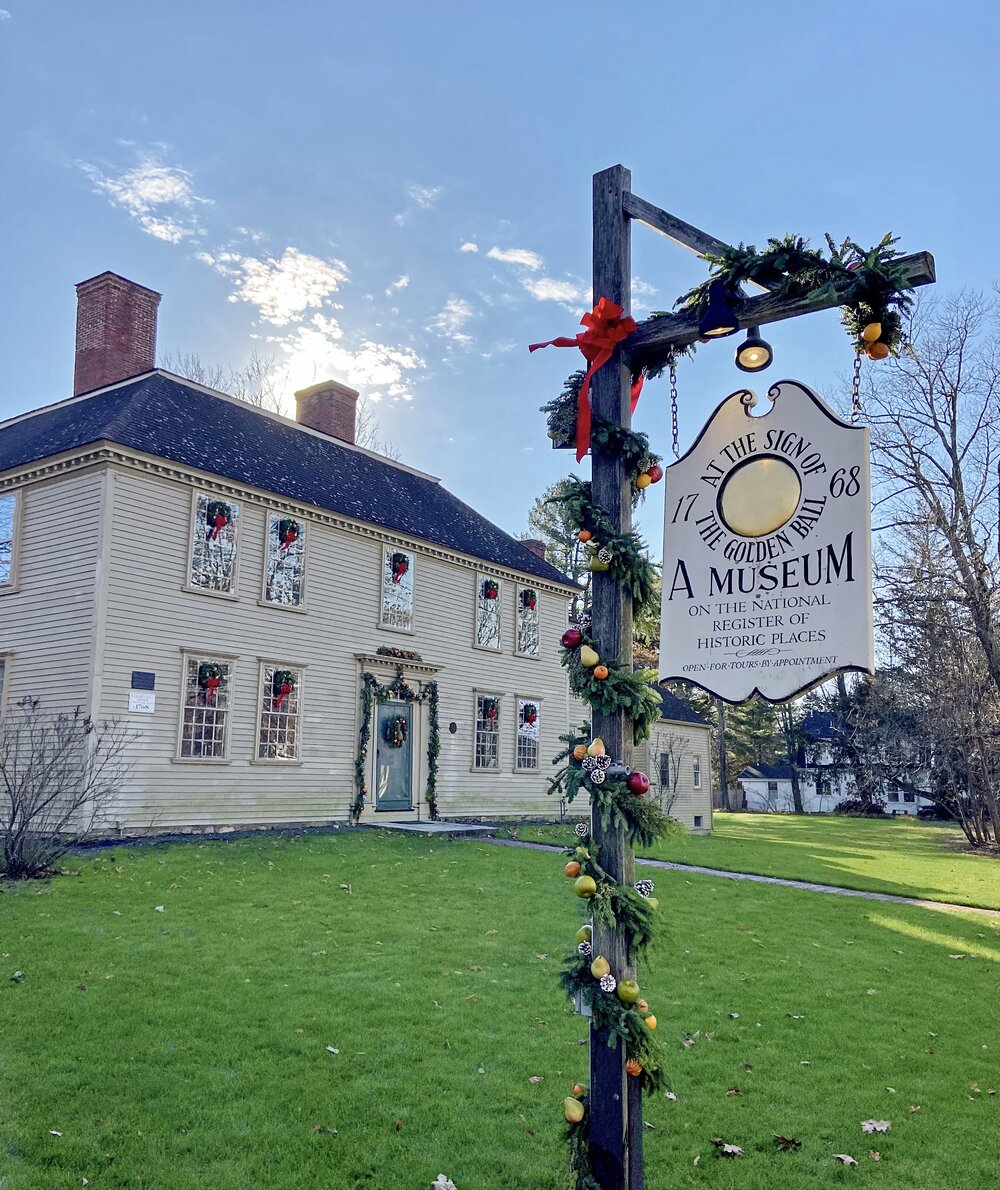
On Thursday, 15 September, I’ll deliver an online lecture for the Golden Ball Tavern Museum in Weston.

The talk will be titled “General Gage’s Spies,” and here’s our event description:
On February 23, 1775, three men arrived at Isaac Jones’s tavern in Weston, saying they were surveyors from Boston. They were actually two officers and a private from the king’s army. The royal governor, General Thomas Gage, had assigned them to find cannons and other military supplies that the rebel Massachusetts government was collecting outside of Boston. Drawn from new research, this talk discusses who those men were, the crucial role they played in the Battle of Lexington and Concord, and what happened to them after the Revolutionary War.
The spies’ visit to Jones’s Golden Ball Tavern is fairly well known. In The Road to Concord I showed how their mission fit into Gen. Gage’s larger strategy to locate and neutralize the artillery that rural Patriots were hiding. Since then I’ve gathered some more information about the two army officers, which will be part of this talk.

Yet another new wrinkle is that even as those spies were staying at the Golden Ball on their way to Worcester, people elsewhere in Weston were preparing two cannon for battle. Braddyll Smith, recently chosen to be both Weston’s representative to the Massachusetts Provincial Congress and colonel of the local militia regiment, knew about that effort and was probably in charge.

Smith’s predecessor in those posts was Elisha Jones, a Loyalist who had left for Boston around the turn of the year. Presumably Smith and his Patriot neighbors made sure that Elisha’s cousin Isaac, proprietor at the Golden Ball, never heard about their two cannon. After all, you didn’t know who might come through town.

My talk is scheduled to start at 6:00 P.M. Here’s the link to register. This event is free, thanks to support from the Weston Cultural Council, and folks can also join or donate to the Golden Ball Tavern Museum to support and learn about more such events.

Friday, February 12, 2021

Four Representative Men

I’ve been analyzing a letter about cannon sent to the Massachusetts Provincial Congress’s committee of safety in February 1775.

This posting looks at the four men who signed that letter, in order of their signatures.

James Barrett (1710-1779) of Concord is already a big presence in The Road to Concord and on Boston 1775. He was a sixty-five-year-old farmer, patriarch, and community leader. In the fall of 1774, the town made Barrett a militia colonel and a representative to the Massachusetts Provincial Congress.

Secretly, Barrett oversaw the collection of provincial military supplies in Concord in the early months of 1775. This letter is one piece of evidence about that effort. Barrett’s lists of weapons, equipment, and food survive in the collection of the American Antiquarian Society. His farmhouse was the furthest target of the British march in April 1775, and that building is now part of Minute Man National Historical Park.

Jonas Stone (1710-1790) was born in Concord, grew up in Sudbury, and then established himself on land his father had purchased in Rutland. In 1751 Stone moved back east to Lexington, having inherited a family estate there. He soon married his second wife in that town.

Starting in 1755, Stone served in many Lexington offices, including treasurer, selectman, and assessor. In the 1770s he became the town’s representative to the Massachusetts General Court and Provincial Congress. Stone was also a deacon and member of the committee of correspondence.

The letter addresses Lexington’s work to prepare two iron cannon for use in 1775. Stone himself may not have been personally involved in that work but rather speaking for neighbors. He didn’t hold an officer’s rank in the militia and did only four days’ of duty himself in May 1775. But his son Jonas, Jr., was among the local militiamen on the town common on the morning of 19 April.

Braddyll Smith (1715-1780) was a long-time town official in Weston. He was clerk of the town militia company in the 1750s and captain by 1774, a selectman from 1758 to 1771, town clerk from 1758 to 1768, and treasurer from 1771 to 1773.

Smith was also a wealthy man. The town’s 1759 tax list, made in part by himself, said he owned more personal property and far more real estate than anyone else on the north side of town. Three men on the south side had larger fortunes, and Elisha Jones (the only “Esquire” on the list) owned more valuable land. In 1773 Smith also held title to two enslaved people, as many as anyone else in Weston; one was named Salem Middlesex, but this seems to have been a different man from the man who became Peter Salem of Framingham.

Smith had several children by his first wife, Mary Hagar, before she died. He remarried to Sarah White of Medford in 1763 and again to widow Ruth Flint of Lincoln in 1766—finding wives in the upper echelon of other towns.

In January 1774, as I mentioned yesterday, Braddyll Smith led a group that petitioned the town meeting to “To Chuse a Committe to take into Consideration the circumstances of our Publick affairs and to Corrospond with the NEIGHBOURING Towns and to Consider what is Best to be Done that our Injured Rights and Priviledges may be Restored and Secured”—i.e., to form a committee of correspondence and participate in Massachusetts’s political resistance. Under the influence of militia colonel and General Court representative Elisha Jones, the town rejected that idea.

But after the Boston Port Bill, Massachusetts Government Act, and other royal measures, local histories say that on 29 September Weston voted to form that committee and to send representatives to the first Massachusetts Provincial Congress. The voters replaced Jones as the town’s representative with none other than Braddyll Smith. Jones soon moved into Boston. By the end of the year Smith replaced Jones as militia colonel and was overseeing the town’s preparations for defense—including cannon.

Jonathan Brown (1724-1797) of Watertown was captain of the town’s military company at Lake George in 1758. When he returned, he began serving in town offices as clerk, treasurer, justice of the peace, and representative to the General Court starting in 1772.

In 1774 Brown as clerk kept the town records showing himself elected to the provincial congress. On 12 December, Watertown also chose him to be “Capt of the train”—the artillery company. That was a couple of weeks after the town had voted to equip two of the eight cannon brought out from Boston that fall.

During the war, Brown remained in town, working in civil posts. He kept busy recruiting soldiers, paying them for their service, and collecting supplies. He continued to represent Watertown in the Massachusetts legislature until 1786.

All four of these men were thus elders in their communities; the youngest was fifty years old. They were all farmers, not professionals and not college-educated, but well off. They had served in town offices for years, and now those civic responsibilities included representing their neighbors in an illegal legislature and preparing for war with the Crown.

TOMORROW: Who will pay for it all?

Thursday, February 11, 2021

Mounting Expenses for Four Towns

This posting continues the analysis of a 3 Feb 1775 letter that I started quoting yesterday, from men in four different towns to the Massachusetts Provincial Congress’s committee of safety.

Yesterday’s extract shows the letter was about eight cannon purchased by William Molineux in Boston in the fall of 1774. Somehow the Patriots got those guns out to Watertown. And then…
…and after Some time Information was given yt it was desired that Watertown & the Neighboring Towns would mount them & git them Ready for emediate Service which is now Nearly Compleated (Viz, two by Watertown, two by Concord two by Lexington, & two by Weston[)],…
The Patriots weren’t just spreading those cannon around to make them harder for the British army to confiscate them. They were also spreading around the heavy expense of mounting and equipping those guns so they could be used in battle.

Artillery pieces themselves were big metal tubes, with a wide hole at one end and a very narrow hole near the other. On board ships and in shore batteries and fortifications, they were mounted on heavy, solid, small-wheeled carriages, and most if not all of those had been left behind.

To become ”field-pieces” suitable for a moving army, those cannon needed to be mounted on large-wheeled carriages that were both strong and maneuverable. Gun crews also needed rammers, swabs, worms, and other tools for loading and maintaining those guns. To “git them Ready for emediate Service” would require the best work of wheelwrights, blacksmiths, carpenters, and other craftsmen.

On 17 October, the Watertown town meeting considered the challenge:
Then the Question was put whether the town will mount & Equip two pieces of Cannon now lodged in the Town at their own Charge and it past in the affeirmative.—

Then it was Voted to Choose three persons a Committe to git Said work don
The cost “to git Said work don” became an issue. The selectmen called another town meeting on 21 November to consider how “to Grant money to pay for the two Carriages to the two pieces of Cannon that were ordered to be procured at the Expence of the town.” The men of Watertown voted to allocate £20 for those carriages, and only £15 for their schools.

Concord followed a similar course, as its town records (transcript now online) show. On 15 October the selectmen called a meeting with the top item being: “To See if the Town will Mount the Cannon brout into this Town by the Committee of Correspondance, and also Provide ammunition for Said Cannon agreeable to the Request of Said Committee.”

That meeting took place on 24 October, and the townspeople agreed that “the Selectmen take the Care that the Cannon brought into this Town by the Committee of Correspondance be Mounted at the Expence of the Town and that there be provided one hundred pound weight of Cannon Ball 4 pound Each Ball, and two hundred weight of Grape Shot, and Seven half Barrels of powder.” How was Concord to pay for all that? From tax revenues collected by the town constables but not yet forwarded to the provincial treasurer, Harrison Gray.

Lexington held its vote early the next month, as Alexander Cain has recounted:
On November 3, 1774, the town selectmen relented and announced the issue would be addressed at the next town meeting. Specifically, “Upon a request of a numbre of Inhabitants to see if the Town will fetch two small pieces of cannon from Watertown, offered by said Town for the use of the Company in this Towne.”

A week later, the town approved the purchase of two guns. “Voted. . . to bring the two pieces of Cannon (mentioned in the warrant) from Watertown & mount them, at the at the Town charge.”

After approving the purchase of two cannons, in true Yankee fashion, the residents voted to create a committee to explore the cheapest methods of mounting of the guns on carriages and building of ammunition boxes. “That a Comtee of three persons go to Watertown & see what the cost of mounting sd pieces will be & whether the carriages cannot be made by work men in this town”
Lexington men didn’t go to Watertown and actually pick up those guns until after 28 November, though.

Weston’s published town records recorded only one meeting in all of 1774, on 13 January. With militia colonel Elisha Jones in the chair, the town voted “by a very great majority” to reject the idea of forming a committee of correspondence. And yet, by the end of the year, Jones had fled into Boston as a Loyalist and the man who had made that proposal was overseeing two cannon at the expense of the town.

TOMORROW: The signatories.

(The picture above shows the Watertown meetinghouse, site of town meetings.)