J. L. BELL is a Massachusetts writer who specializes in (among other things) the start of the American Revolution in and around Boston. He is particularly interested in the experiences of children in 1765-75. He has published scholarly papers and popular articles for both children and adults. He was consultant for an episode of History Detectives, and contributed to a display at Minute Man National Historic Park.

Subscribe thru Follow.it


•••••••••••••••••


Showing posts with label Mary Thomas. Show all posts

Monday, May 11, 2026

“Not playing cards but fondling and kissing each other”

In preparation for tomorrow’s talk about Benjamin Thompson’s early years, I’ve been reviewing the evidence of his affair with Mary (Dill) Thomas, wife of printer Isaiah Thomas.

When Isaiah moved to divorce Mary in 1777 by petitioning the Massachusetts Council, he submitted testimony from several people who had seen his wife traveling with the militia major from New Hampshire in February 1775, behaving like man and wife.

The printer’s file also offered an affidavit from Mary Fowle of Londonderry, New Hampshire, who had stayed with the Thomases in Boston from 20 Sept 1774 to 16 April 1775.

In Sex and the Scientist, Jane Merrill quotes Fowle describing how “Major Thompson [was] then a refugee in Boston who borded in a house opposite.” Mary Thomas started visiting him several times a day even though (or because) she had two children under the age of three.

One Saturday the printer’s wife “dressed herself, shifting her Linen, which I knew was not her custom,” said her house guest. Mary Thomas came home with “a small piece of parchment, on which a Lady’s face had been drawn with a black lead pencil. . . . the Major had taken much pains with it.”

Soon Mary Thomas visited Thompson’s ”bed-chamber, where they staid the whole afternoon and part of the evening.” Fowle stated, “I could not but think there was more intimacy between them than I before tho’t of.” She observed the couple “kissing each other, laying in each others laps, speaking fondly of each without regarding me.”

One day Isaiah came home from business after his wife had gone to play cards with Maj. Thompson. Mary Fowle and a household servant went across to fetch her. They found the couple “not playing cards but fondling and kissing each other, she often laying her head on the Major’s shoulder, and their arms round each other.”

As if that wasn’t clear enough, in February 1775 Mary Thomas insisted on taking that trip to Newbury with Maj. Thompson, first having her hair “in the greatest taste much powdered.” Later the printer gathered testimony from several innkeepers about that journey. At the time, however, he just seems to have felt trapped.

On one Sunday, Isaiah Thomas and Mary Fowle went to church. When they came home, his daughter Mary Ann, who turned three years old that March, showed them a “copper” that Maj. Thompson had given her to go into another room. Fowle stated the little girl said, “The major kissed her Mama and felt her bosom.” In response, little Mary Ann’s mother told her she was lying and threatened to whip her.

Isaiah finally demanded that Mary admit to what was going on. She acknowledged having a sexual affair. And when did it start? True to Benjamin Thompson’s character, he first got into Mary Thomas’s bed right after writing a letter to his own wife back in Concord, New Hampshire.

I won’t bother asking if these marriages can be saved.

TOMORROW: Who was Mary Fowle?

Tuesday, October 19, 2021

“Receiving confirmation various ways of the surrender”

The army around Philadelphia wasn’t alone in waiting anxiously for news from northern New York in October 1777. The publisher of the Massachusetts Spy was gleaning every bit of information that came through Worcester for his readers.

That publisher wasn’t Isaiah Thomas, who had co-founded the Spy in Boston in 1770 and moved it out to Worcester just before the outbreak of war.

In the middle of 1776 Thomas stepped away from day-to-day operations in order to tend to family business—namely, divorcing his wife, finding care for their children, and helping his mother at her home in Cambridge.

Thomas leased the Massachusetts Spy to other printers as a (barely) going concern. Starting in mid-1777 the publisher was Anthony Haswell, a former Thomas apprentice who turned twenty-one that year.

On 23 October Haswell’s Massachusetts Spy printed extracts from a Continental officer’s letter dated eleven days before, reporting that Gen. John Burgoyne’s army had attacked and been pushed back:
Friday [10 October] the whole army marched with three days provision, and we found the road strewed with baggage of all kinds; horses killed in the waggons, and all their sick and wounded, with Burgoyne’s chief surgeon…
Then came another letter from the same officer, dated 14 October:
We have now entirely surrounded the enemy, and it is common to have forty or fifty deserters and prisoners come in per day. The Canadians we are informed have mutinied, and decline having anything further to do in the matter, and that the General had promised they should go home in a few days.
Then a letter from Saratoga dated 14 October:
Last night General [Horatio] Gates received a card from General Burgoyne, requesting to know when it would be agreeable to him to have a field officer of his army wait on him with proposals of great consequence to both armies. . . . General Gates sent the articles on which he would agree . . .

P.S. I believe that General Gates rather than not get Burgoyne and his army, will soften his terms a little.
In the next paragraph the publisher lamented receiving “many different” reports raising doubt about what had really happened next. But then a seemingly reliable witness arrived:
A Gentleman who passed through town yesterday informed, that General Burgoyne was arrived at Albany, on his way to Boston, where it is said he is to take ship for England, according to the capitulation said to be entered into between him and Gen. Gates.

In consequence of receiving confirmation various ways of the surrender of Gen. Burgoyne, a number of the sons of liberty in this town, met on the common and expressed their joy by thirteen discharges of cannon, and drinking several toasts. The whole was conducted with a decency suitable to the occasion, and truly characteristic of the supporters of the glorious cause in which we are engaged.
On the same day that Haswell was printing these bare tidbits, in Boston John Gill was printing the entire Articles of Convention, or terms of surrender, for readers of his Continental Journal. That document must have been couriered to Boston by a route that bypassed Worcester.

Friday, August 07, 2020

The Launch of the Massachusetts Spy

On Tuesday, 7 Aug 1770, 250 years ago today, the second issue of the Massachusetts Spy appeared.

The very first issue, dated 17 July, was a test to drum up subscriptions, distributed for free. The printers had projected regular publication to start at the end of the month. That schedule slipped, and the 7 August issue was their first attempt to publish on a steady schedule.

The men behind the Massachusetts Spy were twenty-one-year-old Isaiah Thomas and his former master, Zechariah Fowle.

Since Thomas had ended their initial relationship unilaterally—i.e., he ran away to Nova Scotia in 1765 and to North Carolina the next year—one might expect Fowle to be leery of a becoming partners with him.

But Thomas had settled down a bit during his second stint away from Boston, which he spent mostly in Charleston, South Carolina. There he had worked steadily as a journeyman for a printer and bookseller named Robert Wells.

Thomas had also gotten married to a woman from Bermuda named Mary Dill. Their first child (and perhaps the reason for their marriage) was stillborn, but they were having more. Thus, when Thomas returned to Boston in the spring of 1770, he was no longer a headstrong apprentice but a practiced printer with a family to support.

Boston already had more weekly newspapers per capita than any other port in British North America, but the closing of Mein and Fleeming’s Boston Chronicle on 25 June appeared to open space for something new.

Thomas later described his business strategy like this:
The Massachusetts Spy was calculated to obtain subscriptions from mechanics, and other classes of people who had not much time to spare from business. It was to be published three times a week, viz. on Tuesday, Thursday and Saturday. Twice in the week it was to be printed on a quarter of a sheet, and once on a half sheet. When published in this way, news was conveyed fresh to subscribers, and the contents of a Spy might with convenience be read at a leisure moment.
All the other Boston papers appeared only once a week—three of them on Monday and the Boston News-Letter on Thursday. The Chronicle had issued two full issues each week, but Mein and Fleeming had the financial backing of the Customs office and a subscriber base drawn from the friends of the royal government. Three issues a week, even if they used no more paper than one weekly, would be a strain.

Thomas and Fowle announced their price as “Five Shillings, Lawful Money per Annum.” In contrast, the Boston Chronicle charged 6s.8d. in 1767, as did the Salem Gazette in 1768 and the Norwich Packet in 1773. The Massachusetts Spy was thus a discount paper—smaller price, smaller sheet, maybe a little less news, but more often.

The July preview invited people who wanted to subscribe to visit Fowle “in Back-Street” or Thomas “in School-House-Lane, near the Latin School”—i.e., School Street. By August, the partners were issuing the paper from “the New Printing-Office, in Union-Street,” near the center of town.

Thursday, February 17, 2011

“Avowed Themselves to Be Man & Wife”

Yesterday I described how the 1769 marriage of Mary Dill of Bermuda and printer Isaiah Thomas of Boston fell on difficult times in the early 1770s. According to Isaiah, the relationship came to a head on 23 Feb 1775.

On that date, Mary and “Major Thompson set out on a Journey together to Newbury Port.” Isaiah said he tried to

dissuade his Wife from journeying at so unreasonable a time of the Year & without any apparent Necessity; but she persisted in her Intentions & swore she would go “if it was to her eternal Ruin” as she expressed herself.
Isaiah later described for the authorities what had happened on that trip:
3d. In the Course of said Journey at the House of Mr Woart in Charlestown, the said Thompson was seen in the said Mary’s bed Chamber, conversing with her while she was in bed.

4th. At the House of Mr. Newell in Lynn the said Thompson & the said Mary were discovered in bed together. And in their Conversation were constantly uttering such Expressions of Endearment & affection to each other as plainly indicated the wickedness of their Hearts.

5th. At the House of Mr. [Samuel] Greenleaf in Newbury Port they remained in a separate Room together while they continued there, & from thence they proceeded to Portsmouth in a Curricle.

6th. At the House of Mr. [John] Stivers in Portsmouth the said Thompson & the said Mary both insisted on lodging in the same Room but being known they were forbid they however remained shut up in a Room together.

7th. On their Return from Portsmouth they stop’d at the House of Mr. Williams an Innholder in Greenland; where they avowed themselves to be Man & Wife, had a Room to themselves and lodged together all Night
After Mary Thomas returned to Boston, Isaiah “closely questioned” her, and she admitted that she had sexual relations with Maj. Thompson.

The printer then “forbore to cohabit” with his wife, and in May 1777 filed for divorce. The description above comes from that filing. The Massachusetts Council determined that Isaiah Thomas had proved his case, and granted the divorce that month. Isaiah established himself as a printer in Worcester. I don’t know what happened to Mary.

Who was “Major Thompson,” who had whisked Mary Thomas off to scenic Portsmouth? None other than our old friend Benjamin Thompson of Woburn, later titled Count Rumford (portrait shown above). He held the rank of major in the New Hampshire militia.

As a teenager, Benjamin Thompson had worked for a short time in the same building on Union Street where Thomas had his print shop (now the Union Oyster House). But that was before the Thomases settled in Boston, and it’s unclear how Mary Thomas met the young man. Maj. Thompson had a wealthy older wife up in New Hampshire, whom he would abandon before the end of the year—but that’s another marriage.

Wednesday, February 16, 2011

The Marriage of Isaiah Thomas and Mary Dill

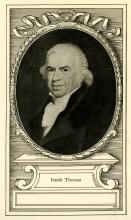
Isaiah Thomas (shown at right as a prosperous old man, courtesy of Amherst College) was apprenticed to the printer Zechariah Fowle on 4 June 1756, at the age of seven. Although his mother was still alive, Boston’s Overseers of the Poor arranged this indenture for Isaiah as “a poor boy belonging to said Boston.”

Isaiah was supposed to work for Fowle until he turned twenty-one on 8 Jan 1769. However, he released himself on his own recognizance in September 1765, sailing off to the excitement of Nova Scotia. In Halifax, Isaiah worked for a Dutch-born printer named Anthony Henry. After a couple of years, the young man tried working on his own in the Carolina colonies.

While there, Thomas married a woman from Bermuda named Mary Dill on 25 Dec 1769. She had a stillborn child sometime in the following year, so it’s possible they had to get married. Later Thomas wrote that “soon after his Marriage to his Astonishment he found that his Wife had had a bastard some Years before & that she had been prostituted to the purposes of more than One.”

The couple sailed to Boston, perhaps for a new start. In late 1770 Isaiah renewed his acquaintance with Zechariah Fowle and convinced him to become a partner in printing a new newspaper, the Massachusetts Spy. After a tough start—the men found they couldn’t make money selling three issues a week, as originally planned—the Spy established itself as Boston’s second radical Whig paper.

In 1772, however, Mary Thomas expressed “a great desire of Living in her native country (Bermuda).” Isaiah wrote to some officials or wealthy merchants on that island asking if they would support a new newspaper there. He even made an implicit offer to tone down his politics, explaining in an 18 March letter that “one of my profession here must be either of one party or the other, (he cannot please both).” Fowle heard through Dr. Thomas Young that Thomas might be planning to leave, and insisted on dissolving their partnership immediately.

No openings in Bermuda seem to have presented themselves, and Thomas’s Massachusetts Spy was pulled further into the resistance movement. Gov. Thomas Hutchinson even tried to prosecute the printer and some of his political essayists, but the Suffolk County grand jury refused to hand down an indictment.

By early 1775, Mary and Isaiah Thomas had had three children together, but the couple was drifting apart. Mary was, according to Isaiah, showing a “petulance of Temper & unhappiness of Disposition which she daily exercised to the disturbance of domestic Peace.” And of course they were still in Boston.

TOMORROW: Can this marriage be saved?