J. L. BELL is a Massachusetts writer who specializes in (among other things) the start of the American Revolution in and around Boston. He is particularly interested in the experiences of children in 1765-75. He has published scholarly papers and popular articles for both children and adults. He was consultant for an episode of History Detectives, and contributed to a display at Minute Man National Historic Park.

Subscribe thru Follow.it


•••••••••••••••••


Showing posts with label Sheffield. Show all posts

Thursday, September 01, 2022

Elizabeth Freeman and the Talk of Liberty

In 1781 Elizabeth Freeman initiated a freedom suit, suing to be released from bondage to John and Hannah Ashley.

(Though John was Freeman’s legal owner, she spoke fondly of him in later years. She described Hannah, on the other hand, as tyrannical, violent, and cold-hearted to others.)

As I quoted on Tuesday, in 1838 Harriet Martineau wrote that Elizabeth Freeman filed her suit after hearing people discuss the Massachusetts constitution of 1780.

In 1853 Catharine Maria Sedgwick wrote that Freeman took action after hearing the Declaration of Independence. Sedgwick also said this happened “soon after the close of the revolutionary war,” which doesn’t match the timing of the lawsuit.

Our most recent tradition says that Freeman heard John Ashley, Theodore Sedgewick, and other Sheffield men discussing natural rights in January 1773 as they formulated resolutions for the town meeting to adopt.

So which statement of natural liberty prompted Elizabeth Freeman to act?

I think all of them did. Or to put it differently, over the years she heard many conversations in which men like Sedgewick and Ashley proclaimed their belief in liberty for all people. She may have figured out that the Massachusetts constitution had more legal weight than a town resolution and the Congress’s Declaration. But I doubt she would have gambled based on overhearing one discussion.

As many contemporaries described, and the printed record bears out, there was a lot of talk about liberty and injustice in those years. Ebenezer Fox was a farmboy in Roxbury in 1775, and in his memoir he described how he and other working boys saw parallels between the colonies’ complaints and their own:
Almost all the conversation that came to my ears related to the injustice of England and the tyranny of government. It is perfectly natural that the spirit of insubordination, that prevailed, should spread among the younger members of the community; that they, who were continually hearing complaints, should themselves become complainants. I, and other boys situated similarly to myself, thought we had wrongs to be redressed; rights to be maintained; and, as no one appeared disposed to act the part of a redresser, it was our duty and our privilege to assert our own rights. We made a direct application of the doctrines we daily heard, in relation to the oppression of the mother country, to our own circumstances; and through that we were more opposed than our fathers were.

I thought that I was doing myself great injustice by remaining in bondage, when I ought to go free; and that the time was come, when I should liberate myself from the thraldom of others, and set up a government of my own; or, in other words, do what was right in the sight of my own eyes.
Fox grabbed freedom by running away to Rhode Island. Freeman sought legal help from Sedgewick—a process that took longer but was more permanent and had far-reaching consequences.

One detail of Freeman’s story appears in both Martineau’s and Sedgwick’s accounts: she felt she had to argue for her very humanity.
  • Martineau: “She replied that the ‘Bill o’ Rights’ said that all were born free and equal, and that as she was not a dumb beast, she was certainly one of the nation.”
  • Sedgwick (published version): “‘I am not a dumb critter; won’t the law give me my freedom?’”
The Sheffield town meeting, and even Ebenezer Fox and his chums, didn’t have to start there.

The town of Sheffield has just recognized Elizabeth Freeman’s move toward freedom by unveiling a bronze statue of her, shown above, along with a college scholarship in her name. I understand the statue, by artist Brian Hanlon, stands on land owned by the church where the town meetings of 1773 occurred, bringing the conversation about natural liberties full circle.

Wednesday, August 31, 2022

The Sites of the Sheffield Resolves

It’s become common to call the Sheffield town meeting resolves of January 1773 the “Sheffield Declaration,” as a forerunner of the Declaration of Independence. Wikipedia does so.

Wikipedia’s entry also says that document was written “in the Colonel John Ashley House, a registered National Historic Landmark in Ashley Falls, a neighborhood of Sheffield, Massachusetts.”

The Ashley House, built in 1735 and moved in 1930, has been owned for the last half-century by the Trustees of Reservations. Its own website now emphasizes the paradox of John Ashley owning slaves while signing onto natural-rights rhetoric, and Elizabeth Freeman’s enslavement in the house.

The link between the Sheffield resolves and the Ashley house is actually quite thin, apparently based on the idea that Ashley was “moderator” of the committee to draft the resolutions.

When Boston newspapers reported that Ashley had been “chosen moderator,” that meant he moderated the 5 January town meeting that appointed the committee, not that he was moderator of the committee. He was just one of eleven men named to that subgroup. 

Committees had chairmen, not moderators, and the chairman was almost always the first man named in the record—in this case, young attorney Theodore Sedgewick. Towns often appointed a lawyer, schoolteacher, or other educated man to head such committees when they wanted some fancy words.

Sedgewick probably drafted the resolutions at his own home, which still stands in Sheffield but has been greatly modified. It also appears to be in private hands, thus not open to tourists.

The town committee probably met to go over Sedgewick’s draft in advance of the follow-up town meeting—whether a couple of days before or one hour before we don’t know. Did the committee meet at Ashley’s house? It’s possible, depending on whether that house was conveniently located and people liked the colonel’s hospitality. If he had a tavern license, the odds go up. But there’s nothing in the historical record to say the committee met there, much less that most of the drafting was done there.

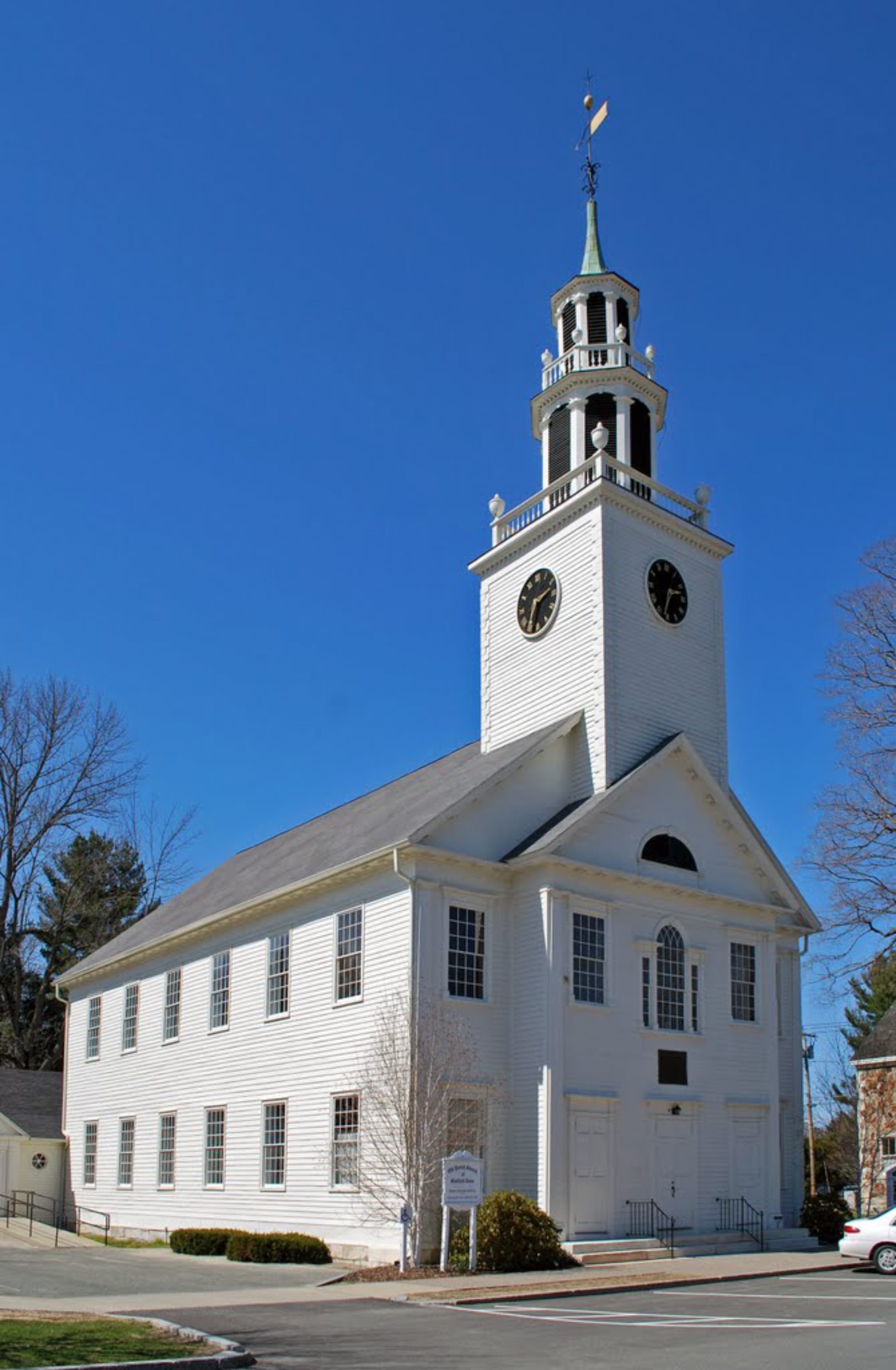
Sheffield held its town meetings in its religious meetinghouse. That church still stands as well, moved back from the road and with a steeple added in 1819, and still has an active congregation. In that building the town formally adopted the resolves with a unanimous vote. That vote gave Sedgewick’s words official standing.

Nonetheless, the “Sheffield Declaration” gets associated with the Ashley House.

Historic houses benefit from having stories attached to them, preferably stories carrying emotional and historical weight. Stories benefit from having concrete settings, especially those people can visit. Thus, there’s a natural gravitation of stories to sites.

TOMORROW: A new statue in Sheffield.

Tuesday, August 30, 2022

The Memory of “Mumbett”

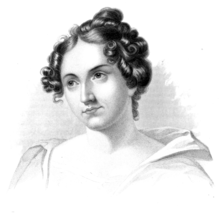
In 1853 Catharine Maria Sedgwick (1789–1867, shown here), one of America’s most popular novelists, published an article in Bentley’s Miscellany titled “Slavery in New England.”

The Massachusetts Historical Society holds Sedgwick’s manuscript of that article, titled “Mumbett,” and has made it available in digital form.

Describing Elizabeth “Mumbet” Freeman (d. 1829), the black woman who helped to raise her, Sedgwick wrote:
It was soon after the close of the revolutionary war that she chanced, at the village “meeting-house” in Sheffield, to hear the declaration of Independence read. She went the next day to the Office of Mr Theodore Sedgwick then in the beginning of his honorable political & legal career.

“Sir” said she “I heard that paper read yesterday that says ‘all men are born equal &, that every man has a right to freedom’ — I am not a dumb Critter, wont the law give me my freedom’?

I can imagine her upright form as she stood dilating with her fresh hope based on the declaration of her intrinsic inalienable right.
At another point in the manuscript, Sedgwick wrote and crossed out these words:
The reader will be prepared for the intelligence & decision which led Mumbet on the very day after hearing the declaration of Independence read in Church to apply to Theodore Sedgwick then at the beginning of his honorable legal & political career to institute a suit for her freedom
The documentary record shows that Theodore Sedgwick, the novelist’s father, took the case of this woman, then called only Elizabeth, though the Hampshire County court in 1781. She won her freedom, took the surname Freeman, and went to work for the Sedgwick family.

That lawsuit produced one of the precedents that led the Massachusetts Superior Court to rule slavery unenforceable in the state in 1783.

Catharine Sedgwick wrote of the Declaration of Independence setting off those events. The Declaration was of course more resonant with a national audience in 1853. And that might well have been what she remembered from hearing the story as a girl.

Authors have discussed two other documents as triggering or contributing to Elizabeth Freeman’s suit. Citing conversations with the Sedgwicks, the British author Harriet Martineau tied Freeman’s request for freedom to having “heard gentlemen talking over the Bill of Rights and the new constitution of Massachusetts” in her Retrospect of Western Travel (1838).

The first article of the Massachusetts state constitution of 1780 says:
All men are born free and equal, and have certain natural, essential, and unalienable rights; among which may be reckoned the right of enjoying and defending their lives and liberties; that of acquiring, possessing, and protecting property; in fine, that of seeking and obtaining their safety and happiness.
That fits with the date of Freeman’s lawsuit, and, unlike the other documents spelling out ideals, the state constitution had legal force.

The other document latterly linked to Elizabeth Freeman’s suit for freedom is the Sheffield resolutions of January 1773, as I quoted yesterday.

Freeman’s enslavers were Hannah and John Ashley, and their house was supposedly where a town committee met to discuss Theodore Sedgwick’s draft of those resolutions. Had Elizabeth overheard? 

TOMORROW: Evidence and tradition.

Monday, August 29, 2022

Sheffield and the State of Nature

In January 1773, the town meeting of Sheffield named a large committee “to take into consideration the grievances which Americans in general, and the inhabitants of this province in particular, labour under; and to make a draught of such proceedings as they think are necessary for this town, in these critical circumstances, to enter into.”

The head of that committee, and thus the person entrusted with the primary responsibility for drafting its report, was the lawyer Theodore Sedgewick, then still in his twenties.

Later accounts say the committee met at the house of John Ashley (1709–1802), a local militia colonel, judge, and town officeholder.

On 12 January, one week after receiving their charge, the committee presented a series of resolutions to the town meeting. The voters approved that document unanimously. A copy went to the town’s representative in the Massachusetts General Court. The text appeared in the 15 February Boston Evening-Post and other newspapers.

Most of those resolutions were a protest against Parliament taxing people in the colony to fund salaries for the royal governor, judges, and other appointed figures—taxes that the men of Massachusetts never voted on to pay officials they never voted on, either.

The town also complained about New York claiming land between the Hudson and Connecticut Rivers, an episode I hope to discuss later.

But the eventually most famous of the Sheffield resolutions was the first, laying out the philosophical basis for the complaints that followed:
Resolved, That Mankind in a State of Nature are equal, free and independent of each other, and have a Right to the undisturbed enjoyment of their Lives, their Liberty and Property.
When the men in Ashley’s house discussed their draft, they surely thought of that as a truism that strengthened their tax protest, with no broader implications.

However, Ashley was also a slaveholder.

TOMORROW: A new statue in Sheffield.

Monday, May 26, 2014

Mum Bett Presentations at Royall House, 31 May

On Saturday, 31 May, the Royall House and Slave Quarters in Medford will host two performances of “One Minute’s Freedom: The Story of Mum Bett” by storyteller Tammy Denease.

This presentation introduces children aged seven and up to Elizabeth Freeman, a woman who helped end slavery in Massachusetts by suing for her freedom in 1781. Her lawyer was Theodore Sedgewick (1746-1813), and she worked for him after becoming free. In 1853 Bentley’s Miscellany published an essay by his daughter Catherine Sedgewick which described Freeman this way:
Mum-Bett’s character was composed of few but strong elements. Action was the law of her nature, and conscious of superiority to all around her, she felt servitude intolerable. It was not the work—work was play to her. Her power of execution was marvellous. Nor was it awe of her kind master, or fear of her despotic mistress, but it was the galling of the harness, the irresistible longing for liberty. I have heard her say, with an emphatic shake of the head peculiar to her: “Any time, any time while I was a slave, if one minute’s freedom had been offered to me, and I had been told I must die at the end of that minute, I would have taken it—just to stand one minute on God’s airth a free woman—I would.”

It was soon after the close of the revolutionary war, that she chanced at the village “meeting house,” in Sheffield, to hear the Declaration of Independence read. She went the next day to the office of Mr. Theodore Sedgewick, then in the beginning of his honourable political and legal career. “Sir,” said she, “I heard that paper read yesterday, that says, ‘all men are born equal,[’] and that every man has a right to freedom. I am not a dumb critter; won’t the law give me my freedom?” I can imagine her upright form, as she stood dilating with her fresh hope based on the declaration of an intrinsic, inalienable right. Such a resolve as hers is like God’s messengers—wind, snow, and hail— irresistible.
This program about Freeman is supported by Historic New England and the Medford Arts Council. The performances will start at 11:00 A.M. and 3:00 P.M. and last about 45 minutes. The mansion and slave quarters will be open to visitors in between. Admission is free, but registration is required; email Programs@RoyallHouse.org for tickets.