J. L. BELL is a Massachusetts writer who specializes in (among other things) the start of the American Revolution in and around Boston. He is particularly interested in the experiences of children in 1765-75. He has published scholarly papers and popular articles for both children and adults. He was consultant for an episode of History Detectives, and contributed to a display at Minute Man National Historic Park.

Subscribe thru Follow.it


•••••••••••••••••


Showing posts with label Arlington (Menotomy). Show all posts

Thursday, February 26, 2026

“It was not the Butler who fell in Battle”

I just finished quoting a letter that Jonathan Hastings, Jr., of Cambridge addressed to “Friend Jacob” on 11 June 1775. The letter probably never reached that friend because it’s in the files of Gen. Thomas Gage, the British commander besieged inside Boston at the time.

Hastings started by referring to “Your Brother’s Letter of 18th. May.” Later he wrote, “John intends to write to your Brother.” The writer had a younger brother named John, born in 1754 and graduating from Harvard College in 1772. Heitman’s Historical Register of Officers of the Continental Army says John Hastings “Served in the Army in 1775” but doesn’t specify a unit until 1777. Massachusetts Soldiers and Sailors of the Revolutionary War likewise documents his service from 1777 on, rising to brevet major.

It looks like the Hastings brothers, Jacob, and Jacob’s unnamed brother were all part of the same crowd in Cambridge, probably connected with Harvard. Jonathan expected Jacob to know where “the Red House leading to Charlestown” was. Jacob and the Hastings family had financial dealings.

That link offers an explanation for Jonathan Hastings’s line “It was not the Butler who fell in Battle, but a Samuel Cooke from Danvers.” Harvard had a staff position called the butler. This man oversaw the buttery, which sold snacks and other little items to undergraduates. Unfortunately, the Harvard archives says, “there is no complete list of all of the Harvard Butlers.” It looks like the college reserved the job for master’s students to hold for two or three years before moving on.

Harvard’s class of 1772 included Samuel Cooke, Jr. (1752–1795), son of the minister in Cambridge’s Menotomy precinct. Some college documents say Cooke filled in as librarian while reading for his master’s degree. I suspect that he was the college butler in that period, thus known to his classmates and those who came after as well as to the administration.

After Samuel Cook of Danvers was widely reported as killed in the fighting at the Jason Russell House, Jonathan Hastings assured his friend Jacob that this wasn’t the fellow they knew from the buttery. The Menotomy Samuel Cooke, Jr.’s most significant action on 19 Apr 1775 was dragging his father away from the fighting.

TOMORROW: A man on the move and on the make.

Wednesday, February 25, 2026

“Boston is environed on all sides”

Having shared his version of the Battle of Lexington and Concord, as quoted over the last two days, the new Cambridge postmaster Jonathan Hastings, Jr., turned to the current situation.

His 11 June 1775 letter described the siege this way:
Boston is environed on all sides. 7000 Men at Camb. 6000 at Roxbury, exclusive of smaller Numbers wch. guard the Coasts both Eastward & Southward. [Thomas] Gage acknowleges our Superiority in Number, but says we have neither Government, Discipline nor Powder. The two first Charges are false; and I hope the other Colonies will not be backward to Supply us with the last, to let him see he is mistaken in that likewise.—

Indeed we are determined to defend ourselves in the best manner at all Events, rather than submit to Slavery.—Our Motto is the same which Caesar engraved on his Breast Plate—“Nil actum reputans si quid superesset agendum.”
That was a standard eighteenth-century British rendering of a line from Lucan’s Civil War, appearing in the Spectator and Lord Chesterfield’s letters. It translates more or less as “As long as there’s anything left to do, we don’t consider anything done.” Curiously, that Latin line appears differently in modern editions of Lucan. I can’t explain the discrepancy.
Should Massachusetts be conquered, your Halcyon Days will soon be at an end. God grant our union may be like that of a Band of Brothers, wch. can never be broken. The Light Troops in Boston we are informed have not done Duty for 4 Days. An Attack is expected soon, for every Delay on their part is a Strengthening to us.

It was not the Butler who fell in Battle, but a Samuel Cooke from Danvers the largest Man in the Colony, I suppose
A Danvers man named Samuel Cook, Jr., was indeed among the provincial casualties on 19 April, killed at the Jason Russell House. I haven’t found any other reference to his size. I’ll discuss why Hastings mentioned him tomorrow.
You must excuse my not being more particular, as John intends to write to your Brother, and my Business call me away: therefore would just acquaint you that an half a whole Sheet with your Name alone will afford a particular Pleasure to your sincere Friend & very humble Servant

Jonathan Hastings Junr.

P.S.—My Father & mother desire to be remembered to you & your Friends, & would inform you that our Papers are removed into the Country, & we know not where to look for any Receipts, therefore beg you will make yourself easy with regard to us—&c
JH
That looks like a very familiar closing for an eighteenth-century letter, begging more time to pay bills. Or maybe Hastings was replying to a correspondent who had begged more time.

Of course, there was a war on. The Hastings house had become the headquarters of both the Massachusetts committee of safety and Gen. Artemas Ward, so it’s understandable that the family had moved their records out.

TOMORROW: Clues to the crowd.

Monday, September 15, 2025

Revolutionary Talks This Week in Dedham and Westford

Here are a couple more Revolutionary lectures coming up this week.

Wednesday, 17 September, 7:00 P.M.
Bullet Strikes from the First Day of the American Revolution
Joel Bohy
Dedham Museum, 612 High Street

In 2013, Joel Bohy began a collaboration with conflict archaeologist Dr. Douglas Scott to better understand the ammunition found during archaeological investigations on former battlegrounds. This morphed into live-fire research and the study of the extant battle-damaged structures and objects from April 19, 1775.

From the Elisha Jones house in Concord, through Lexington and the Jason Russell house in Arlington, Massachusetts—where Dedham soldiers fought—the two carefully studied all the surviving bullet strikes and bullet-struck objects. Using modern forensic techniques adapted to historical studies and live-fire validation, Bohy and Scott tell the story of the brutality of the fighting on the first day of the American Revolution as British forces retreated to Boston.

Joel Bohy is the owner of J.Bohy Historical Consulting. He is an arms & militaria specialist at Blackstone Valley Auctions and an appraiser on the PBS TV series Antiques Roadshow.

Admission is $10, free to museum members. This event will be recorded by C-SPAN for its America 250 series and by DedhamTV.

Thursday, 18 September, 7:00 P.M.
The Plight of the Loyalist in Massachusetts
Larry Kerpelman
Westford Museum, 2 Boston Road

It’s been said that history is written by the victors, so it’s not surprising that the story of Loyalists to the Crown who lived in the American colonies is not as widely known as that of the Revolutionary War’s victors, the Patriots. As the drumbeat to independence grew louder, Loyalists faced their Patriot neighbors’ scorn and the agonizing decision of whether or not to flee their towns and homes. Various historians have estimated that between 60,000 and 100,000 people fled the colonies by the time “America’s first civil war” ended. Dr. Kerpelman will present a picture of how ordinary Massachusetts Loyalists and their Patriot neighbors interacted with one another during the fraught period between the 1750s and the 1790s.

Larry C. Kerpelman, Ph.D., is a freelance writer and communications professional from Acton, Massachusetts. Upon retiring as Vice president and Director of Corporate Communications after 30 years with the Cambridge public policy research and consulting firm Abt Global, he turned to researching, writing, and speaking on singular moments in American history. His work has appeared in American History, American Heritage, The Boston Globe, The Rochester Review, and The Chronicle of Higher Education, among other publications. He holds a B.A. from the Johns Hopkins University and a Ph.D. from the University of Rochester.

Suggested Donation for this lecture of $10 per person.

Wednesday, May 07, 2025

“It was not disturbed, nor was any of their property taken”

I’ve now quoted two nineteenth-century accounts from descendants of Elbridge Gerry, Azor Orne, and Jeremiah Lee (shown here) saying that British soldiers searched the tavern in Menotomy where they were staying on the night of 18–19 Apr 1775.

The three men, all delegates from Marblehead to the Massachusetts Provincial Congress, fled out the back of the tavern and hid outside in the cold.

Less than a month later, Lee died of an illness, which his family attributed to the stress of that night. That obviously made the men’s choices in the early hours of 19 April carry more weight.

There are, however, big problems with the story that part of the British army column searched Ethan Wetherby’s Black Horse tavern that night.

First, Gen. Thomas Gage’s orders for the march said nothing about looking for committee of safety members along the way. His intelligence files have no information on the whereabouts of those committee men. Rather, the general wanted his troops to get to Concord as quickly as possible.

Furthermore, none of the British army officers who wrote reports on that march described searching a tavern in west Cambridge, or anywhere else on their way out.

Finally, no contemporaneous accounts from the provincial side—neither depositions, letters, nor newspaper articles—complained about this search, either. And people made a lot of complaints in the wake of the Battle of Lexington and Concord.

There might be a seed of truth at the start of the story. Both versions say a small number of soldiers approached the tavern after the vanguard passed by. It’s conceivable that some redcoats turned aside to use the tavern’s well or outhouse before catching up with the column. But the lore goes much further than that, saying soldiers spent “more than an hour” searching every room in the building, “even the beds.”

The lore offers no corroborating evidence for that detail, such as the landlord’s testimony. In fact, the nineteenth-century versions specify that the committee men couldn’t point to anything missing as a sign that the soldiers had visited their room:
  • “a valuable watch of Mr. Gerry’s, which was under his pillow, was not disturbed.”
  • “Mr. Gerry’s watch was under his pillow, but it was not disturbed, nor was any of their property taken.”
Ordinarily if everything in a room looks the same as before, we treat that as a sign it wasn’t searched.

By 1916, Thomas Amory Lee might have spotted that weakness in the traditional tale because his article “Colonel Jeremiah Lee: Patriot” for the Essex Institute Historical Collections stated: “Gerry’s silver watch and French great coat disappeared.” That’s a direct contradiction of earlier Gerry family lore, and even that new version said Orne’s watch went untouched.

Given the totality of evidence, I think the Marblehead delegates were more worried about arrest than Gerry’s exchange of notes with John Hancock let on. Seeing hundreds of British soldiers outside their inn, perhaps seeing some of those soldiers coming closer to the building, they bolted for an exit.

There are reports Gerry and perhaps Lee sustained injuries in their flight. Then they stayed outside in the cold until it felt safe to return. Waiting for the whole army column to pass by and go out of sight may have felt like an hour, but it probably took less time than that.

Finally the three men came back inside, grateful to have escaped arrest. Then came news of the shooting at Lexington, the redcoat reinforcement column, the outbreak of war. The delegates fled the tavern again, this time with their possessions. Lee fell ill soon after, and died on 10 May.

Looking back on the episode decades later, Gerry and Orne—and perhaps even more so their and Lee’s descendants—would have resisted the thought that those sacrifices weren’t really necessary. That the three Marblehead men could have stayed in their warm bedroom, watched the glittering troops march by, and never faced arrest. That Lee might have lived longer.

So they convinced themselves that running outside had been necessary. Not just prudent but necessary. Which meant believing that soldiers came into the tavern and searched the bedrooms, leaving no sign of their presence.


Tuesday, May 06, 2025

“The soldiers searched for them, for more than an hour”

On 27 Apr 1861, the Cambridge Chronicle published an article headlined “Revolutionary Incident.” and signed “C.F.O.”

The first paragraph listed its “authentic and reliable sources,” including “the Records of the Provincial Congress, Austin’s Life of Gerry, and the niece of Col. Gerry, daughter in law of Col. Orne, and the grand-daughter of Col. Lee.”

“C.F.O.” was Caroline Frances Orne (1818–1905, shown here), a poet, local historian, and Cambridge’s librarian for seventeen years.

She was a granddaughter of Sally (Gerry) Orne (d. 1846), who was “the niece of Col. [Elbridge] Gerry, [and] daughter in law of Col. [Azor] Orne.” I believe “the grand-daughter of Col. [Jeremiah] Lee” was most likely either Louise Lee Tracy (1787–1869) or Helen Tracy (1796–1865).

Thus, this article was based on family lore, not first-hand witnesses, and the author was herself a member of the intertwined family. She consulted books like the Journals of Each Provincial Congress of Massachusetts and James T. Austin’s biography of his father-in-law, but used those to fill out a story she’d undoubtedly heard from her grandmother.

Caroline Frances Orne wrote of the British army march in April 1775:
Among the objects of this march one was to seize the persons of some of the influential members of the Provincial Congress, to hold them as hostages, or send them to England for trial as traitors, and thus to terrify and dismay their associates and friends.

Among others, Col. [John] Hancock, Col. [Azor] Orne and Mr. Elbridge Gerry had been in session, on the day preceding the march of the troops, in the village of Menotomy, then part of the township of Cambridge, on the road to Lexington, at [Ethan] Wetherby’s Black-Horse Tavern.

Col. Hancock, Samuel Adams, and some others went over to Lexington to pass the night, while Messrs. Gerry, Lee, and Orne remained at the village. The appearance of some officers of the royal army who passed through the village just before dark, attracted the attention of these gentlemen, and a message of warning was at once despatched to Col. Hancock. Of their personal danger they did not entertain an idea, but retired quietly to rest, without taking the least precaution.

As the British advance came into view of the dwelling-house, they arose and looked out of the windows, and in the bright moonlight saw the glitter of the bayonets, and marked the regular march of the disciplined troops. The front had passed, and the centre was opposite the house, when a signal was given, and an officer and a file of men marched towards it. Then the apprehension of danger first struck them, and they hastened to escape.

Rushing down stairs, Col. Gerry in his perturbation, was about to open the door in the face of the British, when the agitated landlord exclaimed, “For God’s sake, gentlemen, don’t open that door[.]” He then hurried them out at the back door, into a cornfield, where the old stalks still remained. Hastening along, Col. Gerry soon fell. “Stop, Orne,” he called in low, urgent voice, “Stop for me till I can get up; I have hurt myself.”

“Lie still,” replied Col Orne, in the same low tone, “Throw yourself flat on the ground,” proceeding at once to do the same himself, in which he was imitated by Col Lee.

This manoeuvre saved them. The soldiers searched for them, for more than an hour. Every apartment of the house was searched “for the members of the Rebel Congress,” and even the beds in which they had lain. Mr. Gerry’s watch was under his pillow, but it was not disturbed, nor was any of their property taken. The troops finally left, and the gentlemen returned, suffering greatly from cold, for it was a cold frosty night, and they were but slightly clothed.

Col. Lee never recovered from the effects of the exposure. He was attacked, soon after, by a severe fever, and died, May 10th, 1775, universally lamented. The others lived to render most important services to their country.
Three years later, the Rev. Samuel Abbot Smith (1829-1865) put a shorter version of the same story into his West Cambridge on the Nineteenth of April, 1775. He credited “Miss Orne, who received this account from the lips of her grandmother, who was niece of Elbridge Gerry, and daughter-in-law of Col. Orne.”

TOMORROW: The watch under the pillow.

Monday, May 05, 2025

“Opposite to the house occupied by the committee”

On 18 Apr 1775, the Massachusetts Provincial Congress’s committee of safety met “at Mr. [Ethan] Wetherby’s, at the Black Horse” tavern in west Cambridge.

Among other business that day, the committee promised “the two brass two pounders, and two brass three pounders” that had been stolen out of Boston to Lemuel Robinson’s Suffolk County artillery company. Robinson had hidden those cannon at his tavern in Dorchester earlier in the year, before they were moved out to Concord.

The committee decided to continue meeting in the same tavern at 10 A.M. the next morning. Three important members from MarbleheadElbridge Gerry, Jeremiah Lee, and Azor Orne—chose to stay overnight since they were far from their own beds. Other members went home to Charlestown, Newton, and elsewhere. 

On the afternoon of the 18th people spotted Maj. Edward Mitchell and other army officers riding by that tavern on horseback. Gerry sent a warning note to John Hancock in Lexington, and Hancock replied. There was a widespread worry that troops might arrest leaders of the resistance. Of course, neither man’s message indicated that he was worried for himself, certainly not.

In 1828 James T. Austin published a two-volume Life of Elbridge Gerry, his father-in-law, which offered this story about what happened in the night that followed:
Mr. Gerry and colonel Orne retired to rest without taking the least precaution against personal exposure, and they remained quietly in their beds until the British advance were within view of the dwelling house. It was a fine moonlight night, and they quietly marked the glittering of its beams on the polished arms of the soldiers as the troops moved with the silence and regularity of accomplished discipline. The front passed on.

When the centre were opposite to the house occupied by the committee, an officer and file of men were detached by signal, and marched towards it. It was not until this moment they entertained any apprehension of danger.

While the officer was posting his files the gentlemen found means by their better knowledge of the premises to escape, half dressed as they were, into an adjoining corn-field, where they remained concealed for more than an hour, until the troops were withdrawn. Every apartment of the house was searched “for the members of the rebel congress”; even the beds in which they had lain were examined.

But their property, and among other things a valuable watch of Mr. Gerry’s, which was under his pillow, was not disturbed.
I can’t identify the source of the phrase in quotation marks, either in earlier books, period newspapers, or Gen. Thomas Gage’s orders. 

TOMORROW: Another family source.

Monday, April 28, 2025

“Fidelity is not given to a single individual”

On Patriots’ Day the towns of Danvers and Peabody come together again to honor the men who marched from that area on 19 Apr 1775 to confront the British regulars.

Seven men in the Danvers company were killed in the fighting at Menotomy.

The Danvers town archivist, author Richard B. Trask (shown here), was among the speakers at this year’s ceremony. He said: “I cannot ignore, at today’s remembrance of the sacrifice for liberty made by our ancient brethren, the danger that I believe our nation now faces.”

Caroline Enos reported for the Salem News:
Their sacrifice led to the nation’s Declaration of Independence in 1776 and, in 1789, the creation of the Constitution, said Trask, one of the most respected historians of the Salem Witch Trials and North Shore colonial history who is a founding member of the Danvers Alarm List Co.

“Our form of government was codified by the ratification of the United States Constitution,” he said. “It included the establishment of co-equal branches of government, the judicial, executive and legislative. But our Constitution and our way of life can only be preserved by a vigilant citizenry who insists these branches perform as specified in this our founding document.”

Trask said the Executive branch has overstepped its power by disregarding the checks and balances enshrined in the Constitution. He criticized the Department of Government Efficiency, created under President Donald Trump upon taking office in January, for its mass firings of government employees and its steps to defund agencies and programs without the consent of Congress, which is responsible for appropriating the government’s funds.

The Trump administration’s mass deportations of undocumented migrants and, in a growing number of cases, immigrants who came into the country legally, has disregarded the Constitution’s right to due process before American courts, Trask said.

“Our Constitution and our way of life can only be preserved by a vigilant citizenry who insists these branches perform as specified in this our founding document,” he said.

“Fidelity is not given to a single individual, a group or a party, but to the adherence to the words and the meaning of our Constitution.”

Trask’s words of concern followed his detailed account of the events of April 19, 1775. “We must, at this time, be brave as those young men, who in ‘75 were willing to lay their lives on the altar of liberty for a cause bigger than themselves, when our country and its future seemed in peril.”

Much of the crowd cheered or clapped for Trask as he used his walker to step back from the podium. Some who were sitting gave him a standing ovation. Others were upset.
Loyalists were upset at criticism of their king in 1776, too.

Sunday, April 27, 2025

Earl Percy’s Map of the Route to Safety

American Heritage just shared a scoop in Edwin S. Grosvenor‘s article “Discovered: First Maps of the American Revolution.”

It’s based on a return visit to the seat of the Dukes of Northumberland, a title bestowed on Earl Percy’s father and inherited by him after his return from the American war.

Grosvenor writes about one document:

On the newly found map, Percy had drawn his route from Lexington to Menotomy and back to Boston. “He's sketching the line of march,” observed local historian Michael Ruderman, studying the new Percy map. “It's the theatre of battle, the hostile territory he had to travel during the afternoon. And he's sketching the landmarks that were significant to him like the Old Powder House tower that he passed on his left."

The Percy map provides many details about the landscape, roads, taverns, and houses that existed in 1775.

Percy averted an even greater disaster by marching his 1,700 men by an unexpected route. Rather than continuing straight to Cambridge, he took a left turn to head to the Charlestown neck, where the ships of the Royal Navy could protect his force with their guns and ferry him across the Charles River, back to Boston.

For nearly 250 years, the maps lay forgotten in a box with dozens of other maps of Revolutionary war battles and encampments brought back by Gen. Percy.
The caption explains: “When rotated with north facing up, the town of Medford is in the upper left, with the home of ‘Col. [Isaac] Royal’ marked outside the town.” At the center, looking like rude high-school graffiti, is the Charlestown powderhouse.

In the lower right corner is Cambridge. Along the bottom is the road from Menotomy village into central Cambridge with several landmarks labeled: “Menotomy mill:g House,” “Adams’s Tavern,” “Brook,” “Grove of Locust Trees,” and “Tavern.”

The last stands at the crucial corner where Col. Percy turned his column onto “Kent’s Lane through which the Troops return’d from Concord” to Charlestown.”

Wednesday, March 26, 2025

Planning for the Sestercentennial of Battle of Lexington and Concord

As the 250th anniversary of the Battle of Lexington and Concord approaches, I’ve gotten requests for information about where the commemorations will happen.

The answer is that they’ll happen all over because that battle didn’t take place on one field, but spread out over twenty miles.

Furthermore, we New Englanders like our traditions. Many towns and organizations have their own time-honored ways of celebrating the anniversary: local parades, marches, pancake breakfasts, and the like. We’re not going to cancel those just because this anniversary ends in 50.

That said, because of the Sestercentennial many of our commemorations this year will be much bigger than usual: more participants, more spectators, more traffic. And that’s not counting the potential complications from the weather and from Washington, D.C.

Therefore, my only recommendation is to choose a couple of events to enjoy from the many on the schedule. But don’t assume that when I say “schedule,” there is one master schedule. Oh, no, that’s not how we operate here. Here are multiple sources to consult, and I don’t claim this list is exhaustive.

Battleroad.org is a venerable website [check out that coding!] which is updated each year with the latest details about events in Middlesex County. These include celebrations on the weekend before the big anniversary, such as Bedford’s pole-capping and Lincoln’s Paul Revere Capture ceremony. More events in early April appear on Minute Man National Historical Park’s page.

On Friday, 18 April, the National Parks of Boston, the Paul Revere House, and the Old North Church all have events linked to the start of Paul Revere’s ride to Lexington. Those three links go to overlapping lists of offerings, which include a reading of the play Revolution’s Edge, a reenactment of Revere’s movements, the lighting of two lanterns in the steeple, a talk by Prof. Heather Cox Richardson, and a talk by me. It’s impossible to see all those since the whole point is that they’re on opposite sides of the Charles River.

Saturday, 19 April, will start with the confrontation on Lexington common; see the Lexington 250 events calendar. Then the action moves into Minute Man Park for the clash at Concord’s North Bridge, followed by what promises to be the largest, most authentic reenactment ever of the fighting along the Battle Road. The best information on those happenings and how to enjoy them safely comes from the park.

This year the reenacting continues on Sunday afternoon with the Battle of Menotomy along Massachusetts Avenue in Arlington. The setting looks modern, but it’s the actual ground of the bloodiest fighting in April 1775.

Monday is of course Patriots’ Day, the state holiday best known for the Boston Marathon. And the celebrations aren’t over yet. It looks like the Lincoln Salute for fife and drum corps has been pushed to 27 April, for example. So choose your fighters.

Wednesday, February 19, 2025

“The Enthuseastic zeal with which those people have behaved”

Many British officers like Lt. John Bourmaster, R.N., shared an image of New Englanders as a bunch of religious zealots, eager to pick up Oliver Cromwell’s fight against the Crown.

I’m not saying he was all wrong in that, but it certainly tinged his reporting on the Battle of Lexington and Concord, which I’ve been quoting.

Again, Bourmaster was responsible for ferrying Lt. Col. Francis Smith’s troops across the Charles River at the start of their march but didn’t go with them. So these are stories Bourmaster had heard from army officers, not events he had personally seen:
The Enthuseastic zeal with which those people have behaved must convince every reasonable man what a difficult and unpleasent task General [Thomas] Gage has before him, even Weamin had firelocks one was seen to fire a Blunder bus between her Father, and Husband, from their Windows; there they three with an Infant Child soon suffered the fury of the day.

In another House which was long defended by 8 resolute fellows the Granadiers at last got possession when after having run their Bagonets into 7, the 8th continued to abuse them with all the moat like roge of a true Cromwellian. and but a moment before he quited this world apply’d such epethets as I must leave unmentioned

God of his Infinite mercy be pleased to restore peace and unanimity to those Countrys again for I never did nor can think that Arms will enforce obedience.
In publishing this document in the William & Mary Quarterly, J. E. Tyler guessed that “moat like roge” might mean “beast-like rage,” or be a transcription error. The sentiment seems clear.

The second anecdote looks like a description of the fight at the Jason Russell House in Arlington. The first doesn’t match any incident I can think of.

TOMORROW: Conditions inside Boston.

Tuesday, February 18, 2025

“The fire then commenced and fell heavy on our Troops”

The rest of Lt. John Bourmaster’s April 1775 account of the Battle of Lexington and Concord, which I started to quote yesterday, didn’t relate his personal experiences as a Royal Navy officer.

He didn’t, for example, write anything about the operation to evacuate regulars from Charlestown back to Boston on the night of 19–20 April. He didn’t mention Maj. John Pitcairn of the marines.

Instead, Bourmaster’s letter passed on what he‘d heard from British army officers. And of course the big message that those officers, up to Gen. Thomas Gage, wanted to put out was that the rebels had started it.

Bourmaster’s very first statement about the fighting was that locals shot first.
A firelock was snapt over a Wall by one of the Country people but did not go off, the next who pulld his triger wounded one of the light Infantry company of General [Studholme] Hodgsons or the Kings own.
Other sources, including Pitcairn, Ens. Jeremy Lister of the 10th, and Capt. John Barker of the 4th (King’s Own), said that a soldier in the 10th Regiment was wounded in the morning at Lexington. In this case, Bourmaster had false information.

The lieutenant never actually got around to describing the search in Concord or the shooting there. Instead, his letter continued:
the fire then commenced and fell heavy on our Troops, the Militia having posted them selves behind Walls, in houses, and Woods and had possession of almost every eminence or rising ground which Commanded the long Vale through which the King’s Troops were under the disagreeable necessity of passing in their return.

Colonel [Francis] Smith was wounded early in the Action and must have been cut Off with all those he commanded had not Earl Percy come to his relief with the first Brigade; on the Appearance of it our Almost conquer’d Granadiers and light Infantry gave three cheers and renew’d the defence with more spirits.

Lord Percys courage and good conduct on this occasion must do him immortal honour, upon taking the Command he Ordered the King’s own to flank on the right, and the 27th [actually the 47th] on the left, the R Welsh Fuseliers to defend the Rear and in this manner retreated for at least 11 Miles before he reached Charlestown—for they could not cross at Cambridge where the Bridge is, they haveing tore it Up, and fill’d the Town and houses with Arm’d Men to prevent his passage;

our loss in this small essay ammounts to 250 Kill’d wounded and Missing. and we are at present cept up in Boston they being in possession of Roxbury a little Village just befor our lines with the Royal and Rebel centinels within Musquet shot of each other. The fatigue which our people pass’d through the Day which I have described can hardly be belived, having march’d at least 45 Miles and the Light Companys perhaps 60,
In fact, even the regulars who went all the way out to James Barrett’s farm in Concord and back traveled less than forty miles that day.

Bourmaster also wrote:
A most amiable young man of General Hodgson’s fell that Day his name Knight brother to Knight of the 43 who was with us at Jamiaca.
This was Lt. Joseph Knight, killed and buried in Menotomy. Ezekiel Russell’s Salem Gazette agreed that Knight was “esteemed one of the best officers among the Kings troops.”

TOMORROW: Those crazy provincials.

Saturday, February 01, 2025

Join Us for “The Outbreak of War,” 3–6 Apr.

Last spring I worked with the Pursuit of History, the nonprofit founded by Lee Wright to organize History Camp, to produce a weekend of talks and tours about the New England rebellion of 1774.

This spring we’re offering a new program. On 3–6 April, we’ll gather in Concord and visit nearby towns to explore “The Outbreak of War.”

Once again, there are a limited number of seats available for this event, and I understand most have already been reserved. People are coming from as far away as California, Texas, Arizona, and New Mexico.

The event will start with dinner on Thursday, 3 April, at the eighteenth-century Wayside Inn in Sudbury. Over dessert I’ll review what led up to April 1775 and look ahead to the next three days.

On Friday, 4 April, we’ll meet inside the Wright Tavern in the center of Concord. Massachusetts Provincial Congress delegates met in committee in this building in the spring of 1775, and on April 19 the British commanders used it as their headquarters. We’ll hear presentations from these experts:
  • Jayne Triber, Ph.D., author of A True Republican: The Life of Paul Revere.
  • Don N. Hagist, author of Noble Volunteers: The British Soldiers Who Fought the American Revolution and editor of The Journal of the American Revolution.
  • Alexander Cain, author of We Stood Our Ground: Lexington in the First Year of the American Revolution.
  • Joel Bohy, expert in historic arms who appears regularly on Antiques Roadshow, sharing findings from recent battlefield archeology.
On that day we’ll also visit Concord’s Old Hill Burying Ground and North Bridge.

That evening, we’ll have dinner at the Colonial Inn, which dates to 1716. I’ll speak afterwards about how the royal government and the Massachusetts Patriots competed to control information before and after the battle.

On Saturday, 5 April, we’ll visit Lexington Common, viewing the historic buildings and monuments nearby and watching the rehearsal for the 250th-anniversary reenactment of the first shots of the Revolutionary War. (We have a contingency plan if bad weather postpones that rehearsal.) We’ll also stop at the Hartwell Tavern site, the Parker’s Revenge site, and the Jason Russell House in Arlington.

On Sunday, 6 April, attendees can sign up for an optional tour of colonial Marblehead architecture with Judy Anderson for an additional cost.

Some meals are included, and some will be up to the attendees. Lodging isn’t included in the cost, but there are rooms available for reserving at the Colonial Inn and other hotel possibilities nearby.

The Pursuit of History has a webpage with lots more details about the event. That page also includes a couple of videos of me out in Concord on a winter day, looking ahead to spring.

Wednesday, January 29, 2025

Talks on Bullet Strikes and Women Printers

Sestercentennial talks are starting to come fast. I’ll have some of mine to announce soon, and here are two happening tonight and tomorrow.

Wednesday, 29 January, 7:00 P.M., at the Acton Town Hall and livestreamed
“‘Dreadful Were the Vestiges of War’: Bullet Strikes from the First Day of the American Revolution”
Joel Bohy

Bohy, historic arms & militaria specialist at Blackstone Valley Auctions and Estates, will discuss the arms and ammunition used by both British and provincial forces on April 19, 1775, as well as the battle damage that remains. Modern shooting-incident reconstruction, archaeology, live fire studies, and new research sheds new light on the heavy fighting along the route of the British retreat back to Boston.

This free event is an Acton 250 program, and a recording will be available through Acton TV.

Thursday, 30 January, 7:00 P.M., at the Westford Museum
“In the Margins: Women Printers in the 18th Century”
Michele Gabrielson

In the 18th century, newspapers and pamphlets were crucial in spreading information and stoking the fires of conflict during the revolutionary period. Although printing was primarily seen as a masculine profession, women—such as widows, wives, and daughters—stepped up to embrace the responsibilities of a free press. These women not only set the type but, in some cases, also owned and managed their own printing businesses. This lecture will lay out the essential contributions of women in the printing industry leading up to the American Revolution.

Gabrielson is an award-winning educator, a historical interpreter, and secretary for the recently formed Mercy Otis Warren Society.

The suggested donation for this event is $10 per person.

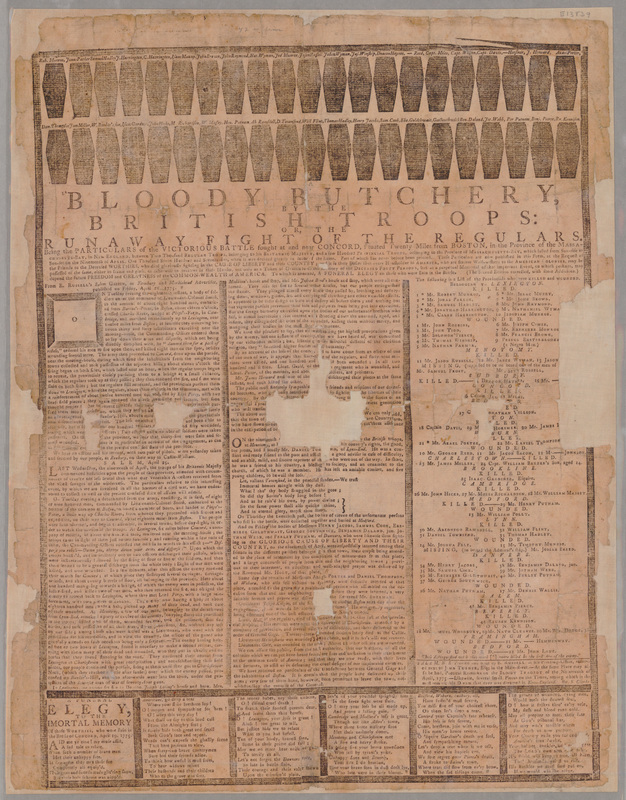
(The picture above shows the broadside “A Bloody Butchery, by the British Troops,” issued after the 19th of April by Ezekiel Russell, whose wife Sarah helped run the print shop.)

Friday, November 15, 2024

“There is one very bad place in this five miles”

A few days back, I linked again to a hand-drawn map at the Library of Congress that appears to be the work of Ens. Henry DeBerniere. The locations on that map match DeBerniere’s first spying trip to the west with Capt. William Brown in February 1775.

Gen. Thomas Gage had those two British officers make a second foray into the countryside starting on 20 March, this time to look for cannon and other military supplies in Concord.

We know the two officers went out to Concord on roads that appear on this map, as shown in the detail above. DeBerniere wrote:
We went through Roxbury and Brookline, and came into the main road between the thirteen and fourteen mile-stones in the township of Weston; we went through part of the pass at the eleven mile-stone, took the Concord road, which is seven miles from the main road.
But Brown and DeBerniere came back by a different route:
Mr. [Daniel] Bliss…told us he could shew us another road, called the Lexington road. We set out and crossed the bridge in the town, and of consequence left the town on the contrary side of the river to what we entered it. The road continued very open and good for six miles, the next five a little inclosed, (there is one very bad place in this five miles) the road good to Lexington.

You then come to Menotomy, the road still good; a pond or lake at Menotomy. You then leave Cambridge on your right, and fall into the main road a little below Cambridge, and so to Charlestown; the road is very good almost all the way.
That “Lexington road” doesn’t appear on the hand-drawn map. It’s possible that DeBerniere produced another map to show it. That would have been useful since that’s the road that Lt. Col. Francis Smith followed to Concord on 18–19 April and then withdrew along.

Donald L. Hafner of Boston College drew my attention to that omission when he left this comment to my recent posting:
It is unfortunate that the surviving map attributed to Ensign DeBerniere does not include the alternate route through Lexington and Menotomy that he and Capt William Brown took on their return to Boston, because it leaves a puzzle about where on that route was the "one very bad place" that DeBerniere describes in his written report to Gage. DeBerniere's sentence is a bit garbled, but he is referring to some location between Lexington and Menotomy center. A good guess would be those locations where the main road is hemmed in to the south by sharply-rising hills, and on the north by wetlands and the Mill Brook. A good candidate would be near the current Lexington/Arlington border. But that is just a guess. Are there better candidates that a soldier would describe as "one very bad place"?
DeBerniere wasn’t clear about where in Concord he started estimating distances, but it is about six miles from the center of Concord to Lexington common, and about five from Lexington common to the modern Arlington town hall. So that does suggest somewhere in the second stretch the officers judged the road “good” but “a little inclosed” with “one very bad place.” The area between Liberty Heights and the Mill Brook in east Lexington indeed seems to be the best candidate—about where Wicked Bagel sits, in fact.

Notably, Smith’s column had its worst experiences before reaching Lexington center at places like Merriam’s Corner, Elm Brook Hill, and the “Parker’s Revenge” site—other spots where the road turned and/or narrowed, but not so much as to make DeBerniere worry.

Wednesday, September 25, 2024

Three Events on Saturday, 28 Sept.

This Saturday, 28 September, will see a number of local events linked to Revolutionary history.

10:00 to 11:00 A.M.
How We Remember
Massachusetts Avenue, Arlington

The Arlington Historical Society, Arlington 250, and Freedom’s Way National Heritage Area host a walking tour of Revolutionary sites in central Arlington, including a newly installed monument.
Historical references point to a mass grave of 40 British regulars who died on April 19, 1775 in the retreat from Lexington and Concord. A recent Ground Penetrating Radar study revealed disturbed soil in this location consistent with a mass grave. A permanent monument, dedicated September 7, 2024, now marks this historic site.

Our program will begin with a brief tour of the Jason Russell House where British bullet holes from April 19th, 1775 can still be seen. We will then walk a flat and easy 0.3 miles to the Old Burying Ground, passing Robbins Memorial Town Hall, a statue by Cyrus Dallin, the Winfield Robbins Memorial Gardens and the Whittemore-Robbins House.

Arriving at the Old Burying Ground, we will see the recently dedicated Monument to the Fallen Crown Soldiers who Died on April 19, 1775 and the 2023 Monument to Enslaved and Free Persons of Color in Menotomy who are buried in the same area. Before returning to the Jason Russell House, we will visit the 1848 Revolutionary War Monument that marks the burial site of Jason Russell and 11 of his fellow Patriots who fell on April 19th, 1775.
Space is limited to twelve people, so register in advance

10:00 A.M. to 4:00 P.M.
Sudbury Ancient Colonial Faire and Fife & Drum Muster
Longfellow’s Wayside Inn, Sudbury

The annual fair in Sudbury includes a colonial encampment, militia and crafts demonstrations, contradancing, and dozens of food and craft vendors. Twenty-five fife and drum corps from across the Northeast are scheduled to perform.

The Grand Parade of fifes and drums will begin at noon; this year there is a new route that starts in front of the camping area. After the groups reach the fair grounds, each performs in turn, providing music through the afternoon.

Admission is $3 cash at the gate. Nearby parking is free.

4:00 to 5:30 P.M.
Battle of Menotomy: Myth, Lore & History
Rebecca Nurse Homestead, Danvers

Prof. Donald Hayes, a longtime member of the Danvers Alarm List Company, will present his recent research on the role that the Danvers militias played in the fighting at Menotomy during the Battle of Lexington and Concord. Danvers lost seven men that day, second only to Lexington itself. He will highlight what is lore and what is documented fact. Reserve free tickets here.

Tuesday, April 23, 2024

“When forty-two countrymen Sure bid their friends adieu.”

Ezra Lunt and Henry-Walter Tinges printed the Essex Journal in Newburyport with the financial backing of Isaiah Thomas, who made a hasty move from Boston to Worcester in April 1775.

On 26 May, the Essex Journal published this verse in a section of the back page titled “The Parnassian Packet”:
A Funeral ELEGY, to the Immortal Memory of those Worthies, who were slain in the Battle of CONCORD, April 19, 1775.

AID me ye nine! my muse assist,
A sad tale to relate,
When such a number of brave men
Met their unhappy fate.
At Lexington they met their foe
Completely all equip’d,
Their guns and swords made glitt’ring show,
But their base scheme was nipp’d.
Americans, go drop a tear
Where your slain brethren lay!
O! mourn and sympathize for them!
O! weep this very day!
What shall we say to this loud call
From the Almighty sent;
It surely bids both great and small
Seek GOD’s face and repent.
Words can’t express the ghastly scene
That here presents to view,
When forty-two brave countrymen
Sure bid their friends adieu.
To think how awful it must seem,
To hear widows relent
Their husbands and their children
Who to the grave was sent.
The tender babes, nay those unborn,
O! dismal cruel death!
To snatch their fondest parents dear,
And leave them thus bereft.
O! Lexington, your loss is great!
Alas! too great to tell,
But justice bids me to relate
What to you has befell.
Ten of your hardy, bravest sons,
Some in their prime did fall;
May we no more hear noise of guns
To terrify us all.
Let’s not forget the Danvers race
So late in battle slain,
Their courage and their valor shown
Upon the crimson’d plain.
Sev’n of your youthful sprightly sons
In the fierce fight were slain,
O! may your loss be all made up,
And prove a lasting gain.
Cambridge and Medford’s loss is great,
Though not like Acton’s town,
Where three fierce military sons
Met their untimely doom.
Menotomy and Charlestown met
A sore and heavy stroke,
In losing five young brave townsmen
Who fell by tyrant’s yoke.
Unhappy Lynn and Beverly,
Your loss I do bemoan,
Five of your brave sons in dust doth lye,
Who late were in their bloom.
Bedford, Woburn, Sudbury, all,
Have suffer’d most severe,
You miss five of your choicest chore,
On them let’s drop a tear.
Concord your Captain’s fate rehearse,
His loss is felt severe,
Come, brethren, join with me in verse,
His mem’ry hence revere.
O ’Squire Gardiner’s death we feel,
And sympathizing mourn,
Let’s drop a tear when it we tell,
And view his hapless urn.
We sore regret poor Pierce’s death,
A stroke to Salem’s town,
Where tears did flow from ev’ry brow,
When the sad tidings come.
The groans of wounded, dying men,
Would melt the stoutest soul,
O! how it strikes thro’ ev’ry vein.
My flesh and blood runs cold.
May all prepare to meet their fate
At GOD’s tribunal bar,
And may war’s terrible alarm
For death us now prepare.
Your country calls you far and near,
America’s sons ’wake,
Your helmet, buckler, and your spear,
The LORD’s own arm now take
His shield will keep us from all harm,
Tho’ thousands gainst us rise,
His buckler we must sure put on,
If we would win the prize.
This tribute to the local men killed the previous month started with the town of Lexington, not just because redcoats had fired the first fatal shots there but because that town lost more men than any other.

Seven Danvers men were killed in and around Jason Russell’s house in Menotomy, so that town got the next mention—which the newspaper’s Essex County audience probably appreciated.

Eventually the poet got to individuals, naming a couple of men at the top of society—Capt. James Miles of Concord and Isaac Gardiner, Esq., of Brookline—and Benjamin Pierce of Salem, also killed at the Russell House. Other dead officers went unnamed, however.

Ezekiel Russell printed this poem at the bottom of his “Bloody Butchery of the British Troops” broadside, shown above. You can peruse that page more closely through the American Antiquarian Society, founded by Thomas.

The Russell broadside contained some errors (a missing “brave,” “young” became “your,” another “your” dropped out), suggesting that shop hastily copied the text out of the newspaper. I would have expected the transmission to go the other way: from the Russell print shop, which was known for publishing a young woman’s elegiac verses, to the Essex Journal.

That in turn suggests that Russell didn’t issue the “Bloody Butchery” broadside until more than a month after the battle. Maybe he needed that time to engrave all those coffins.

Sunday, April 07, 2024

Heading into Patriot’s Day 2024

With yesterday’s posting, Boston 1775 has entered the Patriot’s Day season for 2024.

It’s hard to find a complete posting of Patriot’s Day events because so many towns and organizations have their own celebrations. But a good place to start is the calendar on the front page of Revolution 250.

Among the new commemorations this year is Tavern Week in Arlington, known as West Cambridge or Menotomy in 1775. The Massachusetts Provincial Congress’s committee on safety and supplies met in the Black Horse Tavern on what’s now Massachusetts Avenue on 18 April. Three members planned to spend the night but bolted out the back door when the redcoat column approached.

The Arlington Historical Society is also offering tours of the Jason Russell House, site of the bloodiest fighting of the day, on Saturday, 13 April, and Monday, 15 April, noon to 4 P.M.

Also on 13 April, Michael Lepage will portray Paul Revere at the Paul Revere House in Boston while the Minute Man National Historical Park hosts its annual big tactical demonstration and reenactment of events along the Battle Road.

Some of the towns planning local Patriot’s Day remembrance events include Billerica, Danvers, Somerville, Hanover, and Lynnfield. Others will send traditional contingents to the event in Minute Man Park.

All outdoor events of course depend on welcoming weather. We had snow last week, and flooding forced the cancellation of an event at James Barrett’s farm in Concord today. So let’s hope for sunshine and cool breezes for the next two weeks!

Wednesday, January 10, 2024

Emerging Revolutionary War Bus Tour of Battle Road, 11–13 Oct.

The Emerging Revolutionary War team are planning their fourth annual bus tour of historic places, and this year they’re coming to Massachusetts.

On 11–13 October, historians Phillip Greenwalt, Rob Orrison, and Alex Cain will lead “The Shot Heard Round the World: Battles of Lexington and Concord Bus Tour.”

This tour will consist of:
  • an overview lecture on Friday night.
  • all-day tour of battlefield sites in Lexington, Concord, and other towns on Saturday.
  • a half-day tour of more sites on Sunday morning.
The tour bus and Saturday lunch are included in the $250 cost.

Other meals and lodging are separate, not included in the ticket fee. The host hotel is the Courtyard Marriott in Waltham, with a block of rooms set aside at $239 a night.

Alex Cain is the author of We Stood Our Ground: Lexington in the First Year of the American Revolution and a proprietor of Untapped History.

Phil Greenwalt and Rob Orrison are coauthors of A Single Blow: The Battles of Lexington and Concord and the Beginning of the American Revolution, April 19, 1775. (I wrote the foreword to that book.)

For more information, check out Emerging Revolutionary War. To sign up, go to this page.

Thursday, April 13, 2023

Jason Russell House in Arlington Open for Patriots’ Day

Earlier this month it wasn’t clear if the Jason Russell House would be open during Patriots’ Day, but the Arlington Historical Society has announced its visiting hours.

There will be guided tours of the Jason Russell House on Sunday, 16 April, from 1:00 to 4:00 P.M. and on Monday, 17 April, from noon to 4:00 P.M.

Admission includes the exhibit “Menotomy—Road to Revolution.” The cost is $8 for adults, $4 for children aged six to eighteen, and free for younger children.

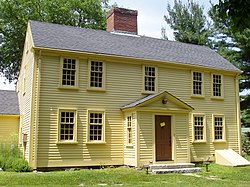
The house itself was studied by the Dendrochronology Laboratory at Oxford University in 2012. That examination showed that some of the timbers were cut around 1684 and probably used to build an older structure. Then Jason Russell bought the property and erected this house in the 1740s, using some older salvaged beams and some new wood.

By 1775 Russell was in his late fifties and too disabled to serve in the regular militia for this western part of Cambridge. Nonetheless, he chose not to leave his house, near the road on which the British columns marched west in the morning.

In fact, Russell welcomed militiamen from towns to the south (Dedham, Needham) and the northeast (Essex County) onto his property. Those men planned to shoot at the withdrawing redcoats, despite warnings that their ambush position was so close to the road they could be outflanked. They were.

British soldiers killed twelve men on this site. Another eight survived by holing up (down?) in the basement.

The dead, including Russell, were buried in one grave. In 1848 the people of West Cambridge, as the town was then known, erected a granite obelisk on that site. However, they knew the names of only three of the men interred there. The rest were from other towns, so they didn’t have local descendants and neighbors to remember them. The Centennial of 1875 stimulated more research, providing the names all the men who died in the battle there.

As I previously noted, the Arlington Historical Society is also sponsoring a lecture on Tuesday, 25 April, at 7:30 P.M. in the town’s Masonic Temple on “The Battle of Menotomy” by A. Michael Ruderman.

Wednesday, April 05, 2023

More 2023 Patriots’ Day Events

The Patriots’ Day 2023 events in Minute Man National Historical Park are just one set of commemorations coming up in the area.

They’re just the easiest to keep track of since there’s a government agency to do so.

Many other events are organized at the town level by historical societies or reenacting groups. Some organizations proudly maintain traditions tied to particular days, regardless of when the holiday falls. And some sites have programs for school vacation week as well.

This is a varied sample of other Patriots’ Day–related events this month.

Saturday, 8 April, 10:30 A.M.
Bedford Parade and Pole Capping
Wilson Park, Bedford

I think the Liberty Cap on a Liberty Pole was a symbol that developed during the Federalist–Jeffersonian rivalry of the 1790s. Liberty Poles in the early 1770s featured variations on the British flag. But this is a beloved local commemoration.

Saturday, 15 April, 1:00 to 3:00 P.M.
A Visit with Paul Revere
Paul Revere House, Boston

Michael Lepage portray’s the house’s most famous owner welcoming visitors. Included in regular admission.

Sunday, 16 April, 2:00 to 3:30 P.M.
Lincoln Salute: Festival of 18th-Century Fife & Drum Music
Pierce Park, 17 Weston Road, Lincoln

The Lincoln Minute Men host the fife and drum groups who come for the next day’s parades in outdoor musical performances. Bring a picnic basket, blanket, and lawn chairs. (The picture above comes from a Lincoln Salute so many years ago this drummer is probably practicing law now.)

Monday, 17 April, all day
Lexington Patriots’ Day Events
Various sites around town

Events include Revere’s midnight arrival at the Hancock-Clarke House, the alarm from the belfry, the fight on Lexington common (starting at 5:30 A.M.), the regathering of the local company (8:30 A.M.), and battle demonstrations in Tower Park (4:00 P.M.). The historical society’s Buckman Tavern, Munroe Tavern, and Hancock-Clarke House will be open for tours, and the film “First Shot” will be shown at the Depot.

Monday, 17 April, 9:00 A.M. to noon
Patriots’ Day Parade in Boston
From City Hall Plaza to “The Prado” on Hanover Street

The description says, “After a flag-raising ceremony at City Hall, the parade stops at King’s Chapel Burying Ground to lay a wreath on the tomb of Major William Dawes [actually that’s the grave of his father; the rider’s remains are at Forest Hills], who was a member of the Ancient & Honorable Artillery Company of the Massachusetts Militia [this company wasn’t part of the official militia in 1775], and continues to Granary Burying Ground to lay a wreath at the grave of Paul Revere.”

Monday, 17 April, 9:00 A.M. to 1:00 P.M.
William Dawes’ Ride
From Eliot Square in Roxbury to Lexington Green

A mounted Royal Lancer portraying Dawes is expected to visit Brookline’s Devotion School about 10:00 A.M., Hill Memorial Church in Allston about 10:30 A.M., Cambridge about 11:00 A.M., and Arlington Town Hall around noon.

Wednesday, 19 April, 11:00 A.M. to 3:00 P.M.
Mix & Mingle with Rachel Revere
Paul Revere House, Boston

Judith Kalaora of History at Play portrays the silversmith’s second wife. Included in regular admission.

Thursday, 20 April, 1:00 to 3:00 P.M.
Patriot Fife & Drum
Paul Revere House, Boston

David Vose & Sue Walko play and discuss period music for everyone visiting the museum.

Tuesday, 25 April, 7:30 P.M.
A. Michael Ruderman on “The Battle of Menotomy”
Masonic Temple, 19 Academy Street, Arlington

The Arlington Historical Society’s provocative description says: “Battle Green was an accident. Concord Bridge, a skirmish. But in the most brutal and deadly warfare of April 19, 1775, nearly 6,000 combatants fought hand to hand and house to house, the length and breadth of Menotomy.”