On a very bad day in May 1794,
Marie Anne Pierrette Paulze Lavoisier lost both her husband and her father to the guillotine.
Within a couple of years, however, more moderate
French governments were restoring her property and clearing those men’s names.
Lavoisier kept busy editing her late husband
Antoine’s
scientific papers into an authoritative collection. She also wrote a denunciation of one of the officials who had sent her relatives to their execution, though she didn’t publish that under her name.
Multiple men proposed marriage to the wealthy, intelligent widow, including
Pierre du Pont, who in 1799 emigrated to the U.S. of A. with his family, and Sir
Charles Blagden, secretary of the Royal Society. However, it would take an exceptionally talented and determined man to win Mme. Lavoisier’s hand.
One candidate arrived in Paris in 1801. He had spent eleven years, from 1785 to 1796, as a minister of all trades for Prince Charles Theodore, Elector of Bavaria and Count Palatine. While in Munich he had reorganized the state’s army, reformed its poorhouses, invented a cheap but nourishing
soup, designed public parks, developed a way to calculate a substance’s specific heat, and made other breakthroughs in thermodynamics (refuting some of Antoine Lavoisier’s ideas). For such services and feats the prince had named him Reichsgraf von Rumford, or Imperial
Count Rumford.
Before that job in
Germany, the count had served as an officer in the
British army, commanding
Loyalist cavalrymen on
Long Island in the last years of the American War. Before that, he was secretary to Lord
George Germain, Britain’s Colonial Secretary and the chief architect of the empire’s military policy from 1775 to 1782. Those activities had won him a British knighthood.
And before attaching himself to Germain, the count had been a young man from
Woburn, Massachusetts, who through brains, hard study, ambition, a lucky marriage, and minimal scruples had transformed himself into a
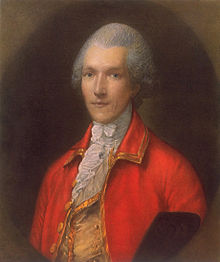
New Hampshire country gentleman with a wealthy wife by the time he turned twenty years old. Yes, it was our old friend Benjamin Thompson (shown above in 1783).
Thompson had left his wife and infant daughter Sally in New Hampshire when he ducked behind British lines in the fall of 1775, worried that he’d be outed as one of Gen.
Thomas Gage’s
spies. (Remarkably, Americans didn’t tumble to this aspect of Thompson’s career until the 1920s.) In the 1780s Thompson resumed correspondence with some of his American connections, including his mother and his friend
Loammi Baldwin, but he was adamant they not tell his wife where he was.
In 1789 Thompson had a second daughter with the Countess Baumgarten, also mistress of Prince Carl Theodore. The count also had a long sexual relationship and friendship with Countess Baumgarten’s sister, Countess Nogarola. In the 1790s Rumford had an affair with Lady Palmerston while Viscount Palmerston had an affair with Emma, Lady Hamilton, later the love of Lord Horatio Nelson. In other words, Count Rumford had entered an aristocratic circle that wasn’t really committed to the traditions of marriage.
Even Count Rumford’s presence in France raised some eyebrows. After all, he was a former British army officer, still on half-pay, and Britain and France were technically at war. The armies of Revolutionary France had also invaded Carl Theodore’s territory twice while Rumford worked for the prince. But First Consul Napoleon Bonaparte was busy consolidating his victories with peace treaties. Starting in March 1802, everyone was supposed to be friendly.
Count Rumford met Marie Anne Lavoisier in Paris on 19 Nov 1801. In the spring of 1802 he made a brief visit back to Britain, then traveled to Bavaria with Sir Charles Blagden. There the new Elector offered him government jobs. On 30 November the count sent a letter to his daughter Sarah in New Hampshire that she summarized like this:
he alludes to his love concern; says he has got into full employment at Munich, but would rather be in Paris; and the certain lady would rather have him there.
In 1803, Mme. Lavoisier joined the count in Munich.
TOMORROW: To marry or not to marry?