J. L. BELL is a Massachusetts writer who specializes in (among other things) the start of the American Revolution in and around Boston. He is particularly interested in the experiences of children in 1765-75. He has published scholarly papers and popular articles for both children and adults. He was consultant for an episode of History Detectives, and contributed to a display at Minute Man National Historic Park.

Subscribe thru Follow.it


•••••••••••••••••


Showing posts with label Ebenezer Mackintosh. Show all posts

Tuesday, June 27, 2023

The Mystery of “Mr. Swift from the North”

I’ve been analyzing the publication of the story from Samuel Swift’s descendants that he tried to instigate an uprising against British troops inside besieged Boston before dying in the summer of 1775.

In the early twentieth century American historians did a lot of debunking. The Colonial Revival period had brought a lot of dramatic stories and traditions into print. Taking a more evidence-based approach, the next generations of authors lopped away at myths and hagiography.

The dramatic story of Samuel Swift’s martyrdom—coming from his family, unsupported by other evidence, incredible in its details—was the sort of lore that debunking authors tried to clear out of reliable histories.

But Samuel Swift’s reputation as a strong Patriot survived into the mid-1900s.

That’s because of a conjunction of sources. First, back on 7 Nov 1765 the Boston News-Letter reported about that year’s tightly controlled 5th of November celebration:
The Leaders, Mr. McIntosh from the South, and Mr. Swift from the North, appeared in Military Habits, with small Canes resting on their Left Arms…
(Pierre Eugène du Simitière’s sketch of leaders of the 1767 Pope Night parades, with canes and speaking trumpets, appears above.)

In the nineteenth century the authors Caleb Snow, Samuel A. Drake, and Francis S. Drake reprinted or paraphrased that 1765 news story, including the name “Swift.”

In 1891, the editors of the Jeremy Belknap Papers from the Massachusetts Historical Society identified Samuel Swift as “one of the Committee of Safety, and a prominent man at the North End.”

The “Committee of Safety” reference probably derives from a line in Samuel Swift’s 2 Oct 1774 letter to John Adams: “The Committee of Safety by me pay their best Regards to you.” But there was no formal “committee of safety” at the time. The town of Boston hadn’t named Swift to its committee of correspondence. He wouldn’t even be on the larger committee named on 7 December to enforce the Continental Congress’s Association boycott. It appears Swift was passing on regards from other men.

As for being “a prominent man at the North End,” Swift wasn’t a member of the North End Caucus. He didn’t hold high political office or militia rank. He was a justice of the peace from 1741 to 1760, but wasn’t reappointed under George III. As an attorney, Swift wasn’t a big employer, like shipyard owner John Ruddock.

I suspect the mention of “Mr. Swift from the North” in the 1765 newspapers caused those Belknap editors to identify that leader of the North End gang as Samuel Swift, thus making him “a prominent man” in that neighborhood.

Certainly that’s where George P. Anderson stood when he presented his ground-breaking paper “Ebenezer Mackintosh: Stamp Act Rioter and Patriot” to the Colonial Society of Massachusetts in 1924:
The leaders—Mackintosh of the South End and Samuel Swift of the North End—appeared in military habits, with small canes resting on their left arms, having music in front and at flank.
For decades after that, historians identified Samuel Swift as the leader of the North End gang. After all, well respected scholarly sources said so. 

But that never made sense. The Pope Night gangs were composed of young men and older boys from the working classes. Samuel Swift, a genteel fifty-year-old lawyer in 1765, was the sort of man they begged money from, not the sort to lead their raucous street processions.

In The Boston Massacre (1970), Hiller B. Zobel noted that Samuel Swift didn’t even live in the North End. The Thwing database shows he owned a house on Pleasant Street in the South End.

But among the people indicted for rioting after the 1764 Pope Night disturbances, Zobel reported, was a teen-aged shipwright named Henry Swift. Following his lead, many authors since 1970 have identified Henry Swift as the North End captain.

References to Samuel Swift as a politically active North End leader survive, however, including in the footnotes of older volumes digitized at Founders Online. He was an interesting character, but he wasn’t a militant in either 1765 or 1775.

Saturday, February 05, 2022

Public Occurrences, Both Foreign and Domestic

Last month on H-Net, Tristan Stubbs reviewed D. H. Robinson’s The Idea of Europe and the Origins of the American Revolution, published in 2020 by Oxford University Press.

Stubbs wrote:
…this highly impressive work offers a genuinely new paradigm through which to view the years leading up to 1776. Americans made the fateful decision to secede not for the economic reasons offered over a century ago by Charles Beard and the Progressive historians; they were not the “radicals” drawn by Gordon S. Wood; and their motivations cannot be ascribed solely to civic republican ideals of virtue and liberty favored by the “canonical intellectual histories” of Bernard Bailyn and J. G. A. Pocock.

Instead, Americans had seen themselves for a long time before the Declaration of Independence as intimately connected to European geopolitics, took a deep interest in the balance of power across the ocean, and were disappointed by the metropolitan Tory government’s failure to shoulder its responsibilities in defending continental liberties against the overweening power of France and Spain. . . .

it spends an impressive amount of time on the effect on metropolitan and colonial opinions of Sweden’s 1772 reversal to absolutism and of the British government’s failure to support the Republic of Corsica against what colonists viewed as French attempts to impose Catholic “universal monarchy” not only on that Mediterranean island but throughout the French sphere of influence—including in America.
This hypothesis truly does seem like a “new paradigm,” in that I hadn’t considered inadequate protection from Catholic empires to be a major concern for the Americans resisting Crown measures from 1765 to 1775.

There would be at least a great irony if colonists adopted independence due to fear of France and Spain given how the young U.S. of A. soon allied with France and Spain. And then felt threatened by Spain/Napoleonic France as well as Britain on its new borders without the protection of a large empire.

To be sure, the Revolution in New England was fueled by suspicion of popery and ended with national freedom of religion, and the war in large slaveholding states was fueled by fear of slave uprisings and ended with slavery coming to an end in other parts of the country. So a paradoxical outcome doesn’t negate a possible cause of the conflict.

But the idea that colonial American discourse about European geopolitics strongly influenced resistance to Parliament’s new taxes and royal officials seems very tenuous. Ebenezer Mackintosh named a son after Corsican independence leader Pasquale Paoli and Loyalists claimed that William Molineux wanted “Paoli” as a nickname himself, but I really don’t see the farmers of Hampshire County shutting down their courthouse because they felt the London government hadn’t supported Paoli’s Corsican cause enough six years before. (Indeed, it was well known the British Crown granted Paoli a pension, supporting him as an asset against France.)

Today we Americans live in a much more democratic society, meaning more people are involved in political decisions. We’re privy to more news from around the world. Our economy is more globalized, as are our military forces. By all measures we should be more concerned with international relations than eighteenth-century farmers. And yet foreign policy is rarely a big factor in our politics, so was it a factor in theirs?

Robinson’s argument appears to rest on what he calls “the discursive evidence,” the same body of evidence that he says should also rule out historical hypotheses about the Revolution based on “relations between classes and genders...racism and material cultures.”

As Stubbs writes, “the discourse under investigation here was led primarily by white, male, anglophone professionals.” And in this case “professionals” appears to mean the sliver of educated, usually wealthy white men who wrote essays for the newspapers.

I have no doubt those essays used contemporary Sweden as an example of the danger of autocracy, the same way they used the Stuart monarchs and the Roman emperors. But I doubt those writings from such a narrow, well, class really got at all the forces driving political change at the time. And I’m skeptical that developments well outside the British Empire motivated colonial Americans to rebel as much as “pocketbook issues.” 

Thursday, February 13, 2020

The Great 1770 Quiz Answers, Part 3

Here are answers from the start of the second part of the Great 1770 Quiz.

VII. What were the real names of people in Boston behind these nicknames or pseudonyms used in 1770?

A) Determinatus
B) The Irish Infant
C) Michael Johnson
D) Paoli
E) Philanthrop
F) Shan-ap-Morgan
G) Vindex
H) William the Knave

One site to find almost all of these names is Boston 1775. Use the search box in the upper left corner of the screen (on the desktop design). I’ve discussed everything but “Paoli.” Of course, one should still confirm what I’ve written, but this site offers a quick start.

Three of those names are pen names used in newspaper essays. Samuel Adams wrote as “Determinatus” and “Vindex,” among many other pseudonyms. Jonathan Sewall signed himself “Philanthrop.” Many newspaper readers knew the identities behind those signatures; they weren’t actually concealing much.

Two other nicknames are examples of how people attacked their political enemies in newspaper essays. Adams called Customs Commissioner John Robinson “Shan-ap-Morgan” because he came from Wales. Boston Chronicle printer John Mein called William Molineux “William the Knave,” along with my favorite, “Admiral Renegado.”

It’s not clear which category “Paoli” belongs in. In 1769 the unsuccessful Corsican revolutionary Pasquale Paoli (1725-1807) was celebrated in Britain, where it was easier to cheer people rebelling against the French king than rebelling against one’s own. American Whigs toasted Paoli, Ebenezer Mackintosh named a child after him, and a Pennsylvania tavern with his name grew into a township (and 1777 battle site).

In an 18 Feb 1770 letter Thomas Hutchinson wrote about Molineux, “whom the Sons of Liberty have given the name of Paoli.” The Censor magazine for 14 Mar 1772 likewise referred to “the Bostonian who assumes the name of Paoli.” But those are Loyalist voices, not actually Molineux’s friends. In fact, they were his enemies, eager to make him seem conceited or alarming.

So did Molineux and his colleagues really use the nickname “Paoli” regularly and unironically? I’m not sure. But many historians have accepted Hutchinson as an accurate reporter and repeated that Molineux seized on the Corsican’s name.

On to “Michael Johnson.” In the week after the Boston Massacre, newspapers and coroners referred to one dead victim under that name. Then suddenly they started calling that tall mulatto man Crispus Attucks—without, unfortunately, offering any explanation for the change. Most historians suspect Attucks was living under an alias, but that’s still a guess.

Finally, in his autobiography John Adams recalled how the merchant James Forrest, “then called the Irish Infant,” asked him to defend the soldiers after the Massacre. Adams used the same nickname in an 1816 letter to Jedidiah Morse. He described Forrest in tears, so people have interpreted the nickname to mean Forrest, an Irishman, cried as easily as a baby.

That said, I haven’t found any other source describing Forrest by that name or trait. When Forrest told the Loyalists Commission about the services he’d rendered to the Crown, he didn’t mention securing the soldiers’ defense attorney. And the younger Abigail Adams used the phrase “the Irish infant” to describe a little person she saw in London in 1785. So there’s still a little mystery there.

Both Kathy and John matched all the nicknames to the right people.

VIII. After approving the Short Narrative of the Horrid Massacre, Boston voted to send a copy to about two dozen potentially sympathetic readers in Britain. Who was the only woman on that list?

Boston’s Short Narrative report can be found at many websites, and in multiple editions. The first printing, as shown by the copy Molineux sent to Robert Treat Paine and the Massachusetts Historical Society later digitized, ends with an index of witnesses. The town meeting authorized a committee to send copies to “the Duke of Richmond, General [Henry Seymour] Conway, and such other Gentlemen as they may think proper” in Britain.

On 16 May, the printers produced more copies with some new pages at the end listing the people in Britain that committee had chosen. A footnote explained, “This list and the following letter, are annexed to such copies only of this pamphlet, as are intended for publication in America.” Then more material was added for later printings. The longer copies were the basis of reprints in 1849 and 1870.

There’s one female name on that long list of recipients: the Whig historian Catharine Macaulay (shown above during her 1784-1785 visit to the U.S. of A.).

Both John and Kathy identified that supporter of the American cause.

IX. What site on the Freedom Trail came under new management in 1770?

There are a limited number of sites on the Freedom Trail, some of which didn’t even exist in 1770. So that narrows down the possibilities.

The Freedom Trail Foundation’s own webpage about those sites includes an entry that begins: “Built around 1680, the Paul Revere House, owned by the legendary patriot from 1770-1800…” A-ha!

A little research in biographies confirms that Paul Revere bought the North End house now named after him in late 1770. It was his home and place of business for several years, though he moved out for grander quarters well before he sold it.

Both Kathy and John correctly landed on that site.

TOMORROW: Tar, feathers, and death.

Friday, August 05, 2016

Living History in Boston, 13 and 14 August

On the weekend of 13-14 August, a group of dedicated historical reenactors who call themselves the Middling Sort will be in Boston participating in a couple of living history events.

On Saturday, 13 August, the Old State House will host “Echoes of the Past,” “a one-day transmedia game in the streets of Boston that will immerse players in the story of Boston’s famous Stamp Act protest” through a “fusion of interactive theatre and puzzle solving.”

Boston’s first anti-Stamp demonstration took place on Thursday, 14 Aug 1765—a market day, when farmers from the countryside brought in fresh wares to sell to townspeople and bought supplies to carry home. The Middling Sort will help to recreate Market Day based on actual vendors and what they sold. Their goods will also be part of the game.

There will be three sessions of the “Echoes of the Past” game, starting at 1:00, 2:00, and 3:00 P.M., followed at 4:00 by a recreation of the anti-Stamp procession through the streets of Boston, led by shoemaker Ebenezer Mackintosh.

On Sunday, 14 August, the action moves to the Loring-Greenough House in Jamaica Plain (shown above), which is commemorating the 300th birthday of Commodore Joshua Loring this month.

From noon to 4:00 P.M., “Fight or Flight” will explore the choices that the Loring family faced as Loyalists in 1774 and beyond. Should they move into Boston? Prepare to leave New England? What would happen to their estate?

Saturday, November 07, 2015

“As regular as a military Corps”

As I read the accounts of anti-Stamp Act demonstrations from late 1765, I’ve been struck by their emphasis on the crowd’s military discipline.

After the 1 November procession, Gov. Francis Bernard reported to London: “[Ebenezer] MackIntosh is a noted Captain of a Mob & has under him 100 or 150 men trained as regular as a military Corps.”

And in more detail:
To show how fully this Town is in the hands of the mob, I will add that Capt. Mackintosh (now called Genl. Mackintosh) who took the care of the Town, after the Militia had refused to muster under my order, & the Council advised me to discharge the Order, & who professes to have 150 or 200 men trained under him; on the 1 of November marshalled at least 2,000 men, & marched in regular order.

What is more surpising is, that one of the Council, Col. [William] Brattle, walked with him, arm in arm, along the Streets, complimented him on the Order kept & told him his Post was one of the highest in the Government. This Councellor conducted him round the Town House whilst both the Houses were sitting; before which regular Huzza’s were made.
Brattle (shown above) was a high-ranking militia officer, on his way to becoming a general, so his praise for Mackintosh meant a lot. As did skipping out on a Council meeting to march around with the working-men outside.

Mackintosh wasn’t really a captain or general, of course. He gained his informal title from leading the South End gang during Pope Night processions and brawls in the early 1760s. But Mackintosh was a veteran of the previous war, and he and nearly every other young man in Boston trained with their militia companies each season, so they knew how to march in step and obey military command.

In fact, they were extremely disciplined. And that worried the royal authorities as much as riots and disorder. Judge Peter Oliver later wrote of Mackintosh:
He dressed genteelly; & in Order to convince the publick of that Power with which he was invested, he paraded the Town with a Mob of 2000 Men in two Files, & passed by the Stadthouse, when the general Assembly were sitting, to display his Power. If a Whisper was heard among his Followers, the holding up his Finger hushed it in a Moment: & when he had fully displayed his Authority, he marched his Men to the first Rendevouz, & order'd them to retire peacably to their several Homes; & was punctually obeyed.
The implication of such discipline, of course, is that with a flick of the same finger Mackintosh could order those same hundreds of men to attack.

Friday, November 06, 2015

“The union was established in a very ceremonial manner”

So what did the “Union” of North End and South End gangs on the fifth of November 1765 look like?

As the Massachusetts Historical Society quoted in 2009, chronicler James Freeman described the day this way:
the disorders which had been committed from time to time induced several gentlemen to try a reconciliation between the 2 parties; accordingly the chiefs met on the 1st of this inst. [i.e., of November], & conducted the affair in a very orderly manner. In ye even’g the commander of ye N. & [S.] after making general overtures they reciprocally engaged in an Union, & the former distinctions to subside, at the same time the chiefs with their assistants engaged their honour no mischief should arise by their means, & that they would prevent any disorders on ye 5th.

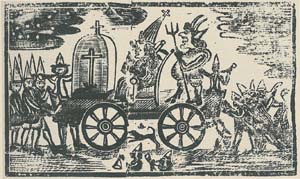
When the day arrived about noon the pageantry representing the Pope, the Devil, & several other effigies signifying tyranny, oppression, slavery, &c. were brought on stages from the N. & S. & met in Kings Str. where the union was established in a very ceremonial manner, & having given three huzzas, they interchanged ground, the S. marched to ye N. & the N. to the S. parading thro’ ye streets until they again met near ye Court House.

The whole then proceeded to Liberty tree, under the shadow of which they refreshed themselves for a while, & then returned to ye Northward agreeably to their plan. They reached Cop’s hill before 6 o’clock, where they halted, & having enkindled a fire, the whole pageantry was committed to the flames & consumed.
That was actually a lot like the way smaller New England ports celebrated Pope Night every year: with a single procession, a big bonfire, and public refreshments. So in 1765 the Boston gangs got to enjoy those things without the violence, while getting extra praise and other goodies.

In 2011 the M.H.S. added some remarks from the merchant Isaac Winslow (1743-1793): “There were no disguises of visages, but the two leaders, [Ebenezer] M’cIntosh of the South, and [Henry] Swift of the North, (the same who was so badly wounded last year[)], were dress’d out in a very gay manner”.

Those men’s outfits were military-style coats that town gentlemen had given to the “chiefs with their assistants” of the two gangs—reflecting their self-conferred titles of “captains and lieutenants.” A couple of years later, the artist Pierre Eugéne du Simitière sketched those coats on gang leaders, as shown above. (Du Simitière’s notes preserve the detail that the coats were blue with red trim.) I suspect that by that year Mackintosh and Swift had passed their roles, and those coats, on to younger men.

TOMORROW: The military discipline of the “mob.”

Thursday, November 05, 2015

The Danger of Pope Night in 1765

As I described earlier in the week, Boston’s civic leaders were very nervous that the fifth of November in 1765 would bring on a riot. As it usually did.

On that date young British males traditionally observed Guy Fawkes Day or Pope Night by carting around effigies of the nation’s political and religious villains and burning them. Boston’s youth took that patriotic display two steps further than anyone else by dividing into South End and North End gangs and having a big brawl after sunset.

In 1764, one of the Pope Night carts ran over and killed a little boy named Brown, described by different sources as five to nine years old. That happened early in the day, and the holiday proceeded anyway, including the brawl. Tradition, you know.

In the following August, Pope Night rituals spread into the town’s anti-Stamp Act protests: twin effigies hanged and burned, processions through the center of town, bonfires. But instead of just threatening to break windows if householders didn’t treat them well, the crowds broke into three or four mansions and smashed all the furniture.

Sheriff Stephen Greenleaf detained the captain of the South End gang, a shoemaker named Ebenezer Mackintosh, after the riot against Lt. Gov. Thomas Hutchinson on 26 August. But then the town authorities worried that arrest would only rile up the rioters, so they set Mackintosh free. He was prominent in the anti-Stamp demonstrations at Liberty Tree in the following months. But what would he, his comrades, and their cross-town rivals do on Pope Night?

Mackintosh seems to have enjoyed his new role as a political leader and the respect that went with it. He probably appreciated the town leaders’ concerns about keeping Boston’s reputation safe. He definitely appreciated what they offered the gangs if they behaved well.

So Mackintosh made a deal with Henry Swift, captain of the North End gang. The young printer John Boyle described the result: “A Union established between the South and North End Popes. Capt. McIntosh on the Part of the South, and Capt. Swift, on the Part of the North. . . . This Union and one other more extensive [the Stamp Act Congress?], may be looked upon as the only happy Effecte arising from the Stamp Act.”

TOMORROW: A new way to celebrate the fifth of November.

Monday, August 24, 2015

Details of the First Stamp Act Protest

The anonymous account of Boston’s 14 Aug 1765 Stamp Act protest I quoted yesterday also includes a passage that’s prompted a lot of questions about who was behind the event:
…thus Hung the Image thro all the Day tho Three Guineas [£3.3s.] was offerd to any one that should take it down and no one dared to make the Tryall. The Paper on which A. O in Capitals was wrote blew off and at mid Day a person came with an Hanchif over his Face went up with a Ladder and fastnid it on in the Sight of Numbers who dard not obstruct him. It was observd that in making a Slip his Trousers slide up and discovered a silke Stockinge and Breeches answerable in Goodness—from whence you may infer that some of them undress’d were not of the lowest Class.
Trousers were stereotypically sailors’ dress, and this anecdote suggests that a man wealthy enough to afford silk stockings and good breeches had disguised himself as a sailor during the protest. That man was probably a member of the Loyall Nine, the political club that included both better established craftsmen and young merchants.

That evening, “Forty or fifty tradesmen, decently dressed,” led the procession with the effigy, according to Thomas Hutchinson, writing in his capacity as historian. The organizers were obviously trying to present the protest as coming from the middling class, not the gentility.

Another passage from that letter that I skipped yesterday described where that procession went:
They…proceeded to the Town House [shown above in 1751], went thro that and here the noise was Bombs bursting and cannons firing, on this the Governor and Councillors who were above stairs consulting the Dispersion of the Mob, thought it prudent to extinguish their Lights and take to their Heels as fast as they could.
Gov. Francis Bernard’s account said only:
knowing that we were sitting in the Council Chamber, they gave three huzza’s by way of defiance, & passed on.
However, Lt. Gov. Hutchinson confirmed that the crowd was actually in the building:
Just at dark an amazing mob brought the image thro the court house [Town House] the council then sitting above…
And Cyrus Baldwin wrote that the effigy “was brought by the Mob through the main street to the Townhous, carried it through…” The street level of the Town House (now the Old State House Museum) was set aside for a merchants’ exchange. Evidently in the evening it was open to pedestrians.

Baldwin’s letter contains another curious phrase about how the procession started: “after sun sett the North gave up & the South keept not back.” That appears to refer to the North End and South End Gangs, best known from their annual brawl on Pope Night. The effigies, the procession to the center of town, and the bonfire on Fort Hill were all part of the South End Gang’s regular Pope Night ritual.

The South End’s “captain” for that year, shoemaker Ebenezer Mackintosh, was soon being called the leader of the protest movement, so he was probably at the head of those “forty or fifty Tradesmen” who marched the effigy through the Town House. However, as Loyall Nine member Henry Bass wrote at the end of the year, those men were “not a little pleas’d to hear that McIntosh has the Credit of the whole Affair.”

Monday, December 01, 2014

“Law and (Dis)Order in Boston, 1773” at Old South in December

In historical Boston, December is Tea Party time, and the Old South Meeting House and Boston Tea Party Ships & Museum are collaborating on a series of public presentations.

Friday, 5 December, 10:00 A.M. to 4:00 P.M.
Holiday Open House at Old South
Meet colonial characters, enjoy a cup of tea, and discover if you would have been a Patriot or Loyalist in 1773. Programs for young children will include puppet making, scavenger hunts, and tiny tea sets! Free.

Friday, 5 December, 12:15 P.M.
“That Pesky Tax on Tea!”
Listen to an exchange between a Son of Liberty and a Tory as they spar on matters of tea and taxes, law and liberty in 1770s Boston. Then join the conversation! Presented by actors from the Boston Tea Party Ships & Museum. Free to all, but pre-registration requested.

Saturday, 6 December, 10:00 A.M. to 4:00 P.M.
Holiday Open House at Old South
See above. Free.

Friday, 12 December, 12:15 P.M.
Ebenezer Mackintosh, the Gangs of Boston, and Riot in the New World
Historian Matthew Wilding will focus on the life of radical Ebenezer Mackintosh as he explores the theme of riot as political expression in colonial Boston, from the Stamp Act Riots to the Boston Tea Party. Free for Old South members, $6 for others. Pre-registration requested.

Tuesday, 16 December, 6:30 to 8:30 P.M.
Tea Party Reenactment
Gather at Old South Meeting House, where the colonists met in 1773, with colonial agitators and Loyalists to debate the tea tax and liberty from the British crown! Afterwards, join the procession to Griffin’s Wharf accompanied by fife and drum. You will line the shores of Boston Harbor to witness the destruction of the tea as the Sons of Liberty storm the brig Beaver, tossing the tea into the frigid water below.

Tickets to the big event cost $25, and there’s a deal if you buy a membership in Old South at the same time.

Wednesday, November 07, 2012

Alfred F. Young, a Giant of a Historian

The historian Alfred F. Young died yesterday at the age of 87. He was the author of significant books about the American Revolution, with particular attention to people from Massachusetts:
Perhaps even more important, Al Young edited or coedited some landmark collections of essays and the catalog for a permanent exhibit at the Chicago Historical Society:
In all his books, Al focused on ordinary people rather than political and military leaders from the elite. He studied men like Ebenezer Mackintosh and events like Pope Night (well, he used the term “Pope’s Day”). Appropriate for a man given the middle name “Fabian,” as in Fabian socialism—and as in Gen. George Washington’s Fabian strategy for patiently winning the war.

Al was also a friend and a mentor. I’m not an academic, and I had no institutional affiliation when I attended my first Omohundro Institute conference on early American history. Al welcomed me and introduced me around. On Sunday morning, as many attendees left early, we had hours of one-on-one conversation about his upcoming work on Deborah Sampson and my research on kids.

Al was always eager to make connections, to bring new folks into the conversation. Though he felt that some of the dominant “consensus” school of American Revolutionary history missed important points by focusing on the top, he didn’t spend his time complaining about those omissions. Instead, as a speaker and writer Al emphasized the good work he saw people doing and tried to ensure more people heard about it.

I helped Al with computer research for his book Liberty Pole, collecting and analyzing newspaper reports about Liberty Trees and Liberty Poles in pre-Revolutionary America. Did they have the same meaning, or were they independent symbols? Earlier this fall I sent Al my experience of a visit to the Boston Tea Party Museum as he planned a new essay.

In late October Ray Raphael told me that Al had fallen ill. I’d just sent him some pages from my George Washington study that I thought he’d like, piecing together the life of a teen-aged girl who worked at the general’s Cambridge headquarters. I ended that letter this way:
Your advice, inspiration, and unflagging encouragement over the past several years have been a great strength for me. You welcomed me into the historical field when I made my first, uncredentialed steps into it, and you’ve given me the confidence to take on greater challenges. I know you’ve done the same for many other researchers, and I’m gratified to have been in that company. Thank you.
There’s no better introduction to Al’s work than The Shoemaker and the Tea Party. It combines an updated an expanded version of his award-winning William & Mary Quarterly paper about George R. T. Hewes with analysis of how we came to celebrate the Tea Party above all the other pre-Revolutionary political action in Boston.

Saturday, November 12, 2011

Ebenezer Mackintosh, Captain of the South Enders

Pope Night is turning out very long this year. Some Boston 1775 readers thought yesterday’s description of the Fifth of November celebration in 1765 put too much emphasis on upper-class gentlemen manipulating the crowds. But I can read the same events the other way as well: the crowds manipulating the elite. Or perhaps both groups got what they wanted together.

There are many more sources from the genteel class than from the working class, of course. Rich men of all political persuasions wrote about the “mob” with distaste. Friends of the royal government blamed riots on secret Whig instigators. Whigs blamed the same events on oppressive laws spurring entirely foreseeable anger from the lower sort. No one recorded much about what workingmen themselves thought, how they organized, and what they hoped to accomplish.

Alfred F. Young’s “Ebenezer Mackintosh: Boston’s Captain General of the Liberty Tree,” an essay published earlier this year in Revolutionary Founders, collects what we know about the most prominent working-class political figure in pre-Revolutionary Boston.

Mackintosh, a twenty-seven-year-old shoemaker, was the captain of the South End gang in 1764. It looks like the youth of that part of Boston chose him for that post, along with some unnamed lieutenants, but we have no idea how. The South Enders won that year’s Pope Night brawl, but a young boy was killed, town officials tried to seize the wagons, and North End captain Henry Swift lay in a coma for days.

In March 1765 Mackintosh, Swift, and others were indicted for rioting, with a stern lecture from Chief Justice Thomas Hutchinson. Yet the same month, Bostonians elected Mackintosh as a Sealer of Leather, one of the town’s many inspectors. So clearly he was still popular, and commanded some respect from the men who could vote in town meeting.

The next month brought news of the Stamp Act, scheduled to take effect at the start of November. Boston was the site of America’s first public protest against that law, carried out by a large crowd in the South End on 14 Aug 1765. With Ebenezer Mackintosh as a very visible leader, that protest used the same sort of effigies as on Pope Night. The elm hanging over the proceedings was later dubbed “Liberty Tree,” and Mackintosh became its “Captain General,” a term borrowed from the militia.

Behind the scenes, it looks like the Loyall Nine, a group of young merchants and luxury craftsmen, did much of the preparation for that protest. Records also show that two days before it Samuel Adams had sworn out a warrant for unpaid taxes against Mackintosh and his partner; later, Adams apparently dropped that matter. Was that because Mackintosh had kept the violence under control and directed against the property of Stamp Act agent Andrew Oliver?

On 26 August, a more spontaneous crowd sacked Hutchinson’s house in the North End. That’s a very murky affair, made murkier by Hutchinson’s conspiracy theories. Mackintosh was arrested for the riot, then let go on the grounds that there would be worse trouble if he were locked up. No one preserved evidence that Mackintosh was actually involved, but by then many officials perceived him as controlling the Boston crowd.

That fall, protests against the Stamp Act spread up and down the Atlantic coast. In Massachusetts it became clear that Oliver wouldn’t be able to collect the new tax, and that judges and other officials would proceed without requiring stamped paper. With that struggle going his way, and legal threats still hanging over him, Mackintosh had an incentive to help keep Boston peaceful. At the same time, his South End gang constituency was probably looking forward to their Pope Night celebrations.

Yesterday’s posting said that town leaders convinced the South End and North End gangs to forgo their traditional brawl on 5 Nov 1765 by supplying a festive banquet instead. In fact, gentlemen paid for large quantities of food and drink three times that fall:

  • In late October, the two “richest men in town”—perhaps John Hancock and John Rowe—hosted two hundred workingmen at a tavern, with Mackintosh and Swift at the head table.
  • On Pope Night, there were refreshments for all under Liberty Tree as the gangs rolled their wagons around peacefully.
  • There was another formal dinner a week after the holiday, filling five rooms.

Furthermore, merchants gave the Pope Night officers new blue and red uniforms, hats, and canes. The young men first wore those in a public march on 1 November, the day the Stamp Act was to take effect. Mackintosh walked alongside William Brattle, general of the Massachusetts militia and Council member. A gentleman and a shoemaker, South Enders and North Enders, Pope Night officers and militia units—Bostonians thus showed their unified opposition to the Stamps. If Pope Night was all about having fun while showing off one’s patriotism, those parades and banquets accomplished the same thing without anyone getting bashed on the head.

Mackintosh wasn’t just getting a few meals and a fancy coat, furthermore. He was also getting a seat at the political table, a show of respect from gentlemen. There’s some evidence Mackintosh did have a wider political consciousness; he named his first son after a famous Corsican rebel. But we don’t have any sense of his platform, or how he might have differed on issues with the town’s rich merchants and employers. Was he a puppet, or a puppeteer, or just another actor in a complex process?

Supporters of the royal government and officials in London continued to worry about Mackintosh until the start of the war. Back in Boston, he was never prominent after 1766. Debt, the death of his wife, and possibly drink caught up with him. Mackintosh took his children to Haverhill, New Hampshire, in 1774.

More genteel men such as Dr. Thomas Young and merchant William Molineux became the Whigs’ street leaders. Members of the Loyall Nine, such as Thomas Crafts, rose to more high political offices. As for the crowds, they continued to act on their own, sometimes supporting Whig positions and sometimes defying pleas from Whig leaders. Even Mackintosh couldn’t really control everyone.

Friday, November 11, 2011

“The 5th of November happily disappointed ones fears”

Back on the Fifth of November, while Boston 1775 embarked on a pop-culture journey to the twenty-first century, the Massachusetts Historical Society’s Beehive blog shared an account of Pope Night in Boston in 1765.

It came from the young merchant and future Loyalist Isaac Winslow (1743-1793), who wrote:
The 5th of November happily disappointed ones fears, a union was formed between the South and North, by the mediation of the principal gentlemen of the town

[The Pope effigies] paraded the Streets together, all day, and after burning them at the close of it, all was quiet in the evening. There were no disguises of visages, but the two leaders, [Ebenezer] M’cIntosh of the South, and [Henry] Swift of the North, (the same who was so badly wounded last year[)], were dress’d out in a very gay manner
That year’s Pope Night was unusual. In 1764 a morning tussle between North End and South End gangs with their big wagons had accidentally killed a young boy. Town officials tried to confiscate the wagons and effigies, but the gangs brought them out again at the end of the day and proceeded to their usual brawl. That evidently left one of the gang leaders seriously hurt (a detail I hadn’t read before).

Furthermore, in the late summer of 1765 Boston had been roiled by protests against the Stamp Act, culminating in a riot that nearly destroyed Lt. Gov. Thomas Hutchinson’s North End mansion. The town’s political leaders were determined not to let the Fifth of November revelry get out of hand. That would have damaged not only local property but Boston’s reputation elsewhere.

Whig gentlemen bribed and cajoled the gangs into acting peacefully. By promising the young men a banquet, they made collecting money through the traditional processions unnecessary. Then the men called on the youths to channel their energy into a dignified patriotic parade against the Stamp Act rather than a battle against each other. That worked for 1765, and the next few Pope Nights in Boston were relatively peaceful as well.

The quotation above comes from a family history called the “Winslow Family Memorial”; researchers can download Robert Newsom’s transcription of it in PDF form from the M.H.S. website.

Thursday, November 04, 2010

“An Exhibition of Effigies at Portsmouth”

In 1765, the Stamp Act was due to take effect on 1 November. And four days after that was the anniversary of the Gunpowder Plot, which young men in most American seaports celebrated with processions, bonfires, and perhaps a few hangings in effigy. New Englanders called this holiday “Pope Night.”

That year, Boston’s town fathers worked hard to convince the South End and North End gangs, led by shoemaker Ebenezer Mackintosh and shipwright Henry Swift respectively, not to have their usual Pope Night parades and brawls. They feared the violence might get out of hand, and ruin the town’s reputation. That story is pretty well known.

I didn’t know, however, that there was a similar effort on a smaller scale up in Portsmouth, New Hampshire. Unlike Boston, that port doesn’t appear to have had rival Pope Night gangs. But town officials did worry about the town’s young men getting out of control.

This is how Portsmouth handled the Stamp Act crisis, according to the Rev. Jeremy Belknap’s History of New Hampshire:

The person appointed distributor of stamps for New-Hampshire, was George Messerve, son of the late Colonel, who died at Louisbourg [in 1758]. He received his appointment in England, and soon after embarked for America, and arrived at Boston. Before he landed, he was informed of the opposition which was making to the act; and that it would be acceptable to the people if he would resign, which he readily did, and they welcomed him on shore.

An exhibition of effigies at Portsmouth had prepared the minds of the people there for his reception; and at his coming to town he made a second resignation, on the parade, before he went to his own house. This was accepted with the usual salutation; and every one appeared to be satisfied with the success of the popular measures. Soon after, the stamped paper destined for New-Hampshire arrived at Boston in the same vessel with that intended for Massachusetts; but there being no person in either Province who had any concern with it, it was, by order of [Massachusetts] Governor [Francis] Bernard, lodged in the castle.

The stamp-act was to commence its operation on the first day of November. . . . In the mean time, the newspapers were filled with essays, in which every plea for and against the new duties was amply discussed. These vehicles of intelligence were doomed to be loaded with a stamp; and the printers felt themselves interested in the opposition. On the last day of October, the New-Hampshire Gazette appeared with a mourning border. A body of people from the country approached the town of Portsmouth, under an apprehension that the stamps would be distributed; but being met, by a number from the town, and assured that no such thing was intended, they quietly returned.

The next day, the bells tolled, and a funeral procession was made for the Goddess of Liberty; but on depositing her in the grave, some signs of life were supposed to be discovered, and she was carried off in triumph. By such exhibitions, the spirit of the populace was kept up; though the minds of the most thoughtful persons were filled with anxiety.

It was doubtful, whether the Courts of Law could proceed without stamps; and it was certain that none could be procured. Some licentious persons began to think that debts could not be recovered, and that they might insult their creditors with impunity. On the first appearance of this disorderly spirit, associations were formed at Portsmouth, Exeter and other places, to support the Magistrates and preserve the peace.

The fifth of November had always been observed as a day of hilarity, in remembrance of the powder-plot. On the following night, a strong guard was kept in Portsmouth. By these precautions, the tendency to riot was seasonably checked, and no waste of property or personal insult was committed; though some obnoxious characters began to tremble for their safety.
“Obnoxious characters” being Belknap’s terms for supporters of the royal government.

Wednesday, November 03, 2010

Henry Knox on Pope Night

In the 1840s Charles Daveis was an official with the Society of the Cincinnati in Maine. He started to collect information for a biography of Gen. Henry Knox, a founder of that hereditary order who had settled in Maine (on land grants his wife Lucy had inherited from her Loyalist father).

One of the stories Daveis tried to track down involved Knox and the raucous celebration of patriotism and anti-Catholicism that Bostonians called “Pope Night.” On 21 July 1848 a Cambridge man named George Ingersoll sent Daveis a letter setting down a story he had heard from another man named Charles Hayward:

The South & North ends of Boston were, in old times, (that is that exceedgly wise & important [?] portion of the Population the boys) in decided and unceasing opposition to each other. In celebration of that immortal day the fifth of Nov. each Party had its Pope accompanied by the “gentleman in black”—there were thus the South End Pope & the North End Pope.

These two parties always continued to meet at some half way spot where a regular fight ensued (an annual battle)—which lasted until one Party drove off the other & took possession of its Pope—the victorious Party then took both Popes to some particular place—generally the Mill Pond, & then burnt them both together.

On the present occasion, one of the wheels which supported the Platform of the South End Pope came off—or broke down—this, of course, would tend to Slide off his Holiness into the Street or at least compel him to lower his head before the rival Pope which would be regarded as a Sign of Submission.

To prevent this awful catastrophe, Knox immediately placed his Shoulder under the platform & kept the Sacred image erect until the fight was over. Which way the victory turnd Mr. Hayward does not remember.

Knox at the time was not—properly speaking—a boy, but rather as Mr. Chamberlain said, a dashing young man, about 18 or so. The belligerents—by the way—on these occasions were not by any means mere boys only, but were composed also of young men.

The South End Party was then commanded by a certain Abraham Foley—usually known as Niddy-Noddy, a nickname given him from a peculiar motion of the head. This man afterwards became a Servant and at last died in the Hospital [i.e., was poor and possibly insane]. Knox as Pope man was Subject to his orders—among others of the South End Party. And here, as the Showman says, is the illustration which the anecdote affords—Foley the comander, dying in the Hospital—Knox, the dashing young man, at last the Major-General.
Over the next two years, Daveis collected similar versions of this anecdote from Hayward and from yet another man, Charles Knapp. They guessed the event had taken place in the early 1770s, but if Knox had indeed been “about 18 or so,” it would have been in the late 1760s. Ebenezer Mackintosh is well documented as the South End captain in 1764-65, but he may well have yielded the position later in the decade.

Daveis never finished his Knox biography. He left his papers to another man with the same goal, Joseph Willard—who also didn’t finish. Eventually Francis S. Drake used their research in his Life and Correspondence of Henry Knox, published in 1873. The Daveis-Willard material is now at the Massachusetts Historical Society.

Saturday, December 16, 2006

Who Identified Men at the Boston Tea Party?

Yesterday I posted the first list ever published of men reportedly involved in the Boston Tea Party on 16 Dec 1773. It didn’t appear in print until 1835, when it was an appendix in Traits of the Tea-Party, written by Benjamin Bussey Thatcher.

Here are a few remarks on that list. Several of those men were teenagers in 1773:

  • Purkitt, Hooton, Sprague, and Dolbeare, mentioned in Thatcher’s book; Purkitt was probably also responsible for his master Peck being listed.
  • The Hunnewell boys, Jonathan and Richard, Jr.
  • Joshua Wyeth, apprenticed to blacksmiths Gridley & Whiston.
And perhaps others as well. The 1835 list probably has a higher percentage of apprentices than the original group because the youngest members of the crowd were most likely to have survived into the period when men began to talk of their experiences. Those teenagers probably tagged along with fathers or masters, or joined in spontaneously, as Purkitt described to Thatcher.

The name "McIntosh" on that list is often linked to Ebenezer Mackintosh, a street leader during the anti-Stamp protests of the mid-1760s. However, he seems to have been far less active by this time, perhaps not even in town. His one recorded comment on the Tea Party implies that he knew the men who had carried it out, not that he did it himself. I wonder if "McIntosh" could have been Peter Mackintosh, an apprentice in the same firm as Wyeth.

Of the 50 or so grown men left on that list, ten (20%) had volunteered to patrol the docks in November, according to meeting notes by town clerk William Cooper. (That number was eleven if Cooper's "Benjamin Stevens" was a mistake for Ebenezer Stevens.) Most likely the same set of politically committed men were eager for both types of duty. It's also conceivable that men who patrolled the docks (or their descendants) came to think of that activity as part of the actual tea destruction.

The 1835 list has at least one error. It names Dr. Thomas Young, but a report to the British government from an informant in Old South Meeting-House makes clear that he was addressing the crowd about the medicinal risks of drinking tea while men boarded the ships. Some historians have suggested that Dr. Young made this speech in order to keep the meeting-house crowd out of the streets so those men at the docks could get to work quickly. Most of the rest of Boston's top Whigs were also at Old South, giving themselves air-tight alibis for the night. The major exception was the merchant William Molineux, so the 1835 list is probably correct that he was at Griffin's Wharf.

Who was responsible for the list itself? Thatcher described it as “furnished to us by an aged Bostonian.” That person did not claim to have been involved in the Tea Party itself, but must have gathered information about it from many sources, given how the men he listed had scattered during and after the Revolution.

No one seems to have talked for attribution in print about the Tea Party until 1826, when the U.S. of A. was all excited about the fiftieth anniversary of independence. That was also the time that the phrase “Boston Tea Party” seems to have become popular. Early in that year Joshua Wyeth, then living in Cincinnati, began to speak publicly of his experience. In July, Nicholas Campbell of Warren, Rhode Island, let himself be named in the newspapers. The next year, a minister/journalist named Timothy Flint published a longer article about Wyeth, which seems to have been the first widely publicized first-person account of the tea destruction.

The Boston Gazette took issue with Wyeth's accuracy on several points, and on 6 Sept 1827 stated:
Wyeth is not the only one [of the Tea Party] who survives. There are two or three in Boston, and two, it is said, not of this city, who yet live.
The Gazette then went into more detail about some recently deceased men involved who had helped to destroy the tea without naming any names. It seems significant to me that the first men who broke the tradition of anonymity were living outside Boston. Men back in Boston might not have felt the need for public acclaim if some of their neighbors already knew privately what they had done. Living in Boston would also have made it harder to exaggerate one's role.

In November 1831, the Columbian Centinel, a pillar of Boston Federalism, published an obituary of a man named Samuel Gore that said:
He was also one of the number (and, so far as we know, has left but three survivors) who on the 16th Dec. 1773, proceeded to the tea ships, (which were at the wharf now called Liverpool wharf, then Griffin’s) and destroyed their cargoes.
Thus, journalists at the Gazette and the Centinel were keeping track of the Tea Party veterans—and the Centinel was no longer adhering to anonymity even after death.

The 1834 publication of A Retrospect of the Tea-Party by James Hawkes, based on conversations with George R. T. Hewes (who had moved to upstate New York), turned the Tea Party into a public event in Boston at last. Hewes was brought to the city and honored. He has his portrait painted; as shown above, it is now displayed at the Old State House Museum. Thatcher sat down with Hewes to write a second book—the book that contained the first attempt at a complete list of tea destroyers.

The man who presided over the Hewes celebration was Benjamin Russell (1761-1845), publisher of the Columbian Centinel. He was also a politician and president of the Massachusetts Charitable Mechanics Association, which in January 1836 invited Thatcher to speak on the Tea Party to them. That organization's first two presidents, Paul Revere and Jonathan Hunewell, appear on the 1835 list, as does its first treasurer, Samuel Gore, and some other members. Francis S. Drake's Tea Leaves (1884) cites Russell as describing how his father John Russell and Thomas Moore disguised themselves for the evening, and as speaking to John Prince about what he saw of the tea destruction. All three of those men appear on the list.

So I think the signs point to septuagenarian Benjamin Russell as the "aged Bostonian." He had a lasting interest in the Tea Party, and political reasons for maintaining its importance. He had connections to many of its veterans who had remained in Boston, and through his newspaper a means of gathering information on others. And he had links to Thatcher and his book.